

Review
Review: Satisfyer Pro 2 Next Generation
Cheapest among the widely sold — 219 SEK and 15 years of warranty.
29 July 2026
Review · Vibro cushion · G-spot vibrator with remote control
Orion’s vibrating cushion with a wireless remote control reviewed against the manufacturer’s own specifications, against the technical documentation Orion submitted for radio approval, and against price data from seven Swedish stores. Three motors with seven vibration modes each, a G-spot vibrator with a 10.6-centimeter insertion length, 29 × 16.1 × 12 centimeters and 446 grams — at a price where there is a 77 percent difference between the lowest-priced and highest-priced store.
The only vibro cushion in Orion’s series with a plug-in part, and the only one with three independent motors. Seven vibration modes per motor and a remote control on 433.88 MHz with a ten-meter range provide more real combinations than any other model in the series. What you’re paying for is a specification full of gaps: neither operating time, charging time, battery capacity, IP rating nor sound level is published; the charging connector is a round DC power connector instead of USB-C, and no manufacturer warranty is stated at all.
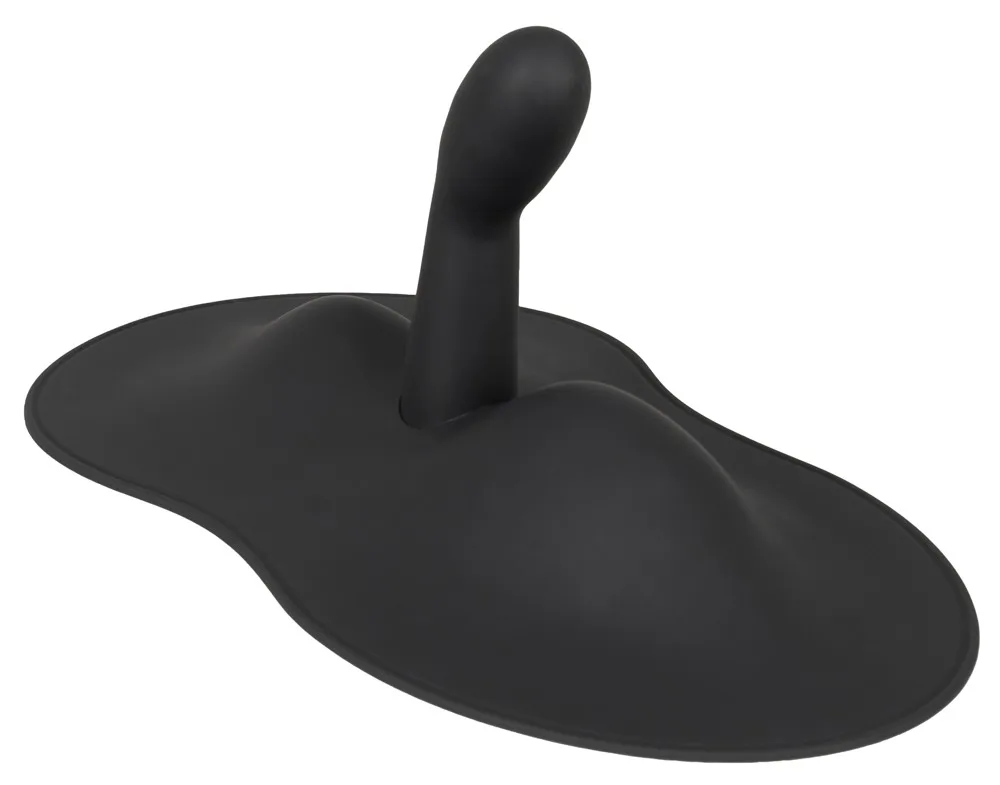
Orion Vibepad 3 is a vibrating cushion that you place on a surface and use hands-free. It belongs to a product category that barely existed ten years ago, and it is still dominated by a single brand: Orion’s own vibepad series. Vibepad 3 is the third edition, and what sets it apart from the two previous ones is that the manufacturer has placed a curved G-spot vibrator in the middle of the cushion, between the two anatomically shaped raised areas.
The specifications look like this according to the manufacturer: three motors, seven vibration modes in each of the two raised areas and seven in the insertable vibrator, a wireless remote control with a range of up to ten meters, silicone, PU, and ABS as materials, dimensions of 29 centimeters in length, at most 16.1 centimeters in width, and 12 centimeters in height, a weight of 446 grams, and an insertion length of 10.6 centimeters with a diameter between 2 and 2.9 centimeters. The product is waterproof and is charged with the included USB cable. The manufacturer’s recommended retail price is 169.00 euro. In Sweden, the item is sold by seven stores at prices between 1,016 and 1,799 SEK, and three of them had it in stock at the price check on July 29, 2026.
This review is exclusively about the item with EAN 4024144261710, the manufacturer’s item number 05599890000. The number is shown on Orion’s own product page along with the barcode, and it is the same number that all seven Swedish stores list. The product is sold in a single color — black — which means there is no risk of mixing up any variants to keep track of, unlike most other products in this category.
Two things are worth establishing right here, because they come up throughout the text. The first is that Orion is unusually generous with its geometry and unusually frugal with electronics: the manufacturer publishes neither operating time, charging time, battery capacity for the pad itself, IP rating, nor sound level. The second is that a large portion of what can still be substantiated about the electronics is contained in the technical documentation Orion itself has provided for the radio approval of the remote control. That documentation is public, and it is the source for several of the details below that are not stated anywhere in the marketing.
A regular vibrator is held in the hand and controlled with the wrist. A vibrating cushion changes that relationship: the product stays still on a surface, and your body moves toward it. The manufacturer describes use plainly—the cushion is, for example, placed on a chair and then used while sitting or straddling, without needing to use your hands.
In practice, that means three differences that are more fundamental than they first appear. First, pressure control moves from the hand to your body weight: how hard the contact surface presses against your body is determined by how you sit, not by how hard you hold it. Second, the stimulation becomes surface-based rather than point-based—the two raised areas cover a broader area than a vibrator head does. Third, a remote control is required, because the buttons on the product end up under your body as soon as it’s used as intended. That’s also exactly why the Vibepad 3 has a remote control as an integrated part of the product, not as an accessory.
The format has a consequence that is rarely mentioned in store texts: 29 × 16,1 centimeters is a large product. It doesn’t fit in a nightstand drawer in the same way as a handheld vibrator, and the packaging measures 31,5 × 21,5 × 12,5 centimeters. It’s about the size of a shoebox. So anyone who buys a vibrating cushion also buys a storage problem, and it’s a reasonable thing to think through before you pay.
Orion has expanded the series into several models that are close to each other in name but far from each other in function. Swedish retailers regularly mix them up, and since they have completely different item numbers and EAN codes, you can keep them apart if you know what you’re looking for.
So it’s not a simple staircase where a higher number means a better product. If you want a slick tongue and heat, you should buy Vibepad 2, not Vibepad 3 — that function isn’t available on three. If you want the most vibration settings per motor, you should buy Intense 2, which has ten versus three’s seven. Vibepad 3 is the only one in the series with a plug-in vibrator, and that’s the only reason to choose that one.
The material issue is the only characteristic of an intimate product that can’t be compensated for with experience or care, and it determines whether the product is still hygienic after five years. Orion lists three materials for Vibepad 3: silicone, PU, and ABS. This is a more honest statement than the Swedish shop text on Joyland, which lists "ABS plastic, silicone" and omits PU, and it’s significantly more informative than Taboos’ and Mshop’s listings, which only write "silicone". The manufacturer’s information takes precedence over retailers’.
Orion doesn’t specify which part is which material, but the construction and the comparison within the series point in one direction. The manufacturer’s description consistently talks about a silky-smooth silicone surface that adapts to the body, and the original Vibepad is explicitly described as "silicone with PU coating". For Vibepad Intense 2, Orion also explicitly states that the ABS part is the remote control. What can be concluded is therefore that the silicone forms the contact surface and the G-spot vibrator, that ABS is the hard plastic in the remote control housing and in the internal load-bearing parts, and that PU is a coating or support material in the pad itself rather than a surface material against the body.
Why it matters: silicone is non-porous. A non-porous surface can be kept clean, because there are no microscopic voids where residue can be left behind. It is the single most important property of a material that is supposed to sit against mucous membranes. Polyurethane is also non-porous on its own, but a PU coating can wear through over time, and a worn-through coating is harder to assess hygienically than a consistent silicone surface. It’s a reasonable reason to inspect the surface at regular intervals, especially on a product that is subjected to body weight every time it’s used.
One thing that sets this product category apart from handheld vibrators is that the contact area is vastly larger. A clitoral stimulator has a contact area of a few square centimeters. Vibepad 3 has an area covering almost the entire pad, 29 × 16.1 centimeters. That makes cleaning more important, not less important—there’s simply more surface area that has been in contact with the body.
Phthalates are a group of plasticizers used to make plastic—especially flexible PVC—pliable. The Swedish Chemicals Agency (Kemikalieinspektionen) describes them as substances that can affect the hormone system and make reproduction harder, and several of them are therefore restricted or banned within the EU in a large number of products. This particular product category is a recurring subject of supervision because it contains flexible plastic against skin and mucous membranes.
Silicone doesn’t require phthalate plasticizers to be soft—the softness comes from the polymer’s own structure. The same applies to ABS, which is a rigid thermoplastic without plasticizers. That Orion lists silicone, PU, and ABS instead of labels like “TPE” or “jelly rubber” is therefore, in itself, better news than most other material listings in the category, because the later ones don’t say anything at all about which plasticizers are included.
Orion, however, publishes no explicit assurance that the material is free from phthalates, BPA, or latex for this article, and neither does it provide any material declaration that breaks down which part consists of what. This is a real difference compared with, for example, Satisfyer and Womanizer, both of which print that assurance on their product pages. The absence of an assurance is not proof that something is wrong—but it’s also not proof that everything is right, and it’s in that difference that a source-based comparison has to stop.
The manufacturer states that it is 29 centimeters long, 16.1 centimeters wide at most, and 12 centimeters high. The height refers to the protruding G-spot vibrator—the actual cushion pad is significantly lower, which is shown in Orion’s own dimension sketch, where the vibrator’s insertion length is marked as 10.6 centimeters and the maximum diameter as 2.9 centimeters. The weight is given as 446 grams. The gross weight in the manufacturer’s article register is 925 grams, meaning including the packaging, remote control, and cable, and Mshop lists the shipping weight as 0.93 kilograms, which matches Orion’s figure.
Two shop details differ and deserve to be presented. Taboo lists the weight as 448 grams instead of the manufacturer’s 446, a deviation of two grams that has no practical significance but that shows that shop data is not always a clean copy of the manufacturer’s. Vuxenkul lists the length as 31 centimeters in its specification box, which is close to the package length of 31.5 centimeters and far from the product’s 29. Where the manufacturer and a shop disagree, it is the manufacturer that applies: the product is 29 centimeters long.
A comparison within the series puts the dimensions in context. Both the original Vibepad and Vibepad 2 measure 29 × 20.7 centimeters and are only 2.9–4.2 centimeters high—so they are wider but almost flat. Vibepad 3 is narrower but three times as tall, and the entire difference in height is the G-spot vibrator. Vibepad Intense 2, in turn, is much smaller than all of them: 23.4 × 11.2 × 5.2 centimeters and 358 grams.
The weight of 446 grams is worth a comment. It’s heavy for a sex toy but light for an object you sit on, and it’s that latter comparison that matters. A cushion that is supposed to stay in place under body weight needs weight; otherwise it will slide. Orion does not publish any information about anti-slip protection or a suction cup on the underside, and the manufacturer’s own image of the underside shows a smooth silicone surface with a button, an LED, and a charging connector—nothing patterned for grip. So you should expect the surface to determine stability: a cushion with 446 grams and a smooth underside will sit still on a fabric-covered seat but not necessarily on glossy vinyl or polished wood flooring.
Orion’s marketing says “three motors, seven settings” and stops there. The manufacturer’s own functional description in the radio documentation goes significantly further, and it describes an interface that is more thought-out than the product description suggests.
On the pillow itself there is a single button. According to the manufacturer’s description, the product is started with a long press of two seconds, after which short presses step through the modes in the order 0–1–2–3–4–5–6–7 and back to 1 again. Another long press of two seconds turns it off. Two white LEDs on the underside blink synchronously in standby mode and stay steadily lit when a motor is working. The button on the pillow controls all three motors together in a combined mode — it’s the remote control that provides separate control.
What makes this design logical is that, by definition, the pillow lies under the body when it is used. A button you can’t see is a button that is meant to do one thing, and it does one thing: it steps upward. All fine-tuning is done with the remote control, which you can hold in your hand or give to someone else.
The remote control has three buttons and an LED. According to the manufacturer’s description, each button connects to its own motor: K1 controls motor 1, K2 controls motor 2, and K3 controls motor 3. Each button steps its motor through modes 1 to 7 and back to 1, and a long press of 1.5 seconds turns off that specific motor without affecting the other two. If you press K1 and K3 at the same time, the entire product turns off.
The LED on the remote control stays steadily lit as long as any function is active, blinks once for a short press, and twice for a long press. It’s feedback that actually matters on a product where you can’t see what’s happening, and it’s also a detail that isn’t stated in a single shop text.
The radio part is covered in Orion’s own approval case. The remote control transmits at 433.88 MHz with ASK modulation over a single channel, via a fixed PCB antenna with 1 dBi gain, and the measured maximum transmitter power is 3.58 dBm versus the limit value of 10 dBm. The range is what the manufacturer states as up to ten meters.
That practically means two things. The first is that it’s not Bluetooth, and therefore there’s also no app: 433 MHz is the classic frequency for simple remote controls, and the selected combination of low power and long wavelength is the reason the range holds through a wall in a way that Bluetooth doesn’t always do. The second is that the control is one-way. The remote control sends, the pillow receives, and there is no feedback back — which is exactly why the LED on the remote control shows what you yourself have pressed, not what the pillow actually does.
A limitation that comes from the same construction: a 433 MHz remote control is paired from the factory and cannot be re-paired. Orion does not publish any information about whether the remote control can be bought separately, and there is no spare part listing for it in the manufacturer’s assortment. If you lose the remote control, you still have the button on the cushion—so the combination mode—but the separate motor control is then gone for good.
The store texts say “7 vibration modes,” which is correct but misleading. The manufacturer states seven modes in each raised section and seven in the vibrator, and that the three can be controlled separately or combined. What can be established purely in terms of counting is that three independent motors with eight settings each—i.e., plus seven modes—give 8 × 8 × 8 = 512 possible combinations, of which 511 include at least one motor running.
That number shouldn’t be overinterpreted. Most of the combinations are impossible to tell apart from one another in practice, and a product doesn’t get better just because a brochure can multiply it. But the difference compared with a product with seven fixed programs is fundamental: here you can run full intensity on the plug-in vibrator while also letting the outer raised sections be completely silent—or vice versa. That option isn’t available on a model where selecting a program switches everything at once.
The comparison within the series is instructive. Vibepad Intense 2 has ten modes per motor versus the third model’s seven, but it has only two motors. More steps per motor give finer intensity resolution; more motors give more independent zones. Which one is best depends on whether you want to be able to set the intensity exactly, or whether you want to stimulate different areas to different extents at the same time.
Orion does not publish what the seven modes contain—so how many are even intensities and how many are patterns with pulses and waves. It’s one of the most common gaps in this category and one of the most irritating: for someone who wants even vibration and someone who wants pulsing patterns, they get completely different value from the same seven-setting scale.
The plug-in part is the only functional difference compared with the rest of the series, and the manufacturer gives its dimensions exactly: insertion length 10,6 centimeter and a diameter that varies between 2 and 2,9 centimeter. The dimensions are repeated identically by Joyland, Mshop, and Taboo, which makes them the most consistent information in the entire material.
The shape is clear from the manufacturer’s own images and dimension sketch: the shaft rises from the middle of the cushion, bends forward, and ends in a thickened, rounded head. It’s the classic G-spot geometry, and according to Orion’s own sketch the third motor sits in that thickened head, while the other two motors sit in their respective raised sections.
Measurements are worth a comparison. A 10.6-centimeter insertion length is shorter than an average insert vibrator, and a maximum diameter of 2.9 centimeters is in the mid range. What’s unusual is that the depth isn’t controlled by the hand but by body weight—you decide how much of those 10.6 centimeters are used depending on how you sit. That makes the product more forgiving in terms of the measurements than a handheld model with the same dimensions would be, and it’s a reasonable argument for not getting stuck on the centimeters.
The manufacturer describes the product as intended for stimulating the clitoris, vagina, and anus or the perineum, and the Swedish stores repeat the same description. Note that this is about the cushion’s outer raised areas being able to lie against the area—not that the insertable part is intended for anal use. Orion does not publish any information indicating that the G-spot vibrator would be designed for that, and it lacks the broad base that is otherwise standard on products that are.
The answer has to be short and honest. Orion does not publish any decibel value for Vibepad 3, either on the product page or in the technical documentation. None of the seven Swedish stores states a measurement either. So there’s no figure to report, and every website that gives an exact decibel figure for this model is either reporting its own measurement or a value without a source.
The only thing the manufacturer says about sound applies to a different model: for Vibepad Intense 2, Orion writes that the new optimized motors are "pleasantly quiet". No corresponding claim is made for Vibepad 3.
What can be established on technical grounds is that three motors in one housing make more sound than one motor, and that a large silicone surface with air underneath works like a membrane. A practical piece of advice that applies regardless of the model is therefore especially relevant here: the surface determines it. A cushion of this type placed on a hard chair seat or a table produces noticeably more sound than the same cushion on a mattress or a padded seat, because the hard surface functions as a resonance box.
Orion states that Vibepad 3 is waterproof and, in the English product text, writes that it can be used "even under or in water". The Swedish translation on the manufacturer’s own page is more specific: the cushion is waterproof and can be used in the shower or in the bathtub. The manufacturer, however, does not state any IP rating, either on the product page or in the technical documentation.
Here there is a conflict worth presenting in its entirety, because it affects how the product can actually be handled. Taboo states in its specification box "Water-resistant IPx5: Yes". Mshop instead writes "100% waterproof" without a rating, and Joyland, Vuxen, Vuxenkul, Lekosmek, and Lustly only write "waterproof".
The difference between the two wordings is not cosmetic. IPX5 is defined in IEC 60529 as protection against water jets from a nozzle—meaning showers and running water, but explicitly not submersion. Submersion requires IPX7, which means a depth of one meter for 30 minutes. A product that is only IPX5 should not be placed in a bathtub. A product that the manufacturer says can be used in the bathtub must therefore be better than IPX5, or else the manufacturer’s wording is too generous.
Where the manufacturer and a shop disagree, the manufacturer applies, and Orion’s statement is that the product can be used in the bathtub. But since Orion does not specify any rating at all, it’s not possible to determine what level it corresponds to, and Taboo’s IPX5 statement is not supported by the manufacturer. The practical advice then becomes: treat it as safely rinsable under running water, and be restrained with prolonged submersion until Orion publishes a rating. That is the only conclusion the material supports.
A technical argument points to caution. The charging port on the underside is a round DC connector in a recess—not a magnetic contact surface. An opening in the casing is always the hardest point to seal, and it is the most common reason why products in this category get IPX5 or IPX6 instead of IPX7.
Rinse the pad in lukewarm water after every use and use fragrance-free soap or a cleaning product intended for intimate products. Be especially careful at the seam where the G-spot vibrator meets the pad surface—that is the only recessed detail on the entire product and thereby the only place where residue can end up staying. Wipe it with a clean towel and let it air-dry. Avoid leaving water standing in the recess around the charging port.
Joyland lists water-based lubricant as the recommended one, and that’s the right advice for a silicone product. Silicone-based lubricant should not be used on silicone—it breaks down the surface over time and makes it porous, and a porous surface can no longer be cleaned properly; it can only be replaced. Oil-based products such as coconut oil leave a film that’s difficult to remove and can also attack PU coatings.
The manufacturer’s technical documentation states the operating temperature is between −10 and +40 degrees. It excludes boiling, dishwashing, and storage in a warm vehicle during summer, regardless of how water-resistant the product is. Store it somewhere cool and dry and—because the packaging measures 31.5 × 21.5 × 12.5 centimeters—preferably in something other than the original box if space is a problem. Orion does not publish any information about whether a storage pouch is included, and Mshop lists the delivery contents as the pad, the remote control, and the USB charging cable. So no pouch is included.
This is the product’s weakest specifications section, and it’s not because of the product but because of the documentation. Orion states that both the pad and the remote control are rechargeable and that a USB charging cable is included. Runtime, charging time, and battery capacity for the pad are not published at all—neither by the manufacturer nor by any of the seven Swedish stores.
With the included USB cable. The manufacturer’s own image on the underside shows a round DC power connector in a recess, labeled DC 5V, along with the CE marking and the symbol for separate electrical waste collection. According to the manufacturer’s image, the remote control has an identical connector on the back with the same marking. The test report in the radio matter states the power supply to DC 3.7 volts from the battery or DC 5 volts via the USB port, confirming the voltage.
That the charging connector is a round DC power connector and not USB-C is a real drawback in everyday use. It means that no regular phone cable works, and a lost cable must be replaced with one of the same type. The benefit of this solution is that the connector is cheap and robust; the downside is that it’s product-specific and requires a hole in a housing that is otherwise supposed to be watertight.
The manufacturer’s functional description also states what happens during charging: both LEDs light up at the same time while the product is charging and turn solid when it’s fully charged; the motors stop and the button on the pad stops working. So you can’t use the product while it’s charging, which is normal and reasonable, but it’s worth knowing.
A detail that only appears in the manufacturer’s technical materials and nowhere in the marketing: both the pad and the remote control automatically shut off after 30 minutes without activity. For the pad, this happens when none of the three motors is running; for the remote control, only the transmitter turns off, without any shutoff signal being sent to the pad. In practice, that means the remote control can fall asleep while the pad is still running, and then you need to wake the remote control with a button press before it can control anything again.
The test report in the radio case states a battery of DC 3.7 volts and 120 mAh for the test object. The report does not specify whether that capacity refers to the remote control or the cushion, and 120 mAh is a cell size that matches a remote control with an LED and a radio transmitter—not a device intended to drive three vibration motors. The reasonable reading is to treat the figure as the remote control’s battery. Orion publishes no information anywhere about the cushion’s own capacity, and therefore it’s not possible to calculate operating time or compare how heavily the cell is loaded versus other models.
An item, however, that is unambiguous and useful: the manufacturer’s functional description states that low-voltage detection is at 3.2 volts, and that the two LEDs blink as a warning when the battery voltage falls below that value. 3.2 volts is the typical lower operating limit for a single lithium-ion cell with a 3.7-volt nominal voltage, confirming that it is a single-cell solution of a standard type.
What generally applies to lithium-ion batteries also applies here: capacity decreases with the number of charge cycles, and the product does best when it’s charged regularly rather than stored fully discharged. Orion publishes no information indicating that the battery is replaceable, and the design with a fully cast, waterproof silicone body makes it unlikely. Expect the battery—not the silicone—to set the limit for how long the product lasts—and that, in practice, it’s used up when the cell is used up.
We do not have price data from shops in your market yet.
Orion publishes the vibrator’s diameter to the nearest tenth of a centimeter, but not a single value about the battery. The geometry is exemplary; the electronics are a gap.
The most relevant comparison for a vibrating cushion is against other vibrating cushions, and there the field is narrow: Orion dominates the category with its own series. Three models from the same series are therefore the most meaningful competitors, and all the information below comes from the manufacturer’s own product pages. The prices in kronor apply to Vibepad 3 and come from the shops’ product feeds as of 29 July 2026; for the other models, the manufacturer’s recommended approximate retail price in euro is used, since they are not included in our price data.
Vibepad 2 has EAN 4024144126170 and item number 05532630000, and the manufacturer’s recommended approximate retail price is 149.00 euro versus 169.00 for Vibepad 3. For the twenty euros of difference, it’s more than you might think—and the difference goes both ways.
Vibepad 2 measures 29 × 20.7 centimeters and is 2.9–4.2 centimeters high, weighs 415 grams, and is built from the same material combination of silicone, PU, and ABS. It has seven vibration modes in each of its two waves—just like Vibepad 3—but adds two things that Vibepad 3 completely lacks: a licking tongue with seven of its own modes and a heat function. The tongue opening measures 1.5 × 2 centimeters.
Vibepad 3 responds with the insertable G-point vibrator, 10.6 centimeters long and 2 to 2.9 centimeters in diameter, with its own motor and its own seven settings. It’s the only functional advantage that the 3 has, and it’s crucial or irrelevant depending on whether you want something inside your body or not.
The conclusion is therefore unusually clear: this isn’t an upgrade but a choice. If you want penetration, you choose Vibepad 3. If you want suction-and-licking stimulation plus heat, you choose Vibepad 2—and you pay less. Vibepad 2 is also noticeably flatter, which makes it easier to store and less demanding to sit on for someone who doesn’t want anything protruding.
The original Vibepad has EAN 4024144606986 and item number 05947330000, and the manufacturer’s recommended approximate price is 99.00 euro—so 70 euro less than Vibepad 3. The dimensions are 29 × 20.7 centimeters and 2.9–4.2 centimeters in height, and the material is listed as silicone with a PU coating.
Functionally, the original is a simpler product with two motors and two stimulation waves, seven vibration modes on each, and the same ability to control them separately via a remote control. It’s waterproof and charges via a USB cable. What it doesn’t have is the third motor and the insertable part.
What makes the original interesting is that it isolates the question: if you want to test whether the vibro-cushion format works for you at all, you can do it as cheaply as possible right here. The basic principle—hands-free use, body weight as a pressure control, and two raised areas that cover a broad area—is identical. What you pay an extra 70 euro for on Vibepad 3 is exclusively the penetration part and the third motor. If you’re unsure whether you want it, the original is the rational first step.
Vibepad Intense 2 has EAN 4024144685738 and item number 54085390000, and the manufacturer’s recommended approximate price is 89.95 euro. It’s the newest and cheapest in the comparison, and it differs from the others in a way that makes it more than just a budget version.
The dimensions are 23.4 centimeters in length, up to 11.2 centimeters in width, and 5.2 centimeters in height, and the weight is 358 grams. That makes it by far the smallest and lightest model—barely two thirds of Vibepad 3’s length and a little over a third narrower. The manufacturer lists two optimized motors with ten vibration modes each, meaning three more steps per motor than the 3, and a remote control with a six-meter range compared to the 3’s ten. The material is silicone, PU, and ABS, with the ABS part explicitly being the remote control.
A practical difference that Orion highlights: on Intense 2, the positions can be controlled both directly on the cushion and with the remote control. On Vibepad 3, the button on the cushion only provides the shared combination mode, while separate motor control requires the remote control. Someone who often uses the product alone and doesn’t want to look for a remote control therefore gets more direct control on Intense 2.
In summary: Intense 2 wins on size, price, number of steps per motor, and direct operation. Vibepad 3 wins on the number of motors, the remote control range, and—crucially—that it’s the only one of the four with an insertable/interlocking part.
Seven Swedish shops sell the item with EAN 4024144261710. The cheapest is Joyland at SEK 1,016, and the most expensive is Lustly at SEK 1,799. That’s a difference of SEK 783, or 77 percent, for the exact same item number, the same color, and the same packaging.
The stock situation is at least as important as the price spread. Only three of the seven stores had the product in stock when the price check was carried out 29 July 2026: Joyland at SEK 1,016, Vuxenkul at SEK 1,364, and Mshop at SEK 1,399. The difference between the cheapest and the second-cheapest available store is therefore SEK 348, not SEK 783. Stores that list a product as sold out may keep an old price in the feed, and that price is rarely what you actually end up paying when the item comes back into stock.
A couple of reference points put the pricing into context. The manufacturer’s recommended list price is EUR 169.00. Taboo states on its own product page a recommended price of SEK 1,495, which is exactly what the shop charges. Joyland’s SEK 1,016 is therefore clearly below the price that both the manufacturer and one of the shops list as normal—and it’s that difference that makes this price comparison worth the trouble for this particular product.
The prices in the table above are updated when the shops’ product feeds are updated, but always check the final price at checkout. Shipping costs are added by most shops below a certain order value. A product with a shipping weight of 0.93 kilos and a cardboard box of 31.5 × 21.5 × 12.5 centimeters is also a package and not a letter, which in practice rules out the cheapest shipping options at several shops.
It’s for you if you want hands-free stimulation with your body in motion instead of a product that’s controlled by hand. It’s for you who wants both external and internal stimulation at the same time without having to hold two things, and it’s for you who want to be able to let someone else control it from up to ten meters away without that person needing an app—or even a phone. Three independent motors with seven steps each provide more real combinations than anything else in Orion’s range.
It doesn’t suit you if you want a published specification to rely on. Run time, charging time, battery capacity, IP rating, and sound level are all missing, and for a product in this price range, that’s striking—Satisfyer and Womanizer publish several of these details on articles that cost less. It doesn’t suit you if you want to be able to charge it using your phone’s cable, because the charging connection is a round DC power connector. It doesn’t suit you if you don’t have much storage space: a 29 × 16.1 centimeter product in a cardboard box of 31.5 × 21.5 × 12.5 centimeters is a volume you notice. And it doesn’t suit you if you mainly want a slick- or heat function—that’s Vibepad 2, not this one.
One more thing belongs in the decision. The remote control is not an accessory but a prerequisite for accessing the separate motor control, and Orion publishes no information that it can be purchased separately. Treat it as part of the product and not as something that can disappear behind a sofa—it's the individual component whose loss costs the most in terms of functionality.
Orion does not publish a manufacturer’s warranty for Vibepad 3 on the product page. That’s a difference from several competing brands in the category, which state the warranty period directly in the specification. The only warranty information that can be verified comes from a shop: Lekosmek states a two-year product warranty on its product page. That’s a shop statement and applies to that purchase, not as a promise from the manufacturer.
What does apply, though, are your statutory rights—and in this case they matter more than usual precisely because the manufacturer’s own promise is missing. Under konsumentköplagen, you have three years to complain about faults in the goods, regardless of what the manufacturer or the shop promises. For distance purchases, you also have a right of withdrawal for fourteen days according to distansavtalslagen och avtal utanför affärslokaler.
Be aware that in practice the right of withdrawal is limited for hygiene products that have been taken out of a sealed package—Konsumentverket describes the exception and how it is applied. The right to complain about faults applies, however, always, and it covers exactly the type of fault that is most likely with this product: a motor that stops responding, a remote control that loses contact, or a battery that no longer takes a charge. Save the receipt and the original box for as long as you can, and when unpacking, check that both the cushion, the remote control, and the USB charging cable are included—that’s the three parts Mshop states are included in the delivery contents. If you have questions about what applies in your case, Konsumentverket guides you via Hallå konsument.
Orion Vibepad 3 isn’t included in any ranking yet. In best i test guides, the entire categories are compared against each other using five shared criteria, with what was left out shown.
Every numerical piece of information in the text can be traced to one of the sources below. The links were checked manually on the specified date.
This page is machine-translated from Swedish. Read the Swedish original