

Review
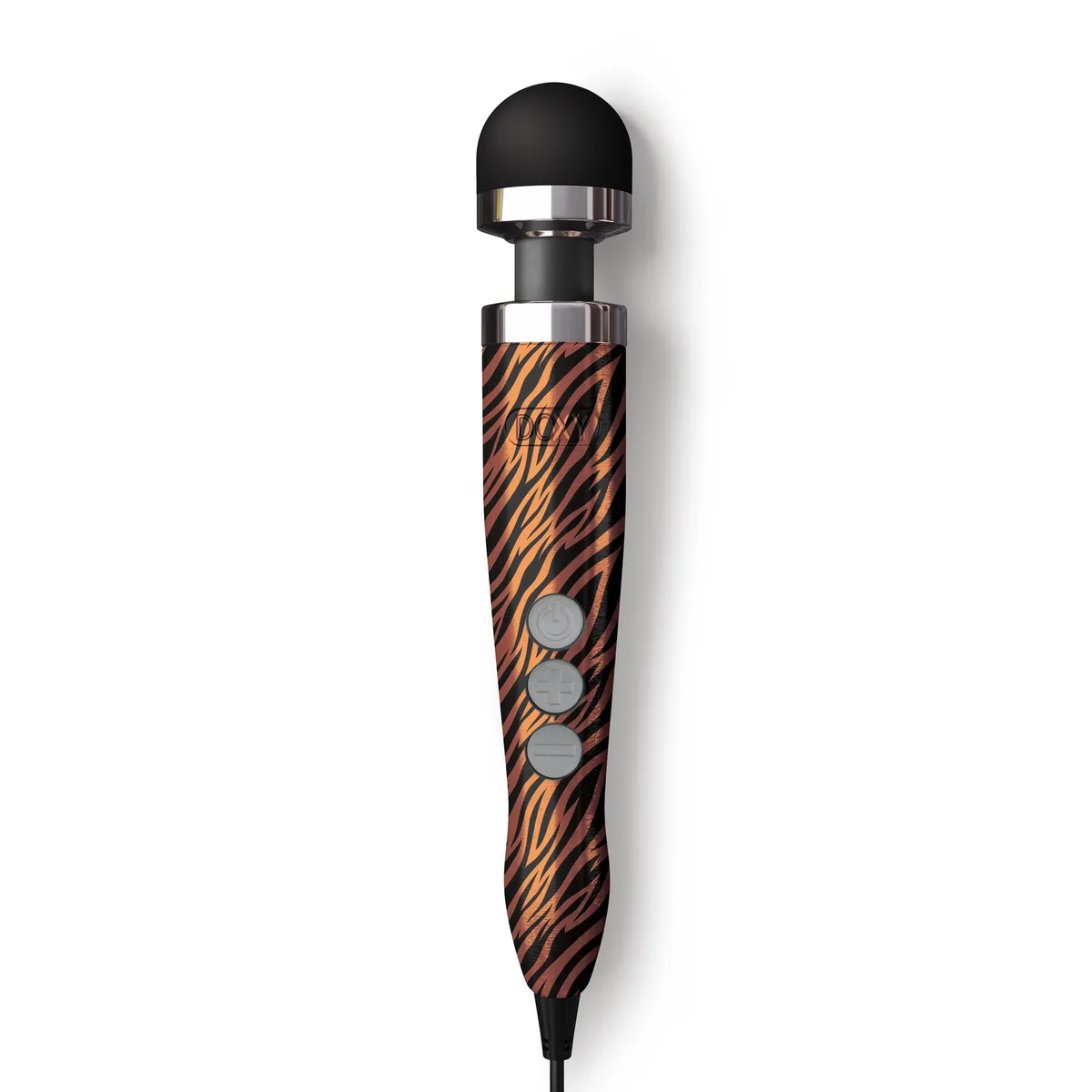
Review: Doxy No. 3 massage wand with cord
The mains-powered counterpole: 28 cm body, 4.5 cm head, and 350 grams.
12 September 2026
Review · Mini-wand · PowerBullet motor
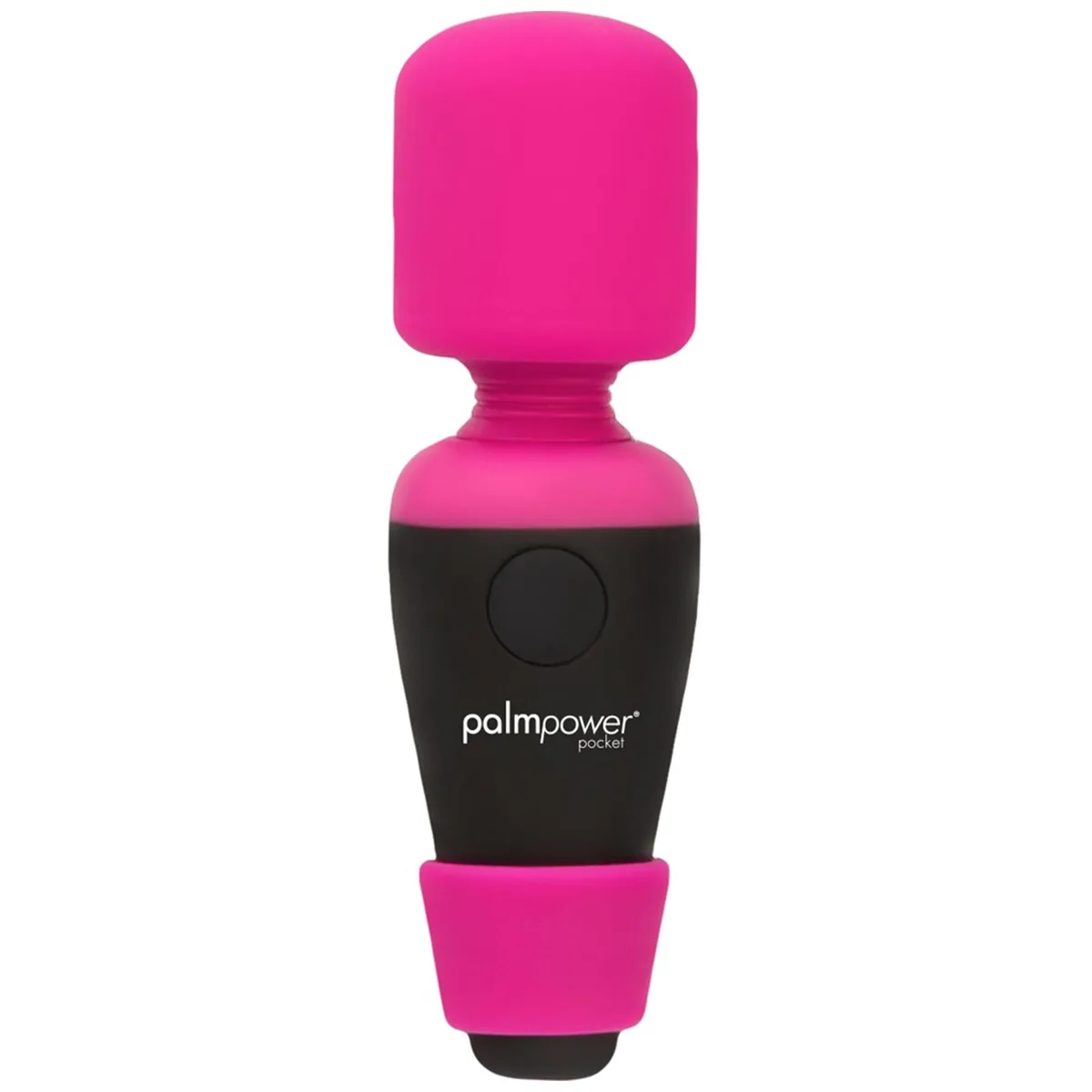
PalmPower’s smallest wand reviewed against the manufacturer’s own specifications and pricing data from four Swedish stores. 90 × 25 millimeters, seven functions, removable silicone head, 90 minutes of operating time, and 1.5 hours of charging time—but no published IP rating, a manual that advises against use near water, and only a 90-day manufacturer warranty.
The smallest wand in the comparison, and one of the few where the motor sits in the head itself. 90 × 25 millimeters, detachable silicone head, travel lock, silicone pouch, and up to 90 minutes of runtime make it a genuinely travel-friendly product. What you pay for is the documentation: no IP rating, a manual that advises against use near water, a model-specific charging connector, 90 days manufacturer’s warranty, and neither published weight, battery capacity, nor sound level.
Palm Power Pocket is the smallest model in the PalmPower range, a wand vibrator that, according to the manufacturer’s own dimension sketch, is 90 millimeters long and 25 millimeters wide. That means it isn’t a downscaled massager wand, but a product that fits in the palm of your hand, and the entire design is built on that premise: a detachable silicone head with the motor positioned inside the head, a flexible neck between the head and the body, a single button, and an included silicone case with a zipper.
The specification from BMS Factory looks like this: seven functions, runtime up to 90 minutes, charging time 1.5 hours, materials ABS plastic and silicone, PowerBullet motor, and USB charging. The manufacturer’s article number is 30828 and the UPC code is 677613308283. In Sweden, the item is sold by four stores at prices between 449 and 499 SEK, and two of them had it in stock during the price check on September 12, 2026.
This review is about the item with EAN 677613308283, which the manufacturer itself links to article 30828. The number can be found in the page source on all four Swedish stores’ pages, so there’s no doubt about which item is being price-compared. However, the stores’ descriptions of the same item differ in a way that’s worth a section of its own further down—one of them sells it under a completely different name, and two of them show a different product in the picture.
A wand vibrator is recognized by its shape: a wide, rounded head on a narrower body, originally designed as a muscle massager wand. What sets a wand apart from a regular vibrator is that the stimulation takes place with the entire surface of the head against the body rather than with a tip, and therefore the vibrations feel broader and more spread out. This category’s focus is on large, often mains-powered models—Doxy, for example, states the body length as 28 centimeters for its Die Cast 3. A mini-wand is the same form scaled down to something that fits in a handbag.
The technical choice that determines everything else in this product is where the motor sits. The manufacturer explicitly states that the PowerBullet motor is located in the head, not in the grip. This is unusual, and the consequences are concrete. The vibration doesn’t have to be carried through a neck and a body before it reaches the contact surface, which reduces losses along the way — and that’s also the whole explanation for why a product of this size can be marketed for power in the first place. The downside is that the hand holds the same piece that vibrates. The manufacturer has solved this with a removable silicone ring, which, according to the description, both dampens vibrations in the fingers and improves grip.
PowerBullet is BMS Factory’s own motor name and shows up throughout their range, from the pure bullet vibrators to the large PalmPower Extreme. It doesn’t say anything about power in watts or about RPM — the manufacturer doesn’t publish such values for any of the models — but it does say that the motor comes from the same family as the brand’s larger products. What can be concluded is that the motor placement in the head is the same solution used in the classic PalmPower, and that it’s the technical point of the entire series.
The PalmPower lineup is less messy than many competitors’, but three models are close to each other and get mixed up in Swedish store texts. All the information below comes from the manufacturer’s own product pages.
So the difference between Pocket and Groove isn’t the number of functions, which several store texts imply. Both come in at seven. The difference is the size, runtime — 90 minutes versus 90 minutes stated as "up to 1.5 hours", which is the same thing — and charging time, where Groove is a half hour faster. The big difference in the series instead is between Pocket and Extreme, and it’s about water and charging contact.
Material matters as the only property of an intimate product that can’t be compensated for with habit or care, and it determines whether the product is still hygienic after a few years. BMS Factory specifies two materials for Pocket: ABS plastic and silicone. It’s a two-piece construction, not an all-silicone product, and it’s important to know exactly where the boundary is.
The manufacturer’s own dimension sketch marks the parts one by one, and it provides the answer. The head is “removable silicone head”—100% silicone according to the product page—and it’s removable. The flexible neck is also silicone-coated. The body with the button is the black ABS part, and at the very bottom sits the comfort grip ring, which is silicone and also removable. The contact surface against the body is therefore silicone all the way; it’s the grip in the middle that’s hard plastic.
That the head can be taken off is the single most important hygienic feature of this construction. Silicone is a non-porous material—a non-porous surface can be cleaned, since there are no microscopic cavities where residue can get trapped—and when the head is also removable, both the outside and inside of the head cap can be accessed. It’s more than what you get on most products in this price range, where the head is fixed and the seam between silicone and plastic becomes a crack you’ll never reach.
The ABS plastic in the body is, in itself, unproblematic. It’s hard, non-porous, and doesn’t require plasticizers to be moldable. What’s lost compared with an all-silicone product is more tactile than hygienic: hard plastic is slipperier in wet hands than silicone. The comfort grip ring exists for exactly that reason, and the manufacturer states that it both improves grip and dampens vibrations in the fingers.
Phthalates are a group of plasticizers used to make plastic—above all soft PVC—flexible. The Swedish Chemicals Agency describes them as substances that can affect the hormone system and make reproduction more difficult, and several of them are therefore restricted or prohibited within the EU in a large number of products. This product category is regularly the subject of supervision, because it contains soft, plastic material against skin and mucous membranes.
There’s a note here that’s worth getting right. BMS Factory doesn’t print “Phthalate Free” on the product page for Palm Power Pocket. They do, however, for the sibling model PalmPower Groove, and they do for the accessory kit PalmPocket Extended—the three extra silicone heads that are made to sit on Pocket. This doesn’t mean that the material in Pocket would contain phthalates; silicone and ABS don’t require phthalate plasticizers to function, and both materials are non-porous. But it does mean that the information is missing where you’d expect it to be.
The retailer Lyko states in its own specification that the material silicone and ABS are free from phthalates. It is a store statement, not a manufacturer statement, and it should be read as such. The difference is not academic: a store that writes about a product description has no testing of its own behind it, while a manufacturer that publishes a materials declaration takes responsibility for it. What can be established is that the two materials themselves belong to the safer end of the category, and that the manufacturer still has chosen not to declare it for this article.
The manufacturer’s dimension sketch states 3.5 inches, i.e. 90 millimeters, in length and 1 inch, i.e. 25 millimeters, in width. It is strikingly small even for a mini-wand. Compare it with PalmPower Groove, which the same manufacturer lists as 6 inches in length — more, i.e. 152 millimeters — or with Doxy Die Cast 3, which Doxy lists as 28 centimeters in body length and 4.5 centimeters in head diameter. Pocket is therefore about 60 percent of a Grooves length and just under a third of a Doxy.
Three of the four Swedish stores confirm the dimensions in their own way: Vuxenkul and Taboo both list the length as 9 centimeters and the diameter as 2.5 centimeters, and Lekosmek has even named its listing "Mini Wand 9 cm". There, the stores and the manufacturer are in agreement for once.
Weight is not published by the manufacturer. Neither the product page, the wholesaler page, nor the dimension sketch states a single gram. The retailer Taboo lists 140 grams. That figure is high for an item measuring 90 × 25 millimeters — it would imply a density significantly higher than water’s — and the manufacturer does not specify whether any weight at all refers to the product itself only or the entire shipment including the case and charging cable. Treat 140 grams as a store statement of unclear origin until BMS Factory publishes its own figure, and assume that the product in hand weighs less than that.
The shape deserves a line of its own. The body tapers upward toward the neck and downward toward the comfort grip ring, creating an hourglass-like grip that stays put between the thumb and index finger. The neck is flexible, which means the angle of the head relative to the body gives way instead of being pressed back. On a large wand, the corresponding neck is rigid and the angle is controlled with the entire arm; with this product, it is effectively controlled by the fingers.
The interface consists of a single button in the middle of the black body. The manufacturer’s manual states exactly what it does: one press starts the product, each new press steps forward to the next function, and a press that is held in for two seconds turns it off. There is no display, no LEDs that count steps, and no app. It’s as simple as a control can get, and for this product category, it’s reasonably the right choice — a product that is 90 millimeters long doesn’t have room for four buttons.
The price of simplicity is that you can’t go back. If you want to go back from function five to function three, you have to step through six and seven and around again. This is the pattern for all single-button products, and it’s worth knowing before you buy, because it becomes more noticeable the more modes the product has.
The manufacturer lists the modes in order, which is more than most do. The first four — low, medium, high, and ultra — are pure intensity steps with constant vibration. The last three are patterns: pulse is interrupted pulses, rise is a rising intensity, and tease is an alternating pattern. That means, in practice, you have four intensity modes and three programs, not seven intensity modes.
This division is worth knowing, because store text almost always just writes “7 vibration modes” straight out and leaves the impression that there are seven steps on an intensity scale. The same applies to the sibling model Groove, where the manufacturer is even clearer and lists “4 Varying Speeds” and “3 Intense Patterns” as two separate lines. Count the same way, and Pocket and Groove have exactly the same number of modes.
A practical consequence of ultra being the fourth mode is that you pass the highest constant intensity after just three presses. That makes the product quick to get started with. If you only want power and no pattern, it’s three presses through the entire learning curve.
The travel lock is the feature that makes the difference between a product you dare put in a packed bag and one you don’t. The manufacturer’s manual describes it like this: when the product is switched off, you lock it by holding the button in for three seconds, and you feel two quick vibrations as confirmation. The same press for three seconds unlocks it again, with the same two vibrations in response.
Two vibrations as confirmation is a well-chosen solution for a product without a display. You don’t need to see anything to know whether the lock is on or off — you feel it. And since the confirmation is the same both ways, the only risk is locking when you think you’re unlocking, which is immediately noticeable with the next press.
All four Swedish stores highlight the travel lock, and that’s reasonable: combined with the silicone travel case with a zipper, it’s the feature that makes the Pocket a travel-friendly product rather than just a small one. What can be established is that the function is available across the entire PalmPower series—even Groove and Extreme are stated to have a travel lock—so it’s nothing unique to this model.
Since the silicone head is removable, the manufacturer sells an accessory set called PalmPocket Extended, with UPC 677613308290. It contains three heads: Palm Bunny with two tips surrounded by structured nubs, Palm Brush with raised bristles, and Palm Pawn with a single rounded point for point stimulation. All are, according to the manufacturer, made from 100% silicone and explicitly stated as phthalate-free.
It’s relevant for two reasons. The first is that the product’s character can be changed without buying a new product—a wide, even cap and a point tip provide completely different stimulation from the same motor. The second is more principled: a product with a mount that the manufacturer itself sells accessories for has a longer service life as a platform than a product with a fixed head. If the cap wears out, it can be replaced.
Vuxenkul mentions “removable sleeves” in its own bullet list, but none of the four Swedish stores sells the accessory set in the price data for this item. So don’t assume it’s in the same shopping cart.
This is the section that matters most for how you can actually use the product, and it’s also where the sources differ the most. Read it before you decide.
The manufacturer’s product page lists “Water resistant” among the key features. No IP rating is given, either on the product page, on the wholesaler page, or in the dimension drawing. At the same time, the manufacturer’s own manual for the same article contains two plain-text instructions: “Do not use near water” and “Do not charge near water”. Those are the manufacturer’s words, not an interpretation.
The stores describe the same product completely differently. Vuxenkul writes that the product is waterproof and can be used in both the shower and the bath. Taboo states in its specification table “Water-resistant IPx5: Yes.” None of that information is backed by the manufacturer. The rule we work by is simple: if a store contradicts the manufacturer, the manufacturer wins, and the deviation is noted. Here, the deviation is also of the kind that can cost money—a product that’s taken into the bath on a store claim and then stops working is difficult to have a complaint processed for.
Enclosure classes are defined in the international standard IEC 60529. The number in the second position indicates the protection against water: IPX5 means that the product is tested against water jets from all directions, and IPX7 means that it is tested for immersion one meter deep for 30 minutes. The point of the system is that it is a test result, not a formulation in a brochure.
The term "water resistant" without a number is not a rating. It is a marketing term that can mean anything from the product being able to withstand a damp cloth to the product being able to withstand a shower, and it involves no testing at all. Combined with the manual’s "Do not use near water," the practical conclusion is clear: treat the Palm Power Pocket as a product that can be wiped off, not as a product for a shower or bathtub. The absence of a rating is never a sign that the product would be approved for more.
That it can be done differently is shown by the manufacturer themselves. On PalmPower Extreme, "Waterproof" is printed among the key features. So they have a model that they themselves call waterproof, and they have chosen not to call Pocket waterproof. That difference is made intentionally and should be read as information.
Since the product should not be kept under running water, cleaning becomes a two-step issue. The removable silicone head is the part that actually touches the body, and it is also the part that can be detached and cleaned separately—the outside and the inside. The body with the button and charging port are instead wiped with a damp, well-wrung cloth and a cleaning agent intended for intimate products. Let everything air-dry before the head is put back on.
The manufacturer’s manual is clear on the lubricant question: always use a water-based, compatible lubricant. Silicone-based lubricants should not be used on silicone products—they break down the silicone surface over time and make it porous, and a porous surface can no longer be cleaned properly; it can only be replaced. Here, the consequence is milder than usual, because the cap is a replaceable part, but the principle still applies. Oil-based products like coconut oil leave a film that is difficult to remove.
The manual also covers three things that rarely appear in store texts. The product must not be placed in a dishwasher or a microwave oven. It should be stored cool and dry and not be exposed to strong heat. And it is explicitly intended for external use—the manufacturer writes "For external use only. NEVER use internally", with the capital letters in the original. The retailer Lyko repeats the same thing in its own text. The included silicone pouch with a zipper is intended for storage and solves both the dust issue and the discretion.
The manufacturer states the runtime as up to 90 minutes and the charging time as 1.5 hours. The same two figures appear on both the product page, the wholesaler’s page, and in the manual, which is unusually consistently done. One and a half hours of operation on one and a half hours of charging is a reasonable ratio for a product of this size and, in practice, means it lasts longer than most individual uses.
With the included USB cable, which connects to the charging port at the bottom of the body— the manufacturer’s dimension sketch labels it as "USB Charging Port" below the comfort grip ring. The cable has a standard USB-A connector on the end that plugs into the charger, and a product-specific pin connector on the end that plugs into the product.
That detail is more important than it sounds, and the manufacturer writes the reason itself. In the manual’s safety section, it says: do not use other USB cables with the product if you have lost the one that came with it. In other words, no ordinary phone cable works as a backup. That’s a real difference compared to big brother PalmPower Extreme, which the manufacturer states is charged via USB-C— meaning with basically any modern cable. If you lose the cable for a Pocket, you have to get a replacement from the manufacturer or a retailer.
The manual also includes the usual but easy-to-forget instructions: do not charge near water, do not charge again if the cable looks damaged, and do not use the product while it is charging. The last point is worth noting because several competing products expressly allow it.
BMS Factory does not publish the battery’s capacity in mAh, its voltage, or its chemistry for Palm Power Pocket, neither on the product page, in the manual, nor on the wholesaler’s page. It’s a gap worth noting, because it makes it impossible to convert runtime into power consumption or to compare how heavily the cell is loaded against another model.
The retailer Lyko lists a rechargeable NiMH battery of 450 mAh. That’s a store claim with no equivalent from the manufacturer and should be treated as such. If it checks out, it’s interesting in its own right: NiMH is a different chemistry than the lithium-ion battery that dominates the category, with lower voltage per cell, higher self-discharge, and significantly better tolerance for being stored discharged. But since the information can’t be verified with BMS Factory, it remains just a claim.
What the manufacturer writes, in its warranty policy, is a care instruction that applies regardless of chemistry: rechargeable products should be charged with a few months in between even when they are not used, and batteries should be removed from products that have removable ones. For a product that is built to lie in a toiletry bag and be used occasionally, this is the single most important line in the entire document — a cell that is left empty for a year is usually depleted, and the battery in this product is not replaceable.
The retailers’ information about battery life differs quite a bit and deserves its own note. The manufacturer states up to 90 minutes of operation and 1.5 hours of charging. Taboo lists in its table about 300 minutes of charging time and 90 to 120 minutes of usage time. Lekosmek lists about 150 minutes of charging time and up to 60 minutes of usage time. Three sources, three answers — and two of them are shops that describe the same article number. Go by the manufacturer’s figures: up to 90 minutes of operation on 1.5 hours of charging.
We do not have price data from shops in your market yet.
The manufacturer’s product page says "water resistant". The manufacturer’s manual says "Do not use near water". Two stores say "water resistant" and IPX5, respectively. Only one of them has tested anything.
Three comparisons are relevant: against the two sibling models in the same series, which show exactly what you pay for when you go up in size, and against a classic large wand that shows what a mini-wand can never be. All information below comes from the respective manufacturers’ own product pages.
PalmPower Groove is the same manufacturer, the same motor family, and the same basic idea in a larger format. The manufacturer states 6 in length and 1.4 in width, versus Pocket’s 3.5 in and 1 in. So Groove is roughly 70 percent longer and significantly bulkier.
On the features side, they are nearly identical. Groove is listed as having four speeds and three patterns, so seven settings in total — exactly the same breakdown as Pocket low, medium, high, ultra, pulse, rise, and tease. Both have a travel lock, both have a silicone head, both are powered by PowerBullet, and both charge via USB. The runtime is practically the same: up to 90 minutes for Pocket versus up to 1.5 hours for Groove. The charging time is Groove’s only concrete advantage on paper — 1 hour versus 1.5.
Where Groove, however, wins is in the documentation. The manufacturer spells out "Body-Safe Materials" and "Phthalate Free" for Groove but not for Pocket, and also lists "Whisper Quiet" as a feature. None of the models has a published decibel value, so the sound information is just as unmeasurable there — but it does at least exist as a commitment. The conclusion is simple: if you want something that fits in the palm of your hand and in a toiletry bag, Pocket is the right choice; if you want a longer grip and a clearer materials declaration, then Groove is it.
PalmPower Extreme is the series’ top model and the only comparison that shows what Pocket actually lacks. The manufacturer lists seven functions here as well, but adds stepless speed control with a pressure that’s held in—in other words, a continuous scale instead of fixed steps. The head is described as premium silicone, and the body has an ergonomic bend.
Two lines in Extreme’s specifications are the ones that matter most. Waterproof, printed as a key feature, versus Pocket’s "water resistant" and a manual that says "Do not use near water". And USB Type C charging, versus Pocket’s product-specific pin connector and a manual that forbids other cables. Those are two of the three weaknesses in Pocket, and the manufacturer has solved both in its larger model.
That says something about how to read Pocket. It isn’t a downsized Extreme; it’s a different product, designed around the format and the case rather than around performance and durability. If you want one single wand that can handle the bathroom and is charged with the same cable as your phone, Extreme is the answer within the same brand.
Doxy Die Cast 3, often called Doxy Number 3 in Sweden, is the opposite. Doxy specifies the body length as 28 centimeters, the head diameter as 4.5 centimeters, the circumference as 12 centimeters, and the weight as 350 grams. It’s powered from a wall outlet via a power adapter with a three-meter cable.
The differences are so big that the comparison is really about two different answers to the same question. The Doxy is more than three times as long and has a head that’s almost twice as wide, which gives a completely different contact area. It’s mains-powered, which means unlimited operating time but also that it never leaves a wall outlet—and that the three-meter-long cable is both the prerequisite and the limitation. Pocket weighs, according to the retailer Taboo, 140 grams versus Doxy’s 350, fits in a pocket, and can be used anywhere for 90 minutes.
What that means in practice: the one who wants the most powerful muscle massage wand possible shouldn’t buy a mini-wand, and the one who wants something to pack in a carry-on bag shouldn’t buy a mains-powered wand with a three-meter cable. Pocket doesn’t compete with Doxy—it competes with not taking anything at all.
Four Swedish stores sell the item with EAN 677613308283. Cheapest is Lekosmek at 449 SEK, and most expensive are Vuxenkul and Taboo at 499 SEK each. Mshop sits in the middle at 474 SEK, reduced from 499. It’s a 50 SEK or 11 percent difference between the cheapest and the most expensive—an unusually tight price range in this category, where the same article number is often priced significantly more differently than that.
The inventory situation is the factor that actually influences the choice. Two of the four stores had the product in stock during the price check: Lekosmek at 449 SEK and Taboo at 499 SEK. Mshop and Vuxenkul listed it as out of stock. That means the real difference between the two available options is 50 SEK. Stores that list a product as out of stock may also have an old price left over in the feed, and that price is rarely what you actually end up paying when the item comes back in.
One more detail is worth including. Vuxenkul themselves report that the lowest price over the past 30 days has been 349 SEK. So the product was bought for 100 SEK below today’s lowest price within the last month, which indicates that it appears in promotions. If you’re not in a hurry, it’s an argument to wait for the next sale rather than chasing the 50 SEK difference between stores.
This is a warning that belongs in a buying guide and not in a specification table. During the review of the store pages on September 12, 2026, both Lekosmek and Taboo showed a product image that does not depict Palm Power Pocket. The image on both pages shows a black wand with a gold-colored detail on the handle and three buttons, and the packaging in the image series is labeled "LUZ by TOYJOY — ZENITH" with the dimensions 23 centimeter in length and 4 centimeter in diameter printed on the box. It’s a completely different product from a completely different manufacturer.
Both stores also have the correct barcode, 677613308283, in the page source at the same time, and both list item number 594474. Taboo’s own specification table also states that the length is 9 centimeter and the diameter is 2.5 centimeter—so those are the Pocket’s dimensions, not Zenith’s. Lekosmek has also removed the brand entirely and sells the item under the name "Mini Wand 9 cm".
What can be established is that the item being price-compared is the same across all four feeds, but that two of the stores’ presentations can’t be trusted in detail. If you order from the cheapest store: check that PalmPower Palm Power Pocket is what’s listed on the packing slip, and compare the product you receive against the dimensions 90 × 25 millimeter and the removable silicone head. That’s also the strongest reason to read the manufacturer’s specifications instead of the store’s.
It’s for you if you want a wand-shaped design in a format that actually fits in a handbag, and if you value that the motor sits in the head rather than in the shaft. It’s for you if you travel and want a travel lock and a hard silicone case with a zipper included. It’s for you if you want to be able to detach the head and clean it separately, and you may also want to build on it with the manufacturer’s three extra heads. And it’s for you if you want an interface with exactly one button.
It doesn’t suit you who want to use the product in the shower or in a bathtub. The manufacturer’s manual explicitly says it should not be used near water, and no IP rating is published—regardless of what two of the Swedish stores write. It doesn’t suit you who want to charge it with the same cable as your phone, because the connector is product-specific and the manufacturer advises against other cords. It doesn’t suit you who want a wide head for larger muscle groups; with a 25-millimeter width, the contact surface is small. And it doesn’t suit you if you require published battery capacity, weight, or sound level before buying, because BMS Factory does not publish either for this model.
One more thing belongs in the decision. The product is explicitly intended for external use—the manufacturer writes it in all caps in the manual—and it is also sold as a novelty product, not as medical technology. The person looking for a massage wand for the neck and shoulders gets a product that works on a small area at a time; the person looking for muscle treatment in the actual sense is better served by a larger, mains-powered model.
BMS Factory’s warranty policy is short and clear, and it’s worse than the category average. All BMS products have 90 days of limited warranty, with the exception of the Swan and Pillow Talk brands that have one year. PalmPower is not among the exceptions. Three months is short compared with the five years that several premium manufacturers in the category offer.
The terms are also worth reading before you count on the warranty. They apply only with a specified receipt and only to products returned within 90 days from the purchase date in-store. If the product is assessed as defective, the customer gets a replacement product—not a repair—and it may come in neutral packaging. The warranty explicitly covers only manufacturing defects; damage from improper use, external impact, or wear and tear on materials is not included. The customer pays the shipping costs to BMS, and BMS pays the shipping costs for the replacement product back. If it turns out the product works, the customer also pays the return shipping costs back.
Two of the Swedish stores add their own commitments. Lekosmek lists a two-year product warranty on its pages, i.e., eight times longer than the manufacturer’s 90 days. It’s a store commitment and applies against the store, not against BMS.
What always applies, though, is your statutory rights, and they are significantly stronger than the manufacturer’s warranty. Under konsumentköplagen, you have a period of three years for complaints regarding defects in the item, regardless of what the manufacturer promises. In the case of distance purchases, you also have a right of withdrawal for fourteen days under lagen om distansavtal och avtal utanför affärslokaler. Note that in practice the right of withdrawal is limited for hygiene products that have been taken out of a sealed package. The right to make a complaint for defects applies, however, always. If you have questions about what applies in your case, Konsumentverket guides you via Hallå konsument.
In summary: a 90-day manufacturer’s warranty is the worst line in the entire specification, but in practice it’s less important than it looks, because Swedish consumer purchase law (konsumentköplagen) gives you three years against the store you bought from. Save the receipt and make your complaint with the store, not with BMS.
PalmPower Palm Power Pocket is ranked på plats 8 av 11 in wand vibrator best i test, where the entire category is compared against each other using five shared criteria. Guiden vinns av We-Vibe Wand 2 Purple.
Every numerical piece of information in the text can be traced to one of the sources below. The links were checked manually on the specified date.
This page is machine-translated from Swedish. Read the Swedish original