

Review
Review: Satisfyer Pro 2 Next Generation
Cheapest of the widely sold — 219 SEK and a 15-year warranty.
29 July 2026
Review · Automatic masturbator · Suction, thrusts, and vibration
Pipedream’s motor-driven masturbator vagina reviewed against the manufacturer’s own specifications sheet, user manual, and EU declaration of conformity, plus price data from six Swedish stores. Three suction modes, two thrust speeds, and five vibration patterns in ABS and TPR — but only 60 minutes of runtime, a proprietary charging connector, and the enclosure rating IPX0, meaning there is no liquid protection at all.
Unusually a lot of functionality for the money: three suction modes, two impact speeds, and five vibration patterns that run independently of each other, with its own button for releasing the negative pressure. The sleeve unscrews and is rinsed out separately, which is necessary because the manufacturer states an IPX0 enclosure rating — the product must not be submerged in water. What you pay with is the material, a 60-minute operating time, a proprietary charging connector without replacement chargers, and a one-year warranty.
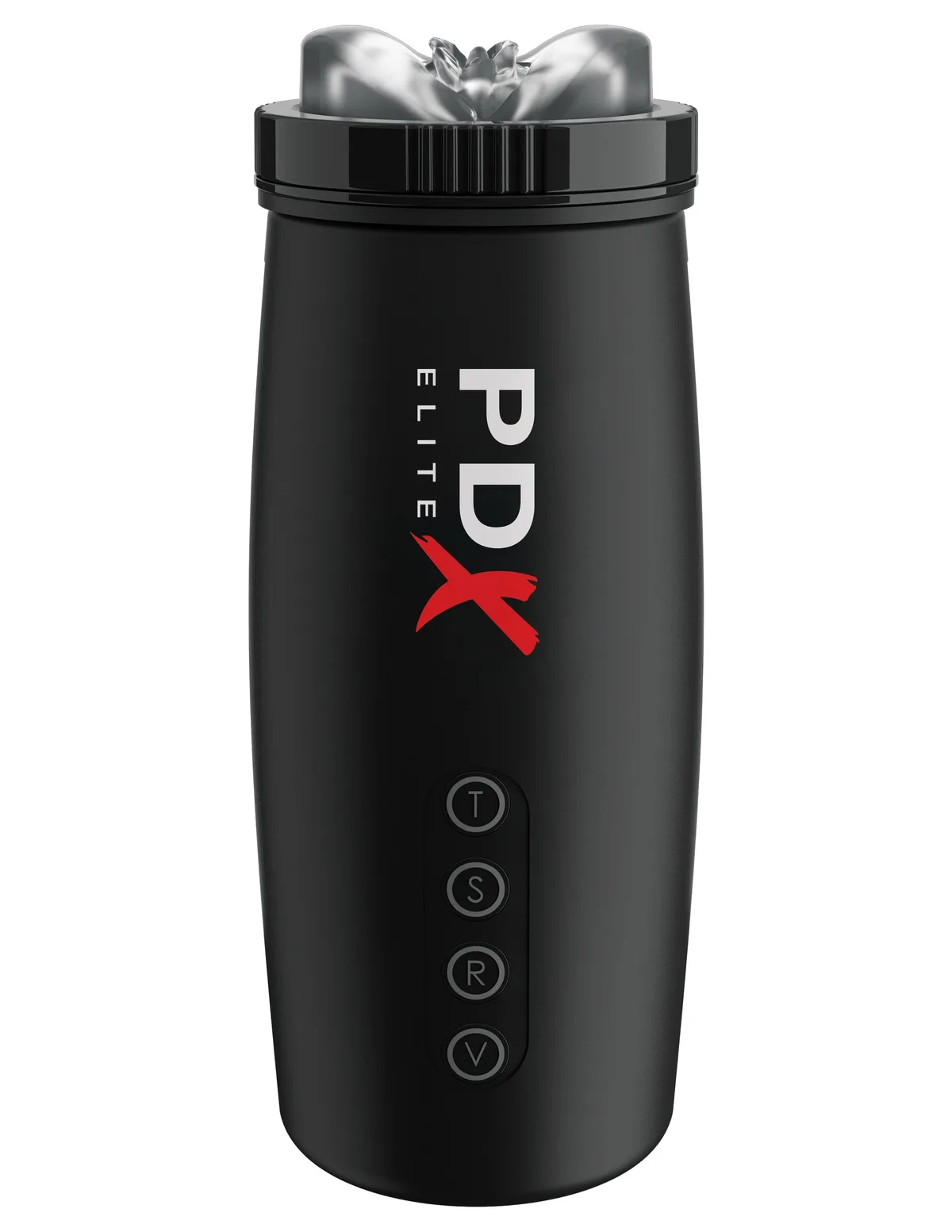
PDX Elite Moto-Bator 2 is a motor-driven sex sleeve from Pipedream Products—i.e. a masturbator where a motor does the work instead of your hand. What sets it apart from most of the category is that it does three things at the same time, and the three things are controlled independently of each other. The manufacturer lists three modes for vacuum suction, two speeds for thrusting plunger action, and five vibration patterns, and all of them can be run either separately or together.
The specification looks like this according to the manufacturer’s own spec sheet: length 22.9 centimeters in the retracted position and 26.7 centimeters when the plunger is extended, maximum width 10.2 centimeters, penetrable depth 13.5 centimeters, and inner diameter 4.6 centimeters. The materials are listed as ABS plastic and TPR. The battery is a rechargeable lithium-ion type with 60 minutes of runtime and 150 minutes of charging time. The warranty is one year. The enclosure rating is stated as IPX0, meaning there is absolutely no liquid protection at all—this is the single most important line in the entire specification, and it comes up again further down.
This review is about the item with EAN 603912755213, the manufacturer’s model number RD529, in the only color variant that is sold: a black housing with a transparent sleeve. The number has been checked against the manufacturer’s own product page, where the item number RD529 is linked to exactly that barcode number, and the same pair is printed on the first page in the official manual. Six Swedish shops sell the item at prices between 995 and 1 486 SEK.
Three different functions sound, in marketing text, like three modes on the same control. That’s not the case. The manufacturer’s user manual describes them as three separate systems with their own button, and the difference between them is physical.
The suction function works with negative pressure. A pump draws air out of the enclosed space between the sleeve and the housing, which makes the sleeve’s walls lie more tightly against the penis. So it’s not a suction movement in the sense the word suggests, but a pressure difference that changes how firmly the material rests against. The manufacturer lists three modes and describes them as steady vacuum suction.
Thrusting is mechanical. A motor drives the sleeve back and forth along the product’s length axis—what the manufacturer calls piston-action thrusting, piston action. It’s the function that makes the product hands-free in the real sense, because the movement that would otherwise come from the arm instead comes from the motor. Two speeds are listed, one high and one low.
Vibration is the simplest of the three and the one that normally appears in cheaper products: a motor that shakes the casing and transfers the movement through the material. The manufacturer lists five patterns.
What can be said is that the combination space becomes large. Three suction modes, two thrust speeds, and five vibration patterns that can be run either separately or together provide significantly more combinations than products with a single control. In practice, it also means a learning curve: four buttons where each button both scrolls between modes and turns off its own function with a long press is more to keep track of than a single plus and minus rocker switch.
Pipedream’s naming within the PDX Elite series is confusing, and Swedish retailers don’t make it any clearer. Three models are close to each other in the range.
So the upgrade from Moto-Bator to Moto-Bator 2 is not a general boost in performance, but the addition of a third function. It’s worth knowing before you pay 149 SEK extra: if you don’t get anything out of the vibration patterns, the predecessor has the same basic principle and is cheaper.
Also note that the retailers’ naming for this product is all over the place. Sexonic sells the item under the generic name "Pdx Elite Stroker Ultra-Powerful Rechargeable", while Vuxen calls it "Moto-Bator 2 – Uppladdningsbar Lösvagina" and Blush Me "Pipedream Moto Bator 2 Masturbator med motor". All of them list the same EAN. Compare by the number, not by the name.
The material question is the single most important property of a product that sits against the mucous membrane, because it’s the only thing you can’t compensate for with care or habit. The manufacturer lists two materials for Moto-Bator 2: ABS plastic and TPR. The split is practically determined by the design—ABS is the hard outer casing with the buttons and motor, and TPR is the soft sleeve you push into.
TPR stands for thermoplastic elastomer of the rubber type. It’s a soft plastic that behaves like rubber and is inexpensive to injection-mold into complicated shapes—which is precisely what a sleeve with, as the manufacturer describes it, rows of soft bumps require. The material heats up to body temperature faster than silicone, and that property is highlighted in both the manufacturer’s and retailers’ product texts.
What can be established is that TPR differs from silicone on one point that matters for hygiene: TPR is a porous material at the micron level, while silicone is non-porous. A non-porous surface can be cleaned completely, because there are no microscopic cavities where residue can remain. A porous surface can be cleaned well, but not completely, and that’s why TPR and TPE products have a shorter practical service life than silicone products. It’s also why the fact that it can be removed plays such a big role here: the manufacturer states that the sleeve comes off by unscrewing the upper ring, which means the entire sleeve can be rinsed out separately instead of only being flushed through in place.
It’s fair to compare it with the silicone alternatives in the same price bracket. Arcwave specifies medical silicone and body-friendly ABS plastic for Ion 2, which is sold starting from 1 186 SEK—that is 191 SEK more than Moto-Bator 2. The difference in material quality is real, but at the same time these are two different product types: Ion 2 has no impact function.
Phthalates are a group of plasticizers used to make plastic flexible. The Swedish Chemicals Agency (Kemikalieinspektionen) describes them as substances that can affect the hormone system and reproduction, and several of them are restricted or banned in the EU. This product category in particular is a recurring subject of supervision, because it consists of plasticized plastic that sits against the mucous membrane.
Here is a solid point that most summaries miss. Pipedream has published an EU declaration of conformity for that specific model RD529, issued by PD Products, LLC on January 11, 2021. The document lists the REACH regulation 1907/2006/EC and states that the phthalate content was tested in accordance with BS EN 14372 against point 51 and 52 in Annex XVII—i.e., precisely those points that regulate phthalates in this type of product. The same document also addresses the RoHS Directive 2011/65/EU, with testing in accordance with IEC 62321 for lead, mercury, cadmium, hexavalent chromium, and two groups of brominated flame retardants, the EMC Directive 2014/30/EU, the WEEE Directive 2002/96/EC, and UN38.3, with the transport tests T.1 to T.8 for the lithium battery.
This is significantly better documentation than a shop text that only claims “phthalate-free.” For example, Vuxen writes “Body-safe & Free from Phthalates” on its product page without providing any basis; the manufacturer’s declaration points to a named test standard and a date. Still, two objections belong here. The declaration is from 2021 and applies to the design that existed then. And a declaration of conformity is the manufacturer’s own statement—it is not a third-party certificate.
A final material note, and it’s about the shops. Both Blush Me and SexleksakerOutlet describe the sleeve as “Lifelike Fanta Flesh Material.” Fanta Flesh is one of Pipedream’s product brand names, but the manufacturer does not use it for this model—the RD529 specification sheet lists only ABS plastic and TPR. Mshop, in turn, lists the material as “TPR/TPE.” None of the shop labels is directly wrong, but neither of them comes from the manufacturer either, and they don’t say anything about which plasticizers are included.
The manufacturer provides five measurements. The length is 22.9 centimeters when the piston is retracted and 26.7 centimeters when it’s extended—so the product expands by almost four centimeters during operation, which is a practical detail to account for if it’s going to fit in a drawer. The maximum width is given as 10.2 centimeters, the penetrable depth as 13.5 centimeters, and the inner diameter as 4.6 centimeters.
The dimension sheet deserves a remark that we normally wouldn’t make, but that is supported. Exactly the same dimension block—26.7 / 22.9 / 10.2 / 13.5 / 4.6 centimeters—appears word for word on the manufacturer’s specification sheet for the much larger Deluxe Mega-Bator (RD517), along with the same battery type, the same runtime, the same charging time, and the same charging contact dimensions. That two such different products would have identical measurements in five out of five fields is unlikely, and it suggests that Pipedream reuses the same dimension block between models.
What saves the numbers for RD529 specifically is that the shops independently of each other confirm three of them. Joyland states the length as 23 centimeters and the penetrative length as 13 centimeters, and Vuxen states the total length as 23.1 centimeters—so both are very close to the manufacturer’s recessed 22.9 centimeters and penetrable 13.5 centimeters. The reasonable conclusion is that the length and depth measurements match for this model.
The width, however, is not quite as clear. Both Joyland and Vuxen state the diameter as 8.6 centimeters, versus the manufacturer’s maximum width of 10.2 centimeters. The two measurements do not necessarily measure the same thing—maximum width can refer to the widest point including the screw fitting—but the difference of 1.6 centimeters is too large to dismiss. Vuxen also states the inner diameter as 6.6 centimeters, versus the manufacturer’s 4.6 centimeters. There, claim is met with claim, and the manufacturer’s value is what applies until something else is shown. That a shop customer in the only review on Vuxen’s product page describes the product as “a little too tight” rather points to the lower measurement.
The weight is not published by the manufacturer. Pipedreams’ specification sheet contains no weight information at all, neither for the product nor for the shipment. The retailer Joyland states 555 grams. That figure seems reasonable for a product of this size with two motors, a pump, and a battery, but it is a shop detail and should be read as such. Mshops’ fields for packaging dimensions and packaging weight are filled in with placeholder values—1.00 centimeter in all three directions and 1.00 kilogram—and therefore cannot be used for anything.
Overall: count on a product that is just under 23 centimeters long, slightly over eight centimeters thick, and that weighs about half a kilo. It’s a two-handed product in everyday life, not something that fits in a toiletry bag.
The interface consists of four buttons in a row on the side of the housing, labeled with letters. The manufacturer’s user manual is unusually clear about exactly what each one does, and that logic is consistent throughout: a short press starts or scrolls, and a press for three seconds turns off that specific function.
What is worth highlighting is the R button. A vacuum function that cannot be stopped directly is unpleasant, and the fact that the manufacturer has given the release its own physical button instead of hiding it behind a button combination is a genuinely good design choice. In practice, it means you never need to scroll your way out of a suction mode.
The counterargument to the interface is just as simple. Four buttons, each with its own on and off switching, means the product can be in fifteen different combination states before you even count which mode each function is in, and there is no display and no main power switch that turns everything off at once. The manufacturer also publishes no information about automatic shutoff after a certain amount of time.
The manufacturer specifies three modes for vacuum suction and describes them as strong and steady. What differentiates the modes—whether it’s the size of the vacuum pressure, the pulse frequency, or both—is not specified, and no measurement of the vacuum pressure in kilopascals or millibar is published. That’s typical for the category and means the suction modes can’t be compared between brands except by number.
What can be established is that the suction function is the one that places the highest demands on the sleeve being seated correctly. The vacuum is based on a closed system, and if the sleeve isn’t fitted correctly into the screw thread after cleaning, the pump has no seal to work against. The manufacturer’s care instructions specifically point out that the upper ring is unscrewed to release the sleeve—so that’s also where it should sit properly when it’s screwed back on.
The thrust function is what justifies the price tag compared with a manual sleeve. The manufacturer specifies two speeds, high and low, and describes the movement as deep thrusts driven by an ultra-strong motor. The stroke length isn’t stated as its own measurement, but it can be derived from the dimension sheet: the difference between the extended length of 26.7 centimeters and the recessed length of 22.9 centimeters is 3.8 centimeters, which is the distance the sleeve carriage moves. It’s a short but real stroke length—and a significantly more useful figure than “powerful thrusts.”
The number of strokes per minute is not published. So there is no manufacturer information to compare the speeds against each other or against competitors, and that’s a limitation in the specification.
The wording in the manufacturer’s user manual is that the V button scrolls through all five vibration modes, and they are described as patterns. That’s an important difference from intensity steps: five patterns means five different rhythms, not five increasing levels of strength. No separate intensity control for the vibration is stated. In practice, that means that anyone who wants weaker vibration has no setting for it and instead has to choose a pattern with shorter pulses.
Here the answer has to be short and honest. Pipedream does not publish any decibel value for Moto-Bator 2, either on the product page, in the specification sheet, or in the user manual. The manufacturer also does not use any marketing term that suggests quietness—unlike, for example, Satisfyer’s “Whisper Mode,” or Womanizer’s sound-comparison graphics, there’s nothing to go by here at all. None of the six Swedish stores lists any value either.
The only thing that can be established without guessing is the design principles. According to the manufacturer, the product contains at least three moving systems: a vacuum pump, a motor that drives the piston action, and a vibration motor. An air pump and a piston motor are two of the more noise-producing components you can build into a handheld product, and the housing is hard ABS plastic, which transfers sound better than soft silicone. Expecting a quiet product would therefore be unreasonable—but a specific number can’t be given, and sites that state an exact decibel value for this model either report their own measurement or a value without a source.
A practical tip that applies regardless of model: when using the product while lying down, place it on a soft surface. A hard tabletop works as a resonance box.
This is the review’s most important section, and it contains a direct contradiction within the manufacturer’s own material.
The manufacturer’s 2025 specification sheet states plainly: "IPX0: No liquid protection", meaning there is absolutely no liquid protection at all. The maintenance instructions in the same document repeat it: do not submerge Moto-Bator 2 in water. Vuxen writes the same thing in Swedish on its product page, and Mshop states in its specification table word for word, "Not waterproof".
The EU declaration of conformity from 2021, however, lists IEC 60529 and IPX5 for the same model number, RD529—that is, protection against low-pressure water jets from all angles. The same declaration for the larger Deluxe Mega-Bator also lists IPX5, and that model’s specification sheet in turn states IPX5 as well. So it’s only RD529 that has IPX0 in the manual and IPX5 in the declaration.
How should it be read? Conservatively. Follow the stricter of the two notices, meaning IPX0, and treat the product as not waterproof. It’s also the notice that is the freshest—the manual is dated 2025, the declaration 2021—and it is the notice that is repeated in the care instructions, which is the text the manufacturer addresses directly to the user. That both Vuxen and Mshop independently state that the product is not waterproof points in the same direction.
The ratings come from the international standard IEC 60529, which defines enclosure classes for electrical equipment. The second digit in the IP code indicates protection against water. IPX0 means no protection at all. IPX5 means the product is tested against low-pressure water jets from all angles, so it can be rinsed off but not submerged. IPX7 means submersion to a depth of one meter for 30 minutes.
The difference is crucial in practice, and it determines how the product can be cared for. Arcwave Ion 2 is rated IPX7 and can therefore be rinsed off in its entirety. Moto-Bator 2 can’t. What saves the situation is the design: since the sleeve is removable, it can be rinsed out separately, while the housing with the motors and battery is kept dry. Without that removability, a product of this kind with IPX0 would have been difficult to recommend at all.
The manufacturer’s care instructions are short and to the point. Unscrew the upper ring to loosen the sleeve. Clean with an antibacterial cleaning agent and warm water. Do not submerge the product in water. Feel free to use a water-based lubricant—the manufacturer mentions its own brand Moist, but it’s the product type and not the brand that matters.
Here there is another internal contradiction in the manual that is worth knowing about. The general lithium-ion section—which is the same text for all Pipedreams rechargeable products and is also available in Swedish in the document—says: "Clean the product with a soft, dry cloth. Do not use water or chemical cleaning agents." The product-specific care instructions on the specifications page say the opposite: that the sleeve is cleaned with warm water. The reasonable interpretation is that the general section applies to the housing with the electronics, and that the product-specific text applies to the sleeve, but the manufacturer does not spell that out, and that is a shortcoming in the documentation.
If there is a rule for lubricants in the sense that it’s not stated in the manual but is material-technical: you shouldn’t use silicone-based lubricant on silicone products. Here the sleeve is TPR and not silicone, but water-based is still the right choice—this is what both the manufacturer and Joyland recommend, and it’s the only thing that can be safely rinsed out of a porous material. Oil-based products like coconut oil leave a film that’s difficult to remove and that’s exactly what you don’t want to remain in a material that can’t be cleaned completely.
The manual’s general section also covers two temperature limits that rarely show up in store texts. The product should be used within the range of 0 to 45 degrees, and it must not be exposed to temperatures above 60 degrees. Boiling water and the dishwasher are therefore out of the question—which they already are, since the product must not be submerged. For longer storage, the manufacturer states that the battery should be charged to about 50 percent, and that the product should be stored cool and dry.
The manufacturer specifies a rechargeable lithium-ion battery with 60 minutes of operating time and 150 minutes of charging time. So the charge-to-use ratio is two and a half hours of charging for one hour of use, which is one of the weaker figures in this price range. Arcwave states 90 minutes of operating time and 120 minutes of charging time for the Ion 2—so both longer operation and shorter charging.
That the operating time is short is at the same time easier to defend here than on a simple vibrator. The product runs, at worst, three systems at the same time—pump, plunger motor, and vibration motor—and the 60 minutes reasonably refers to a normal case rather than all three functions at maximum. Which operating scenario the figure applies to is not stated by the manufacturer.
With the included cable, and only with that. The manufacturer lists the charging connector as “Pin Plug/USB A” with a plug length of 13.5 millimeters and a plug diameter of 2.5 millimeters. So it’s not USB-C and not micro-USB, but a round pin connector of the type found on small DC devices, with USB-A on the other end.
This is the single biggest practical downside of the product, and it becomes serious in combination with a clause in Pipedream’s warranty terms: the manufacturer explicitly states that replacement chargers are neither provided nor sold. So if you lose or break the cable, there’s no official way to get a new one. A 2.5-millimeter DC plug is admittedly a common standard size in electronics retail, but the manufacturer does not specify polarity and voltage, and guessing with a lithium-ion battery is not a suggestion we would make. Assume that the cable is the product’s weakest point and store it with the product.
Pipedream does not publish the battery's capacity in mAh or its voltage for RD529, either on the product page, in the specification sheet, or in the general lithium-ion information. What is stated is the battery type — rechargeable lithium-ion — and that the UN38.3 tests T.1 through T.8 for safe air transport have been carried out, as shown in the EU declaration of conformity.
Without the capacity, it is not possible to convert operating time into power consumption, nor to compare how heavily the cell is loaded between models. The general rule still applies: the capacity of a lithium-ion battery decreases with the number of charge cycles; the manufacturer states that the battery must not be disassembled or repaired, and the product is essentially used up when the cell is. With an operating time of 60 minutes, there are also more charge cycles per usage hour than on a product with a longer operating time, which is an indirect cost that rarely appears in any specification.
We do not have price data from shops in your market yet.
The manual states IPX0, and the declaration of conformity states IPX5—for the same model number. Follow the stricter statement.
Three comparisons are relevant: with the predecessor in the same series, with the larger sibling model, and with a premium option from another brand. All specifications below come from the respective manufacturers’ own material, and all prices come from the shops’ product feeds on July 29, 2026.
The predecessor PDX Elite Moto-Bator, item number RD510 with EAN 603912744446, costs from 846 SEK. The difference versus Moto-Bator 2 is therefore 149 SEK.
The manufacturer’s own description of RD510 mentions two functions: powerful vacuum suction and piston action with two stroke patterns, where the two motors work independently of each other. Vibration is not mentioned. Moto-Bator 2 adds exactly that third function, with five patterns and its own button, and the manufacturer describes the motor as improved — without stating in what respect or by how much.
The conclusion is straightforward. If vibration is something you know you’ll get something out of, 149 SEK is a low cost for an extra function. If it isn’t, you get the same suction and the same piston action cheaper in the predecessor. Note, however, that the predecessor was only in stock at one of the stores that list it at the price check, while Moto-Bator 2 was in stock at five of six.
PDX Elite Deluxe Mega-Bator, item number RD517 with EAN 603912744989, costs from 1,495 SEK — i.e., 500 SEK more than Moto-Bator 2.
The manufacturer’s two specification sheets are, as noted above, largely identical: the same material, the same battery type, the same 60-minute operating time, the same 150-minute charging time, and the same 13.5 × 2.5 millimeter pin connector. Two differences, however, are real and are disclosed. The first is what’s included in the delivery: Mega-Bator is delivered, according to the manufacturer, with three interchangeable tops, a removable suction cup, a mobile holder, a sleeve, and a charging cable, while Moto-Bator 2 is delivered with the product and a USB charging cable—nothing else. The second is the enclosure rating: Mega-Bator’s specification sheet states IPX5, meaning protection against water jets, while Moto-Bator 2’s states IPX0.
So for 100 kronor you get accessories, freedom of choice in how the opening is designed, and a liquid-protection rating that Moto-Bator 2 lacks. What you don’t get is longer operating time, shorter charging time, or different material.
Arcwave Ion 2, EAN 4251460631112, costs from 1 186 SEK, meaning 191 SEK more than Moto-Bator 2 at its cheapest. On the price tag, they’re almost the same product; in the design, they’re not at all.
Arcwave specifies medical-grade silicone and body-friendly ABS plastic as the materials, an IPX7 enclosure rating, a rechargeable lithium-ion battery with 90 minutes of operating time and 120 minutes of charging time, product dimensions 153.5 × 51.98 × 83.19 millimeters, packaging dimensions 196 × 136.5 × 70 millimeters, and a two-year warranty. The product is based on air pressure technology and is aimed at the glans area rather than the entire shaft, and it has no impact function.
The differences that actually matter are four. Ion 2 has silicone instead of TPR, meaning a non-porous material. Ion 2 is IPX7 and can be rinsed as a whole, versus IPX0. Ion 2 has 50 percent longer operating time and shorter charging time. And Ion 2 has a warranty twice as long. Moto-Bator 2, on the other hand, has something Ion 2 completely lacks: a motor that performs the movement. If you want hands-free, the choice is obvious, and there’s no reason to compare the products based on material quality—they solve different problems.
Six Swedish shops sell the item with EAN 603912755213. Cheapest are Blush Me and SexleksakerOutlet, both at 995 SEK. The most expensive is Sexonic at 1 486 SEK. That’s a difference of 491 SEK, or 49 percent, for the same item number, the same color scheme, and the same packaging.
The stock situation is unusually good for this category. Five of the six shops had the product in stock at the time of the price check, and the only one that didn’t have stock was at the same time the most expensive. That means the price spread is real and not an artifact of old prices for sold-out items: the difference between the cheapest available at 995 SEK and the second-most expensive available at Mshop at 1 289 SEK is 294 SEK.
A detail that can affect the assessment: Joyland, which lists it at 1,016 SEK, states on its product page that three silicone penis rings are included with the purchase. It’s a store campaign and not something the manufacturer includes, but it’s 21 SEK more than the lowest price for three extra items, and it may very well be worth more than that for anyone who still wanted them. Check that the offer is still available before you count on it.
The prices in the table above are updated when the shops’ product feeds are updated, but always check the final price at checkout. Shipping is added at several of the shops under a certain order value — Blush Me and SexleksakerOutlet both state 29 SEK in their feeds, while Joyland and Mshop list free shipping — which evens out part of the difference between the cheapest options.
It’s for you if you specifically want a hands-free product where the motor performs the movement, and you want to be able to combine thrusts, suction, and vibration independently of each other. It’s for you who wants that feature set for under one thousand SEK, which is unusual — most products in that price range do one thing. It’s for you who prefers a soft, fast body-warm TPR material over the firmer feel of silicone, and you who want to be able to remove the sleeve and rinse out the inside separately.
It’s not for you if you want to be able to rinse off the entire product. IPX0 is IPX0, and even though a statement of conformity indicates IPX5, there’s no reason to take a chance on a four-year-old document when the manual says the opposite. It’s not for you if long-term hygiene of the material matters a lot to you — silicone is a better choice there, and Arcwave Ion 2 is 191 SEK away. It’s not for you if you want to be able to charge it with the same cable as your phone: the 2.5-millimeter pin connector is product-specific, and the manufacturer doesn’t sell any replacement charging cables. And it’s not for you if you need more than an hour of operating time between charges.
One last thing belongs in the decision. This is a large product — just under 23 centimeters long and, according to Joyland, 555 grams — that can’t be submerged in water or charged with a regular cable. It’s designed to stay at home in a drawer and be used there. If you want something portable or something that can handle water, you’re looking in the wrong product category.
Pipedream provides a one-year warranty. Both the spec sheet and the manufacturer’s warranty page state one year counted from the purchase date, and the warranty applies to mechanical defects or manufacturing defects. It’s short compared with the category overall: Arcwave states two years on all of its products.
Read the terms before you count on the warranty, because three of them have practical significance. First of all, Pipedream requires that the product is registered before a claim is filed — so if you don’t register the product when you buy it, you may need to do it afterward before the case is even taken up. Second, you need a receipt from an authorized retailer within the warranty period. Third, and most importantly here: the manufacturer states that replacement chargers are neither provided nor sold. So the component that is most likely to fail or get lost first is also the only one that is explicitly not possible to replace through the manufacturer.
What always applies, on the other hand, is your statutory rights, and they are stronger than the manufacturer’s one-year warranty. According to konsumentköplagen, you have three years to make a complaint for defects in the goods, regardless of what the manufacturer promises and regardless of whether the product is registered. For distance purchases, you also have a right of withdrawal for fourteen days under lagen om distansavtal och avtal utanför affärslokaler. Note that in practice the right of withdrawal is limited for hygiene products that have been taken out of a sealed package — but the right to complain for defects always applies. If you have questions about what applies in your case, Konsumentverket will guide you via Hallå konsument.
Finally, a waste notice, because the product contains a built-in lithium-ion battery. The manufacturer’s manual states that the battery must not be disposed of in household waste, but should be taken to a recycling station or an authorized collection point, and the EU declaration points to the WEEE Directive 2002/96/EG. These are the same rules as for all other electronics, but they’re easy to forget for this type of product.
PDX Elite Moto-Bator 2 isn’t included in any ranking yet. In best i test guides, the entire categories are compared against each other using five shared criteria, with what was left out shown.
Every numerical piece of information in the text can be traced to one of the sources below. The links were checked manually on the specified date.
This page is machine-translated from Swedish. Read the Swedish original