
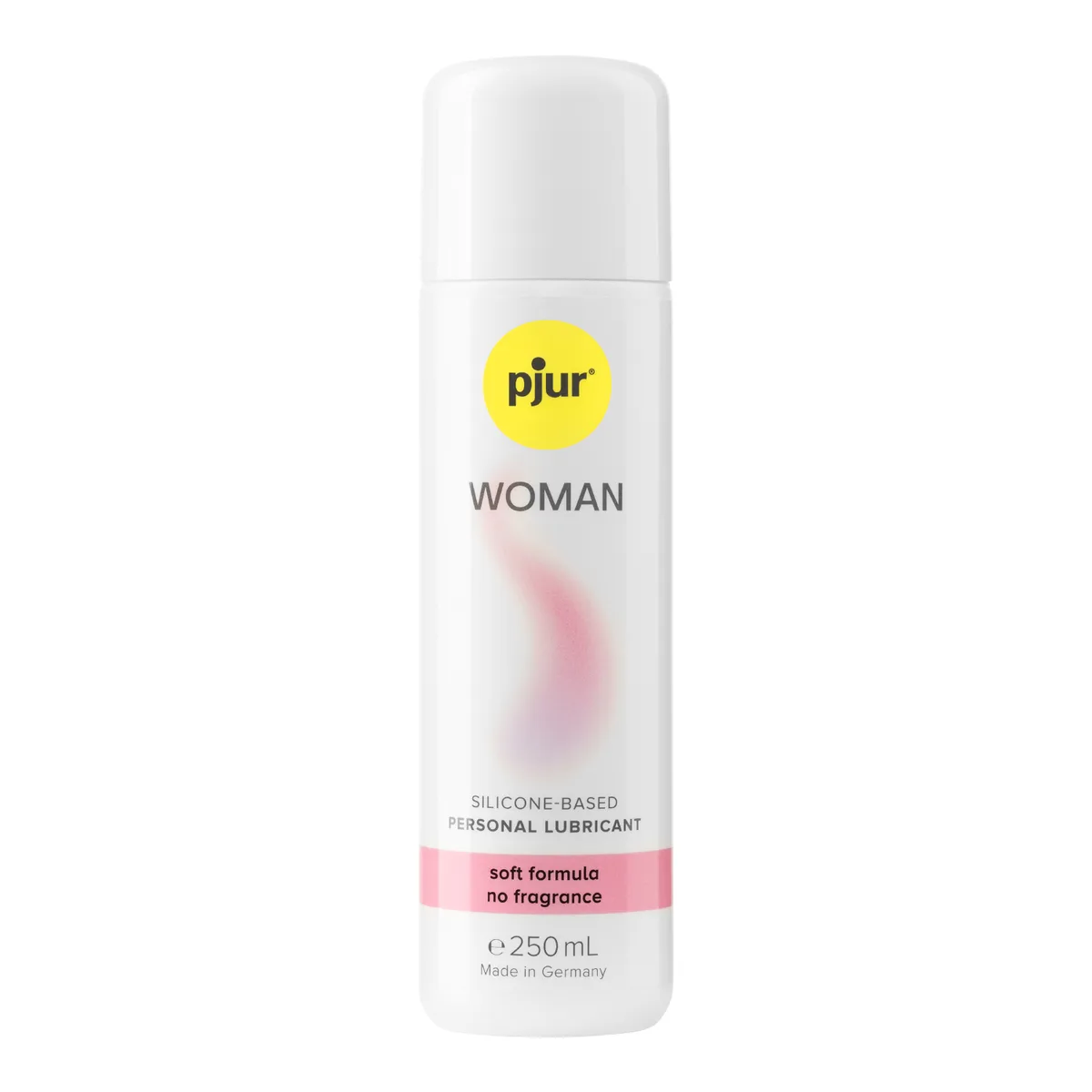
Review · Lubricant · Silicone-based
Pjur Woman 250 ml: review
A silicone-based lubricant assessed against the manufacturer’s own information and WHO’s guidance on lubricants. Three silicones and nothing else — no water, no preservatives, no glycerin — approved for latex condoms and published with an MDR certificate. But the first ingredient is a substance that the EU now restricts, and neither pH nor osmolality are published.
My rating
One of the most transparently declared lubricants in the category: three silicones, no water, no preservatives, approved for latex condoms and with an MDR certificate that the manufacturer publishes. What you’re paying for is the trade-off — polyisoprene condoms are not certified, and silicone sex toys should be tested first — as well as the fact that the main ingredient cyclopentasiloxane is subject to the EU’s new restriction. Prices vary by retailer: pjur was checked at 47.95 EUR and in stock, and Sinful at 39.99 GBP and in stock on 26 September 2026.
- Ingredients: cyclopentasiloxane, dimethicone, dimethiconol — ”Total 100% Silicone”
- No preservatives, no fragrance, no flavorings according to the manufacturer
- Latex condoms: yes. Polyisoprene: not stated for Pjur Woman
- MDR certificate class IIb, notified body 0482 DNV MEDCERT
- pH and osmolality are not published
- Sold by pjur and Sinful in this market.
Pjur Woman at a glance (250 ml)
Pjur Woman is a silicone-based lubricant from pjur group Luxembourg, marketed for sensitive skin and to relieve vaginal dryness. This review applies exclusively to the largest package, 250 ml, with EAN 827160107277 and the manufacturer’s item number 11670-01. The same lubricant is also available in 100 ml and 30 ml, but those have their own EAN numbers and other prices.
What makes the product easy to review is that the declaration is short. The manufacturer lists three ingredients — cyclopentasiloxane, dimethicone, and dimethiconol — and writes “Total 100% Silicone” after the list. No water, no preservatives, no fragrance, and no added flavorings. The manufacturer states that the product is suitable for latex condoms, that it can be used daily, and that it is washed off with mild soap and water. The 250 ml bottle is sold by pjur and Sinful.
What is missing, however, is just as important to disclose. The manufacturer does not publish pH value, osmolality, or viscosity for Pjur Woman, and none of the eleven stores does either. For a water-free silicone lubricant, that is less serious than it sounds — the first two measurements are primarily relevant for water-based lubricants, which the section on mucous membranes explains — but it means that the comparison with other lubricants must be made based on ingredients, compatibility, and price rather than on laboratory values.
Which variant applies for the review?
The EAN number is checked against the manufacturer’s own variant table. In the source for the product page on pjur.com, item number 11670-01 and the 250 ml content are linked to EAN 0827160107277; item number 10170-01 and the 100 ml content are linked to EAN 0827160106270; and item number 10160-01 and the 30 ml content are linked to EAN 0827160106263. Some product data also lists the same GTIN number with the 250 ml size, and some pages list 827160107277. Other pages use the manufacturer’s item number directly, PJ11670-01, and one has it built into its own: 30337-PJ11670-01.
Both pjur and Sinful list the same 250 ml bottle. It’s worth pointing out because some product pages can give conflicting signals. The specification box shows EAN 827160106263 and the weight 32 grams — that is, the 30 ml variant’s information — on the page that, in the product flow, is connected to 250 ml. In any case, it’s the barcode, and not the headline, that is what identifies the item.
What is the difference between Pjur Woman and Pjur Original?
The question is justified, because the ingredient lists are identical. Pjur ORIGINAL is declared with cyclopentasiloxane, dimethicone, and dimethiconol — the same three substances in the same order. The manufacturer answers in its own FAQ: the products have the same ingredients, and the only difference lies in the concentration. Pjur Woman is described as developed for women with sensitive skin.
How the concentration differs is not published by the manufacturer. The product text says that Pjur Woman has “slightly lower silicone content” than Pjur Original, but that’s a store claim and it states no percentages. The mixing ratio between the three silicones is not published for either of the products, which is normal—an INCI list shows the order, not the amounts.
Two concrete differences can still be documented. Pjur ORIGINAL is available in 500 and 1,000 ml in addition to 30, 100, and 250 ml, while Pjur Woman is limited to 250 ml. And the manufacturer’s own prices for 250 ml are exactly the same: 47.95 euros for both. In this market, Pjur Woman 250 ml is sold by pjur and Sinful. So you don’t pay extra for the Woman variant, and you don’t get more either.
Ingredients: three silicones and nothing else
A complete ingredient list is, by far, the single most important piece of information for a lubricant, and here it is published by the manufacturer itself. It’s on the product page and on the label. One retailer shows in its product gallery an image of the back label where the line “Ingredients: Cyclopentasiloxane, Dimethicone, Dimethiconol” is printed, and it matches the manufacturer’s product page word for word.
What does the INCI list mean?
All three are silicones, but of different types. Cyclopentasiloxane is a cyclic silicone, in EU legislation called decamethylcyclopentasiloxane or D5, with CAS number 541-02-6. Dimethicone is linear polydimethylsiloxane—the same substance group that the WHO’s guidance describes as the silicone oils condom manufacturers themselves use as a lubricant on condoms. Dimethiconol is a closely related polymer. Pjur describes in a document of its own about its silicones that the three are non-comedogenic, that they form a protective film on the skin, and that they are not absorbed.
What isn’t in the list says just as much. No water means there isn’t any water phase where bacteria can grow, and therefore no need for preservatives. The manufacturer explicitly states that the product lacks preservatives, fragrance, and added flavoring ingredients. It also means: no parabens, no phenoxyethanol, no glycerin, and no propylene glycol—the substances that are most often discussed when it comes to lubricants and mucous membranes.
Cyclopentasiloxane and the EU’s new restriction
Here is an item that none of the stores mention. Through Commission Regulation (EU) 2024/1328, D4, D5, and D6 are restricted under REACH: they may not be placed on the market in mixtures at a concentration of 0.1 weight percent or more after 6 June 2026. The regulation justifies the restriction by stating that the substances have been identified as substances that give rise to very serious concerns, with very long-lasting and very bioaccumulative properties. The reason is therefore the environment, not risks for the user.
The regulation provides longer deadlines for certain product groups: 6 June 2027 for cosmetic products that are left on the skin, and 6 June 2031 for medical devices under Regulation (EU) 2017/745. Pjur Woman is marketed for medical purposes — to relieve vaginal dryness and as an accessory to condoms — and the label bears the MD symbol that the manufacturer explains means a medical device. With that classification, the later deadline applies.
What can be established are two things. First, cyclopentasiloxane is the first substance in the ingredient list, which means it is present in the highest concentration of the three. Second, the manufacturer has not published anything about how the product is affected. Pjur’s silicone documentation is dated 28 April 2021 and states that ECHA’s restrictions for shampoos and shower products do not apply to pjur’s products — which was true for the older restriction from 2018, but the document is written before 2024/1328 was adopted. Pjur does not publish any information about a reformulation. For anyone buying a bottle today, that changes nothing; for anyone who cares about the environmental aspect, it is a relevant difference compared with silicone lube without D5, which Eros Classic has below.
When stores reproduce the ingredient list incorrectly.
Six of the store pages reproduce the ingredients, and five do it correctly—some use English or Swedish INCI names, and one does it via the label image. Another entry indicates ”Vatten, Cyclopentasiloxane, Dimethicone, Dimethiconol” — meaning water as the first ingredient. That contradicts the manufacturer’s “Total 100% Silicone”, the retailers’ claim that the product does not contain water, and the label. The most reasonable explanation is that the ingredient list has been copied from a water-based lubricant. The manufacturer’s statement applies: no water.
Several retailers share a product text that describes the product as “free from chemicals and preservatives.” The second half matches the manufacturer. The first is a formulation without any content — cyclopentasiloxane, dimethicone, and dimethiconol are chemicals, and one of them is the one the EU now restricts. There is no danger in itself, but that is the reason why store texts do not work as a source for ingredients.
pH, osmolality and mucous membranes
The two measurements most often used to judge how gentle a lubricant is to mucous membranes are pH and osmolality. Pjur does not publish either one for Pjur Woman, and no store publishes either. To understand what that means, you need to know what the measurements actually measure.
What does WHO say about pH and osmolality?
In 2012, WHO, UNFPA, and FHI360 published guidance on lubricants used with condoms, and it is still the most cited reference. According to it, pH in a healthy vagina normally ranges between 3.8 and 4.5, and a vaginal lubricant should preferably have a pH around 4.5. Vaginal fluid has an osmolality of 260–290 mOsm/kg. The guidance states that a lubricant should preferably not exceed 380 mOsm/kg to minimize the risk of damage to the mucous membrane, and it recommends, as an interim limit, no more than 1,200 mOsm/kg. To stay under that limit, the glycerol content should not exceed 9.9 percent by weight.
What is crucial for Pjur Woman is that the recommendations in the guidance explicitly refer to water-based lubricants. Osmolality occurs when dissolved substances such as glycerol and propylene glycol pull water out of the cells of the mucous membrane—pjur itself writes in its FAQ that it is glycerin and glycols that affect osmolality. Pjur Woman contains neither water, glycerin, nor glycols. In practice, that means that the two measurements are not relevant for this product, and that the manufacturer’s silence about them is less noteworthy than it would have been for a water-based lubricant.
Regarding the silicones themselves, the WHO guidance says that silicone oils are inert, safe, and have minimal effect on the latex film in a condom, and that they are expected to be safe and effective as lubricants—but also that, at the time of publication in 2012, there were no published clinical studies of them in that role, especially when used with latex condoms for anal sex. That reservation is worth reproducing verbatim in substance, since it is often left out.
Glycerin, parabens, and preservatives
The manufacturer’s FAQ recommends silicone-based lubricants without preservatives for anyone who is sensitive to preservatives such as glycerin or phenoxyethanol, and for anyone who repeatedly gets fungal infections, with the justification that glycerin and glycols can provide nutrition for Candida albicans. In those answers, the manufacturer primarily mentions pjur with PREMIUM, pjur with SOFT, and pjur ORIGINAL, but Pjur Woman has the same absence of preservatives and the same three main ingredients.
The manufacturer also states that biological compatibility has been tested by external laboratories and that skin compatibility has been dermatologically tested. The label, as it appears in the product image for Blush Mes, bears the seal “Original Excellent dermatest”. Which tests were included and with what results in numbers the manufacturer does not publish.
Condoms and sex toys
Can you use Pjur Woman with a condom?
With latex condoms: yes. The manufacturer states that the product is suitable for latex condoms and that it should be applied to the outside of the condom when it is on. Pjur’s FAQ states that all Pjur lubricants are compatible with latex condoms and have undergone the tests required. WHO guidance confirms the principle: silicone-oil-based lubricants are compatible with natural rubber latex.
With polyisoprene condoms, the picture is different. Pjur lists four products that are suitable for polyisoprene condoms — pjur AQUA, pjur WOMAN Aqua, pjur BACK DOOR Regenerating, and pjur ORGANIC Touch — and Pjur Woman is not one of them. The manufacturer does not say that the combination is harmful, but it also does not certify it. WHO guidance points out that polyisoprene is as sensitive to oil-based lubricants as latex, and therefore the condom material should be checked. If you use latex-free condoms made of polyisoprene, the manufacturer’s water-based Woman Aqua is the option that is actually certified.
For polyurethane condoms, pjur does not provide any specific information. WHO guidance states that almost any lubricant with a human-safe coating can be used with polyurethane condoms. Also note that the manufacturer states that the product is neither a contraceptive nor spermicide.
Does Pjur Woman work with silicone sex toys?
The manufacturer is cautious. Pjur’s FAQ says that many users successfully combine silicone-based lubricants with toys, but that toys come in different materials and qualities, and therefore recommends testing the lubricant on a small, hidden area of the toy before the first use. The same answer also states that pjur’s water-based lubricants are suitable for all common toy materials.
The product text states that Pjur Woman is “compatible with condoms and sex toys” without any reservations. This is a store claim that goes further than the manufacturer, and the manufacturer’s more cautious wording applies. If you use a silicone toy, it makes sense either to do the test the manufacturer suggests or to choose a water-based lubricant for that specific use.
Medical device: what the certificate shows
Lubricants for medical purposes are regulated in the EU as medical devices. Pjur publishes its certificate openly: an EU certificate for a quality management system, number 7250GB448240806, issued by DNV MEDCERT GmbH — notified body 0482 — according to Annex IX in Regulation (EU) 2017/745. It applies from 6 August 2024 to 15 May 2027 and covers class IIb product group vaginal products in the form of solutions and creams, with the intended purpose of lubricant to relieve vaginal dryness and/or as an accessory to condoms. It is verbatim the intended purpose that the manufacturer states for Pjur Woman.
Two reservations are worth disclosing. The certificate lists product groups, not individual product names, so the link specifically to Pjur Woman goes through the intended purpose and the MD symbol on the label. And in the same PDF there is an ISO 13485:2016 certificate with an expiry date of 15 May 2025. It is an older document that comes with the file; the MDR certificate that is valid at the time of the inspection is the first one.
The manufacturer states on its quality page that the CE mark must be placed together with the notified body’s number on an MDR-certified product. On the back label, the MD symbol is visible, but no CE mark with a number in the part of the label that the picture covers. Separate product descriptions state that the product is MDR-certified and, respectively, CE-marked.
Use, packaging, and shelf life
The manufacturer states that the desired amount should be applied in the intimate area, that the product is suitable for daily use, and that it can also be used for erotic massage. The Swedish instructions for use on pjur’s information page add that silicone-based lubricating gels are very long-lasting and that you should start with a small amount. The warnings are the usual ones: avoid contact with eyes and irritated skin or mucous membranes, contact a doctor in case of persistent irritation, store out of reach of children, and — important for a silicone lubricant — slip risk on smooth surfaces.
Screw cap, 250 ml, and shelf life after opening
The packaging is a bottle with a screw cap. Pjur explains in its FAQ why: according to the manufacturer, pumps have a remaining risk of hygiene problems and leakage that is too high for their requirements, and for the more free-flowing products they have not been able to use a pump at all. One source describes the consistency as free-flowing. In practice, that means a 250 ml bottle with a screw cap is packaging for the bedside table rather than for travel.
The bottle’s dimensions and weight the manufacturer does not publish. One source states 288 grams and 45 × 185 × 45 mm, while another states 0.04 kilo — a figure that cannot be correct for a bottle containing 250 ml. So the shop details diverge by a factor of seven.
Shelf life has two parts. Unopened, pjur states three to five years depending on the base, with a best-before date printed on each package. After opening, the label in the product image shows the symbol for shelf life after opening with “6M”, i.e. six months, and the text “Store at room temperature”. That label, however, carries the article number 10170-01, which according to the manufacturer is the 100 ml package — the image is on the 250 ml page but shows the smaller bottle’s label. That the 250 ml bottle has the same symbol is likely, but not established. For a large pack it matters: six months is a short time for 250 ml of a lubricant that the manufacturer itself describes as very long-lasting.
How do you remove silicone lubricant?
The manufacturer states that the silicone lubricant stays on the surface of the skin and is not absorbed, and that it is washed off with mild soap and water. Water alone is therefore not enough, which is the practical downside of the product being water-free.
Textiles are a chapter of their own. Pjur writes in its FAQ that silicone stains do not come out in a single wash, but that they disappear after three to four washes with regular laundry detergent at the right temperature, and that a stain remover for silicone or oil can speed it up. It’s unusually honest from a manufacturer, and it’s a good reason to put a towel underneath.
Where can you buy it — and what does it cost?
2 shops sell this product. Lowest price £39.99, highest £39.99 — a difference of 0 per cent for exactly the same item. Prices were checked on 26 September 2026 and may have changed since.
Pjur WOMAN and pjur ORIGINAL have the same ingredients. The only difference lies in the concentration — and the manufacturer’s price for 250 ml is the same for both.
Pros
- Complete ingredient list from the manufacturer: three silicones, “Total 100% Silicone”
- No water, no preservatives, no glycerin, and no fragrance
- Latex condoms explicitly approved by the manufacturer
- The MDR certificate from notified body 0482 is published openly by the manufacturer
- See the shops above; at the price check on 26 September 2026, pjur had it in stock at 47.95 EUR and Sinful had it in stock at 39.99 GBP.
- The product comes in a 250 ml bottle.
Cons
- The first ingredient is cyclopentasiloxane (D5), which the EU has limited in Regulation 2024/1328
- Polyisoprene condoms are not certified — the manufacturer only states this for Woman Aqua, etc.
- The manufacturer advises testing silicone toys on a small area first
- Requires soap to be removed, and stains on textiles may require 3–4 washes
- The label in the store photo shows 6 months of shelf life after opening — short for 250 ml
- Price data was compared across stores for the same EAN
Rating in detail: five criteria, the same for the entire category
- Ingredients and labeling
- 8,0
- Full INCI on three silicones and MDR certificate class IIb — but D5 is first in the list.
- Mucosal friendliness
- 7,0
- No glycerin and no preservatives; pH and osmolality are not published.
- Compatibility
- 5,5
- Latex condom certified; polyisoprene is not listed, and silicone toys should be tested first.
- Usage and packaging
- 6,0
- Screw cap and it requires soap to be washed off.
- Price per milliliter
- 5,5
- Price data is available for this market in our listings: pjur at 47.95 EUR and in stock, and Sinful at 39.99 GBP and in stock on 26 September 2026.
Pjur Woman compared with the alternatives
Three comparisons are relevant: against another silicone lubricant, against a water-based glide lubricant without glycerin that also targets sensitive skin, and against a creamy water-based glide lubricant in the same package size. The prices below are the lowest price in stock from the shops’ product feeds on September 12, 2026, and the price per 100 ml has been calculated from them.
Versus Eros Classic Silicone Bodyglide
Pjur Woman 250 ml is sold by pjur and Sinful.
The interesting difference is the ingredients. For Eros Classic, dimethicone and dimethiconol are listed—those same two linear silicones as in Pjur Woman, but without cyclopentasiloxane. That’s a shop claim, but if it’s accurate, Eros Classic is a silicone lubricant that is not affected by the EU’s restriction on D5. Pjur Woman, on the other hand, has a published condom compatibility, a published MDR certificate, and a manufacturer that explains its silicones in a document of its own.
Versus Swede Original Woman Sensitive
In this market, Pjur Woman 250 ml is sold by pjur and Sinful. It targets the same buyer but solves the problem in the opposite way: Swede Original Woman Sensitive is described as water-based, pH-balanced, and free from parabens, glycerin, and propylene glycol.
Choosing between them is, in practice, a choice between silicone and water. A water-based glide lubricant is washed away with water and suits all toy materials according to pjur’s own FAQ, but it’s precisely for water-based glide lubricants that pH and osmolality become decisive—and neither the pH value nor osmolality in numbers is stated on the Swede product page either. Pjur Woman avoids the question entirely by lacking a water phase, but it requires soap and is more cautiously certified for toys.
Versus Bodywise Liquid Silk
Bodywise Liquid Silk 250 ml is described as water-based with a creamy consistency. It’s also the only one in the same package size as Pjur Woman.
The ingredient list is the biggest difference. It specifies, among other things, propylene glycol, dimethicone, and phenoxyethanol, as well as methyl-, ethyl-, and propylparabens — in other words, exactly the preservatives and the glycol that Pjur Woman lacks. For anyone looking for a lubricant without parabens and preservatives, Liquid Silk is therefore no alternative.
Availability in this market: pjur and Sinful.
The 250 ml bottle is sold by pjur and Sinful.
See the shops above.
Several of the shops state a higher regular price. One shop lists a discounted price in euro; the listed non-discounted price matches the manufacturer’s own price. Another shop also states “Lowest price over the last 30 days: 0”, which obviously isn’t correct and makes the discount claim impossible to assess from the site.
In this market, pjur and Sinful sell the product. At the price check on 26 September 2026, pjur had it in stock at 47.95 EUR and Sinful had it in stock at 39.99 GBP.
When the stores contradict each other
Reviewing the eleven shop pages resulted in four discrepancies worth collecting in one place.
Ingredients. The ingredient list shows water as the first ingredient. The manufacturer states 100 percent silicone and no water. The manufacturer’s information applies.
Weight. One listing gives 288 grams, while another lists 0.04 kilos. A specification box also shows 32 grams together with the 30 ml variant’s EAN. The manufacturer does not publish any weight. The 288-gram figure is the only one that seems reasonable for 250 ml.
Toy compatibility. One product listing says “compatible with condoms and sex toys” without reservations. The manufacturer recommends that silicone lubricant is tested on a small area of the toy first.
The test. According to shop product data, the product “received best overall in Aftonbladet’s large lubricant test,” and one shop states “5 out of 5 in Aftonbladet.” None of the shops states when the test was carried out or links to it, so the information cannot be verified from the shop pages and is not included in the assessment here.
Who is Pjur Woman for?
It’s right for you if you want a lubricant with a complete and very short ingredient list: three silicones, no water, no preservatives, no glycerin, no fragrance. It’s right for you if you use latex condoms, because the manufacturer confirms compatibility and WHO guidance confirms the principle. And it’s right for you if you want a medically certified product where the manufacturer publishes the certificate.
It’s a worse fit if you use polyisoprene condoms, because the manufacturer does not confirm that combination but does for Woman Aqua. It’s a worse fit if you primarily use silicone sex toys, where the manufacturer itself refers to its water-based lubricants. It’s a worse fit if you want to slipp soap afterward. And if you care about the environmental aspects of cyclopentasiloxane, there are silicone lubricants without D5 in the ingredient list.
If you compare it with Pjur Original, you should know that the ingredients are the same and that the manufacturer’s price for 250 ml is identical. According to the manufacturer, the difference lies in the concentration, which is not published. And don’t buy 250 ml if you don’t plan to use it within the shelf life after opening stated on the packaging.
Complaints, right of withdrawal, and the hygiene exception
Some voluntary manufacturer warranty does not cover Pjur for Pjur Woman. What applies regardless of retailer is your statutory rights—for example, in the EU and EEA the seller is liable for defects that exist at delivery and appear within at least 2 years (the legal guarantee).
In the EU and EEA, the seller is liable for defects that exist at delivery and appear within at least 2 years (the legal guarantee). For a lubricant, a defect is typically something that existed at delivery—leaking bottle, damaged cap, packaging that has passed the best-before date. The legal guarantee applies regardless of what the manufacturer promises.
When purchasing online from the EU and EEA, consumers generally have a 14-day right of withdrawal, starting when the goods are received. Under EU rules, sealed goods that are not suitable for return for reasons of health or hygiene are exempt from the right of withdrawal once unsealed. A lubricant that has been opened typically falls within that description, so assume the right of withdrawal applies to an unopened bottle. One store offers a 365-day exchange window, which is the store’s own policy—read how it applies to hygiene products before you assume it applies to an opened bottle.
Specifications: ingredients, compatibility, packaging, and purchase
Ingredients and base
- Base
- Silicone
- Manufacturer: “Total 100% Silicone”
- Ingredients (INCI)
- Cyclopentasiloxane, Dimethicone, Dimethiconol
- The retailer lists the deviating “Water” first
- Mixing ratio
- Not published by the manufacturer
- Water
- No
- Preservatives
- No
- Fragrance and flavoring agents
- No
- Glycerin and parabens
- No
- Appears in the ingredient list. The store text also states this.
- Cyclopentasiloxane (D5)
- Yes, first ingredient
- Limited under (EU) 2024/1328, expires on 6 June 2031 for medical devices
- Difference from Pjur Original
- Same ingredients, different concentration
- The concentration is not published
Mucous membranes and compatibility
- pH
- Not published by the manufacturer
- Osmolality
- Not published by the manufacturer
- Viscosity
- Not published by the manufacturer
- One retailer describes it as “easy-flowing”
- Skin compatibility
- Dermatologically tested
- Biological compatibility tested by external laboratories
- Latex condom
- Yes
- Polyisoprene condom
- Not specified
- The manufacturer attests this for Woman Aqua, AQUA, BACK DOOR Regenerating, and ORGANIC Touch
- Polyurethane condom
- Not published by the manufacturer
- Silicone toys
- Test on a small area first
- One retailer states compatibility without reservation—store information
- Contraception
- No, not spermicide
- Sound level
- Not applicable — no electronics
- Battery and charging
- Not applicable — no battery
- Water resistance
- Not applicable — lubricant
Packaging and shelf life
- Volume
- 250 ml
- Also available in 100 ml and 30 ml
- Packaging
- Bottle with screw cap
- Weight
- Not published by the manufacturer
- Retailer information gives 288 g; another lists 0.04 kg
- Dimensions
- Not published by the manufacturer
- Retail information: 45 × 185 × 45 mm
- Shelf life, unopened
- 3–5 years depending on the base
- Best before date on the packaging
- Shelf life after opening
- 6M on the label
- Label image, article number 10170-01 (100 ml)
- Storage
- Room temperature, protected from sunlight
- According to the 100 ml label image
- Cleaning
- Mild soap and water
- Stains in textiles
- Goes away after 3–4 washes according to the manufacturer
- Country of manufacture
- Germany
Regulations, purchase and warranty
- EAN
- 827160107277
- 100 ml: 827160106270. 30 ml: 827160106263
- Manufacturer item number
- 11670-01
- Manufacturer
- pjur group Luxembourg S.A.
- SRN LU-MF-000000315
- Medical device class
- IIb according to MDR
- Certificate 7250GB448240806, valid until May 15, 2027
- Notified body
- 0482 DNV MEDCERT GmbH
- Manufacturer price
- 47,95 euro
- 191,80 euro per liter
- Sold in this market
- pjur and Sinful
- Two stores sell it
- Price per 100 ml
- See the shops above
- Manufacturer warranty
- Not specified by the manufacturer
- The seller offers its own 2-year warranty
- Right to complain (legal guarantee): in the EU, the seller is liable for defects that exist at delivery and appear within at least 2 years.
- 3 years
- In the EU, the seller is liable for defects that exist at delivery and appear within at least 2 years.
Frequently asked questions about Pjur Woman 250 ml
What does Pjur Woman contain?
Can you use Pjur Woman with a condom?
What is the difference between Pjur Woman and Pjur Original?
What pH and what osmolality does Pjur Woman have?
Can you use Pjur Woman with sex toys made of silicone?
Is Pjur Woman a medical device?
How long does an opened bottle last?
Why does the price differ so much between stores?
The best overall product
Pjur Woman 250 ml is ranked på plats 6 av 12 in lube best i test, where the entire category is compared against each other using five shared criteria. Guiden vinns av Pjur Aqua 100 ml.
Related guides and searches
Sources
Every numerical piece of information in the text can be traced to one of the sources below. The links were checked manually on the specified date.
- The ingredient list “Cyclopentasiloxane, Dimethicone, Dimethiconol, Total 100% Silicone”, the base is silicone, that the product is intended to relieve vaginal dryness and is suitable for latex condoms, that it contains no preservatives, fragrance, or added flavoring agents, that it can be used daily, that it is washed off with mild soap and water, that biological compatibility has been tested by external laboratories and that skin compatibility has been dermatologically tested, the warning texts, the instruction to report any serious incidents to the manufacturer and the national competent authority, the three sizes 30, 100, and 250 ml — as well as the variant table in the side source that links article numbers 11670-01 and 250 ml to EAN 0827160107277 to the price of 47,95 euro (191,80 euro per liter), 10170-01 and 100 ml to EAN 0827160106270 (22,95 euro), and 10160-01 and 30 ml to EAN 0827160106263 (9,95 euro), and the FAQ answer that pjur WOMAN and pjur ORIGINAL have the same ingredients but different concentrations: pjur — official product page for pjur WOMAN — checked 26 September 2026
- The manufacturer’s statement about its silicones: that pjur primarily uses cyclopentasiloxane, dimethicone, and dimethiconol, that they are described as non-comedogenic and not absorbed by the skin, that, according to the manufacturer, they fall under Reach, that the former ECHA restrictions for shampoos and other shower products do not apply to pjur’s products, as well as the document’s date 28 April 2021: pjur group Luxembourg S.A. — ”Silicones used by pjur” (PDF) — checked 26 September 2026
- The manufacturer’s description of risk classes I, IIa, IIb, and III under the MDR, the claim that lubricants from 2024 must meet the requirements for class IIb in order to be sold as lubricants, and what the CE mark with the notified body number and the MD symbol mean on a package: pjur — Quality promise / Medical Device — checked 26 September 2026
- EU certificate for quality management system number 7250GB448240806 according to Annex IX chapters I and III in Regulation (EU) 2017/745, issued 6 August 2024 and valid until 15 May 2027, notified body 0482 DNV MEDCERT GmbH, manufacturer’s SRN LU-MF-000000315, product group class IIb “Vaginal devices in the form of solutions/creams/ova/tablets” (EMDN U0803) with the intended purpose “Lubricants for alleviation of vaginal dryness and / or as accessories for use with condoms” — and an accompanying ISO 13485:2016 certificate with an expiration date of 15 May 2025: pjur — MDR certificate from DNV MEDCERT (PDF) — checked 26 September 2026
- That all of pjur’s lubricants are compatible with latex condoms, and that only pjur AQUA, pjur WOMAN Aqua, pjur BACK DOOR Regenerating, and pjur ORGANIC Touch are stated as suitable for polyisoprene condoms, the advice to test silicone lubricant on a small, hidden area of a sex toy, that pjur uses screw caps instead of a pump for hygienic and leakage reasons, that silicone stains on textiles come out after 3–4 washes, that shelf life is three to five years depending on the base, that all products are manufactured and filled in Germany, that glycerin and glycols affect osmolality, that the packaging symbols include shelf life after opening and MD, and that the lubricants are sperm-neutral and should not be ingested in large amounts: pjur — FAQ — checked 26 September 2026
- The manufacturer’s Swedish instructions for intimate lubricating gels: that pjur describes itself as a manufacturer of medical devices in class IIb, the instructions for use, that silicone-based lubricating gels are very long-lasting and should be dosed sparingly, and the warnings: pjur — Product information / Instructions for use (Swedish) — checked 26 September 2026
- Comparative data for pjur ORIGINAL: the ingredient list includes cyclopentasiloxane, dimethicone, dimethiconol, the same intended use and condom compatibility as pjur WOMAN, and the sizes 30, 100, 250, 500, and 1,000 ml, where 250 ml (article number 10070-01, EAN 0827160106256) costs 47.95 euro: pjur — official product page for pjur ORIGINAL — checked 26 September 2026
- That silicone oils (polydimethylsiloxane) are inert, safe, and compatible with natural rubber latex, but that in 2012 there were no published clinical studies of them as lubricants, that polyisoprene is as sensitive to oil-based lubricants as latex, that the vagina’s pH normally ranges from 3.8 to 4.5, that vaginal secretions have an osmolality of 260–290 mOsm/kg, that a lubricant preferably should not exceed 380 mOsm/kg and, as an interim limit, 1,200 mOsm/kg, that the glycerol content should not then exceed 9.9 weight percent, and that the pH and osmolality recommendations refer to water-based lubricants: WHO/UNFPA/FHI360 — Use and procurement of additional lubricants for male and female condoms: advisory note (2012) — checked 26 September 2026
- The limitation of D4, D5 (decamethylcyclopentasiloxane, CAS 541-02-6) and D6 in mixtures at a concentration of 0.1 weight percent or more after 6 June 2026, the later deadlines of 6 June 2027 for cosmetic products that are left in place and 6 June 2031 for medical devices according to Regulation (EU) 2017/745, and that the substances were identified as substances that raise very serious concerns with very long-lasting and very bioaccumulative properties: Commission Regulation (EU) 2024/1328 — EUR-Lex — checked 26 September 2026
- Store listing: EAN13 0827160107277, the price 38.84 euro reduced from 47.95 euro and the discount 19 percent: Product page for Pjur Woman Bodyglide Silicone Lubricant 250 ml — checked 26 September 2026
- Item number for EAN 827160107277 at two shops. Retrieved from the stores’ own product feeds 12 September 2026: Adtraction (channel Testkollen) and Addrevenue (channel Testra) — checked 12 September 2026
- Consumer rights when shopping in the EU Your Europe (European Union) — checked 2026-09-26