

Review
Review: Satisfyer Pro 2 Next Generation
Cheapest among the widely sold — 219 SEK and 15 years of warranty.
29 July 2026
Review · Penis ring and ball ring · Vibrating with remote control
Playhouse Affinity’s combined penis and ball ring reviewed against the manufacturer’s own specifications and price data from five Swedish stores. Ten vibration modes, wireless remote control, 100 percent silicone, IPX6 according to IEC 60529, 55 dB, and 50 minutes of operating time — at a price that differs by 21 percent between the cheapest and the most expensive store.
Unusually much product for under three hundred kronor: combined cock and ball ring in silicone, ten vibration modes, and a wireless remote control, with a manufacturer that actually publishes sound level, operating time, charging time, and ingress protection class. What you pay for is the battery—fifty minutes of operation versus two hours of charging—and an IPX6 class that covers showering but not a bathtub. Add that no warranty period, no battery capacity, and no remote control range are published.
Playhouse Brutal Ring & Ball Cage Vibrating + Remote is a combined penis and ball ring in silicone with a built-in vibrator and a wireless remote control. Playhouse is a brand in the Dutch wholesaler Scalas range, and this item is in their Affinity series. In the brand’s own web shop, the item is named 25601-BLUE and is linked to the barcode 8713221837622 — the same EAN used by all five Swedish stores. The color is blue, and the manufacturer lists no other color for the item.
The specifications look like this: total length 8 centimeters, width 7 centimeters, ring diameter 5 centimeters, ten vibration modes, lithium-ion battery, 50 minutes of operating time, 120 minutes of charging time, IPX6 ingress protection rating, and a published sound level of 55 dB. Weight is listed as 0.09 kilograms per unit, and the packaging measures 14 × 7.5 × 4.5 centimeters. Country of manufacture is China. In Sweden, the item is sold by five stores at prices between 297 and 359 SEK, and four of them had it in stock at the price check.
What makes this product interesting to compare is not that it does something new — a vibrating penis ring with a remote control is one of the most copied designs in the entire category. What’s interesting is that the manufacturer actually publishes numbers: operating time, charging time, ingress protection rating, sound level, ring diameter, and weight are all written out. That’s something many brands at this price level don’t do. Then, the fact that some of the figures point in an uncomfortable direction is another matter, and that’s what this overview will cover.
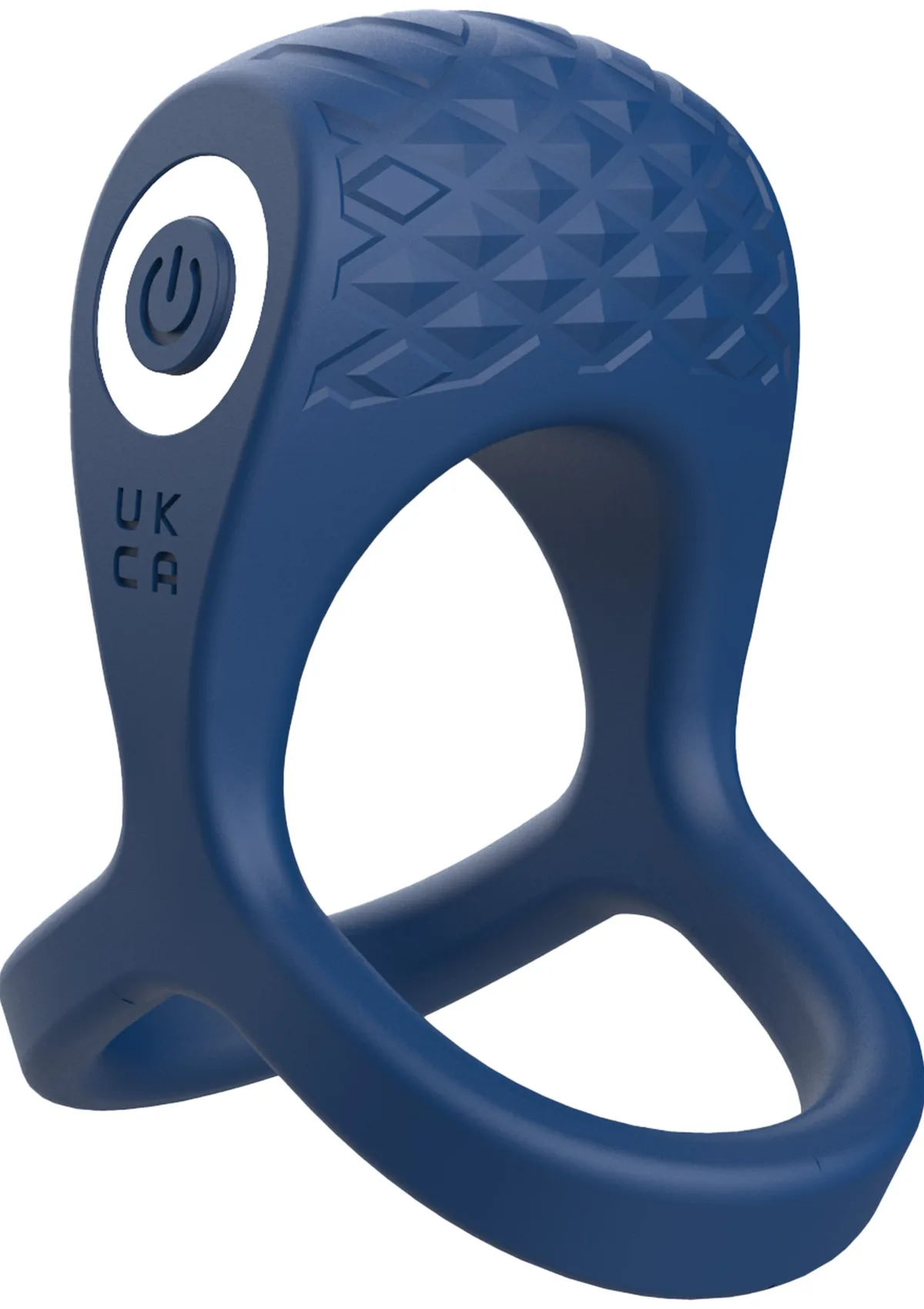
A regular penis ring is a single loop. A combined ring — what in English is called ring & ball cage and what the manufacturer itself describes as a combination of a cock ring and a ball cage — consists of two connected loops. The upper one goes around the base of the penis, the lower one around the scrotum behind the testicles. The dimension sketch in the manufacturer’s gallery clearly shows the construction: an 8 centimeter-high body with two openings, the upper one marked 5 centimeters, and a total width of 7 centimeters.
The difference in practice comes down to two things. The first is stability: a simple ring can slide, while a double loop has two attachment points and therefore stays in place. This matters especially when the product is also supposed to hold a vibration motor, since a ring that slides moves the stimulation point somewhere else. The second is that the lower loop tightens the scrotum slightly, which is the whole point of the design and at the same time the reason it fits less well for the person who wants something discreet and easy to take off quickly.
The motor sits in the wide, textured top above the upper ring. The placement is intentional: when the ring is worn, that part lies against the partner’s body during intercourse, and that is why the manufacturer writes that the vibrations stimulate both the wearer and the partner. The design is therefore as much a couple product as it is an individual product, and it’s worth keeping in mind before buying.
Playhouse Affinity has two closely related vibrating rings with a remote control, and it’s easy to mix them up because several stores list the names incompletely. The difference can be determined by the item number and EAN.
Everything else in the manufacturer’s specifications is identical between the two: silicone, ten vibration modes, 50 minutes of operating time, 120 minutes of charging time, IPX6, 55 dB, lithium-ion battery, and the same packaging dimensions. So this is not a matter of a simpler and better model, but two different fits for the same electronics. Vicious Ring is also sold in Sweden and costs from 195 SEK, which means the price difference versus Brutal Ring is a little over one hundred kronor for the lower loop and the larger ring opening.
The material is the only characteristic of a body-hugging product that neither habit nor care can compensate for, and it determines whether the product can still be kept clean after a few years. The manufacturer lists one material for this item: silicone. Both the side panel of the packaging and the function panel in the product gallery repeat it with the wording 100 percent silicone and “Made of 100% Soft Silicone,” respectively.
Silicone is a non-porous material. A non-porous surface can be cleaned, because there are no microscopic pores where residue can get trapped. It is the single most important property of a material that sits against skin and mucous membranes for longer periods, and that’s why the material line weighs more than almost any other line in a specification.
For a penis ring specifically, a second property applies: elasticity. A ring has to stretch to get on, and then regain its shape without losing its spring. Silicone does this without plasticizers, unlike molded PVC and some TPE blends where stretchability comes from added substances that migrate out of the material over time. Vuxen describes the material on its product page as stretchable, and Joyland lists the firmness as medium—two store claims that are just store claims, but they point in the same direction.
There is, however, a caveat that should be reported. Joyland states that the product consists of body-safe silicone plus ABS plastic, while the manufacturer only writes silicone. When a store contradicts the manufacturer, the manufacturer wins, and the manufacturer’s material information is the one that applies in the specification table further down. But the discrepancy is worth noting, because a product with a push button, an LED, and a charging contact reasonably has something hard in it—and because whatever sits against the body is still the silicone surface, regardless of what’s inside it. The manufacturer does not publish a material breakdown per part.
Phthalates are a group of plasticizers used to make plastics—especially molded PVC—flexible. The Swedish Chemicals Agency describes them as substances that can affect the hormone system and make reproduction more difficult, and several of them are restricted or banned within the EU in a large number of products. Body-hugging soft plastic products are a recurring subject of supervision for that very reason.
The manufacturer does not state that the article is free from phthalates, BPA, or latex. It doesn’t say it on the product page or on the packaging, which is satisfied with “Body Safe” and “100% Soft Silicone.” Joyland, on the other hand, states phthalate-free in its product text, and that is a store claim with no equivalent at the manufacturer. It should be read as just that.
At the same time, silicone as a material description is in itself a stronger signal than most other wording in the category. Silicone does not require phthalate plasticizers to become soft—the softness comes from the polymer’s own structure—which is the fundamental difference compared with labels like “TPE,” “jelly rubber,” or just “soft plastic,” which say nothing at all about what additives are included. So when the manufacturer writes silicone and nothing else, that is more meaningful than it might look, even without an explicit phthalate declaration.
The manufacturer states a total length of 8 centimeters and a ring diameter of 5 centimeters. The dimension sketch in the product gallery adds a third figure that is not included in the specification table: the width is 7 centimeters. The sketch also places the 5-centimeter measurement in the upper opening, i.e. the loop that goes around the base of the penis, while the lower scrotal loop has no separate measurement. The manufacturer does not publish a measurement for the lower opening, and that is the information that is missing the most in the entire specification, because it is the loop that determines the fit for the person who is unsure.
Five centimeters is at the wider end of the range for a penis ring. The comparison within the brand’s own range makes it clear: the sibling product Vicious Ring is listed at 3.5 centimeters, i.e. 1.5 centimeters narrower. The Lelo Tor 3 states a 29-millimeter inner diameter, i.e. just under six tenths of 5 centimeters. The name Brutal refers to the grip rather than the measurement — but anyone who assumes that a ring with the word brutal in the name is the tightest on the shelf reads it wrong. The silicone stretches, and a ring with a larger rest opening creates less pressure, not more.
The weight is listed as 0.09 kilograms, i.e. 90 grams, as the unit weight in the manufacturer’s logistics information. It should be read as exactly that logistics information — it refers to the item as it is delivered, with the cardboard box and the remote control — and the manufacturer publishes no separate weight for the ring by itself. For comparison, Satisfyer lists 52.7 grams for Mighty One, which is a product of a similar type. The carton measures 14 × 7.5 × 4.5 centimeters and is packed in an outer carton of one hundred units, which is a wholesaler figure, but at the same time the only thing the manufacturer writes about the packaging.
A note about the manufacturer’s own material belongs here, because it’s easy to miss. The product-gallery photo shows a cardboard box whose front bears the model name Brutal Ring & Ball Cage. But the barcode on the same box reads 8713221837615, and the item row next to it says 25600_Vicious Ring Vibrating — in other words, the sibling product’s number, not this product’s 25601 and 8713221837622.
You can also see it on the side panel, which states “Total lenght 6.5 cm / 4 inch”. Just 6.5 centimeters is exactly the total length the manufacturer lists for item 25600, while this product is listed as 8 centimeters. So the box in the picture is the sibling product’s box, reused in the wrong gallery. As a bonus, the printed conversion is also wrong: 6.5 centimeters is 2.6 inches, not 4 inches. The conclusion for the person who is going to buy is simple — use the specification table, not the text on the box in the product photo.
The interface is as simple as it can be. On the ring’s control section there is a single round button, set in a white ring that serves as an LED window. In the manufacturer’s product images, the button is clearly visible, as is the embossed UKCA marking just below. The back of the same control section carries three markings: the charging port labeled DC, the CE mark, and the crossed-out wheeled bin, which means the product should be disposed of as electrical waste.
The remote control is a separate, black, oblong unit with three touch surfaces: an upward arrow for stronger vibration, a power symbol in the middle, and a downward arrow for weaker. The manufacturer states ten vibration modes and that control is done with the remote control. What is not stated is how the modes are distributed between fixed strengths and pulse patterns, whether all ten can be reached from the button on the ring itself or only from the remote control, and in what order they are. It’s a striking gap in a specification that is otherwise unusually detailed for the price category.
The point of having a remote control on a penis ring is practical rather than technical. The button on the ring sits in a position that is difficult to reach when the product is in place, and even harder to reach without moving the entire ring. With a remote control, the partner can control the vibration, or the wearer can switch modes themselves without having to interrupt. That’s the only reason the feature exists, and it’s fully sufficient.
However, that’s where what can be substantiated ends. The manufacturer does not publish the remote control’s range in meters, its transmission technology, its power supply, or whether it can be replaced separately. It doesn’t say so on the product page, in the logistics information, or on the packaging. None of the five Swedish stores fills in the gap either — Blush Me does, however, state the delivery contents as ring plus remote control, which confirms that it’s included, but nothing more than that.
It’s a real weakness in the source material, and it’s worth taking into account. A remote control without a published range can’t be compared with an app-controlled product, where the range in practice is unlimited as long as both have mobile coverage. Lelo Tor 3 and Satisfyer Mighty One are both controlled via app and Bluetooth according to their manufacturers; the Playhouse ring has a physical unit and no published figures about it. If you want to control the vibration from another room, then this isn’t the product you should buy, because no one has promised that it will work.
Ten is a common number in this price range, and Satisfyer lists exactly the same number of vibration programs for the Mighty One. Lelo lists eight for the Tor 3. The pattern in this product category is that the first settings are fixed intensity levels in ascending order, and that the rest are pulse patterns—wave, pulse, staircase, and similar—but the manufacturer does not specify the distribution for this item, so it should not be written as if it were known.
What can be established purely in principle is that the number of modes is the least decisive factor in a specification like this. A ring with ten modes and a ring with thirty modes rarely differ in how they are used, because in practice you end up with two or three settings. What actually differentiates products is the motor’s power, the ring’s fit, and how long the battery lasts—and of these three, the manufacturer only publishes the last.
The manufacturer lists the sound level as 55 dB in the specification table. That’s more than most brands in this price range disclose at all, and it deserves to be noted positively—the number is there, it’s on the manufacturer’s own page, and it’s quoteable.
But a decibel figure without the measurement distance and measurement method is more a matter of magnitude than an actual measurement. The manufacturer does not state at what distance 55 dB has been measured, in which vibration mode, or against which standard, and the same figure is also published for the sibling product Vicious Ring. That two different products have exactly the same stated sound level is in itself a sign that the figure is a motor design specification rather than a measured value for the finished product. The functional panel in the manufacturer’s gallery rounds it off with the marketing wording “Soft whispering,” which adds no information.
The comparison with the two named competitors tells you about the same amount. Lelo lists a maximum of 60 dB for the Tor 3—so a cap rather than a typical value—while Satisfyer does not publish any decibel figure at all for the Mighty One. The conclusion is that 55 dB places the Playhouse ring in the same ballpark as a ring from a significantly more expensive brand, but that none of the numbers is good enough to rank the products by sound. A practical tip that applies regardless of model: a vibrating product sounds louder against a hard surface than against a mattress, because the surface acts as a resonance box.
Playhouse Brutal Ring & Ball Cage is rated IPX6. The rating comes from the international standard IEC 60529, which defines enclosure classes for electrical equipment. The number 6 in the second position means that the enclosure is tested against powerful water jets from all directions. The manufacturer itself prints the rating both in the specifications table and on the feature panel in the product gallery, where it is listed as “IPX6 Waterproof”.
This is the most important technical line in the entire specification, and it is routinely misunderstood. IPX6 and IPX7 are not a ladder where the higher number includes the lower one. They test two different things.
A product that is only rated IPX6 is thus not tested for submersion. Practically, it means: rinse it under the tap as much as you want, but don’t put it in the bathtub. The difference versus Satisfyer Mighty One, which the manufacturer states is IPX7, is therefore real and not just a formality. Lelo, for its part, states “100% watertight” for Tor 3 without providing any IP rating at all, which is worse documented than both of the other ones—without a rating, a formulation can’t be checked against a standard.
That the manufacturer itself writes “IPX6 Waterproof” is, in this light, an unfortunate wording, because the word waterproof in Swedish is usually translated as watertight and suggests precisely submersion. Read the rating, not the adjective.
Water resistance is also the point where the Swedish stores don’t agree. Vuxen says that the product is “only splash-proof,” while Blush Me and SexleksakerOutlet both list IPX6 and describe it as shower-proof. Joyland lists IPX6. Sexonic doesn’t provide any information about water at all.
When a store goes against the manufacturer, the manufacturer wins, and the manufacturer’s claim is IPX6. But the discrepancy itself is revealing in two ways. First, it shows how much of the store copy is rewording rather than specifications. Second, Vuxen’s wording, although incorrect as a rating, is more cautious in the right direction: the one who follows Vuxen’s advice and never submerges the product won’t damage it, while the one who reads the word watertight and puts it in the bathtub does something the rating doesn’t cover.
Rinse the product in lukewarm water after each use and use an unperfumed soap or a cleaning product intended for intimate products. With IPX6, the entire ring withstands running water, including the area around the button and the DC contact on the back. Let it air-dry before putting it away, and do not put it back in the packaging while it is still damp.
The remote control is another matter. The manufacturer states that no enclosure rating is given for the remote control and mentions it at all in connection with water resistance. Treat it like a regular piece of electronics: wipe it off with a damp cloth, never under the tap.
The choice of lubricant is the same as for all silicone products. Use a water-based lubricant—Joyland explicitly recommends it on its product page. A silicone-based lubricant should not be used on silicone: it breaks down the surface over time and makes it porous, and a porous surface can no longer be cleaned properly—only replaced. Oil-based products such as coconut oil leave a film that is difficult to remove, and oil also breaks down latex if a condom is used at the same time. Store the ring in a cool, dry place, not together with products made of soft, pliable plastic, because plasticizers can migrate between materials that are in contact with each other.
Here is the product’s clearest weakness, and you can see it right away in the manufacturer’s own figures. Runtime is listed as 50 minutes and charging time as 120 minutes. That means that charging takes 2,4 times as long as the product can then be used. Two hours in the outlet gives fifty minutes of operation.
Fifty minutes is more than enough for a single use—this is hardly where the problem lies. The problem is that the margin is small if the product hasn’t been charged in a while, and that lithium-ion batteries lose capacity with the number of charging cycles. A cell that initially provides fifty minutes will provide less after a couple of years, and from such a low starting point the loss is noticeable earlier than on a product that starts at two hours.
The comparison is uncomfortable. Lelo states up to 2 hours of operating time for the Tor 3 and up to 2 hours of charging time—so the same charging time but more than double the operating time, which gives a 1:1 ratio instead of 2,4:1. Lelo also states up to 90 days of standby time, which Playhouse does not publish. Satisfyer does not publish operating time or charging time for the Mighty One, so there is nothing to compare with—meaning that Playhouse, after all, reports more than Satisfyer on this specific point.
The charging connector sits on the back of the control unit and is labeled DC in the manufacturer’s product image. The picture shows two small contact points in the silicone surface rather than an opening for a connector, which is the usual solution for achieving an IP rating without a rubber plug. The manufacturer, however, does not publish the cable type, the connector type, the charging voltage, or the charging current, and they also do not state that a charging cable is included in the delivery. Joyland says that charging happens via USB, which is a store claim and not a manufacturer claim.
The consequence is the same as for all products with a product-specific charging cable: if you lose the cable, no standard USB-C cable will work—you need a replacement of the same type. Satisfyer solves the same issue with a magnetic USB cable that they explicitly state is included in the package, and Lelo states charging at 5.0 volts and 70 milliamps. None of that information is available for this article.
The manufacturer states the battery type as lithium-ion. The capacity in mAh and the voltage in volts are not published, either on the product page or in the logistics information. That makes it impossible to convert runtime into power consumption, and thus impossible to compare how heavily the cell is loaded between models.
The contrast with Lelo is striking: there, 3.7 volts and 70 mAh are given outright, along with charging current and frequency. With Lelo’s numbers, you can see that a small cell drives a 130-hertz motor for two hours. With Playhouses’ numbers, you can only see that something drives something for fifty minutes. What generally applies to lithium-ion batteries also applies here: the cell is very likely not replaceable in a fully molded silicone product; the capacity decreases with charging cycles, and the product does best when charged regularly rather than stored completely discharged.
One final battery-related observation belongs here: the manufacturer publishes no automatic shut-off time. Lelo states that Tor 3 shuts itself off automatically after 20 minutes. For a product that’s worn on the body, it’s a relevant feature to know whether it exists, and for this article we don’t know.
We do not have price data from shops in your market yet.
Fifty minutes of operating time versus one hundred and twenty minutes of charging time. Two hours in the outlet gives fifty minutes of use—that’s the figure that determines whether the price is a bargain or just low.
A penis ring works by limiting the backward flow of blood from the penis, and that is the whole reason it can provide a firmer erection. It is also the reason there is an upper limit on usage time, and that a ring that’s worn too tight or for too long can cause injury. This is the only product category in our range where a time limit is a safety issue rather than a comfort issue.
Against that background, the following is worth knowing before you buy: the manufacturer publishes neither a recommended maximum usage time, any warning text, nor any contraindications for this item. None of the five Swedish shops does either. There is nothing in the published material that says how long the ring is intended to be worn, and it is a clear lack in the documentation — not a sign that there is no limit.
Still, two things you can consider are as follows. The first is that the 50-minute runtime is not a recommended usage time but a battery specification; the battery’s length says nothing about how long the product should be worn. The second is that the relatively wide ring opening of 5 centimeters, compared with the sister product’s 3.5 centimeters and Lelo’s 29 millimeters, in itself means a milder pressure at the same level of stretch. If you’re unsure whether the product category suits you, or if you have any known circulation or bleeding disorder, you should ask healthcare rather than a product page.
Three comparisons are relevant: against the brand’s own sister product, against the premium brand in the category, and against the most sold app-controlled ring. All of the specifications below come from the respective manufacturers’ own product pages, and all prices come from the shops’ product feeds on July 29, 2026.
Vicious Ring Vibrating + Remote costs from 195 SEK compared with Brutal Ring’s 297 SEK. That is 102 SEK, or 52 percent, difference. For that money, according to the manufacturer’s own figures, you get exactly nothing in terms of technology: silicone, ten vibration modes, 50 minutes of runtime, 120 minutes of charging time, IPX6, 55 dB, a lithium-ion battery, and a remote control are identical between the items, as are the package dimensions.
What you’re paying for is the shape. Brutal Ring has a lower cock ring that Vicious Ring doesn’t have, and a ring opening of 5 centimeters versus Vicious Ring’s 3.5 centimeters. Total length is 8 centimeters versus 6.5. So it’s two different fits for the same electronics, just as was described above.
The conclusion is unusually simple: if you want a double loop and a wider ring, Brutal Ring is the way to get there, and it’s the only way within the series. If you want a narrower, single ring with the same electronics, you save one hundred kronor on Vicious Ring. Comparing them in the specification table is pointless — they differ only in two measurements.
Lelo Tor 3 costs from 846 SEK, meaning it’s 549 SEK more than Brutal Ring at its cheapest. That’s almost three times the price, and the differences justify the amount in part, but not entirely.
Tor 3 measures 46.7 × 22.2 × 60 millimeters, with an inner diameter of 29 millimeters—therefore, a significantly smaller and tighter product. The material is listed as body-friendly silicone and ABS plastic, so it is not full silicone. Lelo states eight vibration patterns versus Playhouse’s ten, app control via Bluetooth, a lithium-ion battery of 3.7 volts and 70 mAh, operating time up to 2 hours, charging time up to 2 hours, standby time up to 90 days, motor frequency 130 hertz, maximum sound level 60 dB, automatic shutoff after 20 minutes, and a two-year warranty with an additional ten-year quality warranty on top of that.
Sum it up, and the difference is less about function than about presentation. Tor 3 has more than double the operating time at the same charging time, and that’s a real advantage. But it has fewer modes, it isn’t full silicone, it doesn’t state any IP rating at all, and it has an inner diameter of 29 millimeters versus Playhouse Ring’s 50. What Lelo primarily delivers for the extra 549 kronor is a complete specification: mAh, volt, hertz, standby time, shutoff time, and warranty time are all written out. Are you the kind of buyer who wants to be able to check every figure? Then it’s worth the money. If you aren’t, you get more modes, a better fit, and a published ingress-protection rating for a third of the price.
Satisfyer Mighty One costs from 279 SEK, i.e. 18 SEK less than Brutal Ring. On the price tag, they’re practically the same product; in terms of construction, they aren’t.
Mighty One measures 90 × 49.2 × 26.8 millimeters and weighs 52.7 grams. The material is listed as medical-grade silicone, the ingress protection rating is IPX7, the number of vibration programs is ten, and charging is done with a magnetic USB cable that’s included. It’s controlled via Satisfyer’s app rather than with a physical remote control, and the manufacturer offers a 15-year warranty.
The differences that actually matter: Satisfyer is IPX7 and can therefore handle submersion, while Playhouse is IPX6 and can’t. Satisfyer has a 15-year warranty, while Playhouse publishes no warranty period at all. Satisfyer is controlled with an app; Playhouse with a physical unit—which is an advantage for someone who doesn’t want to install anything and a disadvantage for someone who wants to control it at a distance. Playhouse, however, publishes operating time, charging time, and sound level, which Satisfyer does not do for this model, and Playhouse has a double loop while Mighty One is a single ring. On the same price tag, then, it’s not one better and one worse option, but two different answers to the same question.
Five Swedish shops sell the item with EAN 8713221837622. The cheapest is Joyland at 297 SEK, and the most expensive is Vuxen at 359 SEK. That’s a difference of 62 SEK or 21 percent for exactly the same item number, same color, and same packaging—a significantly more even pricing picture than in pricier product categories, where the spread often exceeds fifty percent.
The inventory situation is unusually good. Four of the five shops had the product in stock during the price check: Joyland at 297 SEK, Blush Me and SexleksakerOutlet at 349 SEK each, and Vuxen at 359 SEK. Sexonic at 304.30 SEK was the only one without stock. That means the difference between the cheapest available and the second-cheapest available is 52 SEK.
One detail from the flows deserves a mention. According to the shop’s own flow, Joyland’s 297 SEK is a discounted price from 349 SEK, while Blush Me, SexleksakerOutlet, and Vuxen are at their regular prices. So the cheapest price in the table is a promotional price, and it can disappear. If the four available shops still fall within 62 kronor of each other, it’s not the price chase that matters here, but shipping cost and delivery time. Several of the shops charge shipping below a certain order value, and in this price range most individual purchases end up under that limit—so the shipping fee can easily become larger than the entire price difference between the shops.
The prices in the table above are updated when the shops’ product flows are updated, but always check the final price at checkout.
It’s for you if you want a combined penis and ball ring rather than a simple ring, and if you want it to sit firmly without slipping. It’s for you if you want to be able to change the vibration mode without having to touch the product, and if you prefer a physical remote control over an app. It’s for you if you want full silicone against the skin and a published enclosure rating for shower use. And it’s for you if you want all of this for under three hundred kronor, because the combination package is difficult to find cheaper from a named brand with a stated specification.
It’s not for you if you want to be able to put the product in a bathtub—IPX6 does not cover submersion, and that’s where Satisfyer Mighty One with IPX7 is the right choice for almost the same price. It’s not for you if you need more than fifty minutes of runtime, or if it bothers you that charging takes 2.4 times as long as use. It’s not for you if you want to control it from another room, because the remote control’s range has never been published. It’s not for you if you require a published warranty duration before purchase. And it’s not for you if you want a narrow ring—5 centimeters is wide for this category, and the sibling product Vicious Ring at 3.5 centimeters is then the nearby alternative within the same series and a hundred kronor cheaper.
One last thing belongs in the decision. This article is cheap enough that it can be bought to test whether the product category is a good fit, which is a completely legitimate reason. But it is precisely in that category that fit matters above all, and where a missing measurement—the opening of the lower scrotal ring—can determine whether the product works for you or is put in a drawer. The manufacturer does not publish that measurement, and no store fills it in.
The manufacturer does not publish any warranty period for the Playhouse Affinity series. It is not stated on the product page, in the logistics information, or in the brand presentation, and none of the five Swedish stores indicates any manufacturer’s warranty for the item. That is a clear difference compared with the two competing brands being compared: Lelo states a two-year warranty with an additional ten-year quality guarantee, and Satisfyer states 15 years for Mighty One.
This does not mean that you are left without protection. What always applies is your statutory rights, and they are independent of what a manufacturer promises. Under the Consumer Sales Act (konsumentköplagen), you have three years to complain for defects in the goods. A battery that stops holding a charge long before the expected service life, a button that stops responding, or a remote control that never pairs are all examples of things that may be original defects—and the complaint is filed against the store you bought from, not against the manufacturer.
For distance purchases, you also have a right of withdrawal for fourteen days under the Act on distance contracts and contracts outside business premises (lagen om distansavtal och avtal utanför affärslokaler). Be aware that, in practice, the right of withdrawal is limited for hygiene products that have been removed from a sealed package—but the right to complain for defects always applies. If you have questions about what applies in your case, Konsumentverket guides you via Hallå konsument.
A practical piece of advice that follows from the lack of a manufacturer’s warranty: save the receipt and the packaging. Without a manufacturer’s warranty to fall back on, the store’s documentation of the purchase is the only way to make a complaint, and the crossed-out waste bin on the back of the product at the same time reminds you that once it has been used up, it should be disposed of as electronic waste and not in household trash.
Playhouse Brutal Ring & Ball Cage Vibrating + Remote is ranked på plats 10 av 16 in cock ring best i test, where the entire category is compared against each other using five shared criteria. Guiden vinns av Satisfyer Swordsman Vibrating Cock Ring Blue.
Every numerical piece of information in the text can be traced to one of the sources below. The links were checked manually on the specified date.
This page is machine-translated from Swedish. Read the Swedish original