

Review
Review: Fun Factory Be One Finger Vibrator Purple
The finger vibrator with full specifications — IPX7, USB-C, and 28 grams.
13 September 2026
Review · Finger vibrator · Ten modes with memory function
Pretty Love’s tongue-fitted finger vibrator reviewed against the manufacturer’s own specifications and price data from three Swedish stores. Ten vibration modes, memory function, silicone as the only material, 100 × 23 × 40 millimeter and 39 gram — but neither enclosure rating, battery capacity, operating time, nor charging time is published, and that gap determines whether the price of 195 SEK is cheap or just low.
Most function per dollar in the comparison: ten vibration modes and a memory function in a silicone housing for 195 SEK, with an included charging cable and a published measurement drawing of 100 × 23 × 40 millimeters. What you pay for is the information that’s missing — the manufacturer does not publish any ingress protection rating, battery capacity, operating time, or charging time; the charging port is an opening in the housing, and the cable has a pin connector instead of USB-C.
Pretty Love Peterson is a finger vibrator: a small silicone housing that slides over your index finger and turns your finger into the tool instead of replacing it. The manufacturer is Liaoyang Baile Health Care Product Co., Ltd, which sells it under the article number BI-300062. The specification that can actually be verified is short but clear: ten vibration modes, a memory function, silicone as the only material, USB charging, a total length of 100 millimeters, and a net weight of 39 grams.
This review is about the item with EAN 6959532364354. The number is checked against the manufacturer: it appears in the “Bar Code” field on Baile’s own product page for BI-300062, and the same digits are printed under the barcode in the manufacturer’s packaging image together with the text ITEM:BI-300062. Three Swedish stores sell it; all three had it in stock at the price check on September 12, 2026, and the price is between 195 and 249 SEK.
It’s also worth stating plainly what cannot be verified, because it affects the assessment more than any single value in the list above. The manufacturer does not publish battery capacity, voltage, operating time, charging time, sound level, or the protection rating for this model. None of the three Swedish stores fill in the gaps. In this price range it’s common, but it’s not inevitable—and the rest of the text is largely about what those missing details mean when you’re choosing.
A finger vibrator is constructed around an opening that the finger goes into, and the principle differs from a wand vibrator in a way that’s easy to miss. A wand transfers vibration from a motor through a shaft you hold. A finger vibrator instead places the motor directly on top of the fingertip, which means you keep the sense of touch, the accuracy, and the natural pressure that a finger provides. The angle is determined by your hand, not by the product’s shape.
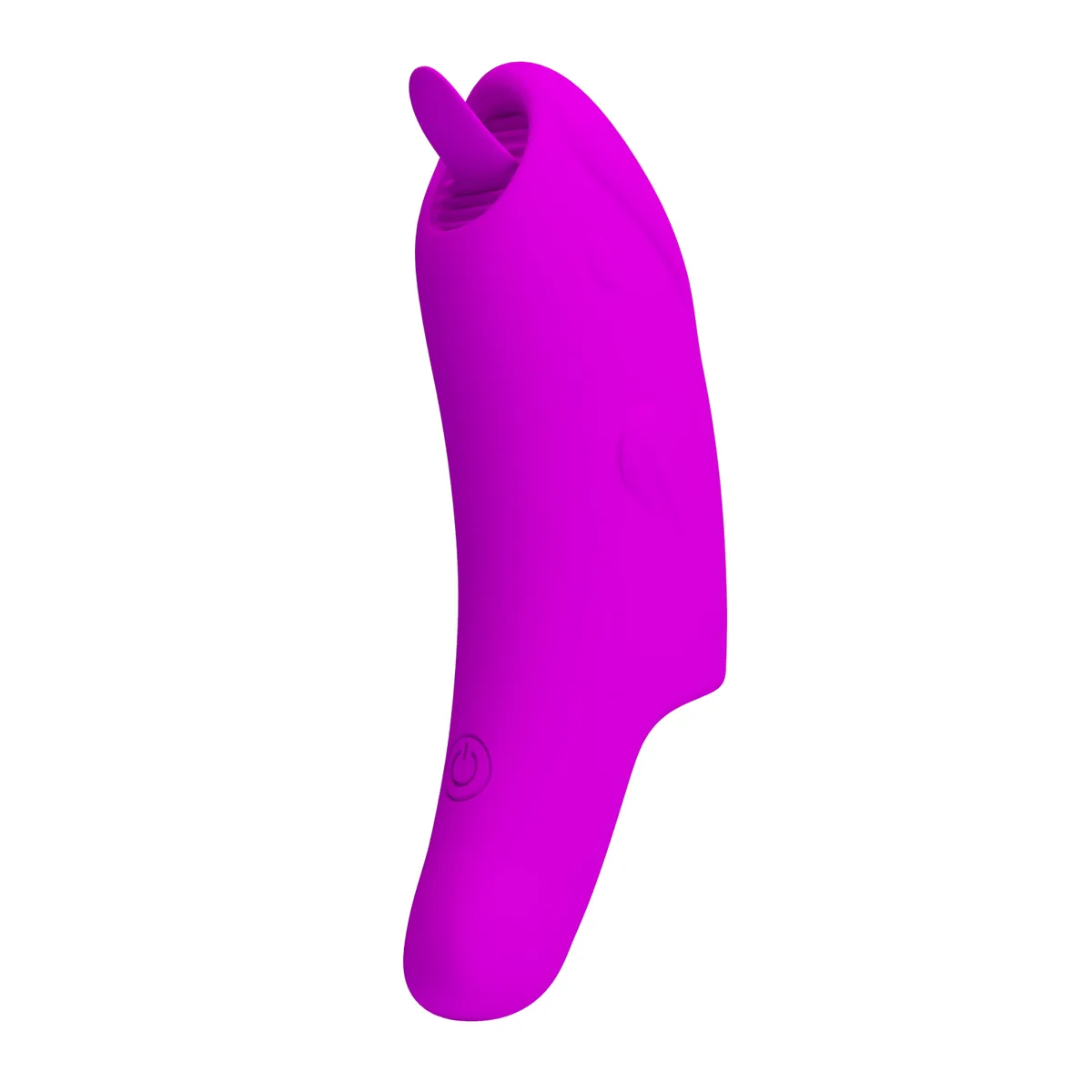
Peterson’s variant on the theme is a small, flexible tongue that sticks out from a ribbed opening on the top side of the tip. The manufacturer’s product description puts it as follows: that the “tongue” on the tip delivers its own kind of stimulation and hits sensitive areas with soft, tickling movements, while the housing follows the body’s natural lines. It’s a marketing formulation, but it corresponds to something concrete in the design: in the manufacturer’s own images, the tongue appears as a separate, thin silicone protrusion that sits freely in a recess and can therefore move when the housing vibrates.
What you can confirm purely from a technical standpoint is that Peterson has two contact surfaces with different characteristics: the broad, smooth underside of the housing and the narrow tongue on the tip. It’s the same idea as behind other tongue-shaped stimulators, just executed in the smallest possible format. What the tongue is not, despite the product name tempting you to interpret it that way, is a motor-driven licking function—the manufacturer lists ten vibration modes and nothing about rotating or pendulum movement.
The question of the name is worth a section, because it’s the most common reason why you think you’re comparing two products when you’re only comparing one. On the manufacturer’s packaging, three labels are shown at the same time: the product type “Powerful Fingering Vibrator”, the model name “Peterson” in handwritten style in the top-right, and the series name “Honey Finger” in large format at the very bottom. The item number ITEM:BI-300062 is printed on the side of the packaging.
In Sweden, the three stores have also chosen a different name variant each. Blush Me and SexleksakerOutlet print the brand—“Pretty Love Peterson Fingering Vibrator”—while Vuxen shortens it to just “Peterson Fingering Vibrator”. All three sell the same item; Vuxen lists 6959532364354 as the item number straight out, while the other two use the same digits as their own item identifier in the product feed.
Practical consequence: if you search for “Honey Finger”, you’ll find several Pretty Love models, because the series name is shared by more than one item. If you search for “Peterson”, you’ll find this one. If you search for BI-300062, you’ll find the manufacturer’s own listing—the only place where both the weight and the official barcode are shown.
The material question is the only characteristic of an intimate product that can’t be compensated for through experience or care. The manufacturer states a single material for BI-300062: silicone. It’s also the only material the three Swedish stores mention, albeit with different wording—Blush Me writes “High-quality silicone”, SexleksakerOutlet “Silicone”, and Vuxen “Silicone” in its facts box, plus “Skin-friendly silicone material” in its sales text.
Silicone is a non-porous material. A non-porous surface can be cleaned, because there are no microscopic cavities where residue can get trapped, and that is the single most important property of a material that is supposed to sit against the mucous membrane. That is why the material line weighs more heavily than almost any other line in a specification, and that is also why labels such as TPE or “jelly rubber” are a worse sign: they say nothing about which plasticizers are included.
That the entire body is silicone — not just the contact surface — has two consequences here. The first is grip: a soft surface provides better hold against the finger than hard plastic when the hands are wet or have lube on them, and a finger vibrator that slides is a finger vibrator that doesn’t reach. The second is that there is no seam between a silicone head and a plastic shaft where dirt can collect.
There are still two details in the design that are worth noting, and both can be seen in the manufacturer’s own images. The tongue sits in a ribbed recess with clear grooves, and the grooves are exactly the kind of geometry that requires you to actually brush or rinse through them instead of simply wiping the surface. And at the back end of the body, the charging port sits as an opening in the silicone. These are two places where the construction is harder to clean than a smooth, sealed surface — not a defect, but something to know before relying on the idea that “silicone” is enough as a hygiene statement.
Phthalates are a group of plasticizers used to make plastic, above all soft, flexible PVC. Kemikalieinspektionen describes them as substances that can affect the hormone system and make reproduction more difficult, and several of them are therefore restricted or banned within the EU in a large number of products. Intimate products are a recurring category in supervision, precisely because they consist of soft plastic against skin and mucous membranes.
Here, the conclusion has to be straightforward: the manufacturer does not publish any declaration that the BI-300062 is free from phthalates, BPA, or latex. The product page states the material as “Silicone” and nothing more. None of the three Swedish stores adds any such claim either. It should be compared with premium brands, which as a rule print exactly that wording on every product page.
What does that mean in practice? Two things at the same time, pulling in different directions. On the one hand, silicone does not require phthalate plasticizers to become soft—the softness comes from the polymer’s own structure—so the material designation itself is, in that sense, better information than “TPE”. The packaging also bears both CE and UKCA markings according to the manufacturer’s own image, which means that the manufacturer assumes responsibility that the product complies with the applicable EU legislation. On the other hand, the absence of an explicit declaration is precisely that: an absence. Anyone who chooses products based on published material declarations has nothing to go on here, and that is a legitimate objection rather than a mere formality.
The manufacturer publishes a dimension drawing, which is unusual in this price range and the single most useful source in the entire material. It states the total length as 100 millimeters, the width as 23 millimeters when viewed straight from the front, and the depth as 40 millimeters when viewed in profile. The net weight is given on the product page as 39 grams.
Instead, the three Swedish stores state “total length 10 cm” and “diameter 4 cm”. The first piece of information matches exactly the manufacturer’s 100 millimeters. The second is an oversimplification worth clarifying: the 4 centimeters are not a diameter in the strict sense but the manufacturer’s depth measurement in profile, that is, the distance from the front edge of the finger opening to the back of the housing at the widest point. Viewed straight from the front, the product is only 23 millimeters wide, and none of the stores publish that figure. It’s the difference between thinking you’re buying something four centimeters thick and knowing that it’s just over two centimeters wide.
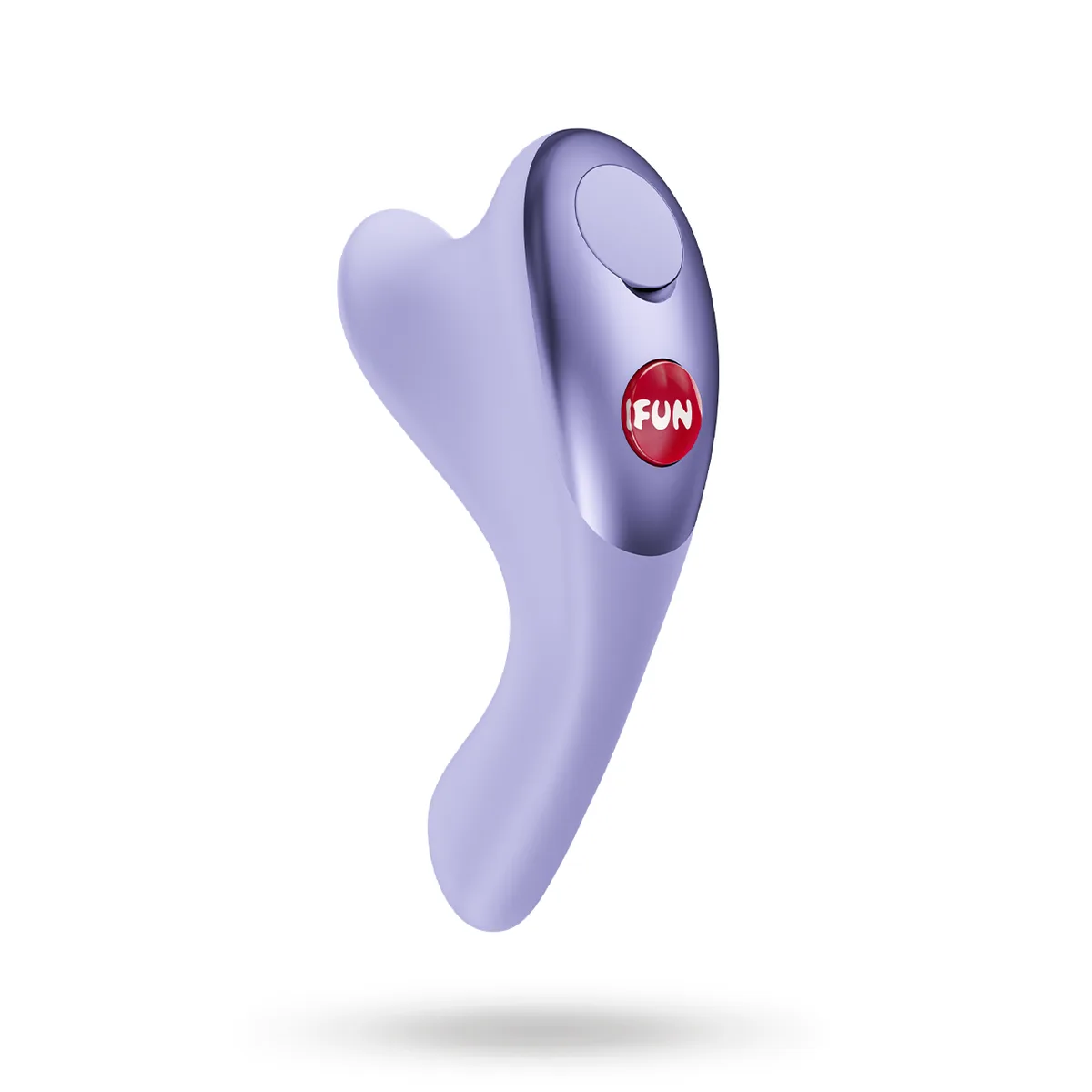
The weight information is the only one in the entire material that exists only with the manufacturer. None of the three stores publishes any weight at all. 39 grams places Peterson roughly where you’d expect it in its category: Fun Factory lists 28 grams for Be One, and Pretty Loves’ own sibling models are at 32, 36, and 47 grams. The differences are small in absolute terms but not insignificant for an object that’s meant to sit on a finger during use—eleven grams is about one third of the product’s total weight.
According to the manufacturer, the packaging measures 140 × 80 × 45 millimeters, and 80 units go into an outer carton. The last number, of course, is a wholesaler figure rather than something that affects you as a buyer, but it does say something about where the product belongs: lybaile.net is a manufacturer website aimed at retailers, with a minimum order quantity of 1,000 units stated on the product page. That’s why the specification looks the way it does—it’s written for a buyer who is going to stock a shelf, not for you choosing between two models.
The interface is as simple as it can possibly be. The manufacturer’s own feature image names exactly one button on the product and labels it “ON/OFF VIBRATION BUTTON”. It sits on the outside of the housing, below the finger opening, where your thumb naturally rests when your index finger is in place. All control comes from there: ten vibration settings that you step through with repeated presses.
In practice, that means a trade-off that’s typical for this format. The advantage is that you don’t need to see the button to use it, and there’s nothing to learn. The downside is that a single-button setup always goes one way: if you’ve clicked past a step, you have to go all the way around to get back. With ten settings, that means up to nine presses. Products with a plus and minus button avoid that, but you pay for it with an extra button and a larger housing.
The manufacturer doesn’t say how the settings are distributed between steady intensities and pulsing patterns. What it states is “10 vibration functions”—nothing about how many of them are direct strength steps. The pattern in this product category is that the first steps increase in strength and the rest are rhythmic programs, but that’s a pattern and not a description of this specific model—so expect to explore the loop once to know what’s included.
The manufacturer explicitly states a memory function, both in the specification field on the product page and as its own symbol on the packaging. The function means the product starts in the position it was last turned off in, rather than always starting over from step one.
That sounds like a minor detail, and it isn’t. On a single-button product with ten settings, the memory function is what determines whether you have to click your way to your setting every time or whether you can just turn it on and continue. The longer the loop is, the more valuable the function is—and that’s exactly why it’s notable that it’s present here but missing on the sibling model BI-300088, which has the same ten settings but where the manufacturer doesn’t state any memory function at all.
One thing the memory function doesn’t replace is a child lock. The manufacturer does not indicate a locking function for BI-300062, which means the button can, in principle, be pressed in by itself in a bag. Combined with the fact that the product starts in the last-used setting, it’s an argument for storing it somewhere it won’t get crushed—not a flaw, but a result of the design that’s worth knowing.
The construction is clearly shown in the manufacturer’s images. The housing has an opening all the way through the back end that the index finger is inserted into, and a projecting, narrow tab that runs along the underside of the finger. On one side of the housing, there are also three cutouts that make the silicone flexible where the finger is thickest. It is a passive fit: no strap, no loop that you adjust, and no size setting.
What can therefore be established is that the fit is determined entirely by the silicone’s stretchiness and by how big your finger is. This is the key difference compared to a finger vibrator that stays in place thanks to an elastic loop: a loop adapts, a shaped housing does not. The manufacturer does not publish any information about which finger range the opening is dimensioned for, and in practice this is the single biggest uncertainty when buying this exact model—significantly more than the question of how many vibration modes it has.
The shape is asymmetrical and intended to be worn with the tongue up and the smooth underside against the body. An adult describes the intended use as spot stimulation of the clitoris and nipples, which matches the geometry: the narrow tongue is made for a small area, and the housing completely lacks the length and stiffness that would be needed for anything else.
The tongue is the product’s entire selling point, and it deserves to be described precisely. In the manufacturer’s images, it is a thin, bent silicone protrusion that sticks up out of a ribbed recess on the top side of the tip. It is molded into the housing and sits freely in the recess, which is what makes it sway when the housing vibrates.
That means two things. The first is that the tongue has no own motor or its own movement mechanism—it moves because the rest of the product does. The second is that its range of movement varies depending on which vibration mode you’re in: a program with short pulses and one with steady high-frequency vibration do not produce the same movement in a freely hanging silicone tongue. It’s not a flaw—this is how the construction works—but it explains why a tongue function of this type is experienced very differently between modes.
What it definitely is not: an air stimulator. There is no enclosed pressure chamber and no pump in Peterson, and the manufacturer also does not make any such claims. If you’re looking for the touch-free feel that air-pressure technology provides, that’s a different product category, and it starts at a completely different price point.
Here’s the short answer. The manufacturer does not publish any decibel value for BI-300062, and it also does not make any claim that the product would be particularly quiet. Neither the product page, the specifications field, nor the packaging mentions the sound level. None of the three Swedish stores states any value either.
So there’s nothing to compare, and a figure that shows up somewhere else on the internet for this model would in that case come from an individual measurement or from nowhere at all. What can be said generally is that a small product with a thin silicone housing has less mass to dampen the motor than a larger housing, and that resonance from the surface affects perceived sound level more than most people think—place the product on something soft between uses instead of on a hard tabletop.
Notable is that Fun Factory also does not publish any decibel value for Be One. The absence of sound data is therefore not something that sets this cheap model apart; it’s a problem throughout the entire product category.
This is the most important gap in the specification, and it deserves to stand on its own. The manufacturer does not state any enclosure rating for BI-300062—neither IPX7, IPX6, nor anything else. None of the words watertight, water-resistant, or splash-proof appear on the product page or in the specification field. None of the three Swedish shops either states any water resistance.
On top of that, there’s an observation from the manufacturer’s own image material: charging takes place through an outlet at the rear end of the housing—that is, a physical opening in the silicone where a pin contact is inserted. Such an opening is not in itself proof that the product can’t handle water, but it is the design detail that makes it hardest to achieve a high enclosure rating, and that’s also the reason why more expensive models either use magnetic charging or place the contact under a sealed flap.
The conclusion, therefore, is the cautious one: treat Peterson as a product that is not approved for submersion. If there’s no rating, the absence is never a sign that the product would be able to handle more than what’s stated—it’s a sign that nobody has promised anything.
Enclosure ratings are defined in the international standard IEC 60529. The letter X in IPX means that protection against solid objects has not been tested or is not specified, and the number after it indicates protection against water. IPX7 means the product is tested for submersion in water to a depth of one meter for 30 minutes, and it’s the class that’s standard practice for intimate products in the premium segment—for example, Fun Factory lists IPX7 for Be One.
The difference between having that information and not having it is concrete. With IPX7, the entire product can be rinsed under the tap without overthinking it and used in a shower or bathtub. Without any rating at all, cleaning has to be done with a damp cloth and while avoiding the charging port, which is more troublesome on a product that also has ridges around the tongue where residue can get stuck.
Clean the product after each use with lukewarm water and fragrance-free soap or a cleaning agent intended for intimate products. Be careful with the ridged recess around the tongue—it is the only place on the product where the geometry actively holds on to residue. Keep the charging port at the back end dry, since the manufacturer does not publish any ingress protection rating. Let it air-dry completely before putting the product away.
The lubrication rule is the same as for all silicone products, and it’s a principle rather than a recommendation: use water-based lubricant. Silicone-based lubricant breaks down the silicone surface over time and makes it porous, and a porous surface can no longer be cleaned properly—only replaced. Oil-based products such as coconut oil leave a film that is hard to remove and that attracts dirt.
Store it so that button cannot be pressed in by itself. According to the manufacturer’s specifications, the product has no button lock, and it also starts in its most recently used position thanks to the memory function—making a tightly packed toiletry bag a worse storage option than a bag or a box on its own.
The manufacturer describes the power source in two words: “USB rechargeable”. That’s the entire battery specification. The fact that the product is rechargeable and not powered by button cells is, by itself, an advantage in this price range—replaceable button cells are cheaper to manufacture, provide worse performance, and turn the product into an ongoing cost.
With the included cable. The manufacturer’s own charging image shows the cable in full: a standard USB-A connector on one end and a narrow pin connector on the other, of the type that is inserted into a small port. The port is shown in the same image at the back end of the housing, i.e. in the tapering grip section farthest from the tongue.
It’s a trade-off that’s worth understanding before buying. This is not USB-C at the product end—so a regular phone cable can’t be used. If you lose the cable, you’re stuck finding a replacement with the same pin connector, and that’s not a given for a product in this price range where the manufacturer doesn’t sell spare parts to consumers. The comparison with Fun Factory Be One is straightforward: it charges with USB-C, and most people already have that type of cable at home in multiple copies.
On the other hand, it’s a real cable that comes with it, which isn’t something you can always assume in this price range, and the USB-A end works with any charger, power bank, or computer. So only the product side of the cable is proprietary.
Here, the three pieces of information that are completely missing are gathered. The manufacturer does not publish either the battery’s capacity in mAh, its voltage, the operating time, or the charging time for BI-300062. None of the three Swedish stores supplements it. So there’s no way to recalculate anything, and no way to compare how heavily the cell is stressed versus a competitor.
That has to be set against the fact that the information is available from the competitor: Fun Factory states a 60-minute operating time and 1–2 hours of charging time for the Be One on its product page. The difference isn’t that one product would be better “on paper”—it’s that one manufacturer discloses it and the other doesn’t, and that’s a difference you either pay for or save on depending on how you look at it.
What generally applies to rechargeable lithium cells also applies here: the capacity decreases with the number of charge cycles, the battery in this type of product is not replaceable, and the product does best when it’s charged regularly rather than stored fully discharged. The packaging carries the symbol for e-waste, which means the product should be taken for recycling and not thrown away in household trash once it’s used up.
We do not have price data from shops in your market yet.
Ten vibration modes for 195 SEK is a lot of function per SEK. What you don’t get is a single figure for battery, operating time, or water resistance.
Two comparisons are relevant: versus the manufacturer’s own sibling models, which show what you’re actually choosing between within the brand, and versus a finger vibrator in the next price bracket, which shows what extra money gets you. All of the information below comes from each manufacturer’s own specifications, and all prices are from store data checked September 12, 2026.
The manufacturer has finger vibrators as its own product category, and three models in the same series are close enough to Peterson to be confused with each other on the store shelf. The differences can be laid out precisely, because all four have published listings with the manufacturer:
The conclusion from the lineup is useful precisely because it’s un-dramatic. Within the series, the Peterson mid-range model has a full set of features: ten modes and a memory function—meaning more than BI-300072 in modes and more than BI-300088 in functions. What differentiates the models in practice is the shape of the contact surface and how they’re attached, not the technology—all four are silicone, all four are USB-rechargeable, and for none of them does the manufacturer publish battery data or an ingress-protection rating. So if you choose within the series, you’re choosing geometry, not performance.
Fun Factory Be One is the closest comparison outside the brand: it’s also a finger vibrator, also silicone, and also rechargeable. It costs 289 SEK at Vuxen compared with Peterson’s lowest price of 195 SEK, so it’s 94 SEK more—a price difference of just under 50 percent on a small amount.
On the function count, Peterson wins. Ten vibration modes versus Be One’s four speeds plus one random rhythm program is more than twice as many steps to choose from, and Peterson also has a memory function, which Fun Factory doesn’t state for Be One.
On everything else, Be One wins, and that’s where the price difference lies. Fun Factory lists an ingress-protection rating of IPX7 according to IEC 60529, meaning submersion one meter for 30 minutes—Pretty Love states no rating at all. Fun Factory lists 60 minutes of operating time and 1–2 hours of charging time—Pretty Love states neither. Be One charges via USB-C, meaning with any standard cable, while Peterson requires its included pin charging cable. Be One is also smaller and lighter: 7 × 2 centimeters and 28 grams versus Peterson’s 10 centimeters and 39 grams.
That makes the choice unusually clear. If you want the most modes per SEK, Peterson is cheaper per vibration mode by a wide margin. If you want to be able to rinse the product under the tap, know how long it runs, and charge it with a cable you already have, 94 SEK is a small amount to get three pieces of information that are otherwise completely missing.
The question is often asked and rarely answered concretely, so here’s the answer based on the two products that have just been compared. The difference is almost never in the number of vibration modes—the cheaper product often has more there, because adding modes is free in the software. The difference lies in the four things that cost money to prove: a tested ingress-protection rating, a reported battery capacity and operating time, a standardized charging contact, and a published materials declaration.
That’s also why a number comparison between two product pages can be directly misleading. Peterson appears on paper to offer more than twice the functionality of Be One for two thirds of the price. In reality, it has more modes and fewer settings, and it’s two completely different things to pay for.
At the same time, it should be said that nothing in Peterson’s specifications is bad. Silicon all the way through, a rechargeable battery, an included cable, a memory function, and a published measurement drawing are more than you have any right to expect for 195 SEK. The objections are about what is not stated, not about what is stated.
Three Swedish shops sell the item under EAN 6959532364354. The cheapest are Blush Me and SexleksakerOutlet, both at 195 SEK. The most expensive is Vuxen at 249 SEK. That’s 54 SEK, or just under a 28 percent difference, for the exact same item number.
The inventory situation is unusually straightforward this time: all three stores had the product in stock at the price check. That makes the price comparison meaningful in a way it isn’t always, because the cheapest option can actually be bought. Vuxen also states 249 SEK as its lowest price over the past 30 days, which means its price is not a temporary promotional price but the store’s regular level.
The price spread is not because any store sells a different variant. Vuxen lists 6959532364354 word for word as the item number, and the other two use the same digits in their product feeds. So it’s about the stores’ own margin setting for one and the same item—and at a price around the two-hundred SEK mark, 54 SEK is enough for a comparison to be worth it, even if the amount is small in absolute terms.
A practical note: shipping costs may very well exceed the price difference in this price range. Most stores have a free-shipping threshold that is well above 249 SEK, so if you buy only this one item, the more expensive store can end up being the cheapest overall depending on the shipping terms. Always check the final total at checkout.
It’s for you if you want to try the finger vibrator format without spending more than a couple of hundred SEK. It’s for you if you want lots of modes to step through rather than a few and well-defined ones. It’s for you if you appreciate not having to deal with button cells, and you think an included charging cable belongs. And it’s for you if you want silicone against your skin without paying a premium price for it.
It doesn't fit you if you want to be able to rinse off the product under running water or use it in the shower and bathtub, because the manufacturer does not publish any ingress protection rating and the charging port is an opening in the housing. It doesn't fit you if you require a published operating time and battery capacity before purchase. It doesn't fit you if you want to be able to charge it with the same cable as your phone. And it doesn't fit you if you choose products based on an explicit phthalate and BPA declaration, because the manufacturer does not publish any.
One more thing belongs in the decision, and it concerns the fit. Peterson is kept in place by the silicone’s stretchiness in a fixed opening, not by an adjustable loop, and the manufacturer states no finger circumference. If you have unusually thick or unusually narrow fingers, it’s that uncertainty that is most likely to determine whether the product ends up being usable or lying around—more than any of the technical openings. The sibling model BI-300038 solves the same issue with a stretchable loop, which is worth knowing if the opening turns out to be wrong.
Overall, this is a product that does exactly what it says on the packaging and not a bit more. You should buy it for what it is: a cheap, simple, and functional finger vibrator with no disclosed technology—not as a budget alternative to a product with complete specifications, because it isn’t.
The manufacturer publishes no warranty period for the Pretty Love range on its product page, and none of the three Swedish shops states any manufacturer warranty for this item. The packaging bears the text “Sold as adult novelty only”—an American marketing phrase that has no legal meaning in Sweden, but which says something about how the manufacturer itself classifies the product.
What always applies, though, are your statutory rights, and they are not dependent on the manufacturer promising anything. Under konsumentköplagen (the Swedish Sale of Goods Act), you have three years’ right to lodge a complaint for defects in the goods. For distance purchases, you also have a right of withdrawal for fourteen days under the lagen om distansavtal och avtal utanför affärslokaler (the Distance Contracts and Off-Premises Contracts Act). In this price range, in practice that’s essentially your entire protection, and it’s fully sufficient for a manufacturing defect—the requirement is asserted against the store you bought from, not against the manufacturer in Liaoyang.
Be aware that in practice the right of withdrawal is limited for hygiene products that have been taken out of a sealed package. The right to complain for defects, however, always applies. If you have questions about what applies in your case, Konsumentverket guides you via Hallå konsument.
The packaging carries CE and UKCA markings according to the manufacturer’s own image, as well as the symbol for electrical waste. The CE marking means that the manufacturer certifies that the product meets the applicable EU legislation. For this article, however, no EU declaration of conformity is published openly, which is worth noting for anyone who wants to be able to read which directives and standards the certificate actually refers to.
Pretty Love Peterson Fingering Vibrator is ranked på plats 10 av 14 in mini vibrator best i test, where the entire category is compared against each other using five shared criteria. Guiden vinns av Svakom Echo 2.
Every numerical piece of information in the text can be traced to one of the sources below. The links were checked manually on the specified date.
This page is machine-translated from Swedish. Read the Swedish original