

Review
Review: Fun Factory Be One Finger Vibrator Magenta
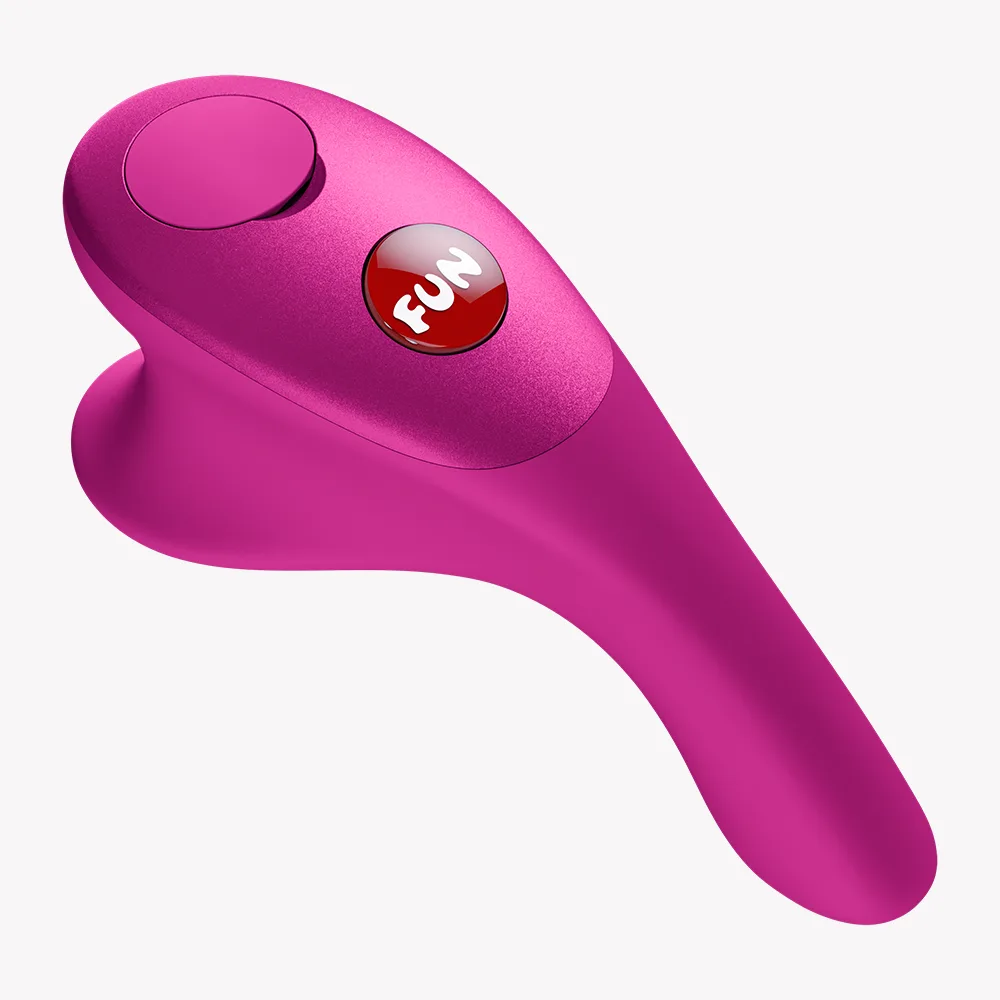
Same product in magenta — EAN 4255821800162.
29 July 2026
Review · Finger vibrator · Two motors
Fun Factory's smallest couple vibrator reviewed against the manufacturer’s own specifications, quick guide, and price data from four Swedish stores. Two motors in a housing weighing 28 grams, four speeds plus a random pattern, a 110 mAh lithium-ion battery with USB-C, IPX7 according to IEC 60529 — and documentation that contradicts itself in four points.
The smallest product in the comparison and the only one that keeps your hands free: two motors in a housing weighing 28 grams that sits between your index finger and middle finger without any mounting device. USB-C and IPX7 are clear advantages, and the manufacturer publishes an unusually complete technical specification. What you pay for is a runtime of about 35 minutes, only four speed steps—and documentation where the product page and the quick guide contradict each other regarding runtime, materials, and the charging cable.
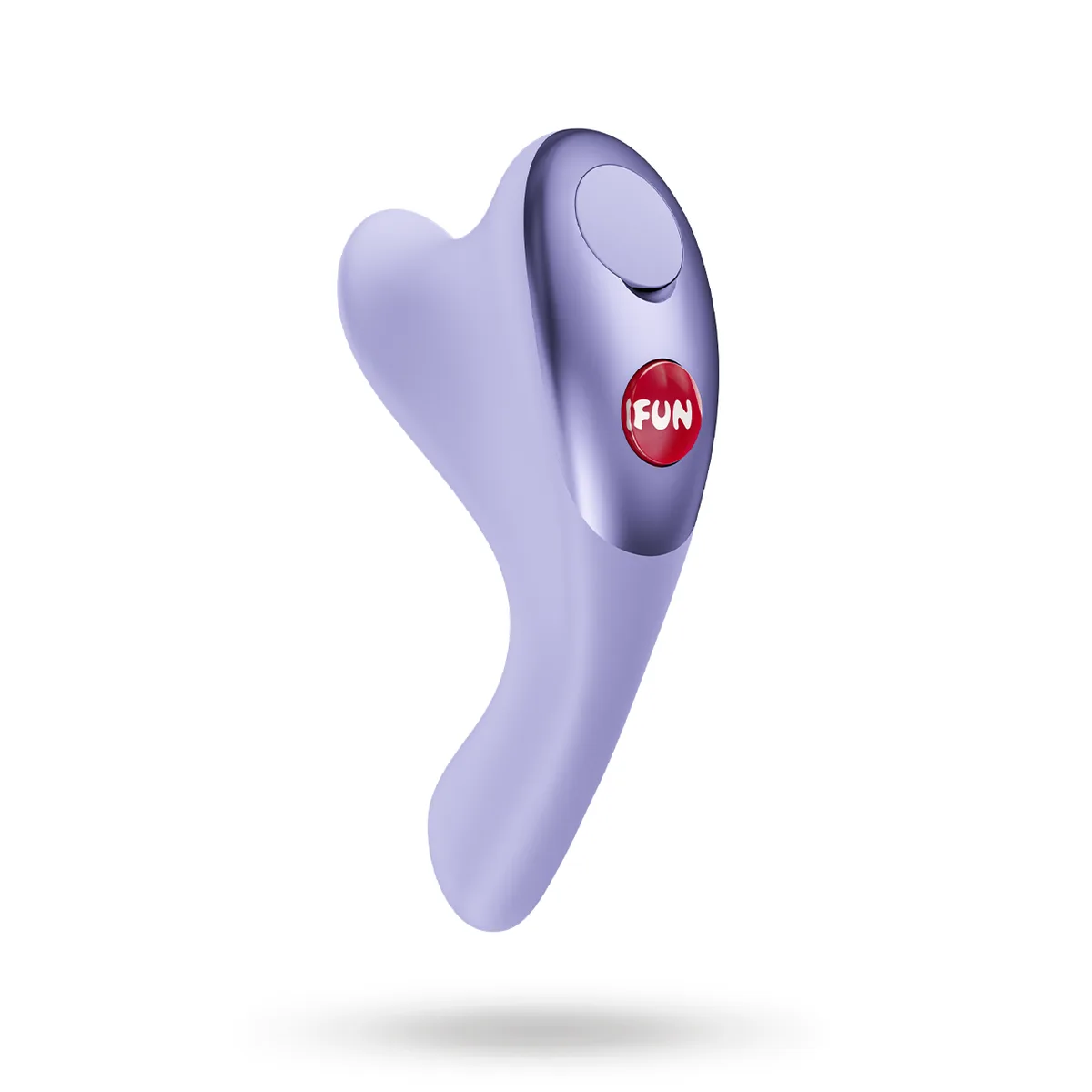
Fun Factory BE·ONE is a finger vibrator, and the category deserves an explanation before the numbers come up. A finger vibrator isn’t held like a pen and isn’t placed against the body like a clitoral stimulator. It’s clamped in place between the index finger and the middle finger, making the whole hand the tool. The manufacturer classifies it itself as a pair vibrator rather than a solo product, and the design language reflects that: a wide, heart-shaped plate resting on top of the fingers, a narrow “snout” running down between them, and a single round FUN button on the top side.
According to Fun Factory, the specification looks like this: two motors, four speed settings plus a fifth random rhythm program, touch lock, enclosure protection rating IPX7, charging via USB-C, and battery status indication in the button. The size is stated as 7 × 2 centimeters and the weight as 28 grams. According to the manufacturer’s quick guide, the battery is a 3.7-volt lithium-ion battery with 110 milliampere-hours. The item number for the purple variant is FF000948PL01.
This review is exclusively about the purple variant with EAN 4255821800148. Fun Factory sells BE·ONE in three colors — purple, black, and magenta — and each color has its own barcode number in the manufacturer’s own variant data: black is 4255821800124 and magenta is 4255821800162. Functionally, they are identical, but the number is the only thing that is certainly different when a store lists all three on the same product page. In Sweden, the purple variant is sold by four stores at prices between 285 and 385 SEK, and three of them had it in stock at the price check on 12 September 2026.
What makes the product interesting to review isn’t the technology itself, but how far apart the manufacturer’s own documentation is. Run time is stated as 60 minutes on the product page and about 35 minutes in the quick guide. Material is listed as body-friendly silicone on the product page and as ABS, PC, and silicone in the quick guide. Length is stated as 7 centimeters by the manufacturer and as 7.3 centimeters by all four Swedish stores. The charging cable is listed as included in the package contents on the product page, but it is explicitly stated not to be included in the quick guide. All of that is clarified below, and in every single case the same rule applies: the manufacturer weighs heaviest, and the discrepancy is written out instead of being evened out.
The technically distinguishing feature is that BE·ONE has two motors instead of one. The manufacturer states two powerful motors both in the bullet list on the product page and as a symbol on the packaging, and describes the function as the vibrations working in a targeted way via two contact points rather than setting an entire finger or the entire hand into vibration.
What this means in practice can be reasoned about based on the design. A vibrator with a single motor has one point where the amplitude is greatest, and the farther away from the motor, the more the movement of the material is dampened. With two motors, one at each end of a small housing, the movement is distributed over two points—which is exactly what the shape is set up for: the wide plate on top of the fingers and the narrow protrusion between them. What can therefore be established is that the design is intended to provide stimulation at two places at the same time, not to deliver more power at one place.
The manufacturer publishes no power specifications for the motors—neither RPM, amplitude, or frequency—and not even any breakdown of the battery capacity between them. What is provided is the capacity for the entire product, 110 mAh, and it is supposed to be enough for both motors at the same time. This is a partial explanation for why the runtime in the quick guide is as short as about 35 minutes: two motors on a battery that is roughly a quarter of the size in the brand’s own Laya III, which is listed as 420 mAh, reduce the runtime by a corresponding amount.
The color choice is cosmetic, but the article number is not. The manufacturer’s own variant data links color, article number, and barcode in a way that makes it possible to check exactly which item a store actually sells:
All four Swedish stores that sell the purple variant either list the barcode 4255821800148 verbatim or use their own article number that is built around it. Sexonic displays the EAN number openly in two fields, Blush Me, and SexleksakerOutlet uses the barcode as its own article number, while Vuxen builds the entire EAN number into its own. It is unusually clear for the product category, and it makes the price comparison unusually reliable—you know that all four stores are talking about exactly the same product in exactly the same color.
A caveat belongs here, though. The manufacturer’s materials use the spellings BE·ONE and Be-One, and Swedish stores alternate between "Be One", "Be·One", and "Beaone". If you search for the name in a store search, it’s worth trying several spellings before concluding that the store doesn’t have it.
The material is the only property of an intimate product that can’t be compensated for through habit or care, and it determines whether the product is still hygienic after five years. Here there’s a difference between what the manufacturer’s product page says and what the manufacturer’s own quick guide says, and the difference isn’t cosmetic.
The product page says "body-friendly silicone" in the bullet list and describes the materials as body-friendly, hypoallergenic, and non-porous. The quick guide is more specific and lists three materials: ABS, PC, and silicone. PC stands for polycarbonate. That means the product isn’t all-silicone; it’s a combination where the silicone is on the outside, and two hard plastics make up the housing and the moving/operating part. Fun Factory’s own FAQ describes the same principle for the entire range: the toys are stated to consist of one hundred percent medical-grade silicone, while the battery housing and the moving/operating part are stated to be made of body-friendly thermoplastic.
This isn’t a criticism of the product. Almost every rechargeable vibrator in this price range is built that way, and We-Vibe lists exactly the same combination — ABS plus body-friendly silicone — for Tango X. But it’s a criticism of the marketing, and it’s worth knowing before you compare the BE·ONE to a product that’s truly silicone all the way through.
Silicone is a non-porous material. A non-porous surface can be cleaned, because there are no microscopic cavities where residue can get stuck. That’s the single most important property of a material that’s meant to come into contact with mucous membranes, and that’s why the material declaration weighs more than almost any other line in a specification. The manufacturer explicitly states that the materials are hypoallergenic and non-porous, and the FAQ adds that the range’s silicone is vegan and halal.
In this specific product, it’s the silicone that meets the body. The wide plate and the sprue between the fingers are silicone-coated, while the small round FUN button and the part around the charging contact are the visible part of the operating part made of hard plastic. The seam between the soft and hard materials is the point that deserves attention during cleaning — that’s where residue collects on all products built this way, regardless of brand.
A property that comes from the silicone surface and matters for this particular finger vibrator is that soft silicone provides friction against the skin. That’s an advantage when the product needs to stay in place between two fingers without a strap or ring, and it’s reasonably likely that’s why the manufacturer can claim it stays put completely without a fastening device. The downside is the usual one with silicone: the material attracts dust and lint in a bag or pouch, and on a light, lavender-colored surface it shows more clearly than on the black version.
Phthalates are a group of softeners used to make plastic—above all flexible PVC—pliable. The Kemikalieinspektionen (Swedish Chemicals Agency) describes them as substances that can affect the endocrine system and make reproduction more difficult, and several of them are therefore restricted or banned within the EU in a large number of products. Intimate products are a recurring category in supervision, precisely because they contain soft plastic that sits against the skin and mucous membranes.
Fun Factory states in its FAQ that all products in the range are free from softeners, BPA, and phthalates. This is a commitment at the range level rather than a declaration on BE·ONE’s own product page, and the difference is worth noting—but it explicitly applies to all products, and the packaging for the lilac variant also carries the symbol for body-safe materials. What can be established is that listing silicone as the material in itself is a better indication than labels like "TPE" or "jelly rubber," which say nothing about which softeners are included. Silicone does not need phthalate softeners to be soft; the softness comes from the polymer’s own structure.
The manufacturer publishes no EU declaration of conformity for BE·ONE, either on the product page or as a downloadable document on funfactory.com. What is documented is the WEEE registration number DE66139642 and the information about the responsible person within the EU—Triple A Import GmbH, Am Lenkwerk 3 in Bielefeld on the product page, and FUN FACTORY Germany GmbH at the same address in the quick guide. Anyone who wants to see the formal declaration must request it from the manufacturer.
The manufacturer states the size as 7 × 2 centimeters and the weight as 28 grams in the specification table. In the manufacturer’s own variant data, the weight is instead listed as 0.026 kilograms, i.e. 26 grams. The difference of two grams is negligible in practice, but it shows that the two figures come from different systems—one is presumably a rounded product weight, the other a shipping weight per item.
The length is more interesting. All four Swedish shops state 7.3 centimeters, while the manufacturer states 7. Blush Me writes 7.30 cm in its feature table, and Vuxen, SexleksakerOutlet, and Blush Me all use the same Swedish descriptive text where 7.3 centimeters is mentioned in the running text. It is therefore not a matter of four independent measurements, but of a shared distributor text that differs from the manufacturer’s rounded 7-centimeter figure. The difference is three millimeters and affects nothing in practice, but it is the shops’ figure, not the manufacturer’s, and it should be reported as a shop statement.
The manufacturer does not publish height separately or the package’s dimensions. What can be determined about the format is that 7 × 2 centimeters and 28 grams place the product at the very smallest end of the category. Compared with Fun Factory’s own Laya III, which measures 107 × 50 × 41 millimeters and weighs 85 grams, BE·ONE is about one third of the weight. Compared with We-Vibe Tango X, which measures 9.98 × 2.29 × 2.43 centimeters, it is shorter but in the same width. It’s a product that fits in an inner pocket, and the manufacturer itself points out that it does not look like a sex toy.
A note about the delivery contents belongs here because it concerns what is actually in the box. The product page’s list mentions three items: the toy, a charging cable without a USB adapter, and a booklet with instructions for use and play ideas. The running text on the same page also mentions a matching case for hygienic transport, but the case is not included in the manufacturer’s own contents list. Count on the toy and the booklet, and treat both the cable and the case as uncertain until you see them in the box.
The interface consists of a single button: the red FUN button on the top side of the control unit. According to the manufacturer’s quick guide, you turn the product on and off with a press of the button for 1–2 seconds. The same button steps between the modes with short presses, and the same button also functions as a charging indicator— the product page explicitly states that charge-status indication is a feature.
It’s a deliberate minimalist interface, and it’s a direct consequence of the format. With 7 × 2 centimeters to build on, there isn’t space for a rocker switch and a mode button next to each other, and the manufacturer has chosen to put all the control into one button instead of shrinking two. The benefit is that you can find it without looking, even when the product sits between your fingers with the underside against your body. The downside is that it can’t jump directly to a specific mode—you have to go through the loop.
The quick guide’s mode diagram shows a closed loop labeled 1 to 5 with arrows in both directions. In practice, that means short presses step upward through the modes, and the loop starts again from the beginning when you pass the last one. The manufacturer specifies the contents of the loop as four speed steps plus one pattern, both in the quick guide’s technical data and in the specification table on the product page, where it says "4 speeds and 1 random rhythm".
It’s worth stopping to consider this, because the marketing says something else in terms of form. The bullet list on the product page and the symbol on the packaging both indicate five programs. It checks out mathematically, but the five are not five equivalent patterns: four of them are intensity levels on the same vibration, and the fifth is a random rhythm program. The manufacturer describes the fifth as a mode that varies strength and speed unpredictably. A comparison based on “number of programs” without looking at what the programs consist of is therefore misleading in BE·ONE’s favor.
What this means in practice is that you have four levels to choose from and a fifth mode that takes over the rhythm for you. There are few steps compared with the category—We-Vibe states eight intensity steps and seven patterns for Tango X, and Fun Factory’s own Laya III is stated to have seven speed steps and three patterns—but it’s also a product with a single button and a motor pair that has to share 110 mAh. Fewer steps here are a result of the format, not a cost-saving.
The manufacturer lists the tangent lock as an explicit function in the specification table and describes it in the marketing text as a guarantee that the product only starts when you want it to. It sounds like a detail and it isn’t. A 28-gram product with a single button on the top side is exactly the kind of item that starts on its own in a bag, and a vibrator that kicks off during a carry-on security check is a problem that a lock function solves cheaply.
The same applies to the battery. With 110 mAh and a stated operating time of 35 to 60 minutes, there’s no room to waste half an hour in a toiletry bag. The tangent lock is therefore just as much a battery function as it is a discretion function. We-Vibe solves the same problem with what they call a travel lock on Tango X, which says something about how the designers in the category see the same thing.
The manufacturer, however, does not publish how the tangent lock is activated—neither the product page nor the mode diagram in the quick guide describes the button combination. The quick guide only shows on/off with 1–2 seconds of pressing and the mode cycle. It’s the only function on the product where the manufacturer’s documentation promises something it doesn’t explain, and anyone who buys it should expect to look it up in the included booklet.
Here the answer has to be honest: Fun Factory publishes no measured decibel value for BE·ONE, neither on the product page, in the quick guide, nor on the packaging. There is no symbol for quiet operation among the six symbols on the cardboard box, and none of the four Swedish stores state anything about sound level either. Anyone who sees an exact dB figure for this model somewhere should ask themselves where it comes from.
What can be established without measuring is that two small motors in a 28-gram housing have some mass to dampen the vibration against. The sound from a vibrator occurs when an unbalanced weight sets the casing vibrating, and the smaller and lighter the casing is, the less material there is that can absorb the movement. It is a fundamental difference from a heavier product like the Laya III at 85 grams, and it indicates that a product in this format is not the quietest solution in a room with thin walls. Without published measurement values from any of the manufacturers, however, the difference cannot be expressed in a number.
A practical tip that applies regardless of model: place the product on a soft surface between uses. A hard tabletop works as a resonance box and noticeably amplifies the sound.
BE·ONE is rated IPX7. The rating comes from the international standard IEC 60529, which defines enclosure classes for electrical equipment. The number 7 in the second position means that the product has been tested for submersion in water to a depth of one meter for 30 minutes. The information is stated in three places in the manufacturer’s own material: in the bullet list on the product page, in the technical data in the quick guide, and as a symbol on the packaging. Fun Factory’s FAQ also formulates the implication for the entire range—all rechargeable toys from the brand are stated to be one hundred percent waterproof.
The difference compared with a splash-proof product is greater than the wording suggests. Splash protection covers water droplets and, at best, water jets, but not submersion. Such a product can handle a damp cloth and possibly a shower, but not a bathtub, and it should not be held under running water without careful consideration of the button and the charging contact.
With IPX7, the entire product can be rinsed off without taking precautions. There is still one caveat, and it says so in the quick guide: the cleaning illustration expressly shows a crossed-out charging contact next to the bathtub. So the cover over the USB-C port must be properly in place before the product is put in water, and it should not be cleaned with the cable connected. If a product has no IPX information at all, it should be treated as not waterproof—having no rating is never a sign that the product is approved.
Rinse off the product in lukewarm water after each use. The quick guide shows cleaning through submersion, together with a symbol for cleaning agent, and Fun Factory refers in its FAQ to a cleaning agent developed for silicone toys. Pay special attention to the seam between the silicone and the operating part and to the edge around the cover over the charging contact—these are the two places where residue collects on a product made of both soft and hard material.
The lube question is unusually clear with Fun Factory, and the answer is unambiguous: water-based. Silicone-based lube should never be used on silicone sex toys, because according to the manufacturer it is difficult to remove completely and makes the product unhygienic despite careful cleaning. The FAQ goes further than most and explicitly warns against oils and creams—tanning oil, sunscreen, lip cerate, essential oils, coconut oil, and all kinds of cooking oils. The manufacturer writes that such products can cause irreversible damage to the control unit and to the entire toy, and that the warranty right can be lost if they are used. This is one of the few warranties in the category where the lubricant choice is expressly linked to the warranty.
The storage instructions in the quick guide state a storage temperature of −5 to +60 degrees Celsius and show the product in a bag, along with a crossed-out image of several toys lying against each other. Silicone surfaces can react with each other over time, and having a dedicated compartment or a dedicated bag is therefore not an exaggeration. The quick guide also addresses when the product should not be used at all: if it has become unusually warm, if it is mechanically damaged or deformed, or if it has changed color. The manufacturer also advises against use on irritated or damaged skin and recommends that piercings and jewelry in the genital area be removed first.
The manufacturer’s quick guide specifies a lithium-ion battery of 3.7 volts with a capacity of 110 milliampere-hours, a maximum charging current of 100 milliampere, and a charging voltage of 5 volts. It’s a small cell even by the category’s standards—Fun Factory’s own Laya III is stated at 420 mAh—and 110 mAh across two motors is the technical explanation for why the runtime is the weakest point in the entire specification.
Via USB-C. The quick guide’s charging picture shows a USB-C connector being inserted into a socket under a foldable cover on the back of the control unit, and the product side lists USB-C in the bullet points. The charging time is stated as approximately 2 hours in the quick guide and as 1–2 hours in the specification table on the product side. During charging, the FUN button pulses; when the battery is full, it lights up with steady light.
Using USB-C instead of a proprietary magnetic charging cable is a real advantage, and it’s worth more than it sounds like. A magnetic charging cable that disappears makes the product unusable until you’ve ordered a new one from the manufacturer. A USB-C cable is in every household. Vuxen writes it plainly in its product text: all Fun Factory products now have USB-C, which means that any standard cable works.
But here is the most concrete contradiction in the entire documentation. The manufacturer’s included-in-delivery list on the product page lists a charging cable without a USB adapter, while the quick guide’s charging image explicitly says that a USB-C charging cable is not included. The Swedish shops lean toward the quick guide’s information: Vuxen, Blush Me, and SexleksakerOutlet all write "chargers not included" and refer to the fact that you can use a cable you already have. The most reasonable interpretation is to read the product page’s "without USB adapter" as meaning that the wall outlet plug is missing, but since the manufacturer’s two own documents contradict each other about the cable itself, you should assume that you need your own USB-C cable. The cost is negligible, but the surprise in the box is not.
The manufacturer lists two different operating times for the same product. The product page’s specification table says 60 minutes, and the quick guide’s technical data says about 35 minutes. Neither source explains the difference, and neither of them states at what intensity the figure applies.
The most likely explanation, based on how the category usually calculates these figures, is that 60 minutes refers to operation at a low setting and 35 minutes refers to operation at full power with both motors running, but that is a reasoned assumption and not a statement from the manufacturer. What can be established is that 110 mAh is a small cell and that the lower figure comes from the more technical of the two documents. Take the quick guide’s 35 minutes as a planning value, not the product page’s 60.
Seen in its context, the figure is still reasonable for the format. Laya III has nearly four times the battery capacity, but it is also stated to last only about 60 minutes, because a larger product has more powerful motors that need to be driven. We-Vibe states up to 2 hours for Tango X with a 90-minute charge, which is the clearest advantage that product has in the comparison. What generally applies to lithium-ion batteries also applies here: capacity decreases with the number of charge cycles, the battery is not replaceable, and the product performs best when it is charged regularly rather than being stored fully discharged. With use a couple of times a week, it is the battery—not the silicone—that sets the limit for how long the product lasts.
We do not have price data from shops in your market yet.
The product page says 60 minutes of operating time. The quick guide says about 35 minutes. Same manufacturer, same product, same week.
Three comparisons are relevant: against the brand’s own best-selling handheld vibrator, against the nearest competitor in the same size class, and against the product’s own sibling variants. All the information below comes from the respective manufacturers’ own specifications.
Laya III is Fun Factory’s own classic in the same category of handheld vibrators, and it is the most illuminating comparison because both come from the same manufacturer with the same documentation standard. Laya III measures 107 × 50 × 41 millimeters and weighs 85 grams versus BE·ONE’s 7 × 2 centimeters and 28 grams. The material is listed as silicone and ABS plastic on the product page and as ABS, PC, and silicone in the quick guide—so exactly the same breakdown as on BE·ONE. Both are IPX7.
The difference lies in the drive. Laya III has a lithium-ion battery of 420 mAh versus BE·ONE’s 110, a maximum charging current of 300 milliampere versus 100, a charging time of about 3 hours versus about 2, and seven speed steps plus three patterns versus four plus one. The runtime is still listed as about 60 minutes for Laya III versus about 35 for BE·ONE, which is a good illustration that a larger cell is used for more powerful motors rather than for longer runtime.
The conclusion is that the two products solve different problems. Laya III is a handheld vibrator that rests in the palm and stimulates a larger area. BE·ONE is a tool for fingertips that is intended to be used together with something else and that does not take up your hand. If you choose by number of modes, battery, and power, Laya III wins. If you choose by format, discretion, and the fact that your hands should remain free, BE·ONE wins—and then the difference in steps and runtime is the price for that.
We-Vibe Tango X is the closest competitor in the same size class and measures 9.98 × 2.29 × 2.43 centimeters—so it is longer but in the same width as BE·ONE. The material is listed as ABS and body-friendly silicone without phthalates, BPA, or latex, which is the same material breakdown as Fun Factory’s quick guide. The enclosure rating is IPX7 for both.
Where Tango X pulls ahead is in operation and control. We-Vibe states up to 2 hours of runtime on a 90-minute charge versus BE·ONE’s about 35 minutes, and seven vibration patterns plus eight intensity steps versus four steps plus one pattern. Tango X also has a travel lock, just like BE·ONE has a button lock, and the charging cable is listed as included—however not the power adapter. The warranty period is stated as two years, which is the same as Fun Factory’s general 24 months for products that are not purchased directly from the manufacturer.
What Tango X is, however, is a finger vibrator. It is an elongated bullet vibrator with a silicone grip that rests in the palm, and it requires that one hand holds it. BE·ONE’s whole point is that it sits between two fingers without a mounting device and leaves your hand free. If that is the feature you’re after, more modes and longer runtime are not an option but a different product. If you want the most function per SEK in a small format, and you can imagine holding it, then Tango X is the better specification on paper.
The other two colors are the same product. The manufacturer’s variant data shows that all three have the same price, the same weight of 0.026 kilograms, and the same article number structure, and they differ only by the color code in the article number and by the barcode. What differs in practice, therefore, is availability and the price in Swedish retail, not the product.
There are two practical consequences of this. The first is that you can compare prices across colors if you don’t care which one you get—if you find magenta or black for less, you get exactly the same technology. The second is the opposite: when a store lists one color but delivers another, it’s the EAN number, not the product name, that determines what you actually ordered. For this page, it’s 4255821800148, and that number appears in all four stores’ article registers.
Four Swedish stores sell the item with EAN 4255821800148. The cheapest is Sexonic at 285 SEK, while the most expensive are Blush Me and SexleksakerOutlet at 385 SEK each. That’s a 100 SEK or 35 percent difference for exactly the same article number, the same color, and the same packaging.
However, the stock situation changes the picture. Sexonic, which has the lowest price, was marked as out of stock in the product flow during the price check. The cheapest store that actually had the item in stock was Vuxen at 289 SEK—four kronor above the lowest noted price and nearly one hundred kronor below the two most expensive. That means the actual price difference between available options is 96 SEK, not 100, and there’s a clear choice to make: Vuxen is 25 percent below the list price of 385 SEK that the other two stores keep.
The price spread doesn’t come from one store selling a different variant. All four list the barcode 4255821800148, either directly or built into their own article number. The difference is about each store’s own margin setting, and about the fact that 385 SEK seems to work as a recommended price in Swedish distribution—Vuxen itself reports 385 SEK as the recommended price and 289 SEK as its own price.
For comparison, the manufacturer’s own European store lists 33.95 euro for the same product, regardless of color. That figure can’t be converted to a Swedish price tag without taking shipping and the exchange rate into account, but it shows that the Swedish prices are in the same ballpark as the manufacturer’s own. The prices in the table above are updated when the stores’ product feeds are updated, but always check the final price at checkout—shipping costs are added by most stores under a certain order value, and in this price range, all four are below the threshold for free shipping.
It’s made for you if you want vibration as an addition to your hands rather than instead of them. That’s the whole idea of this format: the product sits between your index finger and middle finger without a strap or ring, leaving your fingertips free, and the manufacturer classifies it as a finger vibrator for exactly that reason. It’s made for you if you want something small enough to slip into an inner pocket, that charges with the same cable as your phone, and that can be rinsed under the tap without a second thought.
It also suits you if you prioritize material disclosure and documentation. Fun Factory publishes a complete technical specification with battery capacity, charging current, and charging voltage, which is unusual in this price range—competitors often just settle for "rechargeable lithium-ion battery". The fact that the brand also prints out its material policy and its WEEE number makes the product easier to check than most.
It’s not for you if you want lots of modes. Four speeds plus a random pattern is fewer than both Laya III and Tango X offer, and there’s no way around that. It’s not for you if you want a long runtime—around 35 minutes according to the quick guide is short, and 110 mAh is a small cell for two motors. It’s not for you if you shop based on noise level, because the manufacturer doesn’t publish any noise value at all. And it’s not for you if you want a product to use with one hand while your other hand is busy with something else: BE·ONE is designed to work together with your hands, not to replace them.
One last thing belongs in your decision. Considering how much the manufacturer’s own documents contradict each other—runtime, materials, charging cable, pouch—it’s sensible to order from a shop with reasonable returns handling and to check the contents of the box before anything is thrown away. It’s not a reason to skip it, but it is a reason to read the delivery contents one extra time.
The warranty issue needs a clarification, because the packaging and the manufacturer’s FAQ say different things. The purple variant’s box carries the symbol for a 25-year warranty, and Fun Factory’s FAQ confirms that 25 years applies—but only for toys bought directly from Fun Factory, meaning via funfactory.com or the brand’s earlier own stores, and only with proof of purchase. For other Fun Factory toys, the same FAQ states a warranty period of 24 months.
In practice, that means that if you’re buying from any of the four Swedish stores above, you should plan for 24 months—not 25 years—no matter how clearly the symbol is printed on the box. It’s not a small difference, and it’s worth knowing before you pay a premium price with a 25-year warranty in mind.
Read also what the warranty does not cover. Fun Factory states in three places in its FAQ that using oils and creams — sun oil and sun cream, lip care, essential oils, coconut oil and cooking oils — can cause irreversible damage to the control unit and to the entire toy, and that your right to claim under the warranty can be lost if they are used. A silicone-based lubricant is discouraged separately. So it is your choice of lubricant — not just a broken motor — that can determine whether you have a warranty claim you can make.
What applies, on the other hand, are your statutory rights. Under konsumentköplagen (the Swedish Consumer Sales Act), you have a three-year right to complain in the event of defects in the goods, regardless of what the manufacturer promises — and it is therefore longer than Fun Factory’s 24 months for products purchased in retail. For distance purchases, you also have a right of withdrawal for fourteen days under lagen om distansavtal och avtal utanför affärslokaler. Be aware that the right of withdrawal is, in practice, limited for hygiene products that have been removed from a sealed package — but the right to complain in the event of defects applies at all times. If you have questions about what applies in your case, Konsumentverket guides you via Hallå konsument.
Fun Factory Be One finger vibrator Purple is ranked på plats 5 av 14 in mini vibrator best i test, where the entire category is compared against each other using five shared criteria. Guiden vinns av Svakom Echo 2.
Every numerical piece of information in the text can be traced to one of the sources below. The links were checked manually on the specified date.
This page is machine-translated from Swedish. Read the Swedish original