

Review
Review: Satisfyer Pro 2 Next Generation
Cheapest among the widely sold — 219 SEK, IPX7, and a 15-year warranty.
29 July 2026
Review · G-spot vibrator · Vibration and movement function
Pretty Love's Romance Lexie reviewed against the manufacturer's published materials and price data from six Swedish shops. Seven vibration modes, four movement modes of the "come hither" type, 200 millimeters in length, silicone surface and magnetic USB charging — but neither the enclosure rating, battery capacity, operating time, nor warranty period is published by anyone. From 336 SEK.
An inexpensive way into G-spot products with a movement function: seven vibration modes and four movement modes on two independent buttons, a 200-millimeter-long silicone body and magnetic charging, from 336 SEK. What you pay for is the documentation. No enclosure rating is published, which means the product cannot be assumed to be waterproof, and neither battery capacity, operating time, charging time, sound level, nor warranty period is available to read anywhere — not from the manufacturer and not at any of the six shops.
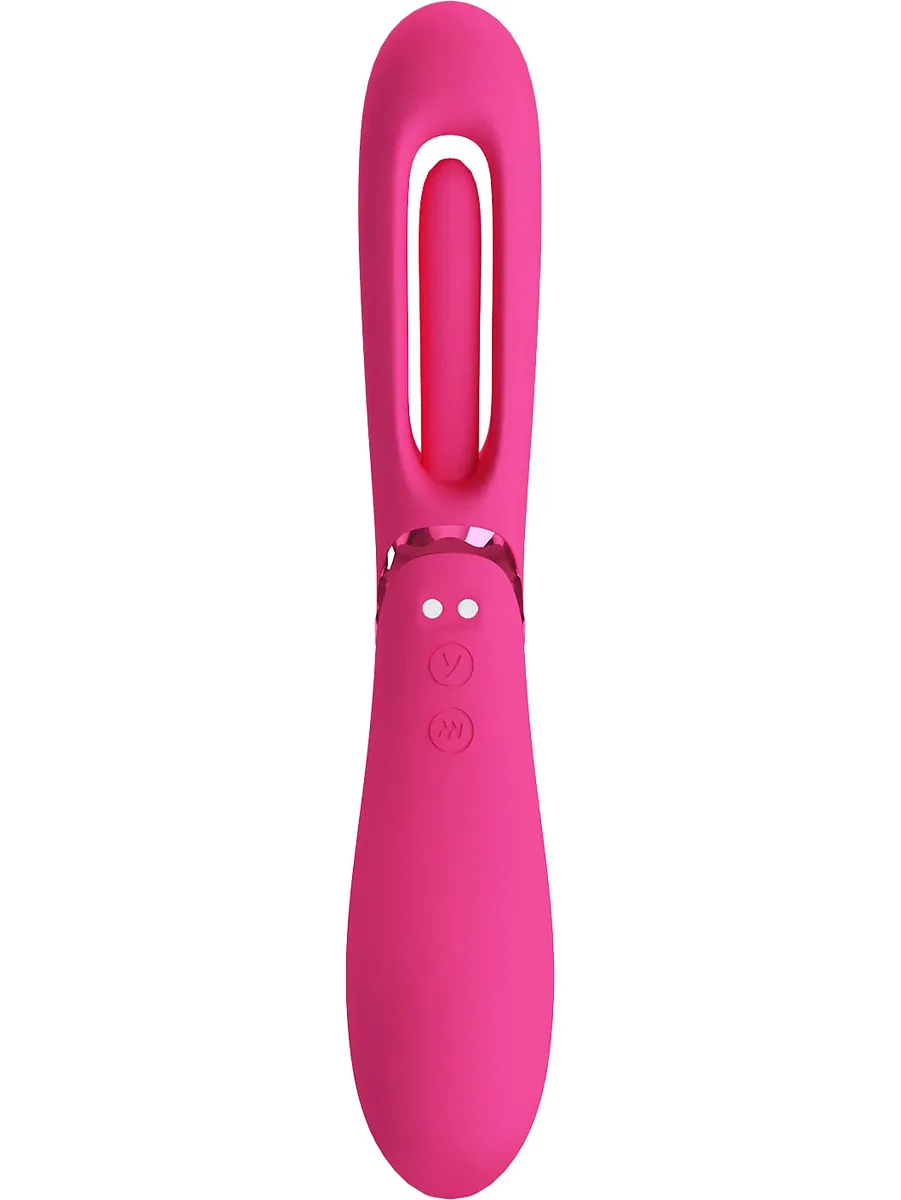
Romance Lexie is a G-spot vibrator that does two things at the same time: it vibrates, and it moves. The movement comes from a flexible tab that sits in a long, narrow recess on the top side of the shaft and waves back and forth toward the G-spot. The manufacturer calls the function wiggling settings on the packaging, Swedish shops translate it as "fladdrande lägen" or "rörelsemönster", and in English-language marketing it’s described as a "come hither" movement.
The specification looks like this, and it’s short: seven vibration modes, four movement modes, two buttons, a silicone surface, magnetic USB charging, and a total length of 200 millimeters. The width goes from 28 millimeters at the head to 37 millimeters at the widest part. It’s basically everything the manufacturer publishes itself, and it’s worth saying plainly right here: there is nowhere to find battery capacity, operating time, charging time, an IPX rating, sound level, or warranty period. We’ll get back to each individual missing detail further down, because missing information is also a message.
This review is about the pink variant with EAN 6937526503538, item number MC63 according to the packaging. Six Swedish shops sell the item for prices between 336 and 395 SEK, and five of them had it in stock when the shop data was retrieved on 29 July 2026. That makes Lexie one of the cheapest routes to a G-spot product with a movement function rather than pure vibration — and that’s what the comparison the entire text revolves around.
A typical vibrator transfers mechanical motion from a motor through the material to the skin. The motion is fast, small, and directionless: it spreads throughout the product and feels like a trembling. The frequency is typically around one hundred oscillations per second — Lelo, for example, lists 100 Hz for its Gigi 2 — and the amplitude is fractions of a millimeter.
A movement function of the kind Lexie has works the other way around: slow frequency, large amplitude, and a clear direction. The flap in the recess bends toward one side and back again, and since the recess sits on the inside of the product’s bend, the movement goes toward the front vaginal wall where the G-spot is located. The manufacturer’s own function graphic illustrates it with two arrows pointing in opposite directions from the flap—exactly the movement pattern you should have in mind.
What that means in practice is that the two functions don’t compete but complement each other. Vibration gives surface stimulation over a larger area; a directed movement gives a pressure that alternates, meaning more of a massage than a trembling. What can be stated is that Lexie has both, and that each has its own button. Seven steps on one and four on the other give 28 combinations, compared with, for example, eight pure vibration modes on Lelo Gigi 2 and twelve on Lelo Ina Wave 2.
It should be said that the movement mechanism differs technically between models. According to the manufacturer, Lelo Ina Wave 2 uses two synchronized motors where the entire inner part bends in a wave motion. Lexie’s solution is simpler: a separate flap in a recess, not a bend of the entire insertion part. You can clearly see it in the manufacturer’s own image straight from the front, where the flap sits like a separate tongue inside the oval opening.
There’s some confusion here that’s worth clearing up before you compare prices, since the shops list the same item under two different brands.
In practice, that means that a search for "Pretty Love Lexie" and a search for "Romance Lexie" lead to different shops but the same product. Check the EAN number if you’re unsure—all six shops in the table on this page list 6937526503538 or their own item number that’s linked to that particular pink Lexie.
An observation that belongs here and colors the rest of the text: it is not possible to find any official product page for Lexie with the manufacturer. Pretty Love’s own product search returns zero hits for the model name, and there is neither a published manual, an EU declaration of conformity, nor a datasheet you can pull information from. Everything that can be substantiated comes either from the manufacturer’s printed materials—dimension graphics, packaging, and functional images that the shops reproduce in their galleries—or from the shops’ own product pages. It’s a real difference compared with brands like Lelo and We-Vibe, which publish the entire specification with dimensions, weight, battery capacity, operating time, charging time, water resistance, and warranty on a single page.
The material issue is the only property of an intimate product that can’t be compensated for through experience or care, and it determines whether the product is still hygienic in a few years. It’s also the only material detail that the shops actually agree on—almost.
Silicone is a non-porous material. A non-porous surface can be cleaned because there are no microscopic cavities where residue can get trapped. It’s the single most important property of a material that will lie against mucous membranes, and that’s why the material line weighs more than almost every other line in a specification.
Four of the six Swedish shops state silicone directly. Joyland writes "silikon" in its spec table and describes the surface as silky and smooth, with the hardness set to medium. Blush Me lists "high-quality silicone". Vuxen writes "skin-friendly silicone material" and SexleksakerOutlet "body-safe silicone". The manufacturer’s own functional graphic has an icon labeled Silicone Material, which is the closest thing to a material declaration that exists in the official material.
Joyme contradicts the others and lists "ABS and silicone". That difference is not cosmetic. If the product contains ABS plastic, the question is where the plastic is located: in the rigid core that holds the motors and the battery, or in a surface that lies against the body. The manufacturer’s pictures provide an indication—the decorative ring in the middle of the shaft appears to be hard plastic with a metallized surface, and that ring sits between the vibrating part and the grip. What can therefore be established is that an all-silicone product of the kind Lelo describes for Ina Wave 2 ("body-friendly silicone, ABS plastic") is not pure silicone either, and that Lexie, at best, is on the same level. The manufacturer never specifies the material breakdown, and the conflict between the shops therefore has to remain unresolved.
However, the detail that deserves the most attention is, however, not the material but the geometry. The recess with the moving flap is a gap all the way around the flap — a narrow slot between two surfaces that move relative to each other. That is the hardest type of surface to keep clean, regardless of material, because water and soap don’t reach into the slot in the same way as on a smooth exterior. Compare it with a completely smooth G-spot vibrator like the Lelo Gigi 2, where the entire insert part is an unbroken surface. It’s a real hygienic difference that follows directly from the design, not from quality.
Phthalates are a group of plasticizers used to make plastic — above all soft PVC — flexible. The Swedish Chemicals Agency describes them as substances that can affect the endocrine system and make reproduction more difficult, and several of them are therefore restricted or prohibited within the EU in a large number of products. This product category is a recurring subject of supervision because it contains soft plastic against the skin and mucous membrane.
No source—neither the manufacturer’s printed materials nor any of the six stores—states that Romance Lexie is free from phthalates, BPA, or latex. This is not the same as saying that it contains them. Silicone doesn’t require phthalate plasticizers to be soft, because the softness comes from the polymer’s own structure, and a product that is declared as silicone is therefore, in itself, a better sign than labels such as "TPE" or "jelly rubber". But it’s a conclusion we draw from the material information, not a commitment the manufacturer makes.
The difference from the competitors is clear and easy to verify. We-Vibe states on the Rave 2 product page that the material is body-friendly silicone manufactured without phthalates, BPA, or latex. Lelo specifies the material composition for both the Ina Wave 2 and the Gigi 2 as "body-friendly silicone, ABS plastic." If you’re allergic to latex or want an explicit declaration, it’s these product pages that give it to you — Lexie’s doesn’t.
What can, however, be substantiated is that the product is CE-marked and UKCA-marked. Both markings are cast into the decorative ring together with the symbol for separate collection of electrical waste, and they can be seen in the manufacturer’s own detail image. The CE marking is the manufacturer’s own assurance that the product meets the applicable EU requirements; it is not a material approval and not a receipt that shows that an external party has tested the product.
The measurements are the best documented part of the entire product, and that’s because the manufacturer itself has created a dimension drawing that the stores publish in their galleries. It states the total length as 200 millimeters, the curved head portion as 85 millimeters from the tip down to the decorative ring, the width as 28 millimeters at the head and 37 millimeters at the widest part of the base. Seen straight from the front, the product is 31 millimeters wide at the top and 35 millimeters at the bottom. The same three measurements — 200, 31, and 35 millimeters — are printed on the back of the packaging.
Blush Me confirms the figures with its own spec table: length 20.00 centimeters, minimum diameter 2.80 centimeters, and maximum diameter 3.70 centimeters. Joyland states 20 centimeters. Three independent pieces of information pointing in the same direction are unusual in this price range and make the measurements the most reliable thing you can plan around.
What do they mean in practice? 200 millimeters is a long product, but that isn’t the insertion depth. The bend and the cutout take up the top 85 millimeters, and the rest is grip. A diameter that varies between 28 and 37 millimeters is also in the middle of the category — Lelo lists 37.09 millimeters as the diameter for Ina Wave 2 and 37.8 millimeters for Gigi 2, which are therefore equally wide at their widest point despite being shorter overall (200 and 163 millimeters, respectively).
The manufacturer does not publish the weight. The retailer Joyme lists 226 grams and the shipping dimensions as 50 × 240 × 100 millimeters, but those figures come from the store’s shipping information and, with all likelihood, refer to the packaged item, not the product by itself. Take them as an upper limit. For comparison, Lelo lists 176 grams for Ina Wave 2 and 79 grams for Gigi 2, both as product weight without packaging. Comparing 226 grams with those numbers would be like comparing apples with packages.
The interface is as simple as it can be when two functions are meant to be controlled independently of each other. Joyland describes it plainly: with the two buttons you choose between seven vibration modes and four fluttering stimulation modes. In the manufacturer’s images, the two buttons appear as embossed symbols in the silicone just below the decorative ring — the upper one marked with a vibration symbol, the lower one with a wave symbol — and above them sit two small LEDs.
That means each function has its own button and its own scale. So you can run motion without vibration, vibration without motion, or any combination of the two. It’s the same principle that means a product with two sliders shouldn’t be compared with a product that has eleven programs: eleven programs means eleven fixed settings, whereas seven times four means 28 combinations plus each function run on its own.
How button presses work in detail — whether a long press shuts it off, whether the scale cycles back after the last step, whether the product remembers the last setting — nothing is published anywhere, because there is no manual to read. It’s one of the more irritating gaps, precisely because it would have been free for the manufacturer to fill.
Seven vibration steps and four movement steps are more than most people use. The pattern in this product category is that the lowest steps are clearly spaced apart, while the top ones are closer together, because the difference per step decreases as the motor approaches its maximum power. Expect that in practice you’ll end up returning to two or three combinations.
What makes this model more interesting than the number suggests is that the movement and the vibration don’t feel like the same thing. A movement on the lowest step with the vibration turned off is a completely different setting than vibration on the lowest step without movement, even though both are at the bottom of their scale. It’s also the argument for having two buttons instead of a single program button that steps through a predetermined list.
The counterargument is just as simple. Two controls take longer to find the right one for than one, and for someone who wants a button and a feel, it’s a disadvantage rather than a feature. Because the buttons are also embossed in the same color as the rest of the silicone, you have to find them with your fingers, not your eyes.
The shape is asymmetrical: a bent, tapered head section of 85 millimeters, the decorative ring with the buttons marking the transition, and then a wider, flattened grip that ends in a rounded base. The angle between the grip and the head is fixed, which means you control the direction toward the body with your wrist.
Two things follow from this geometry. The first is that the cutout with the tab is on the inside of the bend — the same side the head tilts toward — and the product therefore has a clear “right” orientation. The second is that the wide grip provides leverage, which matters when you want to maintain an even pressure at a point rather than moving the product back and forth.
A caveat that comes with a product of this shape: a 200-millimeter vibrator with a bent tip is not designed for anal use, and it also lacks the wide safety stop at the base that anal products should have. None of the sources indicate any other intended use than G-spot stimulation.
The answer is short. No source publishes a decibel value, a measurement method, or even a qualitative description of the sound level for Romance Lexie. The manufacturer says nothing about it on the packaging or in the feature graphics, and none of the six shops mentions sound. Websites that provide an exact decibel value for this model either report their own measurement or a value without a source.
What can be established generally is that a product with two separate driving functions has two separate sound sources, and that a slow-moving mechanism sounds different from a fast vibrating motor—lower in pitch, but with an audible pattern instead of steady background noise. It’s also worth noting that Lelo doesn’t publish any decibel value for Ina Wave 2 or Gigi 2 either, which says something about how little comparable sound data is available in the category, even among manufacturers that otherwise show the most.
A practical piece of advice that applies regardless of model: place the product on a soft surface between uses. A hard tabletop works like a resonance box and noticeably amplifies the sound.
This is the biggest gap in the entire specification, and it deserves its own section. Neither the manufacturer nor any of the six shops specifies an enclosure rating for Romance Lexie, and none of them claims that the product is waterproof either. The packaging has four icons—seven vibration modes, four motion modes, silicone material, and magnetic charging—and water resistance isn’t one of them.
The enclosure ratings come from the international standard IEC 60529. The number after "IPX" indicates which water test the product has been tested against: IPX4 corresponds to water splashing from all directions, IPX6 to powerful water jets, and IPX7 to submersion to a depth of one meter for 30 minutes. So the difference between the classes isn’t differences in degrees of "durability"—it’s different tests with different outcomes.
The point of a rating is that it’s a test result, not a claim. And that’s why the absence of a rating has a clear practical consequence: if a product lacks an IPX rating, it should be treated as not waterproof. Absence is never a sign that the product has been approved. This is especially true for a model like Lexie, where the magnetic charging contact sits exposed in the silicone surface and where there is a movable part with a gap all the way around.
Concretely, that means the product should not be submerged in a bathtub or kept under running water, and that cleaning can be done with a damp cloth. For comparison, Lelo states that both the Ina Wave 2 and the Gigi 2 are 100 percent waterproof, and We-Vibe states IPX7 for the Rave 2 with an express reference to baths and showers. It’s one of the clearest differences between the price categories, and it’s just as much about documentation as it is about construction.
Without an IPX rating, the cleaning routine is more restrictive than it is for a waterproof product. Wipe the product with a damp cloth and fragrance-free soap or a cleaning product intended for intimate products, and be careful with the gap around the moving tab — that’s where residue remains. Pat dry with a clean towel and let it air-dry before putting the product away. Keep the magnetic charging contact dry, and never charge a product that is still damp on the contact surface.
Joyland explicitly recommends a water-based lubricant, and that’s the right answer for a material-technical reason. Silicone-based lubricants should not be used on silicone products — they break down the silicone surface over time and make it porous, and a porous surface can no longer be cleaned properly; it can only be replaced. Oil-based products such as coconut oil leave a film that’s difficult to remove and can also get into the gap around the tab.
Storage: no storage pouch is stated to be included. Lelo indicates a satin pouch in the delivery for both Ina Wave 2 and Gigi 2, and it’s that kind of detail that sets the price tiers apart. Store the product dry and separately from other silicone products, since silicone against silicone can leave marks over time.
The charging is one of the few technical details that are actually documented, and it’s documented unusually clearly — the manufacturer has an image of the cable, labeled "Magnetic charging".
With a magnetic charging cable. The manufacturer’s image shows a white cable with USB-A on one end and a round two-pin magnetic head on the other, and Joyland indicates in its product text that you charge it "via the magnetic USB cable". Blush Me, Vuxen, and SexleksakerOutlet all state that the product is rechargeable via USB, and Joyme specifies magnetic USB charging.
Magnetic charging is a trade-off, not a pure advantage. The advantage is that no opening in the housing is needed, which is a prerequisite to even be able to make a product watertight. The disadvantage is that the cable is product-specific: if you lose the charging cable, no standard USB-C cable will work, and since there is no manufacturer-side page to order spare parts from, it is, in practice, a matter of finding a magnetic cable with the correct pole spacing from a third party, or of buying a new product. This is a clear difference from Lelo, which includes a regular USB cable in the package for both the Ina Wave 2 and Gigi 2.
That the cable ends in USB-A rather than USB-C is also worth noting. It means you need a charger or a computer with USB-A ports, or an adapter. For a product that’s purchased in 2026, that’s an anachronism, even if a cheap one that solves the issue.
No source provides the battery capacity in mAh, its voltage, how long the product lasts on a charge, or how long it takes to charge. Stores write “rechargeable via USB” and nothing more. The manufacturer’s packaging and functional graphics mention only “Magnetic Charge.”
It’s worth noting how big the difference is compared with the competitors, because this is information that is normally available. For both the Ina Wave 2 and Gigi 2, Lelo states a lithium-ion battery of 520 mAh at 3.7 volts, a charging time of two hours at 5.0 volts and 500 milliamps, and an operating time of up to two and four hours, respectively. Lelo also lists a standby time of up to 90 days and automatic shut-off after 20 minutes. That level of disclosure makes it possible to convert operating time into power draw and to compare how heavily the cell is loaded between models. For Lexie, none of those calculations can be made.
What generally applies to rechargeable products in this category naturally also applies here: capacity drops with the number of charging cycles, the cell is fixed inside a molded silicone body, and it isn’t replaceable, and the product does best when it’s charged regularly rather than stored completely discharged. With use a couple of times a week, it’s the battery—not the silicone—that sets the limit for lifespan—and since it can’t be replaced, the product is, in practice, used up once the cell is done.
One final practical consequence of the missing operating-time information: charge fully before you plan any longer use, because you don’t have a figure to plan around. It sounds trivial, but it’s the only sensible way to handle an unknown battery capacity.
We do not have price data from shops in your market yet.
Seven vibration modes and four motion modes are printed on the box. Runtime, charging time, and water resistance don’t.
Three comparisons are relevant: against the product that does the same thing at the highest price and with the best-documented information, against the simple G-point vibrator without a motion function, and against a model that shows what a published ingress-protection rating is worth. All the information below comes from each manufacturer’s own specifications.
Lelo Ina Wave 2 is the closest equivalent on the market, and the similarity starts with the dimensions: Lelo lists 200 × 65 × 45 millimeters, meaning exactly the same overall length as Lexie at 200 millimeters. The insertion part is listed as 110 millimeters and the diameter as 37.09 millimeters, compared with Lexie’s 85 millimeters for the bent head part and 37 millimeters at its widest. Two products of effectively the same size, with the same basic idea.
Then everything else differs. Ina Wave 2 uses, according to Lelo, WaveMotion technology with two synchronized motors where the entire insertion part bends in a wave motion — not a flap in a cutout. It has twelve settings compared with Lexie’s seven plus four, weighs 176 grams, is made of body-friendly silicone and ABS plastic, is powered by a lithium-ion battery of 520 mAh and 3.7 volts that charges in two hours and provides up to two hours of runtime, is 100 percent waterproof, and is delivered with a USB cable, a satin pouch, a manual, and a warranty card. The warranty is two years plus a ten-year quality warranty.
The conclusion is uncomfortable but straightforward: Ina Wave 2 isn’t just a more expensive product, it’s a documented product. Every number above can be found on the manufacturer’s own page. For Lexie, corresponding figures are not provided at all. If you want the motion function at the lowest possible price, Lexie is the way there; if you want to know what you’re buying, it isn’t.
Gigi 2 is the second extreme: a G-point vibrator with no motion function at all. Lelo lists 163 × 35 × 42 millimeters, insertion part 95 millimeters, diameter 37.8 millimeters, and weight 79 grams — so it is 37 millimeters shorter than Lexie and significantly lighter. Eight vibration modes, frequency 100 Hz, lithium-ion battery 520 mAh at 3.7 volts, two-hour charging time, up to four hours of operating time, up to 90 days of standby time, automatic shut-off after 20 minutes, and 100 percent waterproof.
The comparison is instructive precisely because Gigi 2 lacks what Lexie has. Four hours of operating time on a simple product is more than most people need, the smooth insertion part is significantly easier to clean than a cutout with a moving flap, and it is waterproof. What Gigi 2 can’t do is move. So the question becomes whether the motion function is worth giving up waterproofing, a published operating time, a smooth surface, and a warranty — or whether you’d rather put the money into a simple product that does one thing and documents it.
We-Vibe Rave 2 is a G-spot vibrator in the premium class, and it’s brought here for one purpose only: We-Vibe states IPX7 and explains what it means—that the product can be used in bath and shower. The manufacturer also states a two-year warranty, app control via the We-Vibe app, and adjusting intensity with plus and minus buttons.
The point is not that Rave 2 would be a reasonable alternative in the same price range. The point is that IPX7 is the only wording that gives you a tested indication about water, and that it costs money in that sense in that it only exists among the manufacturers that invest resources in testing and documentation. When you choose Lexie, you’re choosing that away. It can be completely rational—but it should be a choice, not an assumption.
Six Swedish stores sell the item with EAN 6937526503538. The cheapest was Joyland at SEK 336, and the most expensive was Vuxen, Blush Me, and SexleksakerOutlet at SEK 395 each during the price check on July 29, 2026. That’s SEK 59—or just under 18 percent difference—for the exact same item number and the same color—an appreciably tighter spread than in most comparisons we make, which usually indicates that the product is distributed through a single wholesaler.
The inventory situation was also unusually good: five out of six stores had the product in stock when the store data was retrieved. The only exception was Sexonic at SEK 376, which was thus right in the middle of the price range but sold out. That means that the difference between the cheapest and the second-cheapest available store was SEK 13—Joyland at SEK 336 and Joyme at SEK 349. At that level, it’s the shipping terms—not the product price—that determine what you actually pay.
The prices in the table above are updated when the stores’ product feeds are updated, but always check the final price at checkout. Shipping costs are added at most stores under a certain order value, and in this price range all six stores are likely to be below the threshold for free shipping—which can completely change the order among the cheapest options.
It’s for you if you’re curious about what a motion function adds beyond vibration, but you don’t want to spend premium money on finding out. It’s for you if you want two independent controls rather than a list of pre-set programs. It’s for you if you know that you prefer a longer product with a solid grip—200 millimeters overall, 37 millimeters at the widest—and who plans to use it with a water-based glide lubricant.
It doesn’t fit you if you want to be able to use the product in the shower or in a bathtub, because no IP rating is published and the product therefore can’t be assumed to be waterproof. It doesn’t fit you if you want to know how long the battery lasts before you buy it. It doesn’t fit you if you require a material declaration for phthalates, BPA, and latex. It doesn’t fit you if you want to charge it with the same cable as your phone—the charging cable is both magnetic and USB-A. And it doesn’t fit you if you want a manufacturer manual to look up when something goes wrong, because there is none.
One more thing belongs in the decision. It’s easy to read a text like this as a verdict on the product, but what it’s primarily a verdict on is the documentation. Seven vibration modes and four motion modes for 336 SEK is a reasonable offer in itself. The problem is that you buy it without knowing how long it lasts, how robustly it’s built, or what you get if it breaks—and for some, it’s a perfectly acceptable price to pay in order to get into a product category that otherwise starts several hundred SEK higher up.
No source states any manufacturer warranty for Romance Lexie. Neither the packaging, the function graphic, nor any of the six retailers’ product pages mentions a warranty period. It’s a clear difference from the competitors: Lelo states two years of warranty plus a ten-year quality warranty for both Ina Wave 2 and Gigi 2, and We-Vibe states two years for Rave 2.
What does always apply, however, are your statutory rights—and they are stronger than many think. Under the Swedish Sale of Goods Act (consumentköplagen), you have three years of right to complain for defects in the item, regardless of what the manufacturer promises or fails to promise. The right to complain is directed at the seller—i.e., the store you bought it from, not the manufacturer in China—and it applies to defects that existed in the item when you received it, even if the defect becomes apparent only later. So the lack of a manufacturer warranty doesn’t reduce your protection against manufacturing defects.
For distance purchases, you also have a 14-day right of withdrawal under the Act on Distance Contracts and Contracts Outside Business Premises. Be aware that, in practice, the right of withdrawal is limited for hygiene items that have been removed from a sealed package—Konsumentverket (the Swedish Consumer Agency) describes the exception and when it may be applied. The right to complain about defects, however, always applies. If you have questions about what applies in your case, Konsumentverket guides you via Hallå konsument.
A concrete tip that follows from this product’s documentation situation: save the receipt and the packaging. With the article number MC63 and EAN 6937526503538 on the box, you have the only two identifiers that exist, and they’ll be needed if you ever need to file a complaint about a product whose manufacturer has no published product page.
Romance Lexie Vibrator Pink isn’t included in any ranking yet. In best i test guides, the entire categories are compared against each other using five shared criteria, with what was left out shown.
Every numerical piece of information in the text can be traced to one of the sources below. The links were checked manually on the specified date.
This page is machine-translated from Swedish. Read the Swedish original