

Review
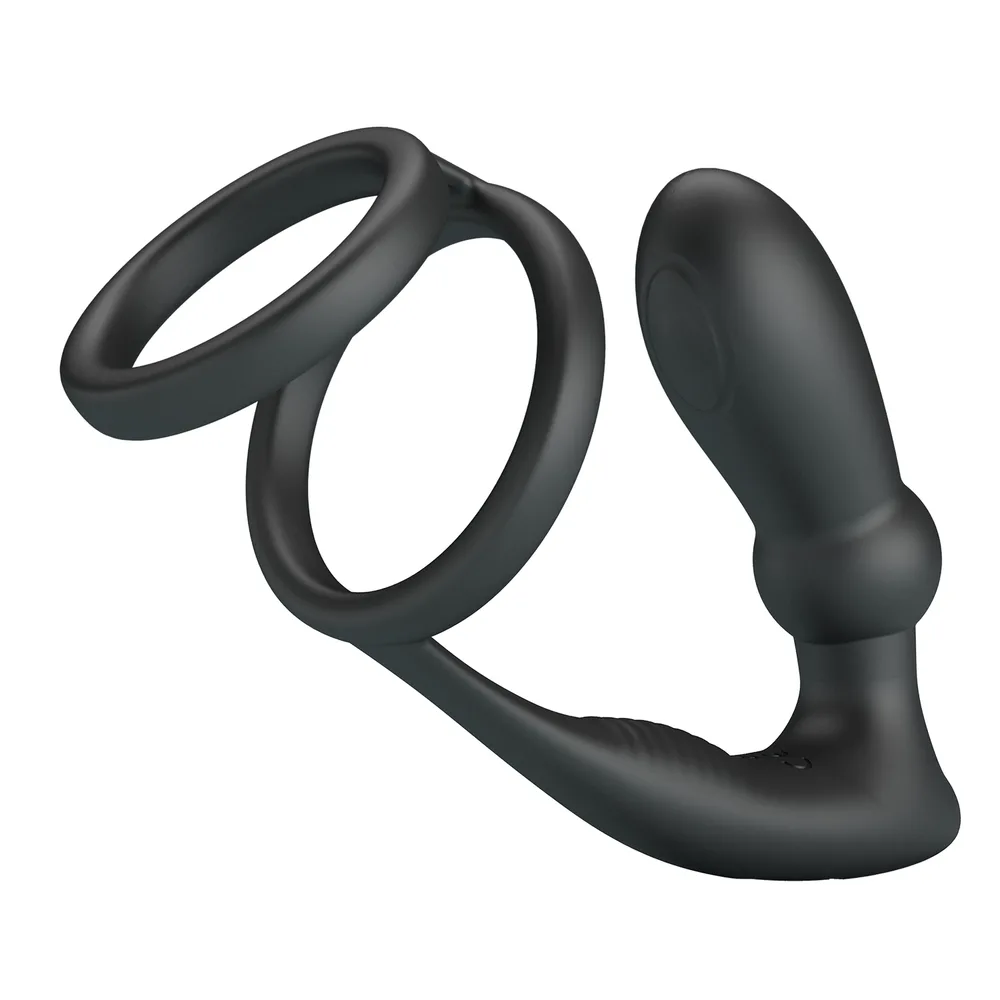
Review: Pretty Love Emoni Cock Ring With Butt Plug
Same design without a remote control — but with published ring measurements.
29 July 2026
Review · Prostate vibrator · Penis ring with remote-controlled plug
Rebel’s combined penis and ball ring with a prostate plug and a perineum vibrator reviewed against the manufacturer’s own specifications and price data from five Swedish shops. Two motors with ten settings each, a remote control with an eight-meter range, six published dimensions and a weight of 112 grams — but neither runtime, charging time, battery capacity, nor a materials declaration is published, and the IPX7 icon on the packaging is contradicted by the manufacturer’s own user manual.
An unusually well-thought-out design for a reasonable price: two motors set separately, a remote control that is actually included, and six published dimensions that make it possible to assess the fit in advance. What you pay for is the data sheet. Neither runtime, charging time, battery capacity, sound level, material distribution, nor warranty is published, and the manufacturer’s packaging and user manual contradict each other regarding waterproofing.
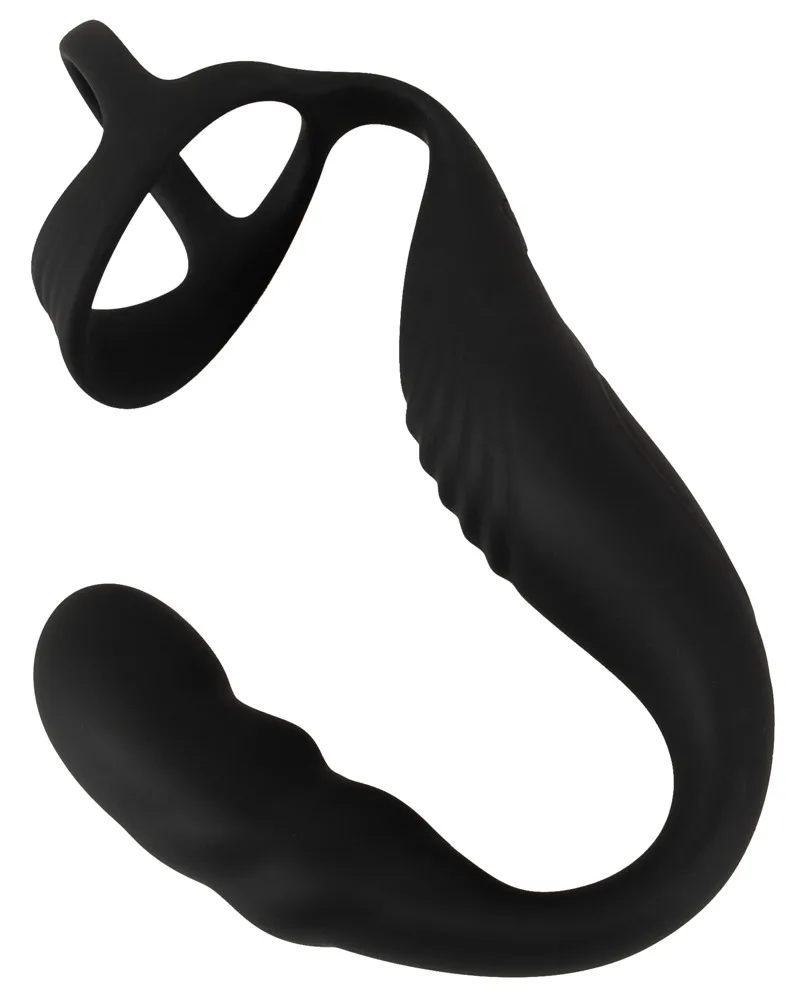
Rebel Cock Ring with RC Prostate Plug is not a product but three parts that fit together into a single unit: a stretchable penis ring, a stretchable scrotum ring, and a bent arm that runs backward between the legs, carrying a vibrating perineum stimulator on the outside and ending in a vibrating prostate plug on the inside. The construction is integrated, which means the plug cannot slip out of position and the rings simultaneously exert a backward pull that keeps it in place.
The specification looks like this according to the manufacturer. The plug is 9.5 centimeters long with an insertion length of 8.5 centimeters and a diameter that increases from 1.0 to 2.9 centimeters. The perineum step is 12 centimeters long and 3.6 centimeters wide. Both the penis ring and scrotum ring measure 3.7 centimeters in diameter in the resting position and are stretchable. The entire unit weighs 112 grams. The material is listed as silicone, PU, and ABS. Two separate motors sit in the construction—one in the prostate plug for internal stimulation and one in the perineum stimulator for external stimulation—and each of them has ten vibration settings. Control is either on the underside of the perineum part or with the included wireless remote control, which the manufacturer states has an eight-meter range.
This review is about the item with EAN 4024144451036, which at the manufacturer has item number 5402280 0000. The number is worth keeping track of, because Rebel sells another product with an almost identical name—more about that further down. In Sweden, the item is listed by five stores at prices between 599 and 829 SEK, and two of them had it in stock when the price data was retrieved on July 29, 2026. The manufacturer’s own list price in the German store is 74.95 euro.
The single most important line in the specification is that there are two motors in the product and not one. It sounds like a detail but it changes the entire product type. A typical combination of a penis ring and an anal plug has one motor somewhere in the construction and lets the vibrations propagate through the silicone to the rest. Here, the manufacturer states one motor in the plug and one in the perineum stimulator, with ten settings each.
In practice, this means that internal and external stimulation can be set separately. You can run the plug high and the perineum part low, or vice versa, or turn off one of them completely. What can be established purely in numerical terms is that ten positions times ten positions give one hundred possible combinations — but you should read that figure with caution, since the manufacturer does not publish what those ten positions are, meaning neither how many of them are fixed intensities and how many are pattern-based, nor which frequencies are used. But the store descriptions only refer to them as "vibration modes" respectively "steps", and that difference isn’t trivial: ten evenly increasing intensities are something entirely different from three intensities plus seven pulse patterns.
The manufacturer also doesn’t state which of the two motors is the strongest, or whether they’re equally strong. On a product where one motor is supposed to drive vibrations through an insert part and the other is supposed to work against the perineum area via a flat surface, that’s a relevant piece of information that is simply missing. What is provided are the structures: the plug has a wave profile and a marked ball tip directed toward the prostate, while the perineum stimulator has knurling on the underside. Joyland describes the surfaces using the same three words — knurled, silky-smooth, and wavy.
This is where the most common mix-up in the entire product family happens, and it’s worth its own section because the two articles are sold side by side and differ by three letters in the name.
So the differences are real and go in different directions. The Butt Plug model is more expensive from the manufacturer, has a thicker plug — 4.0 versus 2.9 centimeters — but only one motor, no perineum stimulator, and a shorter remote-control range. The Prostate Plug model is cheaper, narrower, and has the other motor plus two extra meters on the remote control. If you want external stimulation of the perineum area, only this model provides that. If you want the largest diameter, it’s the other one. Check the item number or the EAN number before you pay — the names aren’t enough to tell them apart in a store listing.
The material question determines whether an intimate product can still be cleaned after a few years, and it is the only characteristic that neither habit nor care can compensate for. The manufacturer lists three materials for this item: silicone, ABS, and PU. The same three materials are given for the sister item, and two of the Swedish shops repeat them — Lustly writes "Silikon, PU, ABS" and Vuxen writes "ABS + Silicone".
Silicone is a non-porous material. Non-porousness is the decisive feature of anything that is meant to lie against the mucous membrane, because a surface without microscopic cavities can actually be cleaned — there is nowhere for residue to get stuck. That the contact surfaces are silicone is therefore the most important single feature in the entire materials lineup.
The other two materials deserve an explanation. ABS is a hard thermoplastic and is used practically always for the electronics housing — the button panel, the motor casing, and the remote control’s shell. PU, polyurethane, shows up in this type of construction most often as a flexible core or a conductive layer inside the arm that is meant to hold its shape but still bend. The manufacturer does not specify which material sits where, and it is a real gap in a product whose point is that part of it is inserted into the body. What can be established is that the manufacturer’s own product photos show a unit with an entirely matte black silicone surface, and that both the manufacturer and Mshop use the term Soft Touch — which, on the packaging, is listed as one of eight icons.
The construction has a practical consequence that’s worth mentioning. Since the rings, the steps, and the plug sit together as one piece, there are no seams between different parts where dirt can collect, unlike combinations where a ring and a plug are connected with a strap or a clip. On the other hand, nothing can be taken apart for cleaning, and the button panel on the underside of the perineum part is the point where the electronics meet the surface.
Phthalates are a group of plasticizers that make plastic, above all soft PVC, flexible. Kemikalieinspektionen describes them as substances that can affect the hormone system and make reproduction more difficult, and several of them are restricted or prohibited within the EU in a long list of products. The sex toy product category is repeatedly subject to oversight precisely because it contains soft plastic against skin and mucous membranes.
Here, the conclusion must be blunt: the manufacturer publishes no declaration about phthalates, BPA, or latex for this item, neither on the product page nor in the customer information. The only thing that appears in the manufacturer’s safety text is the general instruction to read the information on the packaging to avoid allergic reactions, with latex mentioned as an example. It is a reference, not a commitment.
The retailer Mshop, however, writes "phthalate-free" in its product text. That information should be read as a store claim and nothing else, because the manufacturer does not write it itself. Where a shop and a manufacturer say different things, the manufacturer carries more weight, and where the manufacturer says nothing at all, a shop cannot fill the gap for it. Objectively speaking, the risk is low — silicone does not need phthalate plasticizers to become soft, because the softness comes from the polymer’s own structure — but the difference between "low risk" and "declared by the manufacturer" is exactly the difference this site exists to explain and present.
The manufacturer’s dimension list is unusually detailed for the price category, and it is the strongest part of the entire datasheet. Six measurements are given: the plug’s total length is 9.5 centimeters, the insertion length is 8.5 centimeters, the plug’s diameter is 1.0 to 2.9 centimeters, the perineum step’s length is 12 centimeters and width is 3.6 centimeters, and the diameters of both rings are 3.7 centimeters each. The weight is stated as 112 grams. All six measurements are repeated verbatim by Vuxen and Lustly, which is a good sign — the store stream is based on the manufacturer’s own text and not on guesses.
There is still one deviation, and it should be reported. Vuxenkul states the insertion depth as 9 centimeters where the manufacturer writes 8.5. The difference is half a centimeter and is reasonably due to rounding or to the store having taken the plug’s total length of 9.5 centimeters and rounded down. The manufacturer’s specification is this: 8.5 centimeters goes in; 9.5 centimeters is the entire plug’s length.
The manufacturer does not publish the packaging dimensions. Mshop lists them as 18 × 13 × 5 centimeters, with a packaging weight of 0.21 kilograms. This is a store claim, but it is useful for two reasons: it confirms that the product comes in a flat cardboard box of the same kind as shown in the manufacturer’s packaging photo, and the difference between 0.21 kilograms and the product’s 112 grams gives an idea of how much the cardboard, remote control, and cable weigh together.
The dimensions also say something about who the product is built for. A maximum diameter of 2.9 centimeters is a medium-groove anal plug—significantly narrower than Rebel’s own Butt Plug model at 4.0 centimeters—and an insertion length of 8.5 centimeters is short enough that the tip ends up in the zone where the prostate can be reached, but not deeper. The ring size of 3.7 centimeters in the resting position is the measure that matters most of all for whether the product can be worn, and it comes up again in the section about fit further down.
The manufacturer’s own user manual describes the order: the penis ring is placed over the penis, the scrotum is pulled through the scrotal ring, and the prostate vibrator is gently inserted into the anus, after which the perineum vibrator rests against the perineum. The vibrations are controlled either directly on the underside of the perineum part or with the remote control. The manufacturer recommends water-based lubricant and states explicitly that it provides both easier insertion and better transfer of the vibrations.
Two instructions in the manufacturer’s safety text are worth highlighting because they rarely appear in the store texts. The first is that the product should be switched on before it is inserted, not after. The second is the general anal instruction: gently stretch the ring muscle beforehand, go slowly, use plenty of lubricant, and never force anything against resistance. The manufacturer also points out that there are two muscle rings that the product must pass, and that the person who encounters resistance should take a pause instead of increasing pressure.
The remote control is the feature that most clearly justifies the price difference versus simpler combination products. The manufacturer states the range as 8 meters and explicitly describes that control can therefore be handled by a partner. The same figure also appears as its own icon on the packaging—"8 M"—and is repeated by all Swedish stores that publish the information.
Eight meters is a practical range, but not an impressive one. It works within a room and for much of a normal-sized apartment, but not through multiple walls. For comparison, Rebel’s own Butt Plug model states 6 meters, so two meters less, while We-Vibe Vector+ solves the same thing with both remote control and an app and therefore, in practice, has no distance limit when the app is used. The manufacturer does not state which technology the remote control uses—either frequency bands, output power, or whether it uses Bluetooth or a simpler radio link. The only thing that is published is that the product meets the Radio Equipment Directive 2014/53/EU, which in itself confirms that it is a radio transmitter and not an optical link.
The remote control is powered by a CR2032 button cell battery that is included, while the product itself is charged via USB. It’s a common and reasonable solution: the button cell lasts a long time in a transmitter that only sends short commands. Still, count on it needing to be replaced at some point during the product’s service life, and note that the manufacturer does not state whether the remote control is water-resistant. Describing the product as waterproof says nothing about the transmitter, and on comparable products the remote control is regularly the part that must not be dipped.
Cock rings are the product category where the fit matters the most, and where a single measurement determines whether the product works or not. The manufacturer states 3.7 centimeters in diameter for both the cock ring and the ball ring in the relaxed position, and that both are stretchable. That corresponds to a circumference of just under 12 centimeters in an unstretched position.
What can be established is that 3.7 centimeters is a measurement in the middle of the category: it’s wider than the narrowest silicone rings, but clearly narrower than the rings that are marketed as roomy. how far the material stretches before it becomes uncomfortable, the manufacturer does not publish, and there is also no information about the rings’ width or material thickness either—two measurements that Pretty Love, for example, lists for its corresponding product, where the rings are stated to be 8 millimeters wide with inner diameters of 38 and 43 millimeters respectively.
A general piece of advice that applies to all cock rings and that no manufacturer can measure for you: a ring should sit firmly but never cause pain, should never be worn for more than about thirty minutes in a row, and should be removed immediately at numbness, discoloration, or cold. This applies here to at least the same extent, because the design also pulls backward when the plug is in place.
The plug is designed to stay in place rather than to be moved back and forth. The manufacturer describes the ball tip as being directed toward the P-spot and the wave profile as an extra stimulating structure, and emphasizes that the rings keep the plug in position so that it neither slips in nor out. That’s exactly the kind of construction that makes the product portable for longer periods, which the manufacturer itself highlights as a benefit.
The measurements point to a beginner-to-intermediate anal option: 2.9 centimeters at most and 8.5 centimeters in is manageable for most people who have tried anal before, and the conical shape from 1.0 centimeter means that insertion starts narrow. Someone who already uses a thicker prostate massager will, on the other hand, find it thin. That’s where Rebels own Butt Plug model at 4.0 centimeters is a more logical choice, if you can do without the second motor.
These are the desk review’s most important findings, and they must be presented plainly, because the manufacturer’s own documents conflict.
On the product side, the manufacturer states that the product is waterproof and that it works in the bath, pool, and shower. On the packaging, “WATERPROOF IPX7” is one of eight icons, together with VIBRATION, FLEXIBLE, REMOTE CONTROL, 8 M, SOFT TOUCH, 2 MOTORS, and RECHARGEABLE. The stores follow suit: Mshop writes “100 % waterproof,” Joyland and Vuxenkul write waterproof.
The manufacturer’s customer information for the exact same item number says something else. In the Swedish text, both under “Innan första användning” and under “Skötselråd”: “Do not immerse the device in water!”, as well as “Make sure that no water gets into the battery compartment to prevent damage to the device”. The same wording is used in the English and German versions, and it remains in both the 05/2025 edition and the 02/2026 edition.
How should this be read? The most reasonable assumption is that the customer information is a standard document that Orion uses for its entire range, including products with a battery cover, and that the text therefore is not written specifically for this article—which has neither a battery compartment nor an open charging contact. But the document is named after the article, it is linked from the article’s own product page, and it is the only instruction a buyer gets in the package. What can be established is that the manufacturer publishes no IP rating in any of its technical documents—IPX7 appears only as a printed icon on the carton.
Enclosure classes are defined in the international standard IEC 60529. The X in the first position means that protection against solid objects has not been tested or is not reported. The number 7 in the second position means that the product has been tested for immersion in water to a depth of one meter for thirty minutes. A product with IPX7 can therefore be rinsed under running water and left in a sink.
The difference versus a splash-proof product is greater than the wording suggests. Splash protection covers drips and, at best, jets, but not immersion. Our practical recommendation here is therefore more cautious than the packaging: rinse the product under running water and wipe it dry, but avoid putting it in the bathtub as long as the manufacturer’s own written instruction says that it should not be immersed. The remote control must be kept dry regardless, since no information at all is published for it.
The manufacturer’s instruction is to clean the product after each use with warm water and mild soap, and to disinfect it with a product intended for that purpose. Let it cool and dry before putting it away; store it clean, cool, and dry, and avoid direct sunlight. The manufacturer also recommends that the product be stored separately and not together with products made of other materials, since materials can react with each other—an instruction that is especially relevant for silicone.
The question of lubricant has one clear answer and one that doesn’t tolerate deviations: use only water-based lubricant. The manufacturer states it on both the product page and in the instructions for use, with the justification that silicone-containing lubricants can damage the material. The reason is chemical: silicone-based lubricant breaks down the silicone surface over time and makes it porous, and a porous surface can no longer be cleaned properly—only replaced. Oil-based products such as coconut oil also leave a film that’s difficult to remove. On a product that is meant to be inserted anally, this isn’t a cosmetic issue.
According to the manufacturer, the delivery includes the product with a remote control, a USB charging cable, and a CR2032 battery for the remote control. The manufacturer’s own product photos show a charging cable with USB-A on one end and a two-pin magnetic contact on the other, and one image shows the cable connected to two metal pins on the underside of the perineum part, right next to the keypad.
With the included cable, which attaches magnetically to the contact pins. The solution has a clear advantage: it doesn’t require an opening in the housing, which is the technical prerequisite for being able to claim any kind of water resistance at all. The disadvantage is equally clear and applies to all products with this design—the cable is product-specific, and if you lose it, no regular USB-C cable works as a replacement. The manufacturer doesn’t sell the cable separately on the article’s product page, and no spare-part listing is published.
An instruction from the manufacturer’s safety text belongs here: the product should only be charged with an appropriate charger connected to a wall outlet, and if it turns off automatically when the battery is low, it should be charged instead of being turned back on again. The manufacturer also mentions that, for transport safety reasons, lithium batteries are normally delivered charged to only 40–50 percent, which means the first charge should be done before the product is used.
Here you’ll find the largest gap in the entire datasheet, and it should be stated clearly: the manufacturer does not publish run time, charging time, battery capacity in mAh, or battery voltage for this product. The information is missing both on the product page and in the two versions of the customer information, and none of the five Swedish retailers fills the gap—each of them only states that the product is USB-rechargeable.
That’s a noticeable difference from what the competitors report. We-Vibe states up to two hours of run time, ninety minutes of charging time, and the rating 3.7 V 0.32 A for Vector+. Without corresponding information, it’s not possible to convert run time to power consumption or to compare how hard the cell is loaded—and on a product with two motors, the run time also depends on how you use it, because two motors at full power draw more than one.
The general rule still applies, though. Lithium-ion cells lose capacity with the number of charge cycles; the battery in this type of product is molded in and not replaceable, and the product does best when it’s charged regularly rather than being stored completely discharged. With use a couple of times a week, it’s the battery—not the silicone—that sets the limit for lifespan.
One last piece of information that isn’t published and that buyers often ask about: the sound level. Neither the manufacturer nor any of the retailers provide a decibel value, and the packaging has no “quiet” icon. So there’s no measurement that can be reported. The only general thing that can be established is that two motors running at the same time can’t be quieter than one of them running alone, and that a product worn against the body under clothing dampens the sound more than one that lies freely.
We do not have price data from shops in your market yet.
The packaging states IPX7. The manufacturer’s own user manual for the same item number says "Do not immerse the device in water!". There is no IP rating mentioned in any of the technical documents.
Three comparisons are relevant: versus the cheapest path to the same design, versus a premium product for prostate massage, and versus Rebels own article with a nearly identical name. All the information below comes from each manufacturer’s own specifications.
Pretty Love Emoni, item number BI-210341, is the closest direct competitor in design: also a combined penis-and-cock ring with a fixed-mounted vibrating anal plug. The manufacturer lists the net weight as 98 grams versus Rebels 112, the function row "12 vibration functions 12 thrusting settings Memory function", the material as silicone, and the power supply via USB.
The differences that matter go both ways. Emoni has more options on paper—twelve vibration modes plus twelve thrusting modes and a memory function that starts the product in the most recently used mode—and Pretty Love also lists two measurements that Rebel doesn’t: the inner diameters of the rings, given as 38 and 43 millimeters, and the width of the rings, 8 millimeters. Rebel, in return, has two separate motors instead of one—an outer perineum stimulator that Emoni lacks completely—and, above all, a wireless remote control, which Emoni doesn’t have—Pretty Love’s own functional diagram shows a single button on the underside of the perineum arm.
The datasheets are about equally thin at the bottom: none of the manufacturers publishes runtime, charging time, battery capacity, IP rating, or sound level. If you choose based on the number of modes and the listed ring measurements, Emoni wins. If you choose based on remote control, two independent motors, and external stimulation, Rebel wins.
We-Vibe Vector+ isn’t the same design—it has no penis ring—but it’s the obvious comparison point for anyone who wants remote-controlled prostate stimulation with two motors and is wondering how much it’s worth paying. The manufacturer’s list price is 139 euros versus Rebel’s 74.95 euros—so almost double the price.
What the extra money buys can be itemized point by point, and almost everything comes down to the data they list. We-Vibe states runtime of up to two hours per charge, charging time ninety minutes, and the built-in lithium-ion battery’s rating 3.7 V 0.32 A. Rebel publishes nothing at all there. We-Vibe provides a two-year manufacturer’s warranty; Rebel publishes no warranty at all. Vector+ also has both remote control and app control, while Rebel only has the remote control—and its eight meters.
What Rebel has that Vector+ lacks is the penis and scrotum ring—the erection support and the retainer that keeps the plug in place—plus the outer perineum stimulator. These are two entirely different product ideas: Vector+ is a prostate massage wand with documented numbers; Rebel is a combination harness with two motors and a thin datasheet. If the numbers matter to you, the price difference is justified. If the design matters to you, then the Vector+ route just isn’t an option.
The sister item 0550728 0000 costs 79.95 euros from the manufacturer—so five euros more—and differs in four points: one motor instead of two, ten modes instead of 2 × 10, a six-meter range instead of eight, and a plug with a 4.0-centimeter diameter instead of 2.9. The material specification is identical—silicone, PU, and ABS—and both have the same CR2032-powered remote control.
The conclusion is simple. If you want a thicker plug, the Butt Plug model is the only one of the two that delivers that. If you want external stimulation of the perineum, a second motor you can set separately, and a two-meter longer reach, the Prostate Plug model is both cheaper and more equipped. That the more expensive of the two has fewer functions is unusual enough to be worth knowing before you choose based on the name.
Five Swedish shops list the item with EAN 4024144451036. Cheapest in the list is Lustly at 599 SEK, and most expensive are Vuxen, Mshop, and Vuxenkul, all at 829 SEK. That’s a 230 SEK or 38 percent difference for the exact same article number.
The stock status completely changes the picture. Only two of the five shops had the item in stock when the price data was retrieved on July 29, 2026: Joyland at 676 SEK and Mshop at 829 SEK. Lustly’s 599 SEK was therefore a price for an item the shop couldn’t deliver. The difference between the two available options is 153 SEK, which is the price difference you can actually act on.
A couple of things are worth knowing about this particular type of price spread. Shops that list a product as sold out often still have an old price in the feed, and that price is rarely the one that applies when the item comes in again. Also, three of the five shops that list exactly 829 SEK suggests it’s the distributor’s recommended price, and that 599 and 676 SEK are promotional prices rather than regular prices. The manufacturer’s own list price of 74,95 euro sits in the same ballpark as the Swedish 829 kronor, which strengthens that interpretation.
The prices in the table above update when the shops’ product feeds are updated, but always check the final price at checkout. At most shops, shipping is added for orders below a certain order value, and in this price range, several of them are below the threshold for free shipping.
It’s for you if you want both internal and external anal stimulation while the penis and scrotum are held by two rings, and if you want to be able to set the two zones independently of each other. It’s for you if you want to be able to hand over control to a partner in the same room — eight meters is enough. It’s for you if you’re looking for a medium-thick plug measuring 2.9 centimeters, with a short insertion length of 8.5 centimeters, and if you want to be able to carry the product for six instead of holding it. And since the manufacturer publishes six dimensioned measurements, you can determine the fit in advance instead of guessing, which is more than what most in this price range offer.
It doesn’t fit you if you want to know how long it runs on a charge, how long it takes to charge, or how big the battery is—none of that is published. It doesn’t fit you if you require a written material declaration from the manufacturer about phthalates, BPA, and latex; it doesn’t exist. It doesn’t fit you if you want to bathe with the product without doubts, because the packaging’s IPX7 icon and the user manual’s “do not immerse the device in water” contradict each other. And it doesn’t fit you if you want a thick plug—2.9 centimeters is a modest diameter in this product class.
One more thing belongs in the decision. The product is charged with a product-specific magnetic cable, which means that a misplaced cable in practice can take the product out of commission. It’s worth placing the cable in a specific spot starting from day one, and it’s an argument for choosing a store based on how easy it is to contact rather than based on the last twenty or so kronor.
The manufacturer does not publish any voluntary warranty for this item, neither on the product page nor in customer information. That in itself is a piece of information worth noting, because several competitors do it—We-Vibe, for example, offers a two-year warranty on Vector+. The responsible person for the product is listed as OV-Großhandel in Flensburg, and in the customer information the manufacturer assures that article 5402280 0000 complies with Directive 2014/53/EU on radio equipment.
There is, however, a note to make. The customer information refers to www.orion.de/zertifikate for the complete EU declaration of conformity, but article 5402280 0000 is not included in that list as of the inspection date. So the declaration as such is issued according to the document, but it can’t be read at the place the manufacturer itself points to. It’s a formal error rather than a safety problem, but it’s precisely the kind of issue that’s hard to verify afterwards—and therefore worth printing.
What always applies, on the other hand, are your statutory rights—and they’re stronger than most manufacturer warranties. Under the Swedish Sale of Goods Act (konsumentköplagen), you have three years of right of complaint for defects in the goods, regardless of what the manufacturer promises or chooses not to promise. In distance purchases, you also have a fourteen-day right of withdrawal under the Distance Contracts and Contracts Outside Business Premises Act (lagen om distansavtal och avtal utanför affärslokaler). Be aware that in practice the right of withdrawal is limited for hygiene products that have been removed from a sealed package—but the right of complaint for defects always applies. If you have questions about what applies in your case, Konsumentverket guides you via Hallå konsument.
Rebel Cock Ring with RC Prostate Plug is ranked på plats 11 av 15 in prostate vibrator best i test, where the entire category is compared against each other using five shared criteria. Guiden vinns av Svakom Iker Neo.
Every numerical piece of information in the text can be traced to one of the sources below. The links were checked manually on the specified date.
This page is machine-translated from Swedish. Read the Swedish original