

Review
Review: We-Vibe Sync Go Purple
C-shaped couple vibrator with IPX7, a 90-minute runtime, and a two-year warranty.
29 July 2026
Review · Prostate vibrator · Anal and vaginal stimulation
The sex toy that combines an anal plug and a flexible vaginal shaft, reviewed against the manufacturer’s own specifications and price data from five Swedish stores. Two independent motors, ten vibration and pulse modes, wireless remote control, platinum-cured silicone, and IPX7 — but only one hour of operating time and a specification with multiple blank rows.
The only one in the comparison that stimulates anal and vaginal stimulation at the same time, with two independent motors and a physical remote control that does not require an app. The materials section is unusually clear — platinum-cured silicone, explicitly zero tolerance for phthalates, TPE, latex, and nickel. What you pay with is one hour of operating time, a product-specific magnetic charging cable, and a specification where battery capacity, sound level, charging time, insertion length, and the remote control’s range are all missing.
Rocks-Off Cocktail is a sex toy that tries to solve a problem that most products in the category skip. A typical dual-action rabbit vibrator is placed between two bodies and stimulates the clitoris and G-spot during intercourse. Cocktail does something else: it combines an anal plug with a flexible shaft, and it stays in place so both parts work at the same time while penetration is happening. The manufacturer describes the product as designed to stimulate the anus and vagina while the penis is stimulated during sex.
The specifications look like this. Rocks-Off lists materials as silicone and ABS plastic, a lithium-ion battery, ten vibration and pulse levels, two powerful and independent motors, magnetic USB charging, 100% water resistance, and a runtime of one hour. Product dimensions are given as 66.5 × 114 × 33.5 millimeters, and the product weight is 131 grams. A wireless remote control is included. In Sweden, the item is sold by five stores at prices between 509 and 699 SEK, and two of them had it in stock at the price check on September 12, 2026.
This review is exclusively about the black variant with EAN 811041014587, the manufacturer’s item number 10COTLBK. The number has been verified against the retailer Sexonic, which lists the exact barcode under the name Rocks-Off Cocktail Plug Remote Control Black, and it matches the item number 10COTLBK for the same black model listed by Vuxens. An international retailer outside our list, Tradeinn, links the same barcode to a page titled Purple. This is a discrepancy worth knowing about if you compare prices across borders, but the manufacturer’s own item number ends with BK and points unambiguously to black.
The term "dubbla motorer" is used loosely in this product category. It sometimes means two motors that sit at opposite ends but are controlled by the same program, which in practice is one motor with two placements. Rocks-Off explicitly states that Cocktail has two powerful and oberoende motors, one in the plug and one in the flexible shaft.
What can be established is what independent motors make possible purely in technical terms. When two motors can be run in different modes, you can put the emphasis on one part without the other following along. An anal plug and a vaginal shaft stimulate completely different tissue, and the intensity that works in one place is rarely the one that works in the other. On a product with a shared control, you have to compromise. You don’t do that here.
The downside is just as concrete. Two motors that can run at the same time draw more current than one, and the operating time of one hour should be read in that light. The manufacturer publishes no information about whether the hour applies to both motors on the highest setting or to one motor on the lowest setting, which is a recurring weakness in the reporting of this product and something we return to under the battery section.
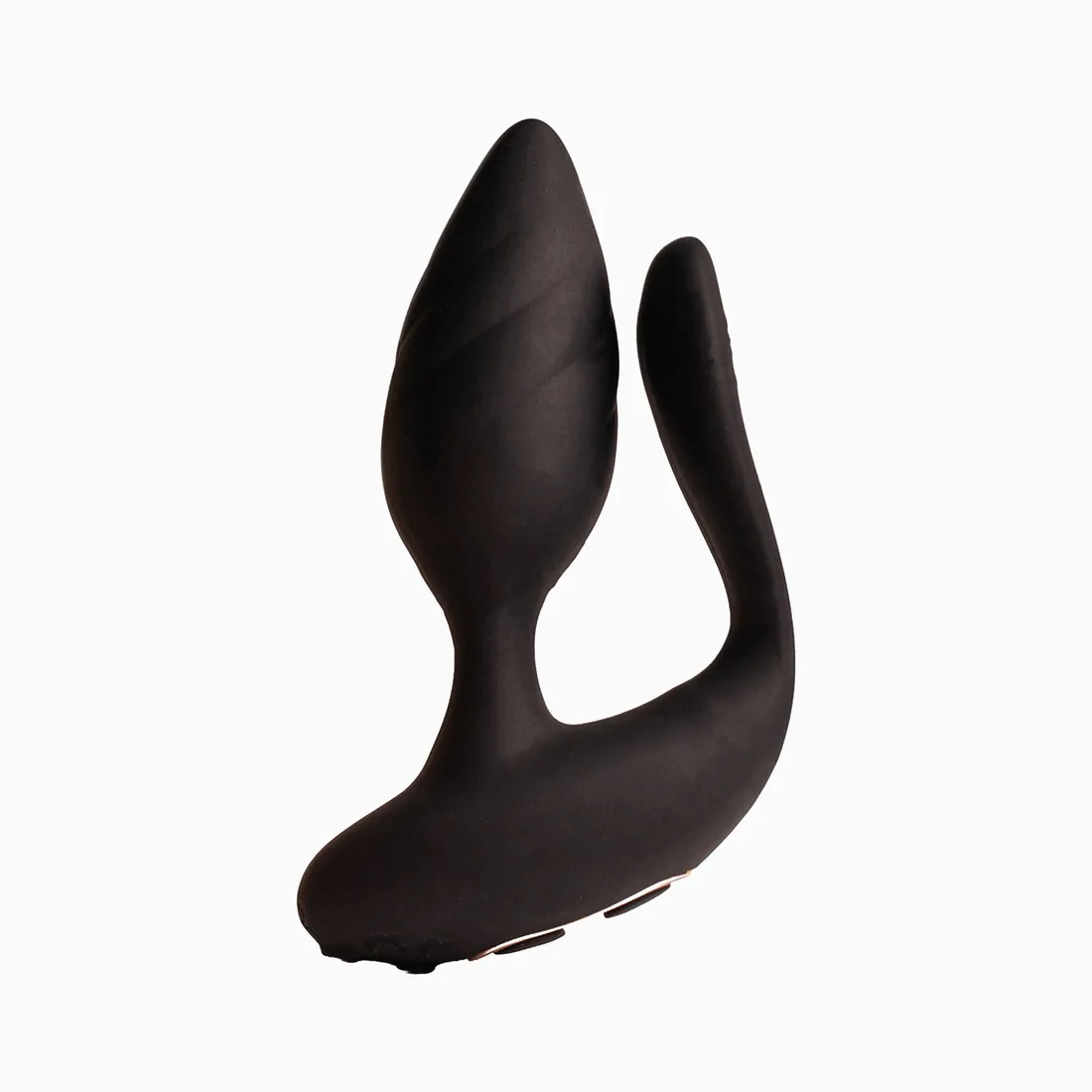
The product consists of three functional parts that are joined together in one piece. The first is a fixed, contoured plug with a tapered tip. The second is a narrow neck under the plug, which is the detail that makes an anal plug stay in place instead of gliding. The third is a flexible shaft that bends forward and is positioned vaginally, with a connection running down to the base where the buttons are located.
Rocks-Off describes the construction as a fixed, contoured plug with a narrow neck that sits close to the body, and a flexible shaft that slides in and stimulates with every deep vibration. The retailer Joyland describes the surface in more detail than the manufacturer does and lists it as bumpy, ridged, and silky with a medium-firm consistency. Vuxen describes the texture as ribbed and the elasticity as pliable. The fact that two different shops describe the same surface structure gives the information some reasonable weight, but it does not come from the manufacturer and should be read as a shop’s statement.
The construction has a safety-related consequence that matters more than it sounds like. A product intended to be inserted anally must have something that makes it impossible to lose, and here it is the base with the buttons and the forward-bent shaft that form that safeguard. So it isn’t a loose plug but a continuous body where a large part is always located outside. That is the design that the category requires, and it is fulfilled.
What the manufacturer does not state is how much of the product is actually inserted. Rocks-Off writes plainly in its specifications that circumference and insertion length are not given. It’s an unusually honest wording, but it still leaves the buyer without the piece of information that matters most for the fit. Joyland fills the gap with a shop statement: penetrative length 9 centimeters and diameter 3.1 centimeters. That figure is not the manufacturer’s, and it should be treated accordingly.
Material is the only property of an intimate product that cannot be compensated for through habit or care, and on a product that is used anally and vaginally by two people at the same time, it matters more than usual. Rocks-Off specifies two materials for Cocktail: silicone and ABS plastic. It’s the same combination that the retailers list—Joyland writes ABS plastic and silicone, and Vuxen writes Medical Grade Silicone.
Silicone is a non-porous material. A non-porous surface can be cleaned because there are no microscopic cavities where residue can get trapped. It’s the single most important property of a material that’s meant to lie against mucous membranes, and that’s why the material declaration weighs more heavily than almost all other lines in a specification.
Rocks-Off goes one step further than most and specifies what kind of silicone they use. On their materials page, the manufacturer states that the silicone is platinum-cured and describes it as the cleanest form of silicone because it does not produce toxic chemical byproducts in the same way as peroxide- and tin-cured silicone. The manufacturer also states that the material can withstand high temperatures and can be sterilized.
That’s a relevant clarification, because “silicone” in itself is not a guarantee of any particular level of purity. The curing method determines which residual products remain in the material, and platinum-cured silicone is the variant used in the medical and food industries. That a manufacturer of intimate products actually states which curing they use is unusual, and it’s one of the stronger arguments for this particular brand.
ABS plastic also deserves a comment, because it’s often presented as a budget material. Rocks-Off states that they use premium ABS and describes the plastic as chemically inert—meaning it does not react with other chemicals and therefore can be used together with lubricants without breaking down. ABS is hard, non-porous, and odorless, and it’s a material that buttons, charging contacts, and electronics housings normally are made from. The problem with combined materials isn’t the materials themselves, but the joint where they meet—and that joint is here in the base, which is the part that’s easiest to access during cleaning.
Phthalates are a group of plasticizers used to make plastic—above all, flexible PVC—pliable. The Swedish Chemicals Agency describes them as substances that can affect the endocrine system and make reproduction more difficult, and several of them are therefore limited or banned within the EU in a large number of products. Intimate products are recurring objects of supervision precisely because the category includes flexible plastic against skin and mucous membranes.
Rocks-Off states on its materials page that it applies zero tolerance for phthalates and extends this to also include TPE and thermoplastic elastomers. It is a sharper wording than the industry average, because TPE is precisely the material that is otherwise used to make soft products cheaply without saying anything about which plasticizers are included. Vuxen repeats the information in its Swedish product data using the wording body-safe and free from phthalates.
Two additional pieces of information belong here. The manufacturer states that latex does not occur anywhere in their factories, which eliminates the risk of cross-contamination—relevant for anyone who is allergic to latex, since latex allergy causes reactions on the mucous membrane faster than on ordinary skin. Rocks-Off also states that nickel is not used, referring to the fact that nickel allergy occurs in a significant portion of the population. Neither of these statements is specific to Cocktail; both apply to the range as a whole and are found on the manufacturer’s own materials page.
The manufacturer also addresses electromagnetic compatibility with pacemakers as part of its safety work. It’s an unusual claim to find in the marketing of an intimate product, and it’s worth noting because the product is charged magnetically and therefore contains magnets. However, Rocks-Off does not publish any measurement or certificate that supports the claim for this specific model.
Rocks-Off lists the product measurements as 66.5 × 114 × 33.5 millimeters. The 114-millimeter dimension is the product’s longest extent, i.e. just under 11.5 centimeters, and that matches Joyland’s store information about a length of 11.5 centimeters. The 66.5-millimeter width refers to the product’s total overall extent with the forward-bent shaft, not the plug’s thickness. Joyland lists the diameter separately as 3.1 centimeters, which is close to the manufacturer’s third measurement of 33.5 millimeters.
Joyme reproduces the manufacturer’s measurements verbatim—66.5 × 114 × 33.5 millimeters—which is a good sign: when a store copies the manufacturer’s numbers instead of making up its own, you can trust that the product is the same. So it’s three independent sources pointing to the same size, which is more than you normally get in this category.
The weight information is more messy, and it deserves a note. Three different weights circulate for the same item, and only one of them is the manufacturer’s product weight. Rocks-Off’s specifications list 131 grams, expressly as Product Weight. At the same time, the manufacturer’s own product data lists 0,203 kilograms—so 203 grams—but that field is a shipping weight and includes packaging, the remote control, and the charging cable. Joyme lists 200 grams in its weight field, along with the package dimensions 30 × 130 × 165 millimeters, which confirms that the 200-gram figure is a package weight and not the product’s.
The conclusion is simple but worth stating out loud: the product weighs 131 grams, and the whole delivery comes to a little over 200 grams. The 131 grams are a low weight for a product that’s supposed to stay put during movement, and that in itself is an argument—a heavy plug pulls downward and requires more of the neck to stay in place. For comparison, Lelo lists 42 grams for the Tiani 3, but that product is also significantly smaller and lacks an anal part.
The package dimensions, on the other hand, are not the manufacturer’s figures. The 30 × 130 × 165 millimeters stated come from Joyme and are the store’s shipping measurements. Rocks-Off does not publish any packaging dimensions for the Cocktail.
Rocks-Off lists ten vibration and pulsing levels. The wording is more important than it looks: it’s not ten intensity steps, but ten modes in which both constant vibration and pulsing patterns are included in the same count. Vuxen uses the same breakdown in Swedish and writes ten powerful vibration and pulsing levels, and Joyland phrases it as ten vibration and pulsing modes.
Control is handled in two ways. The product has buttons in the base—the manufacturer’s own product image shows two round buttons with a gold-colored inset on the underside—and a wireless remote control is included. Vuxen states that the remote control has two push buttons, which is a store detail, but it matches the picture of the remote control in the manufacturer’s product photos.
The start sequence is the same across the entire Rocks-Off range and is stated on the manufacturer’s care page: the power button must be held down for three to four seconds for the product to start. It’s a deliberate travel safety feature—the manufacturer writes that they don’t want vibrating luggage. Joyland and Joyme both list three seconds for both start and shutdown. So it’s not a malfunction if the product doesn’t react to a short press; that’s how it’s designed.
The remote control is the product’s main selling point, and it is also the part where the manufacturer’s documentation is the thinnest. Rocks-Off states that the product is controlled with a remote control and that it keeps your hands free, and Joyland specifies that the vibration modes can be adjusted separately for the two motors via the remote control. That the modes can be set independently is a shop claim that makes logical sense given the manufacturer’s own wording about two independent motors, but Rocks-Off doesn’t state it themselves.
What can be established is why a remote control matters more for this particular product than for a handheld vibrator. When the product is in place during sex, the buttons are practically out of reach, and anyone who wants to change the mode otherwise has to pause. The remote control also shifts control—you can keep it with your partner, which is a functional difference and not just a convenience.
Rocks-Off does not publish the remote control’s range, its frequency band, or how it is powered. None of the five Swedish stores lists any of that either. This is a noticeable gap, because the range determines whether the remote control works from the other side of the room or only at arm’s length, and because the power source determines whether you need to have button-cell batteries at home. For comparison, Lelo lists a wireless range of up to twelve meters for Tiani 3 and also clearly states that two AAA batteries for the remote control are included in the package. That difference in reporting is significant, and it can’t be explained away.
Ten modes is a common number in this price range, and it’s also roughly what most people use. The pattern in this product category is that the first modes are constant vibrations with increasing strength, while the later ones are patterns—pulses, waves, and intervals. Rocks-Off does not publish a breakdown of which of the ten modes are constant and which are pulsing, and none of the stores does either.
In practice, that means you don’t know how many pure intensity steps the product has until you have it up and running. If the distribution follows the category’s usual pattern—about three or four constant strengths and the rest patterns—the number of usable intensity levels is lower than the figure ten suggests. This isn’t a criticism of this specific model—it applies to almost the entire segment—but that’s the reason why a mode count is a weak comparison metric. We-Vibe, for example, lists ten intensity levels for Sync 2 and then keeps intensity and patterns separate in its own reporting.
One more thing worth knowing before buying: since the two motors are independent, the number of combinations is significantly higher than ten. How many exactly can’t be determined without knowing whether both motors have all ten settings, and the manufacturer doesn’t indicate that. That’s why we don’t provide any combination number here—this is exactly the kind of figure that other sites guess at.
Rocks-Off does not publish any decibel value for Cocktail, either on the product page or in any other official material. None of the five Swedish stores either indicates a measurement value. There is therefore no sourced figure to report, and every number you find on other sites is either its own measurement or a value without a source.
What can generally be established is that the sound level of a two-motor product depends on how many are running at the same time and at what level. A product intended to be worn inside the body is also dampened by tissue in a way that a handheld vibrator doesn’t, which in practice lowers the perceived sound level during use compared with the same product lying on a table.
The comparison with Lelo is once again unforgiving toward Rocks-Off. For the Tiani 3, Lelo gives both a maximum sound level of 50 decibels and a vibration frequency of 125 hertz. It’s exactly the kind of data that makes two products comparable, and the fact that Rocks-Off does not provide it is one of the clearest reasons why the rating for this model is downgraded in the reporting rather than in the design.
A practical tip that applies regardless of model: place the product on a soft surface between uses. A hard tabletop works like a resonance box and noticeably amplifies the sound.
Rocks-Off states that Cocktail is 100 percent completely waterproof. Joyme repeats the claim in Swedish, and Vuxen links it to the design with the wording that USB charging takes place with magnetic contact for 100 percent waterproofing. Joyland states that the product is completely waterproof and can be used in the shower and bath.
Here the source location must be stated exactly, because it differs from how most manufacturers do it. The product page for Cocktail does not state any IP rating at all—it only says "100 % fully waterproof". The information about IPX7 is instead on the manufacturer’s care page, where Rocks-Off writes that all of their toys are 100 percent IPX7 waterproof and can be submerged for play in the bath. It’s therefore a range statement from the manufacturer, not a product-sheet-specific classification.
The rating comes from the international standard IEC 60529, which defines enclosure ratings for electrical equipment. The number 7 in the second position means that the product is tested for submersion in water to a depth of one meter for 30 minutes. The difference compared to a splash-proof product is greater than the wording suggests: splash protection covers water droplets and, at best, water jets, but not submersion.
The magnetic charging is connected to this. Without a socket in the housing, there is no opening that needs to be sealed with a rubber plug, and it is one of the most common explanations for why a product can achieve IPX7 without weak points. Adult describes the construction in exactly that way. It is a technical trade-off that costs something else, and that cost is addressed in the battery section.
Practically speaking, this rating means that the entire product can be rinsed under running water regardless of buttons or the charging contact. It is a real advantage for a product used both anally and vaginally, because it must be cleaned completely between the two uses—not just wiped off.
Rocks-Off’s own care instructions are short and clear. Clean with soap and water or with a cleaning product intended for intimate products. Do not use dish soap or alcohol-based products, because, according to the manufacturer, they can damage the surface. Make sure that oil and lubricant do not penetrate the product and check that all parts are seated properly.
The lubricant issue is unambiguous with this manufacturer: use only water-based lubricant. It is stated verbatim on the manufacturer’s care page and is repeated by Joyland, which lists water-based as the recommended lubricant. The reason is the material. Silicone-based lubricant breaks down the silicone surface over time and makes it porous, and a porous surface can no longer be cleaned properly—only replaced. Oil-based products such as coconut oil leave a film that is difficult to remove and, in addition, can carry bacteria into the next use.
The storage advice from the manufacturer is more unusual and worth taking seriously: Rocks-Off writes that their products should be stored separately from other brands because low-quality jelly-type toys can damage premium silicone. It is a real phenomenon—softeners can migrate between materials that are in contact—and it costs nothing to follow.
However, the hygienic main rule for this particular product is not stated by the manufacturer, and it has to be said here: a product that has been inserted anally must be cleaned completely before it is used vaginally. Since Cocktail has an anal and a vaginal part that are joined together and used at the same time, it doesn’t apply within the same occasion, but between uses it is crucial. That’s also why IPX7 and silicone are more than just nice details on this model — they’re a prerequisite for the cleaning to be done properly.
Rocks-Off states the operating time as one hour and the battery type as lithium-ion. It’s the weakest line in the entire specification, and it should be weighed carefully before buying. One hour is short even with generous figures in this category — We-Vibe states up to 120 minutes for Sync 2, and Lelo states two hours for Tiani 3, meaning twice as long operating time for both of the compared models.
At the same time, the figure has to be read against what the product does. Two motors that can run at the same time draw more power than a single one, and Cocktail is designed to be used during intercourse rather than in a long solo session. Whether one hour is enough is therefore a question of usage patterns, not just technical quality. What cannot be defended, however, is that the manufacturer doesn’t state under what conditions the hour is measured.
With a magnetic charging cable to USB. The manufacturer states USB magnetic charge in the product specification, and Joyme and Joyland describe the same solution in Swedish. The manufacturer’s own product image of the delivery shows a black cable with a magnetic end next to the product and the remote control.
The charging time is not published by the manufacturer. Rocks-Off’s specification for Cocktail lists operating time but not charging time. Two Swedish stores fill in the gap and both state that it’s about one hour: Joyland writes that one hour of charging provides up to one hour of pleasure, and Joyme writes that a full charge takes about one hour and provides about one hour of use. The information is consistent, but it’s store information. If that’s correct, the 1:1 ratio between charging and operating time is unusually good in the category — We-Vibe states 90 minutes of charging for 120 minutes of operation, and Lelo states two hours of charging for two hours of operation.
Magnetic charging is a trade-off, not a pure advantage. The advantage is the water tightness, which is described above. The downside is that the cable is product-specific: if you lose the charging cable, no regular USB-C cable works, meaning you have to get a replacement that fits this product’s specific connection points. It’s a real difference compared with products that charge with a standard connector, and it becomes especially noticeable when the operating time is only one hour and the charger is therefore used often.
A direct piece of advice from the manufacturer’s care page: fully charge the product before first use. Rocks-Off states that this is how you get the most out of the rechargeable battery. The advice is reasonable regardless of brand—lithium-ion cells do best when they are charged regularly and not stored completely discharged for long periods.
Rocks-Off does not publish either the battery’s capacity in mAh or its voltage for Cocktail, and none of the five Swedish stores lists any of it. The only information given is the battery type: lithium-ion. Without the capacity, it’s not possible to calculate run time into power consumption, and it’s not possible to compare how heavily the cell is loaded between models.
The competitors show what it can look like instead. Lelo states that for Tiani 3 it has a lithium-ion battery of 3.7 volts and 70 mAh, charging for two hours at 5.0 volts and 70 milliamps, as well as a standby time of 90 days. It’s a complete presentation that makes it possible to work out the product. Rocks-Off provides none of this information.
What generally applies to lithium-ion batteries also applies here: capacity drops with the number of charge cycles, the cell is essentially not replaceable in a fully molded waterproof body, and the product is therefore used up when the battery is. With a run time of one hour, the product is also charged more often than a model with double the run time, which means more charge cycles per year with the same level of use. It’s one of the factors that pulls down the score for the battery criterion.
We do not have price data from shops in your market yet.
Two independent motors are the product’s strongest argument. One hour of operating time is its weakest point, and the manufacturer does not state under what conditions that hour applies.
Two comparisons are relevant: versus the best-selling couple vibrator in the premium segment, and versus the model that provides the most data in the category. All information below comes from the respective manufacturer’s own specifications. None of the three products does exactly the same thing, and that’s the point—Cocktail is the only one that combines an anal part with a vaginal.
We-Vibe Sync 2 is the classic C-shaped couple vibrator: one arm inside for the G-spot and one outside for the clitoris, carried during intercourse. So it does nothing anally, and for someone looking specifically for that combination, it isn’t an alternative. For everyone else, it’s the given reference object.
The specification looks like this. We-Vibe lists the dimensions as 41.7 × 74.8 millimeters, body-friendly silicone without phthalates, BPA, and latex, a lithium-ion battery with USB charging, a run time of up to 120 minutes, a charging time of up to 90 minutes, ten intensity levels, an IPX7 enclosure rating, and a two-year warranty. According to the manufacturer, the delivery includes a USB cable, a quick guide, an illustrated manual, a storage pouch, and a lubrication sample.
The differences that actually matter: Sync 2 has twice the operating time, is controlled with both a remote control and an app — even over distance — and presents its delivery contents in detail. Cocktail, on the other hand, has two independent motors instead of a shared vibration source, an anal part that Sync 2 completely lacks, and a physical remote control with no dependence on a phone or account. Both state ten settings, both are silicone, both are IPX7, and both come with a two-year warranty.
If you go by the data presented and operating time, We-Vibe wins. If you go by what the product actually stimulates, Rocks-Off wins, because it covers a combination the other one doesn’t do at all.
Lelo Tiani 3 is also a remote-controlled sex toy that’s worn during intercourse, with an inner arm toward the G-spot and an outer arm toward the clitoris. In terms of shape, it’s close to Sync 2. What makes it interesting here isn’t the shape but the specification sheet, which is one of the most complete in the entire product category.
Lelo lists body-friendly silicone and ABS plastic, dimensions 78 × 44.5 × 32 millimeters, insertable length 78.2 millimeters, weight 42 grams, a lithium-ion battery of 3.7 volts and 70 mAh, charging in two hours at 5.0 volts and 70 milliamps, usage time two hours, standby 90 days, maximum sound level 50 decibels, frequency 125 hertz, automatic shut-off after 20 minutes, wireless range up to twelve meters, and an interface with one button plus a remote control. The warranty is two years, with a ten-year quality warranty on top, and two AAA batteries for the remote control are included.
Put this list next to Rocks-Off’s. For Cocktail, insertable length, circumference, battery capacity, battery voltage, charging time, sound level, frequency, range, automatic shut-off, and delivery contents are missing. Rocks-Off states materials, dimensions, weight, operating time, battery type, number of settings, and water resistance — which is more than many in the price bracket, but clearly less than what you can get.
At the same time, it’s important not to draw the wrong conclusion. A thinner specification doesn’t mean the product is built worse; it means less can be controlled in advance. Where Rocks-Off is stronger than Lelo on the materials side, because they actually specify that the silicone is platinum-cured and that TPE and thermoplastic elastomers are excluded. That’s something Lelo doesn’t provide in the same way. And once again, Cocktail does something none of the competitors do: it stimulates the anal and vaginal areas at the same time.
Five Swedish stores sell the item with EAN 811041014587. The cheapest is Joyme at 509 SEK, and the most expensive is Vuxen at 699 SEK. That’s a difference of 190 SEK, or 37 percent, for the exact same article number, the same color, and the same packaging. Two stores are in the middle at 695 SEK, Blush Me and Joyland, and Sexonic at 623 SEK.
The stock situation is at least as important as the price spread. Only two of the five stores had the product in stock at the price check on September 12, 2026: Joyme at 509 SEK and Joyland at 695 SEK. That means the difference between the cheapest and the second-cheapest available is 186 SEK, i.e. almost the entire price spread. Stores that list a product as sold out may keep an old price in the feed, and that price is rarely what you actually pay when the item comes in again.
Two of the stores also list a regular price above their current price. Both Joyland and Blush Me list 895 SEK as the regular price, compared with a current price of 695 SEK—a reduction of 22 percent. It’s worth noting because it makes the campaign price of 695 SEK a price that can disappear, while Joyme’s 509 SEK is listed as the regular price without any discount marking.
The price spread is not because any store sells a different variant. All five list the item under the same product, and the manufacturer’s article number 10COTLBK is the same at Vuxen. So this is about the stores’ own margin setting—and that’s exactly the situation where it pays off the most to compare before you pay.
The prices in the table above are updated when the stores’ product feeds are updated, but always check the final price at checkout. Shipping costs are added at most stores under a certain order value, and in this price range, all five stores are below their respective free-shipping thresholds.
It’s for you who want both anal and vaginal stimulation during penetrative sex, and who can’t find that combination among the usual couple’s vibrators. That’s the product’s real reason for existing: neither a We-Vibe Sync 2 nor a Lelo Tiani 3 does that, and neither do most other products in the category. It’s for you who want to be able to hand over control to your partner via a physical remote control without having to connect a phone, and for you who want a product that can be fully rinsed off under running water between uses.
It’s for you who put emphasis on the material disclosure. Platinum-cured silicone, stated zero tolerance for phthalates and TPE, no latex and no nickel—this is a stronger material disclosure than most products in this price range provide, and it comes from the manufacturer’s own materials page rather than from a store description.
It does not suit you if you need a long operating time. An hour is short, and both of the compared competitors state twice as long. It does not suit you if you want to charge it with the same cable as your phone—the charging cable is magnetic and product-specific. It does not suit you if you want app control or control from a distance, because the remote control is physical and the range is not published. And it does not suit you if you require a full specification before buying: battery capacity, sound level, charging time, insertion length, circumference, and what’s included are all missing from the manufacturer’s listing.
One more thing belongs in the decision. The product is new enough that anal toy habits matter—the plug is a fixed contoured part with a stated diameter of around three centimeters according to Joyland, which is not a beginner size. Anyone who has never used an anal plug would do well to start smaller and slimmer, and anyone who has already done that knows what the diameter number means.
Rocks-Off provides a two-year manufacturer’s warranty on its products. Read the terms carefully, because it includes a limitation that is unusually strict: the warranty applies, according to the manufacturer, only to products that are purchased directly in Rocks-Off’s own web store. The manufacturer states plainly that anyone who bought it in another store must contact the retailer for compensation or a refund, and that warranty claims can only be made for goods purchased on their own site.
So, if you buy from any of the five Swedish stores listed above, you are not covered by the manufacturer’s warranty. It sounds worse than it is, for a simple reason: your statutory rights in Sweden are, in practice, stronger than the warranty anyway.
According to konsumentköplagen, you have a three-year right to complain about defects in the goods, regardless of what the manufacturer promises and regardless of where in the EU the manufacturer is based. The right to complain is directed at the seller, i.e. the Swedish store you bought from, and it is one year longer than Rocks-Off’s own warranty. In distance selling, you also have a 14-day right of withdrawal under the lagen om distansavtal och avtal utanför affärslokaler.
Be aware that, in practice, the right of withdrawal is limited for hygiene products that have been removed from a sealed package. Rocks-Off applies the same principle in its own store and writes that returns are not accepted if the seal has been broken, unless the product is defective. The right to complain about defects, on the other hand, always applies. If you have questions about what applies in your case, Konsumentverket guides you via Hallå konsument.
A final practical detail from the manufacturer’s own material: Rocks-Off states that they are connected to the recycling of electrical and electronic waste and accept used products for recycling — but even that is limited to products purchased directly in their store. A product bought in Sweden is instead left at the municipality’s recycling station, because it contains a permanently installed lithium-ion battery and does not belong among household waste.
Rocks-Off Cocktail Dual Motor Couples Toy is ranked på plats 5 av 15 in couples vibrator best i test, where the entire category is compared against each other using five shared criteria. Guiden vinns av We-Vibe Sync O Petrol Green.
Every numerical piece of information in the text can be traced to one of the sources below. The links were checked manually on the specified date.
This page is machine-translated from Swedish. Read the Swedish original