

Review
Review: Lelo Hugo 2
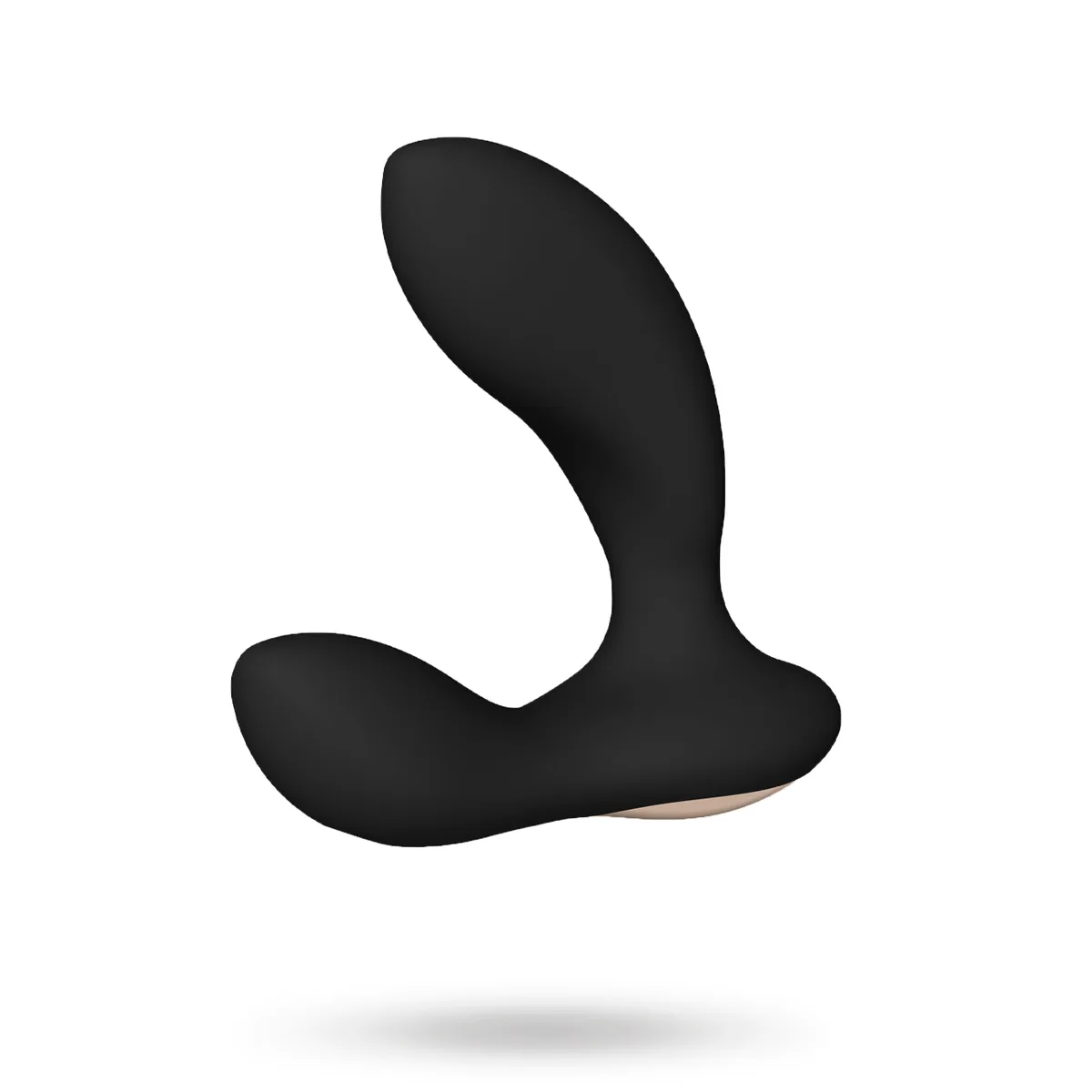
Rechargeable premium prostate vibrator with two motors and an app.
29 July 2026
 Best budget
Review · Prostate vibrator · Detachable bullet
Rocks-Off’s smallest prostate vibrator reviewed against the manufacturer’s own specifications and price data from six Swedish stores. Circumference 78.5 millimeters, insertable length 90 millimeters, 92 grams, platinum-hardened silicone, detachable RO-80mm bullet and IPX7 — plus two contradictory pieces of information in the manufacturer’s own material that we clarify: the number of settings and the circumference.
The smallest and lightest of Rocks-Off’s four prostate models, and the one the manufacturer itself positions as an entry-level option: circumference 78.5 millimeters, insertable length 90 millimeters, and 92 grams. The construction is old-fashioned in a way that’s both a strength and a weakness—a removable bullet on an N battery means the motor can be replaced and nothing needs charging, but the insertion part only vibrates indirectly and the power drops with the battery. What you pay for is fit and simplicity, not technology.
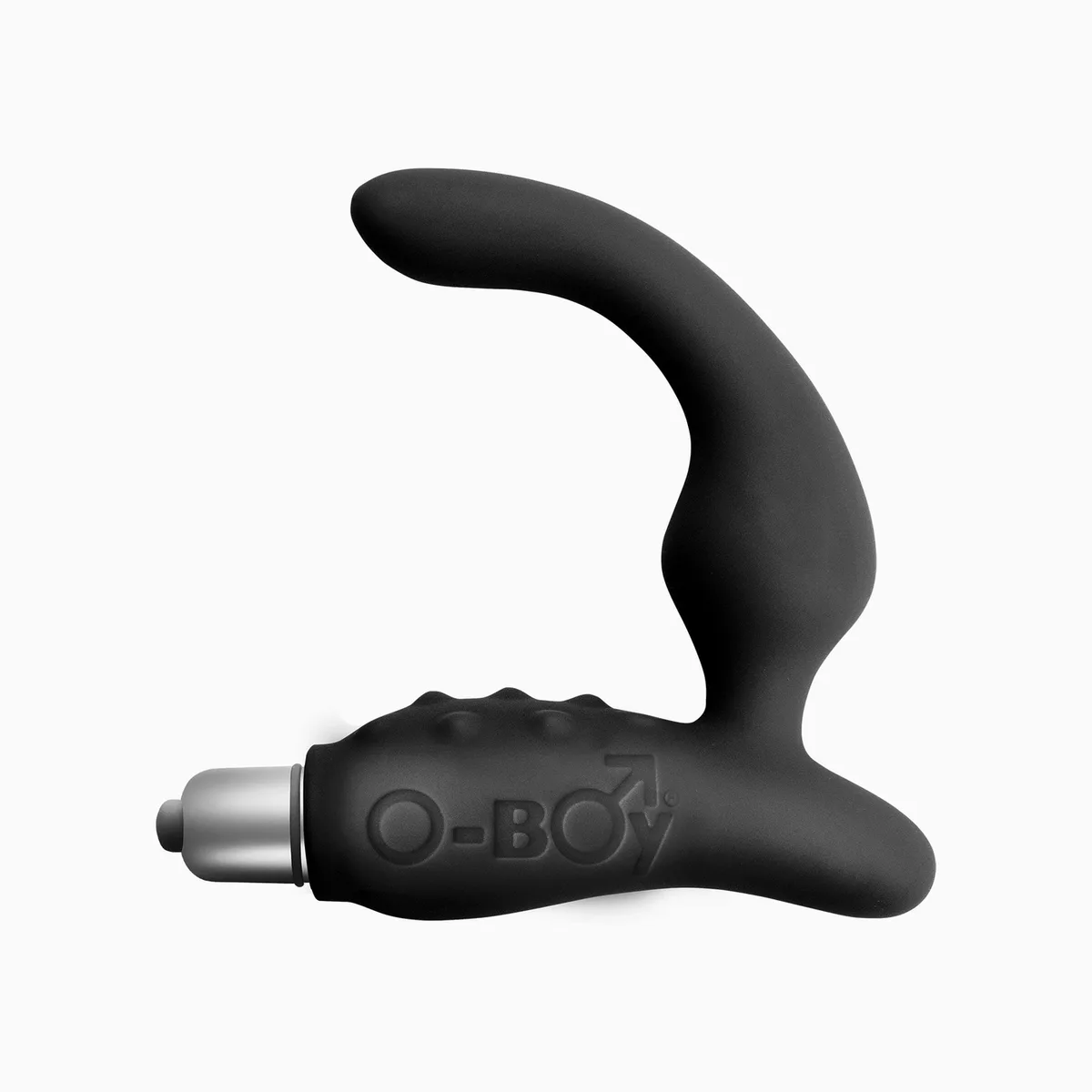
Rocks-Off O Boy is a prostate vibrator of the simplest type of construction there is: a shaped silicone housing with a hollow channel in the base, and a removable, battery-powered bullet that is pushed into the channel. No app, no charging cable, and no electronics in the body itself. All technology sits in the small metal cylinder, and when you replace it, you in practice replace the entire product’s motor.
The specification according to the manufacturer looks like this: product dimensions 33 × 100 × 98 millimeters, circumference 78.5 millimeters, insertable length 90 millimeters, and a product weight of 92 grams. The material is listed as silicone and ABS plastic. It is powered by a battery of size N, and the runtime is stated to be 2 hours and 30 minutes. The manufacturer’s item number is 7OBBKV-FB021, and the list price in the UK web shop is 27.99 pounds. In Sweden, the item is sold by six stores at prices between 295 and 399 SEK, and three of them had it in stock at the price check.
This review is about the black variant with EAN 811041012453. The number is confirmed in two ways: Sexonic lists the item under EAN13 811041012453 on its own product page, and the manufacturer’s variant data for item number 7OBBKV-FB021 includes a barcode field that starts with the same digit sequence. All six Swedish stores in the price table state the same EAN or a separate item number that is tied to that specific black O-Boy.
The manufacturer is Rocks Off Limited, a company registered in England and Wales with company number 04763811 and its seat in Wellingborough, Northamptonshire. It’s worth noting in a category where a lot is sold by middlemen without traceable manufacturers: here, there’s a company with an address, company number, and a published materials policy to push back against.
The product is sold in Sweden under names such as "O-Boy 7 Speed" and "O-Boy Prostatic Stimulator 7V", and all six stores list seven vibration modes. Blush Me and SexleksakerOutlet write that the product is powered by the RO-80mm bullet and that it delivers seven different intense speeds. Joyland lists seven vibration modes that are controlled via the button at the end of the vibrator. Vuxen lists seven speeds. Joyme lists seven vibration modes via the RO-80mm bullet.
However, one of the deviations that must be reported arises here. The manufacturer’s own product description on rocks-off.com talks about four vibration modes, not seven. The rule on this site is that the manufacturer wins when a store contradicts—but in this case, the manufacturer contradicts itself, and it’s worth going through what the rest of the manufacturer material actually shows:
What can thus be established is that four separate pieces of information from the manufacturer itself—article number, packaging print, the product’s embossing, and the descriptions of the sibling models—point to seven modes, while a single sentence in the running text on the product page says four. The most reasonable explanation is that sentence is a leftover or a writing error in the web text. We list seven modes in the specification, but anyone who wants to be sure should know that the manufacturer’s body text right now says something else.
One more thing about the modes themselves: seven modes on a bullet of this type doesn’t mean seven intensities. Bullets in this class usually mix a couple of fixed speeds with a number of pulse patterns, and the manufacturer does not publish a breakdown of which of the seven are continuous and which are patterns. Rocks Off also does not publish any frequency in hertz and no amplitude for the RO-80mm bullet, which means the strength can’t be compared in figures to a product like Lelo Hugo 2, where the motor frequencies are stated as 130 and 108 hertz.
Rocks-Off's prostate range consists of four models with similar names that get mixed up in almost every Swedish store. All four are based on the same principle—a silicone casing with a channel for a bullet of size N—and all four are stated by the manufacturer to have the same playtime of 2 hours and 30 minutes. What sets them apart is the size:
So the difference between the models is, in practice, just measurements and weight—not technology. If you choose O-Boy, you’re choosing the smallest and lightest of the four otherwise comparable products—and that’s a completely reasonable basis for choosing in this category, where the fit matters more than the effect.
The material issue is the only feature of an anal product that can’t be compensated for with experience or care. It determines whether the product will still be hygienic after five years, and it’s especially important here because the anal mucosa doesn’t have the same self-cleaning function as the urethra. The manufacturer lists two materials for O-Boy: silicone and ABS plastic.
The breakdown is easy to trace from the product’s design. The silicone is the entire molded body—the bent insertable part, the wave-shaped section, the wide base, and the dimpled casing around the bullet. The ABS plastic and the metal casing are in the bullet, which is the only part with electronics. The silicone is the only part that comes into contact with the body as long as the bullet is in its channel.
Silicone is a non-porous material. A non-porous surface can be cleaned, because there are no microscopic cavities where residue can remain. Rocks Off also specifies which type of silicone it is: platinum-hardened silicone, which the company describes as the purest variant because it doesn’t produce the chemical byproducts that peroxide-hardened and tin-hardened silicone produce. Platinum-hardened silicone is used in the medical and food industries and can withstand high temperatures.
The ABS plastic the manufacturer describes as chemically inert, which according to the company means that it does not react with other chemicals and is therefore safe to use together with lubricant. Having hard plastic in the product is not a disadvantage in itself here, since it sits inside the bullet and not against the body — but it’s worth knowing that it’s that part that determines whether the product is intact or broken, and that it isn’t molded in one piece with the rest.
That the bullet is removable has two consequences. The first is hygienic: the channel in the base can be rinsed out separately, which Joyme explicitly highlights as a cleaning argument, and the manufacturer’s own close-up image shows how the bullet is pulled out of the housing. The second is economic: if the bullet breaks, the silicone body is still intact, and bullets of the type RO-80mm are sold separately. It’s a real advantage over fully integrated products, where a broken motor turns the entire product into waste.
Phthalates are a group of softeners used to make plastic — above all, flexible PVC — pliable. The Kemikalieinspektionen (Swedish Chemicals Agency) describes them as substances that can affect the hormonal system and make reproduction more difficult, and several of them are therefore restricted or prohibited within the EU in a large number of products. This particular product category is the subject of ongoing oversight because it contains flexible plastic against mucous membranes.
Rocks Off goes further than most in its material declaration. The company states zero tolerance for phthalates and writes that it also does not use TPE or thermoplastic elastomers. It’s an unusually precise commitment. TPE is, after all, the material designation that most often conceals a flexible blend in which the manufacturer does not disclose what the softener is made of, and it’s exactly the kind of product that a materials policy needs to be able to rule out in order to be worth anything.
Latex is also said to be completely omitted, with the justification that it is both a common allergen and a porous material. Latex allergy causes reactions on mucous membranes faster than on normal skin, and that’s why an anal product is exactly the kind of use where the information matters. The company also states that it performs its own laboratory tests on site and that the tests include electromagnetic compatibility with pacemakers, watertightness, sharp edges, and toxic substances.
A reservation belongs here. All of this is the manufacturer’s own statements about its own operations. Rocks Off does not publish any third-party certification, any test protocol, and any EU declaration of conformity for the O-Boy on its website. What you can, however, see in the manufacturer’s own packaging image is that the cardboard carries the CE mark, the UKCA mark, the recycling symbol, and the symbol for separate collection of electrical waste.
It gets messy here, and it’s the most important point in this entire review. The manufacturer lists the product dimensions as 33 × 100 × 98 millimeters, the circumference as 78.5 millimeters, and the insertable length as 90 millimeters. Two Swedish shops provide completely different figures:
So the circumference range is 5.5 to 9.1 centimeters, depending on who you ask—almost a factor of two. The manufacturer’s 78.5 millimeters falls right between the two shops’ figures. Insertable length is listed as 90 millimeters by the manufacturer, but as 12 and 12.7 centimeters by the shops—so that’s about one-third more.
The manufacturer’s figures are the ones that apply in this text, for two reasons. One is principled: the manufacturer measures its own product. The other is that the manufacturer’s figures are internally consistent across the whole product family—the circumference is listed as 78.5 millimeters for both O-Boy and Rude-Boy, 97.3 millimeters for Bad-Boy, and 113 millimeters for Big-Boy, and that scale follows the models’ stated size range. The shops’ diverging figures lack a corresponding internal logic and look like either rounded estimates or figures that measure something else—for example, the entire product length including the bullet instead of the insertable part.
Practically speaking, the manufacturer’s circumference of 78.5 millimeters corresponds to a largest diameter of about 25 millimeters, which places it in the lower end of the category. It’s one of the narrower prostate products on the Swedish market, and that matches the manufacturer’s own description of the model as an entry-level option. An insertable length of 90 millimeters is also restrained—the prostate typically sits five to seven centimeters in, so the design has some margin without being too long.
The weight information deserves its own line. The manufacturer lists the product weight as 92 grams. At the same time, in the manufacturer’s own variant data, the shipping weight is listed as 121 grams—that is, product plus packaging. Joyme lists 232 grams and the package dimensions as 55 × 145 × 165 millimeters, which is the shop’s shipping weight including outer packaging and not the product’s weight. It’s the same kind of mixing of product weight and shipping weight that occurs throughout the category, and the only figure that describes the product itself is the manufacturer’s 92 grams.
The shape is easy to describe: a curved, tapered insertion part that points forward toward the prostate, a flared section just inside the opening that’s meant to hold the product in place, and a wide base that sits outside the body. From the base, the textured outer casing protrudes with the bullet out, directed toward the perineum. There are no moving joints and no adjustable angle—the fit is completely locked in by the molded shape, which is the whole point of a handsfree design and at the same time its main limitation.
Rocks-Off O Boy has no interface worth the name. All control sits at the end of the bullet, which sticks out of the silicone casing: a single button that cycles between modes and then to off. Joyland puts it plainly: the vibration modes are controlled via the button at the end of the vibrator. There is no display, no LEDs, no app, and no remote control.
That’s also the product’s whole idea. The construction is based on the wide base resting against the body so the product stays in place without being held. SexleksakerOutlet describes the intended use as prostate, perineum, and anus all in one. The manufacturer puts it as the widened base enabling handsfree use, either alone or with a partner. In practice, that means the button should be reachable without you seeing it—and that’s where a single button is an advantage rather than a drawback.
The back is just as clear: you can only step forward. If you want to go back to mode two from mode six, you have to go through seven, off, on, and one. With seven modes, that’s annoying. On a product with twenty modes, that would be a problem.
Two things in the manufacturer’s instructions are worth knowing before the first use, and both are located next to product care rather than on the product page.
The first is the isolator. Battery-powered Rocks Off products are delivered with a strip between the battery and the contacts so the battery doesn’t discharge on the store shelf. It needs to be pulled out before the product is used, and the manufacturer particularly points out that the cap must be screwed back on properly afterward—which is exactly the detail that determines whether the product is still watertight.
The second is the travel lock. According to the manufacturer, all Rocks Off products have a travel-safe function that requires the power button to be held down for three to four seconds for the product to start. That explains the most common error report in this category: that the product “doesn’t work” when it in fact is just waiting for a longer press. If it still doesn’t work, the manufacturer directs you to its customer service.
The fussy housing around the bullet is not decoration. The design places the bullet outside the body, aimed at the perineum, and the manufacturer describes for the sibling model Big-Boy that the vibrations are directed toward the base of the perineum for maximum effect. The same principle applies here: the vibrating part is never inside; it rests against the outside.
That explains a feature that surprises someone who’s used to modern prostate products. The insertion part on O-Boy vibrates only indirectly, via the silicone. The vibrations are damped through the material, and that part works more like pressure against the prostate than like a vibrator. Someone who expects strong vibration in the very tip compares with another product category—for example, the Lelo Hugo 2, which has two separate motors with specified frequencies of 130 and 108 hertz.
The design has a practical consequence that rarely appears in store descriptions: since the bullet sits in an all-through channel and sticks out, it is that part that receives pressure when you lie on or sit on the product. That’s why the manufacturer emphasizes that the cap should be securely attached.
Rocks Off is categorical on this point: use only water-based lubricant with the company’s products. Joyland gives the same recommendation and adds that a lubricant specially adapted for anal use is preferred.
The reason is material-related. Silicone-based lubricant on a silicone product breaks down the surface over time and makes it porous, and a porous surface can no longer be cleaned properly—only replaced. Oil-based products such as coconut oil leave a film that’s difficult to remove and that collects dirt. The manufacturer also warns specifically that oil and lubricants must not be allowed to penetrate the product, and emphasizes that all parts must be fitted correctly and securely.
Anal use requires more lubricant than most people expect, because the rectum does not produce its own moisture. This applies regardless of how narrow the product is, and it applies especially to a product with a tapered tip that SexleksakerOutlet highlights as easy to insert—because a tip that’s easy to insert is also easy to insert too fast.
The manufacturer states battery size N and a playtime of 2 hours and 30 minutes. Both Vuxen and Joyland state that a battery is included, and Joyland specifies the type as LR1 (N). The manufacturer’s own packaging image has "BATTERY INCLUDED" in the seal, which confirms the same thing.
N, also called LR1, is an alkaline disposable battery of 1.5 volts. It’s about half as long as an AA battery and a bit narrower. The format was evidently chosen so it fits in a bullet-sized cylinder, but it has two practical consequences worth considering before buying.
The first is availability. The N battery is not a format you typically have lying around at home, and it isn’t available in every grocery store. Anyone who wants to be able to use the product on impulse should buy a spare pair at the same time as they buy the product.
The second is that the manufacturer does not publish the battery’s capacity in milliampere-hours and does not publish the product’s power consumption. The playtime of 2 hours and 30 minutes can therefore not be converted into anything else, and it’s not possible to determine whether it refers to the lowest setting, the highest setting, or an average. The same figure is also given for Rude-Boy, Bad-Boy, and Big-Boy, which suggests that it’s a value for the bullet rather than a measurement per model.
That makes the comparison with a rechargeable product interesting. For Hugo 2, Lelo lists a lithium-ion battery of 420 milliampere-hours and 3.7 volts, a charging time of up to two hours, and a run time of up to one hour. Rocks-Off O Boy therefore has, on paper, a run time that’s two and a half times longer—but that run time runs out and costs a new battery, while Hugo 2’s runs out and costs two hours plugged into the wall socket. Which one is better depends entirely on how often the product is used.
The question comes up right away: can’t you just insert a rechargeable battery? The manufacturer answers no, and justifies it by saying that rechargeable battery types don’t provide sufficient voltage to deliver full power in the company’s products.
It’s a technical explanation that holds up. An alkaline N battery provides 1.5 volts, while a rechargeable NiMH battery in the same size provides 1.2 volts. Twenty percent lower voltage on a simple DC motor without control electronics means noticeably weaker vibration. What can be stated is therefore that, in practice, the product is tied to disposable batteries if you want the power level the manufacturer has factored in—and that it’s an ongoing cost and an environmental issue that belongs in the buying decision.
The manufacturer also brings up recycling on its own initiative: the products can be returned for recycling, the company states that it complies with the rules for recycling of electrical and electronic waste, and the packaging carries the symbol for separate collection of electrical waste. Returning old products to Rocks Off for recycling, however, according to the company, only applies to goods purchased directly in their own store.
All stores state that the product is 100 percent waterproof. The manufacturer is more precise than that, but on a different side than the product page: on its product care page, Rocks Off states that all of the company’s toys are 100 percent IPX7 waterproof and submersible for play in the bath. The classification is not written out in the specifications table specifically for the O-Boy, but it is a commitment that covers the entire range.
The rating comes from the international standard IEC 60529, which defines enclosure classes for electrical equipment. The number 7 in the second position means that the product has been tested for submersion in water to a depth of one meter for 30 minutes. The difference compared with a splash-proof product is bigger than the wording suggests: splash protection covers water droplets and, at best, water jets, but not submersion.
With IPX7, the entire product can be rinsed off without being careful, and with this specific design it’s a real advantage, because the channel where the bullet sits needs to be possible to flush out. If a product has no IP rating at all, it should be treated as not waterproof — the absence of a rating is never a sign that the product would be approved.
There is, however, a caveat that is specific to battery-powered products of this type. The waterproofing depends on the bullet’s cap being screwed on correctly, and the manufacturer points this out in its instructions about the insulating strip. A bullet with a slanted screw-on cap is not rated IPX7, no matter how the product is constructed.
The manufacturer’s instructions are short and clear. Clean with soap and water, or with the company’s own antibacterial cleaning. Do not use dish soap or alcohol-based products — they can, according to the manufacturer, damage the surface of the product. It’s an instruction that is often ignored, and hand sanitizer on a silicone surface is one of the most common reasons the surface becomes dull and sticky.
Remove the bullet and rinse the channel separately. That is the only part where water and residue can be left standing, and it’s also the whole point of a removable bullet from a hygiene perspective. Wipe it off and let it air-dry before putting the product away.
The storage instruction is unusual enough to deserve a section: Rocks Off writes that their products should be stored separately from other brands, because low-quality jelly-type toys can damage the silicone. It sounds like marketing, but it’s correct chemistry — softeners from a soft, PVC-based product can migrate over and make the silicone surface sticky after long contact. So having a separate pouch or a separate box is justified.
One more thing, for completeness: this product has no heating function and no published instructions about temperature limits. The manufacturer states that platinum-hardened silicone can withstand high temperatures, but because the bullet contains an alkaline battery and electronics, the product should never be boiled or put in a dishwasher with the bullet in place.
Rocks Off does not publish any measured decibel value for O-Boy, either on the product page or on the product care page. None of the six Swedish stores either provides any measurement figure. The marketing on third-party sites describes the product as quiet, but we haven’t found any source that presents an actual measurement.
What can be established is basically this. Bullets of this type are powered by a small DC motor with an eccentric weight—i.e., an unbalanced weight that rotates. This design is usually higher per unit of power than a linear motor, but the motor in an N-bullet is physically small, and its noise is dampened by the surrounding silicone. So the design with a bullet inside a silicone housing is not the quietest possible, but it’s also not the loudest.
For comparison, Lelo lists a maximum sound level of under 60 decibels for Hugo 2—which says something about how little exact information there is to compare in this category, even when a number is actually published. A practical piece of advice that applies regardless of model: place the product on a soft surface when it’s not in use. A hard desktop surface works like a resonance box and noticeably amplifies the sound.
We do not have price data from shops in your market yet.
Four details from the manufacturer itself — item number, packaging print, the product’s embossing, and the descriptions of the sibling models — say seven settings. A single sentence on the product page says four.
Four comparisons are relevant: against the three sibling models in the same series, which are the closest competitors both in design and in price, and against a rechargeable premium product from another brand. All specifications below come from each respective manufacturer’s own product pages, and all prices come from the stores’ product feeds on July 29, 2026.
Rude-Boy is the most direct competitor, and it costs from 313 SEK versus O-Boy’s 295 SEK at the lowest. So the price difference is, in practice, basically nothing.
The specifications have more in common than they differ: the same 78.5-millimeter circumference, the same silicone and ABS plastic materials, the same N battery size, and the same run time of 2 hours and 30 minutes. The manufacturer’s list price differs by just one pound—27.99 versus 29.99.
What the Rude-Boy adds is size. The insertable length is 95 millimeters versus O-Boy’s 90, the overall dimensions are 40 × 115 × 120 millimeters versus 33 × 100 × 98, and the weight is 180 grams versus 92. So the Rude-Boy is almost twice as heavy without being noticeably thicker—the mass sits in the wider base and the longer outer portion. That means it sits more steadily against the perineum, but it also feels more noticeable to carry when you move around.
The conclusion is simple: if you want the smallest possible product, O-Boy is the choice, and if you want a heavier base with more contact against the perineum, Rude-Boy is the one. In everything else, they’re comparable, and the price doesn’t set them apart.
Big-Boy also costs from 313 SEK and is the series’ largest model. The circumference is listed as 113 millimeters versus O-Boy’s 78.5—that’s 44 percent more, which is a completely different product in practice even if the technology is identical. Insertable length 111 millimeters versus 90, overall dimensions 40 × 120 × 123 millimeters, and weight 222 grams versus O-Boy’s 92 grams.
The manufacturer explicitly targets it at someone who’s looking for a fuller and more intense experience, and describes it as a choice for experienced users. It’s not marketing language; it’s a correct description of what the difference in circumference means.
For anyone buying their first prostate product, Big-Boy is the wrong choice despite costing the same. Circumference is the single most important variable in how an anal product feels, and going straight for the series’ thickest model is a common and unnecessary mistake. If, however, you’re already experienced, and you think that a product with a 25-millimeter diameter doesn’t provide enough pressure on the prostate, Big-Boy is the logical upgrade within the same series.
Bad-Boy costs from 313 SEK and sits between the others: circumference 97.3 millimeters, insertable length 80 millimeters, dimensions 38 × 120 × 122 millimeters, and weight 184 grams. So it’s shorter to insert than O-Boy but clearly thicker.
It’s that combination that makes it interesting for a specific group: the person who wants more fullness without going deeper. The manufacturer also highlights that Bad-Boy’s bullet is removable and can be used separately, which in practice also applies to O-Boy—the bullet is the same RO-80mm type and sits in a continuous channel in both.
Want to summarize the series in one sentence: O-Boy is the narrowest and lightest, Bad-Boy is thicker but more shallow, Rude-Boy is just as narrow but longer and heavier, and Big-Boy is the biggest in everything. The price difference between them in Swedish shops is so small that it shouldn’t determine your choice—the dimensions should.
Lelo Hugo 2 costs from 931 SEK, meaning 636 SEK more than O-Boy at its cheapest, and it illustrates what your money buys in this category.
Hugo 2 measures 104 × 107 × 41 millimeters with an insertable length of 72 millimeters and weighs 121 grams. The material is listed as body-safe silicone and ABS plastic, i.e. the same combination that Rocks-Off uses. The battery is a lithium-ion battery with 420 milliamp-hours and 3.7 volts; the charging time is stated as up to two hours and the runtime as up to one hour. The product has two motors with specified frequencies, 130 and 108 hertz, a maximum sound level of under 60 decibels, and a single button as the interface.
The differences that actually matter: Hugo 2 has a rechargeable battery instead of a disposable battery, two motors instead of one, and a manufacturer that publishes battery capacity, frequency, and sound level. O-Boy has a longer stated runtime—2 hours 30 minutes versus 1 hour—and a longer insertable part, 90 versus 72 millimeters, as well as one-third of the price.
If you choose based on published data and on not having to deal with batteries, Hugo 2 wins without discussion. If you choose to find out whether prostate stimulation works for you at all, at the lowest possible cost and without needing to charge anything, O-Boy is a hard-to-beat way to do it—and that’s exactly the role the manufacturer itself describes for the model.
Six Swedish stores sell the item with EAN 811041012453. Cheapest is Sexonic at 295 SEK, most expensive is Vuxen at 399 SEK. That’s 104 SEK or a 35 percent difference for the exact same item number and the same packaging.
However, the stock situation changes the picture. Only three of the six stores had the product in stock at the price check: Joyme at 319 SEK, Joyland at 339 SEK, and Blush Me at 395 SEK. So the cheapest available is 319 SEK, not 295. The difference between the cheapest and most expensive available store then shrinks to 76 SEK.
One detail worth noting: Sexonic’s own product page stated 39 units in stock when the sources were checked, even though the store’s product flow did not mark the item as being in stock. That’s exactly the kind of gap that makes a price feed something to read as an indication rather than a promise. Always check at checkout.
Shipping cost is also a larger share of the price here than in most comparisons we make, because the product is cheap. Blush Me lists 29 SEK in shipping in its flow, SexleksakerOutlet 29 SEK, Joyland 59 SEK, and Sexonic 98 SEK to Sweden. So for a product that costs just over three hundred kronor, the shipping fee alone can change the ranking between stores. Work it out based on the total, not the unit price.
One last price perspective: the manufacturer’s own list price is 27.99 pounds. So the Swedish prices are in the same ballpark as the manufacturer’s British price, which is unusual in this category and suggests that the item is a volume product with established purchasing channels rather than a novelty with high margins.
It’s for you who want to try prostate stimulation for the first time and don’t want to spend more than a couple of hundred kronor to find out whether it works for you. The circumference of 78.5 millimeters is among the more restrained in the category, the insertable length of 90 millimeters is reasonable, and the design with a wide base makes it possible for the product to stay in place without being held. It’s also for you who prefer a product without electronics in the body itself: the only part that can break is a bullet that can be replaced.
It’s for you who want to be able to rinse the entire product under running water, for you who don’t want yet another charging cable in the box, and for you who want a materials declaration that explicitly excludes phthalates, TPE, and latex.
It’s not for you if you want strong vibration in the insert itself — that part vibrates only indirectly through the silicone, because the motor sits in the outer section against the perineum. It’s not for you if you want to be able to step back between modes, because the only button only goes forward. It’s not for you if you require published battery capacity, frequency, or measured sound level before buying, because Rocks Off doesn’t publish any of that. And it’s not for you if you want to avoid having to buy batteries — the N-battery is a format that people rarely have at home, and the manufacturer explicitly advises against rechargeable options because their lower voltage results in weaker vibration.
One last objection that belongs in the decision: someone who already knows that prostate stimulation works for them will likely grow out of this product. That’s the manufacturer’s own positioning — O-Boy is described as the model that will guide you slowly into prostate pleasure — and someone who’s already there should look at Bad-Boy or Big-Boy within the same series, or at a rechargeable product with two motors such as the Lelo Hugo 2.
An anal product is judged on one point that doesn’t exist in other categories: it must be possible to get it back out. The rectum has no natural stopping point, and a product without a sufficiently wide base can be pulled in. Rocks-Off O Boy has a wide, transverse base that sits outside the body and also carries the protruding bullet housing — the construction means the product can’t pass inside. This is the single most important safety feature of an anal product, and it’s met here.
In addition to the shape, the usual things apply. Use plenty of water-based lubricant according to the manufacturer’s recommendation. Take it slow when inserting—the tapered tip that SexleksakerOutlet highlights makes insertion easy, but easy insertion isn’t the same as your body being ready. Never share an anal product between people without cleaning it in between, and never transfer a product from anal to vaginal use without cleaning it first.
The manufacturer mentions another thing that’s relevant for a small group: the company states that it tests its products for electromagnetic compatibility with pacemakers. It’s a claim that’s rarely published in this category, and it’s worth knowing for anyone with an implanted device—but it doesn’t replace advice from the treating doctor.
Rocks Off provides a two-year warranty on its products. Read the terms before you count on it: according to the manufacturer, the warranty applies only to goods purchased directly in Rocks Off’s own web shop. If you bought the product from a Swedish retailer, the manufacturer explicitly refers you to the shop for compensation or a refund. That makes the manufacturer’s warranty practically irrelevant for all the six shops in the price table above.
The manufacturer’s own return rules—30 days, free returns, unopened packaging except in case of defects—apply for the same reasons only to purchases in their own store. If you shop in Sweden, it’s the Swedish store’s terms of purchase and Swedish law that apply.
And that’s where the real rights are. Under konsumentköplagen (the Swedish Consumer Sales Act), you have three years to make a complaint for defects in the item—regardless of what the manufacturer promises—so that’s one year longer than Rocks Off’s own warranty, and without the requirement that the purchase has to be made in a specific store. In addition, for distance purchases you also have a right of withdrawal for fourteen days under lagen om distansavtal och avtal utanför affärslokaler (the Act on distance contracts and contracts outside business premises).
Be aware that in practice the right of withdrawal is limited for hygiene products that have been taken out of a sealed package—that’s the same principle the manufacturer applies in its own return rules. The right to complain for defects, however, always applies. If you have questions about what applies in your case, Konsumentverket guides you via Hallå konsument.
Rocks-Off O Boy is ranked på plats 2 av 15 in prostate vibrator best i test, where the entire category is compared against each other using five shared criteria. Guiden vinns av Svakom Iker Neo.
Every numerical piece of information in the text can be traced to one of the sources below. The links were checked manually on the specified date.
This page is machine-translated from Swedish. Read the Swedish original