

Review
Review: Satisfyer Pro 2 Next Generation
Air pressure technology instead of vibration — 219 SEK and 15-year warranty.
29 July 2026
Review · Mini vibrator · Bullet vibrator
ROMP’s cheapest vibrator reviewed against the manufacturer’s own specifications, quick guide in PDF form, and price data from four Swedish stores. Six intensity levels and four pattern modes with a single button, 150-millimeter body-friendly silicone, IPX7 according to IEC 60529, and a two-year warranty — but a 180-minute charging time for 60 minutes of operation, and a specification in which neither weight, battery capacity, nor sound level is published.
An honest entry-level vibrator: one button, ten settings, IPX7, and body-friendly silicone in the contact area for under three hundred. It’s unusually large for a bullet, which gives a better grip than the competitors. What you pay with is the battery — 60 minutes of runtime on 180 minutes of charging is the weakest ratio among the compared models — as well as a product-specific charging pin without a power adapter and a specification where weight, capacity, and sound level are not published.
ROMP Beat is a bullet vibrator from ROMP, the brand that WOW Tech Europe GmbH in Berlin operates alongside Womanizer and We-Vibe. It is the same manufacturer, the same address on Hermann-Blankenstein-Strasse in Berlin, and the same warranty organization as the more expensive sibling brands — but ROMP is the budget end of that lineup, and the Beat is at the absolute cheapest end of that segment. The manufacturer’s own list price in the EU store is 29.99 euro. In Sweden, the item is sold by four stores at prices between 249 and 449 SEK.
The specification looks like this: six intensity levels and four pattern modes, a single button that controls everything, the IPX7 enclosure rating, 60 minutes of operating time, 180 minutes of charging time, and a two-year manufacturer’s warranty. The dimensions are 150 × 33 × 33 millimeters, and the color is called Light Purple, specified as Pantone 513C. The product model number is RPBB, and the manufacturer’s item number is RPBBSG4.
This review is about the item with EAN 4251460601290. The number is checked directly in the page source on both the manufacturer’s European and American product pages, where the GTIN details are linked to item number RPBBSG4, and all four Swedish stores in the price table list the same number. ROMP sells the Beat in a single color, which makes the risk of confusing variants smaller than for most products in the category — but the stores’ own names differ a lot, from "ROMP Beat Bullet" to "ROMP – Beat Mini Multifunction Vibrating Bullet Violet", and it is the EAN number that determines that it is the same product.
A bullet vibrator is the simplest construction in the entire vibrator category: an elongated body with a motor at one end, a button at the other, and nothing in between. No air pressure chamber, no insert piece, no app, no remote control. The motor transfers mechanical motion through the housing to the skin, and the strength is determined by how large and how fast the unbalanced mass in the motor is. That is the fundamental difference compared to an air-pressure product like the Womanizer Premium or Satisfyer Pro 2, where pressure waves in the air do the work without the chamber touching the clitoris.
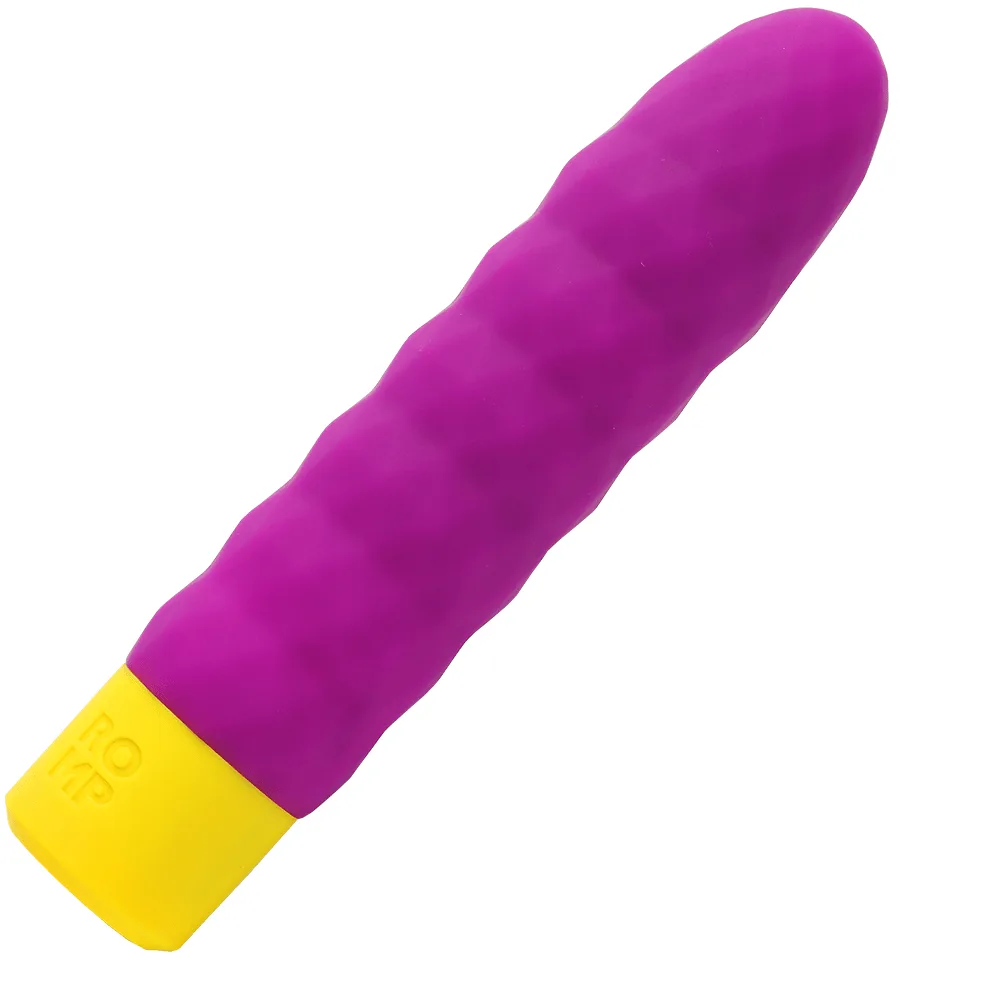
Just Beat stands out in one point within the bullet category: it’s big. Classic bullets are nine to eleven centimeters—We-Vibe Tango X measures 9.98 centimeters and Lelo Mia 3 11 centimeters. ROMP Beat is 15 centimeters long and 33 millimeters in diameter. It’s closer to a classic wand vibrator than a bullet in the traditional sense, and the manufacturer still consistently describes it as "bullet vibrator" in its own categorization.
In practice, that means two things. The first is that the grip becomes more comfortable than on a small bullet: there’s actually something to hold, and you don’t need to pinch a two-centimeter cylinder with your fingertips. The second is that the product isn’t discreet in the way a bullet usually is. It doesn’t fit in the palm of your hand, and it also can’t be kept discreetly in a toiletry bag together with other items. If you want the very smallest possible, Beat is the wrong product—but if you want a bullet’s simplicity in a format that’s easy to hold, it’s unusual in the lineup.
The surface is the other distinctive feature. The entire shaft has a diagonal grid pattern in relief—Lustly describes it as a "ribbed structure"—and it’s a deliberate design, not decoration. The relief provides both grip when your hands are wet or lubricated with glide and a different tactile feel against the skin than a smooth surface. The manufacturer publishes no information about the depth of the relief or the pattern density, so all that can be established is that it exists and that it covers the entire purple part.
Three products from the same group are close in price and use, and they’re regularly mixed up in Swedish store copy. The differences aren’t cosmetic.
In other words: Lipstick is a different kind of product despite looking like a bullet, and Tango X is the same kind of product as Beat but with double the operating time, half the charging time, and three times the price. It’s that comparison that determines whether Beat is a bargain or a saving you’ll regret, and it comes up again further down.
The material question is the only property of an intimate product that can’t be compensated for through habit or care, and it determines whether the product is still hygienic after five years. Here is ROMP Beat as an example of how a specification can look different depending on where you read it—and it’s worth going through it carefully before you pay.
Silicone is a non-porous material. A non-porous surface can be cleaned, because there are no microscopic cavities where residue can get trapped. It is the single most important property of a material that is meant to lie against mucous membrane, and that’s why the material declaration weighs more heavily than almost all other lines in a specification. Silicone also tolerates repeated cleaning without breaking down; it is chemically stable against water and mild soap, and it does not require softeners to become flexible—the softness comes from the polymer’s own structure.
The manufacturer lists body-friendly silicone as the main material for Beat and describes it as “body-safe,” using the wording skin-friendly, high-quality, and hygienic. This applies to the surface that actually lies against the body, meaning the entire purple part with the grid pattern.
Here there’s a gap worth pointing out, because it says something about how specifications should be read. ROMP’s specification table for Beat has a row called “Head Material” with the value body-friendly silicone—but no row called “Materials”. That means the manufacturer discloses the head’s material and nothing else.
That this is a deliberate setup and not an oversight can be shown using the manufacturer’s own page for another product. ROMP Lipstick has both lines: “Head Material: Body-safe silicone” and “Materials: Soft-touch ABS”. With Lipstick, you therefore know that the head is silicone and the body is ABS plastic. With Beat, you only know the first thing. The yellow base with the embossed ROMP logo is made of a different material than the purple shaft—you can see it in the pictures—but which one the manufacturer doesn’t state.
In this case, the stores are more forthcoming than the manufacturer, and their role should be read as precisely a store’s claim. The retailer Mshop states the material as only “Silicone” in its specification table, and Vuxenkul does as well, “Silicone.” None of them breaks down the material by part. What can be established, then, is that the contact surface is silicone according to the manufacturer, and that two Swedish stores describe the entire product as silicone, while the manufacturer itself does not make that promise.
It practically matters less than it sounds, because the yellow base is the part that neither comes into contact with the mucous membrane nor needs to be soft. But it’s a reminder that “silicone” on a shop page can mean anything from solid silicone to silicone in a single contact area, and that the manufacturer’s specifications are the authoritative source when the two contradict each other.
Phthalates are a group of plasticizers used to make plastic—above all, flexible PVC—pliable. The Swedish Chemicals Agency (Kemikalieinspektionen) describes them as substances that can affect the endocrine system and make reproduction more difficult, and several of them are therefore restricted or banned within the EU in a large number of products. Intimate products are a category that is repeatedly subject to supervision, precisely because it contains flexible plastic against skin and mucous membrane.
ROMP makes no explicit guarantee that Beat is free from phthalates, BPA, or latex, either on the product page or in the online manual. This is a difference from the company’s other brand: We-Vibe states plainly on the Tango X page that the materials are ABS and body-friendly silicone “free from phthalates and BPA and made without latex.”
How serious is it? Significantly less than it sounds, for a technical reason. Silicone doesn’t require phthalate plasticizers to become soft, unlike flexible PVC and some TPE blends. A material declared as silicone is, in itself, a better signal than labels like “TPE” or “jelly rubber,” which say nothing at all about which plasticizers are included. What still needs to be said outright is that the absence of a guarantee is never the same as a guarantee, and that someone who is allergic to latex gets no information at all from the manufacturer here. If you want it in black and white, Tango X is the product within the group that provides that.
The manufacturer states the dimensions 150 × 33 × 33 millimeters. Both Swedish shops that publish dimensions confirm the length: Mshop lists 15.00 centimeters in length and 3.3 centimeters in diameter, while Vuxenkul lists 15 centimeters. It’s unusual for shop details and manufacturer details to match exactly in this category, and that they do here is a small but real quality signal for the shops’ product data.
The width and height being identical—33 and 33 millimeters—means the cross-section is basically round. So the shape is a uniformly thick cylinder with a rounded top, not an asymmetrical or flattened body. That makes it easier to roll in your hand and to angle freely against your body, but it also means it doesn’t have an obvious “right” side to place against the skin.
The manufacturer does not publish a weight for ROMP Beat. The specification table has no weight field, and the online manual does not cover it either. The only weight information that can be found comes from a shop, and it should be read with caution: the retailer Mshop lists 0,17 kilograms — but the information is shown under the heading "Dimensions (Package)" together with the package’s dimensions 16,50 × 7,50 × 6,00 centimeters, which means it is reasonably the packaged weight including cardboard, cable, and printed materials, not the product by itself. For comparison, Lelo lists 36 grams for the Mia 3, which is eleven centimeters long and 22 millimeters thick. Expect Beat in your hand to weigh more than that, because it is larger, but treat the 170 grams as a package weight until someone publishes a product weight.
The package dimensions are useful on their own when comparing shipping costs or if you want to know whether the package will fit through a mailbox slot. 16,5 × 7,5 × 6 centimeters is a small cardboard box, and the packaging is a printed cardboard sleeve in magenta with the product pictured — not a neutral cardboard box. However, all Swedish stores in the list ship in outer packaging.
The interface on ROMP Beat is as simple as it can be made: one button. The manufacturer lists the control as "One button" in its own specification table, and the quick guide names the product’s three parts — LED lamp, charging port, and on/off button. There is no display, no app, no remote control, and no travel lock.
The operation description in the manufacturer’s manual is as short as the interface. Press and hold the button for two seconds to start. Press briefly to step through six intensity levels and four pattern modes. Press and hold the button for two seconds again to turn it off. That’s the whole user guide, and it is both the strength and the weakness of the design.
Six intensity levels plus four pattern modes make ten modes in total. That’s also how the Swedish stores describe the product: Mshop writes "10 different vibration modes (6 stepping speeds and 4 pulsing)", Lustly writes "10 vibration patterns — 6 strengths and 4 pulsing", and Vuxenkul lists six vibration speeds and four vibration patterns as separate bullet points. So the stores and the manufacturer are in agreement, which is not something you can take for granted.
What can be established about the consequence of a single button is that cycling can only go in one direction. You can’t go back one step; you have to go all the way around the ten settings to get back to the one you passed. On a product with six intensities and four patterns, that means that in the worst case you have to press nine times to reach the mode immediately before the one you’re currently on. It’s a direct cost of simplicity, and it’s worth weighing against, for example, Lelo Mia 3, which has two buttons and therefore can step in both directions.
Four pattern modes are on the low side compared with the category — We-Vibe lists seven modes for Tango X — but pattern modes are also the feature that’s used least in practice. ROMP doesn’t publish what the four patterns actually do: there’s no description of pulse frequency, waveform, or intervals, either on the product page or in the manual. What you can count on is that they’re pre-programmed pulse sequences, and that you need to try out different ones to see which you prefer.
A discrepancy in the manufacturer’s own material belongs here, since it causes recurring confusion. Both the product page and the online manual state six intensity levels and four pattern modes. But in the printed quick guide that comes with the product — the PDF version is on the manufacturer’s own site under user manuals — it says in step 4 in English: "Briefly press the button to cycle through 10 intensity levels".
It’s an incorrect label in the manufacturer’s own material, not another version of the product. Ten is the sum of the six intensities and the four patterns, and the quick guide has obviously combined them into a single number and called everything intensity levels. The same PDF is dated 12/2021, while the online manual is dated 04/2022, which suggests that the later version is the corrected one. It’s worth knowing if you read the guide in the package and wonder where the four missing steps went: they’re there, but they’re patterns, not strengths.
ROMP markets Beat as "whisper quiet" and describes it as nearly soundless and discreet. The question is what that means in numbers, and the answer has to be straightforward: ROMP doesn’t publish any measured decibel value for Beat, either on the product page, in the online manual, or in the quick guide. There’s also no comparison chart or scale to lean on, like Womanizer provides for its products.
For comparison, Lelo provides a figure for the Mia 3: maximum sound level under 60 dB. That, in turn, doesn’t say very much—60 dB is a generous upper limit rather than a measured value—but it’s at least a published figure backed by a manufacturer. We-Vibe uses the same wording as ROMP, "whisper quiet", without a number, for the Tango X.
What you can generally conclude, though, is that a vibrator with a rotating eccentric motor always makes more noise than an air pressure product, because the sound comes from an unbalanced weight that rotates, not from a pump. And size matters in both directions: a larger housing gives more material to dampen it, but also a larger resonance chamber. Never state a decibel value for this product without a source—sites that list it either do their own measurement or use a figure without an origin. A practical tip that applies regardless of model: place the product on a soft surface between uses. A hard tabletop works like a sound box and noticeably amplifies the sound.
ROMP Beat is rated IPX7. The rating comes from the international standard IEC 60529, which defines enclosure classes for electrical equipment. The number 7 in the second position means that the product is tested for submersion in water to a depth of one meter for 30 minutes. The manufacturer’s manual states the consequence plainly: Beat is waterproof and submersible, and can be cleaned with warm water and toy cleaner or simply taken into the bath.
It’s worth pausing on one detail in the construction here, because it’s unusual. Charging happens via a hole straight into the silicone—the manufacturer’s manual explicitly puts it, "yes, the little hole into the silicone!"—and there’s no rubber cap or plug over it. That a product with an open charging port still manages IPX7 is because the silicone seals tightly around the contact pin and the contact itself is sealed from the inside. It works, but it also means the hole is the part you should keep an eye on over time: if the silicone around the opening cracks, the seal is gone.
The difference from a splash-proof product is greater than the wording suggests. Splash protection covers water droplets and, at best, water jets, but not submersion. Such a product can handle a damp cloth and possibly a shower, but not a bathtub, and it shouldn’t be held under running water without careful consideration of what that means for the button and the charging contact.
With IPX7, the entire product can be rinsed off without being careful, and on a product that is a single sealed body without removable parts, that is, in practice, the entire cleaning procedure. Two of the Swedish shops describe the product as "100 % vattentät", which is a marketing wording rather than a classification—it's the manufacturer’s IPX7 that is the exact information. If a product has no IPX information at all, it should be treated as not waterproof. The absence of a rating is never a sign that the product would be approved.
Rinse off the product in lukewarm water after each use. The manufacturer specifies warm water and a cleaning product intended for intimate products. Wipe it down with a clean towel and let it air-dry before putting the product away. No storage pouch is included in the delivery—this is one of the things you get with We-Vibe but not here—so think about where you put the product. An embossed relief pattern collects more dust than a smooth surface if it’s stored loose in a drawer.
ROMP’s own instructions are clear on the lubricant issue: use a water-based lubricant, and do not use perfumed, silicone-based, or alcohol-based lubricants, gels, or massage oils. Silicone-based lubricant should never be used on silicone products—it breaks down the silicone surface over time and makes it porous, and a porous surface can no longer be cleaned properly; it can only be replaced.
The warranty page also sharpens the wording in a way that’s easy to miss and expensive to ignore: WOW Tech writes that using oils and creams with their products can result in irreparable damage, explicitly mentions sunscreen, lip care, essential oils, coconut oil, and cooking oils, and ends by saying that anyone who still uses them risks making the warranty void. Coconut oil as a lubricant is therefore not only a material risk, but also a warranty risk.
The manual also covers three things that rarely appear in store texts. The product and its battery must not be exposed to temperatures above 45 degrees—so boiling water and the dishwasher are out of the question despite IPX7. The product contains magnets, which means it should not be used directly over a pacemaker and that cards with a magnetic stripe should be kept away from it. And Beat is expressly not designed for anal use: the manual writes "This product is not designed for anal use. Do not use anally!". This is a relevant warning for an evenly thick, 15-centimeter-long product without a wider base or a stop edge.
It deserves a note that the stores describe the intended use more broadly than the manufacturer does. Mshop specifies the body part "Clitoris, Vagina" and the stimulation "Vibration, Penetration," and Vuxenkul specifies the stimulation area "Vulva & Vagina". The manufacturer’s own manual describes only external use — clitoris, nipples, penis, and perineum — and does not mention penetration at all. It is not a contradiction in a strict sense, but when the store and manufacturer describe the same product differently, the manufacturer’s instructions apply.
The clearest weakness of the product is right here, and it shows immediately in the manufacturer’s own figures. ROMP states the operating time as 60 minutes and the charging time as 180 minutes. That means three hours of charging for one hour of use — a 3:1 ratio.
Comparing it with the competitors makes the figure concrete. We-Vibe states up to two hours of operating time and 90 minutes of charging time for Tango X, meaning a 0.75:1 ratio — four times better. Lelo states up to 1.5 hours of operating time and up to two hours of charging for Mia 3, roughly 1.3:1. Even ROMP’s own Lipstick, in the same brand and in the same price range, states 120 minutes of operating time on 90 minutes of charging. Beat is therefore the product in the comparison that charges the longest and runs the shortest, and it’s not marginal.
With a cable that has a thin charging pin on one end and USB on the other. The manufacturer’s manual describes the process in three steps: insert the charging pin into the charging hole in the silicone, connect the USB end to a power source, and wait 180 minutes. The LED light shows the status — off means no power supply or a misconnected charger, blinking means charging is in progress, and steady light means fully charged.
Two things in that description deserve to be highlighted before purchase. The first is that no AC adapter is included. The delivery includes the product, a USB charging cable, quick guide, and safety information — nothing like a wall charging outlet. The manufacturer explicitly writes "AC Adapter not included" on both the product page and in the manual. If you have a phone charger or a USB port on your computer, it’s no problem; if you don’t have either, you should expect an extra cost.
The second is that the cable is product-specific. The quick guide is blunt: "Use original provided cable only" — use only the included original cable. The pin connector is not USB-C, not micro-USB, and not magnetic like on several newer products; instead, it’s a thin pin that fits just this opening. If you lose the cable, none of the cables you already have at home will work. That’s a noticeable difference from a product that charges with standard USB-C, and that risk increases over the product’s lifespan rather than decreases.
The manufacturer’s specification table lists the battery type as a “prismatic rechargeable battery,” and the manual specifies that it’s a lithium-ion battery that is not replaceable. The quick guide’s technical data goes one step further and states the wattage as 3.7 V and 0.45 A for the built-in battery, as well as 5 V and 0.46 A when charging via USB.
But the capacity in milliampere-hours is not published for Beat. 0.45 A is a current specification, not a capacity, and the two shouldn’t be confused, even though the number looks familiar. That the difference matters becomes clear when you compare: ROMP states for Lipstick "rechargeable li-ion battery (3.7V, 450mAh)" — where the capacity is written out. For Beat, it doesn’t. Lelo lists 70 mAh and 3.7 V for Mia 3. Without the capacity, you can’t convert the runtime to a power consumption, and you can’t compare how heavily the cell is loaded between models.
What generally applies to lithium-ion batteries also applies here: the capacity drops with the number of charge cycles, the battery isn’t replaceable, and the product does best when it’s charged regularly rather than stored fully discharged. The manufacturer writes in the manual itself that the product should be charged regularly even when it isn’t being used. With a runtime of 60 minutes, the product will also be charged often, and each charge is a cycle. It’s the battery, not the silicone, that sets the limit for lifespan—and because the cell is fixed in place, the product is essentially used up when the battery is.
One more detail from the warranty side that’s practically useful: ROMP describes the LED indicator as a troubleshooting point and writes that a blinking light can mean the product needs to be charged. So before you report a fault, the first step is to charge it fully for three hours and see whether the behavior disappears.
We do not have price data from shops in your market yet.
Three hours of charging for one hour of use. It’s the only number in the specification that determines whether the price is a bargain or a saving you regret.
Three comparisons are relevant: against the company’s own premium bullet, against the most well-known bullet vibrator from a competing premium brand, and against ROMP’s own product in the same price range but with a different technology. All the information below comes from each manufacturer’s own specification pages.
We-Vibe Tango X is the direct equivalent within the same group, and the comparison is awkward for Beat on almost every line. Tango X states up to two hours of runtime against Beats 60 minutes, 90 minutes of charging time against Beats 180, eight intensity levels and seven modes against Beats six and four, an explicit materials declaration—ABS and body-friendly silicone, phthalate- and BPA-free, and made without latex—against Beats only line about the main material, as well as a travel lock so the product does not start by itself in a bag. The package also includes a storage pouch and a lubricant sample. Both are IPX7, and both have a two-year warranty.
What Beat has that Tango X doesn’t is size and price. Beat is 15 centimeters versus Tango X 9.98 centimeters, which gives a completely different grip—Tango X is a classic small bullet that’s pinched between the fingers. And the price tag differs a lot: the manufacturer’s own price is 29.99 euros for Beat versus 89 euros for Tango X, so three times as much.
The conclusion is easy to formulate. If you pay three times more, you get double the runtime, half the charging time, more modes, a complete materials declaration, a travel lock, and a storage pouch. If budget is the deciding factor, Beat is cheaper by a good margin, but you should know exactly what you’re giving up.
Lelo Mia 3 is interesting in the comparison above all because Lelo provides more data than any other manufacturer in the category. Mia 3 measures 22 × 22 × 111 millimeters and weighs 36 grams. The battery is stated as 70 mAh and 3.7 volts, charging up to two hours at 5.0 volts and 70 milliamps, runtime up to 1.5 hours, standby time 90 days, vibration frequency 130 hertz, the automatic shut-off after 20 minutes, and the maximum sound level at under 60 dB. The material is stated as ABS and body-friendly silicone, and the warranty is two years plus a ten-year quality warranty.
Put that list up against ROMP Beat, where weight, capacity in mAh, frequency, and sound level are all missing, and the difference in reporting becomes obvious. That doesn’t automatically make Mia 3 a better product—a published number isn’t the same as a good number, and 70 mAh is a small cell—but it makes Mia 3 a product you can compare in a way Beat can’t be compared.
The functional differences: Mia 3 is significantly smaller and lighter, has two buttons instead of one and can therefore step in both directions, has automatic shut-off after 20 minutes and a ten-year quality warranty in addition to the two years. Beat has a longer body, a textured relief surface, and a lower price. If you choose based on the reported data and on being able to step back one level, Lelo wins; if you choose based on grip and price, ROMP wins.
ROMP Lipstick costs 59.99 euro from the manufacturer, that is double the price of Beat, and yet it is blended together with it in store listings because both are small, colorful, and from the same brand. They are not the same kind of product. Lipstick is a clitoral stimulator with air-pressure technology, where pulsing air pressure stimulates without the chamber touching the clitoris directly. Beat is a vibrator with a motor that transfers motion through the material.
On the specifications, Lipstick has seven intensity levels, 120 minutes of operating time, 90 minutes of charging time, and a battery listed as 3.7 V and 450 mAh. It is 10.5 centimeters long including the cap and 1.9 centimeters in diameter, so it is significantly smaller, and it has both a silicone head and a listed body in soft ABS plastic. Both are IPX7 and both have a two-year warranty.
The choice between them therefore isn’t primarily about price, but about which type of stimulation you know works for you. If you know that air pressure suits you, Lipstick is the cheapest way to get there within the brand, with double the operating time thrown in. If you know you prefer vibration—or want to be able to use the product in more places than the clitoris, which Beat’s manual explicitly suggests—then Beat is the right product of the two, and it’s also the cheaper one.
Four Swedish stores sell the item with EAN 4251460601290, spread across five listings because Sexonic has posted the same EAN twice under different item numbers. The cheapest is Mshop at 249 SEK, and the most expensive is Vuxenkul at 449 SEK. That’s a difference of 200 SEK or 80 percent for exactly the same item number, the same color, and the same packaging.
The stock situation is at least as important as the spread in prices. Only two of the stores had the product in stock at the price check: Mshop at 249 SEK and Lustly at 349 SEK. That means the difference between the cheapest and the second-cheapest available options is 100 SEK, not 200. Stores that list a product as sold out may keep an old price in the feed, and that price is rarely what you actually end up paying when the item comes in again. Stock status in this category also changes quickly—always check in the store before you plan a purchase based on it.
Sexonics duplicate listing is worth a comment, because it’s a common phenomenon in product feeds. The store has the same EAN set up under item number 103392142 with the name "Romp Beat Purple" and under 126074870 with the name "ROMP – Beat Mini Multifunction Vibrating Bullet Violet", both for 267 SEK and both without stock. It’s the same item, not two variants—ROMP manufactures Beat in a single color, Light Purple according to Pantone 513C. The store states its regular price as 29.99 euro and its campaign price as 24.29 euro on its own page, which is close to the manufacturer’s list price.
The prices in the table above are updated when the shops’ product feeds are updated, but always check the final price at checkout. Shipping costs are added by most shops under a certain order value, and in this price range all Swedish shops are below the free-shipping threshold—which means that shipping can make up a fifth of the total price and thereby easily eats away at the difference between the two shops that actually have the item in stock.
It’s for you if you want a vibrator without having to learn anything: one button, ten modes, waterproof, clear. It’s for you if you think regular bullets are too small to hold comfortably and you want something with grip without having to go up in the size of a massage wand. It’s for you if you want a product you can rinse off under the tap or take with you in the bath without thinking twice. And it’s for you if you have a budget of a couple of hundred SEK and you don’t want to risk more money on a product category you may not even know you like.
It’s not for you if you use the product for long stretches at a time. One hour of runtime on a three-hour charge is the weakest ratio of the category among the compared models, and it’s the single most common thing that leads to disappointment after purchase. It’s not for you if you want to be able to step backward among the modes—it can’t be done with a single button. It’s not for you if you require published battery capacity, weight, and measured sound level before buying, because ROMP does not publish either of them for this model. It’s not for you if you’re allergic to latex and want it stated clearly by the manufacturer. And it’s not for you if you want to be able to charge with the same cable as your phone: the charging cable has a product-specific pin, no mains adapter is included, and the manufacturer expressly writes that only the original cable may be used.
One more thing belongs in the decision. Beat is built as an entry-level product and priced accordingly, but it’s not built as a travel product. Fifteen centimeters, no storage pouch, no travel lock, and a charging cable that can’t be replaced at the nearest electronics store—those are three reasons to leave it at home and take something smaller with you. That’s also where We-Vibe Tango X, with a travel lock and storage pouch included in the package, justifies its price difference best.
ROMP provides a two-year manufacturer’s warranty. The warranty is issued by WOW Tech Europe GmbH and applies in accordance with the terms and conditions to all rechargeable, battery-powered products that are purchased directly from WOW or from an authorized retailer. In countries where the law requires a longer warranty period, it is extended to the corresponding extent. The manufacturer specifically points out that sellers on Amazon and eBay who are not WOW Tech themselves are considered non-authorized—if you shop at any of the Swedish stores in the table above, on the other hand, it is the store that is your counterparty, and it is the receipt you should save.
Read the exceptions before you rely on the warranty. It covers parts that affect the product’s function, but expressly does not include cosmetic wear from normal use and does not cover damage that has occurred due to an accident, incorrect use, or neglect. Any attempt to open or take apart the product or its accessories makes the warranty invalid—which in practice also means that the permanently attached battery cannot be replaced within the warranty. In a approved warranty case, the manufacturer replaces it with the same model or an equivalent product if the model has been discontinued, and no registration is required as long as you have a receipt or other proof of purchase.
Two things in the manufacturer’s own material conflict with each other and deserve clarification. On the product side, there is labeling that reads "100 day Pleasure Guarantee". On the warranty side, it is stated at the same time that WOW does not offer any satisfaction guarantee and does not accept returns, because the goods cannot be resold for hygiene reasons, and that returns are not accepted when the seal has been broken. What the label covers and for which purchases the manufacturer does not specify in more detail—therefore don’t count on being able to return an opened product to the manufacturer, and read the store’s return terms for the store you actually buy from.
A note about compliance with regulations also belongs here, since it is easy to check yourself. ROMP’s EU declaration of conformity page only publishes CE declarations for two products—ROMP Cello and ROMP Party. There is no declaration for Beat there. This does not mean that the product lacks CE marking: the mark is embossed in the silicone near the charging hole and is visible in the product images. It means that the document itself is not published openly for this particular model, and that anyone who wants to read it must request it from the manufacturer.
What always applies, on the other hand, are your statutory rights, and they are stronger than the manufacturer’s warranty in several respects. Under konsumentköplagen, you have a right to complain for three years if the product is faulty, regardless of what the manufacturer promises and regardless of the fact that the warranty period is only two years. For distance purchases, you also have a right of withdrawal for fourteen days under lagen om distansavtal och avtal utanför affärslokaler. Be aware that, in practice, the right of withdrawal is limited for hygiene products that have been removed from a sealed package—however, the right to complain for faults always applies. If you have questions about what applies in your case, Konsumentverket will guide you via Hallå konsument.
ROMP Beat Bullet is ranked på plats 8 av 14 in mini vibrator best i test, where the entire category is compared against each other using five shared criteria. Guiden vinns av Svakom Echo 2.
Every numerical piece of information in the text can be traced to one of the sources below. The links were checked manually on the specified date.
This page is machine-translated from Swedish. Read the Swedish original