

Review
Review: ROMP Reverb
Same brand, but with a product page, a specifications image, and a manual.
29 July 2026
Review · Thrusting vibrator · Suction-cup base
ROMP’s thrusting vibrator with a suction cup was reviewed against the manufacturer’s own packaging markings and pricing data from five Swedish stores. 23 centimeters total and 10.5 centimeters insertable, six thrust speeds and four patterns, IPX6 embossed in the material, and 90 minutes of operating time — but a manufacturer that neither publishes a product page, a manual, nor a material declaration for the model.
The only impact vibrator in the comparison with a suction cup base—and it’s also its only claimed advantage. Ten settings, 10.5 centimeters insertable, and 90 minutes of runtime are reasonable for the price. What you give up is an IPX6 ingress protection rating instead of IPX7, a proprietary charging plug instead of USB-C, and a manufacturer that neither publishes a product page, a user manual, nor a materials declaration for the model—which leaves the shops’ conflicting product descriptions as the only source.
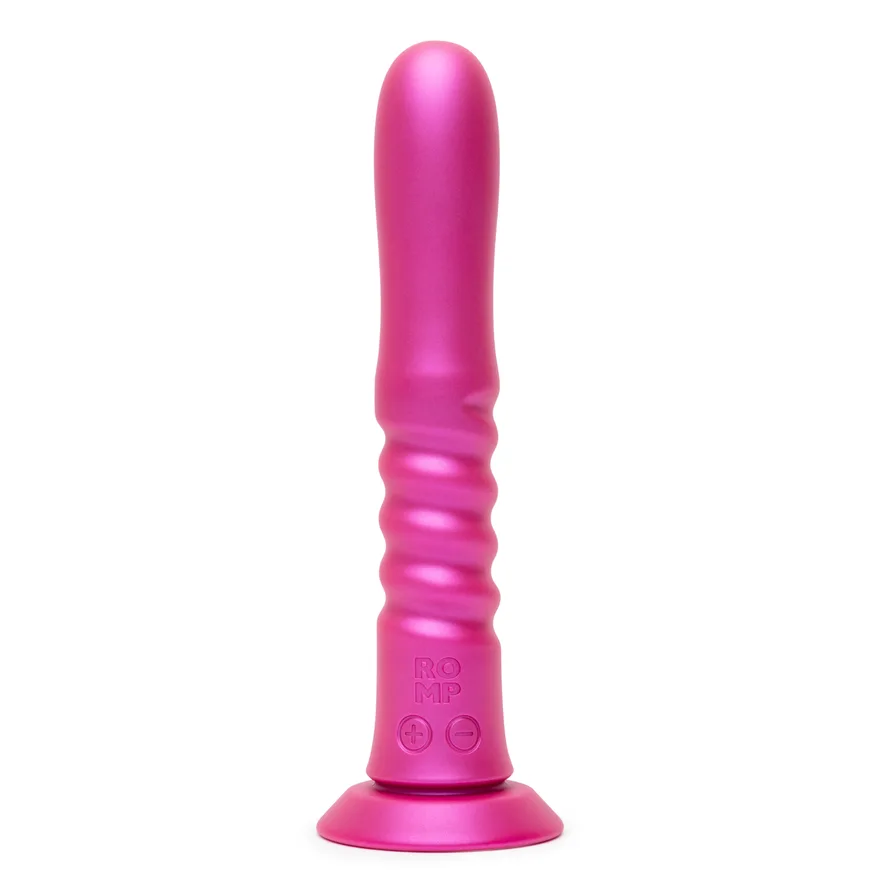
ROMP Jiggle is a thrust vibrator, meaning it’s a product whose motor moves part of the product back and forth instead of just vibrating. It has a suction-cup base and is sold in a single color that ROMP calls Cosmic Pink. The model number is JIG10A, and the Swedish item carries EAN 4251460632485.
The specification that can be substantiated by the manufacturer looks like this: total length 23 centimeters, insertable length 10.5 centimeters, 3.5 centimeters in diameter, a suction-cup base of 7.4 centimeters, six thrust speeds, four thrust patterns, protection rating IPX6, charging via USB, and 90 minutes of operating time at the highest speed. The input voltage is 5 volts DC at 0.8 ampere. In Sweden, the item is sold in six listings at five stores at prices between 537 and 649 SEK, and all the listings that actually have the product in stock are at 649 SEK.
So far, it’s a completely ordinary product walkthrough. But this model has a peculiarity that must be mentioned before anything else, because it affects how each of the digits above should be read.
ROMP does not publish a product page for Jiggle. The model is missing from the manufacturer’s complete catalog on both the European and the US versions of romp.toys. The address romp.toys/eu/jiggle returns 404. The model is also missing from the manufacturer’s list of downloadable user manuals, which otherwise covers nineteen other ROMP models. And it is missing on the page with the EU declaration of conformity, where ROMP, as of the time of writing, only publishes documents for two products.
It’s unusual, and it’s worth knowing before you pay. For a product like Reverb, the same manufacturer publishes a product page, a specification image, an image showing what’s included in the delivery, and a downloadable quick guide in PDF. For Jiggle, there is nothing like this. In practice, that means the only documentation a buyer has to go by is what comes in the box — and the information the stores themselves provide, which this review will show is not particularly reliable.
What can still be directly traced to the manufacturer are two things, and both are first-hand details in the true sense of the word. The one is the labeling that is embossed on the underside of the suction cup: JIG10A, IPX6, the batch code 2538, and the electrical data 5 V DC at 0.8 A. The other is the packaging’s own side panel, which ROMP has printed itself and which lists seven features and includes a dimension drawing. Both are legible in the retailers’ high-resolution product images. Every number in this text that is described as the manufacturer’s information comes from one of these two.
The difference is mechanical, and it is fundamental. A normal vibrator has a motor that makes the entire product shake—either through an unbalanced weight on a rotating shaft or through a linear motor that shakes a mass back and forth over a very short distance. The product stays still in relation to the body; it’s the surface that vibrates.
A thrusting vibrator does something completely different. Here, the motor drives a mechanism that moves part of the product over a significantly longer distance, in an in-and-out motion. The outer shell of the product remains still while an internal part moves, or else the entire shaft moves relative to the base. So the motion is not a vibration, but a displacement, and it’s large enough to see with the naked eye.
The technical “price” for the motion is high, and that’s why this product class is worth understanding before you buy. A thrust mechanism requires more power than a vibration motor, because it moves mass over a long distance against friction. It contains moving parts that slide against each other, which creates more wear points than an encapsulated eccentric motor. And it’s harder to make completely sealed, because the mechanics need room to move. That explains two of the most striking traits in Jiggles specifications: the relatively short runtime of 90 minutes, and the IPX6 enclosure rating instead of the IPX7 that is standard in the rest of the category.
ROMP is clear in its own packaging text about what the product is. The side panel starts with the line “Thrusting vibration,” and the two lines that follow state six thrust speeds and four thrust patterns. So the manufacturer counts speeds and patterns in thrust terms, not in vibration terms—a detail that matters further down, because two of the Swedish shops describe the same ten settings as if they were six vibration levels plus four thrust patterns.
The dimension drawing on the package’s side panel is the manufacturer’s own and gives four measurements: 23 centimeters total length, 10.5 centimeters insertable length, 3.5 centimeters diameter, and 7.4 centimeters for the suction-cup base. It is unusually detailed for a package drawing, and it is also the only place where ROMP themselves print the measurements anywhere.
The proportions are worth stopping to think about. Of the 23 centimeters total length, less than half is intended to be inserted. The rest is the mechanical housing and the suction-cup base. It is a direct consequence of the design: the impact motor, the gearbox, and the battery must fit somewhere, and on a product that is meant to stay attached to a surface they have to be in the lower part. So the person who bases their judgment of whether the product is too big on the total length will therefore end up judging it wrong by more than twelve centimeters.
There is a clear contradiction in the shop listings, and it is big enough to be a purchase decision in its own right. Blush Me and SexleksakerOutlet both state the insertable length as 18 centimeters, in a product text that is word for word identical on the two shops. Vuxen states 10.5 centimeters. The manufacturer’s own dimension drawing on the package states 10.5 centimeters. And a retailer outside the Swedish list states 4.1 inches, which is 10.4 centimeters.
Three independent sources therefore point to 10.5 centimeters, and the manufacturer is one of them. The reasonable conclusion is that the 18-centimeter information is wrong, and that it has spread between two shops because the same supplier text has been copied. That this figure still appears in two of four Swedish product texts is one of the strongest arguments for never buying a product in this category based solely on the shop description.
The difference is not academic. 18 centimeters insertable is roughly what a large realistic dildo offers; 10.5 centimeters is a moderate, in practice easy-to-handle length that reaches the G-spot area without going any further. A buyer who orders based on the 18-centimeter information and then gets 10.5 centimeters will experience the product as significantly smaller than promised—and a buyer who refrains from ordering because 18 centimeters feels like too much is refusing for the wrong reasons.
The suction cup is the feature the manufacturer highlights most clearly after the actual thrust movement. The package’s side panel states “Suction-Cup base — your hands-free fun,” and the dimension drawing sets the base width at 7.4 centimeters. It’s a big suction cup in this context, and there is a physical reason it needs to be that size.
A suction cup holds in place through the pressure difference between the air outside and the partial vacuum under the cup. The holding force grows with the cup’s area—so, with the square of the diameter. But with a thrust vibrator, the mechanism is working against the attachment all the time: each stroke sends a force through the shaft down into the base, and that force tries to pull the cup loose. A normal dildo with a suction cup only needs to withstand what you do with it yourself. A thrust vibrator also has to withstand its own motor, fifty times per minute or more. That is why 7.4 centimeters is a reasonable measure here and would be excessive for a passive product.
What is required of the surface follows from the same principle. The surface must be smooth and airtight—tile, glass, painted sheet metal, a bathtub side. Porous material such as untreated wood or plastered walls allows air in under the edge, and the cup loses its grip. The shops describe this correctly: Blush Me states the wall, floor, tile, or glass. It is also that combination—suction cup plus splash resistance—that is what makes several shops market the product explicitly for the shower wall.
The material question is the only property of an intimate product that can’t be compensated for through experience or care, and it determines whether the product is still hygienic after five years. That is why it is notable that it is the least documented line in the entire specification.
ROMP does not state any material for Jiggle anywhere in the accessible material—neither on the side panel of the packaging, in the markings on the unit, nor on a product page, because there is no. All Swedish shops state silicone. Vuxen specifies it as medical silicone and adds that the material is hypoallergenic and phthalate-free. Blush Me and SexleksakerOutlet write premium silicone. Mshop writes silicone in its specification table.
Silicone is a non-porous material. A non-porous surface can be cleaned, because there are no microscopic cavities where residue can get trapped. It is the single most important property of a material that will be placed against mucous membranes, and that is why the material declaration carries more weight than almost all other lines in a specification. Silicone also tolerates heat, ages slowly, and retains its shape.
The terms “premium silicone” and “medical silicone,” however, are not protected concepts and they say nothing beyond what the word silicone already says. There is no standard that determines when a silicone can be called medical in this product category. So the information has value only insofar as it comes from someone who knows, and here it comes from the shop—not from the manufacturer.
A statement belongs here. On a thrust vibrator, the silicone is only the outer shell. Inside there is a mechanism that consists of plastic and metal, and the manufacturer does not publish a breakdown of which materials are where. It matters less for hygiene, since only the outer shell comes into contact with the body, but that means the usual comparison “full silicone vs. silicone and ABS” cannot be made for this model.
Phthalates are a group of softeners used to make plastic—above all soft PVC—flexible. The Swedish Chemicals Agency describes them as substances that can affect the endocrine system and make reproduction more difficult, and several of them are therefore restricted or banned within the EU in a large number of products. This product category is a recurring subject of supervision precisely because it contains soft plastic in contact with skin.
Silicone itself doesn’t require any phthalate softeners to become soft—the softness comes from the polymer’s own structure. That’s why, in practice, a correct material statement about silicone is also a statement that phthalates aren’t needed. But that isn’t the same as a declaration. ROMP publishes no commitment about phthalates, BPA, or latex for Jiggle. The only source for such a claim is the retailer Vuxen, which states that the material is hypoallergenic and phthalate-free. It’s a store claim and should be read as a store claim.
What there is, on the other hand, is CE and UKCA marking molded into the body, together with the WEEE symbol for electronics recycling and the origin statement Made in China. The CE mark is the manufacturer’s own declaration that the product meets applicable EU legislation, and that in itself is a statement. However, it does not replace a material declaration, and the declaration of conformity that normally underlies the mark is not published by ROMP for this model.
The interface is as simple as it can be. The product images show two buttons embossed into the silicone on the lower, conical part just above the suction cup: one with a plus sign and one with a minus sign, with the ROMP logo embossed above them. There is no display, no LEDs visible in the images, and no third button.
The manufacturer’s packaging text states six thrust speeds and four thrust patterns, meaning ten settings in total. How they’re accessed—whether the plus button steps through all ten in sequence or whether a long press switches between speeds and patterns—is not shown in any material that ROMP publishes, because there is no instruction manual to download. It’s one of the details that would normally be found in a quick guide.
The buttons’ placement is, however, logical and worth noting. They’re located on the part of the product that is outside the body even during full insertion, and they’re positioned over the suction cup rather than on it. That means they can be reached both when the product is held in your hand and when it’s secured to a surface—which is the whole point of a product marketed for hands-free use.
Six speeds and four patterns are not twenty-four combinations, and it’s important to understand why. In this type of product, the patterns are preprogrammed rhythms with built-in speed variation of their own—they switch themselves between faster and slower strokes. The six speeds are fixed settings. The norm in this product category is that you choose either a fixed setting or a pattern, not both at the same time. That’s why ten modes are the reasonable interpretation, and it’s exactly how Blush Me and SexleksakerOutlet count it: ten thrusting modes, including six intensity levels and four patterns.
Six constant steps are fewer than what a plain vibrator typically has, and there’s a technical explanation. A thrusting mechanism has a mechanically predetermined stroke length, and the only thing that can be varied is how quickly the stroke is repeated. A vibration motor, on the other hand, can be varied step-less in both amplitude and frequency. So six steps on a thrusting mechanism correspond to a wider span in perceived difference per step than six steps on a vibrator would. Still, expect that in practice you end up going back to two or three of them.
The stores disagree here, and the difference isn’t cosmetic. Vuxen describes the product as equipped with dubbla motorer: one that drives the thrusting mechanism and one that provides six vibration speeds, in addition to four thrusting modes. Blush Me and SexleksakerOutlet describe the same ten modes but exclusively in thrusting terms—six thrusting speeds and four thrusting patterns.
The manufacturer’s own packaging panel determines the answer to the extent that it can be determined. ROMP writes “6 Thrusting speeds” and “4 Thrusting patterns”, meaning six thrusting speeds and four thrusting patterns. The header row at the top of the same panel reads “Thrusting vibration,” which suggests that the thrusting movement itself is experienced as vibrating rather than there being a separate vibration motor. Nowhere in the manufacturer’s materials is two motors or a separate vibration mode mentioned.
The conclusion is that Vuxen’s description of dual motors and six separate vibration speeds isn’t supported by the manufacturer’s own material, and it should be treated as a store interpretation until ROMP publishes something that says otherwise. So the person who buys the product specifically to get both thrusting and independent vibration is buying based on a claim that only one of four stores makes.
This is the specification item that is most strongly supported throughout the entire specification, and at the same time the one that most shops describe incorrectly. The IPX6 enclosure class is stamped directly into the suction cup’s underside, along with the model number JIG10A and the electrical data. The same class is also printed on the side panel of the packaging, phrased as “Splashproof (IPX6) — for easy cleaning”.
The rating comes from the international standard IEC 60529, which defines enclosure classes for electrical equipment. The number in the second position indicates protection against water. IPX6 means that the product is tested against a powerful water jet from all directions. IPX7 means that the product is tested for immersion to a depth of one meter for 30 minutes.
The difference is crucial in everyday life. With IPX6, the product can be rinsed under the tap, withstand the shower spray, and be used in a wet bathroom. It must not be submerged in water. That rules out the bathtub as a place of use, and it also rules out putting the product in a bowl of soapy water for cleaning. Blush Me and SexleksakerOutlet state this plainly in their product texts: “However, do not fully submerge it in water.” That is correct, and it’s good that they write it.
There is also a design explanation for why it stops at IPX6 here. A shock-impact mechanism needs either a movable seal or an elastic membrane where the mechanism moves—and both are harder to make watertight than a completely enclosed housing. The products in the category that handle IPX7 solve it with a fully encapsulated outer housing that deforms instead of sliding—which is exactly what Fun Factory does in the Stronic series, and that’s also why they can state IPX7.
Mshop’s product page contradicts itself three times on the same page. In the bullet list at the very top it says “IPX6 splashproof — perfect for play in the shower”, which is correct. In the specification table further down it lists water resistance: “100% waterproof”. And in the care instructions text it says the product is “IPX7 waterproof”.
Two of the three pieces of information are wrong, and it is the most serious factual contradiction in this review—serious because a buyer who thinks they have an IPX7 product could submerge it in the bathtub and ruin it. The manufacturer’s marking on the housing takes precedence over the shop’s text. Treat the ROMP Jiggle as splashproof, not as submersible, regardless of what the product page says. By the way, the same care-instructions text on Mshop also includes the sentence about rinsing off the “whole egg,” which suggests that the text has been reused from an entirely different product.
Rinse the product with lukewarm water after each use and use an unperfumed soap or a cleaning product intended for intimate products. Keep it under running water instead of dipping it, for reasons that are clear from above. Be extra careful at the seam between the handle and the lower part, because that is where the mechanism moves and where residue is most likely to be left behind. Wipe dry with a clean towel and let it air-dry completely before putting the product away.
The retailers’ instructions are consistent on the issue of lubricants, and they’re right: use a water-based lubricant. Silicone-based lubricant should not be used on silicone products—it breaks down the silicone surface over time and makes it porous, and a porous surface can no longer be cleaned properly; it can only be replaced. Oil-based products like coconut oil leave a film that is difficult to remove, and ROMP’s warranty terms expressly exclude damage caused by oils, creams, sunscreen, and essential oils. So this is not just a care tip—it’s a warranty condition.
For storage, it’s the usual: dry, cool, protected from direct sunlight, and preferably separate from other products, so the suction cup doesn’t get stuck to something else made of silicone. No storage pouch is included according to any of the retailers’ delivery listings.
The manufacturer states 90 minutes of runtime at the highest speed. The wording on the packaging is exactly that—“90 mins on highest speed”—and it’s a more honest formulation than the usual one, because runtime is otherwise almost always stated at the lowest setting, where it looks best. At lower speeds, the battery therefore lasts longer than 90 minutes—and ROMP does not state how much longer.
Ninety minutes is short compared with the category overall but reasonable for a thrusting product. A thrusting mechanism accelerates and brakes a lot multiple times per second against friction, and it takes significantly more power than spinning an unbalanced weight. Fun Factory states up to two hours for the Stronic Real, which is the level that is realistic to compare against.
Via a supplied cable that connects to the suction cup’s neck. The manufacturer’s own charging image clearly shows what it’s about: a thin black cable with a proprietary yellow pin plug on one end and a standard USB-A connector on the other. The plug is inserted into a socket on the product’s lower part just above the suction cup. The marking on the housing indicates 5 volts DC at 0.8 ampere, which is standard values for a USB-A port and means the product can be charged from any standard USB charger or computer port.
But the plug itself is product-specific, and that is the model’s most important practical drawback. If you lose the cable, no ordinary USB-C cable works as a replacement. You are limited to a replacement cable from the manufacturer—the same manufacturer that does not publish any product page for the model, which makes it harder than usual to know where to order such a cable. This is a real difference compared with Fun Factory’s Stronic series, where both Petite and Real are charged with a standard USB-C cable.
There’s also another retailer contradiction here. Mshop’s care instructions text claims that “ROMP Jiggle comes with magnetic USB charging.” The manufacturer’s own picture shows a plugged-in pin plug, not a magnetic connector. So the claim about magnetic charging has no support, and anyone who buys the product believing the cable attaches magnetically will be disappointed.
ROMP does not publish the battery capacity in mAh, its voltage, or the charging time for Jiggle. The 5 volts and 0.8 ampere embossed into the housing are input data for the charging circuit, not the cell’s data—they say that the charger can supply a maximum of four watts, nothing about how big the battery is. Vuxen states that it involves a lithium battery, which is the only battery-type information that can be found anywhere, and it is a store claim.
The charging time is only listed as a store claim as well. Blush Me and SexleksakerOutlet state about 130 minutes in their identical product texts. Mshop and Vuxen list no charging time at all. If you calculate backwards from 5 V and 0.8 A for 130 minutes, you arrive at an order of magnitude that is reasonable for a battery in this product class, but it is an estimate and not a published value, and that’s why it isn’t shown as a number in the specifications table below.
What applies generally to lithium-ion batteries also applies here: capacity decreases with the number of charge cycles, the cell is very likely not replaceable in a product that is cast in silicone, and the product does best when it is charged regularly instead of being stored fully discharged. On a shock/vibration product, it is also usually the mechanism rather than the battery that sets the limit for service life, because it is the only part with sliding surfaces.
ROMP publishes no measured decibel value for Jiggle, and neither does any of the Swedish retailers. None of them even describes the product as quiet, which is unusual in this category and in itself informative—silence is otherwise a standard argument that marketing rarely fails to use.
What can be established without measuring is that a percussive mechanism generally sounds louder than a vibration motor. The sound does not come only from the motor, but also from the gearbox and from the mass that moves at each end of the stroke, and every change of direction produces a mechanical sound. A product that is attached with a suction cup to a hard surface also gets a resonance box for free: tiled walls, glass, and bathtub side panels amplify the sound significantly more than a soft surface would do.
So anyone who needs a quiet product should assume that this one is not. And anyone who has heard a decibel value for the model somewhere else should ask themselves where it comes from. There is no published value.
We do not have price data from shops in your market yet.
The packaging’s side panel is the most reliable specification available for ROMP Jiggle at all. The manufacturer publishes nothing else.
Three comparisons are relevant: against the shock vibrator that costs exactly the same, against the one that costs less and is better documented, and against ROMP’s own product in the corresponding price range. All technical information below comes from each manufacturer’s own published specifications, and all prices come from the shops’ product feeds on July 29, 2026.
Fun Factory Stronic Petite costs from 649 SEK, meaning exactly the same price as Jiggle at the stores that have it in stock. That makes the comparison above unusually clear: this isn’t about what you get for more money, but what you get for the same money.
Fun Factory publishes total length 170 millimeters, cross dimensions 38 × 37 millimeters, weight 218 grams, material silicone and ABS plastic, eight shock programs, charging via USB-C, and enclosure rating IPX7. ROMP publishes total length 23 centimeters, insertion length 10.5 centimeters, diameter 3.5 centimeters, ten positions, proprietary charging connector, and IPX6 — and neither weight, material specification, nor battery data.
Line by line, Stronic Petite wins on four points that are all controllable: IPX7 instead of IPX6, USB-C instead of a product-specific plug, a published weight instead of none, and a manufacturer that actually has a product page and a downloadable manual for the model. Jiggle wins on two: a suction cup for hands-free use, which Petite completely lacks, and a longer insertion portion.
If the suction cup is important to you, that’s an easy choice in Jiggle’s favor, because Petite can’t be attached to a surface. If it’s not important, it’s hard to justify Jiggle at the same price.
Fun Factory Stronic Real costs from 506 SEK, meaning it is 143 SEK less than Jiggle. It’s also the shock vibrator in the comparison with the most published data behind it: total length 202 millimeters, cross dimensions 40 × 35 millimeters, weight 275 grams, body-friendly silicone, ten shock programs, up to two hours of operating time, charging via USB-C, and IPX7.
Ten shock programs for Jiggles’ ten settings is therefore tied in terms of number. Runtime is two hours versus 90 minutes. The ingress protection rating is IPX7 versus IPX6, which means that Stronic Real can be submerged in water and Jiggle cannot. The charging connector is USB-C versus a proprietary plug. And the weight is published instead of unknown.
What Stronic Real doesn’t have is the suction cup. It’s made to be held in your hand or laid against your body, not to be attached to a surface. And it’s wider: 40 millimeters versus Jiggles’ 35. If you want a shock vibrator and don’t care whether the hands-free mount exists, then on paper there’s no reason to pay 143 SEK more for a model with worse water resistance, a shorter runtime, and a cable that can’t be replaced in a regular electronics store.
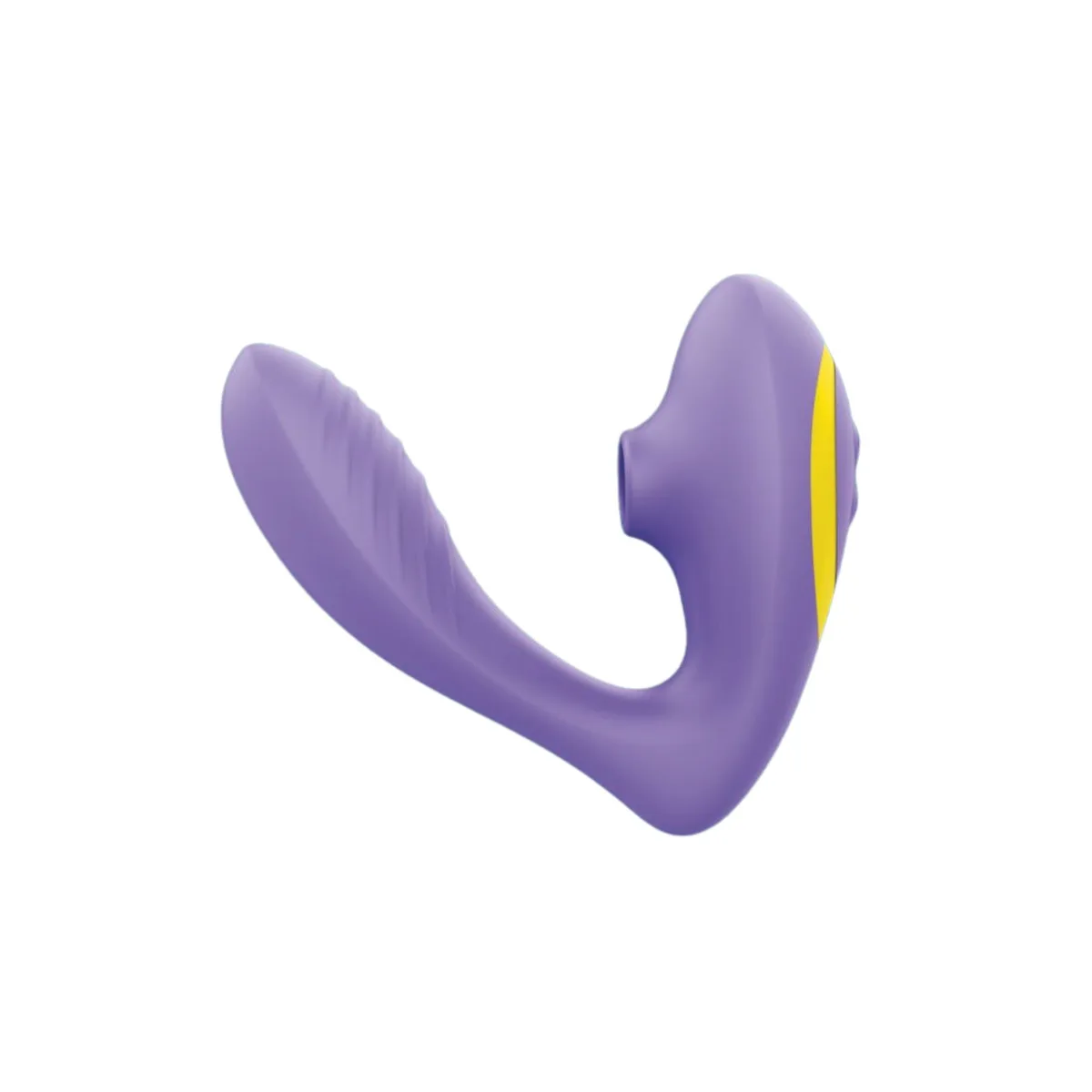
The last comparison isn’t about technology, but about what a brand is worth. ROMP Reverb costs from 395 SEK and is a different kind of product — a dual stimulator with an air pressure chamber, not a shock vibrator — but it comes from exactly the same manufacturer.
For Reverb, ROMP publishes its own product page: a specification image with dimensions and material details, an image showing what’s included in the delivery, and a downloadable quick guide in PDF form. For Jiggle, the same manufacturer publishes nothing at all. It’s the same brand, the same warranty terms, and the same stores — but two completely different levels of traceability.
That’s the difference that matters most for the rating here. A product that lacks a manufacturer page also lacks the place where a buyer can look up what applies when something breaks, which replacement cable fits, how the buttons work, and what the material is made of. It isn’t a fault in the product, but it’s a real cost for the buyer, and it’s paid for in uncertainty.
Five Swedish stores list the item with EAN 4251460632485, spread across six listings — Sexonic has posted the same EAN on two separate product pages, one under the name “Romp Jiggle Pink” and one under “Romp Jiggle Up and Down Vibrator with Pink Suction Cup”. It’s the same item twice, not two variants.
The lowest listed price is 537,09 SEK at Sexonic. However, that price applies to both of the sold-out listings. All four stores that actually have the item in stock — Blush Me, SexleksakerOutlet, Mshop and Vuxen — are at exactly 649 SEK. So there’s no price difference at all to compare among the available stores, which is unusual and suggests that the item is still being sold at the recommended price without any store starting to squeeze the margin.
The fact that the only lower price tag is attached to a sold-out item is worth noting in itself. Stores that list a product as sold out may keep an old price in the feed, and that price is rarely what you actually end up paying when the item comes back in. A price watch that counts 537 SEK as the model’s lowest price therefore gets it wrong in practice.
Shipping cost is added at all stores in this price range—the feeds show between 29 and 98 SEK depending on the store—and in this case that difference is larger than the price difference on the item itself, since the latter is zero. Always check the final price at checkout.
It’s for you if you specifically want a thrust vibrator with a suction cup. The combination isn’t a given in the category: neither Stronic Petite nor Stronic Real has a grip, and a suction cup that’s 7,4 centimeters wide and designed to withstand a working thrust motor is the real argument for this model. It’s for you if you want to be able to use the product in the shower, because IPX6 is more than enough for a stream of water. And it’s for you if you think 10,5 centimeters insertable and 3,5 centimeters in diameter are the right size—those are modest dimensions that aren’t meant to impress.
It’s not for you if you want to be able to submerge the product in water, because IPX6 doesn’t allow that. It’s not for you if you want to charge it with the same cable as your phone, because the plug is product-specific. It’s not for you if you want to read the manufacturer’s specifications before you buy, because they aren’t available. And it’s not for you if you assume that a product with a total length of 23 centimeters has 23 centimeters to work with—less than half is insertable.
One more thing belongs in the decision, and it’s uncomfortable. In this comparison there’s a direct competitor at the same price and another at a lower price—both with IPX7, both with USB-C, both with published weight, and both with a manufacturer that documents its products publicly. Jiggle wins on the suction cup and on nothing else that can be substantiated. If the suction cup is what you’re after, it’s a reasonable buy. If it isn’t, it’s hard to recommend the model over the alternatives.
ROMP provides a two-year manufacturer’s warranty on all rechargeable and battery-powered products, so the warranty also applies to Jiggle despite the fact that the model doesn’t have its own product page. According to the manufacturer, the warranty covers the function-carrying parts—that is, the parts that affect that the product works. There’s no requirement to register; it’s enough to save the receipt. ROMP states that, at its own discretion, it either replaces the product or refunds the purchase price.
Read the exceptions before you rely on the warranty. It does not cover cosmetic wear and tear, accidents, or incorrect use, neglect, or damage caused by oils, creams, sunscreen, or essential oils. The warranty also ceases to apply if the product has been opened or taken apart. This last point is relevant for just a thrusting vibrator, because the mechanics are the part that is most likely to break first and at the same time the part that cannot be accessed without breaking up the housing.
Two years is shorter than what several competitors in the broader category provide, but it is the brand’s standard and applies equally to all ROMP products. What always applies, however, is your statutory rights—and in Sweden they last longer than the manufacturer’s warranty: according to the Consumer Sales Act (konsumentköplagen), you have three years to file a complaint in the event of defects in the goods, regardless of what the manufacturer promises.
When buying at a distance, you also have a right of withdrawal for fourteen days under the Act on Distance Contracts and Contracts Outside Business Premises. Be aware that, in practice, the right of withdrawal is limited for hygiene products that have been removed from a sealed package—however, the right to complain in the event of defects always applies. If you have questions about what applies in your case, the Swedish Consumer Agency (Konsumentverket) guides you via Hallå konsument.
One final practical point about this specific model: since the manufacturer does not publish any product page, no manual, and no statement of conformity, the receipt and the package are the only documentation you have. Save both. As this review (genomgång) has shown, the side panel of the packaging is the most reliable specification available for the ROMP Jiggle.
ROMP Jiggle Thrusting Vibrator is ranked på plats 11 av 12 in thrusting vibrator best i test, where the entire category is compared against each other using five shared criteria. Guiden vinns av Fun Factory Bi Stronic Arc Thrusting Rabbit Pulsator.
Every numerical piece of information in the text can be traced to one of the sources below. The links were checked manually on the specified date.
This page is machine-translated from Swedish. Read the Swedish original