

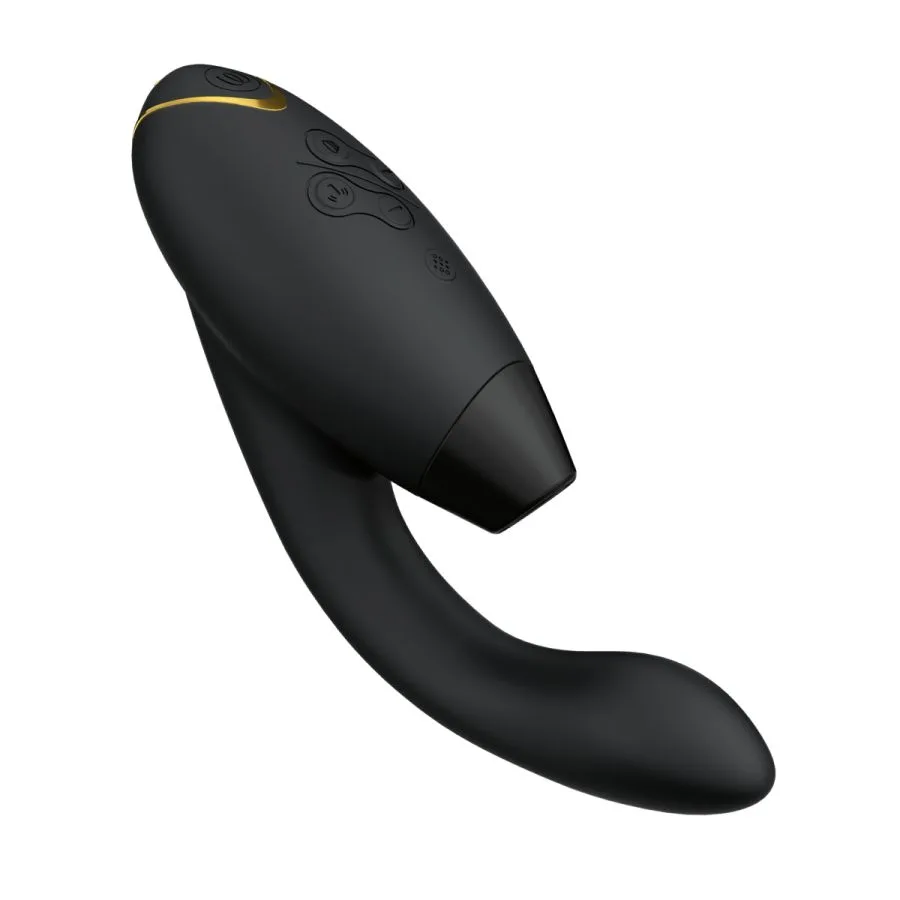
Review
Review: Womanizer Duo 2 Black
The premium version of the same idea—14 levels and a five-year warranty.
29 July 2026
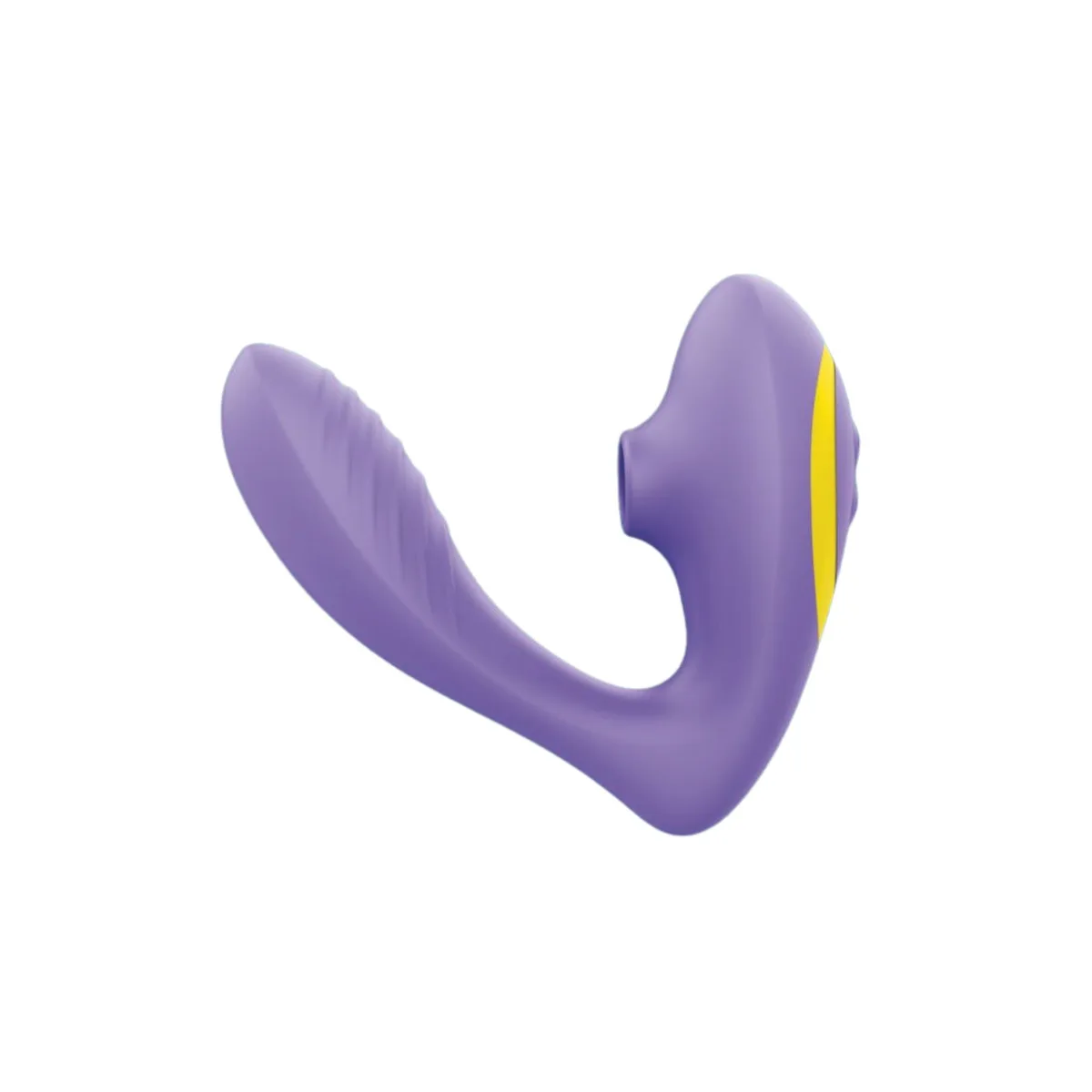 Best budget
Review · Double stimulator · Air pressure and G-spot vibration
The double stimulator from Womanizer’s sister brand reviewed against the manufacturer’s own specifications and price data from seven Swedish stores. Ten suction levels and ten vibration modes with its own button, body-friendly silicone and ABS, IPX7 according to IEC 60529, a 600 mAh lithium-ion battery, and 90 minutes of operating time — at a price that differs by 128 percent between the cheapest and the most expensive store.
The cheapest way to get the combination of air pressure and G-spot vibration: two motors with their own button, ten suction levels, three speeds, and seven patterns, IPX7, and 90 minutes of runtime on a battery whose capacity the manufacturer actually publishes. You get a two-year warranty instead of five, a product-specific charging pin, a specification without a phthalate declaration, and a manufacturer that states two different runtimes on the same page.
ROMP Reverb is a dual stimulator: a clitoral part that works with air pressure and a curved insert part that vibrates against the G-spot. The two parts are driven by separate motors and controlled by separate buttons, which is the whole point of the design — you can run them either separately or at the same time. The manufacturer calls the air-pressure part Pleasure Air Technology, the same technology name used by Womanizer, and that’s no coincidence: both ROMP and Womanizer are made by WOW Tech Europe GmbH in Berlin.
The specification looks like this: ten suction levels on the clitoral part, three vibration speeds and seven vibration patterns on the G-spot part, body-friendly silicone and ABS as materials, enclosure rating IPX7, a 3.7-volt lithium-ion polymer battery and 600 milliampere-hours, 90 minutes of operating time, 150 minutes of charging time, a locking mechanism for storage and a two-year manufacturer’s warranty. The insert part is 140 millimeters long and 40 millimeters wide, the suction arm is 116 millimeters, and the product’s model number is REV10A. In Sweden, the item is sold by seven stores at prices between 395 and 899 SEK.
This review is about the lilac variant with EAN 4251460621984, the manufacturer’s item number RPRE1SGD. The color is called Lilac by the manufacturer, while the Swedish stores alternately call it Lilac, Purple and Lila — it’s the same item, and the EAN number is identical in all seven stores. Reverb is sold according to the manufacturer’s product page only in this color, which makes the purchase comparison above unusually simple: if you find a cheaper Reverb, it’s the same product, not a different variant.
Air pressure technology is based on a pump alternately creating under-pressure and over-pressure in a closed chamber that is placed over the clitoris. The chamber never touches the clitoris directly. The stimulation happens through pressure waves in the air inside the head, and that is why the product category is described as touch-free. The difference compared with a regular vibrator is fundamental: a vibrator transfers mechanical motion from a motor through material to the skin, while an air-pressure product transfers pressure changes through air. The manufacturer states that the opening in the suction chamber measures 16 millimeters, and it is that figure that determines whether the product fits—an air-pressure chamber must seal tightly around the clitoris for the technology to work at all.
What the Reverb adds is the second arm. The insert part is 140 millimeters long, 40 millimeters wide, and has a circumference of 125 millimeters according to the manufacturer’s dimension sketch. It is ridged on the top side and curved so that the pressure is directed forward toward the front vaginal wall. The construction is therefore the classic rabbit principle, but with air pressure instead of a vibrating clitoral arm. What can be established purely from a technical perspective is that you get two independent controls: ten suction levels on one button and ten vibration modes on the other.
Having the parts controlled separately is more important than it sounds. On many dual stimulators, a single program switches both vibration and pulse at the same time, making it impossible to adjust one half without the other moving. The manufacturer’s button description is unambiguous: the upper button drives the clitoral stimulator, the lower button drives the G-spot stimulator, and both are started by pressing and holding for two seconds. In practice, that means you can leave the air pressure at the same level while you step up the vibration, or turn off one of them completely.
ROMP is WOW Tech Europe GmbH’s cheaper brand. The address in the quick guide is the same as Womanizer’s—Hermann-Blankenstein-Str. 5 in Berlin—and the support address on ROMP’s own product page is even a womanizer.com address. Pleasure Air Technology is the same technology family in both ranges.
The differences between the brands, however, are systematic and are worth knowing before you compare a ROMP with a Womanizer:
The material in question is the only property of an intimate product that cannot be compensated for with experience or care, and it determines whether the product is still hygienic after five years. The manufacturer lists two materials for Reverb: body-friendly silicone and ABS. For the stimulation head, only body-friendly silicone is specified.
Silicone is a non-porous material. A non-porous surface can be cleaned, because there are no microscopic cavities where residue can get trapped. It is the single most important property of a material that is meant to lie against the mucous membrane, and that is why the material declaration weighs more heavily than almost all other lines in a specification.
The manufacturer does not specify exactly where the boundary between silicone and ABS is on Reverb, but the design can still be read from. What is stated explicitly is that the main material — the one that makes up the stimulation head — is body-friendly silicone, and that the product as a whole consists of body-friendly silicone and ABS. The same breakdown is confirmed by all Swedish stores, which list “silicone and ABS plastic” respectively “ABS plastic/Silicone”. ABS is a rigid construction plastic and is normally used for the inner chassis and for the button and battery housing—i.e., where strength is needed.
Practically speaking, that means that the surfaces that meet the body are silicone, which is what matters hygienically. It also means that the stimulation head is not detachable—the manufacturer does not list any replaceable tips in the delivery, unlike Womanizer DUO 2, which comes with two sizes. The inside of the comb therefore must be cleaned in place. The manufacturer’s own instruction is to do it with a cotton swab, which is a reasonable but not as convenient alternative as being able to pull off the head and rinse it separately.
Phthalates are a group of plasticizers used to make plastic—above all, flexible PVC—pliable. Kemikalieinspektionen describes them as substances that can affect the hormone system and make reproduction harder, and several of them are therefore restricted or banned within the EU in a large number of products. This product category in particular is a recurring subject of supervision because it contains flexible plastic that touches the skin.
Here there is a gap that is worth pointing out. ROMP does not publish any phthalate, BPA, or latex declaration for Reverb. The material line in the specification only reads "Body-safe silicone, ABS". This is particularly striking because the manufacturer does it for another model in the same range: ROMP Pulse is expressly stated to be "Produced without phthalates and latex". Womanizer DUO 2, from the same group, is stated to be manufactured without phthalates, BPA, or latex.
What does the absence of the declaration mean? Not that the product contains phthalates—silicone does not require phthalate plasticizers to become soft, because the softness comes from the polymer’s own structure, and ABS is a hard plastic that is normally not plasticized at all. But it means that you have to rely on the material wording instead of on a promise. It is one step worse than what the same manufacturer offers on the neighboring model, and that kind of gap is worth noting precisely because it is easy for the manufacturer to fix.
A second gap belongs in the same section. The manufacturer does not publish an EU declaration of conformity for Reverb. On ROMP’s page for the Declaration of Conformity, there are two documents: one for the Cello model and one for the Party model. Reverb is not there. The product bears a CE mark molded into the silicone according to the manufacturer’s own product images, but the declaration itself therefore cannot be downloaded and read.
The manufacturer states the measurements broken down by component rather than as an external box, which actually is more useful. The suction arm measures 116 millimeter; the insert part is 140 millimeter long and 40 millimeter wide; the circumference of the insert part is 125 millimeter; and the suction opening is 16 millimeter. The dimension sketch on the product page shows the same three main dimensions: 140 millimeter in length, 116 millimeter in height, and 125 millimeter in circumference.
The Swedish shops list the same figures rounded to centimeters—the clitoral pulsator is 11.6 centimeters, the vibrator is 14 centimeters long and 4 centimeters wide—which is a good sign that the information has made it all the way from the manufacturer without anyone recalculating it on their own.
One shop deviates, and the deviation is interesting rather than incorrect. Mshop states an inner length of 12 centimeters and an inner diameter of 3.6 centimeters. Presumably, this is a measure of how much of the insert part actually goes in, meaning it is a different quantity from the manufacturer’s total arm length of 14 centimeters. Use the manufacturer’s figures when you compare against other models, and use the shop’s figures when you consider the insert depth. The same shop also states the packaging dimensions as 16.5 × 13.5 × 6.0 centimeters.
ROMP does not publish a weight for Reverb. The specifications tab includes rows for dimensions, material, battery, runtime, charging time, and warranty—but no weight. It’s one of the most common gaps in this category, and the only piece of information in the entire specification where the retailers’ details contradict each other.
Four of the Swedish retailers—Blush Me, SexleksakerOutlet, Vuxen and Vuxenkul—list 177 grams, with wording so similar to each other that they evidently go back to the same wholesaler text. Mshop, instead, lists 0.29 kilograms (i.e. 290 grams). The difference of 113 grams is too large to be a measuring error, and the most likely explanation is that the two figures measure different things: the product by itself versus the entire shipment including packaging, the charging cable, and printed material. For comparison, Womanizer lists 263 grams for the DUO 2 and 196 grams for the Enigma Cruise—both as product weight.
The conclusion has to be this, honestly: 177 grams is the figure most stores provide and the one closest to the competitors’ product weights, but it comes from the retailers and not from the manufacturer. Treat 290 grams as a likely shipping weight until ROMP publishes its own figure.
The interface of ROMP Reverb consists of two buttons, and the manufacturer explicitly states that the control is precisely "Two buttons". The upper button drives the clitoral stimulator; the lower button drives the G-spot stimulator. Both are started by holding them pressed for two seconds, and then repeated presses step through the modes. Two buttons for two motors is the simplest possible interface for a dual stimulator, and it’s a genuine advantage compared with products where a single program controls everything.
There is a direct consequence of there being only two buttons: there is no way back in the scale. The manufacturer’s description indicates that you move forward through the modes, not that you can step down. So if you want to lower the intensity, you have to cycle around. It’s the same trade-off that applies to almost all two-button products, and it’s worth knowing before you buy—LELO Enigma Cruise, for comparison, has three buttons and two LEDs.
The clitoral part has ten suction intensities, according to the manufacturer. What the manufacturer, however, does not publish is how the steps are distributed, what pressure they correspond to, or what frequency the pump works with. The pattern in this product class is that the lowest steps are clearly spaced apart, while the top steps are closer together, because the difference in pressure per step decreases as the pump approaches its maximum output. Expect that in practice you end up returning to three or four of them.
Ten levels are more than on ROMP’s own Pulse, which has five suction power settings, and fewer than on the Womanizer DUO 2, which has fourteen intensity levels. That is, it’s a reasonable range for a product that costs one quarter of the DUO 2. What can be established is that the number of steps does not say anything about the maximum pressure— a product with fourteen steps can very well have the same peak intensity as one with ten, just more finely divided.
Here there’s a question of interpretation that’s worth clearing up, because the store texts and the manufacturer describe the same thing in two different ways. The manufacturer states “3 vibe speeds and 7 patterns” for the G-spot section. Several Swedish stores instead write “10 vibrating modes.” Both are right: three even speeds plus seven patterns add up to ten modes in total. Lustly is the store that reproduces the breakdown exactly as the manufacturer does.
The difference between speed and pattern is practical. A speed is a constant vibration with different strengths; a pattern is a rhythm that alternates between strengths. Three constant speeds are on the low side if you want to fine-tune an even vibration, and it’s one of the clearest cost savings compared with pricier models. Womanizer DUO 2 lists ten vibration patterns in addition to its fourteen air pressure levels, and LELO Enigma Cruise has eight modes in total, while also publishing the frequencies 60 and 100 hertz—information that ROMP does not provide for any part of Reverb.
Reverb has a lock, and the manufacturer’s quick guide describes the function exactly: press and hold both buttons for three seconds to turn the lock on or off. The product vibrates twice and the LED blinks twice as confirmation. A detail that rarely appears in the store texts: the lock is also automatically deactivated if the product is put on charge.
Lock is the function that makes the difference between a product that can be packed in a bag and one that can’t. Vuxen is the only Swedish store that highlights it, under the name button lock. What can be established is that the function only protects against the buttons being pressed in—it does not protect the battery from self-discharging on its own, and the manufacturer explicitly recommends charging the product regularly even when it isn’t being used.
The LED also functions as a charging indicator, and the quick guide states what the three states mean: off means no power or a charger that’s been placed incorrectly; steady light means fully charged; and blinking light means charging in progress. That’s more information than most manufacturers provide about their single LED.
The question of how quiet a pressurized-air product is is one of the most common before making a purchase, and the answer must be honest: ROMP does not publish any measured decibel value for Reverb, either on the product page or in the quick guide. There is also no marketing wording about quietness in the manufacturer’s feature list—unlike, for example, Womanizer, which describes its models as whisper-quiet and includes a comparison chart.
What can be established in general is that pressurized-air products, as a category, are quieter than rotating eccentric motors, because the sound comes from a pump rather than an unbalanced weight. But Reverb has two motors, of which one drives a standard vibration in the attachment part, and that part is not covered by that reasoning. None of the competitors in the comparison publishes a decibel value either: neither Womanizer for DUO 2 nor LELO for Enigma Cruise. Websites that provide an exact decibel value for any of them either present their own measurement or a value without a source.
A practical tip that applies regardless of the model: place the product on a soft surface between uses. A hard tabletop works as a resonance box and noticeably amplifies the sound.
ROMP Reverb is rated IPX7. The rating comes from the international standard IEC 60529, which defines enclosure classes for electrical equipment. The number 7 in the second position means that the product is tested for submersion in water to a depth of one meter for 30 minutes. The manufacturer states the consequence plainly in the feature list: the product can handle both baths and showers.
The difference versus a splash-proof product is greater than the wording suggests. Splash protection covers water droplets and, at best, water jets, but not submersion. Such a product can handle a damp cloth and possibly a shower, but not a bathtub, and it should not be held under running water without thinking through how it affects buttons and the charging contact.
With IPX7, the entire product can be rinsed off without being careful. This is especially relevant for this design, because the charging contact is a hole in the silicone—if the product had a rubber plug that would need to be closed by hand, the water resistance would depend on whether the user remembered. Note at the same time the manufacturer’s explicit instruction that the product must not be used or cleaned while the battery is charging, and that the charging cable must never be submerged in water. IPX7 applies to the product, not the cable. If a product is missing an IPX rating entirely, it should be treated as not waterproof—the absence of a rating is never a sign that the product would be approved.
Rinse the product in lukewarm water before and after each use, and use an unperfumed soap or a cleaning product intended for intimate products. The manufacturer’s own instructions mention warm water and toy cleaner, and they suggest that the inside of the suction comb can be cleaned with a cotton swab—this is the only part where water and residue can remain, and the only part that can’t be reached with your fingers. Let it air-dry before putting the product away, in a safe, dry place away from direct sunlight.
The question of lubricant is unambiguous in the manufacturer’s instructions: use a water-based lubricant. Do not use perfumed or alcohol-based lubricants, gels, or massage oils, and do not use silicone-based lubricants on silicone products. Silicone-based lubricants break down the silicone surface over time and make it porous, and a porous surface can no longer be cleaned properly—only replaced. ROMP’s warranty page further tightens the wording and warns that oils and creams can cause irreparable damage—sunscreen, lip care, essential oils, coconut oil, and cooking oils are mentioned by name, with the addition that use can void the warranty.
The quick guide also covers three things that rarely appear in store texts. The product and its battery must not be exposed to temperatures above 45 degrees—so boiling water and a dishwasher are out of the question despite IPX7. The product contains a magnet, which means it should not be used directly over a pacemaker, and short periods with a magnetic strip should be kept away from it. And Reverb is expressly not designed for anal use.
ROMP is unusually open about battery data, and it’s worth noting in a category where most manufacturers are satisfied with just “rechargeable.” The specification states a 3.7 volt lithium-ion polymer battery and 600 milliampere-hours. The quick guide’s label data repeats 3.7 volts and 0.5 ampere for the battery, and indicates 5 volts and 0.5 ampere for charging via USB. According to the same guide, the battery is not replaceable.
600 milliampere-hours is a decent cell for the size. For comparison, LELO lists 850 milliampere-hours for Enigma Cruise, while Womanizer does not publish capacity or voltage for DUO 2. That ROMP does means that the operating time can actually be put in relation to something, which is rare enough to count as an advantage in itself.
With a charging pin that is inserted into a hole in the silicone, and the other end of the cable into a USB connector. The manufacturer’s instructions describe it verbatim as saying that the pin should be pressed into the charging hole before the USB end is connected to a power source. On the sibling model Pulse, the manufacturer explicitly states the type of the charging connector as "DC Pin", and the picture of the contents of delivery for Reverb shows the same kind of cable: USB on one end, and a narrow yellow pin on the other.
This is the clearest weakness in the design. The cable is product-specific, and the manufacturer explicitly states that only the supplied original cable may be used. If you lose the cable, no normal USB-C cable works, and a power adapter is not included either—you have to use a USB adapter you already have, with an output power that corresponds to the product’s rating. A charging pin also has a practical disadvantage compared with magnetic charging: it has to be inserted into a hole, and the hole sits in a soft material that can stretch over time. The advantage is the opposite of what you might expect—because the hole is covered by silicone, no rubber plug is needed, which is part of the explanation for why the product can maintain IPX7.
The charging time is stated as 150 minutes. That’s longer than both Womanizer DUO 2 and LELO Enigma Cruise, which are both charged in 120 minutes, and longer than ROMP’s own Pulse at 130 minutes.
There’s a contradiction in the manufacturer’s own material that’s worth disclosing openly. The specification tab on the product page states the operating time as 90 minutes. The function list higher up on exactly the same page instead states "Runtime 60 minutes". The quick guide in the PDF settles the question: it says that after 150 minutes of charging, the product is ready to be used in 1.5 hours, meaning 90 minutes.
So, two out of three of the manufacturer’s claims point to 90 minutes, and that’s also the figure Lustly goes on to use in its Swedish product text. The sixty-minute statement looks like a leftover label in the function block—a similar kind of error occurs on the sibling model Pulse, where the function list states 120 minutes while the specification states 70. Count on 90 minutes, but be aware that the manufacturer itself isn’t consistent.
What generally applies to lithium-ion batteries also applies here: capacity drops with the number of charging cycles, the battery is not replaceable, and the product does best when it is charged regularly instead of being stored fully discharged. The manufacturer itself writes in the quick guide that the product should be charged regularly even when it isn’t being used. With use a couple of times per week, it’s the battery—not the silicone—that sets the limit for the service life—and since the cell is permanently mounted, the product is essentially used up when the battery is.
We do not have price data from shops in your market yet.
Same technology and same factory as Womanizer Duo 2 — for a quarter of the price. What you don’t get is the warranty years, the tips, and the last four steps.
Three comparisons are relevant: against the group’s own premium model, against the other premium brand in the category, and against ROMP’s own rabbit vibrator. All information below comes from each manufacturer’s own specifications, and all prices from the shops’ product feeds on July 29, 2026.
Womanizer DUO 2 costs from 1 468 SEK versus Reverb’s 395 SEK as the lowest price. That’s a difference of 1 073 SEK for two products that are based on the same technology and made by the same company, and the difference in specifications is therefore unusually interesting to read line by line.
DUO 2 measures 88 × 203 × 58 millimeters and weighs 263 grams. It has fourteen intensity levels in air pressure versus Reverb’s ten, ten vibration patterns versus Reverb’s seven plus three speeds, 120 minutes of run time versus 90, and 120 minutes of charging time versus 150. The materials are ABS and body-friendly silicone, explicitly made without phthalates, BPA, or latex. In the package, there are two stimulation tips in different sizes and a cotton pouch. The warranty period is five years versus Reverb’s two. Both are IPX7, and both have two motors that are controlled independently.
Two features are only on the DUO 2 and have no counterpart on Reverb: Smart Silence, which makes the product start only when there is skin contact, and Afterglow, which lets the stimulation fade out instead of shutting off abruptly. Reverb, on the other hand, has a feature that DUO 2 does not market: a travel lock.
The conclusion is that the price difference buys four things—more steps, longer run time, interchangeable tips, and three extra years of warranty—but not another technology. If you want to know whether air pressure combined with G-point vibration works for you, Reverb is a significantly cheaper path to the same answer.
LELO Enigma Cruise costs from 1 495 SEK. It does not use air pressure, but rather what LELO calls Sensonic, meaning sonic wave stimulation—the principle is related but not identical, and that’s a difference worth knowing before you compare.
The specifications: dimensions 100 × 50 × 185 millimeters, insertable length 140 millimeters, weight 196 grams, body-friendly silicone and ABS plastic, three buttons and two LEDs, lithium-ion 850 milliampere-hours and 3.7 volts, run time up to two hours, standby time up to 90 days, automatic shut-off after 20 minutes, frequencies 60 and 100 hertz, and eight modes in total. The warranty is two years plus ten years of quality warranty, and LELO states that the product meets ISO 3533, the international safety standard for sex toys.
The insertion part is exactly the same length as Reverb—140 millimeters in both cases. What the Enigma Cruise adds is longer runtime, a larger battery, a published frequency specification, a third control, and a standard product it is measured against. What Reverb adds is more selectable steps overall, a suction lock, and a quarter of the price. If you choose based on the presented data, LELO wins. If you choose based on price per function, ROMP wins by a wide margin.
Within ROMP’s own range, Pulse is the closest relative: also a rabbit construction with Pleasure Air. It costs 599 SEK at Mshop, which is 204 SEK more than Reverb at its cheapest.
Pulse is 20 centimeters long and 48 millimeters wide at the head—so it’s a significantly larger product with a handle to hold, while Reverb is a short C-shaped model without a shaft. Pulse has five suction power levels against Reverb’s ten, seven vibration patterns, 70 minutes of runtime versus 90, and 130 minutes of charging time versus 150. Both are IPX7, both have a two-year warranty, and both charge with a pin connector. One difference carries more weight than the others: Pulse is explicitly stated to be manufactured without phthalates and latex, which Reverb is not.
So the choice between them is not about performance but about shape. If you want a grip to control with, you choose Pulse. If you want a model that stays in place against the body without needing to be held, and that has twice as many suction levels, you choose Reverb. If you just want to try air pressure on its own, without an insertion part, ROMP Kiss costs from 259 SEK.
Seven Swedish shops sell the item with EAN 4251460621984, spread across eight listings—Sexonic has set up the same product twice, with two different item numbers but the same EAN and the same price. Cheapest is SexleksakerOutlet at 395 SEK, most expensive is Vuxenkul at 899 SEK. It’s a 504 SEK difference, or a 128 percent difference, for exactly the same item number, the same color, and the same packaging.
The stock situation is more favorable than for most premium models. Five of the eight listings were in stock during the price check: SexleksakerOutlet at 395 SEK, Blush Me at 449, Vuxen at 499, Mshop at 599, and Lustly at 849. That means the difference between the cheapest and the most expensive available specimens is 454 SEK, and that the cheapest one can actually be purchased. Both Sexonics’ listings and Vuxenkul’s post were sold out. Shops that list a product as sold out may still have an old price in the feed, and that price is rarely what you actually end up paying when the item comes in again.
The price spread does not depend on any store selling a different variant—all seven stores list the item under EAN 4251460621984. For reference, the product costs 59.99 euro in the manufacturer’s own European web store, which places the Swedish prices in the wide range from clearly below to clearly above the manufacturer’s own price. So it’s about the stores’ own margin-setting, and this is exactly the situation where it pays off the most to compare before you pay.
The prices in the table above are updated when the stores’ product feeds are updated, but always check the final price at checkout. Shipping costs are added by several of the stores under a certain order value, and for a product in this price range, shipping can make up a noticeable part of the total—the feeds show everything from 0 to 98 SEK in shipping, depending on the store.
It’s for you if you want to try the combination of air pressure and G-point vibration without paying a premium price, and if you want to be able to control the two halves independently of each other. It’s for you if you want a short, handle-less model that stays against your body rather than a long device to hold in your hand. It’s for you if you travel and want a way to lock it, and for you who want to be able to rinse off the entire product under running water. And since the manufacturer publishes the battery capacity, it also makes it easier to compare it head-to-head than several pricier competitors.
It’s not for you if you want finely stepped vibration—three constant speeds are few. It’s not for you if you need to be able to change the size of the suction chamber, because the stimulation head is neither detachable nor available in multiple sizes. It’s not for you if you require an explicit phthalate and BPA declaration or a published EU declaration, because the manufacturer publishes neither of those for this particular model. And it’s not for you if you want to be able to charge it with the same cable as your phone: the charging pin is product-specific, and a mains adapter is not included.
One last thing belongs in your decision. Reverb is designed as an entry-level product in premium technology, and the price reflects that. If you get 90 minutes of runtime, ten suction levels, and IPX7 for 395 SEK, the calculation is hard to beat—but you pay for it with a two-year warranty instead of five, a charging time that’s the longest in the comparison, and a specification that lacks three details that competitors publish.
WOW Tech Europe GmbH provides a two-year warranty on all rechargeable products that are purchased directly or from an authorized retailer, and states that the warranty period is extended in countries that require a longer time. The warranty covers functioning parts that affect the product’s function, but expressly does not cover cosmetic wear from normal use and does not cover damage caused by an accident, misuse, or neglect. Any attempt to open the product or its accessories voids the warranty. In an approved case, the manufacturer replaces the product with a new one of the same model, or with an equivalent one if the model has been discontinued.
Two things are worth reading carefully before counting on the manufacturer’s promises. The first is that no registration is required — a receipt is enough — but that a case without proof of purchase cannot be pursued. The second is a contradiction in the manufacturer’s own material: the product page for Reverb shows a labeling for “100 day Pleasure Guarantee,” while the warranty page in plain text states that WOW does not offer any satisfaction guarantee and does not accept returns because, for hygienic reasons, the goods cannot be resold. Base yourself on the wording on the warranty page and don’t assume you can cancel an opened purchase with the manufacturer. When you buy from a Swedish store, the store’s terms apply in the first place.
What always applies, however, are your statutory rights. Under konsumentköplagen, you have three years of right to complain about defects in the goods, regardless of what the manufacturer promises — in other words, one year longer than ROMP’s own warranty. With distance selling, you also have a right of withdrawal for fourteen days under lagen om distansavtal och avtal utanför affärslokaler. Be aware that in practice the right of withdrawal is limited for hygiene products that have been taken out of a sealed package — the right to complain about defects, however, always applies. If you have questions about what applies in your case, Konsumentverket guides you via Hallå konsument.
ROMP Reverb is ranked på plats 3 av 21 in rabbit vibrator best i test, where the entire category is compared against each other using five shared criteria. Guiden vinns av We-Vibe Nova 2.
Every numerical piece of information in the text can be traced to one of the sources below. The links were checked manually on the specified date.
This page is machine-translated from Swedish. Read the Swedish original