

Review
Review: Satisfyer Pro 2 Next Generation
Same price range, eleven intensity levels, and a 15-year warranty.
29 July 2026
 Author's pick
Review · Clitoral stimulator · Air-pressure technology
The smallest air-pressure product in the comparison, reviewed against the manufacturer’s own specifications and price data from five Swedish stores. Three intensity levels, 64.12 millimeters, body-friendly silicone across the entire product, IPX7 according to IEC 60529, a 250 mAh lithium-ion battery, and 90 minutes of runtime — at a price where there is a 73 percent difference between the cheapest and the most expensive store.
The smallest air-pressure product in the comparison and the only one in its price range that is made of silicone all over the body. Sixty-four millimeters and a two-finger grip make it a genuinely different product rather than a cheaper copy, and 90 minutes of runtime is twice as long as ROMP’s own larger models. What you pay for is three intensity levels instead of eleven, a two-year warranty instead of fifteen, a product-specific charging cable without an included power adapter, and a specification where neither weight, depth measurements, nor sound level are published.
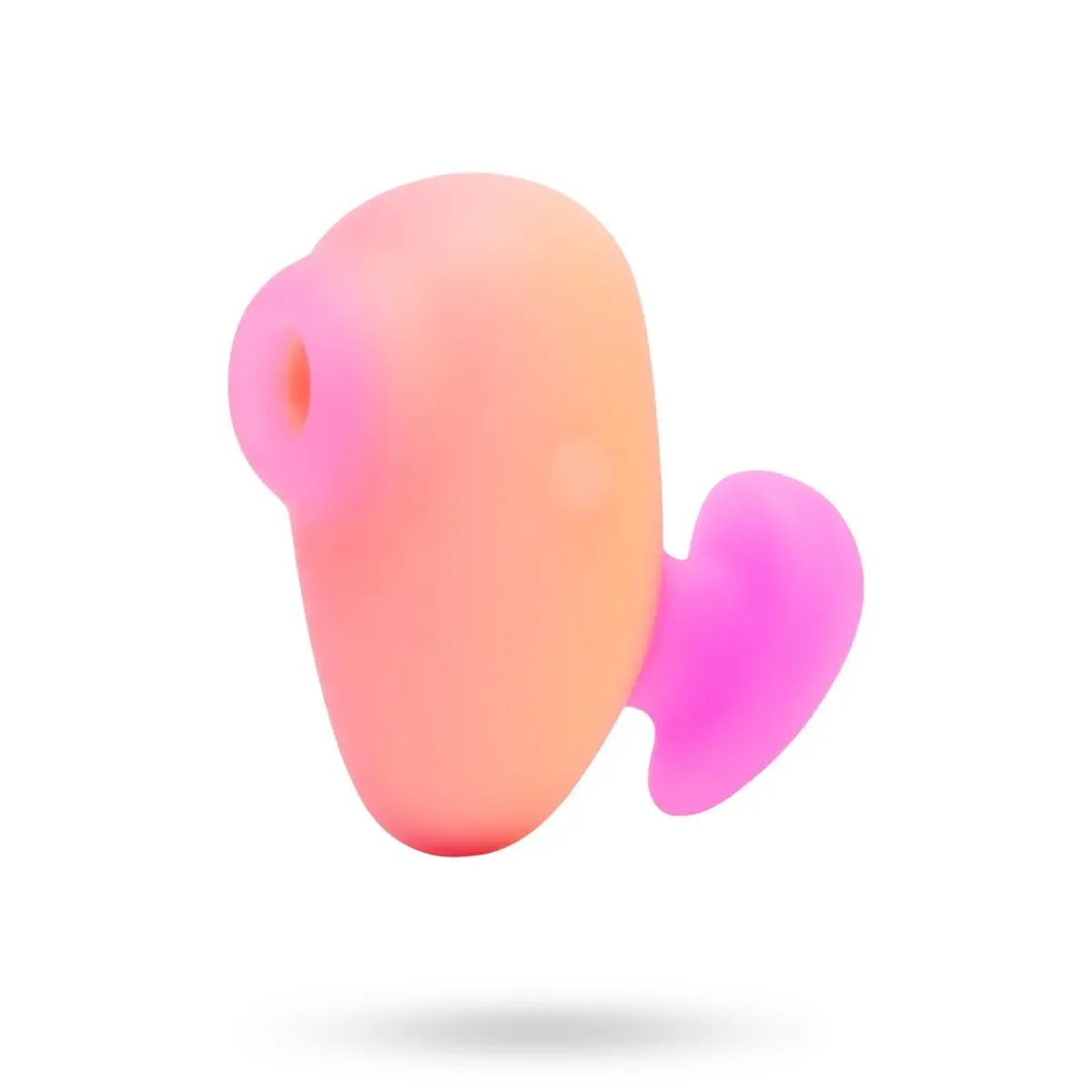
ROMP Kiss is the smallest air-pressure product in ROMP’s range, and the size is not a side effect but the entire design concept. The manufacturer states the length as 64.12 millimeters and the width as 63.5 millimeters at the widest point. It’s a clitoral stimulator that fits in a clenched hand, and according to the manufacturer’s own user manual, it’s intended to be held between the index finger and the middle finger rather than in a shaft.
The specification is short, and that in itself is informative. Three intensity levels. One single button. Body-friendly silicone. Enclosure rating IPX7. Ninety minutes of operating time and 120 minutes of charging time. A built-in lithium-ion battery of 3.7 volts and 250 milliampere-hours. Two years of manufacturer warranty. The product model number is KIS10A. In Sweden, the item appears in six store listings from five stores at prices between 259 and 449 SEK, and four of the listings had the item in stock at the price check.
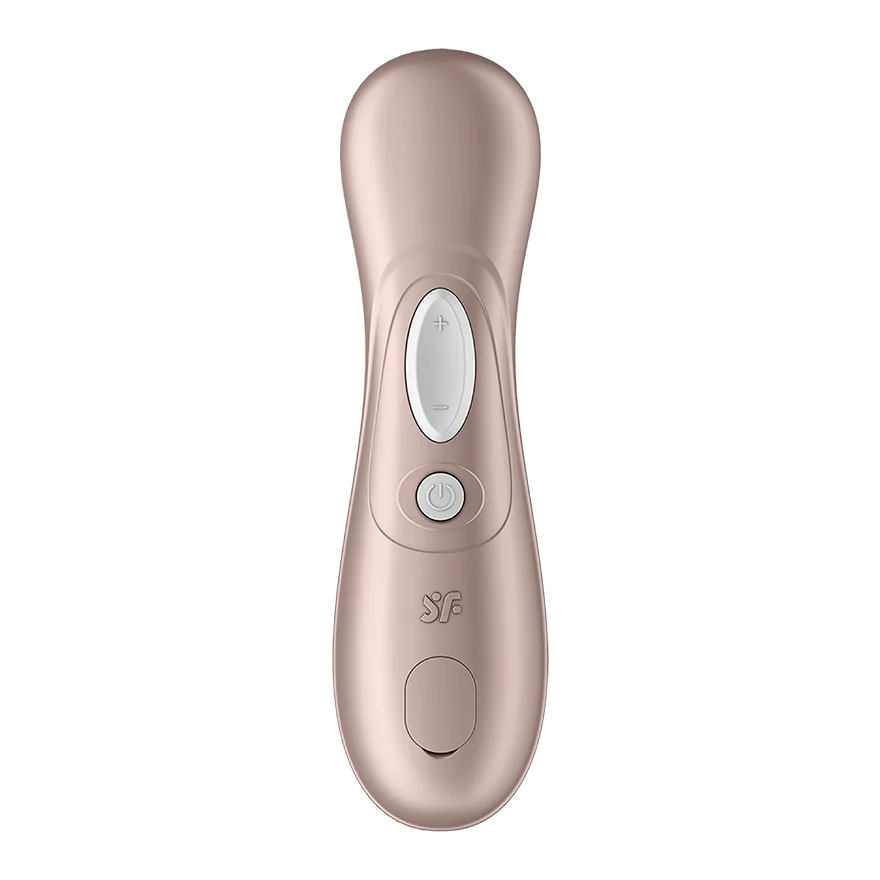
The comparison that comes most readily to mind is not against the big premium models, but against what you get for the same money. In practice, ROMP Kiss sits in the same price range as Satisfyer Pro 2 Next Generation, which costs from 254 SEK. The differences between them are not about who is the most expensive, but about format, number of steps, and charging contact—and that is the comparison this review devotes the most space to.
ROMP markets Kiss with Pleasure Air Technology, the same technology name used within the WOW Tech family, where Womanizer is also included. The technology works by using a pump to create alternating under-pressure and over-pressure in a small enclosed chamber that is placed over the clitoris. The chamber never makes direct contact with the clitoris. The stimulation happens through pressure changes in the air inside the head, and that is why the product category is described as touch-free clitoral stimulation.
The difference from a typical vibrator is fundamental, not just a difference in degree. A vibrator transfers mechanical motion from a motor through the material to the skin. An air-pressure product transfers pressure waves through air. The consequence is that the sensation is described as sucking or pulsing rather than vibrating, and that it is much more localized—the pressure waves seem to act only where the chamber seals tightly.
This matters for how you should read Swedish store texts about the product. Several of them refer to Kiss alternately as an air-pressure vibrator, a finger vibrator, and a suction vibrator, and one of the stores even describes the technology as "pulsing vibrations". What can be established based on the manufacturer’s own material is that Kiss is a Pleasure Air product without a separate vibration motor: ROMP lists three air-pressure intensity levels—nothing else. The name finger vibrator refers to the grip, not to the technology.
All of the Swedish store listings state that EAN 4251460631631 is for ROMP Kiss. The manufacturer’s own EU product page, however, publishes GTIN 4251460623551 for the same model, linked to the item number RPKS1SGZ and the color Pink Lemonade. Both numbers start with the same manufacturer prefix, and ROMP publishes only a single variant of Kiss—one color, one size, one configuration. So it’s the same product under two different barcodes, not two variants, but the discrepancy is worth knowing if you search by number instead of by name.
The store color descriptions differ for the same reason. One store lists the item as orange, while another lists it as pink. The manufacturer’s own color description is Pink Lemonade, and the product is in fact tinted in a transition from pink to orange with a magenta-colored finger grip. None of the stores is wrong—they’ve simply chosen different words for the same tinting.
If there’s one thing you should take with you from this walkthrough, it should be the measurements. ROMP Kiss is radically smaller than almost everything else in the category, and that explains both what it’s good at and where it falls short.
The manufacturer lists two measurements: the length is 64,12 millimeter and the width is 63,5 millimeter at the widest point. The product is therefore, in practice, as wide as it is long—the shape is a rounded drop with a protruding finger grip, not an elongated shaft. To put it in perspective, Womanizer Next measures 171 × 54 × 57 millimeter, and ROMP’s own Shine X is 142 millimeter long. Kiss is therefore less than half the length of the sibling model in the same brand.
The manufacturer, however, does not publish a depth measurement—so no third dimension. That means you can figure out how big it is when viewed straight on, but not exactly how thick it is. For a product that’s marketed as a travel-sized model, it’s a strange gap, because thickness is exactly the measure that determines whether something fits in a jewelry case or an inner pocket.
The manufacturer also does not publish the packaging dimensions, but here there’s a piece of information you can get from a retailer. Mshop lists the packaging as 8,0 × 6,2 × 9,4 centimeters in length, width and height. It’s a store claim and not manufacturer data, but it’s useful if you want to know how much space the cardboard takes up—and it confirms the scale: the entire package is less than a tenth of a meter in its longest direction. The same store size table lists the product as 6,4 × 6,30 centimeters, meaning roundings of the manufacturer’s 64,12 and 63,5 millimeter, and it also doesn’t list any depth measurement.
What the published measurements mean in practice is nonetheless clearly evident. A product that is 64 millimeters on the outer edge fits in the palm of your hand, in a toiletry bag without taking up any space worth mentioning, and in most things that count as carry-on luggage. It also doesn’t immediately look like what it is, which for some is the whole point of choosing a small format.
The protruding magenta-colored tab on the back is not decoration. The manufacturer’s user manual is explicit: you grip Kiss between your index finger and middle finger, and place the stimulation head against the clitoris with light pressure. So the design replaces the shaft that otherwise creates distance between the hand and the body.
It solves two things. The first is the angle — with the finger grip, you control the head with your fingertips instead of your wrist, which gives finer control over exactly where the chamber seals tightly. The second is that the hand comes closer to the body, which makes the product usable with a partner in a way that a 17-centimeter-long model isn’t.
The cost is just as concrete. A finger grip provides worse leverage than a shaft, and all the pressure has to come from two fingers. Anyone with reduced hand strength, joint pain, or simply someone who prefers holding something that fills the hand will experience the format as a drawback rather than an improvement. It’s also a product that’s easy to drop in the bathtub — and unlike most of the competitors, it lacks a shaft to catch it.
ROMP does not publish any weight for Kiss, either on the product page or in the online manual. It’s one of the most common gaps in this category, but it’s especially noticeable in a product whose main selling point is that it’s small and easy to take along. Without a weight claim, you can’t compare it to the competitors other than by outer dimensions.
A closely related figure can still be found, and it should be read carefully. The retailer Mshop states 0.17 kilograms — but that information is listed under the heading "Dimensioner (Förpackning)" in the store’s specification table and therefore refers to the packaging with contents, not the product itself. The 170 grams includes the cardboard box, the USB cable, the quick guide, and the safety information. What Kiss weighs without its packaging is not shown, and that figure should therefore not be used as the product weight. What it does provide, however, is a limit: the product itself weighs less than 170 grams.
What can still be established is that a 64-millimeter silicone product with a 250 mAh battery, by definition, weighs only a fraction of what a full-size air-pressure model does. The cell size itself is an indication: the battery is the heaviest single component in this type of product, and 250 mAh is about half of what’s in the larger models in this category. But it is a conclusion based on the construction, not a published value, and it should not be treated as a measured metric.
The material is the only quality of an intimate product that neither experience nor care can compensate for, and it determines whether the product is still hygienic after a few years. ROMP specifies a single material for Kiss: body-friendly silicone. No split between the main unit and the casing, no indication of plastic besides.
Silicone is a non-porous material. A non-porous surface can be cleaned, because there are no microscopic cavities where residue can be left behind. It is the single most important property of a material that sits against mucous membranes, and that is why the material declaration weighs more heavily than almost all other lines in a specification.
On Kiss, the material listing is also unusually clean compared with the rest of ROMP’s own range. Both Shine X and Free X are listed with body-friendly silicone in the stimulation head, but soft-touch ABS in the actual casing—the hard plastic in the part you hold. Kiss is listed only as silicone. That is a real difference, and it goes in the right direction: a product without a seam between the silicone stimulation head and the plastic casing has a smaller gap where dirt can collect, and it also feels soft in the hand instead of slick.
One limitation should be noted. The stimulation head on Kiss is not detachable, and the manufacturer offers no alternative head sizes. The inside of the chamber can be rinsed but not opened, and the fit is simply what it is—which, at this price point, is to be expected, but it’s worth knowing if you already know that you need a larger or smaller opening for the technology to work for you.
Phthalates are a group of plasticizers used to make plastic—above all, flexible PVC—pliable. Kemikalieinspektionen describes them as substances that can affect the hormone system and make reproduction harder, and several of them are therefore restricted or banned within the EU in a large number of products. Intimate products are a recurring category of oversight precisely because they contain flexible plastic against skin and mucous membranes.
Here the message must be precise. ROMP writes "body-friendly silicone" for Kiss but does not publish any explicit commitment that the material is free from phthalates, BPA, or latex, either on the product page or in the online manual. That is a difference from the sister brand Womanizer, which prints that exact wording for its models. The absence of the commitment does not mean that the material contains plasticizers—it means that the manufacturer has not stated anything, and it should be presented as it is instead of being filled in with assumptions.
What the material label itself says is not trivial. Silicone does not require phthalate plasticizers to become soft; the softness comes from the polymer’s own structure. That is why "silicone" as a material statement is significantly stronger than labels like TPE or jelly rubber, which say nothing at all about which plasticizers are included. But it is a statement about the material class, not a declaration about contents, and the two things should not be mixed up.
The manufacturer, however, addresses the material issue from another angle in its warranty terms, and it is guidance worth reading: according to WOW Tech, oils and creams can cause irreversible damage to the products, and sunscreen and sun lotion are mentioned in particular. In practice, it is a material warning disguised as warranty text, and it applies to all silicone products in the range.
The interface on the ROMP Kiss is as simple as it can be. The manufacturer specifies control with one button, and that button does everything: start, stepping, and shutoff. There is no display, no LEDs that indicate the level, and no separate plus and minus buttons. You hold in the button to start, press it briefly to step between the three intensity levels, and hold it in again to turn it off.
The simplicity is a deliberate trade-off and not a cost saving. One button means you can find the right setting without looking, which matters when the product is held between two fingers and the button is out of sight. It also means there is nothing to learn before the first use—compare with Womanizer Next, where fourteen intensity steps times three depth levels give 42 combinations to navigate via four buttons.
One detail deserves a note, because it can be confusing in real life. The manufacturer’s product page states that you press and hold the power button for two seconds to start Kiss and that you press and hold the same button for two seconds to turn it off. The manufacturer’s own online manual for the same model instead says that you should press and hold the power button for five seconds to turn it off. Those are two different instructions in the manufacturer’s own material about the same process. Which of them is correct in practice can’t be determined from the documentation—but if the product doesn’t turn off after two seconds, the likely explanation is that it needs five seconds, not that it’s broken.
The lack of a level indicator has a more everyday consequence. Since there’s no light showing which of the three steps is active, you have to keep track yourself, and you can only step forward. If you want to cycle from level three back to level one, you go through the entire cycle again. With three levels, it’s hardly dramatic—but the difference compared with products that use a rocker switch is that you can go down directly.
The manufacturer’s user manual also includes a recommendation that’s easy to overlook and that matters more for this product than for most others: apply water-based lubricant to both the stimulation head and the clitoris before use. The reason is technical. Air pressure works only when the chamber seals tightly, and a small chamber on a small product has less margin for that. Dry skin breaks the seal, and then the effect disappears completely.
This is the most important question to ask before buying, and the answer depends on what you’re comparing it to. Satisfyer Pro 2 Next Generation has eleven pulse-wave intensities for about the same price. Womanizer Next has fourteen, in three depth levels. So three is low by the standards of the category.
The counterargument is that the number of steps and the usable range aren’t the same thing. The pattern in this product category is that the lowest steps are clearly separated, while the top ones are close together, because the difference in pressure per step decreases as the pump approaches its maximum power. An eleven-step scale is rarely used in more than three or four settings in practice. So the fact that ROMP provides three clearly distinct levels instead of eleven nearby ones isn’t automatically a downgrade—it’s another trade-off between fine-tuning and simplicity.
But that trade-off has a limit, and it’s worth being honest about. With three steps, there’s no way to find a setting between two of them. If what you want is between level one and level two, there isn’t one, and you can’t compensate with any other setting because there isn’t any. The manufacturer also doesn’t list any automatic modes, no programs, and no app control for Kiss—what you see is what you get.
Here the answer has to be short and to the point. ROMP does not publish any measured decibel value for Kiss, either on the product page, on the packaging, or in the online manual. The manufacturer also makes no silence claim at all for this model—there is no “whisper quiet” wording to refer to, unlike with several competitors.
What can be established generally is that air-pressure products are quieter as a category than vibrators with a rotating eccentric motor, because the sound comes from a pump rather than from an unbalanced weight striking the housing. But that observation applies to the category, not this specific model, and it does not replace a measured value. Websites that provide an exact decibel number for ROMP Kiss either show their own measurement or a value without a source from the manufacturer.
A practical tip that applies regardless of the model and that doesn’t require any numbers: place the product on a soft surface between uses and don’t hold it against a hard tabletop while it’s running. A tabletop works as a resonance box and noticeably amplifies the sound, and on a small product with little of its own mass, that effect is proportionally greater than on a heavy model.
ROMP Kiss is rated IPX7. The rating comes from the international standard IEC 60529, which defines enclosure classes for electrical equipment. The number 7 in the second position means the product has been tested for immersion in water to a depth of one meter for 30 minutes. The manufacturer’s manual states the consequence plainly: Kiss is waterproof and immersible, and can be cleaned with warm water and cleaning products for intimate products, or simply taken into the bath.
The difference versus a splash-proof product is greater than the wording suggests. Splash protection covers water droplets and, at best, water jets, but not immersion. Such a product can handle a damp cloth and possibly a shower, but not a bathtub, and it should not be held under running water—use some common sense about the buttons and the charging contact.
With IPX7, the entire product can be rinsed off without any special precautions. For Kiss specifically, it’s especially relevant for two reasons: the charging contact is an opening in the housing rather than a magnetic plate, and the chamber is small enough that lube and residue easily get left behind in it. Being able to rinse the product off under the tap without having to think is, in practice, a requirement for keeping it clean. If a product is missing any IPX information at all, it should be treated as not waterproof—lack of a rating is never a sign that the product would be approved.
Rinse the product in lukewarm water after each use, and use an unperfumed soap or a cleaning product intended for intimate products. Pay extra attention to the chamber—it's the only place on the product where water and residue can remain, and it cannot be disassembled. Wipe it off and let it air-dry before putting the product away. The manufacturer states that the product should be stored dry and protected from direct sunlight.
ROMP’s lubricant instructions are clear and should be followed exactly: use a water-based lubricant, and do not use perfumed or alcohol-based lubricants, gels, or massage oils. Silicone-based lubricants should not be used on silicone products. The reason is chemical and not a sales issue—silicone oil attacks the silicone surface over time and makes it porous, and a porous surface can no longer be cleaned properly; it can only be replaced. Oil-based products such as coconut oil also leave behind a film that is difficult to remove.
The manual also covers three things that rarely appear in store descriptions. The product and its battery must not be exposed to temperatures above 45 degrees, which rules out boiling water and a dishwasher despite IPX7. The product contains magnets, and should therefore not be used directly over a pacemaker; cards with a magnetic stripe should be kept away from it. And Kiss is expressly not designed for anal use—which, for a product without a handle and without a guard, is a warning with practical meaning, not just a formality.
One last detail from the manual that’s easy to miss: the manufacturer advises against placing the product’s soft side against an absorbent surface, because this can cause discoloration. So if you want to store Kiss in a fabric bag, it’s not necessarily problem-free, and no storage bag is included with the delivery.
Here is ROMP unusually open compared with the rest of the category. The online manual states a built-in lithium-ion battery of 3.7 volts and 250 milliampere-hours, with rated current 3.7 volts and 0.14 ampere during operation and 5 volts and 0.21 ampere when charging via USB. That a manufacturer publishes both capacity and power consumption is the exception rather than the rule—Womanizer, for example, does not publish either mAh or voltage for the Next.
The runtime is stated as 90 minutes, and the charging time as 120 minutes. Ninety minutes is on the low side for the category, but it is proportionate for the battery size: it’s about half of the 150 minutes that ROMP states for its own Pop, which has a 380 mAh battery. The relationship between the two models is largely linear with the capacity, which is a good sign that the stated runtime is reasonable and not a marketing figure.
Charging is done with the included USB cable, which is connected to a charging port in the product. The manual’s description is step-by-step: the cable’s pins are inserted into the charging port, and the USB connector is connected to a power source. After 120 minutes, Kiss is ready for 90 minutes of use. So it’s a cable with charging pins—not a magnetic charging pad and not a USB-C connector directly in the product.
It has two practical consequences worth bearing in mind before buying. The first: the charging cable is product-specific, and the manufacturer explicitly states that only the original cable may be used. If you lose the cable, no standard USB-C cable works as a replacement. That is the clearest difference compared to Satisfyer Pro 2 Next Generation, which is charged via USB-C and therefore uses the same cable as a phone. The second: ROMP states that a USB mains adapter is not included in the delivery. You get the cable but not the wall plug, and the manufacturer points out that the adapter must have an output power that corresponds to the product’s rating.
The advantage of this solution is that it’s cheap to build and easy to seal, which is part of the reason why a product in this price range can be rated IPX7. But anyone who wants a travel product should note that it also becomes a travel product with its own cable to keep track of.
The manufacturer states that the battery is not replaceable, and the manual is clear that you should not try to remove it yourself because it can permanently damage the device. What applies generally to lithium-ion batteries therefore also applies to the product’s total service life: capacity decreases with the number of charge cycles, and once the cell is used up, the product is. Silicone survives the battery by a comfortable margin.
A small battery has a double effect here. On the one hand, 250 mAh charges up quickly and is lightly loaded by a pump that draws 0.14 ampere. On the other hand, the short operating time means you charge more often for the same total usage, and it’s the number of cycles—not the number of hours—that wears out a lithium-ion cell. So, counted per hour of use, Kiss is charged more than a model with a larger battery.
The manufacturer’s own recommendation is to charge the product regularly even when it’s not being used, which is standard advice to avoid deep discharge. That advice is especially relevant for a product marketed as a travel product and that therefore risks sitting unused in a bag for several months between occasions. ROMP does not publish an stated number of charge cycles and does not state an expected battery lifetime, which no manufacturer in the category does.
We do not have price data from shops in your market yet.
Sixty-four millimeters isn’t a side effect of saving money. It’s the whole design idea—and it’s also the explanation for why it only has three levels.
Three comparisons are relevant: against ROMP’s own larger air-pressure model, against the best-selling budget competitor, and against the premium segment. All information below comes from each manufacturer’s own specifications, and all prices come from the shops’ product feeds on July 29, 2026.
ROMP Shine X costs from 448 SEK, i.e., 189 SEK more than Kiss at its cheapest. This is the closest comparison available, because both are air-pressure products from the same manufacturer with the same two-year warranty and the same charging principle using a cable and DC pin.
Shine X is 142 millimeters long with a head width of 42.45 millimeters—meaning it’s more than twice as long as Kiss, and with a narrower stimulation opening. It has two buttons instead of one. But two pieces of information work against it: Shine X is listed with a 45-minute runtime against Kiss 90, and with soft-touch ABS in the housing against Kiss full silicone. The charging time is the same, 120 minutes—which means Shine X charges for the same length of time for half the playtime.
The conclusion is unusually clear for a comparison within the same brand: if you want a shaft to hold and a narrower opening, Shine X is the way to go, but you pay 189 SEK more for half the runtime and a plastic housing. If you want the longest runtime and the most silicone per SEK, Kiss wins. The same applies versus ROMP Free X, which costs from 358 SEK, is 95.25 millimeters long with a cap, and is listed with the same 45-minute runtime and the same ABS housing.
Satisfyer Pro 2 Next Generation costs from 254 SEK versus ROMP Kiss 259. A five-SEK difference makes the price argument irrelevant, and that’s why this becomes the purest comparison in the entire review: two air-pressure products for the same money, where everything comes down to what you prioritize.
The Satisfyer wins on three points. It has eleven pressure-wave intensity levels versus Kiss’s three. It charges via USB-C, i.e., with the same cable as a phone, versus Kiss’s product-specific cable with charging pins. And it has a 15-year manufacturer warranty versus ROMP’s two years—an 13-year difference that’s hard to argue away. The battery is listed as 220 mAh at 3.7 volts, i.e., slightly less than Kiss’s 250 mAh.
ROMP Kiss wins on two points, and they’re not small. The material is full silicone across the entire product, while the Satisfyer has silicone only on the contact area and ABS plastic in the shaft. And the format is a completely different matter: 64 millimeters versus a full-size handheld model with a shaft. Both are IPX7. Both have fixed stimulation heads with no alternative sizes.
When choosing based on specifications and warranty, the Satisfyer clearly wins. When choosing based on size, material, and a two-finger grip, Kiss wins. What isn’t a valid argument is the price—they differ by five SEK.
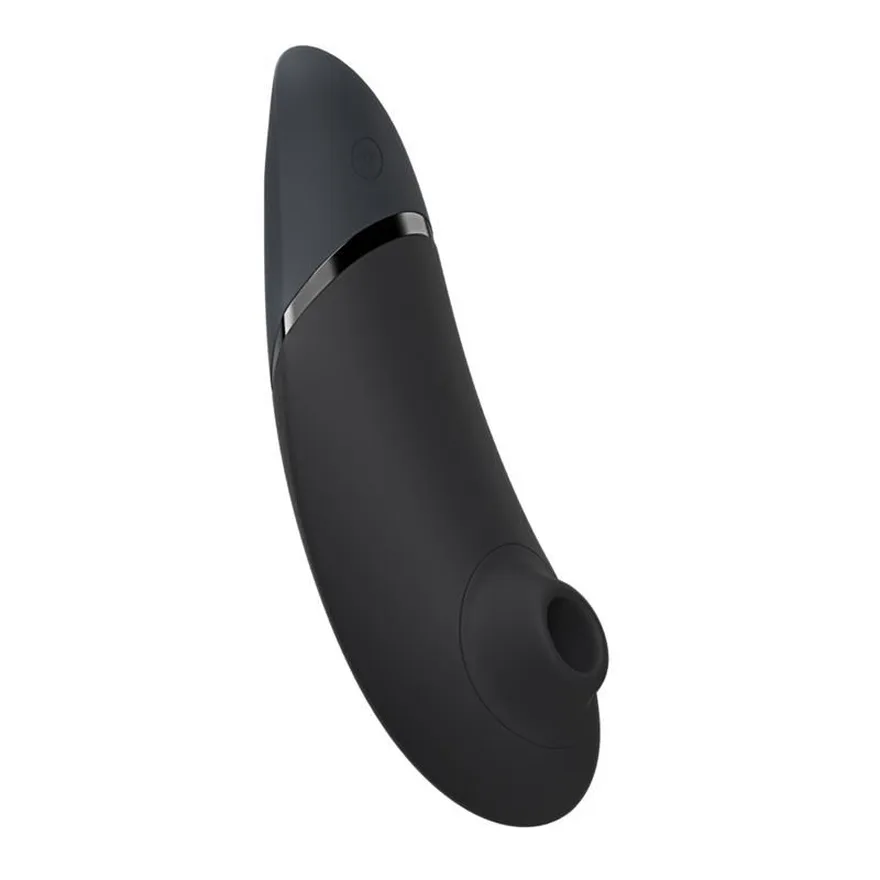
Womanizer Next costs from 1,495 SEK compared to ROMP Kiss 259, so almost six times as much. The comparison is still relevant, because both brands belong to the same group and use the same technology name, Pleasure Air.
What you get for those extra thousand kronor is measurable: fourteen intensity levels versus three, three adjustable depth levels versus none, 240 minutes of operating time versus 90, a five-year warranty versus two, and a detachable stimulation head in two sizes versus one fixed. Womanizer Next also measures 171 × 54 × 57 millimeters, so almost three times Kiss’s length.
The conclusion is that they’re not competing for the same purchase. If you’re unsure whether air pressure technology works for you, Kiss is a cheap way to find out, and it retains its value as a pleasure product even if you upgrade later. If you already know that the technology suits you and want fine-tuning, the price difference is justified—that’s an upgrade in the experience, not in the technology itself.
Five Swedish shops sell the item in six listings under EAN 4251460631631. The cheapest are Blush Me and SexleksakerOutlet at 259 SEK each, and the most expensive is Lustly at 449 SEK. That’s a difference of 190 SEK or 73 percent for the exact same item number, the same color, and the same packaging.
In this case, the stock situation is favorable, unlike with many more expensive models. Four of the six listings had the product in stock at the price check, and both of the cheapest were among them. That means the lowest price is actually one you can purchase at, not just a figure from a sold-out listing. The two store listings at Sexonic at 313 SEK and the listing at Mshop at 376 SEK were out of stock.
It’s worth explaining why the same shop shows up with two listings for the same EAN. Sexonic lists the product both as "Romp Kiss Pink" and as "ROMP — Kiss Clitoral Suction Rechargeable Finger Vibrator", with different internal item numbers but the same price and the same gtin. These are duplicate entries in the shop’s own assortment, not two variants.
One last note about total cost. In this price range, the product is far below most shops’ threshold for free shipping, so the shipping cost is therefore a significant part of what you actually pay. The difference between the cheapest shop and the second-cheapest shop can very well be outweighed by shipping, so compare the final total in the checkout and not just the row in the table. The manufacturer’s own list price in its EU shop is 34,99 euro, which provides a useful reference for what a normal price level looks like.
It fits you if you want an air-pressure product in the smallest possible format. Sixty-four millimeters is a format that none of the premium options comes close to, and the two-finger grip makes it useful in situations where a full-size model with a shaft is in the way—together with a partner, in the shower, or in a suitcase where space matters. It fits you who want silicone all over the product instead of just on the contact surface, and you who want to be able to rinse everything off under the tap without having to think about it. It also fits you who want to try whether air-pressure technology works for you before you spend four-figure amounts on a premium model.
It’s not for you if you want to fine-tune. Three levels are three levels, and there’s no setting in between them. It’s not for you if you want to charge with the phone’s cable—the charging cable is product-specific, and the mains adapter is not included. It’s not for you if you want a long runtime between charges; 90 minutes is on the low side for the category. It’s not for you if you need a shaft to be able to hold it steadily or to reach comfortably, and not for you if you require a published weight, measured sound level, or an explicit phthalate-free declaration before buying—ROMP publishes none of the three for this model.
A trade-off belongs in the decision, and it’s the warranty. Two years is short in this category, where Satisfyer offers 15 and Womanizer five for products in the same or nearby price range. For a product priced at 259 SEK, it’s not decisive—but it is a sign of how long the manufacturer itself expects it to last, and that’s a message you should pay attention to.
The warranty issue for ROMP is handled by WOW Tech Europe GmbH, which is behind the brand. The terms are brief, but they include several points that are easy to miss and that directly affect what you actually get if something breaks.
WOW Tech provides a two-year warranty on all rechargeable and battery-powered products that you buy directly from them or from an authorized retailer, and states that the warranty period is extended in countries that require a longer time. The warranty applies to working parts that affect the product’s function. In the event of a justified claim, WOW chooses either to replace the product with a new one of the same type and quality—or a comparable product if the model has been discontinued—and to refund the purchase price.
Read the exceptions before relying on the warranty. It does not cover cosmetic wear and tear from normal use, and it does not cover damage from accidents, misuse, or neglect. Any attempt to open or take apart the product or its accessories voids the warranty—which in practice means you are not allowed to try to replace the battery even when it is depleted. Resellers on Amazon and eBay that are not WOW Tech themselves are explicitly considered unauthorized, so the warranty does not apply to such a purchase.
Two conditions should be read especially carefully. The first: WOW states that they do not accept returns once the packaging seal has been broken, citing the products’ hygienic nature. The second: WOW expressly states that they do not offer any satisfaction guarantee. The latter is worth noting because it conflicts with the brand’s “100 day Pleasure Guarantee” shown in the product page’s own purchase box. Which of these claims applies is not stated in the manufacturer’s materials, so a reasonable approach is not to count on any satisfaction guarantee at all. There is no registration requirement—but a receipt or other proof of purchase is required, so save it.
What always applies are your statutory rights, and in this case they are stronger than the manufacturer’s warranty. Under the Consumer Sales Act (konsumentköplagen), you have three years’ right to complain about defects in the goods, regardless of what the manufacturer promises—so one year longer than WOW Tech’s own warranty. The complaint is directed to the shop you bought from, not to the manufacturer, and it is the shop that must handle your claim.
For distance purchases, you also have a right of withdrawal for fourteen days under the Law on Distance Contracts and Off-Premises Contracts (lag om distansavtal och avtal utanför affärslokaler). Be aware that, in practice, the right of withdrawal is limited for hygiene items that have been taken out of a sealed package—this is the same principle the manufacturer refers to in its own return terms. The right to complain about defects applies, however, always, regardless of whether the seal has been broken or not. If you have questions about what applies in your case, Konsumentverket (the Swedish Consumer Agency) provides guidance via Hallå konsument.
ROMP Kiss is ranked på plats 26 av 32 in clitoral stimulator best i test, where the entire category is compared against each other using five shared criteria. Guiden vinns av Womanizer Premium 2 Red Gold.
Every numerical piece of information in the text can be traced to one of the sources below. The links were checked manually on the specified date.
This page is machine-translated from Swedish. Read the Swedish original