

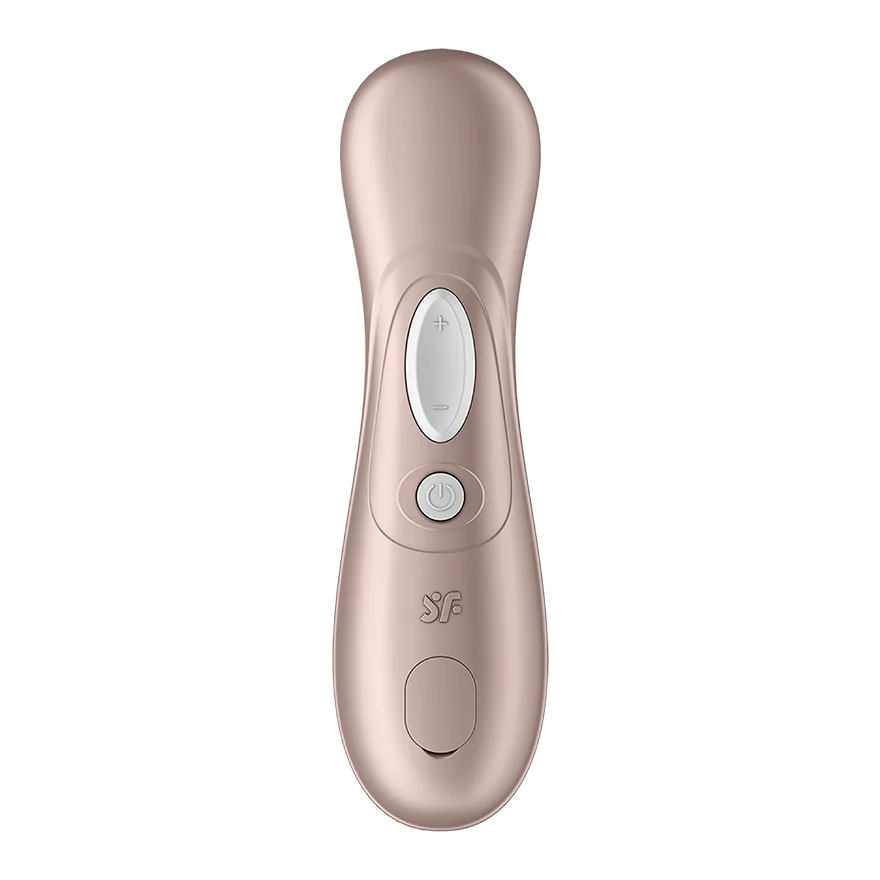
Review
Review: Satisfyer Pro 2 Next Generation
Simple model without vibration — 219 SEK, USB-C and half the charging time.
29 July 2026
Review · Clitoral stimulator · Air pressure and vibration
Satisfyer’s compact combination stimulator reviewed against the manufacturer’s own specifications, quick guide, and price data from seven Swedish stores. Eleven pressure-wave intensities and ten vibration programs from two motors, 87.55 × 67.5 × 31.8 millimeters, IPX7 according to IEC 60529, 450 mAh — and a charging time-to-operating time ratio of four to one.
Most function per krona in the comparison: two motors provide eleven pressure-wave steps and ten vibration programs, the body is the shortest of the compared models, and a hygienic cap is included. What you pay for is the battery — about 60 minutes of operating time versus about four hours of charging via a product-specific magnetic cable, and that battery is expressly excluded from the manufacturer’s fifteen-year warranty.
Satisfyer Love Triangle is a clitoral stimulator that does two things at the same time. It uses air pressure technology — Satisfyer calls it Air Pulse Technology — and adds vibration on top. The manufacturer specifies two separate motors in the device, and it’s that design that explains both the product’s strongest and weakest side. One is that you get two stimulation types in a single unit that fits in the palm of your hand. The other is that two motors have to be driven by a battery that lasts for about one hour.
The specifications look like this: eleven pressure wave intensity levels, ten vibration programs, dimensions 87,55 × 67,5 × 31,8 millimeters, weight 115,5 grams, silicone and ABS plastic as materials, IPX7 enclosure rating, a 450 mAh lithium-ion battery and 3,7 volts, about 60 minutes of operating time, about 4 hours of charging time via a magnetic cable, control via the Satisfyer Connect app, and a fifteen-year manufacturer warranty. In Sweden, the item is sold by seven stores at prices between 251 and 729 SEK, and five of them have it in stock.
This review is exclusively about the black variant with EAN 4061504001784, which in the manufacturer’s quick guide carries item number 4001784. Satisfyer sells Love Triangle in two colors, black and white, and the same quick guide lists two additional item numbers — 4001777 and 4106052 — that belong to the model family. Functionally, the variants are the same, but check the number if you compare prices between stores, because several of them list both colors on the same product page.
Classic air pressure technology is based on a pump creating alternating under-pressure and over-pressure in a closed chamber that is placed over the clitoris. The chamber never touches the clitoris directly. The stimulation happens through pressure waves in the air inside the head, and that is the whole reason this product category is usually described as touch-free clitoral stimulation. The difference from a regular vibrator is fundamental: a vibrator transfers mechanical movement from a motor through the material to the skin, whereas an air pressure product transfers changes in pressure through air.
What Satisfyer does with Love Triangle is to put both principles into the same housing. The manufacturer’s functional graphic expressly shows two independently controlled motors, and the product section lists eleven pressure-wave intensities plus ten vibration programs. What can be established purely arithmetically is that this provides 11 × 10 = 110 possible combinations if both motors run at the same time, versus eleven pure pressure-wave modes on a model that is the Satisfyer Pro 2 Next Generation. None of those numbers says anything about how the stimulation is experienced — but they do say something about how much can be adjusted.
Two motors also have a consequence that is rarely mentioned in store texts. Two motors draw more current than one. The manufacturer states 450 mAh battery capacity and about 60 minutes of operating time for Love Triangle. The same manufacturer’s Pro 2 Generation 2, which has only a pump and no vibration element, is stated to have 220 mAh and likewise about 60 minutes of operating time. In practice, that means Love Triangle needs a battery that is twice as large to reach the same operating time as the single-motor model — and that is the single most important trade-off in the entire specification.
The stores sell the product under at least three names: Satisfyer Love Triangle, Satisfyer Love Triangle Air Pulse Stimulator + Vibration, and Satisfyer Love Triangle Lufttrycksvibrator. The manufacturer’s own product page is called Satisfyer Love Triangle Connect App. It’s the same item — all seven Swedish stores in the table further down list EAN 4061504001784 or their own item number that is tied to just that black Love Triangle.
The addition “Connect App” therefore isn’t a more expensive variant, but the manufacturer’s way of indicating that the model can be controlled from the Satisfyer Connect app. The product page makes it clear that the app is not mandatory: it expressly states that the product can be used even without an app. It’s worth knowing, because app support with some brands means the basic functions are locked behind a phone. Here, that isn’t the case.
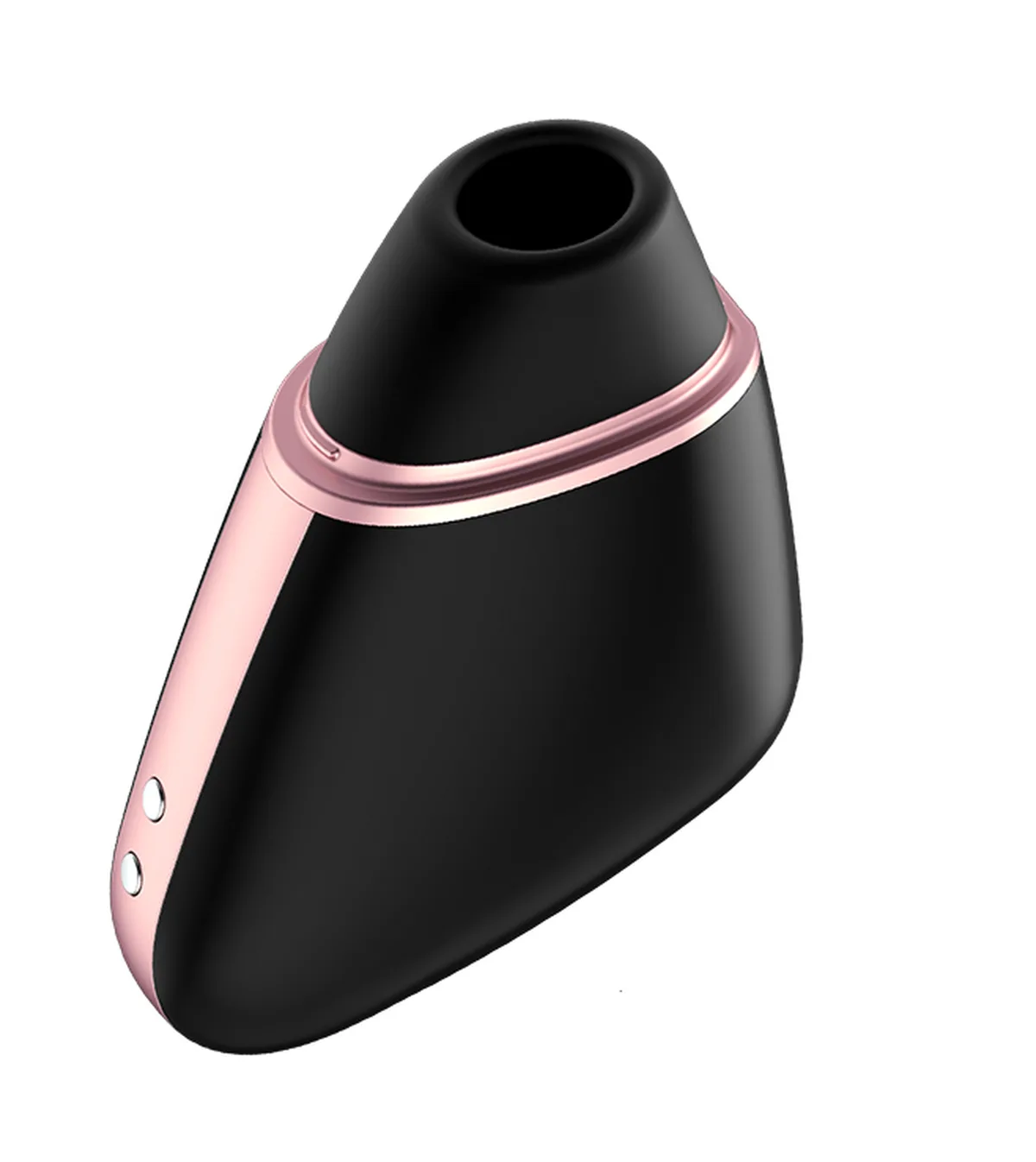
One more thing about the name. "Triangle" refers to the shape, not the function. The manufacturer’s dimensions — 87.55 millimeters in length and 67.5 millimeters in width — describe a body that’s almost as wide as it is long, with a tapering section and a stimulation head that sits at the sharpest end. It’s an entirely different geometry from the classic handle-shaped air-pressure product, and that’s also why it fits in a necessär in a way that Pro 2 Next Generation, with its 165 millimeters, does not.
The material issue is the only property of an intimate product that can’t be compensated for with experience or care, and it determines whether the product is still hygienic after five years. Satisfyer lists two materials for Love Triangle: silicone and ABS plastic. The same two materials appear both in the feature table on the product page and in the specification list in the manufacturer’s quick guide, which is a welcome consistency — the two documents don’t always say the same thing in this industry.
Silicone is a non-porous material. A non-porous surface can be cleaned, because there are no microscopic cavities where residue can get trapped. This is the single most important property of a material that should lie against mucous membrane tissue, and that’s why the material declaration weighs more heavily than almost all other lines in a specification.
ABS plastic is a hard, dimensionally stable structural plastic. It’s used in the housing because it holds its shape, can be dropped onto the floor, and can be joined tightly—which is a prerequisite for the enclosure class. ABS isn’t a problem by itself; it’s in the casing, not against the mucous membrane. The manufacturer’s functional graphic points out "soft silicone head" as the part that meets the body, and that’s the breakdown you should expect: silicone where the product touches you, ABS plastic in the rest of the construction.
At the same time, there’s a clear difference from more expensive models where the entire housing is covered in silicone. The difference shows up in two ways. The surface is harder in the hand than on an all-silicone product, and there’s a seam between the silicone head and the plastic body. Seams are always the place where dirt collects first, and that’s why they’re worth paying extra attention to when cleaning. On the other hand, the hard body makes the product easy to hold steadily even with lubricant on your hands, because you’re holding something that doesn’t give way.
Phthalates are a group of plasticizers used to make plastic—above all soft PVC—flexible. The Chemical Inspectorate (Kemikalieinspektionen) describes them as substances that can affect the endocrine system and make reproduction more difficult, and several of them are therefore restricted or banned within the EU in a large number of products. This specific product category is repeatedly the subject of supervision because it contains plastic in contact with skin.
A clarification is needed here, and it became clearer when we looked beyond the product page. On the product page for Love Triangle, Satisfyer states that the material is skin-friendly silicone but makes no commitment about phthalates at all. The information, however, is found in another one of the manufacturer’s own documents: Satisfyer’s EU declaration of conformity for article 001784SF certifies that the product complies with the RoHS Directive 2011/65/EU, including the amending Directive (EU) 2015/863. It is precisely this amending directive that added the four phthalates DEHP, BBP, DBP and DIBP to the list of substances that are restricted in electrical and electronic equipment. The declaration is retrieved using the article number from the manufacturer’s register of product compliance, and it is signed by Triple A Import GmbH in Bielefeld.
Read it for what it is, neither more nor less. A RoHS declaration is a commitment that the four named phthalates do not occur above the directive’s limit values—it is not the same as a voluntary commitment that the product is completely phthalate-free, and it says nothing about either BPA or latex. As for BPA and latex, Satisfyer still has nothing published for this model. Womanizer does for the Starlet 3, where the product page expressly states ABS plastic manufactured without phthalates, BPA or latex.
Two of the Swedish retailers go further than the manufacturer. Joylands’ specification table for the article has the line "Phthalate-free: Yes", and Vuxen labels its product page "Body-safe & Free from Phthalates". So the two retailers are saying the same thing, but this is retailer information and not manufacturer data—none of them states where the figure or the certification comes from, and Satisfyer itself never formulates it that way. If you weigh the material declaration heavily, the manufacturer’s RoHS declaration is the evidence that can actually be checked; the retailer texts are not.
What can, however, be established is that both silicone and ABS are types of material that do not need phthalate plasticizers to function. Silicone gets its softness from the polymer’s own structure, and ABS is intentionally hard. It is soft PVC, TPE, and undefined "jellygum" that are the category where the plasticizer issue is truly an open question, and Love Triangle contains none of that according to the manufacturer’s declaration.
Love Triangle comes with a cap that covers the stimulating head. The manufacturer describes it as a practical cap that ensures hygienic and discreet storage, and the function graphic calls it a “hygienic cap,” with the addition that the product is made to be taken on trips. It’s a small thing that, in practice, ends up having disproportionately big importance.
The reason is that the air pressure chamber is the only part of the product that’s difficult to keep clean in a toiletry bag. The chamber is an open bowl that catches everything it’s placed against—dust, lint from a bag, and skin cream from a toiletry pouch. A cap solves that, and that’s why a product with a cap in practice can handle a different usage pattern than one without. Neither Satisfyer Pro 2 Next Generation, Satisfyer Curvy 1 Connect App, nor Womanizer Starlet 3 indicates any corresponding protection in their specifications.
Satisfyer lists the length as 87.55 millimeters, the width as 67.5 millimeters, the height as 31.8 millimeters, and the weight as 115.5 grams. These are unusually precise figures for this category—hundredths of a millimeter and tenths of a gram are more than what most manufacturers publish—and they make it possible to compare for real.
The comparison is telling. Satisfyer Pro 2 Generation 2 is listed as 165 × 46 × 65 millimeters and 174.7 grams. Satisfyer Curvy 1 Connect App is listed as 134.1 × 46 × 77.9 millimeters and 143.8 grams. Womanizer Starlet 3 is listed as 117 × 46 × 47 millimeters and 80 grams. Love Triangle is therefore the shortest of all four, with a comfortable margin: 87.55 millimeters versus 117 millimeters for the second-shortest. At the same time, it’s the widest, 67.5 millimeters versus 46 millimeters for the other three, and the lowest, with a height of 31.8 millimeters.
What that means in practice is that Love Triangle is a flat, wide body instead of an elongated handle. It sits in the palm rather than in a grip between the fingers, and the 31.8 millimeters in height means it can go down into an inner pocket in a bag without building up. At 115.5 grams, it’s lighter than both Pro 2 Generation 2 and Curvy 1, but heavier than Starlet 3. The shape, however, is a matter of taste: anyone who’s used to a long shaft and wants to be able to reach from different angles will have to think differently, because such a short body is controlled with the wrist rather than with the shaft.
The manufacturer does not state the dimensions of the packaging. The 115.5 grams should be read as the product’s own weight, in line with how the same table specifies the weight for the other models in the range. Satisfyer also does not publish shipping weight — but the retailer Lekosmek states 241 grams in its product data for barcode 4061504001784. It is a store listing, not a manufacturer figure, and it refers to the packaged shipment: product, lid, charging cable, quick guide, and carton together. The difference from the product’s 115.5 grams is therefore roughly what the packaging and accessories weigh, and it is only relevant if you are calculating shipping weight.
The interface on Satisfyer Love Triangle consists of three buttons, and the manufacturer’s functional graphics name what they do: one button controls the vibrations and two buttons control the pulse waves. The buttons are on the tapered edge, on the same side as the rose-gold colored strip, which means they sit under your thumb when the product is held in your palm.
That the pulse waves have two buttons and that the vibration has one is a design detail that says something about how the product is intended to be used. Two buttons in practice mean up and down on a scale — the eleven pulse-wave intensities — while a single button steps cyclically through the ten vibration programs. So the pulse waves are what you fine-tune, and the vibration is what you choose between.
The manufacturer’s quick guide shows the button sequences as symbols instead of text. Pressing for two seconds turns the product on and off. A short press steps to the next one. Series 1–11 in the guide correspond to the eleven pulse-wave intensities, and it also specifies an eleven-count pressure, a four-second press, and a double press as separate commands. What each of those sequences does in detail is not spelled out in plain text in the quick guide — it is drawn as a symbol guide without any explanatory caption, which is a real weakness in the documentation.
So the practical advice is simple: plan on learning the buttons by trying them, not by reading. It is not unique to this model — symbol guides without text are standard throughout Satisfyer’s range — but it is worth knowing before you tear open the packaging and look for a user manual in Swedish. The manufacturer publishes all user manuals on its website if the paper guide gets lost.
That the product can be used completely without a phone is also one of its stronger points. The product page explicitly states that it can be used even without an app, and the eleven pulse-wave steps and ten vibration programs are all built into the product itself. The app adds features; it does not unlock anything.
Satisfyer Connect is the manufacturer’s free app for iOS and Android. According to the manufacturer, you connect your phone, the tablet, or an Apple Watch to the product via Bluetooth or the internet. In the app, you can create your own programs instead of choosing from the pre-set ones, share programs with other users, let a partner control the product remotely, and let the stimulation follow music from a playlist. The manufacturer also states that the app complies with GDPR and European data protection rules.
What makes the app support truly useful here is precisely the combination of two motors. The product page describes the option not only to choose pre-set intensity combinations of pressure waves and vibration, but to compose your own. It’s a feature that makes no sense on a product with only one motor, and it’s therefore one of the few app functions in the category that actually adds something that the buttons can’t.
A detail about the radio, because the product page says nothing at all about it. The manufacturer’s EU declaration of conformity for the article lists ETSI EN 300328 V2.2.2 — the standard for equipment that transmits in the 2.4 GHz band—along with ETSI EN 301489-1 and -17 for electromagnetic compatibility of radio equipment, as well as EN 62368-1 and EN 62479. The same documents also state the product’s certification marking J2018-57-black and the article code 001784SF. It’s not data that determines a purchase, but it’s the only place where the manufacturer states which frequency band the Bluetooth connection uses, and that explains why the range behaves like ordinary Bluetooth does: a few meters indoors, and worse through walls.
The trade-off is the usual one for connected products. An app depends on the manufacturer continuing to maintain it, on the phone’s operating system continuing to support it, and on the Bluetooth connection being in place. None of the three things can be checked in advance, and none of them are covered by the product warranty. Therefore, buy the product for what the buttons do, and consider the app a bonus—not the other way around.
Eleven pressure-wave steps and ten vibration programs look impressive in a product table. The pattern in this product category is that the lowest steps are clearly spaced out, while the top ones are closer together, because the pressure difference per step decreases as the pump approaches its maximum power. Expect that, in practice, you’ll end up going back to just a few combinations.
That argument applies even more to vibration programs. A “program” is a preset pattern—pulses, waves, steps—and the difference between program number six and program number seven is rarely something you can describe afterward. That’s why the app’s ability to save your own program is more valuable than the number of factory programs: it lets you return to what you already know works, instead of stepping through ten options every time.
An observation about what the manufacturer itself says about fit belongs here. Satisfyer points out on the product page that the product has an air chamber and therefore may not fit a clitoris that has been enlarged due to hormone treatments, and in that case it refers to multitoys and finger vibrators instead. That’s unusually straightforward for a manufacturer text, and it’s a piece of information that’s worth more than most of the marketing claims on the same page.
Satisfyer markets Love Triangle as quiet as a whisper and highlights the quietness in the bullet points on the product page. The question is what that means in numbers, and there the answer has to be honest: Satisfyer does not publish any measured decibel value for Love Triangle, either on the product page or in the quick guide.
What can be established is that air-pressure products as a category are quieter than rotating eccentric motors, because the sound comes from a pump rather than from an unbalanced weight. But Love Triangle has both a pump and a vibration element, and the second of those is precisely the type of mechanism that tends to be heard. The manufacturer does not specify what type of motor the vibration element uses—the only wording on the product page is “2 super-strong power motors,” which is a marketing term and not a technical designation. We also went through the quick guide and the manufacturer’s EU declaration without finding any motor designation, so there’s no way to take that comparison any further with any certainty.
Websites that state an exact decibel value for this model either show their own measurement or provide a value without a source. A practical tip that applies regardless of model: place the product on a soft surface between uses. A hard tabletop works like a resonating box and amplifies the sound noticeably.
Satisfyer Love Triangle is rated IPX7. The rating comes from the international standard IEC 60529, which defines enclosure classes for electrical equipment. The number 7 in the second position means that the product has been tested for immersion in water to a depth of one meter for 30 minutes. The manufacturer states the consequence plainly on the product page: thanks to the watertight surface, the product can be used safely in water and is easy to clean.
The difference versus a splash-proof product is greater than the wording suggests. Splash protection covers water droplets and, at best, water jets, but not immersion. Such a product can handle a damp cloth and possibly a shower, but not a bathtub, and it should not be held under running water—without some thought about the buttons and the charging contact.
With IPX7, the entire product can be rinsed off without any precautions. The fact that the charging is magnetic contributes directly to this: there’s no need for an opening in the housing for a connector, and therefore there’s no rubber cap that can sit wrong or wear out. If a product completely lacks an IPX rating, it should be treated as not waterproof. The absence of a rating is never a sign that the product has been approved.
The manufacturer’s instructions are that the soft silicone can be cleaned easily with lukewarm water and soap, or with a cleaning product for sex toys. Rinse the product after each use, be extra careful at the seam between the silicone head and the plastic body, wipe it with a clean towel, and let it air-dry before putting the cap on. Putting the cap on over a damp chamber is the only routine that can truly cause problems, because a sealed damp chamber is exactly the environment you want to avoid.
Silicone-based lubricant should not be used on silicone surfaces. It breaks down the silicone over time and makes it porous, and a porous surface can no longer be cleaned properly—only replaced. Water-based lubricant is what to use. Oil-based products such as coconut oil leave a film that is hard to remove and that collects dirt at the seam.
The quick guide states a storage temperature of −5 °C to +60 °C. This is the range that applies for storage, and in practice it rules out both a car in winter and a car in the sun in summer. Boiling and the dishwasher are also ruled out despite IPX7—not because of the water but because of the heat, which is far above the limit and that a lithium-ion battery cannot tolerate. The quick guide also makes it clear that the product should not be used if it feels unusually warm, is mechanically damaged or deformed, or has discolored, and that you should stop using it if you experience pain or discomfort.
Here lies the product’s weakest point, and the manufacturer’s own quick guide lays it out openly. The battery is a 3.7-volt lithium-ion type with a capacity of 450 mAh. The charging voltage is 5 volts, the maximum charging current is 180 milliampere, the charging time is about 4 hours, and the operating time is about 60 minutes. The interface is listed as USB.
Using the magnetic USB charging cable included in the package. Both the product side and the function graphic indicate magnetic charging connection, and the cable is listed as included.
Magnetic charging is a trade-off, not a pure advantage. The advantage is that no opening in the housing is needed, which makes it easier to achieve IPX7 without a rubber plug—and as already pointed out, it’s a direct hygiene benefit because the entire product can be rinsed off. The disadvantage is that the cable is product-specific: if you lose the charging cable, no regular USB-C cable works, so you need to get a replacement. Satisfyer sells a separate USB charging cable in its own store, but that’s an extra cost and an extra order.
It’s also a real difference compared to the Satisfyer Pro 2 Generation 2, which, according to its quick guide, charges via USB-C—so the same connector as in your phone. That the cheaper model has the more practical charging solution is one of the less logical details in Satisfyer’s range.
The comparison within the manufacturer’s own lineup makes the matter clear. Pro 2 Generation 2 has 220 mAh and is stated to have about 60 minutes of operating time. Love Triangle has 450 mAh—more than double—and is also stated to be about 60 minutes. The difference is that Love Triangle has two motors to power instead of one. So the power draw is roughly twice as high, and it eats up the entire capacity gain.
Charging time worsens the picture. The maximum charging current is stated to be 180 milliampere. A 450 mAh battery charged with up to 180 mA needs, for purely mathematical reasons, at least a couple of and a half hours, and the manufacturer states about four hours. Pro 2 Generation 2, with 220 mAh and a maximum charging current of 220 mA, charges according to its quick guide in about two hours. So Love Triangle charges twice as long for the same operating time. The ratio between operating and charging is four hours of charging for one hour of use, and that’s a worse ratio than on any of the three compared models.
Two things follow from that. The first is that the product should be charged after each use rather than when it runs out, because a dead unit can’t be used again the same evening. The second is more long-term: a lithium-ion battery loses capacity with the number of charge cycles, and a product that needs frequent charging goes through the cycles faster. The manufacturer does not state that the battery is replaceable, and Satisfyer’s warranty terms expressly exclude the included battery from the warranty. So it’s the component that wears out first that also sits outside the protection.
We do not have price data from shops in your market yet.
Four hours of charging for one hour of use. Two motors consume power, and 450 mAh lasts no longer than 220 mAh does in the single-motor model.
Three comparisons are relevant: versus Satisfyer’s own classic model without vibration, versus Satisfyer’s own app-controlled sibling model, and versus the closest premium alternative in the same size class. All details below come from each respective manufacturer’s own specifications, and all Swedish prices come from the stores’ product feeds on July 29, 2026.
Satisfyer Pro 2 Next Generation, which the manufacturer calls Pro 2 Generation 2, costs from 219 SEK. Love Triangle costs from 251 SEK. That’s a 32 SEK difference, and the price tag therefore practically says nothing about which one you should choose.
The specifications do. Pro 2 Generation 2 measures 165 × 46 × 65 millimeters and weighs 174,7 grams. It has pressure waves, but according to the manufacturer’s specification chart it has no vibration and no app support. The battery is 220 mAh, it charges in about two hours via USB-C, and it provides about 60 minutes of runtime. The material is the same silicone and ABS plastic, and it is likewise IPX7.
Love Triangle therefore adds vibration, app control, a hygienic cap, and a body that’s almost half as long. Pro 2 Generation 2 adds USB-C, half the charging time, and the longer handle. What can be concluded is that the two aren’t different price categories of the same thing, but two different products for nearly the same price: one is a simple, fast-charging air-pressure product with a familiar connector, and the other is a compact combination product with an app. If you only want to know whether air-pressure technology works for you, the simpler model is still the purest way to find out.
Satisfyer Curvy 1 Connect App is the closest relative in the lineup: pressure waves, vibration, IPX7, silicone and ABS plastic, app control via Satisfyer Connect. From the manufacturer, it costs 779,95 SEK versus 831,95 SEK for Love Triangle — so 52 SEK less in the manufacturer’s own store.
The difference lies in the geometry. Curvy 1 measures 134,1 × 46 × 77,9 millimeters and weighs 143,8 grams. That means it is 46,5 millimeters longer, 21,5 millimeters narrower, and 46,1 millimeters higher than Love Triangle, and 28,3 grams heavier. Curvy 1 is a curved, durable shape with a shaft; Love Triangle is a flat, wide body without a shaft. Neither of them is objectively better—they suit different hands and different angles.
Two things still speak for Love Triangle in this comparison. It’s the only one of the two that the manufacturer specifies it comes with a cap for, and it’s significantly more compact in all directions except width. What speaks for Curvy 1 is its more traditional shape, which for many is easier to angle correctly. Satisfyer does not publish battery capacity, runtime, or charging time in the specification chart for any of the models — those figures are only found in the respective quick guide, and for Curvy 1 we haven’t checked them here, so they are not claimed.
Womanizer Starlet 3 is the closest competitor outside of Satisfyer’s own line in the same compact class. Womanizer lists the dimensions as 117 × 46 × 47 millimeters and the weight as 80 grams, so it’s a longer but narrower and significantly lighter product. The material is listed as ABS plastic made without phthalates, BPA, or latex, with a head made of body-friendly silicone, and it is IPX7.
Starlet 3 has six intensity levels compared with Love Triangles eleven; it lacks vibration and it lacks app support. Womanizer states a 30-minute operating time and a 30-minute charging time—so it’s half the operating time versus Love Triangles’ 60 minutes, but only one eighth of the charging time. The ratio of charging to operation is 1:1 for Starlet 3 versus 4:1 for Love Triangle, and that’s a big practical difference for the person who forgets to charge.
The warranty situation is also different. Womanizer states a five-year warranty on Starlet 3; Satisfyer states fifteen years on Love Triangle. Fifteen years looks better on paper, but read the terms: Satisfyer’s warranty starts only once the statutory right to complain about a purchase in the buyer’s country has expired, and the battery—the part most likely to fail first—is explicitly excluded. Womanizer, in return, provides a clear materials declaration that Satisfyer does not publish for this model. If you choose based on the disclosed materials information and charging logic, Starlet 3 wins. If you choose based on the number of functions per krona, Love Triangle wins by a wide margin.
Seven Swedish stores sell the item with EAN 4061504001784. The cheapest is Joyland at 251 SEK, and the most expensive is Vuxenkul at 729 SEK. That’s a difference of 478 SEK or 190 percent for the exact same item number, the same color, and the same packaging. For comparison, the manufacturer itself charges 831.95 SEK in its own Swedish web shop—that’s more than the most expensive Swedish retailer.
The stock situation is unusually good in this case. Five of the seven stores had the product in stock at the price check: Joyland at 251 SEK, Blush Me and SexleksakerOutlet at 329 SEK each, Vuxen at 395 SEK, and Vuxenkul at 729 SEK. That means the difference between the cheapest available and the second-cheapest available is 78 SEK. The two stores that were out of stock, Lekosmek at 429 SEK and Sexonic at 680 SEK, are both in the upper price range—and a price listed in a feed from a store that doesn’t have the item on hand is rarely what you actually end up paying when the item becomes available again.
Price differences are not due to any store selling a different variant. It’s about each store’s own margin-setting for a model that has existed long enough for some stores to have price-pressed it hard, while others kept an old list price. That’s exactly the situation where it pays off the most to compare before you pay — nearly 480 SEK is more than the product’s lowest price.
The prices in the table above are updated when the stores’ product feeds are updated, but always check the final price at checkout. Shipping costs are added at most stores if the order value is below a certain amount, and in this price range all stores are below the threshold for free shipping at most stores — which can level out some of the difference between the cheapest options.
It’s for you if you want both pressure waves and vibration without buying two products, and if you’d rather combine them than choose one. It’s for you if you want something compact: at 87.55 millimeters it’s the shortest among the compared models, and at 31.8 millimeters in height it disappears in a toiletry bag. The cap makes it a reasonable choice to take on a trip, and the eleven pressure-wave steps give you more to adjust than Womanizer Starlet 3’s six. And since the core functions work completely without a phone, it’s also independent of whether the app is maintained.
It’s not for you if you want to charge with the same cable as your phone — the magnetic charging cable is product-specific, and Satisfyer’s own cheaper Pro 2 Generation 2 has USB-C. It’s not for you if you use the product for long sessions, because about 60 minutes of operating time is followed by about four hours of charging. It’s not for you if you want a long shaft to angle with. And it’s not for you if you require an explicit declaration about phthalates, BPA, and latex before purchase, because Satisfyer does not publish any such information for this model.
One more thing belongs in the decision. The manufacturer itself writes that the air chamber might not fit a clitoris that has been enlarged due to hormone treatments. It’s information that deserves to be read for what it is — a design limitation across the entire product category, not just this model — and it’s relevant enough to determine the purchase for the person it applies to.
Satisfyer provides fifteen years of voluntary manufacturer’s warranty, and that’s the figure stated both on the product page and on the packaging. Read the terms before you count on it, because they include three limitations, each of which is essential.
First, the warranty period according to Satisfyer’s own warranty page starts only once the statutory right to complain (reklamationsrätten) in the buyer’s country has expired. In Sweden, it is three years under the konsumentköplagen (Swedish Consumer Sales Act), and fifteen years should therefore be read as an add-on after that period — not as fifteen years from the date of purchase as the marketing suggests.
Second, the included battery is expressly excluded from the warranty. It is worth pausing on this: the battery is the component that is worn out by use, the only part whose service life is counted in charge cycles, and the one that determines when the product is practically used up. So the warranty covers everything except what actually breaks due to the product being used. Condoms, lubricants, massage oils, and care products are also excluded, as are normal wear and tear and damage caused by accidents, misuse, negligence, or your own attempts to open the device.
Third, you are responsible for shipping. Satisfyer states that the customer pays the transportation cost to their return address in Bielefeld and that the company does not reimburse it, and that you must be able to show the original receipt. If it turns out that the product does not have a defect covered by the warranty, you also have to pay the inspection and labor costs. With a product that costs as little as 251 SEK, it’s a trade-off worth considering in advance: the shipping cost to Germany and the risk of having to pay for an inspection can quickly come close to the price of a new unit.
What always applies, on the other hand, are your statutory rights, and in practice they are more important here than the manufacturer’s warranty. Under the konsumentköplagen, you have three years of reklamationsrätt for defects in the goods, regardless of what the manufacturer promises, and you assert it against the store you bought from — not against Satisfyer in Germany. For distance purchases, you also have the right to withdraw within fourteen days under the lagen om distansavtal och avtal utanför affärslokaler. Be aware that in practice the right of withdrawal is limited for hygienic items that have been removed from a sealed package — the reklamationsrätt for defects applies, however, always. If you have questions about what applies in your case, Konsumentverket provides guidance via Hallå konsument.
Satisfyer Love Triangle is ranked på plats 15 av 32 in clitoral stimulator best i test, where the entire category is compared against each other using five shared criteria. Guiden vinns av Womanizer Premium 2 Red Gold.
Every numerical piece of information in the text can be traced to one of the sources below. The links were checked manually on the specified date.
This page is machine-translated from Swedish. Read the Swedish original