

Review
Review: Satisfyer Pro 2 Generation 3 Connect App
Same product with Bluetooth and an app—and the same price at the cheapest store.
29 July 2026
 Best budget
Review · Clitoral stimulator · Air pressure wave technology and vibration
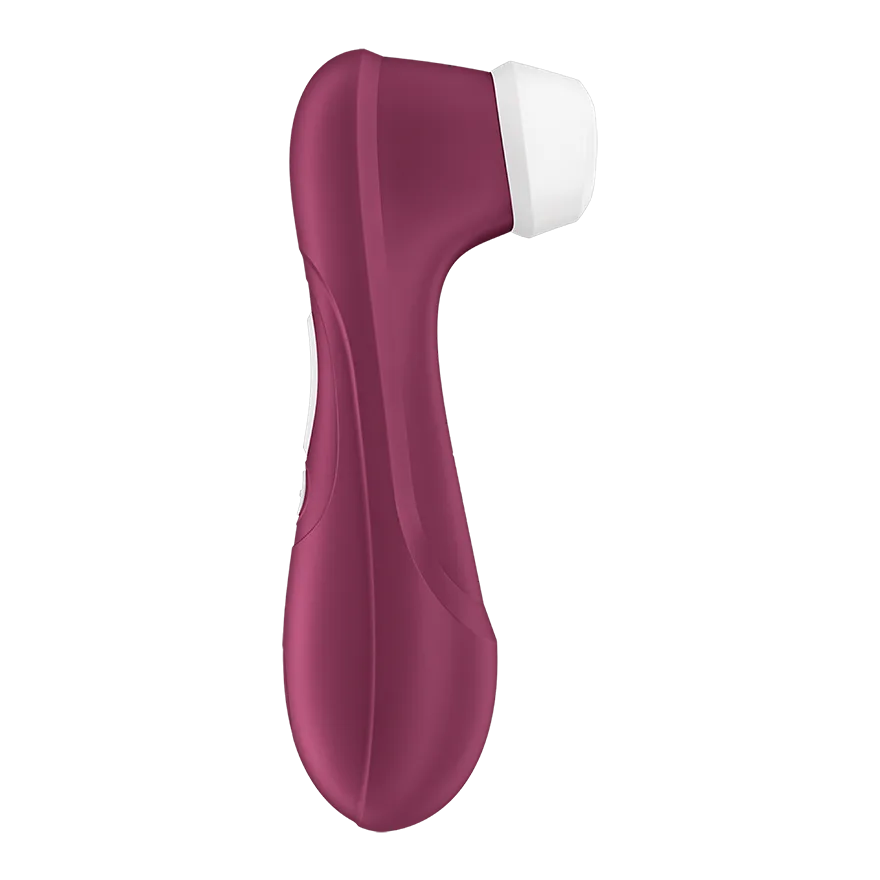
The burgundy Pro 2 Generation 3 without Bluetooth, reviewed against the manufacturer’s own specifications and price data from eight Swedish stores. Two separately controllable motors with eleven pressure wave programs and twelve vibration programs, two detachable caps—one with a Liquid Air membrane—IPX7 according to IEC 60529, a 500 mAh lithium-ion battery with USB-C, and a fifteen-year warranty—at a price that differs by 128 percent between the cheapest and the most expensive store.
Compare with
Satisfyer Pro 2 Generation 3 is the third version of the clitoral stimulator that made air-pressure technology a mass-market product, and this page is about the burgundy variant without Bluetooth and app. The manufacturer states two separate controllable motors, eleven pressure-wave programs, and twelve vibration programs, two interchangeable covers—one of which has a Liquid Air membrane—body-friendly silicone, an IPX7 rating, charging via USB-C, and a 15-year warranty. The dimensions are 164 × 65 × 46 millimeters, and the weight is 203 grams.
Eight Swedish stores sell the item in our price comparison, at prices between 298 and 680 SEK. Seven of them had it in stock at the price check. For comparison, Satisfyer itself charges 831.95 SEK for the same item in its own web shop—which is the single clearest piece of information showing that this product should not be bought at the list price.
The name is also the category’s biggest pitfall. Satisfyer has sold several completely different products under the Pro 2 designation, and Generation 3 is also available in two versions that are named almost the same. This review is exclusively about the item with EAN 4061504051871. Check that number in the store’s product information before you add anything to your shopping cart—it’s the only thing that reliably distinguishes the variants for sure, because the stores name them completely differently.
The manufacturer’s variant selector makes the matter unambiguous. On the product page for Pro 2 Generation 3 there are three colors, and the red one has GTIN 4061504051871. On the separate product page for Pro 2 Generation 3 Connect App there are the same three colors, but there the red one has GTIN 4061504051840. So it is two distinct items with different EANs—not two names for the same thing.
The store feeds confirm the split. Lekosmek lists the item plainly as "Pro 2 Generation 3 – Without App / Burgundy" under EAN 4061504051871, while the same store has a parallel row that is called "With App (connect)" under 4061504051840. Other stores only write "Satisfyer Pro 2 Generation 3 – Burgundy" without mentioning the app issue at all, and that’s where the mistakes arise.
What it means in practice is that everything you can do with this product you do with the buttons on the housing. There is no Bluetooth radio, no remote control from the phone, no vibration designer, and no connection to music or ambient sound. The manufacturer’s own quick guide for the model also contains no radio data, unlike the guide for the app version. If you specifically want app control, you need to buy the other article — and if you don’t want it, you don’t have to pay for the radio part.
The most important technical difference versus older Pro 2 models is that, according to the manufacturer, Generation 3 has two motors that are controlled independently. One drives the air-pressure chamber in the head, the other a vibration motor in the body. Satisfyer lists eleven pressure-wave programs and twelve vibration programs, and specifies in its own product text that the twelve consist of five vibration speeds and seven vibration patterns. The manufacturer’s functional graphic repeats the same thing, with the wording two independently controllable motors.
Principally, it’s a different product than a pure air-pressure stimulator. Air-pressure technology — which Satisfyer markets under the name Air Pulse — is based on the fact that a diaphragm pump creates alternating under- and over-pressure in a sealed chamber that is placed over the clitoris. The chamber never touches the clitoris directly, and the stimulation happens through pressure waves in the air inside the head. That’s the whole reason why the product category is described as touch-free clitoral stimulation. Vibration works the other way around: a motor transfers mechanical motion through the material to the skin.
That both techniques are included in the same housing means the product covers two types of stimulation that otherwise require two purchases. You can put it in perspective against the more expensive models in the category: Womanizer states fourteen intensity levels for its Pleasure Air for Premium 2, and Lelo states ten built-in modes for Sona 3 Cruise — but neither of the two lists a separate vibration motor in its specifications. Here, it’s two motors, and they can be run at the same time.
Liquid Air is Satisfyer’s name for the function that distinguishes Generation 3 from Generation 2. The manufacturer describes it as technology that mimics the sensual wave of pulsing water, and says that the effect is created by an extra cover with a thin and super-soft silicone membrane that is placed over the opening. The membrane therefore sits between the pressure chamber and the skin, widening and damping the pressure wave on the way there.
Overall, mechanically it’s a simple and reasonable solution: same pump, same eleven programs, but a different transfer between air and skin. The manufacturer’s own product image shows the two caps side by side, and the difference is immediately visible— the Pressure Wave cap has an open hole straight through, while the Liquid Air cap is sealed by a membrane. Satisfyer, however, does not publish any measurements for how much pressure is dampened by the membrane, so it’s not possible to give a figure for the difference. What is clear from the manufacturer’s description is that both caps are included, and that you switch between them manually.
The quick guide includes a warning that’s worth reading before improvising: according to the manufacturer, the unit may only be used with genuine Satisfyer caps, which are designed to sit securely on this specific device. Use without genuine caps is described as unauthorized, can cause the product to work in an unintended way, and can lead to the warranty being voided. So dropping a cap is not a minor detail—it’s a warranty matter.
The material question is the only attribute of an intimate product that neither experience nor care can compensate for, and it determines whether the product is still hygienic after three years. Here there’s a contradiction in the manufacturer’s own stated materials that’s worth laying out plainly, rather than choosing the description that sounds best.
In the editorial product text, Satisfyer says that Generation 3, unlike its predecessor, is made of 100 percent seamless skin-friendly silicone with a Soft Touch Feel, and that the material is super-soft, body-friendly silicone of medical quality. The packaging carries the same message in plain language: Full Silicone. In the materials table on that exact same product page, however, the material is listed as ABS plastic and silicone—and the same materials claim, silicone and ABS, is also stated in the manufacturer’s printed quick guide.
You get some of the way there anyway. In its own FAQ, Satisfyer writes that the head of all Air Pulse vibrators is made of hygienic, body-friendly silicone. That part of the distinction is therefore published by the manufacturer—albeit as a general commitment for the entire product family, and not as a model-specific claim. Where the ABS plastic comes in afterward, however, Satisfyer does not specify, and the reasonable interpretation is that the silicone covers the entire area that is visible and that lies against the body, while the ABS is in the inner construction and around the buttons. Two claims about the same product from the same manufacturer are in themselves a point worth making, and you should read “Full Silicone” on the packaging as a description of the surface, not the entire construction.
What can still be concluded is that both materials are pore-free. A pore-free surface can be cleaned, because there are no microscopic cavities where residue can remain, and that is the single most important property of a material that is meant to lie against mucous membrane. The comparison further up is also less uncomfortable than you might think: Lelo states exactly the same material combination for the Sona 3 Cruise—body-friendly silicone and ABS plastic—despite a price that is five times higher. Womanizer states only body-friendly silicone for the Premium 2 and is therefore the only one of the three that presents a pure silicone design.
Phthalates are a group of plasticizers used to make plastic—above all, soft PVC—flexible. The Swedish Chemicals Agency (Kemikalieinspektionen) describes them as substances that can affect the endocrine system and make reproduction more difficult, and several of them are therefore restricted or banned within the EU in a large number of products. This product category is therefore a recurring subject of supervision, because it contains soft plastic that is in contact with skin.
Silicone and ABS are both materials that do not require phthalate plasticizers to function. Silicone gets its softness from the polymer’s own structure, not from an added plasticizer, and ABS is a hard thermoplastic that is not softened at all. That is the whole point of why the material declaration carries more weight than almost every other line in a specification: a product that only lists “TPE” or “jelly rubber” says nothing at all about which plasticizers are included, while “silicone” and “ABS” are unambiguous terms.
One thing, however, should be noted. Unlike Womanizer, which explicitly writes that the material in Premium 2 is manufactured without phthalates, BPA, and latex, Satisfyer does not publish a corresponding explicit commitment about phthalates, BPA, or latex for this model. The manufacturer’s own FAQ goes no further than saying that all products are made from body-safe materials such as body-friendly silicone, cyberskin, and ABS plastic—without mentioning any specific substance group by name.
Two of the stores fill the gap on their own, and that should be read as store information. The retailer Vuxen labels the item SAT4051871 with “Body-safe & Free from Phthalates” in its quick fact box, and the retailer Lustly states “Phthalate-free: Yes” in the specification table for the burgundy variant. The two say the same thing independently of each other, which makes the information reasonable— but it comes from the stores, not from Satisfyer, and neither of them says anything about BPA or latex. The material details silicone and ABS are in themselves good news, but the one who wants a written commitment from the manufacturer regarding all three substance groups still does not get it here.
The manufacturer states the length as 164 millimeters, the width as 65 millimeters, and the height as 46 millimeters, with a weight of 203 grams. That makes the Generation 3 a product that fits in a toiletry bag but not in a jacket pocket. It is the heaviest of the four models in this comparison: Womanizer states 141.4 grams for the Premium 2 and Lelo 128 grams for the Sona 3 Cruise, which is 75 grams lighter than the Satisfyer.
Compared with the predecessor, the numbers are more surprising. Satisfyer states 174.7 grams for the Pro 2 Generation 2, which is sold in Swedish stores under the name Pro 2 Next Generation. The difference of just under thirty grams corresponds to roughly what an extra motor and a larger battery weigh, and it is therefore not empty weight but function. The dimensions, on the other hand, are practically the same: the manufacturer states 165 × 46 × 65 millimeters for Generation 2 and 164 × 65 × 46 millimeters for Generation 3, meaning the same three numbers with the width and height swapped between the two product pages. In other words, the body is largely unchanged—the contents are what’s new.
The shape follows the same asymmetrical basic template as the earlier Pro 2 models: a tapered grip that widens downward to a rounded base, and a head that sits at a fixed angle relative to the shaft. You therefore control the angle toward the body with your wrist, not with the product itself. The size of the opening is fixed—the two included covers change the technology, not the fit—and that is a difference versus, for example, the Womanizer Premium 2, which comes with two stimulation tips in different sizes specifically so you can adapt the fit.
Not at all from a functional standpoint. Satisfyer lists three colors for the model—red, black, and violet—and each color has its own EAN, while the specification is identical. Burgundy is 4061504051871, black is 4061504051888, and violet is 4061504051895.
Price-wise, though, the color can play a role, and it’s worth knowing. Stores set prices per variant, not per model, and a color that sells worse often has a lower price. In the price check, all three colors were at the same level at the stores that carried several of them, but that’s nothing that applies over time. Always check what the other two colors cost in the same store before you decide—it takes ten seconds, and it’s the same product.
Satisfyer lists eleven pressure-wave programs and twelve vibration programs. That’s more modes than most people ever use, and the number of programs is therefore a poor buying criterion in itself. What matters in practice is how far the range is between the weakest and strongest setting, and that the two motors can be run independently of each other. The latter is the real difference versus the predecessor, which, according to the manufacturer, has eleven pressure-wave levels and no vibration motor at all.
Plan on the fact that in practice you’ll return to a couple of combinations. The pattern within this product category is that the lowest steps are clearly separated, while the top steps are closer together, because the pressure difference per step decreases as the pump approaches its maximum output. So eleven programs plus twelve programs doesn’t mean twenty-three equally useful settings, but a range you’ll need to find your way through.
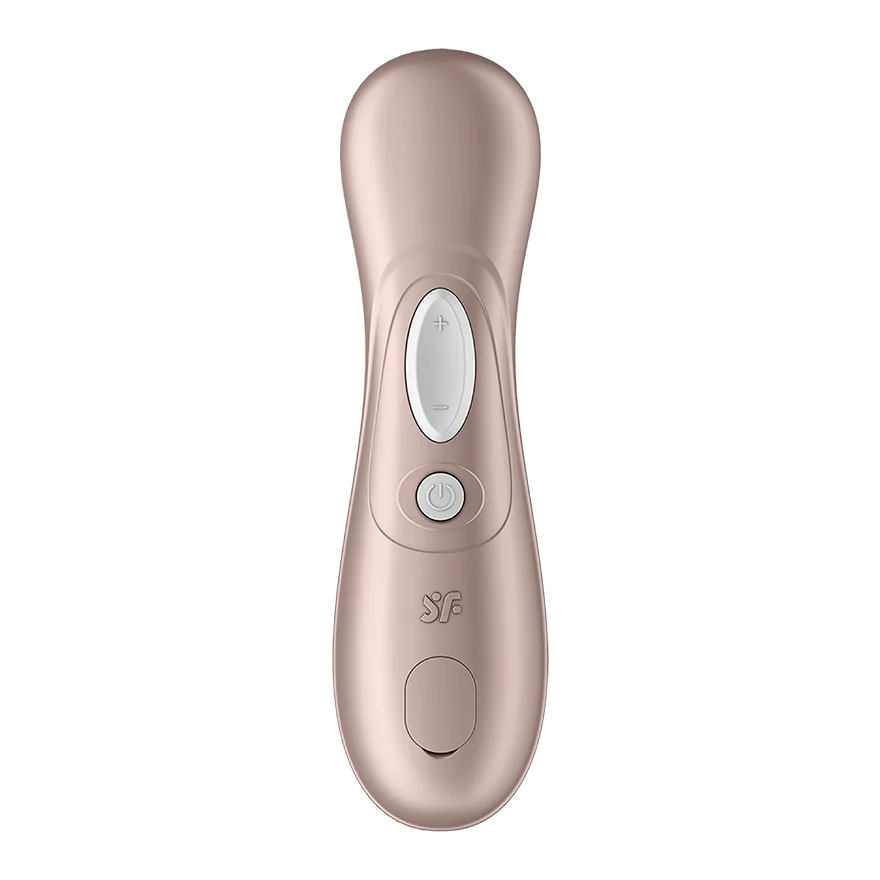
The interface is clearly visible in the manufacturer’s own product image of the back. There sits an elongated, two-part button with symbols for pressure waves, a separate round button labeled with the vibration symbol, and at the bottom the charging connector under a protective cover in the housing.
The quick guide confirms the logic: both Air Pulse and Vibration have their own on/off—one short press turns it on, a press for two seconds turns it off. You then step through the programs with repeated presses. The fact that the motors each have their own on button is more thought-out than it sounds, because it means you can leave the vibration lying unchanged while you change the pressure wave, or turn one of them off entirely without touching the other.
The downside of this solution is the usual one: the buttons are on the top side while the head rests against your body, and the product has no display. So you don’t see which program you’re on—you have to count presses or feel your way. It’s the same objection that applies to almost the whole category, but it’s worth mentioning here because the number of programs is high.
The covers sit on the head and you pull them on and off by hand. One—the Pressure Wave cover—has an open hole all the way through, so the pressure waves reach the skin without any intermediary. The other—the Liquid Air cover—is closed off with a thin silicone membrane, and that’s what gives the water-like feel the manufacturer markets. So it’s the same pump and the same eleven programs behind both.
Having detachable covers has a practical consequence that weighs more than the marketing: the inside of the pressure chamber can be cleaned. With a model with a fixed head, you rinse around an edge and hope for the best. Here you can access the inside of the chamber, and it’s the only part of the entire product where water and residue can end up staying.
The downside is equally concrete. One cover is a small silicone part that’s easy to lose, and according to the quick guide, the manufacturer allows no replacements that aren’t genuine Satisfyer covers. Satisfyer does, of course, sell a five-pack of replacement covers for the Pro 2 series for 145,95 SEK, with white silicone, a diameter of 33,3 millimeters and a height of 23,5 millimeters—but that item was marked as not available in the manufacturer’s own shop at the time of the check, and the page lists Pro 2 Air-Pulse Stimulator without explicitly mentioning Generation 3. So treat the covers as parts you don’t want to lose.
Satisfyer lists whisper mode as a feature for the model. The question is what it means in numbers, and here the answer has to be honest: the manufacturer publishes no measured decibel value for Pro 2 Generation 3, either on the product page or in the quick guide. Whisper mode is a product feature in marketing, not a measurement.
The closest the manufacturer gets to an explanation is in Satisfyer’s own FAQ. There, the whispering mode is described as a low humming from the motor rather than a loud roar, and for the units with Air Pulse technology it states that correct positioning reduces volume significantly — meaning that how quiet the product is depends partly on how you hold it. At the same time, Satisfyer writes plainly that sound generation cannot be completely avoided in motor-driven items. It’s a description of what the term means, not a number you can compare.
Still, it’s possible to say something meaningful about the order of magnitude. As a class, air-pressure products are quieter than vibrators with rotating eccentric motors, because the sound comes from a membrane pump rather than from an unbalanced weight striking the housing. But this model also has a vibration motor, and when both motors run at the same time, it’s reasonable to assume that this combination is what sounds the most — which the manufacturer doesn’t comment on at all.
For comparison, Lelo states that the Sona 3 Cruise has a maximum sound level below 60 dB, and in this category it’s unusual for any figure to be published at all. Websites that provide an exact decibel value for the Satisfyer Pro 2 Generation 3 either show their own measurement or a value without a source. A practical tip that applies regardless of model: place the product on a soft surface between uses, because a hard tabletop works as a resonance box.
Satisfyer Pro 2 Generation 3 is rated IPX7, and the rating is shown both on the product page and on the packaging. The designation comes from the international standard IEC 60529, which defines enclosure classes for electrical equipment. The number 7 in the second position means the product is tested for submersion in water to a depth of one meter for 30 minutes. The manufacturer states the consequence outright: it can be used in a bath and shower and is cleaned with warm water and mild soap.
The difference versus a splash-proof product is bigger than the wording suggests. Splash protection covers water droplets and, at best, water jets, but not submersion. Such a product handles a damp cloth and possibly a shower, but not a bathtub, and it shouldn’t be held under running water—without thinking it through, especially regarding the buttons and the charging contact.
With IPX7, you can rinse the entire product off without being careful, and it’s a genuine everyday advantage—especially on a model where the covers are removable and the inside of the chamber can therefore be cleaned separately. If a product completely lacks an IPX rating, it should be treated as not waterproof. The absence of a rating is never a sign that the product would be approved.
Remove the cover and rinse both the cover and the head in lukewarm water after each use, and use fragrance-free soap or a cleaning agent intended for intimate products. Pat dry with a clean towel and let it air-dry before putting the product away. The manufacturer states the storage temperature as −5 to +60 degrees, which in practice means the product should not be left in a cold car in winter or in direct sunlight behind a car window in summer.
The lubricant question has a clear answer for silicone products: use a water-based lubricant. Silicone-based lubricant should not be used on silicone—it breaks down the surface over time and makes it porous, and a porous surface can no longer be cleaned properly, only replaced. Oil-based products such as coconut oil leave a film that’s hard to remove and that gathers dirt.
That the product is IPX7 does not mean it can handle all water. Boiling and a dishwasher are out of the question—partly because of the temperature limit, and partly because a rating according to IEC 60529 refers to clean water at room temperature and not hot water under pressure. Rinse, wash, dry. Nothing more is needed.
Satisfyer provides significantly more information than most competitors, and the manufacturer deserves credit for that. The quick guide states a lithium-ion battery of 3.7 volts with a capacity of 500 mAh, a charging voltage of 5 volts, a maximum charging current of 300 milliamperes, a charging time of about three hours, and a usage time of about 60 minutes. The interface is listed as USB, and the product page and the function graphic specify the USB-C connection.
With a regular USB-C cable, plug it into the port under the protective cover at the bottom on the back. The light blinks while the battery is charging and lights up with a steady glow when it’s full. It’s a significantly better solution than the magnetic charging cable that several more expensive models use, for one simple reason: a magnetic charging cable is product-specific, and if you lose it, you have to buy a replacement from the manufacturer. You already have a USB-C cable at home, in the car, and at work.
Having the charging connection sit under a protective cover in the housing—and not as an open port—is also what makes IPX7 possible. Make sure the protective cover is properly closed before the product is placed in water—that’s the only point on the entire product where water resistance depends on something you do correctly or incorrectly.
The ratio is the product’s weakest point and should be said plainly. A three-hour charge for one hour of runtime means you charge three times as long as you use it. The comparison is not flattering: Womanizer states 240 minutes of runtime on a 120-minute charge for the Premium 2, i.e., four times as long runtime on two-thirds of the charging time, and Lelo states up to two hours of runtime on up to two hours of charging for the Sona 3 Cruise.
Two things soften the picture. One is that 60 minutes refers to continuous operation, and that the product is normally used in sessions of just a few minutes—so a full charge covers many occasions, not just one. The other is that charging is done via USB-C, making it easy to top up whenever you want, unlike a proprietary cable that you keep in a drawer somewhere else.
But the low maximum charging current—300 milliampere—also explains why charging takes three hours despite a battery of only 500 mAh. Fast charging isn’t available here, regardless of which charger you plug in. It’s a design characteristic, not something you can affect with a better cable.
What applies generally to lithium-ion batteries also applies here: capacity drops with the number of charge cycles, and the product does best when it’s charged regularly instead of being stored fully discharged. The manufacturer does not publish any number of charge cycles or an expected battery lifespan.
Instead, what matters is a line in the warranty terms, and it should be read before letting the fifteen-year warranty affect the purchase: the battery is expressly excluded from Satisfyer’s warranty. Since the battery is fixed in place and the warranty also ends if you open the device, the product is effectively used up when the cell is. So fifteen years applies to the design—not to the part that is statistically the first to fail.
We do not have price data from shops in your market yet.
Fifteen years of warranty sounds unbeatable. But the battery is expressly excluded — and it’s the battery that breaks first.
Four comparisons are relevant: versus its own app variant, versus the predecessor, versus one premium brand in the category, and versus the other. All specifications below come from the respective manufacturers’ own pages, and all prices come from the stores’ product feeds on July 29, 2026.
The difference is Bluetooth and the Satisfyer Connect app—nothing else in the basic functions. Both have two motors, eleven pulse-wave programs, twelve vibration programs, two lids with Liquid Air, IPX7, USB-C, and a fifteen-year warranty. The app variant is a separate item with its own EAN—4061504051840 in red versus 4061504051871 for the model this text is about.
The price picture is what’s interesting. From the manufacturer itself, the app version costs 935.95 SEK versus 831.95 for the one without the app—so 104 SEK more. In the retail channel, that difference completely disappears: both variants cost 298 SEK at the cheapest store during the price check. In practice, that means that the person who doesn’t care about the app doesn’t get any discount for skipping it—and that someone who’s unsure might as well take the app version and leave Bluetooth unused.
There’s a counterargument, and it’s principled. A product without a radio has no cloud service, no account, no app that stops being updated, and no Bluetooth module that draws power in standby. For someone who wants as few moving parts as possible in an intimate product, it’s a good enough reason to choose this version even when the price is the same.
The predecessor is called Pro 2 Generation 2 at the manufacturer and Pro 2 Next Generation in most Swedish stores, with EAN 4049369015030. It costs from 254 SEK, so 44 SEK less than Generation 3 at its cheapest.
For those 44 kronor, you get a second motor with twelve vibration programs, two removable covers instead of one fixed head, and the Liquid Air membrane. What you don’t get is a smaller product: the manufacturer lists 165 × 46 × 65 millimeters and 174.7 grams for Generation 2, so it’s the same body and just under thirty grams less weight. Common to both are eleven pressure-wave programs, IPX7, the material silicone and ABS plastic, and fifteen years of warranty.
The conclusion is unusually simple. The 44 SEK price difference doesn’t come close to matching the functional difference, and in this situation there’s no rational reason to choose the predecessor if both are in stock. The only argument for Generation 2 is if you find it significantly cheaper on clearance—and then it’s a price argument, not a product argument.
Womanizer Premium 2 costs from 1 164 SEK. Generation 3 costs from 298 SEK, so 866 SEK less—just under a quarter of the price. Both are air-pressure products for clitoral stimulation, and both are IPX7.
Womanizer lists fourteen intensity levels, body-friendly silicone explicitly without phthalates, BPA, or latex, 240 minutes of operating time, 120 minutes of charging time, dimensions 155 × 50 × 35 millimeters, weight 141.4 grams, two stimulation tips in different sizes, and a five-year warranty. It’s a smaller, lighter, and significantly more long-lasting product, with a clearer materials declaration and the ability to adjust the fit.
What the Satisfyer has that Womanizer doesn’t is a separate vibration motor, a Liquid Air membrane, charging via standard USB-C instead of a magnetic cable, and fifteen years of warranty against defects for five years. If you choose based on runtime, size, and a materials declaration, Womanizer wins. If you choose based on features per krona, Satisfyer wins so clearly that the comparison is hardly meaningful: you can buy Generation 3 three times over for the price of a Premium 2.
The Lelo Sona 3 Cruise costs from 1 513 SEK, i.e. a little more than five times as much. Lelo lists the dimensions 112 × 51 × 55 millimeters, the weight 128 grams, the material body-friendly silicone and ABS plastic, a lithium-ion battery of 520 mAh and 3.7 volts, up to two hours of operation, up to two hours of charging, 90 days of standby, the frequency 63 hertz, a maximum sound level during operation of under 60 dB, ten built-in modes plus two via app, and two years of manufacturer warranty with a ten-year quality warranty thereafter.
It has the most complete specification in the comparison, and that in itself is an argument: published sound level, published frequency, and published standby time are details that Satisfyer does not provide. Battery capacity, on the other hand, is almost identical — 520 vs 500 mAh — which makes the difference in runtime interesting. Lelo gets twice as long runtime from a battery that is four percent larger, and that difference is either due to the motors’ power draw or to how runtime is measured. Neither manufacturer states at what intensity the figure applies.
The material is the same combination for both: silicone and ABS. What differs is that Lelo’s product is smaller, lighter, more durable, and better documented, while Satisfyer’s has a second motor, two interchangeable caps, and costs 1 215 SEK less. If you want the most data and the least product, Lelo is the answer. If you want the most features per krona, that question is already settled.
Eight Swedish stores sell the item with EAN 4061504051871. Cheapest is Mshop at 298 SEK, most expensive is Sexonic at 680 SEK. That’s a difference of 382 SEK or 128 percent for exactly the same article number, the same color, and the same packaging — and the only one of the eight that didn’t have the item in stock was the most expensive one.
So seven stores had it at home during the price check, and the four cheapest are within one krona of each other: Mshop at 298 SEK, and Vuxen, Blush Me, and SexleksakerOutlet at 299 SEK each. That means there’s no reason to chase the absolute lowest price here — choose the store whose shipping terms or delivery time suits you, because shipping with certainty exceeds the one-krona difference.
The price spread upward, however, is worth noting. Lekosmek at SEK 492 and Taboo at SEK 495 both list their regular prices as SEK 719 and SEK 799, respectively, in their product feeds—i.e., prices on a par with the manufacturer’s own SEK 831.95. This suggests that this level is the official list price level, and that the low few hundred SEK represent real competition between the biggest stores, not a temporary promotion. Still, always check the final price at checkout—shipping costs are added by most stores under a certain order value, and at this price range a single product almost always falls under the free-shipping threshold.
It’s for you if you want to try air pressure technology without having to spend over SEK 1,000, and you also want vibration in the same product instead of buying two. It’s for you if you want to be able to switch between completely touch-free pressure waves and the softer Liquid Air feel without changing products. It’s for you if you want to charge with the same cable as your phone, and if you want to be able to rinse the entire product and the inside of the chamber under running water.
It’s also for you if you consciously don’t want a connected product. This is the variant without Bluetooth, without an app, and without an account—and unlike most products in the category, that option actually exists.
It’s not for you if you want long, continuous operating time. Around 60 minutes on about three hours of charging is the weakest in this comparison, and that’s not a figure you can talk away. It’s not for you if you require a measured sound level before buying, because the manufacturer only states “whisper mode” without publishing a decibel value. It’s not for you if you want an explicit manufacturer commitment regarding phthalates, BPA, and latex—it’s available at Womanizer, while Satisfyer publishes none at all, and phthalate-free here is only attested by the retailers Vuxen and Lustly. And it’s not for you if you need to be able to adjust the opening size, because the lids change the technology but not the fit.
One last thing belongs in the decision. With a price around three hundred kronor, this is a product where the risk in the purchase is low, and where the difference from a more expensive alternative mainly comes down to endurance, size, and how much the manufacturer discloses. If you’re unsure whether air pressure technology works for you at all, this is one of the most rational ways to find out.
Satisfyer offers fifteen years of warranty for material and manufacturing defects, and it’s the longest manufacturer warranty in the category—Womanizer offers five years and Lelo two years, plus a ten-year quality warranty. Fifteen years, on paper, is an outstanding commitment for a product that costs under three hundred kronor.
However, the terms deserve to be read properly, because they contain four limitations that are rarely quoted in store texts. First of all, according to Satisfyer, the warranty period begins only once the statutory warranty period in the buyer’s home country has stopped applying. Second, the battery is expressly excluded—that is, precisely the component that normally sets the limit for the product’s service life. Third, the warranty stops applying if you try to open or take apart the device or its accessories. And fourth, you pay the postage yourself when sending it in, to a return address in Bielefeld, Germany, and shipping costs are not reimbursed.
Add to that the requirement for an original receipt throughout the entire warranty period and the requirement in the quick guide that only genuine Satisfyer covers may be used, and it becomes clear that fifteen years is a strong promise with multiple conditions. It does not make the warranty worthless—but it shouldn’t be the argument that decides the purchase.
What always applies, however, are your statutory rights. Under the Swedish Consumer Sales Act (konsumentköplagen), you have three years of right to complain for defects in the item, regardless of what the manufacturer promises, and it is directed against the store you bought from—not against Bielefeld. In the case of distance purchases, you also have a right of withdrawal within fourteen days under the Act on Distance Contracts and Contracts Outside Business Premises. Please note that in practice the right of withdrawal is limited for hygiene products that have been taken out of a sealed package; however, the right to complain for defects always applies. If you have questions about what applies in your case, Konsumentverket (the Swedish Consumer Agency) provides guidance via Hallå konsument.
Satisfyer Pro 2 Generation 3 with Liquid Air, burgundy is ranked på plats 8 av 32 in clitoral stimulator best i test, where the entire category is compared against each other using five shared criteria. Guiden vinns av Womanizer Premium 2 Red Gold.
Every numerical piece of information in the text can be traced to one of the sources below. The links were checked manually on the specified date.
This page is machine-translated from Swedish. Read the Swedish original