

Review
Review: Satisfyer Pro 2 Next Generation
Cheapest among the broadly sold ones — 219 SEK and 15 years of warranty.
29 July 2026
Review · Masturbator · App-controlled clitoral vibration
Satisfyer’s app-controlled masturbator reviewed against the manufacturer’s own specifications, the quick guide in the PDF, and pricing data from seven Swedish stores. Fourteen vibration programs, body-friendly silicone in the tapered tunnel, IPX7 according to IEC 60529, a lithium-ion battery of 1200 mAh — and a charge ratio of six hours for ninety minutes of operation, which brings down the overall rating.
The cheapest way to get an app-controlled, submersible masturbator: fourteen editable vibration programs, silicone in the tapered tunnel, IPX7 and Bluetooth for 371 SEK. What you pay with is the charging ratio — six hours in the outlet for ninety minutes of operation — a specification without fit measurements, motor specs, or sound level, and a fifteen-year warranty that, according to the manufacturer’s own terms, does not cover Sweden.
Satisfyer Men Vibration+ is a vibrating masturbator that’s built around a single idea: stimulating the glans instead of the whole shaft. The manufacturer calls it Men Vibration+ Connect App in its own range, and it’s in the Male Masturbator category. It works standalone, but it’s also one of the Satisfyer products that can be controlled from your phone via Satisfyer Connect.
The specification looks like this: fourteen preset vibration programs, body-friendly silicone in the opening, and ABS plastic in the housing, an IPX7 ingress protection rating, a 1200 mAh lithium-ion battery and 3,7 volts, about 90 minutes of use time, about six hours of charging time, a magnetic USB charging cable included in the package, and a 15-year manufacturer’s warranty. The dimensions are 171,5 × 67 × 61 millimeters, and the weight is listed as 339,5 grams. In Sweden, the item is sold by seven stores at prices between 371 and 769,54 SEK, and five of them had it in stock at the price check.
This review is about the black variant with EAN 4049369016570, the manufacturer’s item number SW10203. The number is checked against the gtin13 meta tag on Satisfyer’s own product page, and all seven Swedish stores list the same number. It’s worth knowing because several of them shorten the name to only "Satisfyer Men Vibration" — which is the name of a completely different and significantly cheaper product in the same series.
The product category needs an explanation, because it’s different from both classic masturbators and from cock rings. A traditional masturbator is a casing with a tunnel into which the entire shaft is inserted, and the stimulation comes from friction when the product is moved back and forth. Satisfyer Men Vibration+ is built the other way around: only the upper part of the penis is inserted, and the stimulation comes from vibrations instead of from movement.
The manufacturer’s own functional graphic names the three design details that make it possible. The opening sits at the bottom and is described as a tapered tunnel for intensified stimulation — it’s this geometry that makes the chamber seal tightly around the glans instead of around the shaft. The vibrations are described as targeted glans stimulation. The buttons are on the top side, and the charging contact is magnetic.
What that means in practice is that the product doesn’t require the same kind of movement as a regular masturbator, and that according to the manufacturer’s description it’s intended to be used both as foreplay and as a finish. One of the Swedish store texts also points out that the unique shape makes it possible to stimulate yourself even without a full erection — that claim comes from the store, not from Satisfyer, and the manufacturer doesn’t write anything about it on its product page.
Satisfyer’s naming is the most common cause of wrong purchases in this part of the assortment, and three models are so close to each other in name that Swedish stores mix them up in their own product texts.
So the difference between the plus model and the battery model is not a plus button in the name, but the power supply, app support, and the waterproof rating. That’s also why the price differs so much. Check the EAN before you add it to your cart, especially at stores that have shortened the product name — it’s not enough to just look at the picture, because all three models are black or dark and have roughly the same silhouette.
Material is the only property of an intimate product that can’t be compensated for with experience or care, and it determines whether the product is still hygienic after five years. Satisfyer lists two materials for Men Vibration+: ABS plastic and silicone. The same two materials are stated in the quick guide’s technical specifications. It’s a more honest declaration than the marketing text implies, because shop texts like to describe the product as if it were fully silicone.
The distribution is shown in the manufacturer’s own functional graphic: the opening and tunnel are body-friendly silicone, while the casing is ABS plastic. It’s a completely reasonable design for this product type — the housing needs to be rigid for the motor unit to sit securely, and a rigid silicone housing would be both heavier and more expensive. But it also means that the description "silicone masturbator" is an oversimplification.
What applies to the silicone also applies to silicone in general: the material is non-porous. A non-porous surface can be cleaned, because there are no microscopic cavities where residue can remain. That’s the single most important property of a material that will be in contact with mucous membranes. ABS plastic is also a dense material, but in normal use it doesn’t sit against the skin, so it matters less hygienically.
A limitation should be stated plainly. The tunnel is not removable, and the manufacturer describes no option to remove or replace the silicone insert. This is the difference from masturbators with a replaceable sleeve: here you can’t turn the insert inside out when cleaning; instead, the entire product must be rinsed through as one unit. The IPX7 enclosure rating is therefore not a bonus feature on this product, but a prerequisite for it to be possible to handle.
Phthalates are a group of plasticizers used to make plastic—above all, flexible PVC—more pliable. The Kemikalieinspektionen describes them as substances that can affect the endocrine system and make reproduction more difficult, and several of them are therefore restricted or banned within the EU in a large number of products. This product category is the subject of ongoing oversight because it contains flexible plastic against the skin.
Here, an honest note must be made. Satisfyer does not state any explicit disclaimer from phthalates, BPA, or latex for this model, either on the product packaging or in the quick guide. What’s stated is the materials—silicone and ABS plastic—and the wording “body-friendly silicone.” The fact that the material is silicone is, in itself, a better signal than almost any other claim in a product specification, because silicone does not require phthalate plasticizers to become soft: the softness comes from the polymer’s own structure. But that is a conclusion that follows from the material choice, not a commitment from the manufacturer, and that difference is worth keeping distinct.
The quick guide, however, includes three specific material-related warnings that rarely appear in store texts: do not use the product on irritated or damaged skin, remove piercings and jewelry in the genital area before use, and stop using the product if it becomes unusually warm, damaged, deformed, or discolored. Discoloration is a clear signal that a silicone surface has begun to break down, and that’s why it’s included in the list.
Satisfyer gives the length as 171.5 millimeters, the width as 67 millimeters, and the height as 61 millimeters. The weight is given as 339.5 grams. It is, unlike some other manufacturers’ details in this category, a credible figure: a product of this size with a housing made of ABS plastic, a silicone insert, a motor unit, and a 1200 mAh lithium-ion battery comes out reasonably around three and a half hectograms.
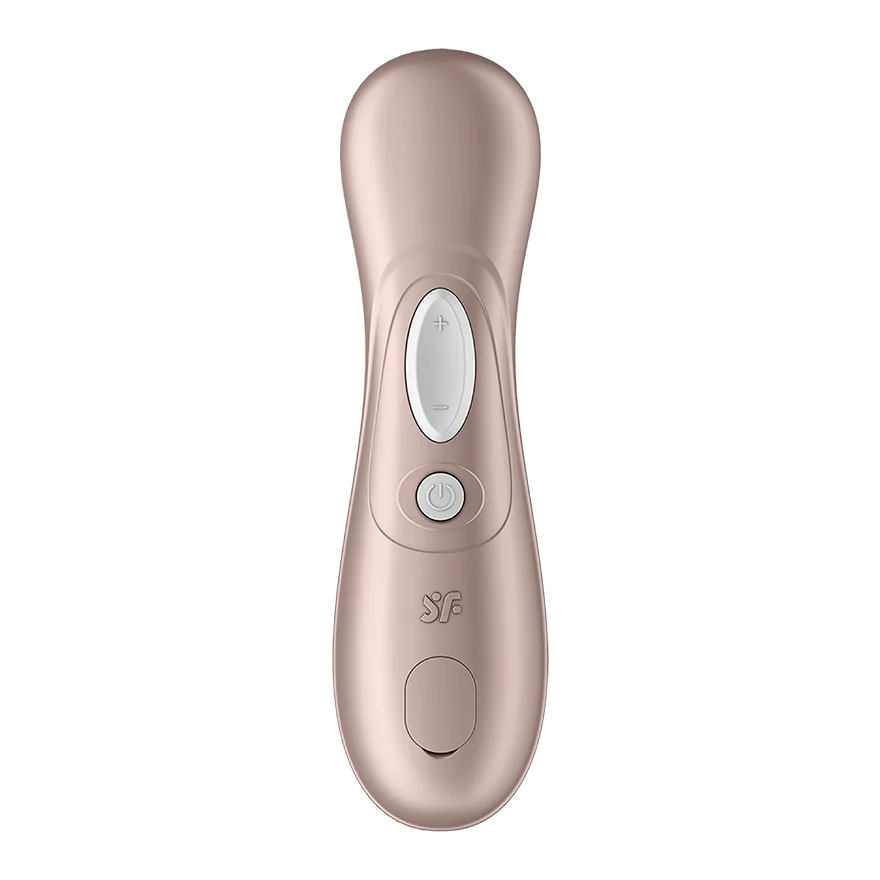
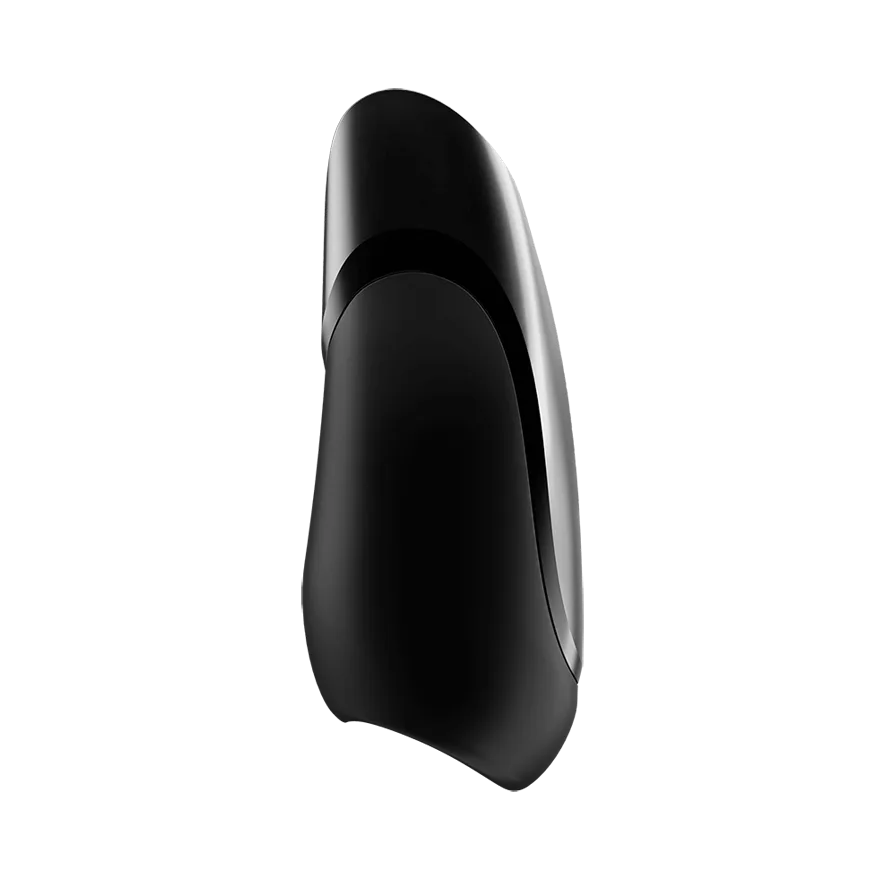
The shape is asymmetrical. The wider part with the buttons sits on top, the body narrows toward the bottom, and the opening is at the lower end. That means the product can be held in your hand like a bottle rather than like a sleeve, and that grip-technology difference versus a classic masturbator is the reason it should be held with your whole hand. The manufacturer describes the shape as ergonomic and designed to lie comfortably in the hand.
Size also sets a practical limit. 171.5 millimeters is too long for a pocket and about the same length as a large mobile phone, but it fits in a toiletry bag. For comparison, the Lelo F1S V3 measures 144 millimeters with a diameter of 72 millimeters and weighs 314 grams — so it’s a shorter but thicker and almost equally heavy product.
There’s one piece of information that is crucial for this particular product type, and that Satisfyer does not publish: how deep the tunnel is and how wide the opening is. Neither the product page nor the quick guide states the insertion length or inner diameter. For a product whose whole point is that only the glans is meant to be inserted, it’s a strange omission, because the fit is what determines whether the design works for an individual user.
Comparing it with a manufacturer that lists the same measurements makes the gap clear: Lelo states for the F1S V3 an insertion length of 110 millimeters and an inner diameter that stretches between 40 and 60 millimeters. With those numbers, you can determine in advance whether the product will fit. With Satisfyer’s information, you can’t.
One of the Swedish stores fills the gap on its own and states 15.00 centimeters in length, 7 centimeters insertable length, and 4.5 centimeters inner diameter in its product text. Those numbers aren’t found with the manufacturer, and the first of them — 15 centimeters — also contradicts Satisfyer’s own length claim of 171.5 millimeters. Treat the store’s measurements as an estimate, not as a specification.
The product’s interface is intentionally small. The manufacturer’s functional graphics show two buttons on the top side, labeled as controls for the vibrations, and the quick guide’s pictograms show that the programs are stepped through from 1 to 14 and that the product is turned off with a longer press. Satisfyer does not publish a written button description on the product page — the quick guide is almost entirely image-based and contains mainly safety information in twenty-eight languages.
Fourteen preset programs are more than most people use. The manufacturer describes them as editable in the app, and that phrasing is the most interesting part: the programs are therefore not locked, but the fourteen are a starting point that Satisfyer Connect can overwrite. Without the app, you get fourteen fixed patterns. With the app, according to the manufacturer, you get a practically unlimited number.
An important clarification: Satisfyer lists fourteen programs, not fourteen intensity levels. The difference matters when comparing with other products. A program is a pattern — a rhythm, a pulse, or a steady vibration — while an intensity level is a strength. A product with fourteen programs can very well have fewer distinct strengths than a product with ten intensity levels, because several programs can be at the same power level but with different rhythms.
The manufacturer does not publish a breakdown of the fourteen programs into steady vs pulsing modes, and it provides no power rating per program. What can be established is that the level steps linearly from 1 to 14 with single presses according to the quick guide pictograms, and that all fourteen are available without an app.
The motor configuration also deserves a note. Satisfyer does not state how many motors the product has, either on the product page or in the quick guide. One of the Swedish stores writes that it has two motors, while another says that the motors are strategically placed for deep and surface vibrations. None of this information can be substantiated by the manufacturer, and they should be read as the stores’ own wording.
The app support is what sets the plus model apart from the rest of the Men series. The manufacturer states that the product is compatible with the free Satisfyer app for iOS and Android, that it can also be used without the app, that the pre-set programs are editable, and that the app provides, in practice, an essentially unlimited variation of programs.
The technical side is covered in the quick guide. The radio frequency is listed as 2402–2480 MHz and the output power as +6 dBm. The frequency band is the standard band for Bluetooth, and the output power corresponds to the power class used in short-range products. According to the quick guide, the manufacturer has issued an EU declaration of conformity according to the Radio Equipment Directive 2014/53/EU and the RoHS Directive 2011/65/EU, and the declaration is published on Satisfyer’s compliance page.
What you should expect from the range, however, is not documented. Satisfyer does not publish a range statement in meters and it provides no Bluetooth version. With +6 dBm output power, this is about short-range connectivity in the room, and remote control over the internet assumes that the app buffers the connection — how it works in practice is not described by the manufacturer in the documentation connected to the product.
A point worth considering before buying: an app is a function with an expiration date. According to the manufacturer, the product works without an app, which is the important guarantee, but the functions that are only available in the app depend on Satisfyer continuing to maintain it for your phone’s operating system. A fifteen-year hardware warranty is not a fifteen-year software warranty.
The manufacturer markets the model with a whisper mode — “Whisper mode” is listed in the feature list on the product page. The question is what it means in numbers, and the answer has to be honest: Satisfyer does not publish a measured decibel value for Men Vibration+, either on the product page or in the quick guide.
It’s also not possible to derive a value from any other information. Whisper mode is only described by its name, without stating how much quieter it is than normal mode or which of the fourteen programs it corresponds to. Websites that provide an exact decibel value for this model either show their own measurement or a value without a source.
For comparison, Lelo lists under 75 dB as the maximum sound level for the F1S V3. It’s interesting mostly as a demonstration of how little information there is to compare in this category, even when a number is published — 75 dB is an upper limit, not a typical value, and it says almost nothing about how the product sounds at low power. A practical tip that applies regardless of model: a hard tabletop surface acts as a resonance box and noticeably amplifies the sound, so place the product on a soft surface between uses.
Satisfyer Men Vibration+ is rated IPX7. The rating appears both in the properties table on the product page, in the feature list, and in the product description, where the manufacturer writes that the waterproof design allows the product to be used in water and makes it easy to clean. The rating comes from the international standard IEC 60529, which defines enclosure ratings for electrical equipment.
The number 7 in the second position means the product has been tested for water immersion to a depth of one meter for 30 minutes. That’s different from IPX5 and IPX6, which cover water jets of different strengths but not immersion. An IPX5 product can handle a shower but not a bathtub and should not be held under water. So the difference is not degrees of the same thing — it’s two different tests.
This is also where I’d put a warning about store data. One of the Swedish stores lists IPX5 for this item in its product text, while the manufacturer lists IPX7. Another store lists the correct IPX7. Both sell the same EAN. The manufacturer’s statement is the one that applies, but the example shows why you should never use a store text as a specifications source. The difference between IPX5 and IPX7 is, in practice, the difference between being able to rinse the product and not being able to.
For this particular product, IPX7 is also more than just a convenience. Because the tunnel isn’t removable, rinsing through is the only cleaning method that reaches the entire inside. A model with the same design but a lower ingress protection rating — like the sister models Men Vibration and Men Heat Vibration, both rated IPX6 — can’t be handled in the same way.
Rinse the product through with lukewarm water after each use and use fragrance-free soap or a cleaning agent intended for intimate products. Let the water run through the entire tunnel, because that’s where residue collects. Wipe the outside and let the product air-dry while standing up, with the opening facing downward, before putting it away — a trapped, damp tunnel is the most common cause of odor in this product category.
A silicone-based lubricant should not be used on silicone products. Over time, it breaks down the silicone surface and makes it porous, and a porous surface can no longer be cleaned properly — only replaced, which here would mean replacing the entire product, since the insert isn’t replaceable. A water-based lubricant is the right choice. Oil-based products such as coconut oil leave a film that’s difficult to get off a tunnel you can’t reach.
The quick guide specifies the storage temperature as between −5 and +60 degrees. It’s a wider range than you might expect, but it also means there’s a clear limit: boiling water and the dishwasher are out of the question, despite IPX7. The product also contains magnets in the charging connector, which is reason enough not to store it next to a card with a magnetic stripe.
This is the area where Satisfyer is unusually open, and where the result is still the model’s weakest point. The quick guide provides the full battery chain: a 3.7-volt lithium-ion battery, 1200 mAh capacity, a charging voltage of 5 volts, a maximum charging current of 500 milliamps, charging time of about six hours, and usage time of about 90 minutes. The interface is listed as USB.
With a magnetic charging cable that connects to USB. The cable is included according to the manufacturer’s functional list, and the magnetic charging contact is excellent in the functional graphics. Magnetic charging is a trade-off, not a pure advantage. The advantage is that you don’t need any opening in the housing, which makes it easier to achieve IPX7 without a rubber plug. The downside is that the cable is product-specific: if you lose the charging cable, no standard USB-C cable will work, so you have to get a replacement from the manufacturer, which sells charging cables as a separate accessory.
That the charging current is limited to 500 milliampere explains the charging time. 500 mA is the current that an older USB-A port delivers without negotiating, and so it’s not the charger that’s the bottleneck, but the product’s own charging circuitry. A modern fast-charging adapter makes no difference here.
The ratio is the most remarkable figure in the entire specification. Six hours of charging gives about 90 minutes of use — four times as long in the outlet as in the hand. It’s a bad ratio even for the category, and it only becomes clear in comparison: Lelo states a two-hour charging time and up to two hours of operating time for the F1S V3, meaning three times shorter charging for one third longer operation.
That the capacity is high — 1200 mAh is more than twice as much as the 520 mAh Lelo lists for one of its clitoral products, and significantly more than the 850 mAh stated for the F1S V3 — makes the ratio more interesting, not less. A large cell that lasts 90 minutes means the motors draw a lot of current. It says something about the power, but it also says that operating time can’t be improved with a larger battery without the product becoming heavier.
Practically, that means two things. First: charge in advance, because a drained product isn’t usable within a quarter of an hour. Second: 90 minutes is enough for multiple occasions, so charging doesn’t have to be often — just planned. What generally applies to lithium-ion batteries also applies here: capacity drops with the number of charging cycles, and the product does best when it’s charged regularly rather than stored completely discharged. The battery isn’t replaceable, and that’s why the cell—not the silicone—sets the limit for the product’s lifespan in practice.
We do not have price data from shops in your market yet.
Six hours of charging for ninety minutes of operation. Four times the time in the outlet as in the hand — and the charging current is locked to 500 mA, so a more powerful charger changes nothing.
Three comparisons are relevant: against the two cheaper sister models in the same series and against a premium product in the same usage area. All details below come from each manufacturer’s own specifications, and all Swedish prices are taken from the shops’ product feeds on July 29, 2026.
This model is the most common mix-up, and the difference is greater than the name suggests. The battery model is powered by two AA batteries instead of a built-in lithium-ion battery; it completely lacks app support, and it is rated IPX6 instead of IPX7—meaning it’s protected against powerful water jets but not tested for submersion. The dimensions are 152 × 79 × 74 millimeters, which makes it shorter but both wider and taller than the plus model. The manufacturer publishes no weight for it.
So what you get for the price difference is three things: rechargeable operation, app control, and submersion. What you save with the battery model is the charging time—two AA batteries are swapped in ten seconds and require no planning. If the six-hour charge for ninety minutes is what bothers you most in the plus model’s specifications, it’s worth knowing that the battery model solves exactly that problem, at the expense of everything else.
The decisive objection to the battery model is the enclosure class. With IPX6 and a tunnel that can’t be removed, there is no cleaning method that reaches the entire inside without risking the electronics. For a product of this kind, it weighs heavily.
But Heat Vibration costs from 259 SEK in Swedish retail, so 112 SEK less than Men Vibration+ at its cheapest. It’s powered by three AAA batteries, is rated IPX6, weighs 305 grams, and measures 82 × 80 × 140 millimeters—a significantly shorter and rounder product with a different form factor. The materials are the same: ABS plastic and silicone.
What it adds is heat. What it lacks is app control, a rechargeable battery, and IPX7. The 112 SEK price difference is small in context, and that makes the choice a pure question of features rather than a budget issue: do you want heat and a battery swap, or app control and submersion? You can’t get both in the same product in this series.
Lelo F1S V3 costs from 1,995 SEK in Swedish retail. But Men Vibration+ costs 371 SEK at its cheapest, so a little over five times less. Both are app-controlled products for penis stimulation, but they’re built for different things and are listed on completely different levels.
Lelo lists the dimensions as 144 × Ø 72 millimeters, an insertable length of 110 millimeters, an inner diameter that stretches between 40 and 60 millimeters, a weight of 314 grams, materials: body-friendly silicone, aluminum alloy, and LEXAN 141R, a lithium-ion battery of 850 mAh and 3.7 volts, a two-hour charging time, up to two hours of operating time, 90 days standby, two separate motors with specified frequencies—64 Hz for the suction motor and 93 Hz for the vibration motor—automatic shutoff after 20 minutes, a sound level under 75 dB, and a two-year manufacturer’s warranty plus a ten-year quality warranty.
The differences that actually matter: F1S V3 takes the whole shaft and combines suction with vibration, while Men Vibration+ only takes the glans and only vibrates. Lelo reports fit measurements, motor frequencies, and sound level; Satisfyer reports none of those things. On the other hand, Satisfyer has higher battery capacity in absolute terms, IPX7 versus Lelo’s general “fully waterproof,” and fifteen years of warranty versus Lelo’s two — even though Satisfyer’s warranty, as shown below, has a geographic limitation that makes the comparison less clear-cut than it looks.
If you’re unsure whether vibration stimulation of the glans works for you, Satisfyer is a hard-to-beat way to find out for under four hundred kronor. If you already know you want suction plus vibration, published fit measurements, and a product in metal and LEXAN, the price difference is justified — but it’s big enough that it should be a deliberate choice.
Seven Swedish shops sell the item with EAN 4049369016570. The cheapest is Mshop at 371 SEK, and the most expensive is Sexonic at 769.54 SEK. That’s a 398 SEK or 107 percent difference for the exact same item number, the same color, and the same packaging. By comparison, the manufacturer’s own list price is 79.95 euro.
The stock situation is unusually good for this product. Five of the seven shops had it in stock at the price check: Mshop at 371 SEK, Vuxen at 372 SEK, Blush Me at 429 SEK, and Lekosmek and Taboo at 699 SEK each. The two that were out of stock — Vuxenkul at 629 SEK and Sexonic at 769.54 SEK — are also the most expensive after the two Shopify shops, which means the practical price spread is 371 to 699 SEK.
The difference between the two cheapest is one crown. Mshop and Vuxen are at 371 and 372 SEK respectively, and both have the item at home. That means the shipping cost in practice determines which one will be cheapest for you — Mshop’s feed shows 39 SEK in shipping, Vuxen’s feed shows no shipping cost at all. Always check the final price at checkout.
The price spread isn’t because any shop sells a different variant. All seven list the same EAN. It comes down to the shops’ own margin setting for a model that has been around long enough to become a volume product for some and a full-price product for others — and that’s exactly the situation where it pays off the most to compare before you pay. Several of the shops also state a regular price around 899 SEK in their feed, which makes even the most expensive listing appear discounted.
It fits you if you want targeted stimulation of the glans rather than friction along the entire shaft, and if you like the idea of a product that works both during foreplay and as a finisher. It fits you if you want app control without paying a premium price — 371 SEK for a Bluetooth-connected product with IPX7 is low in this category. And it fits you if you want to be able to rinse the entire product under running water, which is a genuine advantage when the tunnel can’t be detached.
It doesn’t fit you if you want a classic masturbator for the entire shaft — that’s the right category for the F1S V3 and conventional sleeve products. It doesn’t fit you if you need to know the fit in advance, because Satisfyer does not publish the insertion depth or inner diameter. It doesn’t fit you if you’re bothered by charging time: six hours for ninety minutes of operation is the category’s weakest ratio, and it can’t be improved with a more powerful charger because the charging current is limited to 500 milliamperes. And it doesn’t fit you if you require a published noise level or motor specification before purchase, because the manufacturer does not publish either.
One more thing belongs in the decision. The product is built as a single unit without replaceable parts. The silicone insert can’t be replaced, the battery can’t be replaced, and the charging cable is product-specific. That makes it easy to take care of but impossible to refurbish, and it’s worth factoring in when you compare fifteen years of warranty against a design where no individual wear part can be replaced.
Satisfyer offers fifteen years of voluntary manufacturer warranty, and that figure is shown both in the feature list on the product page and on the manufacturer’s warranty page. The warranty runs according to the terms starting from when the statutory limitation period for breach of contract has expired in the buyer’s country. It covers material and manufacturing defects assessed from the standpoint of the state of the art at the time of manufacture. Satisfyer decides whether to replace the product or refund the purchase price — the latter only if the purchase was made in their own web shop.
Read the exclusions before counting on the warranty, because they are extensive. The rechargeable battery in the product is expressly excluded, as well as normal wear and tear, damage from improper use or an accident, repairs carried out by unauthorized persons, and accessories that are not original. Since the battery is the component that will certainly deteriorate over time, and since it can’t be replaced, the fifteen-year warranty is, in practice, a warranty against manufacturing defects — not against the product stopping working after a number of years.
The most important limitation is geographic. Satisfyer states that the warranty applies in Germany, Austria, Italy, France, Spain, and the United Kingdom. Sweden is not included in the list. If you buy from any of the seven Swedish stores listed above, you should therefore assume that the manufacturer’s warranty is not the path you use in case of a defect, but that you contact the store instead. The terms also require an original receipt, a complaint within one month from the time the defect is discovered, and that the customer pays the return shipping.
What always applies, however, are your statutory rights. Under konsumentköplagen (the Swedish Consumer Sales Act), you have a three-year right to make a complaint for defects in the product, regardless of what the manufacturer promises, and it is directed at the seller—that is, the Swedish store. For distance purchases, you also have a right of withdrawal for fourteen days under lagen om distansavtal och avtal utanför affärslokaler (the Swedish Act on Distance Contracts and Contracts Outside Business Premises). Be aware that, in practice, the right of withdrawal is limited for hygiene products that have been removed from a sealed package—however, the right to make a complaint for defects always applies. If you have questions about what applies in your case, Konsumentverket guides you via Hallå konsument.
Satisfyer Men Vibration+ is ranked etta av 20 in masturbator best i test, where the entire category is compared against each other using five shared criteria.
Every numerical piece of information in the text can be traced to one of the sources below. The links were checked manually on the specified date.
This page is machine-translated from Swedish. Read the Swedish original