

Review
Review: Satisfyer Pro 2 Next Generation
Same air pressure chamber without a vibration motor — 219 SEK and a 15-year warranty.
29 July 2026
Review · Clitoral stimulator · Air pressure and vibration
Satisfyer’s best-selling air-pressure chambers, with a second motor in the silicone edge, reviewed against the manufacturer’s own specifications and price data from ten Swedish stores. Eleven pressure-wave intensity steps across ten vibration programs in two separately controllable motors, IPX7 according to IEC 60529, a 450 mAh lithium-ion battery with about 60 minutes of runtime and a 15-year warranty — at a price that differs by 163 percent between the cheapest and most expensive store.
The air pressure chamber from Satisfyer’s best-selling series plus a real vibration motor on the silicone edge, for under 300 SEK. Eleven pressure-wave steps and ten vibration programs are controlled independently of each other with three buttons. IPX7 means the entire product can be rinsed off, the battery is 450 mAh with around 60 minutes of published runtime, and the warranty is 15 years. What you pay with is the charging cable — magnetic, not USB-C — and a runtime that is one quarter of the premium segment’s.
Satisfyer Pro 2 Vibration is the version of the house’s best-selling clitoral stimulator that has received a second motor. The basic principle is the same as for the entire Pro 2 family: a closed chamber is placed over the clitoris and a pump creates pulsing pressure waves in the air inside the chamber, without anything touching the skin. What’s new is that the edge of the silicone head can also be set to vibrate using a completely separate motor with its own control.
The specification looks like this according to the manufacturer: eleven pressure-wave intensities, ten vibration programs, two separately controllable motors, enclosure rating IPX7, skin-friendly silicone against the body, and ABS plastic in the housing, a lithium-ion battery, and a 15-year warranty. Dimensions are 143 × 46 × 54 millimeters, and the stated weight is 90.3 grams. The quick guide specifies the battery as 3.7 volts and 450 milliampere-hours, the charging time as about two hours, and the operating time as about 60 minutes. In Sweden, the item is sold by ten stores at prices between 277 and 729 SEK, and seven of them had it in stock at the price check.
This review is solely about the item with EAN 4049369016525. The number is verified in the page source on Satisfyer’s own product page, where it is located in the page’s gtin13 tag—on both the Swedish and the German versions. It’s worth checking yourself before you order, since Satisfyer has sold at least a half-dozen products under the name Pro 2 and because the store texts mix them up more often than you’d think.
A price observation belongs here already. Satisfyer sells the product in its own Swedish web store for 727.95 SEK. The cheapest of the ten Swedish retailers charges 277 SEK for the same EAN. That’s just under 62 percent below the manufacturer’s own list price, and that says something about how intensely this model is exposed to competition and about how little the list price matters in this category.
Air pressure technology — Satisfyer calls its variant Air Pulse — is based on a membrane pump that alternately creates underpressure and overpressure in a sealed chamber that is placed over the clitoris. The chamber never touches the clitoris directly. The stimulation takes place through pressure waves in the air inside the head, and that is the entire reason the manufacturer describes the product category as touch-free clitoral stimulation. The fit is therefore crucial: if the edge does not seal tightly against the skin, no underpressure builds up, and the effect completely fails.
The difference from a regular vibrator is principled, not a matter of degree. A vibrator transfers mechanical movement from a motor through the material to the skin. An air-pressure product transfers pressure changes through air. So the fact that Satisfyer builds both into the same product does not mean you get “more of the same thing”—you get two different stimulation principles that work on the same point at the same time.
The manufacturer describes the operation of the second motor very precisely: the edge of the soft head is set into vibration and encloses the clitoris, while the pressure waves operate inside the chamber. So the vibration is in the contact surface, not in the shaft. This is a relevant difference from designs where a vibration motor sits farther down in the handle and the energy is dampened along the way through the plastic. The fact that the edge vibrates is also the reason why both functions can be used separately without one interfering with the other.
What can be established purely technically is that the two motors each have their own control. Eleven pressure-wave intensities are controlled with the plus and minus button in the middle of the device, and the ten vibration programs with a separate button underneath. Multiplied, that gives 110 combinations with both motors running, plus the option to run only pressure waves or only vibration. If you want a number to compare: Pro 2 Next Generation has eleven settings in total, because it only has one motor.
The naming in the Pro 2 series is confusing enough to deserve its own section. All three are sold in parallel in Swedish stores, often by the same retailer, and the price difference between the models is smaller than the price difference between the stores for the same model.
The conclusion is straighter than the price tags suggest. If you only want air pressure and the lowest possible price, Next Generation is the right choice. If you want vibrations too, and you think that a magnetic charging cable is an acceptable inconvenience, Pro 2 Vibration is the cheapest of the ones that have two motors. If you want USB-C and the latest membrane, Generation 3 costs only 21 SEK more than Pro 2 Vibration — and that difference is so small that the charging connector alone can determine the choice.
This is one of the most common sources of bad purchases in this category. Satisfyer markets the product as Pro 2+ on its own website, and that is also the name printed on the packaging together with the wording "Double Air Pulse Vibrator" and "11x10 Programs". Swedish retailers sell essentially the same item under the name Satisfyer Pro 2 Vibration, and one or two shops also call it "2020 Edition".
The only thing that definitely links the names is the EAN number. The manufacturer’s Pro 2+ page shows gtin13 4049369016525 in its page source, and all ten Swedish stores in the price comparison on this page list the same number. If you check the EAN in the store’s specification table before you add it to your cart, you can’t go wrong, regardless of what name the store has chosen.
The color question belongs here too. The manufacturer lists the color of the item as rose gold in its specification table and, at the same time, offers the variants pink, violet, and blue in its own shop. In practice, Swedish stores sell the rose-gold colored one. Functionally, the versions are identical, but since color variants can have their own item numbers, it’s another reason to go by the EAN instead of the product image.
The material question is the only feature of an intimate product that you can’t compensate for through experience or care, and it determines whether the product is still hygienic after three years. Satisfyer lists two materials for Pro 2 Vibration: ABS plastic and silicone. It’s the same material combination as on Pro 2 Next Generation and Pro 3 Vibration, and that sets the series apart from the premium segment, where the whole housing is usually silicone-clad.
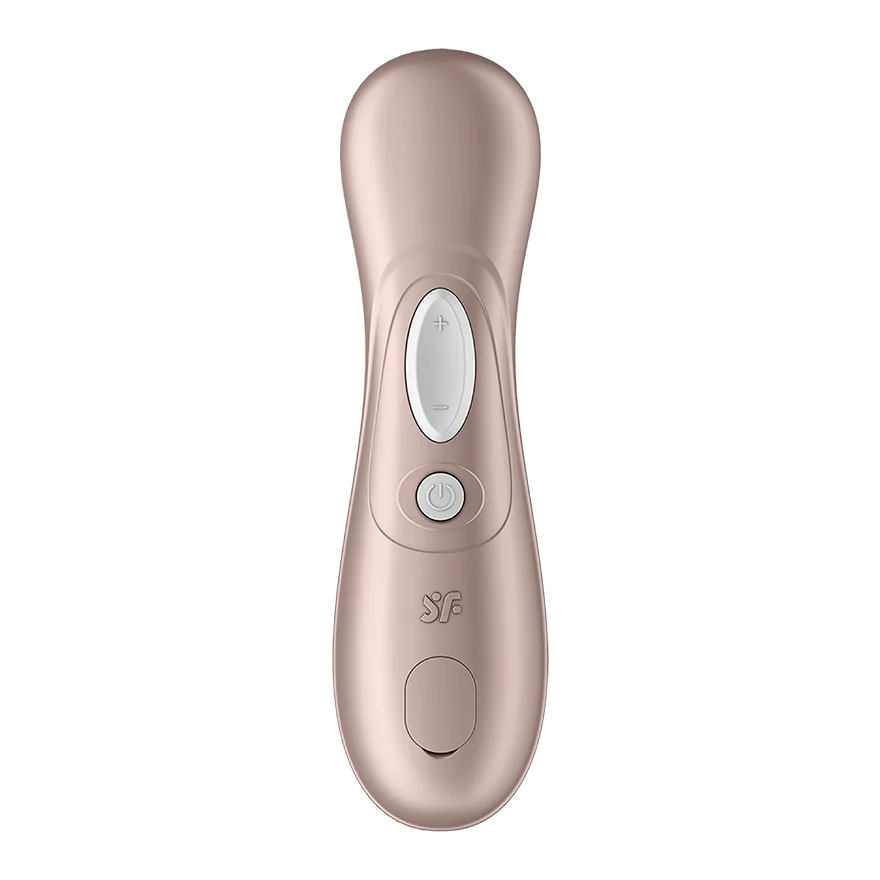
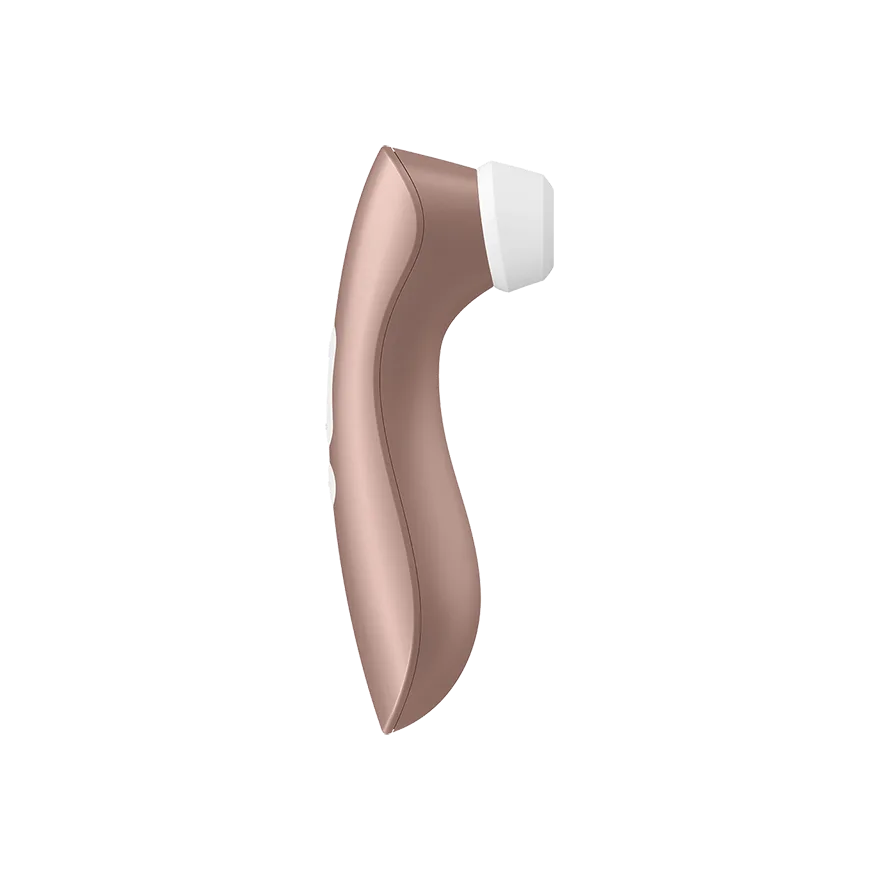
The silicone sits in the white head—that is, exactly the surface that lies against the body—and it is in that section that the other motor works. The manufacturer’s own product graphic names it "softer Silikonkopf" and describes the ring as skin-friendly. The shaft and grip are ABS plastic, a hard thermoplastic with a metallic coating in rose gold.
This is a real difference compared with more expensive models. Womanizer Premium 2 has body-friendly silicone all over, and Satisfyer’s own Pro 2 Generation 3 is described by the manufacturer as made from seamless silicone with a Soft Touch surface. Pro 2 Vibration has silicone only where it’s needed for hygiene. For cleaning, it matters less—both silicone and ABS are non-porous surfaces that can be cleaned. For the feel in your hand, it matters, and it’s one of the most obvious reasons why this model costs a quarter of a Womanizer.
One construction detail worth noting: because the vibration is in the silicone ring and not in the shaft, it matters less that the shaft is hard plastic. On a product where the vibration motor sits in the handle, the ABS plastic would have worked as a resonance box against the palm. Here, instead, it’s the contact area that moves.
Phthalates are a group of plasticizers used to make plastic—above all, soft PVC—flexible. The Swedish Chemicals Agency describes them as substances that can affect the endocrine system and make reproduction more difficult, and several of them are therefore restricted or banned within the EU in a large number of products. This product category is repeatedly the subject of supervision because it contains plastic that lies against skin and mucous membranes.
Silicone and ABS are both materials that don’t require phthalate plasticizers to work. Silicone gets its softness from the polymer’s own structure, and ABS is a hard plastic that should not be flexible at all. That’s the whole point: the material declaration carries more weight than the specifications list. A product that states "TPE" or "jelly rubber" without any further clarification says nothing about which plasticizers are included, whereas "silicone" and "ABS" are unambiguous terms.
An honest remark belongs here. Satisfyer does not publish any explicit statement saying that Pro 2 Vibration would be free from phthalates, BPA, or latex, either on the product page or in the quick guide. What is provided is the materials, and that the silicone is skin-friendly. Womanizer, on the other hand, prints that commitment clearly and in writing for Premium 2. This is a difference in how it’s documented, not necessarily a difference in content—but anyone who chooses based on documented material declarations gets more on paper from the competitor.
Part of the gap is filled in elsewhere, and it is worth knowing where the information comes from. Three of the Swedish retailers, in fact, state that the product is phthalate-free: Vuxen writes "Kroppsäker & Fri från Ftalater", Lustly "Kroppssäker silikon, ftalatfri" with the specifications line "Ftalatfri: Ja", and Joyland has the line "Ftalat-fri: Ja" in its specification table. So the three stores say the same thing. However, these are store details and not manufacturer data — Satisfyer themselves still say nothing about phthalates for this model. And none of the stores says anything about BPA or latex, so the two parts in the declaration are still unanswered no matter where you look.
Satisfyer states the length as 143 millimeters, the width as 46 millimeters, and the height as 54 millimeters. The weight is given as 90.3 grams. That makes the Pro 2 Vibration the smallest and lightest model in the entire comparison — the Pro 2 Next Generation measures 165 × 46 × 65 millimeters and weighs 174.7 grams, the Pro 2 Generation 3 measures 164 × 65 × 46 millimeters and weighs 203 grams, the Pro 3 Vibration measures 145 × 48 × 43 millimeters and weighs 113 grams, and the Womanizer Premium 2 measures 155 × 50 × 35 millimeters and weighs 141.4 grams.
That the model with two motors at the same time would be almost half as light as the single-motor Next Generation deserves a caveat. The weight figure of 90.3 grams comes from the same feature table on the manufacturer’s product page that also claims that the product is powered by two AAA batteries, which it evidently does not. The table therefore contains at least one demonstrable error, and that should affect how much weight you place on the other lines in it. Treat 90.3 grams as the manufacturer’s claim and not as a confirmed measured value.
The shape is the classic Pro 2 shape: an asymmetrical, tapering shaft that curves upward toward the head, built to be held with three fingers. The angle between the shaft and the head is fixed, which means you control the angle toward your body with your wrist and not with the product. It’s a difference from wand models where the head is movable, and it’s also the feature that determines whether the fit sits correctly or not at all.
If you shop online and wonder what comes in the package: the packaging measures, according to the retailer Mshop, 20 × 9.5 × 5 centimeters, and the shipping weight is given as 0.40 kg. The same store lists the contents as the product, a magnetic USB charging cable, and a user manual. Those details come from a retailer and not from Satisfyer, but they match the manufacturer’s own information that a magnetic USB charging cable is included.
This is a question that comes up in store text and deserves a precise answer. Satisfyer sells a separate accessory called Pro 2 – Lock: five interchangeable suction heads in white medical-grade silicone, two flat and three voluminous, with a diameter of 33.3 millimeters and a height of 23.5 millimeters. The manufacturer describes them as made for the Satisfyer Pro 2, as interchangeable “with just two hand movements,” and as identical in shape to the suction head included with the product.
The fact that the covers exist, and that they’re described as interchangeable with the same shape as the one that comes included, is a clear indication that the head in the Pro 2 series is intended to be removed and cleaned separately. However, Satisfyer does not list the covers among the accessories for the specific Pro 2+, and it also does not anywhere on the product page explicitly state that the head on this model is detachable. The manufacturer’s accessory list on the Pro 2+-side only includes lubricants, a disinfection spray, and a USB charging cable—no covers.
The answer, however, is found with one of the retailers. The manufacturer says nothing about it, but the store Taboo explicitly states that the product is “compatible with interchangeable nozzles”, and has “Compatible with extra nozzles” as its own bullet point in its list of features. The information is on a product page that lists the correct barcode, 4049369016525, meaning it is exactly the item this text is about. Joyland points in the same direction by cross-selling a five-pack of nozzles from the Pro 2 series for the model on its page, but that link goes to the nozzles for the Pro 2 Next Generation—so it does not confirm the fit on its own.
So the conclusion is two-part. That the head can be swapped is a store claim, not a manufacturer commitment, and since it’s exactly this part that vibrates—a construction difference versus the simple Pro 2—it’s worth checking with the store before you pay for the extra covers. But the claim that the fit at all cannot be adjusted no longer holds: at least one retailer states plainly that it can be adjusted.
The comparison with the competitors makes the question concrete. Womanizer Premium 2 is delivered with two top sizes in the package, and Satisfyer’s own Pro 2 Generation 3 is, according to the manufacturer, delivered with two covers—one for classic Air Pulse and one with a Liquid Air membrane. Pro 2 Vibration has one head, and the manufacturer does not indicate any alternative size in the delivery. If the chamber fits poorly, then the adjustment is therefore an add-on purchase and not something that comes in the box—and according to the manufacturer’s own materials, it’s not even a documented possibility, just something that a store is willing to vouch for.
The interface is as simple as possible for a product with two motors. The manufacturer’s own functional graphic names the parts: an elongated rocker switch with plus and minus in the middle of the shaft controls the pressure wave programs, and a round button just below controls the vibration. The graphic calls the latter "One Touch Button". Above it sits the soft silicone head, and the grip is described as ergonomic.
The quick guide shows operation with pictograms: a press held for two seconds starts the product and a press held for two seconds turns it off, the pressure wave steps run from 1 to 11, and the vibration is stepped through in ten steps. There is no display, no app, and no Bluetooth connection—if you want app control in the Pro 2 series, it’s the Pro 2 Generation 3 Connect App that applies, not this model.
The manufacturer is clear that the motors are controllable separately. It’s the only piece of information in the entire specification that really distinguishes this product from the simple Pro 2, and it deserves to be understood properly. That the motors are independent means you can run high pressure wave intensity with the vibration turned off, low pressure wave intensity with the vibration on at maximum, or anything in between—without one control moving the other.
Eleven pressure wave steps times ten vibration programs gives 110 combinations when both motors are running. If you add the modes where only one works, the list becomes longer than that. What can be concluded is that this figure makes a comparison based on “number of programs” against single-motor products directly misleading: Pro 2 Next Generation has eleven modes, not eleven of something that can be multiplied.
The counterargument is just as simple and should be said plainly. The more controls, the longer it takes to find the right settings, and in practice most people end up using just a handful of settings. If you know that you want one button and one kind of feel, then the other motor isn’t a feature but an extra that you pay for and don’t use—and then the simple Pro 2 Next Generation is 58 SEK cheaper.
According to the manufacturer’s quick guide, the product is started with a press held for two seconds, and it is turned off in the same way. After that, the plus and minus button steps through the eleven pressure wave intensities, and the round button steps through the ten vibration programs. Switching it on and off requires a long press—this is an intentional design: it prevents the product from turning on by itself in a toiletry bag or a drawer.
Two things that are worth knowing in advance. The first is that the buttons sit on the top side of the shaft while the head rests against the body, which means you change position based on feel, not on sight. The elongated rocker button and the round button clearly feel different, and that is probably why they have different shapes. The second is that the product has no memory as stated by the manufacturer—what position it starts in after being turned off is not shown in the quick guide.
A third caveat comes from the manufacturer itself and concerns the fit. On the product page, Satisfyer states that the product has an air chamber and therefore may not fit a clitoris that has been enlarged through hormone treatment, and if so, it refers to other product types. It’s unusual for a manufacturer to spell out a limitation for its own target group, and it’s worth reading it before you buy.
The pattern in this product category is that the lowest pressure-wave step levels are clearly spaced apart, while the top ones are closer together, because the difference in pressure per step decreases as the pump approaches its maximum power. The same applies to vibration programs: the difference between program one and two is greater than between nine and ten. Count on the fact that in practice you end up with three or four combinations.
That doesn’t mean the others are unnecessary. The point of having two independent controls is not that you use all the modes, but that you can find your own somewhere in the grid instead of choosing the closest one of the eleven presets. What distinguishes this model from a single-motor one is therefore the resolution in the setting, not the number of programs you manage to try.
Satisfyer markets Pro 2 Vibration as as quiet as a whisper and highlights the quietness as a selling point on both the Swedish and the German product pages. The question is what that means in figures, and there the answer has to be honest: Satisfyer does not publish a measured decibel value for this model, either on the product page or in the quick guide. There is also no comparison chart with reference sound, like Womanizer provides for its models.
What can be established without measurement is that this product has two sound sources, not one. The diaphragm pump makes noise on its own, and a vibration motor in the silicone ring adds its own sound. It’s not reasonable to assume that a two-motor product would be quieter than a single-motor one from the same family, and Satisfyer also does not make that claim—they use the same wording for whisper mode for the entire Pro series.
Reviews that state an exact number of decibels for Satisfyer Pro 2 Vibration either present their own measurement or a value with no source. There is no figure from the manufacturer to compare it with, and that in itself is a reasonable reason to be skeptical of precise numbers that show up in store texts.
A practical tip that applies regardless of the model: place the product on a soft surface between uses, and don’t hold it against a hard tabletop while it’s running. A hard surface works like a resonance box and noticeably amplifies the sound—especially from a vibration motor.
Satisfyer Pro 2 Vibration is rated IPX7, and the manufacturer states it both in the bullet list on the product page and in the specifications table. The rating comes from the international standard IEC 60529, which defines enclosure classes for electrical equipment. The number 7 in the second position means that the product has been tested for immersion in water to a depth of one meter for 30 minutes. The manufacturer spells out the consequence plainly: the toy can be used safely in water and is easy to clean.
The difference versus a splash-proof product is greater than the wording suggests. Splash protection covers water droplets and, at best, water jets, but not immersion. Such a product can handle a damp cloth and possibly a shower, but not a bathtub, and it shouldn’t be held under running water without thinking about the buttons and the charging contact.
With IPX7, the entire product can be rinsed off without being careful, and that’s a genuine everyday advantage on a product where the rim of the silicone head vibrates and residue therefore easily collects in the seam between silicone and plastic. If a product is missing an IPX rating entirely, treat it as not water-resistant. The absence of a rating is never a sign that the product would be approved—and if a store text contradicts the manufacturer’s rating, it’s the manufacturer’s rating that applies.
Satisfyer states themselves that the product is cleaned with water and soap, or with a disinfecting cleaning agent made for toys. Rinse it in lukewarm water after each use—be extra careful with the inside of the pressure chamber and with the edge where the silicone meets the plastic—and let it air-dry before putting the product away.
The manufacturer recommends a water-based lubricant and sells its own varieties for this purpose. The advice isn’t just commercial: silicone-based lubricants should not be used on silicone products, because they break down the silicone surface over time and make it porous. Once the surface is porous, it can’t be cleaned properly anymore—only replaced. Oil-based products such as coconut oil also leave a film that’s difficult to remove from a pressure chamber.
The quick guide states the storage temperature as between minus five and plus 60 degrees. It rules out both boiling water and the dishwasher despite IPX7, and it also means that the product should not be stored in a car in winter or in direct sunlight in summer. The safety section in the same guide covers three situations where the product should not be used at all: if it becomes unusually warm, if it is damaged or deformed, or if it has changed color. The guide also advises against use on irritated or damaged skin and asks you to remove piercings in the intimate area before use.
Here, Satisfyer provides more open data than most in the category, but only if you look in the right documents. The product page only says "lithium-ion batteries". The quick guide in the PDF specifies the full chain: the battery is lithium-ion at 3.7 volts with a capacity of 450 milliampere-hours, the charging voltage is 5 volts, the maximum charging current is 450 milliampere, the charging time is about two hours, and the runtime is about 60 minutes. The interface is listed as USB.
450 mAh is more than twice as much as the 220 mAh Satisfyer lists for the Pro 2 Next Generation in the corresponding quick guide. This is exactly what you would expect when a second motor has to be powered from the same cell. If you convert the published values — 450 milliampere-hours consumed in about an hour — you end up with an average power consumption on the order of 450 milliampere, which is a lot for a handheld product and explains why the runtime doesn’t get longer despite the larger battery.
With a magnetic USB charging cable that, according to the manufacturer, is included in the delivery. The cable attaches to two contact points on the bottom of the shaft, which are clearly visible in the manufacturer’s own product images, and the other end goes into a standard USB port. The charging time is stated as about two hours.
Magnetic charging is a trade-off and not a pure advantage. The advantage is that no opening is needed in the housing, which makes it significantly easier to achieve IPX7 without a rubber plug that can break or be left open. The downside is that the cable is product-specific: if you lose the charging cable, no regular USB-C cable will work, and you have to get a replacement. Satisfyer sells it as a separate accessory in its own store.
This is the most obvious difference compared to the sibling models in the series. According to the manufacturer, both the Pro 2 Next Generation and the Pro 2 Generation 3 are charged via USB-C, meaning with the same cable as your phone. Pro 2 Vibration and Pro 3 Vibration do not do that. For a product that is otherwise clearly good value for money, it’s an inconvenience worth factoring in — especially if the product is going to be kept in a suitcase.
An hour of operating time is short compared to the premium segment. Womanizer states 240 minutes for Premium 2, so that’s four times as long — and both products also state the same charging time, 120 minutes. So when you look at how much operating time each charge provides, the difference is therefore fourfold in Womanizer’s favor, despite the fact that Womanizer publishes no capacity in milliampere-hours at all for that model.
At the same time, the figure should be read in its context. Sixty minutes of continuous operation is enough for a number of use cases before the charger needs to be recharged, and a product with two motors necessarily consumes more than one with just one. The important thing is rather that Satisfyer does not state at which setting those 60 minutes apply. Whether it’s with one motor running at the lowest level or with both at max is a difference that is reasonably large, and it’s not shown in any published document.
What generally applies to lithium-ion batteries also applies here: capacity drops with the number of charge cycles, and the product does best when charged regularly instead of being stored fully discharged. The battery is not described as replaceable anywhere in the manufacturer’s materials, and in practice it is the battery—not the silicone—that sets the limit for the product’s lifespan.
A note about Satisfyer’s documentation belongs here, because it can lead to incorrect purchases. In the specifications table at the bottom of the product page — both the Swedish and the German one — the row "Batteri: 2 x Micro AAA" is listed.
That information is wrong. The page’s body text states a lithium-ion battery and that a magnetic USB charging cable is included; the packaging is labeled "Rechargeable", and the manufacturer’s quick guide specifies the battery as lithium-ion 3.7 volts and 450 milliampere-hours, including charging time and charging voltage. So this is an incorrect label in the manufacturer’s own specifications field, most likely copied from the battery-powered Pro 2 version that Satisfyer sells alongside it — not another version of this product.
Knowing about the error has two practical implications. The first is that you shouldn’t buy AAA batteries for this product. The second is fundamental: when a manufacturer’s own specification table contains a demonstrably incorrect value, you should be cautious with the other values in the same table — which is exactly the reason for the reservation about the weight of 90.3 grams earlier in the text.
We do not have price data from shops in your market yet.
Eleven pressure-wave steps multiplied by ten vibration programs result in 110 combinations — and 452 SEK separates the cheapest and the most expensive store for the exact same item number.
Four comparisons are relevant: against the simple Pro 2 without vibration, against the newest generation in the same series, against Satisfyer’s own other two-motor model, and against the premium segment. All the figures below come from the respective manufacturers’ own specifications, and all prices come from the shops’ product feeds on July 29, 2026.
Satisfyer Pro 2 Next Generation costs from 219 SEK, i.e. 58 SEK less than Pro 2 Vibration at its lowest price. Both are air pressure products for clitoral stimulation; both list eleven pressure-wave intensities; both are IPX7; both are made of ABS plastic and silicone; and both have a 15-year manufacturer’s warranty.
What Pro 2 Vibration adds is a second motor with ten vibration programs and its own control, a double-sized battery — 450 mAh versus 220 mAh — and a published runtime. It is also noticeably smaller: 143 × 46 × 54 millimeters versus 165 × 46 × 65 millimeters, and 90.3 grams versus 174.7 grams according to the manufacturer’s figures.
What Next Generation adds is the charging port. It charges via standard USB-C, while Pro 2 Vibration requires its magnetic special cable. For 58 SEK, the choice is therefore almost exclusively a matter of what you prioritize: a second stimulation principle, or the ability to charge with the same cable as everything else you own. If you’re unsure whether air pressure technology works for you at all, Next Generation is also the cheapest way to find out.
Generation 3 costs from 298 SEK, i.e. 21 SEK more than Pro 2 Vibration. It’s such a small difference that it’s hardly worth factoring in, and therefore the comparison is purely technical.
According to the manufacturer, Generation 3 has eleven pressure-wave programs and twelve vibration programs — five speeds and seven patterns — versus Pro 2 Vibration’s eleven plus ten. It has Liquid Air technology with an extra cap that has a thin silicone membrane and that, according to Satisfyer, mimics the wave of pulsing water, and it comes with two caps so you can choose between Liquid Air and classic touch-free Air Pulse. The casing is described as completely seamless silicone instead of silicone plus lacquered ABS. And it charges via standard USB-C.
The price you pay for Generation 3 is its size and weight: 164 × 65 × 46 millimeters and 203 grams, versus Pro 2 Vibration’s 143 × 46 × 54 millimeters and 90.3 grams. So according to the manufacturer’s figures, it’s more than twice as heavy. If you want the smallest and lightest product, Pro 2 Vibration is the choice. If you want all-silicone, USB-C, and a replaceable cap, 21 SEK is a ridiculously low price for the upgrade — and, honestly, it’s the comparison that’s hardest to argue against anywhere in this entire text.
Satisfyer Pro 3 Vibration costs from 319 SEK and is the closest relative of them all: same manufacturer, same material combination, same IPX7, same 15-year warranty, same magnetic charging cable, and the same 450 mAh battery with about 60 minutes of runtime. The setup with eleven pressure-wave steps and ten vibration programs in two separately controllable motors is also the same.
The differences are in the shape. Pro 3 Vibration measures 145 × 48 × 43 millimeters and weighs 113 grams, versus Pro 2 Vibration at 143 × 46 × 54 millimeters and 90.3 grams. So Pro 3 is, in practice, about the same length but lower and wider—a flatter body with a different head. Which shape fits best can’t be determined from a specification, and that’s the most honest phrasing there is to give.
In purely financial terms, the conclusion is simple: there is a 42 SEK difference; the set of functions is comparable; and it’s the shape and color that differ. Anyone who has to choose between them should look at the product pictures rather than the specification list.
Womanizer Premium 2 costs from 1,164 SEK. Pro 2 Vibration costs as little as 277 SEK, so it’s 887 SEK less—just over a quarter of the price. Both are air-pressure products for touch-free clitoral stimulation, and both are IPX7.
Womanizer adds four things that Satisfyer doesn’t have on this model: body-friendly silicone all over the body with an explicit manufacturer declaration that the material is free from phthalates, BPA, and latex; two tip sizes already in the package so the fit can be adjusted without extra purchases; 240 minutes of operating time versus Satisfyer’s 60; and fourteen intensity levels with an automatic mode and a feature that makes the product start only when it makes contact with skin. The dimensions are 155 × 50 × 35 millimeters and the weight is 141.4 grams.
Satisfyer adds back three things: a second motor, which Premium 2 completely lacks; a published battery capacity in milliampere-hours, which Womanizer doesn’t list for that model; and a 15-year warranty versus Womanizer’s five. That the cheapest product has the longest warranty period in the comparison isn’t a given, and it deserves to be said—even if the warranty terms, as shown further down, have exceptions that make the number less impressive than it sounds.
If you already know that air-pressure technology works for you and you want all-silicone, an adjustable fit, and four hours of operating time, the price difference is justified. If you want to try the principle, get vibration thrown in and not pay a four-figure amount, Pro 2 Vibration is one of the strongest value-for-money deals in the entire category.
Ten Swedish stores sell the item with EAN 4049369016525. Cheapest is Mshop at 277 SEK, most expensive is Vuxenkul at 729 SEK. That’s a 452 SEK difference or 163 percent for the same item number, same color, and same packaging—and it’s the single most important piece of information on this entire page.
The stock situation is unusually good here. Seven out of ten stores had the product in stock at the price check, and the two cheapest — Mshop at 277 SEK and Vuxen at 278 SEK — were among them. So the difference between the cheapest and the second-cheapest available store is just one krona. After that, Blush Me and SexleksakerOutlet are both 299 SEK, also in stock. The three stores that were missing stock were Lustly at 389 SEK, Sexonic at 599 SEK, and Vuxenkul at 729 SEK — meaning three of the four most expensive.
This says something important about how this price spread should be read. Stores that list a product as sold out often keep an old price in the feed, and that price is rarely what you actually pay when the item comes back in. The real price spread among stores that can actually deliver runs from 277 to 449 SEK — still 62 percent, but not 163.
The price spread isn’t because any store sells another variant. All ten stores list the item under EAN 4049369016525 or under their own article number that’s linked to that exact item. This is about the stores’ own margin setting on an old high-volume product, and it’s precisely the situation where it pays to compare before you pay. Always check the final price at checkout — in this price range, most stores are below the threshold for free shipping, and the shipping cost can wipe out the entire difference between the four cheapest.
It’s for you if you want to try air pressure technology without paying a premium price, and if you want vibration as an independent function rather than as an add-on that comes along with the air pressure wave program. It’s for you if you want the smallest and lightest product in the Pro 2 family according to the manufacturer’s measurements. It’s for you if you want to be able to rinse off the entire product under running water, and if you want a published battery capacity and a published operating time to go by instead of marketing wording. It’s also for you if you want to be able to compare these details against what the manufacturer states.
It isn’t for you if you want to charge it with the same cable as your phone — there, both Pro 2 Next Generation and Pro 2 Generation 3 are the right choices, and the latter only costs 21 SEK more. It’s also not for you if you need to be able to adjust the fit with different tip sizes: the manufacturer does not state alternative sizes included in the delivery, nor do they list the interchangeable Pro 2 caps among the accessories for this exact model, and whether extra nozzles fit is something a retailer states, not something Satisfyer states. It isn’t for you if you want silicone over the entire body, and it isn’t for you if you require a published sound level or an explicit materials declaration about BPA and latex from the manufacturer before you buy.
One last thing belongs in the decision, and it’s about runtime. Sixty minutes is short in the category, and it’s a direct result of powering two motors from the same 450 mAh. If you want a product that can handle weeks between charges, it isn’t the category you should look at, and within the category, it isn’t this model.
Satisfyer provides a 15-year manufacturer’s warranty—the longest warranty period in the entire product category, and a number that shows up in every store text. The terms, however, are worth reading word for word, because they contain three limitations that are rarely mentioned.
The first is when the warranty starts to apply. Satisfyer states that the warranty period is 15 years and that it takes effect when the statutory warranty period in the buyer’s country stops applying. So it doesn’t run in parallel with your statutory rights, but after them.
The second, and the most important for this particular product: the battery is expressly excluded from the warranty. For a product whose service life in practice is determined by a built-in lithium-ion cell, this exclusion removes a large part of the warranty’s real value. Excluded as well are condoms, lubricants, care and cleaning products, as well as changes to the exterior caused by normal wear and tear. The warranty also doesn’t apply if you try to open the product, or if the instructions for use have not been followed.
The third is the practical aspect. In the event of a warranty claim, the product must be sent together with the original receipt to Satisfyer’s return address in Bielefeld, Germany, and you pay the postage yourself—shipping costs are not reimbursed. The original receipt must be kept throughout the entire warranty period, and if it’s missing, Satisfyer reserves the right to refuse the warranty. For a product that costs 277 SEK, it isn’t necessarily economically sensible to send a return shipment to Germany.
What always applies, though, are your statutory rights, and in practice they matter more here. Under the Swedish Consumer Sales Act (konsumentköplagen), you have three years of right of complaint for defects in the goods, regardless of what the manufacturer promises, and it applies to the store you bought from—not to Satisfyer in Germany. For distance purchases, you also have a right of withdrawal for fourteen days under the Swedish Act on Distance Contracts and Contracts Outside Business Premises (lagen om distansavtal och avtal utanför affärslokaler). Be aware that, in practice, the right of withdrawal is limited for hygiene products that have been removed from a sealed package—however, the right of complaint for defects applies in any case. If you have questions about what applies in your situation, Konsumentverket guides you via Hallå konsument.
Satisfyer Pro 2 Vibration is ranked på plats 13 av 32 in clitoral stimulator best i test, where the entire category is compared against each other using five shared criteria. Guiden vinns av Womanizer Premium 2 Red Gold.
Every numerical piece of information in the text can be traced to one of the sources below. The links were checked manually on the specified date.
This page is machine-translated from Swedish. Read the Swedish original