

Review
Review: Satisfyer Pro 2 Next Generation
Same air pressure chamber without an insert part — and 15 years warranty.
29 July 2026
Review · Rabbit vibrator · Air pressure and G-spot vibration
Satisfyer’s combination of an air pressure chamber and a vibrating G-spot shaft reviewed against the manufacturer’s own specifications and price data from eight Swedish stores. Two separately controllable motors, eleven pressure-wave intensities, silicone and ABS, IPX7, a 700 mAh battery with about 60 minutes of operating time, and a 15-year warranty—at a price that differs by 109% between the cheapest and the most expensive store.
The cheapest serious option for the combination of air pressure and G-point vibration: two separately controllable motors, eleven pressure-wave intensity levels, IPX7, and a 15-year warranty for under 350 SEK. What you pay for is the runtime of about 60 minutes, a charging time that is three times as long, the lack of a display, and a charging cable that isn’t in the box. In addition, the manufacturer does not publish its own product page for the exact EAN that Swedish stores sell.
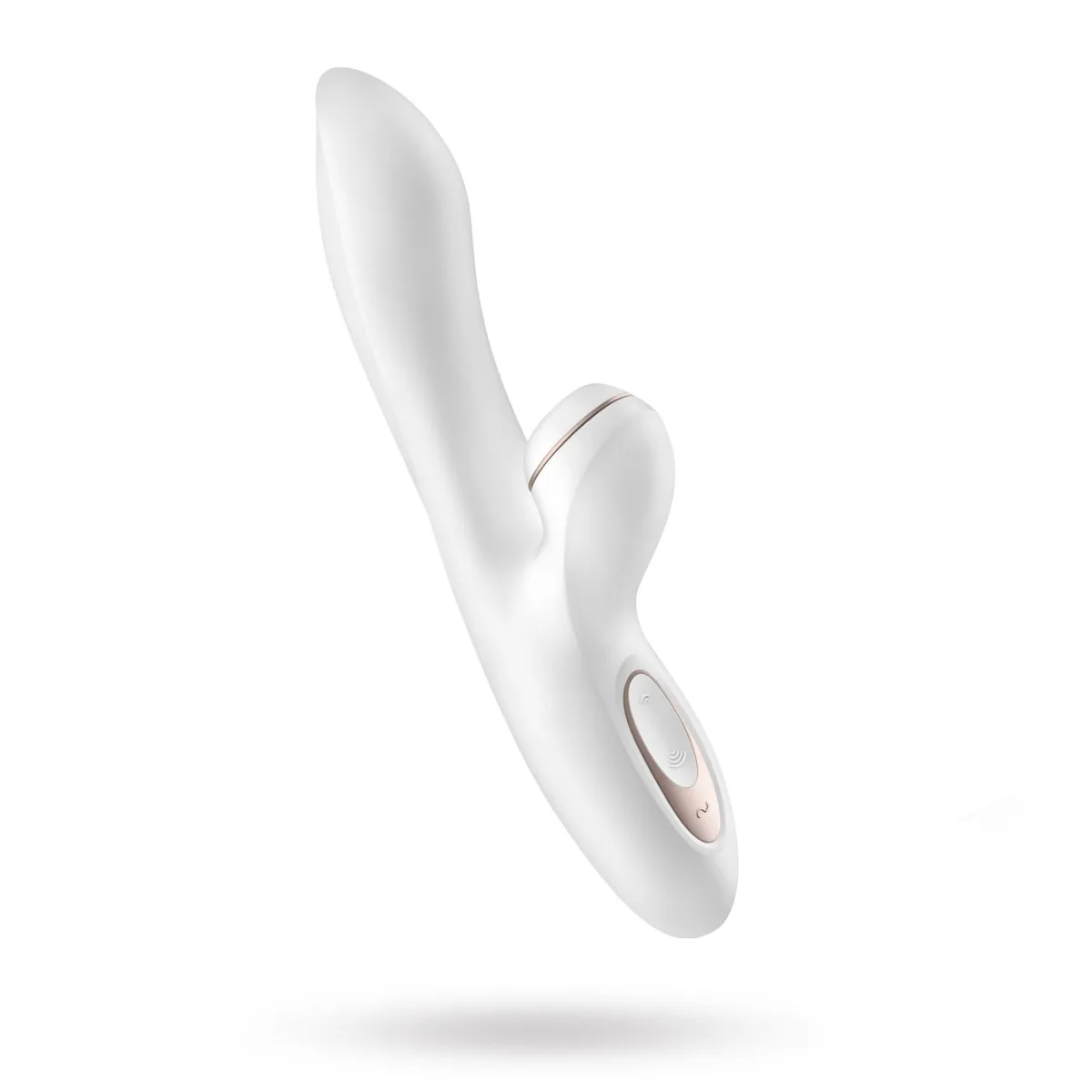
Satisfyer Pro G-spot Rabbit is the brand’s attempt to combine two products into one shaft. One half is the same air pressure chamber that made Satisfyer Pro 2 a mass-market product: a sealed chamber that sits over the clitoris and stimulates with air pressure waves instead of direct contact. The other half is a bent, insertable shaft with its own vibration motor aimed at the G-spot. The manufacturer states that the two motors can be controlled separately, and that’s the whole idea behind the product.
The specification that Satisfyer publishes for the Pro+ G-Spot looks like this: eleven air pressure intensities, twelve vibration programs, two separately controllable motors, silicone and ABS plastic as materials, the IPX7 ingress protection rating, charging via a standard USB-C cable, and a 15-year manufacturer warranty. Battery data is not on the product page but in the manufacturer’s quick guide: lithium-ion 3.7 volts, 700 mAh capacity, about three hours to charge, and about 60 minutes of operating time. In Sweden, the item is sold by eight stores at prices between 325 and 680 SEK, and five of them had it in stock at the price check.
This review is about the item with EAN 4049369015504, which Swedish retailers sell under the names Satisfyer Pro G-spot Rabbit and Satisfyer Pro+ G-spot Rabbit. That number is important, and the next section but one explains why: the manufacturer’s own product page is currently carrying a different EAN.
Air pressure technology — Satisfyer markets it as Air Pulse — is based on a diaphragm pump creating alternating negative and positive pressure in a sealed chamber that sits over the clitoris. The chamber never makes direct contact with the clitoris. The stimulation happens through pressure waves in the air inside the head, and that’s the whole reason this product class is described as touch-free clitoral stimulation.
The difference from a regular vibrator is fundamental, not a matter of degree. A vibrator transfers mechanical motion from a motor through the material to the skin. A pressure-wave product transfers changes in pressure through the air. That’s what explains why the sensation throughout the entire product category is repeatedly described as suction rather than vibrating, and why it feels more concentrated: the energy doesn’t spread throughout the entire housing.
What’s interesting about a combination product like this is that the two principles don’t interfere with each other. The pressure waves work in an air chamber outside the body, while the vibrations work mechanically inside. The manufacturer specifies two separate high-power motors, one for each function, and that they can be run simultaneously or separately. What can be established purely technically is that it provides three operating modes: only pressure waves, only vibration, or both — and that this is a real functional difference compared to a pure pressure-wave product like the Satisfyer Pro 2 Generation 2, which only has the first of those.
The price for that combination is geometric. A pure clitoral stimulator can be shaped only according to the chamber. A rabbit design also has to get the distance between the shaft and the pressure-wave chamber to match the user’s anatomy, because both parts have to be positioned correctly at the same time. That’s the single biggest limitation of the entire product type, and it applies to this model just as it does to the Womanizer DUO 2.
Satisfyer’s naming is notoriously messy, and this model has more names than most. Three products are regularly mixed up in Swedish shops.
If you want a display and the latest version, look for EAN 4061504082004 and expect at least 449 SEK. If you only want pressure waves without the attachment piece, the Pro 2 Generation 2 is both smaller and cheaper. If you want the combination at the lowest price, this is the article that applies.
There is a discrepancy that’s worth printing out clearly, because it affects how you should read each digit further down on this page. All eight Swedish stores list the item under EAN 4049369015504. Satisfyer’s own product page for Pro+ G-Spot, however, carries gtin13 4061504082004 and has the heading Pro+ G-Spot Generation 2.
So it’s not the same item number. The fact that we’re talking about two generations and not an error in the store flows can be verified in three ways. First, at least one Swedish store sells the newer item in parallel under the name "Pro+ G-Spot Rabbit Generation 2", using EAN 4061504082004 and at a clearly higher price. Second, the manufacturer’s page describes an LCD display that shows the selected program and battery level—there is no such display in the product images for the item sold under our EAN, where the controls are instead a simple button on the shaft. Third, 4049369015504 is in the same older number series as Satisfyer Pro 2 Generation 2, EAN 4049369015030, while 4061504082004 is in the series the brand has used for newer items.
The consequence is simple but important: Today, Satisfyer does not publish its own product page for EAN 4049369015504. The dimensions, weights, and functional information shown below are the manufacturer’s information for the Pro+ G-Spot as a family, taken from the page and the manual that the brand actually publishes. Where a specific detail describes Generation 2—the LCD display is the clearest example—it is written out. Don’t assume that every millimeter matches on the older model, and check the EAN number in the store before you pay if you’re looking for a specific generation.
The material is the only characteristic of an intimate product that can’t be compensated for through experience or care, and it determines whether the product is still hygienic after three years. Satisfyer lists two materials for Pro+ G-Spot: silicone and ABS plastic. The same two materials are stated in the manufacturer’s quick guide, which is a welcome match—it’s not always the case that the product page and the manual say the same thing.
The silicone is located where the product meets the body: on the insertable shaft and on the soft top of the air-pressure chamber. The manufacturer describes the surface as super soft and body-friendly, and the stores’ product texts consistently use the wording silk-like silicone coating. The ABS plastic is located in the housing and in the structure that supports the buttons and motors.
Silicone is a non-porous material. A non-porous surface can be cleaned because there are no microscopic cavities where residue can get stuck. It is the single most important property of a material that is meant to lie against mucous membranes, and that is why the material declaration carries more weight than almost every other line in a specifica tion. ABS is also non-porous, so the difference between the two materials is not about hygiene but about feel: silicone is soft and slightly tacky, ABS is hard.
If you look higher up in the price range, this is a real difference. Womanizer states ABS and body-friendly silicone for the DUO 2 as well—that is, the same material combination—but several premium models in the category are fully silicone-coated throughout. The fact that Satisfyer only uses silicone where it’s needed and ABS for the rest is one of the clearest reasons why this product can be in a completely different price class than a Womanizer DUO 2.
Phthalates are a group of plasticizers used to make plastic—especially soft PVC—flexible. The Swedish Chemicals Agency describes them as substances that can affect the hormone system and make reproduction more difficult, and several of them are therefore restricted or prohibited within the EU in a large number of products. This particular product category is the subject of recurring supervision because it contains soft plastic that comes into contact with skin.
Silicone and ABS themselves are not materials that require phthalate plasticizers. The softness of silicone comes from the polymer’s own structure, and ABS is a hard thermoplastic that should not be flexible. That the manufacturer lists both materials by name is therefore a better indication than labels like "TPE" or "jelly rubber," which do not say anything at all about which plasticizers are included.
It should still be noted what Satisfyer does not write. The manufacturer publishes no explicit undertaking that the Pro+ G-Spot is free from phthalates, BPA, and latex. Womanizer does for the DUO 2, word for word, on the product page. The absence of an undertaking is not proof to the contrary—the material choices suggest that the issue is unproblematic—but it is a difference in how the two brands present the information, and anyone who shops based on material declarations should know that.
The manufacturer lists the length as 220.5 millimeters, the width as 43.3 millimeters, and the height as 72.9 millimeters, as well as the weight of 200.43 grams. That makes it a noticeably large product: a little over two decimeters long—meaning longer than a pen and longer than most pure clitoral stimulators. Satisfyer’s own Pro 2 Generation 2 measures 165 × 46 × 65 millimeters and weighs 174.7 grams for comparison.
The measurements should be read with the same reservation as everything else on the manufacturer’s side: they are published for Generation 2. The outer shape of the two generations is the same in the product images—curved shaft, clitoral arm in a soft arc, grip area with buttons toward the base—but the fact that Generation 2 has a display suggests that at least the button surface has been redesigned. Treat the numbers as an approximate range for the older sample, not as a guaranteed measurement.
The shape itself is worth a note. The bend in the shaft is oriented, which means the product has a clear up-and-down side—it needs to be inserted with the curve toward the front of the vagina so that the tip reaches the G-spot while the clitoral arm is in the correct position. The clitoral arm is shorter and thinner than the shaft and sits at a fixed angle. So there is no adjustment of the distance between the two parts, unlike products with a hinged arm. If the geometry doesn’t fit well, you can’t compensate, and that is the most important question to ask yourself before you buy a rabbit in the first place.
The colors the manufacturer lists are rosé and white. Swedish stores sell the item under our EAN as white, and one of them lists the newer generation in pink. The color choice doesn’t affect the function, but it affects which EAN sits behind the “buy” button.
The interface on this generation is a button area on the outside of the shaft, above the grip. The product images show three controls in an elongated plate: one for on and off, one for the pulse waves, and one for the vibration. The shop’s product texts describe the same thing—that a third button controls the vibration settings and thus enables combinations of the two functions.
It’s a deliberately simple interface. You don’t see which step you’re on—you count button presses. That exact shortcoming is solved by the successor Generation 2 with its LCD display, and it’s also the clearest practical difference between the two items besides the price. For someone who runs the same two settings every time, it doesn’t matter. For someone who likes stepping through the entire range, not knowing where you are is a real annoyance.
The manufacturer lists two high-power motors that can be controlled independently. That is the only functional claim in the entire specification that truly changes how the product is used, and it deserves to be broken down.
With separate controls, you can run the air-pressure chamber at high intensity and the shaft at low, or vice versa. You can switch off one of them completely. You can raise one in the middle of a session without the other jumping along. On products where a single program controls both motors at the same time, nothing changes, and that’s why a comparison based on the number of programs is misleading: eleven pressure-wave intensity levels multiplied by twelve vibration programs gives 132 combinations, plus the settings where only one motor runs.
The practical value is greatest for someone who knows that the two types of stimulation fit different amounts. Many describe that the clitoral part needs less intensity than the vaginal part, or vice versa, and it’s exactly that imbalance that separate controls solve. The counterargument is just as simple: two scales take longer to learn than one, and without a display you also have to keep track of them in your head.
There’s a contradiction here that no store text solves for you, and it’s worth presenting in full. If the number of pressure-wave intensity levels is something everyone agrees on: eleven. The manufacturer states eleven, and all store descriptions repeat eleven.
If you look at what the vibration side says, it’s four different things. Satisfyer’s own product page for Pro+ G-Spot lists twelve vibration programs. Lustly writes ten vibration programs. Vuxen says seven vibration programs and three speeds. Blush Me writes three vibration intensity levels and seven rhythms — i.e., the same as Vuxen, just expressed the other way around.
What can be established is that seven rhythms times three speeds is an entirely different structure than a straight list of ten or twelve programs, and that the difference likely reflects exactly the generational shift: the manufacturer’s twelve apply to the side that describes Generation 2. The most likely reading for our EAN is therefore the stores’ version — a number of rhythms, each of which can be run in several strengths. But since Satisfyer does not publish any specifications for EAN 4049369015504, it isn’t possible to determine, we therefore list the manufacturer’s twelve in the specification table, with the reservation stated in the table.
Fit matters more on an air-pressure product than on a vibrator. The chamber has to seal tightly around the clitoris for the vacuum to build up — if it leaks, the effect disappears completely, not gradually. With a rabbit design, there’s a second condition: the insertable shaft must sit at the correct depth while the chamber is positioned correctly.
The top of the chamber on this model is fixed. The manufacturer does not list any interchangeable tops in different sizes, and none of that exists in what is listed for the model. So if the chamber fits poorly, there is no adjustment to make—and that is the single most important limitation of the model. The manufacturer also points this out itself, in its text about the Pro+ G-Spot, that an air-pressure chamber may fit poorly for a clitoris that has enlarged due to hormone treatment.
A concrete piece of advice that follows from the design: use a water-based lubricant on the inner part, but keep it away from the inside of the chamber. Lubricant in the air chamber disrupts the pressure build-up and makes the suction sensation weaker or eliminates it. The same applies to all air-pressure products, but it’s easier to get wrong when both parts are supposed to go in at the same time.
Satisfyer states a whisper mode for the Pro+ G-Spot and describes both motors as whisper-quiet. The question is what that means in numbers, and the answer has to be honest: the manufacturer publishes no measured decibel value for this model, either on the product page or in the quick guide.
What can, however, be established is that a combination product has two sources of sound instead of one. The air-pressure pump produces a duller, more airy sound; the vibration motor in the shaft produces the more traditional buzzing. When both are run at the same time, the product by definition is not quieter than the loudest of the two. The fact that the brand lists a whisper mode suggests that there is a setting intended for a lower noise level, but what the mode does purely technically—does it reduce the maximum power, or only the starting output?—the manufacturer does not report.
Websites that state an exact decibel number for the Satisfyer Pro G-spot Rabbit either report their own measurement or a value without a source. A practical piece of advice that applies regardless of model: place the product on a soft surface between uses. A hard tabletop works like a sound box and noticeably amplifies the sound.
Satisfyer classifies the Pro+ G-Spot as IPX7 and writes that the product can be used safely in water and is easy to clean. The rating comes from the international standard IEC 60529, which defines enclosure classes for electrical equipment. The number 7 in the second position means the product has been tested for submersion in water to a depth of one meter for 30 minutes.
There’s also an objection that’s too concrete to be silenced. One of the eight stores, Vuxen, explicitly writes in its product text that while the manufacturer states that the toy is waterproof, it can’t be used submerged in the bathtub—only with lighter water splashes. So this is a retailer that actively contradicts the manufacturer’s IPX7 claim. The other stores repeat the manufacturer’s wording.
We can’t determine who’s right, and it shouldn’t be claimed that we can. What can be said is that IPX7 is the manufacturer’s own classification, that it’s a formal test rating with a definition, and that a store warning of that kind is unusual enough that it should affect how you handle the product. The cautious approach—rinse it under running water, but don’t put it in bath water—costs you nothing and protects you against both outcomes.
The difference from a splash-proof product is greater than the wording suggests. Splash protection covers water droplets and, at best, water jets, but not submersion. Such a product can handle a damp cloth and possibly a shower, but not a bathtub, and it shouldn’t be kept under running water without giving thought to the buttons and the charging contact.
With a real IPX7 rating, the entire product can be rinsed off without being extra careful. If a product completely lacks an IPX rating, it should be treated as not waterproof—because the absence of a rating is never a sign that the product would be approved. On this particular model, there’s one extra thing to think about: the USB-C port. On products with an exposed charging contact, it’s always the port that’s the weak point, and it must be dry before the cable is plugged in.
Rinse the product in lukewarm water after every use and use fragrance-free soap or a cleanser intended for intimate products. Be especially careful with the inside of the air pressure chamber—that’s the only place on the product where residue can be left behind, because the chamber is a closed internal cavity. Wipe it with a clean towel and let it air-dry before putting the product away. Make sure the USB-C port is dry.
Use a water-based lubricant. Silicone-based lubricants shouldn’t be used on silicone products—they break down the silicone surface over time and make it porous, and a porous surface can no longer be cleaned properly, only replaced. Oil-based products such as coconut oil leave a film that’s difficult to remove and can also interfere with the air pressure chamber’s seal.
The manufacturer’s quick guide states a storage temperature between −5 and +60 degrees. The upper limit is the interesting one: boiling water and the dishwasher are therefore ruled out regardless of the IPX rating. Store the product dry and preferably in a bag or case so that the silicone surface doesn’t attract dust—silicone is strikingly good at trapping lint.
Battery data isn’t listed on the product page, but in the manufacturer’s quick guide, and there the information is unusually complete for the category. Satisfyer states a lithium-ion battery of 3.7 volts with a capacity of 700 mAh, a charging voltage of 5 volts, a maximum charging current of 500 milliamps, a charging time of about three hours, and an operating time of about 60 minutes. The interface is stated as USB.
With a regular USB-C cable. The manufacturer explicitly states that the product is charged via USB-C and just as explicitly that the charging cable is not included in the delivery. Vuxen repeats the same thing in its product text: the charger isn’t included.
It’s a trade-off with two sides. The downside is obvious—you have to pay for it or look for the right cable that you might have thought was in the box. The upside is that it’s a completely everyday cable: the same as for your phone, the same as for your headphones. Compare that with the Womanizer DUO 2, which is charged with a magnetic charging cable that’s product-specific. If you lose it, no regular USB cable will work—you have to order a replacement from the manufacturer. On that point, Satisfyer’s solution is clearly more practical, even if it looks stingier in the box.
It’s also worth doing the calculation: 700 mAh at 3.7 volts corresponds to about 2.6 watt-hours of stored energy, and that energy runs out in about 60 minutes according to the manufacturer. The three-hour charging time at a maximum of 500 milliamps matches the capacity. So it’s not a product that charges quickly, and the relationship between charging time and operating time is three to one.
An hour of operating time is on the low side for the category, and it’s the weakest line in the entire specification. Womanizer lists 120 minutes for the DUO 2—double—using the same charging time of 120 minutes, meaning both longer operation and shorter charging.
At the same time, the figure should be read for what it is. The manufacturer’s operating time is reasonably measured with one motor at a time or on an average setting; if both motors are run simultaneously at high intensity, the product will use more, and an hour becomes less. A session is rarely an hour long, so for normal use this is hardly a problem—but it becomes a problem if you don’t charge between times, because one hour of total operation means that an empty battery and a spontaneous moment don’t go together.
What generally applies to lithium-ion batteries also applies here. The capacity drops with the number of charge cycles, and the battery is not designed to be replaced. The product does best when it’s charged regularly rather than being stored fully discharged. With use a couple of times per week, it’s the battery—not the silicone—that sets the limit for the lifespan—and that detail becomes especially relevant for this particular product, since Satisfyer’s warranty terms expressly exclude the included rechargeable batteries from the 15-year warranty.
We do not have price data from shops in your market yet.
The entire idea of the product is two separately controllable motors. Eleven pressure-wave intensities times twelve vibration programs give 132 combinations — without a display you can count them in your head.
Three comparisons are relevant: against the successor within the same model name, against the pure air-pressure product from the same brand, and against the premium option in the same product type. All information below comes from each respective manufacturer’s own specifications, and all Swedish prices come from the shops’ product feeds on 29 July 2026.
The successor, EAN 4061504082004, is sold in Sweden from 449 SEK at SexleksakerOutlet and for 479 SEK at Vuxen. Our article costs 329 SEK as the cheapest variant in stock. So the difference is 120 SEK.
What you get for those is essentially an LCD display that shows the selected program and battery level. The manufacturer’s other specifications—eleven pressure-wave intensity settings, two separately controllable motors, silicone and ABS, IPX7, USB-C without an included cable, 15-year warranty—are the same, because they are published specifically for Generation 2.
The display sounds like a minor detail but solves a specific problem: on the older generation you count button presses to know where you are on the scale, and you don’t get any warning before the battery runs out. On a product with 60 minutes of operating time, the battery indicator is worth more than it sounds. If the price difference of 120 SEK is insignificant to you, then the successor is the rational choice. If it isn’t, you get the same two motors and the same eleven intensity settings for less money.
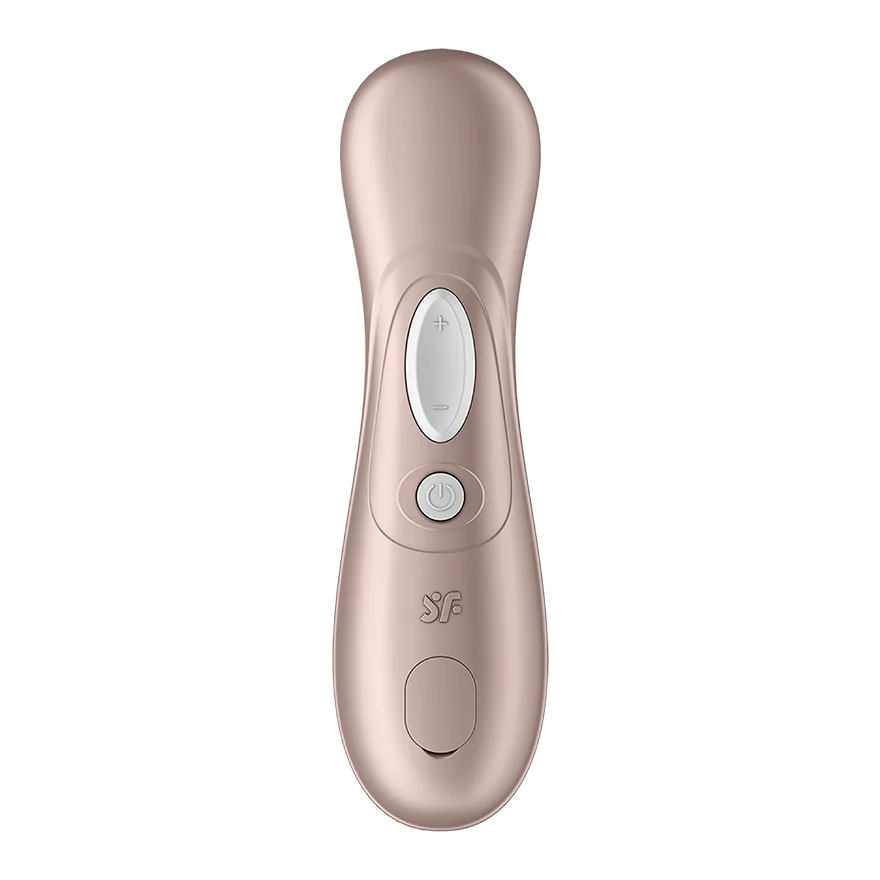
Satisfyer Pro 2 Generation 2, EAN 4049369015030, costs from 254 SEK. It has the same eleven pressure-wave intensity settings, the same materials in silicone and ABS, the same IPX7 rating, and the same 15-year warranty—but no insertable part and no vibration motor. It measures 165 × 46 × 65 millimeters and weighs 174.7 grams, versus 220.5 × 43.3 × 72.9 millimeters and 200.43 grams for Pro+ G-Spot.
So the price difference is 75 SEK between the cheapest Pro 2 Generation 2 and the cheapest Pro G-spot Rabbit in stock. For 75 SEK, you get the entire vaginal half of the product: a bent shaft, a second motor, and twelve vibration programs according to the manufacturer’s specification. Purely in terms of math, it’s an unusually large amount of function per SEK.
The key question is whether you want it. A rabbit is always a compromise between two anatomies that don’t necessarily fit the same geometry, and it’s bigger, heavier, and more cumbersome to get right. If you already know that you only use clitoral stimulation, the Pro 2 Generation 2 is both cheaper, smaller, and easier. If you’re unsure whether G-spot stimulation adds anything for you, 75 SEK is a cheap way to find out.
Womanizer DUO 2 is the direct premium alternative: the same combination of air pressure stimulation and a vibrating G-spot shaft, from the brand that competes with Satisfyer at the top of the category. The manufacturer lists the price as 209 euro on its own page. Satisfyer costs 329 SEK in Swedish retail. The two amounts are stated in different currencies and we don’t convert them — but the order of magnitude is unambiguous, and the DUO 2 is in a completely different price bracket.
The specifications explain part of the difference. DUO 2 measures 88 × 203 × 58 millimeters and weighs 263 grams. It’s made of ABS and body-friendly silicone that is explicitly stated to be manufactured without phthalates, BPA, or latex. It’s rated IPX7 and has fourteen intensity levels for the air pressure, as well as ten vibration patterns. Battery life is stated as 120 minutes and charging time as 120 minutes.
If you put them side by side, Womanizer wins on three points that can be measured: twice the battery life, three more intensity levels, and an explicit material declaration. Satisfyer wins on two: a 15-year warranty versus Womanizer’s five, and charging via standard USB-C instead of a product-specific magnetic cable. On everything else — the number of motors, the water resistance class, the material combination, and the basic principle — they are, in practice, the same product. Whether that difference is worth the price difference is a decision about battery life and disclosure, not about function.
Eight Swedish shops sell the item with EAN 4049369015504. The lowest price in the feed is from Lustly at 325 SEK, and the highest is from Sexonic at 680 SEK. It’s a 355 SEK or 109 percent difference for the exact same item number and the same packaging.
However, the stock situation is more important than the spread in prices here. Lustly, which has the lowest price, had the item sold out at the price check. The same applies to Vuxenkul at 580 SEK and Sexonic at 680 SEK. Of the five shops that had it in stock, Vuxen and Blush Me were the cheapest at 329 SEK each, followed by Joyland at 506 SEK, Lekosmek at 589 SEK, and Taboo at 595 SEK.
That means in practice two things. The difference between the cheapest available option and the second-cheapest available option is zero SEK, because two stores have the same price—and the difference up to the third-cheapest available option is 177 SEK, meaning more than half of the product’s price again. Stores that list an item as sold out may also keep an old price in the feed, and that price is rarely what you actually end up paying when the item comes in again.
The prices in the table above are updated when the stores’ product feeds are updated, but always check the final price at checkout. In this price range, most stores are below the threshold for free shipping, which means that shipping costs are a real part of the total price—a store that is thirty SEK more expensive but offers free shipping can very well end up being the cheapest. Also factor in that you need a USB-C cable, since none is included.
It’s for you if you already know that air pressure technology works for you and you want to add vaginal stimulation without having to buy a second product. It’s for you if you want to be able to control the two parts independently of each other, because that’s the feature that separates a well-thought-out combination product from one where a single program controls everything. And it’s for you if you want that functionality without moving up into the price range where Womanizer DUO 2 sits.
It’s not for you if you need long operating time. Sixty minutes is the weakest item in the specifications, and a three-hour charging time makes it worse. It’s not for you if you want to see which mode you’re on—that function is only available on Generation 2. It’s not for you if you require an explicit phthalate- and BPA declaration from the manufacturer, because Satisfyer does not publish one for this model. And it’s not for you if you want to be sure that you can use the product submerged in the bathtub, because one of the retailers explicitly contradicts the manufacturer’s IPX7 claim.
One last thing belongs in the decision. Rabbit designs are the product type where anatomical differences matter the most, because two fixed points have to match at the same time. If you’ve never used a rabbit before, this is a cheap way to try the format—but go into the purchase with the knowledge that the fit can’t be adjusted, and that it isn’t a fault with the product if the geometry doesn’t match yours.
Satisfyer offers a 15-year voluntary manufacturer’s warranty, the longest warranty period in this entire product category. However, the terms include several details that are rarely quoted in store texts, and they’re worth reading before you rely on the warranty.
The warranty period begins according to the manufacturer to run only once the statutory claim period has expired in the buyer’s country of purchase. So it is not 15 years from the purchase in addition to (i.e., alongside) konsumentköplagen, but 15 years on top of it. The warranty requires the original receipt, that the product has been used according to the instructions, and that you report the fault within one month from the time you discovered it. The buyer is responsible for shipping and risk when sending it in to service.
The exceptions are at least as important. The warranty does not cover damage from incorrect use, use of accessories other than the original accessories, damage from external influences, attempts to repair it yourself, or normal wear and tear. And — expressly — not included rechargeable batteries. Since in practice it is the lithium-ion cell that determines how long a product of this type lasts, this means that the most likely source of failure lies outside the 15-year promise. Replacement is provided with a new product; money back is only offered if you bought from the manufacturer’s own web store.
What, on the other hand, always applies are your statutory rights. Under konsumentköplagen, you have a three-year right to complain for defects in the goods, regardless of what the manufacturer promises. For distance purchases, you also have a right of withdrawal for fourteen days under the Act on distance contracts and contracts outside business premises (lagen om distansavtal och avtal utanför affärslokaler). Be aware that in practice the right of withdrawal is limited for hygiene products that have been taken out of a sealed package — however, the right to complain for defects always applies. If you have questions about what applies in your case, Konsumentverket guides you via Hallå konsument.
Satisfyer Pro G-spot Rabbit is ranked på plats 7 av 12 in g-spot vibrator best i test, where the entire category is compared against each other using five shared criteria. Guiden vinns av Womanizer OG.
Every numerical piece of information in the text can be traced to one of the sources below. The links were checked manually on the specified date.
This page is machine-translated from Swedish. Read the Swedish original