

Review
Review: Satisfyer Pro 2 Next Generation
Cheapest among the widely sold — 219 SEK and air pressure technology.
29 July 2026
Review · Penis ring · App-controlled vibration
Satisfyer’s app-controlled penis ring reviewed against the manufacturer’s own specifications, the Quick Start Guide, and price data from six Swedish stores. Ten vibration programs that also work without the app, IPX7 according to IEC 60529, a 220 mAh lithium-ion battery—and a charging time of 4.5 hours for one hour of operation. The price differs by 76 percent between the cheapest and the most expensive store.
The cheapest way to get an app-controlled vibrating penis ring from a major brand. Ten vibration programs that work without a phone, IPX7, and a published battery of 220 mAh are a solid foundation for under three hundred kronor. What you pay for is runtime: 60 minutes with 4.5 hours of charging time is the weakest ratio among the rings compared. A 15-year warranty applies according to the manufacturer’s own terms, not in Sweden, and it also excludes the battery—so instead, count on the Consumer Sales Act’s (konsumentköplagen) three years.
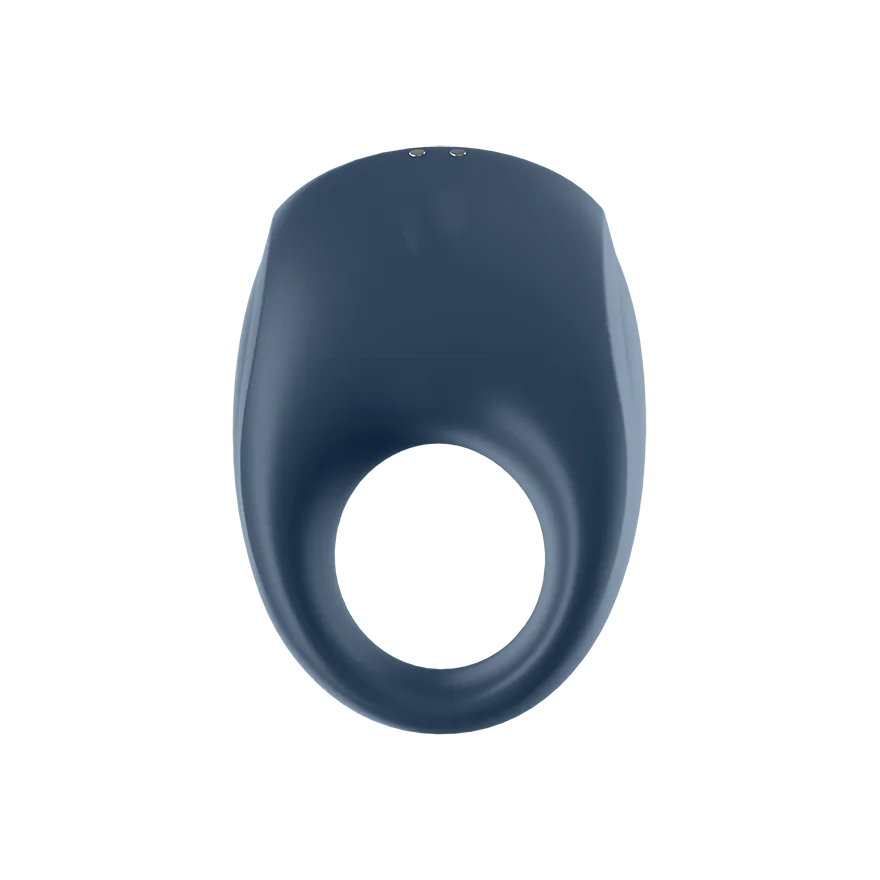
Satisfyer Strong One is a vibrating penis ring with app control. The manufacturer sells it under the full name Satisfyer Strong One Connect App, and it’s the Connect part that sets it apart from the cheaper rings in the range: the ring can be controlled both from a single button on the product itself and from Satisfyer’s free app via Bluetooth. The manufacturer is clear that the app is not a requirement — the product is explicitly stated to work even without it.
According to the manufacturer, the specification looks like this: length 74 millimeters, width 51.8 millimeters, height 34.2 millimeters, and a weight of 51 grams. The material is listed as ABS plastic and silicone, the color is blue, the ingress protection rating is IPX7, and the number of vibration programs is ten. The manufacturer’s Quick Start Guide fills in the rest: a lithium-ion battery of 220 mAh and 3.7 volts, charging voltage 5 volts, charging current of at most 80 milliampere, charging time of about 4.5 hours, and usage time of about 60 minutes. The radio module transmits on 2402–2480 MHz with an output power of +6 dBm, i.e. standard Bluetooth.
This review is about the item with EAN 4061504001968, the manufacturer’s item number SW10118. The number is checked in the page source on Satisfyer’s own product page, where the gtin13 metatag contains that exact value, and it is also written out in plain text by the retailer Vuxenkul. Strong One is made only in blue, so unlike many other models in the range, there is no color variant with its own EAN to mix it up with.
In Sweden, the item is sold by six shops at prices between 295 and 519 SEK, and two of them had it in stock at the price check on 29 July 2026. That’s a price spread of 224 SEK or 76 percent for the same item number, which is unusually large for a product in this price range.
A penis ring has two separate functions, and they’re almost always mixed up in shop texts. The first is mechanical and requires no electronics at all: the ring sits around the base of the penis and slows the venous return of blood, which according to the manufacturer produces a firmer erection that lasts longer. It’s that function that makes an ordinary silicone ring for fifty kronor work.
The second function is vibration, and it is not primarily about the wearer. On Strong One, the motor unit sits on the top side of the ring, meaning it faces the partner during intercourse in missionary position. The manufacturer describes it as the ring satisfying both partners at the same time, and the manufacturer’s own product description explicitly states that the vibrating elements stimulate the glans, clitoris, or perineum—meaning that additional clitoral stimulation is one of the model’s main functions. What can be established, then, is that the motor placement is the actual product design: a penis ring with a vibrator is, in practice, a clitoral stimulator worn by one of the partners.
That also explains why the measurements for this specific product category need to be read carefully. The ring’s outer shell measures 74 × 51.8 × 34.2 millimeters, but the figure that determines whether it fits is the inner diameter, and Satisfyer does not publish it. The manufacturer does not state an inner diameter for Strong One. The retailer Joyland lists 2.5 centimeters. This is a store detail and not a manufacturer detail, but it is the only specific number available to go by, and it matches size-wise with the fact that the outer shell is 51.8 millimeters wide.
Satisfyer sells several penis rings that are close in both price and function, and since most of them have something with “One” in the name, they get systematically mixed up in Swedish stores. All the information below comes from the respective official product page.
The difference between the three app-controlled rings, then, is not the number of programs—everyone has ten—but the form factor. Strong One is the shortest and widest of them, Mighty One the longest and flattest. If you want app control, you should avoid Power Ring, which is the only one in the list without Bluetooth.
Material is the only property of an intimate product that cannot be compensated for through habit or care, and it determines whether the product is still hygienic after five years. There is also a deviation in the manufacturer’s own material statement here that is worth presenting clearly and directly.
The property table on Satisfyer’s product page lists the material as ABS plastic and silicone. However, the specifications line in the manufacturer’s Quick Start Guide lists only silicone. Among the Swedish stores, Joyland and Vuxenkul both list ABS and silicone on the product page, while Lustly lists only "kroppssäker silikon". The reasonable interpretation—also the only one that reconciles both manufacturer statements—is that everything that comes into contact with the skin is silicone and that the ABS plastic sits in the inner chassis around the motor, battery, and charging contacts. The manufacturer, however, does not state how the materials are distributed, and that is why this is an interpretation rather than a documented fact.
Silicone is a non-porous material. A non-porous surface can be cleaned because there are no microscopic cavities where residue can remain. This is the single most important property of a material that is meant to lie against mucous membranes, and that is why the material declaration carries more weight than almost all other lines in a specification.
Satisfyer describes the material as super-soft, skin-friendly silicone of medical quality with a smooth, hygienic surface. For a penis ring, the softness also has a direct functional significance that it doesn’t have on other products: the ring has to stretch to be able to be put on, and it has to stretch back to create the blood-stimulating effect. A ring made of hard plastic or metal does neither; it has a fixed inner diameter that either fits or doesn’t. So, Strong One being cast in flexible silicone is the reason why one size can cover a wide range of users—but it’s also the reason it can’t sit as firmly as a metal ring.
The surface has a practical consequence. Smooth silicone attracts lint and dust during storage, and it becomes tacky from silicone-based lube. Both of these things are manageable, but they are real, and they apply to all-silicone products.
Phthalates are a group of plasticizers used to make plastic—above all, flexible soft PVC—pliable. The Swedish Chemicals Agency (Kemikalieinspektionen) describes them as substances that can affect the endocrine system and make reproduction more difficult, and several of them are therefore restricted or banned within the EU in a large number of products. This particular product category is regularly subject to supervision because it contains pliable plastic in contact with the skin.
The source image is a bit uneven, and I’m going to say it straight out. Satisfyer’s product page for Strong One contains no explicit promise that the product is free from phthalates. What it says is that the material is skin-friendly, medical-grade silicone. The two shops Joyland and Lustly, on the other hand, both explicitly state “phthalate-free: yes” in their specification tables. These are shop statements, not manufacturer statements, and they should be read as such.
In substance, though, it’s still a smaller problem than it sounds, for a chemical reason. Silicone doesn’t require phthalate plasticizers to become soft—the softness comes from the polymer’s own structure—and ABS plastic is a hard technical plastic that also isn’t softened with phthalates. A material description that reads “silicone and ABS” is therefore, by itself, better information than labels like “TPE” or “jelly rubber,” which say nothing at all about which plasticizers are included. But if you want a written phthalate guarantee from the manufacturer, it isn’t provided on this product page.
Latex isn’t mentioned at all, either by the manufacturer or by any of the shops. So if you’re allergic to latex, it can’t be inferred from the specification whether the product is free from latex—but since neither silicone nor ABS contains natural rubber, the risk is limited to any seals, and there’s no information there.
The manufacturer states the length as 74 millimeters, the width as 51.8 millimeters, and the height as 34.2 millimeters, as well as the weight as 51 grams. That makes Strong One a compact product—it fits in a closed fist—but it’s noticeably thick for a ring. The height measurement of 34.2 millimeters is, in practice, how much the ring builds up along the height when it’s in place, and that figure determines whether it feels in the way.
A comparison within the same brand puts the dimensions into context. Satisfyer Power Ring, which doesn’t have app control, measures 55.2 × 44.4 × 21.8 millimeters and weighs 23.5 grams—so less than half the weight. The difference is mainly the electronics: a Bluetooth circuit and a larger battery take up space and add weight. Mighty One weighs 52.7 grams, and Signet Ring weighs 51 grams—so practically exactly the same as Strong One. It’s a clear pattern: all of Satisfyer’s app-controlled rings land around fifty grams.
The dimension information from the shops differs somewhat, and that in itself is a find. Joyland lists the length as 7.4 centimeters, while Vuxenkul lists it as 7.5 centimeters. The manufacturer’s 74 millimeters is the figure that applies—when one shop contradicts the manufacturer, the manufacturer wins—and Vuxenkul’s 7.5 centimeters is probably a rounding up. The difference is of no practical importance, but it illustrates why shop specifications should never be used as the primary source.
The piece of information that is actually missing is the inner diameter. Satisfyer does not publish an inner diameter or a circumference for Strong One, and that is the most relevant figure for anyone buying a penis ring. The retailer Joyland lists 2.5 centimeters in the relaxed position. As a reference, Lelo lists a diameter of 29 millimeters for its Tor 3, meaning that it is four millimeters more in the relaxed position. Since both are molded in stretchable silicone, the relaxed measurement does not tell you everything about the fit, but it does say something about the starting point — and it means that Strong One is the narrower of the two before it stretches.
The interface on Strong One is intentionally minimal. The manufacturer calls it the One Touch button, and it sits on the top side of the ring where it can be reached with a finger while the product is in place. According to the manufacturer’s Quick Start Guide, you turn the product on and off with a two-second press, and you move between modes with short presses.
Having just one button is the direct opposite of how premium products in adjacent categories are built — Lelo lists two buttons on the Tor 3 — and it’s a deliberate choice that has consequences in both directions. The advantage is that you can switch modes blindly, in the middle of use, without having to look. The drawback is that you can only step forward: there is no way to go back one step and no way to jump directly to a specific program. If you’ve gone one step too far, you have to loop around the entire way.
The manufacturer lists ten vibration programs, and they can be run completely without a phone. The product page explicitly states that use without an app is also possible, which is worth noting because app-controlled products sometimes require pairing for them to work at all. Here, the app is an add-on, not a prerequisite.
The manufacturer describes the ten programs as editable preset programs, meaning that the app can overwrite them. What the ten programs consist of — how many have steady intensities and how many are pulsing patterns — Satisfyer does not publish. The pattern in this product class is that a mix of three to four steady levels and six to seven rhythmic programs is common, but that is an observation about the category and not a specification for this particular model.
There’s also a contradiction in the manufacturer’s own material that’s worth knowing about. The product page states ten vibration programs, and all Swedish stores that list a number also state ten. But the setting symbol in the manufacturer’s own Quick Start Guide is labeled 12x. It isn’t possible to determine from the document whether the figure refers to the number of programs, the number of button presses to cycle through, or something else, and Satisfyer doesn’t explain it. Start from ten programs — that’s the number the manufacturer publishes on the product page — but don’t be surprised if the ring turns out to have two additional steps.
Satisfyer Connect is the manufacturer’s free app for iOS and Android, and it’s the real reason to choose the Strong One over a cheaper ring. The manufacturer highlights three things: that you can create your own vibration programs, that the programs can be rebuilt from ambient sound via your phone’s microphone, and that they can follow music from Spotify or other streaming services. Remote control over the internet is also included, which means a partner can control the product from another location.
Two details about the app come from the store and not from the manufacturer, and they’re therefore marked here. The retailer Joyland states that the app can control up to four devices at the same time and that the Bluetooth range is ten meters. The manufacturer’s own specification doesn’t state any range at all — what’s in the Quick Start Guide is the radio frequency 2402–2480 MHz and the output power +6 dBm, which are standard values for Bluetooth Low Energy and in practice mean a range on the order of about ten meters indoors, less through walls.
The practical caveat with any app control is that it depends on the app being maintained. A penis ring with a button works just as well ten years from now as it does today. An app that stops being updated for new operating system versions doesn’t, and that applies to every manufacturer in the category. That Strong One works fully without an app is therefore a real quality and not just a footnote.
Ten programs are more than most people use. What determines the benefit isn’t the number but the spread between the weakest and the strongest setting, and the category doesn’t publish any of that — not in hertz, not in amplitude, and not in power. The only thing that can be compared is the motor’s power supply, and there the numbers are public: Strong One has 220 mAh at 3.7 volts, versus Lelo Tor 3’s 70 mAh at the same voltage.
It doesn’t say that Strong One vibrates stronger—capacity isn’t power—but it says that it has more energy to draw on, and that’s likely part of the reason the manufacturer markets the model with the wording "superstrong, deep vibration". Still, count on the fact that in practice you’ll come back to two or three of the ten programs, just like with every other product in the category.
Satisfyer lists "Flüster Modus"—whisper mode—as one of the Strong One’s features on the product page. The question is what that means in numbers, and there the answer has to be honest: Satisfyer does not publish a measured decibel value for Strong One, either on the product page, in the Quick Start Guide, or in the safety brochure. There’s also no comparison chart of the kind other manufacturers sometimes publish.
That’s why “whisper mode” is a product label and not a measurement, and it should be read as a label. For comparison, Lelo states a ceiling of 60 dB as the maximum sound level for the Tor 3—which is roughly the same level as a normal conversation and therefore not particularly quiet. That one of the few published figures in the category sits there says something about how sound level actually should be interpreted in this product class: the difference between the models is less than the marketing suggests.
A practical point also applies especially to penis rings. The sound is drastically dampened when the product is pressed against the body and covered with a blanket, and that’s how it’s used. A penis ring is therefore, in practice, quieter during use than it is when it’s lying there and buzzing on a table—which is exactly the opposite of how the product sounds when you try it out for the first time.
Satisfyer Strong One is rated IPX7. The rating comes from the international standard IEC 60529, which defines enclosure classes for electrical equipment. The number 7 in the second position means that the product is tested for submersion in water to a depth of one meter for 30 minutes. The manufacturer states the implication plainly on the product page: the toy can be used safely in water and is easy to clean.
The difference vs a splash-proof product is bigger than the wording suggests. Splash protection covers water droplets and, at best, water jets, but not submersion. Such a product can handle a damp cloth and possibly a shower, but not a bathtub—and it shouldn’t be held under running water without giving the button and charging contacts some thought.
With IPX7, the entire ring can be rinsed off without caution. For this particular product, it’s more valuable than for most others, because a penis ring by definition comes into contact with both fluids and lubricant across its entire surface, and because the ring’s inner hole is the hardest surface to wipe dry. If a product lacks an IPX rating entirely, it should be treated as not waterproof—an absence of a rating is never a sign that the product would be approved.
A caveat from the safety brochure belongs here anyway: you should disconnect the product from the charging cable and the power circuit before you clean it. IPX7 applies to the product, not the product with the charging cable connected.
The manufacturer states that the ring is cleaned with warm water and mild soap, and recommends that it is then treated with a toy cleaner—Satisfyer refers to its own disinfectant spray, but any product cleaning agent for intimate products serves the same purpose. Rinse the product after each use, wipe it with a clean towel, and let it air-dry before putting it away.
The lubricant question is simple and important. Use a water-based lubricant—that’s also what Joyland lists as a recommendation in its specification table. Silicone-based lubricants should not be used on silicone products: they break down the silicone surface over time and make it porous, and a porous surface can no longer be cleaned properly—only replaced. Oil-based products such as coconut oil leave a film that’s difficult to remove, and they are also incompatible with latex condoms if you use one together with the ring.
Storage has an explicit limit in the manufacturer’s specifications: storage temperature −5 °C to +60 °C. It’s a wide range that a desk drawer will always fit, but it excludes a car in winter and a car in the sun in summer. The safety brochure also warns about condensation with changing ambient temperatures, for example after transport, and states that the product should not be used until it has adapted to the new temperature.
This is the part of the specification that deserves the most attention, and it’s also the weakest part of the product. The manufacturer’s Quick Start Guide lists a lithium-ion battery of 220 mAh and 3.7 volts, a charging voltage of 5 volts, a maximum charging current of 80 milliampere, a charging time of about 4.5 hours, and a usage time of about 60 minutes.
Read the last two digits together. Four and a half hours of charging provides one hour of runtime — a ratio of 4.5 to 1. That’s an unusually unfavorable ratio even in this category. We-Vibe states 120 minutes of runtime versus 90 minutes of charging time for the Pivot, i.e. 0.75 to 1. Lelo states up to two hours of use time versus up to two hours of charging for the Tor 3, i.e. 1 to 1. In other words, Strong One lasts about four and a half times as long as it runs, while We-Vibe’s ring lasts longer than it charges.
The explanation is in the same specification. The charging current is limited to 80 milliampere. A 220 mAh battery charged with 80 mA needs, purely in terms of the math, about 2.75 hours plus losses and the final constant-voltage phase — and that’s where you end up at roughly the 4.5 hours the manufacturer states. The low charging current is gentle on the cell and is likely a deliberate choice for a product that’s supposed to be completely sealed, but the impact on the user is that charging can’t be done quickly.
Charging is done via a magnetic USB charging cable included in the delivery. Satisfyer’s safety brochure describes how it works: the cable docks onto two magnetic contact points of metal on the product, and if it doesn’t attach itself, you should connect the cable to the power circuit and wait a moment, after which the magnetic force reactivates and the contacts automatically connect.
Magnetic charging is a trade-off, not a pure advantage. The advantage is that you don’t need any opening in the housing, which makes it easier to achieve IPX7 without a rubber plug — and on a penis ring, where the entire surface is in contact with the body, a sealed enclosure is particularly well justified. The downside is that the cable is product-specific: if you lose the charging cable, no regular USB-C cable works, meaning you have to get a replacement from the manufacturer. Satisfyer sells one such replacement separately in its own store. That’s a real difference from the We-Vibe Pivot, which according to the manufacturer is charged with a regular USB cable from any USB port or USB adapter.
Two instructions from the safety brochure are easy to miss and worth following. The first charge can take up to eight hours — meaning almost twice as long as a typical charging cycle — and that’s normal and not a fault. And the charging cable should be unplugged from the wall outlet after each completed charge; the manufacturer explicitly states a risk of damage from overcharging. Charging should also take place in an ambient temperature of no more than 45 degrees, while the product may be used at up to 50 degrees.
An hour of operating time is enough for what the product is built for. A penis ring is used during intercourse, not for an entire evening, and sixty minutes of continuous operation is more than most sessions require. The problem doesn’t arise during use but during preparation: since refilling takes 4.5 hours, you can’t quickly recharge it when it turns out to be empty at the wrong time.
The practical advice follows directly from the figures. Charge the ring fully after each use instead of when you need it, and expect that a full charge lasts for about three to five occasions if you run it for fifteen or twenty minutes each time. The manufacturer does not state how many charging cycles the battery is rated for, and in practice no manufacturer in this category does either. What generally applies to lithium-ion batteries also applies here: capacity drops with the number of cycles, the battery is not replaceable on a closed IPX7 product, and the cell does best when it is charged regularly rather than stored completely discharged.
Satisfyer’s safety brochure for products with a rechargeable battery and a radio transmitter contains three points that rarely appear in store texts and that apply specifically to this product type.
The first is the magnets. The charging system is magnetic, and the manufacturer explicitly states that magnetic fields can affect mechanical and electronic components such as pacemakers and that the product should not be used directly over a pacemaker. Cards with a magnetic stripe, for example payment cards, should be kept away from the product because the magnet can damage them. For a penis ring, the distance to a chest-implanted pacemaker is practically reassuring, but the information is there—and it comes from the manufacturer.
The second point is that the product expressly is not a medical device and has no medical or healing effect. This is relevant because penis rings are marketed in the borderline area of erection aids. The blood-flow-enhancing effect is real and the manufacturer describes it, but in a regulatory sense the product is a sex toy.
The third is about the duration of use on the body, and Satisfyer states it in its own product description: the ring should be put on in a half-erect state so that it sits snugly but comfortably, it should not be worn longer than recommended, and it should be taken off immediately if you feel any sensation of pressure or numbness. A little lubricant helps with putting it on. The manufacturer doesn’t provide any exact number of minutes as an upper limit, which is a notable gap specifically at the point where a time specification would have been most valuable. Satisfyer does not publish a maximum wearing time for Strong One.
We do not have price data from shops in your market yet.
Four and a half hours of charging provides one hour of operation. We-Vibe Pivot lasts longer than it charges — Strong One charges for four and a half times as long as it runs.
Four comparisons are relevant: two within the brand itself, showing what you pay for and, respectively, what you do without, and two against the other major manufacturers of vibrating rings. All information below comes from each manufacturer’s own specifications, and all prices come from the shops’ product feeds on July 29, 2026.
Power Ring is Satisfyer’s ring without Bluetooth, and the difference versus Strong One is bigger than just the app. Power Ring measures 55.2 × 44.4 × 21.8 millimeters and weighs 23.5 grams, versus Strong One’s 74 × 51.8 × 34.2 millimeters and 51 grams. So it’s smaller in every dimension and weighs less than half the weight.
What both have in common is ten vibration programs, a whisper mode, IPX7, and the materials ABS and silicone. What Strong One adds is app control with its own programs, sound-controlled and music-controlled patterns, and remote control over the internet. What Power Ring adds is that it is significantly smaller and lighter, which, specifically for a penis ring, is a functional advantage and not just a convenience — everything that depends on height feels.
The conclusion is that the choice is between function and form, not between better and worse. If you already know that you won’t be using an app, Power Ring is the more discreet product. If app control is the main reason for the purchase, there’s no cheaper way to get it within the brand.
Signet Ring is the closest relative: the same ten programs, the same app control, the same IPX7, the same material, and exactly the same weight of 51 grams. The dimensions differ — 83 × 45.4 × 34.3 millimeters versus Strong One’s 74 × 51.8 × 34.2 — which makes Signet Ring nine millimeters longer and just over six millimeters narrower at the same height.
The functional difference lies in the surface. The manufacturer states that Signet Ring has a ribbed structure on the top side that provides additional clitoral stimulation, meaning a mechanical structure in addition to the vibration. Strong One has a smooth top side. Which one is better can’t be determined from a specification and depends on anatomy and position — but it’s a real design difference, not a color variant, which is worth knowing because the two are often listed as alternatives to each other in the same shop. Signet Ring is also sold in black; Strong One is only sold in blue.
Lelo Tor 3 is the most interesting comparison, not because the products are similar, but because Lelo publishes almost every number Satisfyer leaves out. Tor 3 measures 46.7 × 22.2 × 60 millimeters with a stated inner diameter of 29 millimeters, has a lithium-ion battery of 70 mAh and 3.7 volts, is charged for up to two hours at 5.0 volts and 70 milliamps, runs for up to two hours, has a standby time of up to 90 days, a stated frequency of 130 hertz, automatic shut-off after 20 minutes, a maximum sound level of 60 dB, and two buttons. The material is stated as body-friendly silicone and ABS plastic.
Line by line, Satisfyer does well on hardware and worse on reporting. Strong One has more than three times the battery capacity — 220 mAh versus 70 mAh — but only half the operating time, 60 minutes versus up to 120. That’s a striking combination that suggests that Strong One’s motor draws significantly more current than Tor 3’s. Charging, on the other hand, is Lelo’s: two hours versus 4.5. And Lelo specifies both inner diameter, frequency, sound level, and automatic shut-off, while Satisfyer specifies none of that.
Lelo also provides two years of warranty plus ten years of quality warranty and states that the products meet ISO 3533, the international standard for safety of sex toys. Satisfyer does not refer to any corresponding standard for Strong One — what’s stated is the EU declaration of conformity according to the directives 2014/53/EU for radio equipment and 2011/65/EU for hazardous substances, which is the statutory minimum every Bluetooth product on the EU market must have.
We-Vibe Pivot is the second big app-controlled ring on the market. The manufacturer states operating time up to 120 minutes, charging time up to 90 minutes, IPX7, and a lithium-ion polymer battery that charges via a standard USB cable from any USB port or adapter. The material is stated as body-friendly silicone free from phthalates and BPA and made without latex, and the warranty is two years.
Three differences are decisive. Pivot lasts twice as long and charges one-third faster. Pivot charges with a completely standard USB cable, while Strong One’s magnetic cable is product-specific and must be replaced by the manufacturer if it disappears. And We-Vibe expressly states that the material is free from phthalates, BPA, and latex, which Satisfyer does not do for Strong One.
What Strong One has on its side is two things: the published battery capacity of 220 mAh, which We-Vibe does not state at all, and the price. Strong One costs from 295 SEK in Sweden. That’s the single strongest point in the entire comparison — the three competitors are all in a higher price tier, and the difference in specifications isn’t anywhere near as large as the difference in price tag.
Six Swedish shops sell the item with EAN 4061504001968. The lowest price is Blush Me and SexleksakerOutlet at 295 SEK each — the two share item number 7299 and obviously offer the same range — and the highest price is Vuxenkul at 519 SEK. That’s a difference of 224 SEK, or 76 percent, for exactly the same item number, the same color, and the same packaging.
The stock situation is at least as important as the price spread here. Only two of the six shops had the product in stock at the time of the price check: Joyland at 297 SEK and Vuxenkul at 519 SEK. That means the price difference you can actually act on is 222 SEK between the two available options, and that the three lowest price entries in the table — 295, 295, and 399 SEK — were all sold out. Shops that list a product as sold out may still have an old price in the feed, and that price is rarely what you actually end up paying when the item comes back in again.
A note about data quality belongs here. During the check of the shops’ product pages, one of the six — Sexonic — responded with an error code instead of a product page, even though the item was still present in the shop’s product feed with a price and item number. This is a common situation in affiliate feeds, and it’s a reason to always check that the link lands on the correct product before you pay.
The price spread isn’t because any shop sells a different variant. Strong One is only available in blue, and all six shops list the item either under EAN 4061504001968 or under their own item number tied to that exact model. So this is about the shops’ own margin setting. The prices in the table above are updated when the shops’ product feeds are updated, but always check the final price in the checkout — in this price range, the shipping cost is often twenty to thirty percent of the item’s value and can easily eat up the entire price difference.
It’s for couples who want a ring where the vibration comes to both of you and who want to be able to control it from their phone without paying a premium price. It’s for you if you want the app features — your own programs, sound- and music-controlled patterns, remote control over the internet — but don’t want to lock you into needing the app to work for the product to do anything. It’s also for you who want to be able to rinse off the entire product under running water, which the IPX7 rating allows without reservation.
It doesn’t suit you if you prioritize runtime. Sixty minutes is on the low side, and 4.5 hours of charging time means you can’t save it at the last moment—where both the We-Vibe Pivot and the Lelo Tor 3 are clearly better. It doesn’t suit you if you want to charge with the same cable as your phone, because the magnetic charging cable is product-specific. It doesn’t suit you if you want the smallest possible ring—Power Ring weighs less than half the weight. And it doesn’t suit you if you require a published inner diameter, maximum wear time, or measured sound level before purchase, because Satisfyer doesn’t publish any of that for this model.
One more thing belongs in the decision, and it’s specific to this product type. A penis ring is the only one in this category where the fit can’t be adjusted after purchase. A vibrator that’s too big can still be used; a ring that’s too tight can’t be, and one that’s too loose is of no use. Since Satisfyer doesn’t publish any inner diameter—the only figure listed is the retailer Joyland’s statement of 2.5 centimeters—it’s worth buying from a store with generous return terms and not breaking the seal until you’re sure. This leads directly into the next section.
Satisfyer advertises a 15-year warranty, and the number is shown on both the product page and the packaging. It’s an unusually long promise in this industry, and that’s also why the terms are worth reading properly. They include three limitations that make the promise less than it looks.
The first is geographical, and it’s decisive for a Swedish buyer. Satisfyer’s warranty terms state that the warranty promise only applies within Germany, Austria, Italy, France, Spain, and the United Kingdom. Sweden isn’t included in the list. So if you buy from any of the six Swedish shops in the table above, you therefore won’t be covered by the fifteen-year warranty under the terms.
The second is time-related. According to the terms, the 15-year warranty period doesn’t begin to run at the time of purchase, but only once the statutory warranty period in the buyer’s home country has expired. So it comes after, not alongside, your statutory rights.
The third is the most concrete. The terms expressly exclude included batteries from the warranty. On a product where the battery is built in and not replaceable, and where the battery is the component that will certainly degrade first, that means the warranty in practice doesn’t cover what actually breaks. The terms also exclude damage caused by use of anything other than original accessories—which is worth knowing if you’re considering replacing the magnetic charging cable with something else—plus external wear, accidental damage, and self-attempted repairs. The buyer is responsible for the cost and risk of shipping it to the manufacturer.
What always applies, however, are your statutory rights. Under the konsumentköplagen (Swedish Consumer Sales Act), you have three years of complaint rights for defects in the item, regardless of what the manufacturer promises, and you assert that right against the store you bought from — not against Satisfyer. For distance purchases, you also have a right of withdrawal for fourteen days under the lagen om distansavtal och avtal utanför affärslokaler. Be aware that the right of withdrawal is, in practice, limited for hygiene items that have been removed from a sealed package — but the right to complain about defects always applies. If you have questions about what applies in your specific case, Konsumentverket guides you via Hallå konsument.
The conclusion about the warranty is therefore simple to formulate. The fifteen-year warranty is, in practice, not the argument it appears to be for a Swedish buyer, and it should not be factored into the decision. What matters is the three years that the konsumentköplagen gives you against the store, and it’s the same three years regardless of which of the six stores you choose.
Satisfyer Strong One app-controlled penis ring is ranked på plats 8 av 16 in cock ring best i test, where the entire category is compared against each other using five shared criteria. Guiden vinns av Satisfyer Swordsman Vibrating Cock Ring Blue.
Every numerical piece of information in the text can be traced to one of the sources below. The links were checked manually on the specified date.
This page is machine-translated from Swedish. Read the Swedish original