

Review
Review: Satisfyer Pro 2 Next Generation
Cheapest among the widely sold—219 SEK and 15 years of warranty.
29 July 2026
Review · G-spot vibrator · XXL format
Satisfyer’s largest G-spot vibrator reviewed against the manufacturer’s own specifications and price data from six Swedish stores. 17 centimeters insertable length, 4.7 centimeters diameter, twelve vibration programs, IPX7 according to IEC 60529, and a fifteen-year warranty — but only about 35 minutes of runtime on five hours of charging, and four stores that provide figures the manufacturer does not stand behind.
The largest G-spot vibrator in the comparison, and the only one where size is the whole reason to choose it: 17 centimeters insertable length and 4.7 centimeters diameter in a flexible silicone shaft, with IPX7 and a fifteen-year warranty. The price is paid in battery life. The manufacturer states about 35 minutes of runtime on about five hours of charging — the lowest and the highest in the entire comparison — and the warranty expressly excludes the battery. Four of six stores also publish figures that differ from the manufacturer’s.
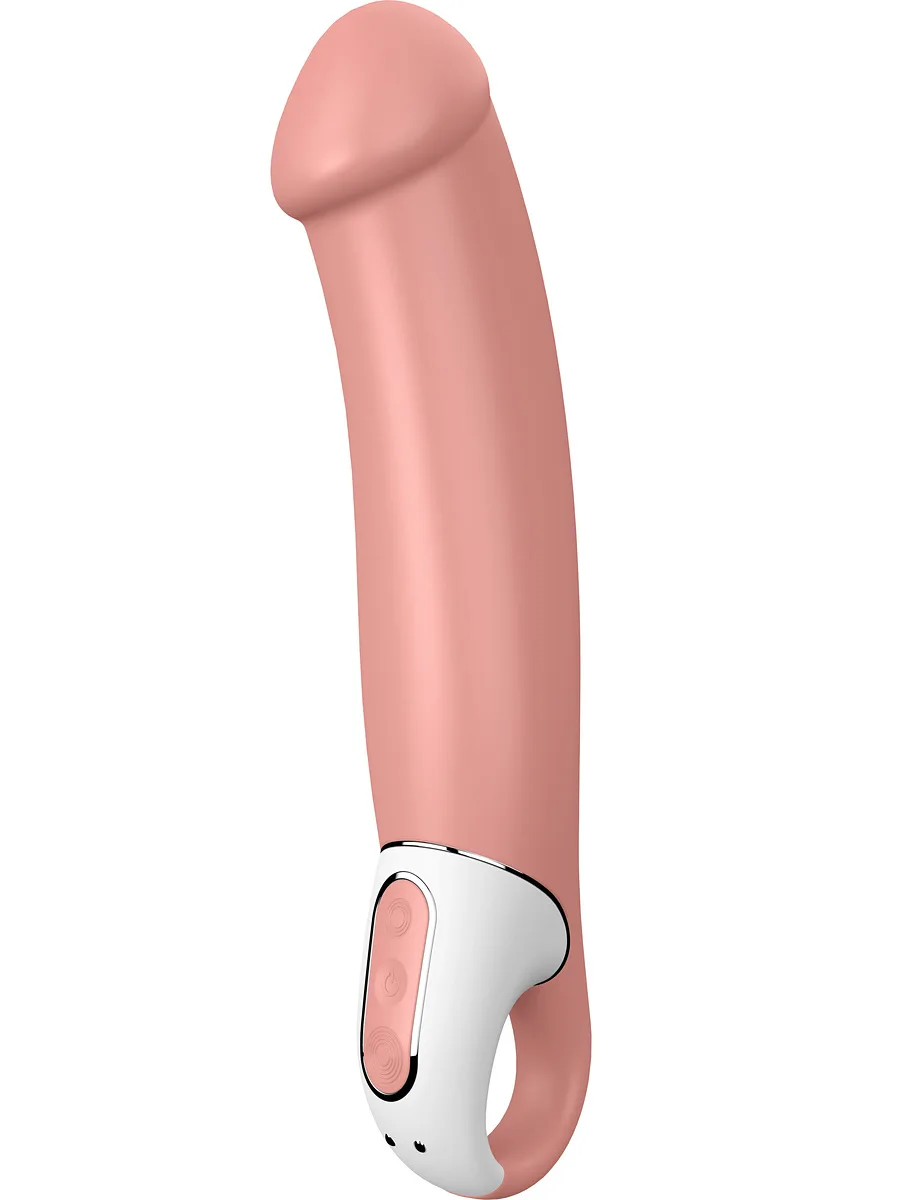
Satisfyer Vibes Master is the largest vibrator in Satisfyer's Vibes series, and the size is the whole point of the model. The manufacturer sells it under the name Master and describes it as a vibrator in XXL format with a shaft made of soft silicone, a slightly bent head designed to seek out the G-spot, and a ring-shaped handle at the bottom. The shaft diameter is stated as 4.7 centimeters, and the insertable length as 17 centimeters. This isn’t a product that sneaks into the lineup — it’s a product designed to stand out in a comparison of measurements.
The specification looks like this: twelve vibration programs, silicone on the shaft and ABS plastic in the handle, protection rating IPX7, a 500 mAh lithium-ion battery that is charged via a magnetic USB cable, and fifteen years of manufacturer warranty. The total length is stated as 235.5 millimeters, the width as 64.88 millimeters, the height as 45.84 millimeters, and the weight as 351 grams. Charging time is stated as approximately five hours and usage time as approximately 35 minutes. In Sweden, the item is sold by six shops at prices between 295 and 667 SEK, and four of them had it in stock at the price check on 12 September 2026.
This review is about the item with EAN 4049369016440, which is the gtin13 number the manufacturer itself lists on the product page. The same number appears verbatim in the item data from Mshop, Taboo, Lekosmek, and Sexonic, which is worth knowing because the Swedish shops sell the product under four different names. The manufacturer publishes only one color for the model; Joyland gives the color designation as light skin color.
XXL is a marketing term, but here there are numbers behind it. The manufacturer’s own feature chart lists the total length as 235.5 millimeters. Of that, the 17 centimeters insertable length is stated in the product description, which means that a little over six and a half centimeters are made up of the handle with the ring and the button panel. The diameter of the shaft is stated as 4.7 centimeters in the description, while the height measurement in the feature chart is 45.84 millimeters — so those two lines differ by just under a millimeter, which is probably because they measure at different points along a shaft that isn’t cylindrical. The width of 64.88 millimeters is the product’s widest point and refers to the handle ring, not the shaft.
Putting the numbers into context is more useful than repeating them. Satisfyer’s own G-Force G-spot vibrator measures 190 × 44 × 54 millimeters and weighs 127 grams. Lelo Gigi 2 measures 163 × 35 × 42 millimeters, has a diameter of 37.8 millimeters, and weighs 79 grams. Master is therefore just over four and a half centimeters longer than G-Force, seven centimeters longer than Gigi 2, and weighs 2.8 times as much as G-Force and 4.4 times as much as Gigi 2. What can be established is that this model belongs to a completely different weight class than the G-spot vibrators it’s placed next to on the store shelf—and that 351 grams at one end of a 23-centimeter-long shaft puts demands on the grip, which in turn explains why Satisfyer has built a ring handle instead of a straight one.
One more thing about the measurements. Insertable depth is not the same as total length, and the difference here is a full 6.5 centimeters. Anyone comparing two products by total length is, in practice, comparing handle design just as much as insertable depth. On Master, the insertable length is 17 centimeters according to the manufacturer, versus 9.5 centimeters on Lelo Gigi 2—so almost twice as much. That number is what actually determines whether the product fits, and it’s the number you should read twice before you pay.
The confusion about the name of this article is worse than usual and deserves its own line. The manufacturer calls the model only Master on its product page. The Swedish stores call the same EAN four different things:
So two of the names include a length specification, 22 centimeters, which doesn’t match any of the manufacturer’s figures: neither the total length of 235.5 millimeters nor the insertable length of 17 centimeters. These aren’t different variants—all six stores list exactly the same barcode. That means, in practice, that you can’t search for the model name to compare prices; you have to search by EAN. If you don’t, you risk comparing Master with another Satisfyer in the Vibes series and thinking you’ve found a bargain.
The materials issue is the only characteristic of an intimate product that can neither be compensated for with experience nor fixed afterward, and it determines whether the product is still hygienic after five years. Satisfyer lists two materials for Master: ABS plastic and silicone. The same breakdown is shown in the manufacturer’s feature table and in the specifications row in the quick guide, and Mshop reproduces it identically in its own product data.
The manufacturer uses the name Silicone Flex Technology and describes it as what makes the shaft soft, smooth, and extremely flexible. From a purely construction standpoint, that means the entire shaft is molded in silicone without a rigid inner core all the way up, so that the rod can be bent toward the body instead of forcing the body to follow the rod’s shape. The manufacturer also writes that the vibrations are carried through the flexible shaft, which is the second function silicone has here: it is both the contact surface and a sound conductor.
Silicone is a non-porous material. A non-porous surface can be cleaned, because there are no microscopic cavities where residue can get trapped. This is the single most important property of a material that is meant to lie against the mucous membrane, and that’s why the material declaration is weighted more heavily than almost every other line in a specification. The ABS plastic sits in the handle—i.e., the white part with buttons and the ring—and ABS is also non-porous—but it’s hard, and that’s exactly why it’s there where the buttons and electronics need to be attached.
The split has a practical consequence that’s worth understanding. The seam between silicone and ABS is at the upper edge of the handle. It’s the point where dirt and lubricant can collect, and it’s the point you should look at extra carefully when you rinse off the product. If you compare it with Satisfyer’s own G-Force, the material specification is identical—ABS plastic and silicone—so this is the brand’s usual construction rather than a deviation. Lelo Gigi 2 specifies the same combination. We-Vibe Rave 2, on the other hand, is stated as body-friendly silicone all the way through.
Phthalates are a group of plasticizers used to make plastic—above all, soft PVC—flexible. Kemikalieinspektionen describes them as substances that can affect the hormone system and make reproduction more difficult, and several of them are therefore restricted or banned within the EU in a large number of products. This particular product category is a recurring subject of supervision, because it contains soft plastic that lies against the mucous membrane.
Here it’s important to be precise about what the manufacturer actually writes. Satisfyer lists silicone and ABS as materials, but does not publish any explicit commitment that the Master would be free from phthalates, BPA, or latex—neither on the product page nor in the quick guide. What it says is “body-friendly silicone”. If you compare that with We-Vibe, which writes “made without phthalates, BPA or latex” in plain text on its product page for the Rave 2, Satisfyer’s wording is weaker.
At the same time, the choice of material itself is a better sign than almost any other wording in the category. Silicone doesn’t require phthalate plasticizers to become soft—the softness comes from the polymer’s own structure—and ABS is a hard thermoplastic that isn’t softened with phthalates either. Someone who sees labels like “TPE” or “jelly rubber” in a product description has instead been given an indication that says absolutely nothing at all about which plasticizers are included. So what can be established is that the materials themselves are the right ones, but the manufacturer’s wording about them is less precise than the industry’s best.
This is the point where a review of store data pays off, because the Swedish store landscape is unusually at odds about this product. The manufacturer’s figures are total length 235.5 millimeters, diameter 4.7 centimeters, insertable length 17 centimeters, and weight 351 grams. This is what the stores list for the same barcode:
When the details clash, the manufacturer’s figures carry the most weight, meaning the ones that apply are 235.5 millimeters, 4.7 centimeters, and 351 grams. But the discrepancies are worth reading in their own right. Taboos 17 centimeters is the manufacturer’s insertable length shown as total length—which is exactly the kind of mix-up error that makes it possible to buy a product that’s six and a half centimeters longer than you meant to. Taboos weight of 594 grams is nearly 70 percent higher than the manufacturer’s and is reasonably the package’s weight. And the heading “22 cm” at both Lekosmek and Taboo matches none of the manufacturer’s figures at all.
The shape is asymmetrical: a long, slightly bent shaft with a marked, rounded tip, and a white-colored handle section with a hole through which the fingers go. The bend is oriented so that the tip points toward the front vaginal wall when the handle is held downward—which is the geometry that makes the product a G-spot vibrator rather than a straight wand. The manufacturer explicitly recommends lubricant precisely because of the length.
The interface consists of three buttons that sit in an elongated panel on the front of the handle. The manufacturer’s own product image shows them clearly: two buttons marked with concentric horizontal rings, one at the top and one at the bottom, and a power symbol in the middle. Two small metal contacts sit under the panel—those are the magnetic charging poles.
The quick guide lists the sequences. The product is turned on and off with a press lasting 1–2 seconds, and the position buttons step through twelve steps. Taboo describes the same thing in Swedish in its store text: the middle button is held down for a few seconds to start, and the vibration modes are switched with the top or bottom button. That means, in practice, that you can step both up and down through the list instead of being forced to go all the way around to get back to one step—something you notice when the product is in place and the buttons aren’t visible.
The manufacturer writes that the twelve vibration programs are made up of different intensities and positions, but does not specify how they are distributed among them. The breakdown into six intensity levels and six rhythms comes from the retailer Joyland, not from Satisfyer. It’s an item that circulates widely within the shop trade and that very well could be correct, but it should be read as a store claim until the manufacturer publishes it themselves.
The difference between intensities and rhythms is not an academic one. An intensity level is a constant vibration at a given setting; a rhythm is a pattern that varies over time, for example pulses or waves. If the breakdown is 6 + 6, that means only half of the programs give you a steady, uninterrupted mode—and the steady mode is the one that most people return to. Compare this with Satisfyer’s own G-Force, where the manufacturer themselves list the breakdown: ten vibration patterns and five intensities, which results in 50 combinations. There, intensity and pattern are two independent controls; on the Master, the twelve preset positions are in a single list.
Practically speaking, that means the Master has a simpler but more blunt interface. You can’t set rhythm A to intensity 2—you get the one Satisfyer has programmed into step number so-and-so. Count on it that in practice you’ll return to two or three of the twelve, which is the usual pattern across the whole product category. The longer the list is, the more steps you also have to press through to get back to your favorite after turning off, because the product restarts from the beginning.
The manufacturer highlights the ring on the handle as one of the model’s main features and writes that it gives you control over the product even when things get lively. This isn’t marketing—it’s design: 351 grams at the end of a 23.5-centimeter-long shaft creates a torque that a straight grip has a hard time resisting, especially with lubricant on your hands. A ring that your fingers pass through locks the grip mechanically instead of relying on friction.
What can be established is that the ring also moves the buttons to where your thumb naturally lands, which is why all three buttons fit on the same narrow panel. The downside is that the handle takes up space: out of the total length of 235.5 millimeters, a little over 65 millimeters goes to the grip. If you want the maximum insertable length per centimeter, the ring design isn’t the most efficient solution—but if you want control over a heavy product, it’s hard to beat.
Satisfyer lists “Whisper mode” as one of Master’s features. The manufacturer publishes no measured decibel value for the model, either on the product page or in the quick guide. Whisper mode is therefore a label with no number behind it in the manufacturer’s own materials, and sites that state an exact dB value for this product either present their own measurement or a value without a source.
What is still possible to reason about, however, is the design. A vibrator of this type is driven by a motor with an unbalanced weight, and the sound occurs when that imbalance makes the housing vibrate. The larger the mass that has to be set in motion, the more energy it takes—and Master has both the longest shaft and the highest weight of the models compared here. A soft silicone shaft also dampens some of the sound that a hard housing would otherwise carry forward. Which of the two effects weighs more heavily can’t be determined without measurements, and no such measurement is published.
A practical tip that applies regardless of the model: never place an activated vibrator on a hard tabletop. The tabletop acts as a resonance box and noticeably amplifies the sound. A folded towel underneath the product does more for the noise level than any program in the menu.
Satisfyer lists the IPX7 enclosure rating for Master both in the feature table and in the product text, and writes that the product can therefore be used in the shower and bathtub and is easy to clean. The rating comes from the international standard IEC 60529, which defines enclosure ratings for electrical equipment. The number 7 in the second position means that the product has been tested for submersion in water to a depth of one meter for 30 minutes.
Here is a store-assignment that is worth correcting explicitly. Taboo states the IPx5 enclosure class in its spec table. According to IEC 60529, IPX5 means protection against water jets from a nozzle—so not immersion. It is a lower class than the one the manufacturer states, and the difference is practically significant: an IPX5 product should not be dipped in a bathtub; an IPX7 product can. The manufacturer’s information applies, and Satisfyer states IPX7.
The point is general. If a product has no IPX rating at all, it should be treated as not waterproof—the absence of a rating is never a sign that the product would be approved. And if two different classes are stated on two sides of the same barcode, it is the manufacturer’s own documentation that decides, not the store that lists the product. Both Mshop (”100 % waterproof”), Joyland (”waterproof IPX7”) and the manufacturer agree; Taboo is the only one that has IPX5.
Rinse the product in lukewarm water after every use, and use unperfumed soap or a cleaning product intended for intimate products. Since IPX7 applies to the entire product, it can be held under running water without any special care needed for buttons or charging contacts. Pay extra attention to the seam between the silicone shaft and the white ABS part, and to the inside of the handle ring, which is the only geometry on the product where water can remain standing. Wipe with a clean towel and let it air-dry before putting the product away.
The lubrication question has an unambiguous answer for a silicone product: use water-based. The manufacturer itself recommends water-based lubricants precisely because of the length, and Joyland states water-based as the recommended type. Silicone-based lubricant should not be used on silicone surfaces—it breaks down the surface over time and makes it porous, and a porous surface can no longer be cleaned properly, only replaced. Oil-based products such as coconut oil leave a film that is hard to get rid of, and they also break down latex if a condom is used over the product.
The quick guide specifies a storage temperature of −5 °C to +60 °C. In practice, it rules out two things people otherwise do: boiling for disinfection and leaving it in a hot car in summer. The guide also lists three situations in which the product should not be put into use at all—if it is unusually hot, if it is damaged or deformed, or if it is discolored—and it advises against use on irritated or damaged skin. Piercings and jewelry in the intimate area should be removed before use.
This is the model’s weakest point, and the figures come from the manufacturer itself. Satisfyer’s quick guide states a lithium-ion battery of 3.7 volts with a capacity of 500 mAh, a charging voltage of 5 volts, a maximum charging current of 400 milliampere, a charging time of about five hours, and an operating time of about 35 minutes. The same line appears in Swedish in the guide’s Swedish section.
With a magnetic charging cable that connects to USB. The manufacturer’s product page explicitly states that a magnetic USB charging cable is included, and the contacts are visible as two small metal dots under the button panel in the manufacturer’s own close-up. Joyland describes the same thing in its shop text.
Magnetic charging is a trade-off, not a pure benefit. The benefit is that there’s no need for an opening in the casing, which makes it significantly easier to achieve IPX7 without a rubber plug—also, the plug is the detail that most often breaks first on cheaper products. The downside is that the cable is product-specific: if you lose the charging cable, no regular USB-C cable works, and you have to get a replacement. That’s a real difference compared with, for example, the Satisfyer Pro 2 Next Generation, which charges with any USB-C cable.
A charging time of five hours deserves a note. With the 500 mAh capacity and the stated maximum charging current of 400 milliampere, a charge would theoretically take a little over one and a quarter hours if the current were held at maximum the entire way. That the manufacturer still states five hours means that the actual charging current is clearly below the maximum value for most of the cycle. That’s not strange in itself—lithium-ion cells are charged with decreasing current towards the end—but the difference compared with Satisfyer’s own G-Force is striking: G-Force has a smaller battery, 380 mAh, and a stated charging time of just two hours.
35 minutes is short, and it’s short even though the battery is relatively large. If you calculate using the manufacturer’s own figures, 500 mAh spread over 35 minutes gives an average current draw of around 850 milliampere. Satisfyer G-Force, with 380 mAh and 60 minutes of operating time, draws just under 380 milliampere. So the Master draws about 2.3 times as much current as the brand’s own smaller G-spot vibrator. Lelo Gigi 2, with 520 mAh and up to four hours of operating time, is around 130 milliampere.
The explanation lies in physics rather than in design flaws. The Master has the longest and heaviest shaft of the compared models, and a motor that’s meant to set 351 grams into vibration needs more power than one that’s meant to move 127 or 79 grams. It’s the same trade-off that applies across the entire product category: power and operating time pull in opposite directions, and the one that chooses the biggest product pays for that in minutes.
The relationship between charging and use is what becomes noticeable in everyday life. Five hours of charging for 35 minutes of operation gives a ratio of about 8.6 to 1. By comparison, We-Vibe Rave 2 charges in 90 minutes and runs for 120 minutes — a ratio of under 1 to 1 — and Lelo Gigi 2 charges in two hours and runs for up to four. In practice, this means that Master is a product you have to charge in advance and plan for, not one you quick-charge a quarter of an hour before.
Two stores list longer run times than the manufacturer. Lekosmek states up to 60 minutes of use and about 150 minutes of recharging, and Taboo states 90 to 120 minutes of use and about 300 minutes of charging. Taboo’s charging time matches the manufacturer’s five hours; the run times do not. Satisfyer’s own figure is about 35 minutes, and that’s the number you should count on.
What applies generally to lithium-ion batteries also applies here: capacity decreases with the number of charge cycles, the cell is not designed to be replaced by the user, and the product does best when it’s charged regularly instead of being stored fully discharged. With use a couple of times per week, it’s the battery, not the silicone, that sets the limit for lifespan — and, as shown in the warranty section further down, it’s also the battery that is explicitly excluded from the manufacturer’s warranty.
We do not have price data from shops in your market yet.
Five hours of charging for 35 minutes of operation. It’s 8.6 hours in the wall socket per hour in-hand — and the battery is the only thing the warranty doesn’t cover.
Three comparisons are relevant: against Satisfyer’s own smaller G-point vibrator, against the classic premium alternative in the category, and against an app-controlled model in the mid-range. All the information below comes from each manufacturer’s own specifications.
Satisfyer G-Force is the brand’s own G-point vibrator in normal size, and it’s the most fair comparison, because the warranty, the material make-up, and the enclosure class are identical: fifteen years, ABS plastic and silicone, IPX7.
Where the similarities end, it’s Master that loses. G-Force measures 190 × 44 × 54 millimeters and weighs 127 grams, so it’s 45 millimeters shorter and 224 grams lighter. G-Force has a smaller battery, 380 mAh vs. 500, but almost twice the run time — about 60 minutes vs. about 35 — and charges in about two hours vs. about five. In addition, Satisfyer G-Force presents the interface in full: ten vibration patterns and five intensity levels, which can be freely combined into 50 combinations, versus Master’s twelve preset modes.
The conclusion is straightforward. If you want a better battery, a nicer control, and a lighter product within the same brand, it’s already in the range. The only thing Master adds is size—17 centimeters insertable length and 4.7 centimeters in diameter, compared with G-Force in a significantly slimmer format. If size is the reason for the purchase, Master is the right choice. If it isn’t, then it’s the wrong choice—and that’s an unusually clear message in this category.
Lelo Gigi 2 is the most established G-spot vibrator in the premium segment and almost the opposite of Master in every respect. Gigi 2 measures 163 × 35 × 42 millimeters, has a diameter of 37.8 millimeters, an insertable length of 95 millimeters, and weighs 79 grams. The material is listed as body-friendly silicone and ABS plastic—so the same breakdown as Master.
On the battery side, the difference is big. Lelo states a lithium-ion battery of 520 mAh and 3.7 volts, a charging time of two hours at 5.0 volts and 500 milliamps, a runtime of up to four hours, standby for up to 90 days, automatic shut-off after 20 minutes, and a vibration frequency of 100 hertz. That’s an unusually complete breakdown, and it makes it possible to calculate: Gigi 2 draws about one-sixth as much current as Master.
The warranties point the other way. Lelo offers two years of warranty plus ten years of quality warranty after that; Satisfyer offers fifteen years, though with the reservations described below. If you choose based on size, Master wins by a wide margin—the insertable length is almost twice as large. If you choose based on runtime, weight, or on how much the manufacturer actually lists, Gigi 2 is equally clearly the winner.
We-Vibe Rave 2 is an app-controlled G-spot vibrator and includes a function that Master completely lacks. We-Vibe lists a runtime of 120 minutes, a charging time of 90 minutes, an IPX7 ingress protection rating, body-friendly silicone that is explicitly stated to be manufactured without phthalates, BPA, or latex, control via the We-Vibe app, and a two-year warranty.
Compared with Master’s roughly 35 minutes of runtime and roughly five hours of charging time, Rave 2 is in another league on the battery side: nearly three and a half times the runtime with one-third of the charging time. Rave 2 also has the clearer material specification and an app, which is the only route to remote control. In return, Master has a warranty that’s 7.5 times as long on paper, and a size that Rave 2 doesn’t come anywhere close to.
It’s a comparison that’s effectively decided by what you prioritize: endurance and features, or format and warranty duration. Satisfyer does not publish app control for Master—the model isn’t included in the Satisfyer Connect series, and the manufacturer doesn’t mention Bluetooth or an app on the product page.
Six Swedish stores sell the item with EAN 4049369016440. The cheapest is Blush Me at 295 SEK, and the most expensive is Sexonic at 667 SEK. That’s a difference of 372 SEK or 126 percent for the exact same barcode, the same color, and the same packaging. The manufacturer’s own recommended price in the British web shop is 66.95 pounds.
The inventory situation here is at least as important as the price spread. The two cheapest stores, Blush Me at 295 SEK and Sexonic at 667 SEK, were both out of stock at the price check on September 12, 2026. Of the four that had it in stock, Lekosmek was the cheapest at 485 SEK, followed by Mshop at 499, Taboo at 549, and Joyland at 595 SEK. So the difference between the cheapest and the most expensive available store is 110 SEK or 23 percent — not 126.
Blush Mes 295 SEK is also a reduced price: the shop lists 495 SEK as the regular price and 295 SEK as the campaign price. Stores that list a product as sold out may keep an old campaign price in the feed, and that price is rarely what you actually end up paying when the item comes in again. That’s why a price comparison should always be read together with the stock column.
The price spread isn’t because any store sells a different variant — all six list the same EAN, including the two that call the product “22 cm”. It’s about the stores’ own margin setting for a model that has existed long enough to be priced freely. The prices in the table above are updated when the stores’ product feeds are updated, but always check the final price at checkout. Several of the stores offer free shipping only over 699 SEK, and in this price range that can eat up the entire difference between the cheapest and the second-cheapest.
It’s for you if you consciously want a large product. A 17-centimeter insertable length and a 4.7-centimeter diameter are not numbers you end up with by mistake, and it’s the only feature where Master beats every alternative in this comparison. It’s for you who want a flexible silicone shaft rather than a rigid wand, you who want a grip that holds up even with lubricant on your hands, and you who want to be able to rinse off the entire product under running water. Fifteen-year manufacturer warranty is also the longest in the category, with a wide margin.
It doesn’t fit you if you want a long runtime. About 35 minutes is the lowest figure in the entire comparison, and a five-hour charging time means it can’t be saved with fast charging. It doesn’t fit you if you want app control — that feature doesn’t exist. It doesn’t fit you if you want fine-grained control over intensity and patterns separately; Satisfyer’s own G-Force is better there. It doesn’t fit you if you want to be able to charge with the same cable as your phone, because the charging cable is magnetic and product-specific. And it doesn’t fit you if you require an explicit phthalate- and BPA declaration before purchase, because Satisfyer doesn’t publish any for this model.
One more thing belongs in the decision. For a beginner in G-spot stimulation, this isn’t the model to start with—the manufacturer itself describes its G-Force as the model for someone with little or no experience, and it’s an unusually honest message from a brand that likes to sell more expensive options. Master is a product for someone who already knows what she wants and wants more of it.
Satisfyer offers fifteen years of manufacturer warranty on Master. It’s the longest warranty period in the product category, and it’s written out both on the product page and in the manufacturer’s warranty terms. But the terms include three clarifications that change the picture, and they’re worth reading before you factor the warranty into your calculation.
First, those fifteen years start running only once the statutory limitation period in the buyer’s home country has expired — so the warranty kicks in after the statutory protection instead of overlapping it. Second, the terms explicitly exclude included rechargeable batteries. That means the component that realistically breaks first on this product — the cell that provides about 35 minutes of runtime — is outside the warranty. Third, refunds are only provided if the product was purchased in Satisfyer’s own web shop; if you buy from any of the six Swedish stores, the replacement product applies instead.
The terms also require an original receipt and that the warranty case is reported in writing within one month from the time you received or should have received knowledge of the defect. The warranty also doesn’t cover damage caused by improper use, use of other accessories than original accessories, external influences, your own repair attempts, or normal wear and tear.
What always applies, though, are your statutory rights. Under the Consumer Sales Act (konsumentköplagen), you have three years’ right of complaint for defects in the item, regardless of what the manufacturer promises. For distance purchases, you also have a right of withdrawal for fourteen days under the Act on distance contracts and contracts concluded outside business premises (lagen om distansavtal och avtal utanför affärslokaler). Note that, in practice, the right of withdrawal is limited for hygiene products that have been removed from a sealed package—however, the right of complaint for defects always applies. If you have questions about what applies in your case, Konsumentverket guides you via Hallå konsument.
Satisfyer Vibes Master isn’t included in any ranking yet. In best i test guides, the entire categories are compared against each other using five shared criteria, with what was left out shown.
Every numerical piece of information in the text can be traced to one of the sources below. The links were checked manually on the specified date.
This page is machine-translated from Swedish. Read the Swedish original