

Review
Review: Satisfyer Pro 2 Next Generation
The same eleven pressure wave levels, without the inner arm—and cheaper.
29 July 2026
 Best budget
Review · Air-pressure vibrator · Clitoris and G-spot
Satisfyer’s app-controlled dual stimulator reviewed against the manufacturer’s own specifications, the quick start guide in the PDF, and price data from six Swedish stores. Eleven pressure-wave intensities, ten vibration programs, two separately controllable motors, a flexible shaft with a chain link, IPX7 according to IEC 60529, and a fifteen-year warranty — but only about 60 minutes of operating time on four hours of charging.
The cheapest way to achieve double stimulation with air pressure available at Swedish stores: two separately controllable motors, eleven air-pressure intensity levels, ten vibration programs, a bendable shaft, and app control for 395 SEK — 910 SEK below Womanizer DUO 2, which is the closest equivalent. What you pay for is the battery. About 60 minutes of runtime on a four-hour charge is the weakest figure in the category, and the manufacturer does not state that the material is free from phthalates, BPA, or latex.
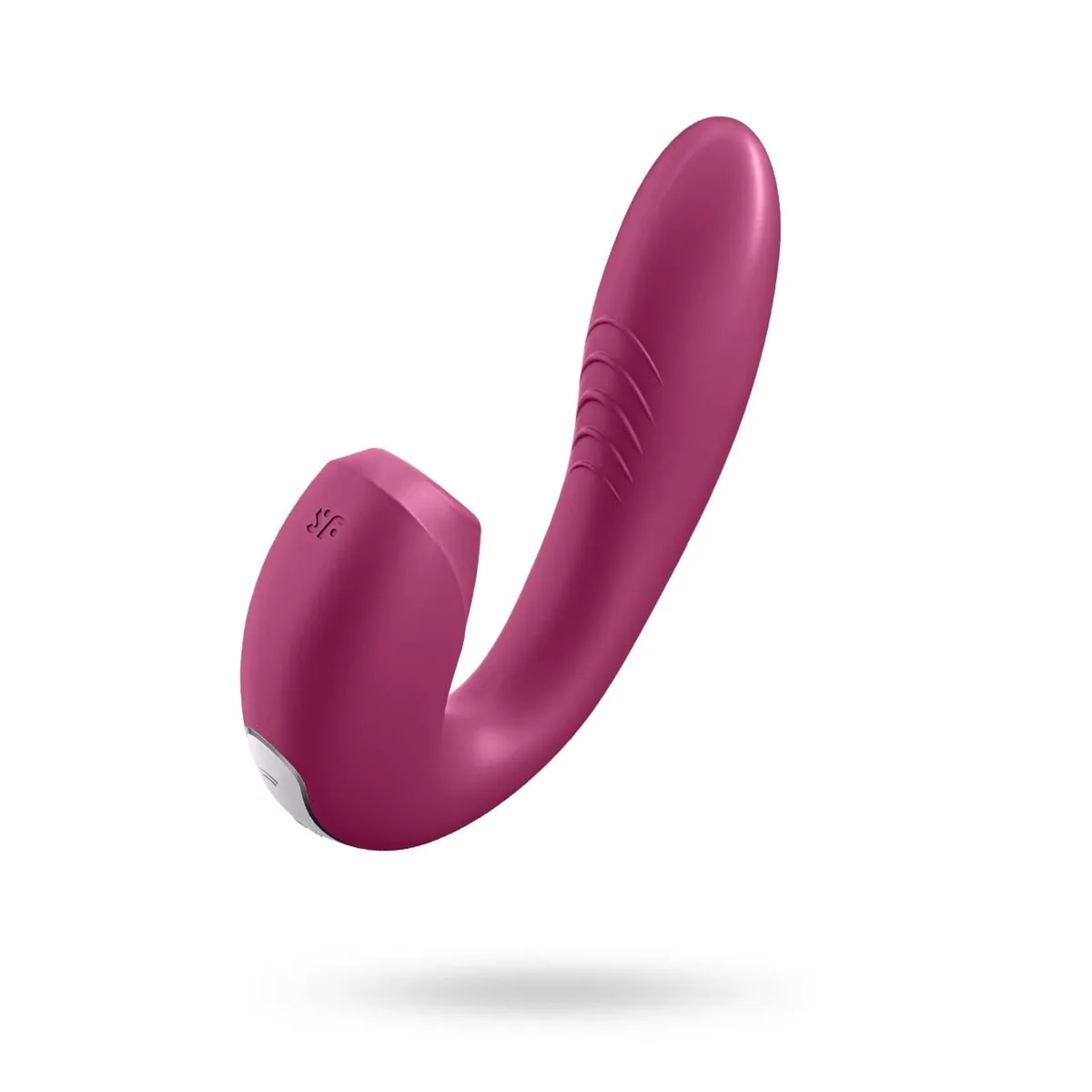
Satisfyer Sunray is the model where Satisfyer combines its two own technologies in a single housing: the air-pressure nozzle that stimulates the clitoris without touching it, and a vibrating arm that sits inside the sleeve against the G-spot. The manufacturer describes it as a rabbit with Air-Pulse technology, and that is a reasonable description as long as you keep apart what the two parts actually do. One works with pressure waves in air. The other works with vibration through silicone. They are powered by two separate motors that can be controlled independently of each other.
The specification looks like this according to the manufacturer: eleven intensities for the pressure waves, ten vibration programs, two separately controllable motors, housing in silicone and ABS plastic, enclosure rating IPX7, lithium-ion battery, magnetic USB charging cable, Bluetooth control via the Satisfyer Connect app, and a fifteen-year warranty. The dimensions are 148 × 88 × 31 millimeters and the weight is stated as 147.52 grams. In Sweden, the item is sold by six stores at prices between 395 and 979 SEK, and three of them have it in stock.
This review is exclusively about the color variant that Swedish stores call Berry, with EAN 4061504009773. The number is checked against the manufacturer’s own variant table: the color choice that Satisfyer’s Swedish shop lists as “Red” carries exactly the same EAN code as in the page’s gtin13 meta tag. The model comes in three colors—manufacturer states Berry, Purple, and Pink—and each color has its own item number in the EU declaration of conformity that the manual refers to: 4009759, 4009766, and 4009773. Functionally, the three are identical, but the item number is the only thing that can be relied on to tell them apart when the stores use different color names for the same product.
Air pressure technology is based on a small pump that switches between underpressure and overpressure in a closed chamber placed over the clitoris. The chamber never touches the clitoris directly—the stimulation happens through pressure changes in the air inside the nozzle. That is the whole reason this product class is described as touch-free, and it is also the fundamental difference compared to a normal vibrator, which transfers mechanical motion from a motor through material to the skin.
Sunray does two things at the same time. The nozzle sits on the short, broad arm and works with pressure waves. The long, curved arm is inserted and vibrates. The manufacturer states that the long arm also has a ribbed structure for vaginal stimulation in addition to the vibration, which the retailer Joyland describes as a surface that is both ribbed and silk-smooth, with the hardness indicated as medium.
What this means in practice is that you control two independent settings. The manufacturer states eleven intensities and ten vibration programs, and since the motors can be run either separately or together, you can use the product as a pure clitoral stimulator, as a pure G-spot vibrator, or as both at the same time. What you can establish technically is that it provides more combinations than a single-motor product—but it also means more decisions to make on the spot, which is the real cost of a product with two controls instead of one.
The naming is messy in Swedish stores, and that’s because the manufacturer itself uses two names for the same product.
Always check the EAN number before comparing prices. The difference between the cheapest and the most expensive Swedish store for the exact item number 4061504009773 is 584 SEK, and that difference quickly disappears in search results where a Sunray in another color or a Double Joy is listed next to it.
The material is the only characteristic of an intimate product that neither routine nor care can compensate for, and it determines whether the product is still hygienic after five years. Satisfyer lists two materials for Sunray: silicone and ABS plastic. The same information appears in the manufacturer’s feature table on the product page and in the specifications line in the quick-start guide, and retailer Joyland reproduces it identically in its own materials table.
Silicone is a non-porous material. A non-porous surface can be cleaned, because there are no microscopic cavities where residue can get trapped. This is the single most important property of a material that is meant to sit against the mucous membrane, and that is why the material declaration carries more weight than almost every other line in a specification.
Listing ABS plastic alongside the silicone isn’t a problem by itself, but it’s worth understanding where the boundary is. In the manufacturer’s own product images, you can see a different, lighter panel at the lower end of the wide grip—this is the charging connector and the part of the housing that isn’t coated with silicone. Everything that is intended to sit against or be inserted into the body is silicone; the ABS plastic sits in the bottom part and in the housing’s construction. The difference compared to a product that is fully silicone over the entire body is that there’s a seam between the two materials, and a seam is always the place where residue collects first.
What can be established is that the material split is the same as on Womanizer DUO 2, which lists ABS and body-friendly silicone, and the same as on Satisfyer’s own Pro 2 Generation 2, which is also listed as ABS plastic and silicone. So the split is the norm in the category, not a distinctive feature of the Sunray.
Phthalates are a group of plasticizers used to make plastic — above all, soft PVC — flexible. The Swedish Chemicals Agency (Kemikalieinspektionen) describes them as substances that can affect the endocrine system and make reproduction more difficult, and several of them are therefore restricted or prohibited within the EU in a large number of products. This specific product category is repeatedly the subject of supervision, because it contains softened plastic that comes into contact with the skin and mucous membranes.
There is a clear difference between the manufacturers here. Satisfyer does not state on the product page or in the manual that Sunray is free from phthalates, BPA, or latex. What is stated is the materials silicone and ABS plastic, as well as the wording “skin-friendly silicone.” Womanizer, on the other hand, explicitly states “made without phthalates, BPA or latex” in the specification for DUO 2. The retailer Vuxen does list “Body-safe & Free from Phthalates” for Sunray, but that is a store claim, not the manufacturer’s declaration, and in the event of a contradiction the manufacturer’s wording carries more weight.
It should be said that silicone by itself does not require phthalate plasticizers to become soft — the softness comes from the polymer’s own structure — and that silicone as a material specification is therefore already a better indication than labels such as “TPE” or “jelly gum,” which say nothing at all about which plasticizers are included. But the absence of an explicit declaration is an absence, and it should be presented as such rather than filled in with guesses.
What the manufacturer documents, however, is electrical compliance. The manual states that Triple A Import GmbH assures that the product meets the directives 2014/53/EU on radio equipment and 2011/65/EU on the restriction of hazardous substances in electronics, and that a declaration of conformity can be downloaded with the article number 4009773 from the manufacturer’s compliance page. It is the RoHS directive, which applies to heavy metals and flame retardants in electronics — not plasticizers in the silicone.
The manufacturer gives the length as 148 millimeters, the width as 88 millimeters, and the height as 31 millimeters. The weight is given as 147.52 grams — an unusually precise figure in a category where most round to the nearest ten. The retailer Vuxen gives the total length as 14.8 centimeters, which matches exactly the manufacturer’s 148 millimeters.
The yellow flag around weight that usually pops up in this category can actually be dismissed here, and it’s worth explaining why. The manufacturer’s product page carries a hidden weight tag of 0,402 kilograms, and Mshop states 0,40 kilograms in its table. But Mshop lists that figure under the heading “Dimensioner (Förpackning)”, together with the package dimensions 23,50 × 7,55 × 11,65 centimeters. So the 402 grams are the weight of the entire packaged shipment, not of the product. The product itself weighs 147,52 grams according to the manufacturer’s specification table, and the two numbers don’t contradict each other—they measure different things.
In terms of size, Sunray is positioned in the middle of the category. Womanizer DUO 2, which does essentially the same thing, measures 88 × 203 × 58 millimeters and weighs 263 grams. Sunray is therefore 55 millimeters shorter, significantly lower in profile, and nearly 116 grams lighter. Satisfyer’s own clean clitoral stimulator Pro 2 Generation 2 measures 165 × 46 × 65 millimeters and weighs 174,7 grams—longer but much slimmer, because it lacks the inner arm.
The function the manufacturer highlights most clearly is flexibility. Satisfyer states that the shaft contains a chain link and that the silicone around it is designed to be bendable so the product can be adapted to the shape of your body. It’s a mechanical design, not an electronic function: a bendable core that keeps the shape you give it until you bend it again.
What can be established is that it solves a real problem with this type of product. Each dual stimulator has a fixed angle between the outer and inner arm, and by definition that angle doesn’t fit everyone. A model with a fixed angle—Womanizer DUO 2 is an example—requires that your anatomy happens to be close to the angle the designer chose. A bendable model moves that decision to the user instead. The manufacturer also specifies a wider grip, specifically to make it easier to adjust the placement during use, and Mshop repeats that information in its own description.
The counterargument is just as simple: a chain link is a moving mechanical part inside a product that otherwise has no moving parts, and moving parts are statistically what breaks first. The manufacturer publishes no information about how many bends the design is dimensioned for, and the warranty terms expressly exclude damage that occurred due to improper handling. Bend it as much as you need, but don’t treat flexibility as a toy in itself.
One final note about the packaging. The manufacturer’s own packaging image lists the product’s selling points on the front: intense air pressure waves, G-point and clitoral stimulation, eleven programs, silicone, flexible form, and waterproof according to IPX7. That the packaging states “11 Programs” while the product page distinguishes between eleven intensities and ten vibration programs is a detail we’ll come back to—it’s the explanation for why Swedish stores list different numbers for the same item.
The interface on Sunray follows Satisfyer’s usual logic, and the manual presents it with pictograms rather than text. The product has one button for the air-pressure section and one button for the vibration section. According to the manual’s usage page, each motor is started and turned off by pressing and holding its own button for two seconds, and the app is accessed with a double-press. That the motors have separate buttons is the point of the design: you can run one without the other.
What can be established is that this is a simpler interface than it looks, but also an interface without a display. The manual specifies how the charging indication behaves—flashing light means the battery is charging, steady light means it’s fully charged—but there’s no corresponding indication for which of the eleven intensities you’re on. You count button presses, or you check the app.
There’s real confusion in the retail chain here that’s worth sorting out, because it affects how the product comes across in a comparison.
The manufacturer’s product page is unambiguous: the two separately controllable motors allow ten vibration programs and eleven intensities. Joyland reproduces the same breakdown in its specification table—eleven intensity modes and ten vibration modes—and Mshop writes “11 air-pressure waves” and “10 vibration programs”. Blush Me, on the other hand, writes “11 pressure-wave programs,” and the manufacturer’s own packaging summarizes the entire product as “11 Programs”.
So it’s not about different variants of the product, but about the same numbers being used for two different things: eleven steps on the air-pressure side and ten programs on the vibration side. A store that writes “11 programs” isn’t wrong about the air pressure, but it omits the other motor. Count on eleven and ten, not twenty-one and not eleven.
For comparison, Womanizer lists fourteen intensity steps and ten vibration patterns for the DUO 2, and Satisfyer lists eleven air-pressure intensity levels for its pure clitoral stimulator Pro 2 Generation 2. Eleven steps on the air pressure are therefore Satisfyer’s standard scale and not something that has been scaled down for the Sunray.
Sunray is Bluetooth-enabled and connects to the Satisfyer Connect app, which the manufacturer states is available for both iOS and Android. The manual specifies the radio part: the product transmits on 2402–2480 MHz with an output power of +6 dBm. This is the standard band for Bluetooth Low Energy and a power level in the lower part of the range, which in practice means short range—this is a product controlled from the same room, not through an apartment.
The manufacturer states that the app lets you design your own vibration programs, edit the pre-set programs, and connect the app to Spotify so the music controls the rhythm. The retailer Joyland goes further and lists the functions by name: Program Play for the pre-installed programs, Live Control where you draw patterns with your finger on the screen and control the two motors separately, Ambient Sound, which converts ambient sound into vibration, Music Vibes for streamed music, Remote Partner for remote control over the internet with chat and video calls, Community Share for sharing your own patterns anonymously, and an alarm function. This is a store description, but it is detailed and broadly matches the manufacturer’s own description of the app.
Two things are worth considering. The first is that the manufacturer explicitly states that the product can also be used without an app—the app is an add-on, not a requirement, and anyone who doesn’t want to link an intimate product to an account doesn’t have to. The second is that an app-controlled product depends on the manufacturer continuing to maintain the app. Fifteen years of warranty on the hardware is one thing; how long a Bluetooth app will work with future operating systems is another, and it provides no manufacturer promise about that.
The manufacturer markets Sunray with the feature “silent mode” and describes Satisfyer’s air pressure motors as whisper-quiet in its other materials. The question is what that means in numbers, and the answer has to be honest: Satisfyer publishes no measured decibel value for Sunray, either on the product page or in the quick start guide. None of the six Swedish stores mentions any measurement either.
What can, however, be established is two things. The first is that air pressure products, as a category, are quieter than vibrators with rotating eccentric motors, because the sound comes from a pump rather than from an unbalanced weight striking the housing. The second is that Sunray has both sound sources: an air pressure pump in the nozzle and a vibration motor in the inner arm. A product with two motors running at the same time is, by definition, not quieter than the same product with one motor running.
A practical tip that applies regardless of model: place the product on a soft surface between uses, and do not hold it against a hard tabletop while it’s powered on. A tabletop acts as a resonance box and noticeably amplifies the sound. Claims about exact decibel levels for Sunray that circulate on other sites are not supported by the manufacturer’s materials.
Satisfyer classifies Sunray as IPX7. The information is shown in the specification table on the product page, in the product text, on the packaging, and in five of the six Swedish retailers’ descriptions. The rating comes from the international standard IEC 60529, which defines enclosure classes for electrical equipment. The number 7 in the second position means that the product has been tested for immersion in water to a depth of one meter for 30 minutes. The manufacturer states the consequence directly: the rabbit is water-resistant and can be used in the shower or bathtub, and it is cleaned with lukewarm water and cleaning products for intimate products.
Here, however, there is a discrepancy that should be reported, because it is the only direct contradiction in all the material. Retailer Vuxen states in its own detail table that water resistance is “Splash-proof only”, and it also writes in the product text that while the manufacturer indicates that the toy is water-resistant, according to the store it cannot be used under water in the bathtub and only tolerates lighter water splashes. The store provides no reason for its assessment and does not refer to any own testing.
In a clash between the manufacturer and a retailer, the manufacturer weighs more, and the manufacturer’s statement is also the only one tied to a defined standard. Formally, then, IPX7 applies. But the discrepancy is worth knowing before you submerge the product in a filled bathtub, and there is a way to handle it without having to pick a side: feel free to rinse the product under running water and use it in the shower, but avoid leaving it submerged longer than necessary. No product in this category benefits from that, and an IPX7 rating refers to a one-time test for 30 minutes — not repeated immersion over several years.
The difference between the two terms is bigger than the words suggest, and that’s exactly why the discrepancy above matters. Splash protection covers water droplets and, at best, water jets, but not submersion. A splash-proof product can handle a damp cloth and possibly a shower, but not a bathtub, and it shouldn’t be held under running water without thinking about the buttons and the charging contact. With IPX7, the whole product can be rinsed off without caution.
If it lacks an IP rating entirely, it should be treated as not being waterproof. The absence of a rating is never a sign that the product is approved—on the contrary, it is the manufacturer’s way of not promising anything.
Rinse the product in lukewarm water after every use and use a cleaning agent intended for intimate products, exactly as the manufacturer states. Be especially careful with the inside of the air-pressure nozzle—that’s the only part where water and residue can be left standing, and, unlike in several premium models, the nozzle on Sunray is not removable according to the manufacturer’s information. Wipe it with a clean towel and let it air-dry before putting the product away.
The lubricant question has a clear answer for all silicone products: use water-based lubricant. Joyland states water-based as the recommended lubricant for this specific article, and Mshop repeats the advice in its own text. Do not use silicone-based lubricant on silicone—it breaks down the surface over time and makes it porous, and a porous surface can no longer be cleaned properly; it only needs to be replaced. Oil-based products like coconut oil leave a film that is difficult to remove.
The manual also covers storage with a specific interval: the product should be stored between −5 and +60 degrees. That’s a wider margin than most manufacturers specify, but the upper limit still rules out boiling water and dishwashers despite IPX7. Store the product so it doesn’t rest against other silicone products—Mshop recommends a fabric bag or a small box, and the reason is that different silicone blends can react with each other during prolonged contact.
The manual’s safety section also includes three points that rarely appear in store texts. Remove piercings and jewelry in the intimate area before use. Do not use the product on irritated or damaged skin, and stop if it hurts or feels unpleasant. And do not use the product if it is unusually hot, mechanically damaged or deformed, or if it has discoloration—all three are signs that something is wrong with the electronics or the material.
This is the section where Sunray is weakest, and it’s also the section where the manufacturer deserves praise for the fact that the information exists at all. It doesn’t appear on the product page—it appears in the quick start guide, in a single dense specifications line that is repeated in thirty languages.
The manual states: lithium-ion battery at 3,7 volts with the capacity 450 mAh, charging voltage 5 volts, maximum charging current 180 mA, laddtid cirka 4 timmar and användningstid cirka 60 minuter. The retailer Joyland states “Up to 1 hour” as the battery life, independent of the manual, and that matches.
An hour of run time is short. It is the single toughest figure in this spec review, and it should be weighed against what competitors claim. Womanizer DUO 2, which does the same thing with two motors, states 120 minutes of run time on a 120-minute charge. Sunray therefore gives half the run time for double the charging time — a quarter of the competitor’s ratio between charging and use.
The explanation is likely that two motors have to share 450 mAh. The capacity itself isn’t unusually small for the format, but an air pressure pump and a vibration motor running at the same time draw more than a single motor. The low charging current of 180 mA in turn explains the charging time: with 450 mAh to fill and a current of 180 mA, you end up roughly within the interval the manufacturer states.
What that means in practice depends entirely on how you use the product. A combined total of sixty minutes of run time is enough for several uses between charges for most people, and it’s rarely that you run a product for an hour in a row. But it also means that Sunray is a product you need to keep charged, not one you can put in a drawer for two months and expect it to start. Lithium-ion batteries self-discharge, and capacity falls with the number of charge cycles.
Charging happens via a magnetic charging cable that connects to USB. The manufacturer states that the cable is included in the delivery, and the manual specifies the interface as USB with a charging voltage of 5 volts. The charging indicator is described in the manual: the light blinks during charging and stays solid when the battery is full, which, according to the same page, occurs after about four hours.
Magnetic charging is a trade-off, not a pure advantage. The advantage is that you don’t need an opening in the housing, which makes it easier to achieve IPX7 without a rubber plug — and on a product that’s meant to withstand showering, that’s a real argument. The downside is that the cable is product-specific: if you lose the charging cable, no regular USB-C cable works, so you have to get a replacement. Satisfyer sells a separate USB charging cable in its own range, which is a reminder that it’s a consumable item.
One more thing belongs here, and it’s more important than it sounds. Satisfyer’s warranty terms expressly exclude the battery from the warranty. So, a fifteen-year warranty applies to everything except exactly the component that is most likely to fail first — and since the battery can’t be replaced in this type of product, the product is effectively used up when the cell is.
We do not have price data from shops in your market yet.
Fifteen years of warranty on everything except the battery — on a product whose battery provides sixty minutes of operation and takes four hours to charge.
Two comparisons are relevant: against the direct premium competitor that does exactly the same thing, and against Satisfyer’s own cheapest air-pressure product that does half of it. All information below comes from each manufacturer’s own specifications, and all prices come from the stores’ product feeds on July 29, 2026.
Womanizer DUO 2 is the most direct competitor there is: air-pressure nozzle for the clitoris, a vibrating inner arm for the G-spot, two motors with separate control. It costs from 1,305 SEK at Vuxen, which has it in stock. Sunray costs 395 SEK at the lowest. The difference is 910 SEK, or just over three times the price.
This is what the specifications look like side by side. The DUO 2 measures 88 × 203 × 58 millimeters and weighs 263 grams; the Sunray measures 148 × 88 × 31 millimeters and weighs 147.52 grams. The DUO 2 lists fourteen intensity levels and ten vibration patterns; the Sunray lists eleven intensities and ten vibration programs. Both are IPX7. Both list ABS and body-friendly silicone as materials — but Womanizer also states that the materials are free from phthalates, BPA, and latex, which Satisfyer does not.
The decisive difference lies in the battery. The DUO 2 lists 120 minutes of runtime on a 120-minute charge time. The Sunray lists 60 minutes of runtime on a four-hour charge time. Womanizer also adds Smart Silence, which makes the product start only upon skin contact, Afterglow for a gentle fade-out after orgasm, and an extra stimulation stop in a second size in the box — three features Satisfyer doesn’t state for Sunray.
Sunray counters with three things of its own. It’s shorter, lower, and 116 grams lighter. It has a bendable chain-link in the shaft, which the DUO 2 with its fixed form does not have. And it has Bluetooth control via the Satisfyer Connect app, which the DUO 2 does not list. The warranty is also formally three times as long — fifteen years versus Womanizer’s five — even though Satisfyer’s terms make it harder to take advantage of, which we’ll come back to.
Conclusion: If you buy based on runtime, the materials declaration, and well-thought-out extra features, the DUO 2 is worth its extra 910 SEK. If you buy based on adjustability, app control, weight, and price, the Sunray is hard to beat.
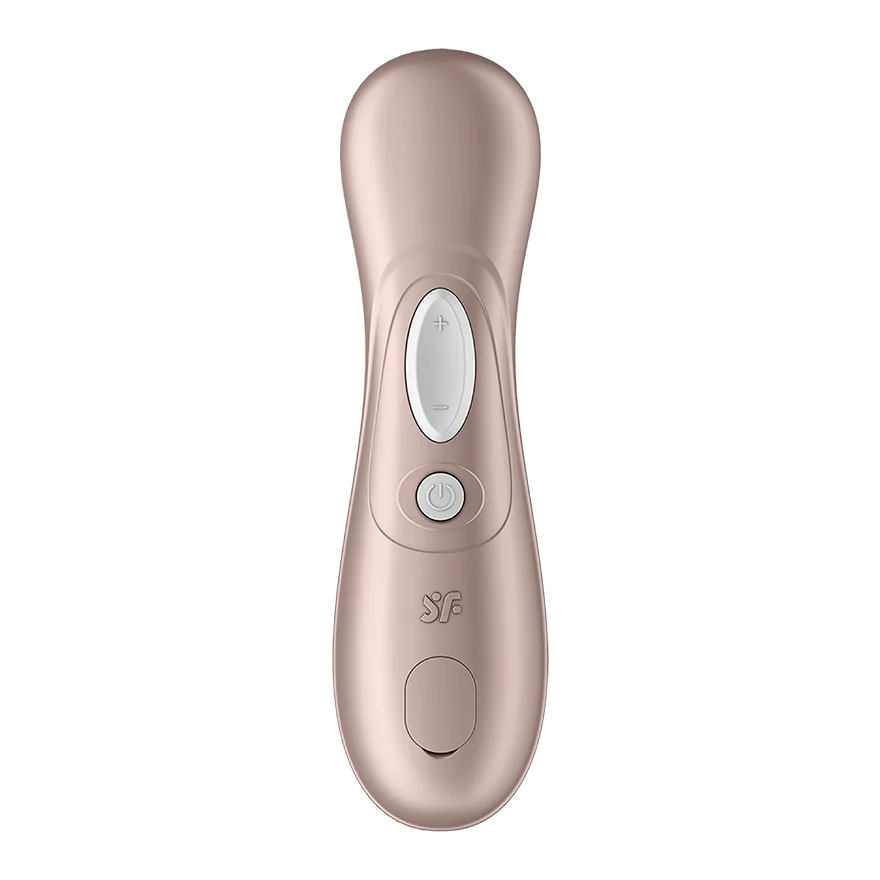
The second comparison is internal and really comes down to one question. Satisfyer Pro 2 Generation 2, which in Sweden is sold as the Pro 2 Next Generation, costs from 254 SEK and is a pure clitoral stimulator. It measures 165 × 46 × 65 millimeters, weighs 174.7 grams, is made of ABS plastic and silicone, is IPX7-rated, and has eleven pressure-wave intensities — exactly the same step as Sunray. A 15-year warranty applies to both.
The difference between the two is therefore not air pressure. It is specified identically. The difference is that Sunray also has a vibrating, flexible inner arm with ten programs, two separately controlled motors, and app control. It costs 141 SEK extra, which is the cheapest way to get double stimulation with air pressure available in the Swedish store selection.
So the question you have to ask is concrete: do you want something inside your body at the same time? If you know you don’t want that, it’s hard to justify Sunray over Pro 2—you pay for a motor you don’t use, and you also get shorter runtime for having to carry it around. If you know you want that, or you’re unsure, 141 SEK is a small amount to find out.
Six Swedish stores sell the item with EAN 4061504009773. The cheapest is Blush Me and SexleksakerOutlet at 395 SEK, and the most expensive is Vuxenkul at 979 SEK. That’s a difference of 584 SEK or 148 percent for exactly the same item number, the same color, and the same packaging—one of the biggest spreads we see in this category.
The stock situation is at least as important as the price spread. Only three of the six stores had the product in stock at the price check: Blush Me at 395 SEK, Mshop at 499 SEK, and Joyland at 591 SEK. That means the difference between the cheapest and the second-cheapest available store is 104 SEK, not 584. Stores that list a product as sold out may still have an old price in the feed, and that price is rarely what you actually end up paying when the item comes back in.
The price spread isn’t because any store sells a different variant. Five of the six stores list the item under EAN 4061504009773 in their own product feeds, and the sixth uses the same number as GTIN. It’s therefore about the stores’ own margin setting on a model that’s been on the market long enough for prices to have diverged—and that’s exactly the situation where it’s most worth comparing before you pay.
The prices in the table above are updated when the stores’ product feeds are updated, but always check the final price at checkout. Shipping cost is added at most stores under a certain order value, and at this price level, all stores are below the free-shipping threshold—which means that a cheaper store with more expensive shipping isn’t always the cheapest overall.
It fits you if you want both touch-free clitoral stimulation and vibration inside the body, and you don’t want to pay a premium price for it. It fits you if you’ve had problems with fixed rabbit vibrators not hitting the right spot, because the chain link lets you change the angle between the arms. It fits you if you want to run one motor at a time. And it fits you if you actually plan to use the app—Live Control and your own programs are real features, not just a bullet point on the packaging.
It doesn’t fit you if you want a long runtime. Sixty minutes on four hours of charging is the weakest figure in this comparison, and it’s hard to get around. It doesn’t fit you if you require an explicit declaration of ftalates, BPA, and latex from the manufacturer, because Satisfyer doesn’t publish any such statement for this model. It doesn’t fit you if you want a detachable nozzle that you can clean separately. And it doesn’t fit you if you want to be able to charge with the same cable as your phone—the magnetic charging cable is product-specific.
One more thing belongs in the decision, and it’s about what 395 SEK actually buys you. This isn’t a cheap product with scaled-down specifications. It has the same air-pressure step as Satisfyer’s best-seller, the same IPX7 rating as the premium models, the same material breakdown as Womanizer uses, plus a second motor and app control. What you pay less for is the battery, the material declaration, and the well-thought-out extra features. Whether that’s the right trade-off for you is only something you can decide—but at least it’s a clear trade-off, not a hidden cut.
Satisfyer provides fifteen years of voluntary manufacturer’s warranty, and it’s the longest warranty in the entire category. But the terms are crucial to what it’s worth, and they’re worth reading before you count on them.
According to the manufacturer’s own warranty terms, the warranty covers material and manufacturing defects, and the warranty period of fifteen years only takes effect after the statutory warranty period in the buyer’s country has ended. So it sits on top of your statutory rights, not instead of them. Furthermore, the battery is expressly excluded from the warranty; the warranty no longer applies if you try to open the product; it doesn’t cover damage from accidents, misuse, or negligence; and it doesn’t cover changes to the exterior from normal wear and tear.
The practical use is also worth knowing about. The terms state that the product must be sent together with the original receipt to Satisfyer’s return address in Bielefeld, Germany, that you pay the postage yourself, and that shipping costs are not reimbursed. If it turns out that the defect is not covered by the warranty, you also cover the inspection cost. The warranty is governed by German law, with Bielefeld as the jurisdiction. For a product that costs 395 SEK, this is, in itself, a trade-off: the shipping cost to Germany can become a significant share of the product’s value.
What always applies, however, are your statutory rights, and in practice, these are what you can rely on. Under konsumentköplagen, you have three years of a right to complain about defects in the goods, regardless of what the manufacturer promises, and you assert this against the Swedish store you bought from—not against Satisfyer in Germany. For distance purchases, you also have a right of withdrawal for fourteen days under the lagen om distansavtal och avtal utanför affärslokaler. Be aware that in practice the right of withdrawal is limited for hygiene products that have been removed from a sealed package—however, the right to complain about defects applies at all times. If you have questions about what applies in your case, Konsumentverket guides you via Hallå konsument.
Satisfyer Sunray Berry is ranked på plats 20 av 32 in clitoral stimulator best i test, where the entire category is compared against each other using five shared criteria. Guiden vinns av Womanizer Premium 2 Red Gold.
Every numerical piece of information in the text can be traced to one of the sources below. The links were checked manually on the specified date.
This page is machine-translated from Swedish. Read the Swedish original