

Review
Review: Satisfyer Pro 2 Next Generation
Cheapest among the widely sold air pressure models—starting from 219 SEK.
29 July 2026
Review · Clitoral stimulator · Licking tongue and suction
Svakom’s cat-shaped stimulator combines mechanical licking motion, suction, and vibration in the same opening. Reviewed against the manufacturer’s product page, user manual, and warranty terms: ten licking modes, three suction power levels, 650 mAh, two hours of charging time, and one hour of operating time — and a water-tightness class that the manufacturer itself describes in three different ways.
Three stimulation methods in one casing, controlled by two buttons and complemented with an app — it’s a genuinely different product than a pure air pressure stimulator, and the only one in the comparison with a mechanical licking tongue. What you pay for it gets you is a worse water-tightness class than the competitors, a proprietary magnetic cable, one hour of operating time, and a two-year warranty instead of fifteen.
Svakom Klitty is a clitoral stimulator that does three things that are otherwise sold separately: it has a moving silicone tongue, a suction chamber that builds up negative pressure, and a vibration section. The manufacturer states that in manual control it offers ten lick modes and three suction strengths, and via the Bluetooth app it offers ten lick modes, three suction strengths, and ten vibration modes. The product measures 70 × 128 × 61 millimeters, weighs 280 grams, has a 650 mAh battery, and charges magnetically in two hours. The water-resistance rating is stated as IPX6.
In Swedish retail, the item is sold under EAN 6959633106266 by six stores at prices between 595 and 899 SEK. The manufacturer’s own item code is ST462B, and Svakom’s own webshop lists the product at 89 US dollars. Svakom sells only one version—the Swedish retailers’ color name "Dusty Lavender" comes from retail, not from the manufacturer, which specifies a single variant with that EAN number.
That makes Klitty a product that’s difficult to compare directly. A pressure air stimulator like the Satisfyer Pro 2 Next Generation does one thing. Klitty does three, and the price follows. The question this desk review is trying to answer is whether the three functions justify the price difference—and what you give up in return, especially in terms of water resistance and charging.
The three stimulation modes work according to completely different principles, and it’s worth keeping them separate because marketing texts in this category rarely do.
What makes the combination interesting is that suction and lick motion can be used separately. The manufacturer describes the functions as independent, controlled by their own button. In practice, that means the product can be used as a pure suction stimulator, as a pure lick tongue, or as both at the same time—three different products in one housing.
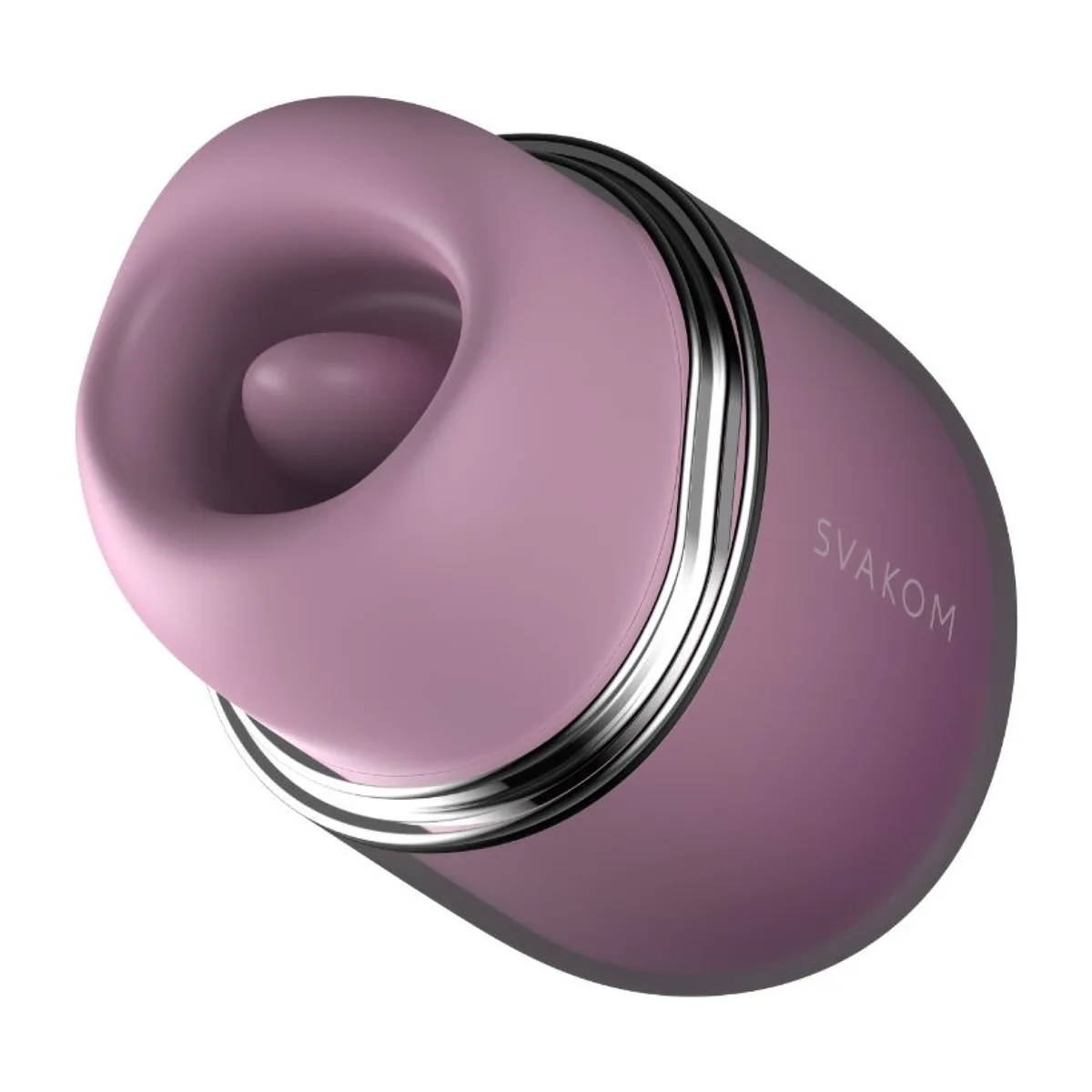
Klitty is designed to look like a cat, with ears and a nose in the housing. It is not just an aesthetic detail. The manual’s part list starts with a removable cover that sits over the silicone tongue, and it does two concrete things: it protects the tongue and the suction chamber from dust and dirt during storage, and it means the product isn’t immediately read as a sex toy if it is left out on display.
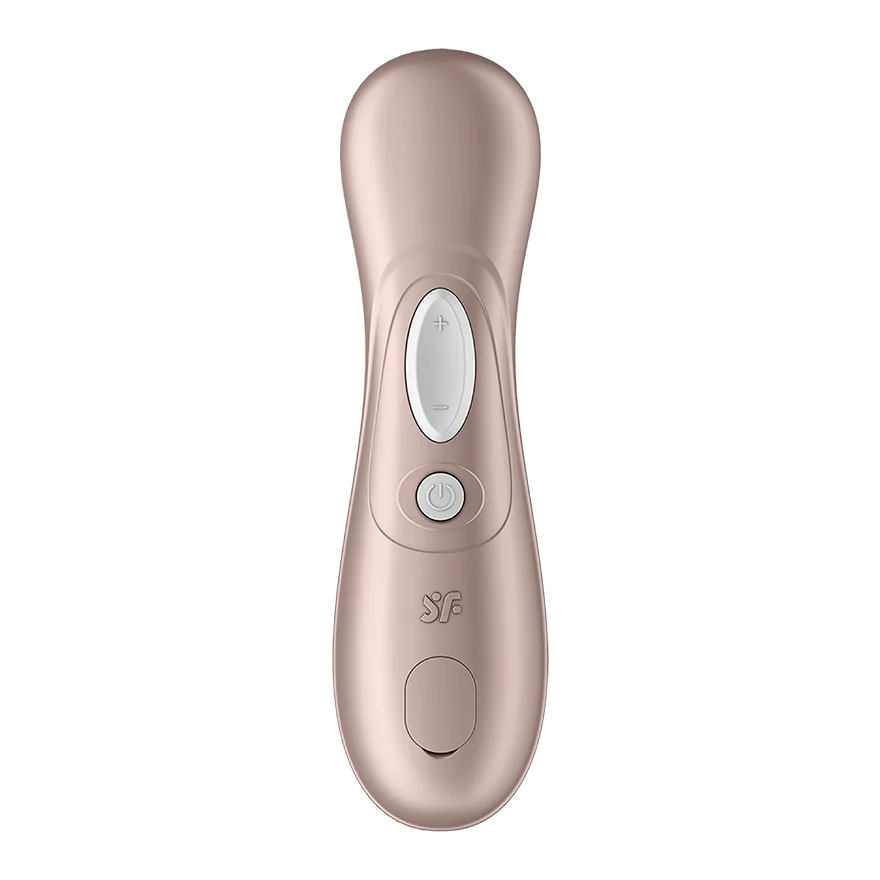
For a product in this category, the second thing is a real function rather than a marketing claim. Klitty measures 128 millimeters at its largest dimension and stands firmly on its base. The comparison is readily apparent with products like Satisfyer Pro 2 Next Generation, which is designed as a handheld device and makes no attempt to hide what it is.
Other parts in the manual’s list are the silicone tongue, an air-flow opening, the magnetic charging port, and the two buttons: an S button for power and licking mode, and an O button for suction mode.
Material is the only characteristic of an intimate product that can’t be compensated for with habit or care, and it determines whether the product is still hygienic after three years. Svakom lists three materials for Klitty: liquid silicone, ABS and POM.
The manufacturer does not specify in the specification which part is which material. What can be established is that the manual’s part list names the tongue as a silicone tongue, and that it is the tongue and the chamber around it that come into contact with the body. The housing—the cat body with its metallic-sheen ring around the waist—is therefore most likely ABS.
It’s the same split that Satisfyer uses on Pro 2 Next Generation: silicone where it needs to be hygienic, and hard thermoplastic in the rest. Both materials are pore-free surfaces that can be cleaned. The difference versus models with silicone over the entire body lies in the feel in the hand and in how the product handles impacts, not in hygiene.
One thing worth noting in this context: Svakom’s own Echo, a tongue-shaped clitoral vibrator in the same category, is listed as ABS only. So Klitty has silicone in the contact area where Echo does not, which is a material upgrade within the brand’s own product range.
POM stands for polyoxymethylene and is also called acetal plastic. It is a hard, dimensionally stable technical plastic with low friction and high abrasion resistance, and it is used primarily in moving mechanical parts: gears, sliding bearings, shafts, and mechanisms that need to move many times without wearing out.
The fact that the material is listed in the declaration therefore says something about the construction. Klitty has a tongue that moves mechanically, and such movement requires a drive mechanism. POM is a reasonable choice for that part. In practice, this means that the material is likely located inside the product and not against the skin — but since the manufacturer does not specify where, it can’t be confirmed. It’s one of the details Svakom should publish and doesn’t.
Phthalates are a group of plasticizers used to make plastic — above all, soft PVC — flexible. Kemikalieinspektionen describes them as substances where several are classified as reproductive toxins and are suspected of disrupting the hormone system, and it states that phthalates can make up up to half of the material in soft plastic. Four of the best-known — DEHP, DBP, BBP, and DIBP — may, within the EU, not exceed more than 0.1 weight percent in soft plastic in most products.
The point of Klitty’s material declaration is that none of the three specified materials requires phthalate plasticizers in order to work. Silicone is elastic on its own, and ABS and POM are hard plastics that are not plasticized at all. A product that instead is declared as “TPE” or “jelly rubber” without further clarification says nothing about which plasticizers are included. “Liquid silicone, ABS, POM” is unambiguous, and that’s why a material declaration is more valuable than a long functional list.
Svakom also publishes a CE and RoHS certificate, as well as a CE-RED certificate, for the article code ST462B on its manual page. The fact that the certificates are publicly available is, in itself, unusual in this product category and makes it possible to verify the documentation before purchase.
Svakom lists the dimensions as 70 × 128 × 61 millimeters and the weight as 280 grams. That makes Klitty a product that’s too big for a pocket but fits in a toiletry bag, and it stands upright on its own — which is a prerequisite for the cat shape to work as intended.
Weight is the figure that most clearly sets Klitty apart from the competitors. Satisfyer lists 174.7 grams for the Pro 2 Next Generation. Svakom’s own Echo weighs 38 grams. So Klitty is a little over one and a half times heavier than the Satisfyer model and over seven times heavier than the Echo.
In practice, this means two things. The product feels premium and stands firmly, which is part of the point of the design. But it also has to be held against the body, often at an angle where the wrist bears the weight, and 280 grams is noticeably heavy in that situation. The longer the use time, the more that matters — and the one-hour runtime effectively sets the ceiling.
The entire interface consists of two buttons. The manual describes them as the S button, which is a combined power and licking mode button, and the O button, which controls suction. Pressing and holding the S button for 1.5 seconds turns the product on; the LED lights up and blinks, and the product goes into standby mode. Pressing and holding the same button for 1.5 seconds again turns everything off.
A short press on the S button starts the licking function. The manufacturer specifies ten licking modes that are stepped through in sequence. A short press on the O button starts the suction, which has three intensities, also cycled through in sequence.
The advantage is that the two functions are completely independent. You can run suction only, a licking movement only, or both at the same time, and you never need to go into any menu to choose. It’s an interface that you can learn in ten seconds, which matters because the buttons are on the housing while the opening is against the body.
The drawback is that the stepping only goes in one direction. The manual describes the modes as cyclic: each press moves one step forward and starts over from the beginning when the series ends. With ten licking modes, that means that going one step back costs nine presses. On a product with three or four modes, that’s not an issue. On one with ten, it’s a real limitation, and the only way around it is the app.
The manufacturer calls the ten licking settings modes, not intensity steps, and that’s a meaningful difference. An intensity step is the same movement but stronger; a mode is a different pattern. The specification lists them as "10 (Licking+Vibration)" in manual mode, meaning a combined series where the licking movement and vibration happen together.
The suction is listed separately with three intensities. Three steps are few compared with, for example, the eleven pressure-wave intensity levels on the Satisfyer Pro 2 Next Generation, and that’s the most obvious functional limitation in Klitty’s suction part. If you want to fine-tune the vacuum in small increments, this isn’t the right product.
The manufacturer publishes no information about tongue stroke frequency or about suction power in kilopascals. So there’s no number you can compare with other models in that regard, and you shouldn’t trust figures that circulate without a source. What can be stated is the number of modes, not how strong they are.
The manual has a section of its own devoted to a detail worth knowing before buying: Klitty has a small air-flow hole next to the licking part. The manufacturer states plainly that it’s an intentional part of the design that regulates airflow and provides even suction, and that it is neither a crack, a defect, nor damage.
The fact that a manufacturer needs to write that sentence in the manual says something about how often the hole is mistaken for a production defect. Practically, this means that you should not return the product because of the hole—but also that the chamber is not completely sealed against the outside world, which is relevant both for cleaning and for how the water-tightness class should be interpreted.
Here, Svakom does something most competitors don’t do: they publish a figure. The specification in the Klitty manual states the sound level as under 50 dB.
The figure should be read with reservation. The manufacturer states neither the measurement distance, the weighting filter (dB(A) or not), nor what measurement mode the reading refers to, and without that information the value can’t be compared directly with a measurement value from any other source. It is a maximum value from the manufacturer, not a measurement under the conditions reported.
That the information is published at all is worth something. Satisfyer, for example, publishes no sound level at all for Pro 2 Next Generation—only a marketed “vibration mode.” A published maximum value can be held against the manufacturer; a marketing term does not.
A piece of advice that applies regardless of model: place the product on a soft surface between uses. A hard tabletop works as a resonance box and noticeably amplifies the sound—especially for a product like Klitty, where both a pump and a mechanical tongue movement work at the same time.
Klitty is app-controlled. The manual states that the product is paired with the SVAKOM app on a Bluetooth-enabled device in order to customize settings and to be controllable remotely by invited guests. The product page also shows that the modes are divided differently in the app: ten slick modes, three suction strengths, and ten vibration modes as separate series.
It’s an important detail that’s easy to miss. In manual mode, the vibration is built into the slick modes. If you want to control vibration as its own function in ten steps, you need the app. So the person who buys the product to avoid using their phone doesn’t get the full set of functions.
The manual’s specification contains unusually concrete radio data: the operating frequency is listed as 2400.0–2483.5 MHz, the transmitter power as at most +6 dBm, and the FCC-ID as 2A74F-ST462B.
The frequency band is the usual 2.4 GHz band that Bluetooth and Wi‑Fi share, and the transmitter power is low. So the range is room range, not more. The so-called long-distance mode is not based on Bluetooth range; instead, the app relays the control over the internet between two devices—the Bluetooth link only stretches between the phone and the product.
App control in this product category is a feature for some and a downside for others. It requires a phone, an app, and usually an account, and it adds a layer that can stop working independently of the product.
What can be established is that neither the product page nor the manual states how long Svakom undertakes to support the app. The buttons on the casing continue to work no matter what happens with the app, so the product is never unusable—but the app-exclusive vibration modes and the long-distance function depend on a service with no guaranteed service life. If you weigh that heavily, a product without app dependence is the safer choice.
Svakom states the water-resistance class IPX6 for the Klitty, described as resistant to powerful rinsing. The classification comes from the international standard IEC 60529, which defines enclosure classes for electrical equipment.
The difference between IPX6 and IPX7 is greater than what a single step in the numbers suggests, and it can’t be talked away. IPX6 covers powerful water jets. IPX7 covers immersion in water to a depth of one meter for 30 minutes. So an IPX6 product can handle showers and rinsing but is not tested for being left under the water surface.
That’s exactly where the Klitty differs from the Satisfyer Pro 2 Next Generation, which is rated IPX7 and therefore can be rinsed without thinking twice and used in a bathtub. The Klitty should be handled more carefully, and for a product in the 600-SEK class, that’s a real drawback.
Here it gets problematic, and it’s the single most important observation in the entire review. Svakom provides three different statements about water resistance in its own published material:
So two of the manufacturer’s own documents provide different answers to the same question. There’s only one reasonable way to deal with it: follow the strictest information. Treat the Klitty as IPX6 and don’t submerge it.
The reason is not just technology but money. Svakoms warranty terms expressly exclude damage caused by products that are not waterproof being submerged in water. If the product stops working after a bath, you’re practically left with a manufacturer whose product page says IPX6 and whose terms exclude submersion. Leaning on the manual’s design note in that situation is a bad deal.
The manual is clear about the method: clean the product before and after each use with lukewarm water and mild soap, or with a cleaning product intended for intimate products. Do not use any cleaning product that contains alcohol, gasoline, or acetone.
Since the product is not meant to be submerged, it practically means rinsing under running water and wiping dry—not soaking. Pay special attention to the suction chamber and the indentation around the tongue—this is where residue collects, and it’s the only part where water can be left standing. Remove the lid and let everything air-dry before putting it back.
The manual also explicitly warns against lubricants: do not use silicone-based lubricant, oils, or lotions, because they damage the product. The manufacturer writes that lubricants that are not water-based break down the material, and that degraded material becomes a breeding ground for bacteria. Massage oil and hand cream are discouraged for the same reason. Water-based lubricant is the only one that does not affect the material.
For storage, the manual specifies a safe, clean, dry, cool, and dark place, away from substances that can damage the materials. The removable lid makes this part easier than for most competitors—the contact surface is protected even in a drawer.
The manufacturer specifies a battery of 650 mAh with a rated voltage of 3.7 volts. The charging voltage is 5 volts, and the manual specifies the input as 5 V and 0.5 A. The charging time is given as two hours and the runtime as one hour. The LED shows the charge level in four steps: 25, 50, 75, and 100 percent. The manual also provides a recommended temperature range of −10 to 70 degrees.
One detail to note: the product page specification calls the battery lithium-ion, while the manual’s specification calls it lithium polymer. The capacity is the same in both, but the battery naming is not consistent with the manufacturer.
650 mAh is almost three times as much capacity as Satisfyer states for the Pro 2 Next Generation, which is 220 mAh. Still, it only lasts for one hour. The explanation lies in the construction: Klitty runs a pump, a heavy-duty mechanism, and a vibration section, and three actuators draw more than one. The fact that the charging time is twice as long as the runtime is the number that sets the limits for how the product can be used—this is not a product for long sessions between charges.
Charging is done via a magnetic charging port and a magnetic cable that the manufacturer states is included. That solution makes sense for a product with an IP rating—an open USB connector is one way for water to get in—but it comes with a price.
The cable is product-specific. If you lose it, no regular USB-C cable will work, and you have to get the correct replacement cable from the manufacturer, which runs its own page just to match the right cable to the right model. On top of that, Svakoms warranty terms expressly exclude accessories such as charging cables from the warranty.
The comparison with Satisfyer Pro 2 Next Generation is uncomfortable for Klitty on this point: it charges with USB-C, meaning the same cable as the phone. It’s one of the clearest practical differences between the two models, and you notice it for the first time the day the cable disappears.
The magnetic cable attaches to the charging port on the product and connects to a standard USB power source at 5 volts. The LED shows the charging level in the four steps, and a full charge from an empty battery takes two hours according to the manufacturer.
The manual adds three conditions that are worth following: only charge where the mains voltage is suitable, do not use, do not clean, and do not immerse the product in liquid while charging, and disconnect the charging cable from the power source as soon as charging is finished. The manufacturer also recommends regular charging for the battery’s service life, which is standard advice for lithium cells—they don’t do well when stored completely discharged for longer periods.
We do not have price data from shops in your market yet.
The product page says IPX6 and discourages submersion. The design note in the manual says that the product is fully waterproof. Two of the manufacturer’s own documents, two different answers.
Two comparisons are most relevant: against the cheapest broad competitor in the stimulator category, and against Svakoms own bulky, form-fitted model. All information below comes from each respective manufacturer’s own specifications.
Satisfyer Pro 2 Next Generation costs from 219 SEK in the shops we follow, meaning it’s 376 SEK less than Klitty at its cheapest. Satisfyer states the dimensions 165 × 46 × 65 millimeters, the weight 174.7 grams, the materials silicone and ABS plastic, eleven pulse-wave intensity settings, the enclosure rating IPX7, a 3.7-volt lithium-ion battery and 220 mAh with USB-C charging, as well as a 15-year manufacturer warranty.
Against that, Satisfyer wins on four points that can all be backed up: price, water resistance (IPX7 versus IPX6), charging (USB-C versus magnetic cable), and warranty (15 years versus 2 years plus a discount promise). Klitty wins on function—it has a mechanical slick tongue and app control that the Satisfyer model completely lacks—and because the manufacturer actually publishes a sound level.
The conclusion follows from that. If you just want to know whether air-pressure-like suction stimulation works for you, Satisfyer is obviously the rational way to find out. If you want slick movement and an app, and you accept a lower water-resistance rating class and a proprietary charging cable, Klitty is another product rather than a more expensive version of the same thing.
Svakom Echo has a molded body, but it doesn’t do the same thing at all. The manufacturer lists the material as ABS, the dimensions as 87.9 × 38.9 × 30 millimeters, the weight as 38 grams, a lithium polymer battery of 200 mAh, a one-hour charging time, a one-hour operating time, five vibration modes, and the water-resistance level "splashproof".
Echo therefore has no suction function, no motor-driven tongue, no app, and no IP rating is provided — and there’s no silicone in the material declaration. The shape resembles a tongue; the function is straightforward vibration. Klitty is a whole class higher in both design and material choice, and the price difference between the models in the manufacturer’s own price list reflects that.
The comparison is still useful, because it shows how much the word "tongue" can mean in this category. Always check whether the product has a moving tongue or whether it’s just shaped like one.
An air-pressure stimulator works with a sealed chamber that is placed over the clitoris. A membrane pump creates alternating underpressure and overpressure, and the stimulation happens through pressure waves in the air inside the head. The chamber never touches the clitoris directly — that’s why the technology is described as contact-free clitoral stimulation.
A slick tongue does the opposite: a soft tongue moves mechanically and has direct contact with the skin. The fit matters less than it does for air pressure, because no seal needs to be built up, but the contact surface becomes smaller and more point-like.
Klitty tries to do both parts through the same opening. In practice, that means the fit still matters for the suction part — the chamber has to seal tightly in order for the underpressure to build up — but the slick movement works even when the seal isn’t perfect. It’s a reasonable design logic, and it’s the best explanation for why the product costs more than a pure air-pressure model.
Six Swedish stores sell the item with EAN 6959633106266. Cheapest is Mshop at 595 SEK, most expensive is Lustly at 899 SEK. That’s a difference of 304 SEK, or 51 percent, for exactly the same item number and the same packaging. Four of the six stores have the product in stock at the price check.
The price spread is not due to one store selling another variant — Svakom only lists one version with the same EAN number. It depends on how the shops price a relatively new model. The manufacturer’s own list price in its own web store is 89 US dollars, which is worth having as a reference point when Swedish prices differ this much.
The prices in the table above are updated when the stores’ product feeds are updated, but always check the final price at checkout. Shipping costs are added by most stores under a certain order value and can change the ranking among the three stores that are within five kronor of each other.
It’s for you if you want more than vibration and are willing to pay for it: three stimulation modes that can be run individually or together make a genuine difference compared with a single-function product. It’s for you if you want to be able to control the product from an app, or use it remotely. It’s for you if you want silicone in the contact area rather than just hard plastic. And it’s for you if you want something that can be left out without being immediately identified for what it is.
It’s not for you if you want to lower the product into the bathtub—IPX6 isn’t enough, and the manufacturer’s warranty terms exclude submersion. It’s not for you if you want to charge it with the same cable as your phone. It’s not for you if you’re looking for long runtime; one hour is one hour. It’s also not for you if you’re looking for the cheapest way into suction stimulation—Satisfyer Pro 2 Next Generation from 219 SEK is a much more rational purchase.
Svakom offers two commitments that are often confused with each other. The first is a two-year warranty against manufacturing defects, counted from the date of purchase: if your case is approved, the manufacturer replaces the product. The second is a ten-year quality support, which is not a warranty but a discount promise—if the product shows damage or impaired function after the first two years, 50 percent off the next purchase is offered in the manufacturer’s own web store.
It’s worth keeping this distinction separate, especially compared with Satisfyer’s 15 years, which is a warranty all the way through. Svakom’s terms also apply only to products purchased directly from svakom.com or from official retailers; they cover only manufacturing defects, and they explicitly exclude damage from incorrect use: lubricants that are not water-based, improper cleaning, submersion of products that are not waterproof, and attempts to take the product apart. Accessories such as charging cables are not covered at all.
The manufacturer’s warranty, however, is a voluntary commitment and does not replace your statutory rights. Under the Swedish Sale of Goods Act (konsumentköplagen), you have three years to make a complaint about defects in the product, regardless of what the manufacturer promises, and it applies to the store you bought it from — not to Svakom. For purchases made at a distance, you also have a right of withdrawal within fourteen days under the Act on Distance Contracts and Contracts Outside Business Premises (lagen om distansavtal och avtal utanför affärslokaler).
Be aware that in practice the right of withdrawal is limited for hygiene products that have been taken out of their sealed packaging. The right to make a complaint about defects, however, always applies. If you have questions about what applies in your case, Konsumentverket guides you via Hallå konsument.
Svakom Klitty is ranked på plats 30 av 32 in clitoral stimulator best i test, where the entire category is compared against each other using five shared criteria. Guiden vinns av Womanizer Premium 2 Red Gold.
Every numerical piece of information in the text can be traced to one of the sources below. The links were checked manually on the specified date.
This page is machine-translated from Swedish. Read the Swedish original