

Review
Review: Fun Factory Be One Finger Vibrator Magenta
The smaller finger vibrator — 28 grams, IPX7 and standard USB-C.
29 July 2026
Review · Finger vibrator · Heat function
Svakom’s app-controlled finger vibrator reviewed against the manufacturer’s own specifications, the user manual for SC511B, and price data from five Swedish stores. Five modes times five intensities, independently-controlled heat at 38 degrees, floating silicone, IPX7 according to IEC 60529, 350 mAh, and a published sound level of at most 50 decibels — at a price that differs by 41 percent between the cheapest and the most expensive store.
A finger vibrator that does more than the category usually does: five modes times five intensities, an independent heat function at 38 °C, app control, and a removable silicone finger sleeve that makes it two products in one package. The manufacturer also publishes both battery capacity and a sound ceiling of 50 decibels, which is unusually transparent. What you pay with is a runtime of 90 minutes, a needle-hole contact that can’t be replaced with a regular cable, and a material declaration that’s limited to being free from harmful chemicals.
Svakom Echo 2 is a finger vibrator: a small, curved silicone body that sits in a removable sleeve with two elastic loops, so it moves with your index finger instead of being held like a handle. The manufacturer describes it as a product for external stimulation during both solo sessions and intercourse, and the entire design is built around that premise. It is not a plug-in sex toy, and according to the user manual it is expressly intended for external use.
The specification looks like this according to Svakom: dimensions 42 × 92 × 41 millimeters, weight 56 grams, liquid silicone as the material, five vibration modes, five intensity levels, an independent heating function that reaches 38 degrees, IPX7 ingress protection, a 350 mAh lithium-ion battery, one and a half hours of operating time, one and a half hours of charging time, and a two-year warranty with ten years of quality support. The manufacturer’s user manual adds a detail that is almost always missing in this category: a sound level of at most 50 decibels.
In Sweden, the item is sold by five stores at prices between 495 and 699 SEK, and four of them had it in stock at the price check on September 12, 2026. This review is about the color the manufacturer calls Pink Lilac, with EAN 6959633105245 and the article number SC511B-PL. The model is also available in Sky Blue, which has its own EAN — the functions are identical, but check the number if you compare prices between stores.
One thing has to be clarified right away, because it affects everything else. One of the five stores, Mshop, sells this item under the heading Svakom Echo Clitoral Stimulator Pink — meaning with the first Echo model’s name. However, the store’s own specification table on the same page lists EAN 6959633105245, and that number is linked to the ECHO 2 Pink Lilac variant in the manufacturer’s own variant data. The store’s delivery description on the same page also lists Echo 2 with a removable finger guard, a USB charging cable, and a storage pouch.
So what can be established is that all five stores sell the same item — Echo 2 in pink — but one of them has kept an older product name in the heading. The other four stores call it Echo 2. This is not a small detail, because Echo and Echo 2 are two completely different products with different materials, different dimensions, different batteries, and even different water resistance. The differences are discussed further down.
Practical consequence for you who shop: go by the EAN number, not the headline. If you see 6959633105245 in the store’s specifications box, it’s Echo 2 that you add to your cart, regardless of what the product name says.
A finger vibrator differs from a standard clitoral vibrator in a single but decisive point: the power doesn’t come from the wrist but from the fingertip. That means less reach and less pressure, but also that you can feel exactly where the contact surface is, because the finger sits directly behind it. It’s the same difference as between painting with a brush on a handle and painting with your finger.
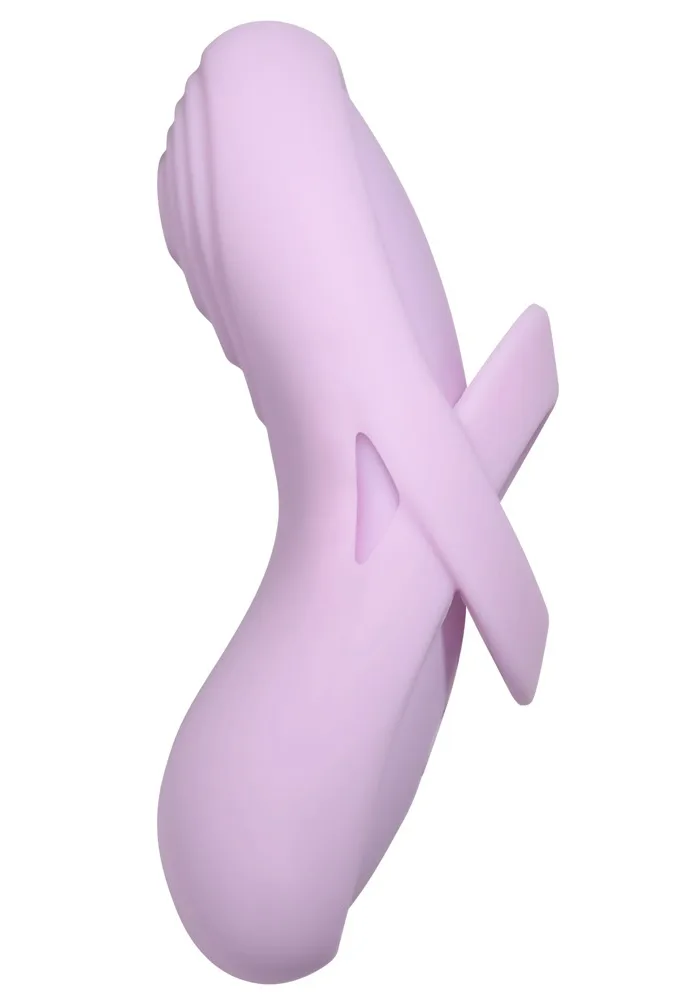
The construction of Echo 2 is two-part. The vibrator itself is a bent, tongue-shaped silicone body with a ridged head, and it can be used on its own as a classic lay-on vibrator placed directly against the skin. The second part is the removable finger sleeve with two loops and structured ridges on the outside. The manufacturer describes the order plainly in the instruction manual: the vibrator is inserted into the sleeve until it sits securely, the finger is slid in under both loops, and the ridges are used against outer parts of the body. To remove the vibrator, you press down the lower edge of the sleeve.
That means two products in one package in practice, and it’s the most underrated feature in the specification. With the sleeve on, Echo 2 is an extension of the hand, intended for foreplay and for keeping both hands free. Without the sleeve, it’s a small lay-on vibrator that stays in place against the body. The manufacturer also explicitly recommends using the heat function without the sleeve, which makes sense — the silicone sleeve sits between the heating element and the skin.
The material question is the only property of an intimate product that can’t be compensated for with experience or care, and it determines whether the product is still hygienic after five years. Svakom specifies a single material for Echo 2: liquid silicone, in English. That applies to both the vibrator body and the finger sleeve. No part of the specification mentions ABS or any other hard plastic, and that’s a real difference compared to models where only the contact area is silicone.
Liquid silicone is silicone that is injection-molded in liquid form and cures in the mold, unlike silicone that is pressed or extruded. For you as a user, the manufacturing method matters less than the basic property of the material: silicone is non-porous. A non-porous surface can be cleaned, because there are no microscopic cavities where residue can get trapped. That’s the single most important property of a material that should sit against mucous membrane.
Because both parts are silicone, there are two consequences. The first is that the finger sleeve can be stretched without cracking—which is why the loops can be elastic enough to fit different finger sizes. The second is hygienic: the sleeve can be removed completely and rinsed separately, which means there is no hard-to-reach seam between two parts where residue could collect. On a product with a fixed casing, it is precisely the seams that are the problem.
What the manufacturer, on the other hand, does not publish is any hardness specification in Shore A, and it also does not provide any material breakdown between the sleeve and the vibrator body. Joyland states in its specification table that the surface is ridged and silky-smooth, and that the hardness is medium, but it is a store claim and not a measurement value.
Phthalates are a group of plasticizers used to make plastic—especially soft PVC—flexible. The Chemicals Inspectorate describes them as substances that can affect the hormone system and make reproduction more difficult, and several of them are therefore restricted or banned in the EU in a large number of products. This particular product category is repeatedly subject to inspection because it contains skin-contact soft plastic.
Here, the wording has to be exact. Somebody at all writes that Echo 2 is made of liquid silicone free from harmful chemicals, but does not list phthalates, BPA, or latex by name on the product page. The user manual similarly states only that all Svakom products are made from body-friendly materials and that the products meet the EU’s RoHS requirements and the CE and WEEE directives. It is a weaker wording than the one several competitors use: We-Vibe, for example, states that Touch X is free from phthalates, BPA, and latex.
The retailer Joyland states in its specification table that it is phthalate-free: yes. That is a store claim, and it should be read as such—it does not carry the same weight as a commitment from the manufacturer. At the same time, it’s worth knowing that silicone by itself does not require phthalate plasticizers in order to become soft; the softness comes from the polymer’s own structure. The material statement silicone is therefore, on its own, a better indicator than terms like TPE or jelly rubber, which say nothing at all about which plasticizers are included.
Svakom lists the dimensions as 42 × 92 × 41 millimeters for the vibrator, and the weight as 56 grams. The manufacturer’s own size guide in the image gallery shows the same numbers measured on the product with the sleeve on: length 92 millimeters, width 42 millimeters as seen from the front, and 41 millimeters as seen from the side. Two of the shops repeat the measurements in their own tables—Intima lists the total length as 9.2 centimeters and the width as 4.2 centimeters, and Joyland lists the same length and width plus the weight of 56 grams. It’s unusual for the manufacturer and shops to be this consistent, and that makes the size information one of the safest in the entire walkthrough here.
Nine centimeters is short even for the category, and that’s the whole point: the product is meant to fit along a finger, not inside a hand. For comparison, We-Vibe lists 10.22 centimeters for Touch X and Fun Factory lists 7 centimeters for BE·ONE, which puts Echo 2 right in between the two. With a weight of 56 grams, the product doesn’t weigh down a toiletry bag in any significant way, and that’s presumably why Svakom markets it as a travel model with a travel lock.
Still, the weight information deserves a note, because the shops’ figures look different. Mshop lists 0.21 kilos and Taboo 240 grams in their product data. Both are shipping weights—that is, the entire shipment including cardboard, charging cable, storage pouch, and instruction manual—and they shouldn’t be confused with the product’s own weight. The manufacturer’s 56 grams refers to the vibrator, and it’s that number that describes what you’re holding in your hand. Mshop also lists the packaging dimensions as 15.0 × 8.0 × 6.5 centimeters, which is the only published information about the box size.
The shape is asymmetrical and curved like a shallow S-curve, with the ridged vibrator head at one end and the charging contact in the base. The curve means the contact surface points outward when your finger is positioned straight, which is the whole point of the design: you don’t need to twist your wrist to hit the right spot.
The interface consists of two buttons on the vibrator body: one for power and vibration, and one for heat. The instruction manual states exactly how they work. The product is turned on and off by pressing and holding for two seconds on the power button. A short press starts the vibration and steps upward through the five intensity levels from the lowest. A double press switches between the five vibration modes.
What can be established purely by numbers is that five modes times five intensities gives 25 combinations, and with the heat function’s independent on/off switching, that becomes 50. That’s fewer than on a premium model with fourteen steps, but clearly more than the typical mini vibrator with three fixed programs. That the intensity always starts at the lowest level after a restart is a safety detail worth knowing—the product can’t surprise you with full power when you turn it on.
The downside of two buttons and two scales is the same as always: the modes can only be reached in a loop. If you want to go back one step, you have to go around the loop. On a product with five modes, it’s less of an irritation than on one with fourteen, but it’s still there.
The heat function is the feature that most clearly distinguishes the Echo 2 from the category’s standard models. The manufacturer states that the heat is turned on and off with a two-second press of the heat button, that it sits in the vibration head, and that it reaches 38 degrees Celsius, corresponding to 100.4 degrees Fahrenheit. It’s a deliberately chosen number: 38 degrees sits just above normal body temperature—enough to feel warm against the skin without being anywhere near any risk of harm.
Two things in the manufacturer’s documentation are worth highlighting. The first is that the heat is independent of the vibration—it’s counted as a separate mode in the specification and can be used with or without vibration. The second is the recommendation in the instruction manual to use the heat without the finger sleeve for best results. This follows from the design: the sleeve is a layer of silicone between the heating element and the skin, and silicone conducts heat slowly.
What Svakom doesn’t publish is how long the warm-up takes or how much the heat function draws from the battery. The operating time of one and a half hours is stated without it being clear whether the heat is turned on or not. Assume that the stated operating time applies to vibration alone, because heating a metal element is the most energy-intensive function a product of this size can have, but treat it as a reasonable conclusion and not as a manufacturer claim.
Echo 2 can be paired with the SVAKOM app. The manufacturer states that the app provides access to a bonus program, the ability to create your own vibration patterns, synchronization with music or ambient sound, text chat, video calls, and shared remote control. The instruction manual repeats the same list briefly and refers to Svakom’s app page for the details.
The technical side is in the instruction manual’s specifications block, and there the information is precise: the radio works in the band 2400.0 to 2483.5 megahertz with a maximum transmitter power of +6 dBm, the product is equipped with FCC-ID 2A74F-SC511B, and Svakom provides an EU declaration of conformity according to the Radio Equipment Directive 2014/53/EU. The 2.4 gigahertz band and the +6 dBm power are a completely standard Bluetooth radio with short range.
It’s worth pointing out this against a store listing here. Joyland states in its table that the product is wireless via Bluetooth or WiFi. The manufacturer’s documentation describes only a radio, and it operates in the 2.4-gigahertz band with +6 dBm. So-called long-distance control in this product category always goes through the phone’s own internet connection, not through the toy’s radio. Practically speaking, that means your partner controls your phone remotely, which in turn controls the toy over Bluetooth — and the control therefore hinges on the phone’s connectivity, not on the toy’s.
Three small functions do more for everyday use than they can fit into the marketing. As described in the manual, the travel lock is activated by holding both buttons pressed for eight seconds when the product is turned off, until the lights blink. The same procedure unlocks it, and charging automatically unlocks the product. On a toy that is explicitly marketed as travel-friendly, this is a function you actually need — a vibrator that starts on its own in a bag is both embarrassing and a drained battery.
The memory function means the product starts in the most recently used mode. The intensity, however, always starts over at the lowest setting. It’s a well-balanced combination: you don’t have to look up your program again, but you also don’t get an unpleasant strength surprise.
The battery lights show the charge level in four steps according to the manual: one light up to 25 percent, two lights 25 to 50 percent, three lights 50 to 75 percent, and four lights 75 to 100 percent. While charging, they blink. Four steps is more information than most products in this price range provide — many settle for a single light that changes color.
Echo 2 has an unusual advantage here, and it’s worth lingering on. Most manufacturers in this category publish no sound measurement at all, and instead content themselves with wording like whisper-quiet. Svakom does both. On the product page, it says that the motor sounds less than an average phone call, which is marketing. In the specification block of the manual, however, there’s a figure: sound level up to 50 decibels.
Fifty decibels is a magnitude you can relate to. It’s in the same range as a quiet office room or a low-key conversation a few meters away, and clearly below a typical vacuum cleaner. What the manufacturer, however, does not state is at what distance, in which mode, or according to which method the value is measured — and that’s a real limitation: a decibel value without a measurement distance can’t be directly compared to another manufacturer’s number. Read it as a ceiling that Svakom is willing to stand behind, not as a measurement protocol.
A practical tip that applies regardless of model: place the product on a soft surface instead of on a hard tabletop. A tabletop works like a resonant box and noticeably amplifies the sound. On a product that lies against the body under a blanket, that effect is also almost gone, which is one of the reasons why small vibrators are experienced as quieter in practice than in product videos.
Svakom specifies the enclosure rating IPX7 for the Echo 2 on the product page and clarifies it as submersible to one meter. The rating comes from the international standard IEC 60529, which defines enclosure ratings for electrical equipment. The number 7 in the second position means that the product is tested for submersion in water to a depth of one meter for 30 minutes. The user manual is more concise and only states waterproof without an enclosure designation, but the product page’s job is the more precise of the manufacturer’s two.
The difference compared to a splash-proof product is larger than the wording suggests, and here’s the best possible example within the same brand. The first-generation Svakom Echo is described by the manufacturer as Splashproof, meaning it is only splash-protected. It can be wiped with a damp cloth, but it must not be submerged. Echo 2 is IPX7 and has that rating.
This isn’t a minor detail but one of the biggest practical differences between the two generations. With IPX7, you can rinse the entire product off under running water without needing to be careful about buttons and the charging connection, and it works in the shower and bathtub. With splash protection, you get a product that should be kept away from the water jet. If a product has no IPX information at all, treat it as not waterproof—an absence of a rating is never a sign that the product would be approved.
An important exception is stated in the user manual and applies to all waterproof products: it must not be cleaned or submerged in water under laddning. IPX7 applies to the closed product, not the product with a cable in the outlet.
The care section in the user manual is short and unambiguous: clean the product before and after each use with warm water and mild soap or a suitable cleaner for toys, rinse off and let it dry. Remove the finger sleeve and rinse it separately—that’s the only part with cavities where water and residue can be left standing.
The lubricant question has a single answer from this manufacturer: the only compatible lubricant is water-based. The instruction manual states plainly that silicone-based lubricants and other substances should not be used. The reason is material technology—silicone-based lubricant breaks down the silicone surface over time and makes it porous, and a porous surface can no longer be cleaned properly; it can only be replaced. Oil-based products such as coconut oil leave a film that is difficult to remove. This is also more than just advice: Svakoms warranty terms expressly exclude damage caused by lubricants that are not water-based and by improper cleaning.
According to the manufacturer, storage should be kept dry and protected from direct sunlight, as well as from extreme heat and cold. The instruction manual specifies an operating environment of between minus 10 and plus 50 degrees Celsius, which in practice rules out both boiling and using a dishwasher despite IPX7. A storage pouch is included in the delivery according to both the instruction manual and three of the shops.
Svakom specifies a lithium-ion battery of 350 mAh with a rated voltage of 3.7 volts and a charging voltage of 4.2 volts. The instruction manual specifies input data of 4.2 volts and 0.35 ampere. The operating time is given as 1.5 hours and the charging time as 1.5 hours—a notably even relationship that means the product charges about as quickly as it runs down.
With a cable that has a needle-hole contact on one end and USB-A on the other. The instruction manual describes the procedure: the needle-hole plugs are inserted into the product’s base and the USB-A connector into a power source. The product should be fully charged before first use.
A needle-hole contact is a trade-off, not a pure advantage. The advantage is the same as with magnetic charging: two small contact pins require no large opening in the housing, which makes it easier to achieve IPX7 without a rubber plug. The disadvantage is that the cable is product-specific. If you lose the charging cable, no regular USB-C cable will work—you’ll have to get a replacement. That’s a real difference compared to, for example, Fun Factory BE·ONE, which is charged with regular USB-C. And because the other end is also USB-A rather than USB-C, you’ll need an older charger or an adapter if all your wall chargers are modern.
Two instructions in the instruction manual are easy to miss and costly to ignore. The first: use only UL-certified or equivalent USB adapters with a 5-volt output, and do not use fast chargers or adapters with a higher output voltage. The second: unplug the charging cable from the power source directly after charging is finished. According to the same manual, the battery is not replaceable, and the product must not be taken apart.
Ninety minutes are short in absolute terms but reasonable in relation to the battery. With 350 mAh in a product that weighs 56 grams, it’s roughly what you can expect, and it’s significantly more than the first generation Echo, which is listed as 200 mAh and one hour. By comparison, We-Vibe states up to two hours for Touch X and Fun Factory 60 minutes for BE·ONE.
What generally applies to lithium-ion batteries also applies here: capacity drops with the number of charge cycles, the battery isn’t replaceable, and the product does best when it’s charged regularly rather than being stored fully discharged. The manufacturer itself writes in the user manual that the product should be charged regularly even when it isn’t being used. With use a couple of times per week, it’s the battery that sets the limit for lifespan—not the silicone—and since the cell is permanently soldered, the product is effectively used up when the battery is used up.
We do not have price data from shops in your market yet.
The store text describes the first Echo; the specifications box on the same page states Echo 2's EAN. When a store contradicts the manufacturer, the manufacturer wins.
Three comparisons are relevant: against the manufacturer’s own predecessor, against a more expensive premium product in the same area of use, and against the cheapest finger vibrator with published specifications. All information below comes from each manufacturer’s own product pages, and all Swedish prices come from the shops’ product feeds on September 12, 2026.
The first Echo is still in the manufacturer’s lineup, and the differences are significant enough that the two shouldn’t be confused. Echo is listed as ABS plastic, measures 87.9 × 38.9 × 30 millimeters, weighs 38 grams, has a polymer lithium battery of 200 mAh, a one-hour charging time, a one-hour operating time, five vibration modes, and the Splashproof enclosure rating.
So Echo 2 is heavier—56 grams versus 38—and a bit larger in every direction. In return, it swaps ABS for liquid silicone, splash protection for IPX7, 200 mAh for 350 mAh, and one hour for one and a half hours of operating time. It also adds five intensity levels in addition to the five modes, a heat function at 38 degrees, app control, travel lock, memory function, battery lights, and a removable finger sleeve that wasn’t on the predecessor.
It’s an unusually honest generation upgrade: every single line in the specification has been improved, and the two features that matter most for hygiene and lifespan—the material and water resistance—are the ones that have changed the most. If you see Echo and Echo 2 side by side at a similar price, there’s no reason to choose the first one.
We-Vibe Touch X is the obvious comparison among more expensive lay-on vibrators. It measures 10.22 × 4.33 × 3.43 centimeters, so it’s larger in every direction, and the manufacturer lists it as ABS and body-friendly silicone free from phthalates, BPA, and latex. It has seven vibration modes and eight intensity levels, an ingress protection rating IPX7, up to two hours of runtime, a 90-minute charging time via USB cable, a two-year warranty, and a list price of 99 euro.
Each of those lines can be set against Echo 2. Touch X has more programs — 56 combinations versus Echo 2’s 25 — and 30 minutes longer runtime. Echo 2, in turn, has a heat function that Touch X completely lacks, a removable finger sleeve, a published decibel value, and a significantly smaller body. In terms of materials, it’s tied in other ways than you might first think: We-Vibe explicitly states that the product is free from phthalates, BPA, and latex, but mixes ABS with silicone, while Svakom specifies silicone across the board but is more vague about which substances are excluded.
In practice, the price tag decides. Echo 2 costs from 495 SEK in Sweden. Touch X is listed by the manufacturer at 99 euro. If you want maximum runtime and the most programs, Touch X is the way to go; if you want heat, a finger sleeve, and the lowest price, it’s Echo 2 that does it.
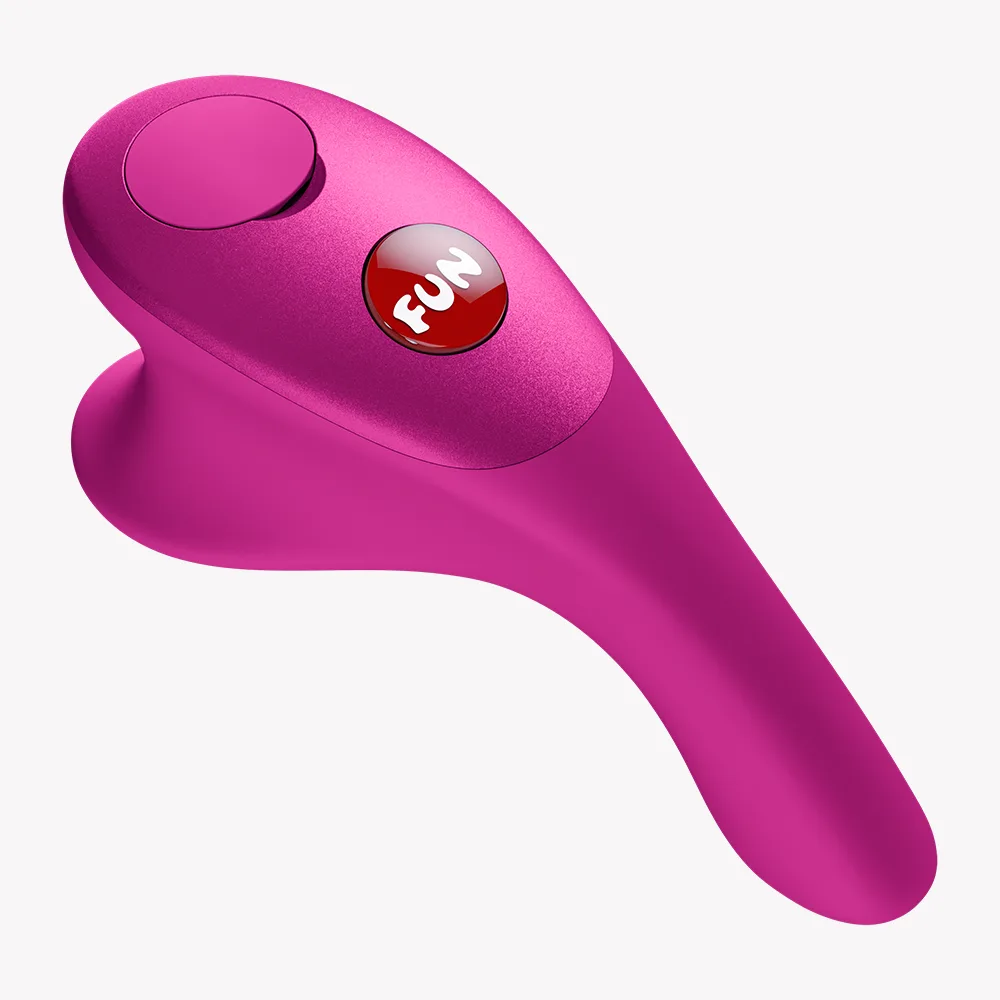
Fun Factory BE·ONE is the closest direct competitor, because it’s a finger vibrator and nothing else. The manufacturer lists the dimensions as 7 × 2 centimeters, the weight as 28 grams, four speeds plus one rhythm program, an ingress protection rating IPX7, charging via USB-C, and 60 minutes of runtime. Fun Factory’s list price is 33.95 euro.
BE·ONE is therefore half the weight and shorter; it charges with a completely standard USB-C cable, and it’s lower in price. Echo 2 counters with five modes and five intensity levels instead of four speeds and one pattern, 90 minutes of runtime instead of 60, a heat function, app control, a published sound value, and a removable finger sleeve with structured ridges.
The conclusion is that the two solve the same task in different ways. BE·ONE is the stripped-down, minimal finger vibrator, where the whole point is that you hardly notice it’s there. Echo 2 is a finger vibrator that also wants to be a lay-on vibrator, a heat product, and a plaything — and it pays for that with twice the weight and a charging cable you can’t replace at your nearest electronics store.
One thing in this review requires its own heading, because it affects what you read when you shop. Mshops’ description text for the article contains a set of details that don’t match the manufacturer’s specifications for Echo 2, but that remarkably well match the first generation Echo.
The store text states the dimensions as 88 × 39 × 30 millimeters — the manufacturer lists Echo as 87.9 × 38.9 × 30 millimeters, and Echo 2 as 42 × 92 × 41. The store text states the material as body-friendly ABS — Echo is ABS, and Echo 2 is liquid silicone. The store text states the operating time as up to one hour — Echo is listed as one hour, and Echo 2 as one and a half. The store text states ten intensity modes — the manufacturer lists five modes and five intensities, meaning 25 combinations. The store text also states IPX7 for the product it describes, which doesn’t even match Echo: the manufacturer lists it as only splash-proof.
The rule when a store contradicts the manufacturer is simple: the manufacturer wins. The store’s own specification box on the same page lists EAN 6959633105245 and a delivery contents that includes removable finger protection and a storage pouch, which corresponds to Echo 2. The item that is shipped is therefore very likely the correct product; it is the sales text that has been left over from the older model. But if you read that text and buy based on it, you’re buying on the wrong assumptions — and that’s exactly why the specification in the table further down only contains values that the manufacturer itself publishes.
A small deviation of the same kind is found with Joyland, which states wireless connectivity via Bluetooth or WiFi. The manufacturer documents only a radio in the 2.4-gigahertz band with a +6 dBm transmitter power. It isn’t wrong in practice — long-distance control works — but it goes through the phone’s connection, not through the toy’s.
Five Swedish stores sell the item with EAN 6959633105245. The cheapest is Joyland at 495 SEK, and the most expensive is Intima and Taboo at 699 SEK each. That’s 204 SEK, or a 41 percent difference, for the exact same item number, the same color, and the same packaging.
The stock situation is unusually good for this category. Four of the five stores had the product in stock at the price check — only Taboo didn’t. That means that the lowest available price actually is 495 SEK, and that the difference up to the second-lowest available store price, Vuxen at 519 SEK, is only 24 SEK. Intima also stated at the check that only two units were left, which is worth knowing if that’s the store you preferably shop at.
The price spread is not because any store sells a different variant. The manufacturer’s variant data, Mshop’s specification table, and Taboos’ own product data all point to the same barcode for the pink variant, and Vuxen lists it under its own item number E35826 with the same color designation Pink Lilac. So this is all about the stores’ own margin setting. Vuxen itself states a recommended price of 659 SEK and sells for 519, which suggests where the list price sits and how much the stores choose to go under it.
The prices in the table above are updated when the stores’ product flows are updated, but always check the final price at checkout. Shipping costs are added by most stores under a certain order value, and in this price range all five are under the threshold for free shipping—so shipping of a few tens of SEK can change the order between the two cheapest.
It’s for you if you want stimulation with fingertip precision rather than with a handle, and for you if you want a product that works both on its own and together with someone else. The finger sleeve makes it a foreplay product in a way a regular vibrator isn’t, because your hand is still a hand. It’s for you if you want heat—38 degrees is a feature that isn’t found on either We-Vibe Touch X or Fun Factory BE·ONE. It’s for you if you want to be able to rinse off the entire product under running water, and for you who travel and want a travel lock that can actually be activated.
It’s not for you if you want the most possible power. Nine centimeters of silicone with a 350 mAh battery is, by definition, not a massaging wand, and the person who knows that it takes a lot to be enough should look at a larger product. It’s not for you if you want to charge with the same cable as your phone—the pinhole connector is product-specific, and the USB-A end is also a generation old. It’s not for you if you require the manufacturer to list phthalates, BPA, and latex by name, because Svakom only states that it is free from harmful chemicals. And it’s not for you if you want a long runtime without having to think about charging, because 90 minutes is on the low side compared with the category’s best.
One more thing belongs in the decision. Echo 2 is designed as a complementary product, not as the only toy in the box. The size, the heat function, and the finger sleeve all point in the same direction: this is something you use during foreplay or take with you on a trip, not something that replaces a main product. If you see it as a complement, the price tag of 495 SEK is reasonable. If you see it as a replacement for a larger vibrator, you’re going to be disappointed with the power.
Svakom provides a two-year warranty against manufacturing defects, calculated from the date of purchase, plus ten years of quality support. Quality support is not an extended warranty but something else: the manufacturer states that after the two warranty years you get a 50 percent discount on your next purchase if the product breaks or loses functionality. It’s a loyalty benefit, not a right to have the product repaired or replaced, and it’s important to read this.
Read the exclusions before you count on the warranty. It does not cover damage caused by lubricants that are not water-based, damage from improper cleaning, submersion of products that are not waterproof, or your own attempts to take it apart. Svakom also states that the warranty only applies to purchases from the manufacturer itself or from an authorized retailer—purchases from unauthorized sellers are not covered. To make a claim, the serial number is required, which according to the manufacturer is on the packaging above the barcode, along with the original receipt.
So save the box, or at least photograph the serial number before you throw it away. It’s one of the very few concrete actions that can actually determine whether a warranty can be used or not, and it takes ten seconds.
What always applies is your statutory rights. Under the Swedish Sale of Goods Act (Konsumentköplagen), you have a right to complain for three years if the item has a defect, regardless of what the manufacturer promises—so it’s longer than Svakom’s own two-year warranty. For distance purchases, you also have a right of withdrawal for fourteen days under the Act on Distance Contracts and Contracts Outside Business Premises. Be aware that, in practice, the right of withdrawal is limited for hygiene products that have been taken out of a sealed package—however, the right to complain for defects always applies. If you have questions about what applies in your case, Konsumentverket guides you via Hallå konsument.
Svakom Echo 2 is ranked etta av 14 in mini vibrator best i test, where the entire category is compared against each other using five shared criteria.
Every numerical piece of information in the text can be traced to one of the sources below. The links were checked manually on the specified date.
This page is machine-translated from Swedish. Read the Swedish original