

Review
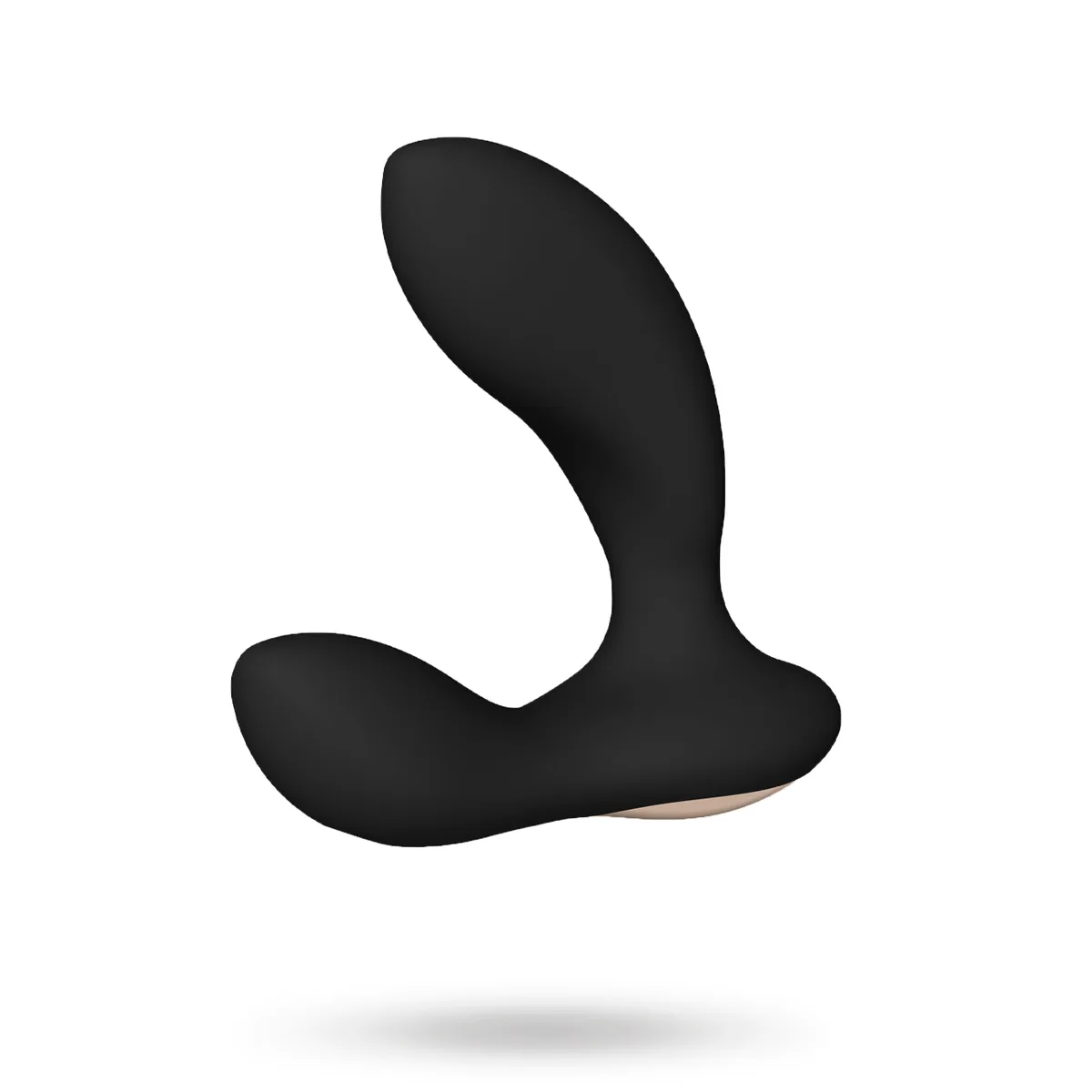
Review: Lelo Hugo 2
The premium option with a shorter insertion part and ISO 3533 certification.
29 July 2026
 Best budget
Review · Prostate vibrator · Two motors · App-controlled
Svakom’s app-controlled prostate vibrator reviewed against the manufacturer’s own manual and price data from seven Swedish stores. Two independent motors, insertion dimensions 100 × 31 mm, 550 mAh polymer lithium, 1.5 hours of runtime and a two-year warranty — plus an incorrect specification table on the manufacturer’s own product page that we sort out figure by figure.
Most battery and the most documentation per krona in the comparison: two independent motors, 550 mAh, 1.5 hours of runtime, and published values for sound level, voltage, current, and the radio module — up to 340 SEK less than Lelo Hugo 2 and 504 SEK less than Lovense Edge 2. What you pay with is a manufacturer website page whose spec table is directly incorrect, an enclosure class that only appears in a marketing image, and a charging cable that can’t be replaced with a regular USB cable.
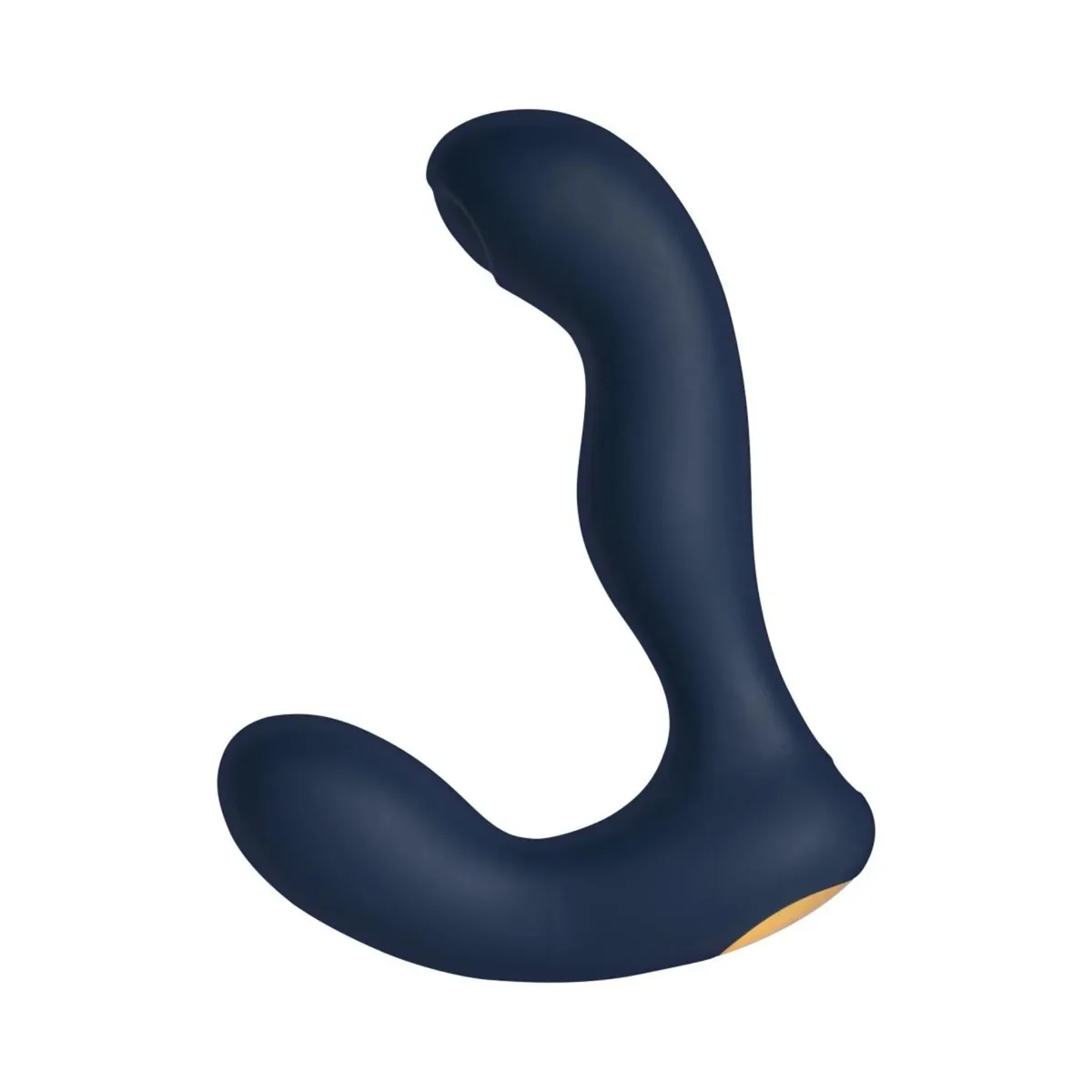
Svakom Iker Neo is an app-controlled prostate vibrator with two separate motors. One is located in the head of the shaft and directed toward the prostate, and the other is in the outer arm that rests against the perineum. It’s this design that gives the product its name line: Svakom markets it as a pulsing prostate vibrator, where the shaft delivers pulses and the arm delivers vibration, and where the two can be run either separately or simultaneously.
The manufacturer’s specifications look like this: dimensions 101 × 135 × 33 millimeters, insertion dimension 100 × 31 millimeters, weight 135 grams, a polymer lithium battery of 550 mAh, 1.5 hours charging time, 1.5 hours operating time, five modes and five intensity levels for each vibration and pulsing, a sound level of at most 60 dB, and a two-year warranty with ten years of quality support on top. The material is listed as liquid silicone and ABS plastic. The product code is SG574A, and the only color is Navy Blue.
This review is about the item with EAN 6959633105313. The number is checked in the page source on Svakom’s own product page, where the variant’s barcode field contains exactly that number linked to item number SG574A. In Sweden, the item is sold by seven stores at prices between 591 and 959 SEK, and six of them had it in stock at the price check.
One thing has to be said right away, since it affects everything else in this text: the specification table on Svakom’s own product page for Iker Neo is incorrect. It’s titled "Product Name: Candy" and lists the dimension Φ156x40.5mm, the weight 124 grams, the battery 300 mAh, and the charging time 40 minutes. None of those figures match the manufacturer’s own manual. We’ll get into how it can be proven further down — all the values in this text are taken from the manual and from the printed table on the back of the package, and they are consistent with each other.
The two-motor construction is the most important technical difference between a simple anal plug and a prostate vibrator in this category. The prostate is located a few centimeters in toward the abdominal wall, while the perineum — the area between the scrotum and the anus opening — is accessible from the outside. The prostate can be reached from both directions, and a product with two motors can therefore work toward the same gland from two directions at the same time.
The manufacturer explicitly states that the motors are independent: the shaft is driven by pulsation, the outer arm by vibration, and they each have their own button. The manual describes the positioning straight out—the head of the shaft is directed toward the prostate, and the outer stimulator is placed against the perineum. In practice, that means three ways to use it: only inside, only outside, or both at the same time with different intensity on each side.
The difference between vibration and pulsation is worth understanding before you pay for it. Vibration is a fast, continuous swinging motion that propagates through the material. Pulsation is slower and works in clearly defined impacts. What you can establish technically is that the two types of stimulation are experienced differently on the mucous membrane precisely because the frequency differs—and that a product that has both offers more combinations than one that has only one. Five modes times five intensities on each side gives 25 mode combinations per motor, and since the motors are independent, you can combine them freely with each other.
The neck between the shaft and the base is flexible. The manufacturer describes it as a flexible arm that adapts to the body. It’s a genuine design advantage in this product category, because the distance between the anal opening and the perineum varies between bodies—a rigid design either sits correctly or not at all, while a flexible neck provides a range. Svakom does not publish how big that range is in millimeters.
Svakom’s naming makes it easy to buy the wrong product, because several models are close to each other in the range and the shops often shorten the names.
Practical advice: never go by the model name in the store text. Check the EAN or the article number. Iker Neo has EAN 6959633105313 and product code SG574A, and that designation appears both in the manual, in the CE certificate, and in the FCC registration.
The material question is the only property of an intimate product that can’t be compensated for with habit or care, and for an anal product it weighs more than for most other categories—the rectal lining absorbs substances faster than skin, and the product is intended to be inserted.
The manual lists two materials: Liquid Silicone and ABS Plastic. It’s the same material combination that Lelo specifies for the Hugo 2, and it’s standard in this price range. In practice, the split is always the same: the silicone sits on the outside and meets the body, while the ABS plastic is inside as the supporting frame that holds buttons and electronics.
Silicone is a non-porous material. A non-porous surface can be cleaned, because there are are no microscopic cavities where residues can remain. It’s the single most important property of a material that is meant to lie against mucous membrane. The term “liquid silicone” refers to the manufacturing method—liquid silicone rubber is injection-molded instead of pressed—and it provides a more even, seamless surface without casting seams. The manufacturer’s own product graphics use the wording “premium medical-grade silicone,” which is a marketing term without a defined standard behind it and therefore shouldn’t be read as a classification.
Including ABS plastic is not a drawback as long as it sits inside. What would be a problem is hard plastic in the contact area, and there’s nothing to suggest that: the entire insertable part and the perineum arm are silicone-coated in the manufacturer’s own images. The only visible hard detail is the two poles of the charging connector in the base.
Phthalates are a group of softeners used to make plastic—especially flexible PVC—pliable. Kemikalieinspektionen describes them as substances that can affect the hormone system and make reproduction more difficult, and several of them are therefore restricted or prohibited within the EU. This product category is repeatedly subject to oversight because it contains flexible plastic against mucous membrane.
Here it’s possible to be more specific than usual, because Svakom publishes the underlying testing documentation. A Verification of Conformity issued on 10 December 2024 states product Iker Neo, brand SVAKOM and model SG574A, and concludes that the test results meet the RoHS directive 2011/65/EU Annex II with amending directive (EU) 2015/863. The testing is done according to the IEC 62321 series and has a traceable test report number. The amending directive 2015/863 is exactly what expanded the RoHS list with four phthalates, which makes the certificate relevant to the material question and not just heavy metals.
Be precise about what this means. RoHS is a directive for electrical and electronic equipment, not a skin-contact standard, and the certificate applies, according to its own text, only to the tested specimen and the tests that were carried out. Otherwise, the manual settles for the general wording that all Svakom products are made from body-friendly materials. Svakom does not publish any explicit declaration that the product is free from phthalates, BPA, or latex—in contrast to, for example, Womanizer and Satisfyer, which state it directly. A test certificate for RoHS is stronger evidence than a marketing statement, but it’s not the same thing as a materials declaration, and the difference is worth knowing.
The manual gives the dimensions as 101 × 135 × 33 millimeters and the insertion dimension as 100 × 31 millimeters. The weight is 135 grams. The same values are printed on the back of the packaging, which is the best kind of confirmation you can get: two of the manufacturer’s own documents that say the same thing.
Here’s how the numbers should be read. 135 millimeters is the product’s total length viewed straight from the front, 33 millimeters is its width in the same view, and 101 millimeters is how far it extends in depth when the perineum arm is included. The insertion dimension 100 × 31 millimeters is what actually matters when buying: a ten-centimeter insertion depth and a maximum diameter of 31 millimeters. The manufacturer’s dimension graphic shows 30 millimeters in one place instead of 31—an offset of one millimeter between the graphic and the manual, which lacks any practical significance but is worth noting for anyone comparing tables.
Comparing it with the competitors makes the dimensions easier to understand. The Lelo Hugo 2 has an insertion part of 72 millimeters, the Lovense Edge 2 has 91 millimeters, with a maximum diameter of 35 millimeters. That means Iker Neo is the deepest of the three in insertion depth and in the middle in diameter. It’s a product for someone who’s already used to anal stimulation—ten centimeters isn’t a beginner measurement, and the manufacturer also markets it to intermediate to experienced users.
At a weight of 135 grams, it falls between the Hugo 2 at 121 grams and the Edge 2 at 151.3 grams. In practice, it’s essentially the same weight class for all three, and the difference is hardly noticeable. What you do notice, though, is that a product that needs to stay in place requires a certain amount of weight in the base so it doesn’t glide—and that the entire battery, all 550 mAh of it, sits in the base under the perineum arm.
The interface consists of two buttons, one per motor. The manual describes them unambiguously: one controls the vibration in the perineum arm, the other the pulsing in the shaft’s main body. Both buttons can start and turn off the product, and both do it the same way—a press for two seconds.
After that, there’s a simple pattern. A short press increases the intensity by one step from the minimum and cycles through within five levels. A double-press changes the position, also within five options. A colored position-indicator light on the product changes color when the position changes—this is the only feedback on where you are. The product has no display.
What makes the construction above unusually easy to learn is that both buttons do exactly the same thing on their respective motor. So you don’t need to learn two interfaces—just one—and apply it twice. It’s a clear advantage compared with products where a single button has to step through all combinations in one long chain.
This is the most common mix-up in this product category, and store texts rarely help. A mode is a pattern—the rhythm of how the motor turns on and off over time. An intensity is the strength of that pattern. They’re two independent controls, just like tempo and volume on a music setup.
The manufacturer states five modes and five intensity levels for vibration, and five modes and five intensity levels for pulsation. That gives 25 combinations per motor. Since the motors run independently of each other, a store text that writes “5 modes” grossly underestimates the product, while one that writes “10 modes” has added up two scales that don’t belong together. The correct way to express it is exactly how the manufacturer does it: 5 (vibration); 5 (pulsation).
A pattern that applies across the entire product category is worth keeping in mind: the lowest steps are clearly separated, while the top ones are closer together, because the effect difference per step decreases as the motor approaches its limit. With five steps instead of fourteen, each step is bigger, which is an advantage if you want to find the right setting quickly and a disadvantage if you want fine-tuning. If you want fine-grained adjustment, it’s the app that matters, not the buttons.
Two functions in the manual deserve more attention than they usually get in store texts.
The memory function makes the product start in the mode that was used last before it was switched off. The intensity, however, always starts over at level 1. It’s a well-thought-out combination: the pattern you liked remains, but the strength doesn’t, which means the product never starts more intensely than you’re prepared for. For an anal product, it’s more of a safety detail than a convenience.
Travel lock prevents the product from turning on in your bag. The manual states the procedure exactly: the product must be switched off, then you press and hold both buttons until the lights blink. The same procedure unlocks it again. One detail that’s easy to miss and that saves a trip: charging automatically unlocks the product. So if you don’t remember the button sequence, it’s enough to plug in the charging cable.
The product connects via Bluetooth to a smart device. The manual lists three platforms: Svakom’s own app, which provides preset functions, your own settings, and control at short and long range, with the option to hand over control to a partner; FeelConnect 3, which synchronizes the product with interactive video content; and FeelPerformer.com, for synchronization with interactive webcam platforms.
The radio part is unusually well documented for this product class. The manual states the operating frequency as 2400.0–2483.5 MHz—i.e., the usual 2.4 GHz band—and a maximum transmitter power of +6 dBm. FCC ID 2A74F-SG574A also makes it possible to look up the radio approval in the authority’s register. It’s more radio information than most manufacturers in the category publish.
Two things the app can’t solve should be said plainly. The Bluetooth range applies only in the same room; long-distance control takes place over the internet via the app and requires that both parties have the app running. And no manufacturer, Svakom included, guarantees how long an app is supported—so an app-controlled product always has a lifetime risk that a button-controlled one doesn’t. That speaks in favor of the Iker Neo: both motors can be run fully from the buttons without a phone. The app is an add-on, not a requirement.
Svakom states a sound level in the manual’s specification table: at most 60 dB. It deserves praise already because the figure is published at all—several of the biggest brands in the category publish no sound level at all for their products.
But the value should be read for what it is. It’s an upper limit value, not a measurement under specified conditions, and the manufacturer states neither the measurement distance, which position the measurement refers to, nor which weighting filter was used. Without measurement distance, a decibel value can’t be compared meaningfully between products, because sound pressure decreases quickly with distance.
The comparison with the competitors shows how little this kind of statement says. Lelo lists "under 60 dB" for Hugo 2—so it’s the same ceiling value, with the same lack of measurement conditions. Lovense goes further and states 43 dB for Edge 2 in a comparison graphic against 40 dB library noise and normal conversation at 60 dB. You can’t conclude that Edge 2 would be audibly quieter than Iker Neo from this, because one is a ceiling value and the other is an alleged typical value. The only thing you can establish is that Svakom and Lelo list identical ceiling values, and that Lovense is the only one of the three that gives a single-point number.
A practical tip that applies regardless of the model: place the product on a soft surface between uses. A hard tabletop works like a resonance box and noticeably amplifies the sound. Under a blanket, the difference between 43 and 60 dB matters far less than the numbers suggest.
There is a contradiction in the manufacturer’s own material that the buyer should know about.
Svakom’s product image in the gallery states "100% Waterproof (IPX7)" in large letters. But the manual’s specification table under the heading Waterproof Level states only the word "Waterproof", without an IP rating, and the same applies to the printed table on the back of the packaging. The IPX7 enclosure class therefore appears only in the marketing graphic—never in the technical documentation.
Why it matters: IPX7 is a defined test under the international standard IEC 60529 and involves immersion in water to a depth of one meter for 30 minutes. The word "waterproof" without a number, on the other hand, corresponds to no test at all—it’s a statement, not a classification. When a company lists the class in an image but omits it from the manual, it’s reasonable to treat the technical documentation as authoritative and the marketing image as an interpretation.
Practical conclusion: the product will most likely handle showering, baths, and rinsing under running water—the entire design with magnetic charging without an opening in the housing points in that direction, and the manual explicitly instructs cleaning with warm water. But if you require a verified IPX7 rating in the technical documentation, you won’t find it here—instead, for example, Lovense Edge 2 states IPX7 outright. The manual also includes a warning that applies absolutely regardless of classification: the product must never be submerged in water while charging.
The manual’s instructions are short and clear. Clean the product before and after each use with warm water and mild soap, or a cleaning agent intended for intimate products. Rinse off and let it dry. For an anal product, cleaning before use is just as important as after, because dust and particles from storage otherwise get carried inside.
The lubricant question has a clear answer in the manual: the only compatible lubricant is water-based. Silicone-based lubricants and other substances must not be used. The reason is chemical—silicone-based lubricant breaks down the silicone surface over time and makes it porous, and a porous surface can no longer be cleaned properly; it can only be replaced. Oil-based products like coconut oil also leave a film that is difficult to remove. For anal use, the general advice also applies to using plenty of lubricant and reapplying it, since the rectum has no lubrication of its own.
Store the product dry, dark, and cool, without direct sunlight, extreme heat, or extreme cold. A storage pouch is included in the package together with the product, the charging cable, and the manual. Do not let the silicone sit in direct contact with other silicone toys for long periods—different silicone compounds can react with each other and create a sticky surface.
The manual also covers the temperature limit, which is rarely stated in store texts: the operating environment is specified as 0–45 °C. Boiling water and a dishwasher are therefore out of the question regardless of how water-resistant the product is. The manual also advises against sharing the product with others due to the risk of infection, and against continuing to use it if you notice cracks or other material degradation.
Svakom publishes more battery data than most in the category, and it’s one of the most concrete advantages of the product’s documentation. The manual states the capacity as 550 mAh, the type as polymer lithium, the rated voltage as 3.7 volts, the rated charging voltage as 5 volts, and the input current as 0.4 amps. The charging time is given as 1.5 hours and the operating time as 1.5 hours.
Publishing the capacity makes it possible to make a comparison that would otherwise be impossible. Lelo states 420 mAh for Hugo 2 and an operating time of up to one hour. So Iker Neo has a 31 percent larger battery and a 50 percent longer stated operating time. Lovense states for Edge 2 an operating time of 65 to 130 minutes depending on intensity—which is the most honest wording of the three, because it admits that the operating time depends on how hard you run it. Svakom’s and Lelo’s only numbers should be read as a specification example, not as a guarantee at the highest level with both motors running.
With two motors that can be run simultaneously, it’s reasonable to expect a shorter runtime than 1.5 hours at full power on both. The manufacturer does not state how this information is measured or under what load, and Svakom does not publish any separate runtime for the mode where both motors are run at the same time.
Charging happens via a magnetic charging cable that attaches to two poles in the product’s base and connects to a USB-A port. The cable is included in the package. The manual also states that the product should be charged fully before first use.
Magnetic charging is a trade-off, not a pure advantage. The advantage is that no opening in the casing is needed, which is a requirement for a product of this kind to be waterproof without a rubber plug that wears out. The disadvantage is that the cable is product-specific: if you lose the charging cable, no regular USB-C cable works, so you have to get a replacement. Svakom’s warranty terms also explicitly exclude accessories such as charging cables, so a broken cable is always your own cost.
The manual is unusually strict on one point that’s worth taking seriously: only use UL-certified or equivalent USB chargers with a 5 volt output, and do not use fast chargers or adapters with a higher output voltage than 5 volts. Many modern phone chargers deliver a higher voltage. The product draws 0.4 amps at 5 volts, i.e., about 2 watts—this is a very small load, and an old phone charger or a USB port on a computer is exactly what the manufacturer intends. Unplug the cable from the wall outlet as soon as charging is complete, too.
The product has four battery lights, and the manual states exactly what they show: one light means up to 25 percent, two lights 25–50 percent, three lights 50–75 percent, and four lights 75–100 percent. Flashing lights mean charging is in progress.
It’s a small thing that makes a big difference compared with the many products in the category that only have a single light that turns red or green. With four steps, you know whether you have half the battery left or almost nothing, and that is exactly the information that determines whether you need to charge before and not after.
The general rule also applies here: the battery is of the lithium polymer type and, according to the manual, is not user-replaceable, and the manufacturer explicitly warns against trying to take the product or the battery apart. Capacity drops with the number of charge cycles. The manual recommends regular charging even when the product is not being used, which is good advice for lithium cells—they do worst when left completely discharged for a long time. With use a couple of times a week, it’s the battery, not the silicone, that sets the limit for service life, and since the cell is permanently soldered in place, the product is, in practice, used up when the battery is.
We do not have price data from shops in your market yet.
The specification table on the manufacturer’s own product page is titled “Product Name: Candy”. The correct battery capacity is 550 mAh, not 300.
This section is about a documentation error on the manufacturer’s part, and it affects every price service and every store text that pulls its data from Svakom’s product page.
On svakom.com/products/iker-neo, there’s a block labeled SPECIFICATIONS. The first line in that block reads "Product Name: Candy" — not Iker Neo. After that, the block lists the measurements Φ156x40.5mm, the weight 124 grams, the battery 300 mAh, the charging time 40 minutes, 5 vibration modes, and 3 so-called "grasping modes". A product with a grasping function is not a prostate vibrator, and the measurement Φ156x40.5mm describes a straight, cylindrical shape—not the angled construction that Iker Neo has.
That this is a template error and not a variant can be demonstrated. The exact same block, word for word and number for number, is also on Svakom’s product page for Iker—another product with a different article number. The same spec table cannot describe two different products, and it obviously describes neither of them.
What applies instead is unambiguous, because two independent documents from the manufacturer say the same thing. The manual SG574A_IKER_NEO.pdf, which is linked from Svakom’s own download page, states 101 × 135 × 33 millimeters, 135 grams, 550 mAh, and 1.5 hours of charging time. The printed table on the back of the packaging gives exactly the same values. Those are the figures used in this text, and those are the ones you should go by.
The consequence for you as a buyer is concrete. If you see a store or a comparison site that lists 300 mAh, a 40-minute charging time, or a weight of 124 grams for Iker Neo, then that site has copied Svakom’s incorrect web table. It’s not another variant and not a newer revision—it’s wrong data. The correct battery capacity is 550 mAh, so almost twice as much, and the correct charging time is 1.5 hours, so more than twice as long.
Three comparisons are relevant: versus the premium alternative from Lelo, versus the most app-controlled alternative from Lovense, and versus Svakom’s own previous model. All the information below comes from each manufacturer’s own specifications, and all prices come from the stores’ product feeds on 29 July 2026.
Lelo Hugo 2 costs from 931 SEK, i.e., 340 SEK more than Iker Neo at its lowest price. That’s a price difference of 58 percent. Both are app-controlled prostate vibrators with two motors; both are silicone and ABS plastic; and both come from established brands, with a two-year warranty plus a ten-year quality-support program.
The specifications differ in three points that matter. The battery: Hugo 2 has 420 mAh versus Iker Neo’s 550 mAh, and a runtime of up to one hour versus 1.5 hours. The charging time is up to two hours versus 1.5 hours. The insert part: Hugo 2 has 72 millimeters versus Iker Neo’s 100 millimeters, meaning a significantly shorter product. And the overall size: 104 × 107 × 41 millimeters versus 101 × 135 × 33 millimeters—Hugo 2 is wider but shorter.
What Hugo 2 adds, however, is not trivial. Lelo states ten settings, four of which are on the toy and six are added via the app, and the company publishes a certification against the international safety standard ISO 3533 for sex toys—something Svakom does not do for Iker Neo. Lelo’s ten-year quality guarantee works the same way as Svakom’s, with a discount in the manufacturer’s own store rather than a replacement product.
The conclusion is that Hugo 2 is mainly bought for its shorter insert part and for Lelo’s documented standard work, while Iker Neo wins on battery, runtime, charging time, and price. If you want a smaller product, then Hugo 2 is worth the money. If you want more battery for less money, it isn’t.
Lovense Edge 2 costs from 1,095 SEK, meaning 504 SEK more than Iker Neo. That’s an 85 percent markup. Conceptually, the two products are closest to identical: app-controlled prostate vibrators with two separate motors, a flexible neck, and magnetic charging.
Edge 2 weighs 151.3 grams versus 135 grams, has an insert part of 91 millimeters versus 100, and a maximum diameter of 35 millimeters versus 31. So it’s shorter and thicker. The runtime is stated as 65–130 minutes depending on the level, the charging time as about 100 minutes. The sound level is stated as 43 dB, versus Svakom’s top value of at most 60 dB.
Two differences are decisive. The first is the enclosure class: Lovense states IPX7 plainly, Svakom only "Waterproof" in its technical documentation. The second is the warranty, and there it goes the other way: Lovense offers a one-year warranty, Svakom two years. Edge 2, in return, has an app ecosystem with an unlimited number of patterns and more developed remote control, while Svakom’s five modes per motor are a fixed number.
Calculated per SEK, Iker Neo is clearly the better deal. Calculated on the documentation’s precision—published IP class and published sound value—Edge 2 is better. Calculated on the warranty, Svakom wins with the doubled time. It’s rare to see three criteria point in three different directions so clearly.
The odd comparison is against Svakom’s own previous model. Iker without the Neo add-on is sold in Sweden starting from 712 SEK, i.e., 121 SEK more than Iker Neo at its lowest price. It’s unusual for the successor to be cheaper than the predecessor, and that’s because pricing here is determined by which store happens to have which item—not by the product’s age.
Unfortunately, it’s not possible to make a value-for-value comparison, because Svakom’s product page for Iker shows the same incorrect “Candy” table as the Iker Neo page. So the only information you can rely on for Iker is what’s stated in that model’s own manual, which is a different document. The practical conclusion is simple: when the newer model with two documented motors, 550 mAh, and a published noise level costs less than the older one, there’s no argument for choosing the older one.
Seven Swedish stores sell the item with EAN 6959633105313. Cheapest is Joyland at 591 SEK, most expensive is Lustly at 959 SEK. That’s 368 SEK, or a 62 percent difference, for exactly the same item number, same color, and same packaging.
The mid-tier is strikingly consistent. Four stores—Vuxen, Mshop, Blush Me and SexleksakerOutlet—are all at exactly 795 SEK, which usually means they’re based on the same suggested distributor price. Joyland’s 591 SEK stands out, sitting 204 SEK below that level—so that’s where you should start.
The stock situation is unusually good for this category. Six of seven stores had the product in stock at the price check—the only one without stock was Taboo at 899 SEK. That means the price comparison is actually useful: the cheapest store is also a store that can deliver, which is far from always the case.
Finally, a reference point that puts the Swedish prices into perspective. The manufacturer’s own list price in its own web shop is 99.00 US dollars. So Joyland’s 591 SEK is below what the manufacturer itself charges, which is a good sign that the Swedish retail market competes on this item number. Still, always check the final price at checkout—shipping costs are added at most stores under a certain order value, and in this price range several stores are below the threshold for free shipping.
It’s for you if you’re already used to anal stimulation and want two independent motors to control separately. The insertion measurement of 100 × 31 millimeters is mid-range to advanced, not a beginner measurement, and a ten-centimeter insertion depth assumes you know how your body reacts. It’s for you if you want app control and the ability to hand over control remotely, but you don’t want to be dependent on a phone in order to use the product at all—both motors can be run fully using the buttons.
It fits you if you value documentation. With published battery capacity, rated voltage, input current, radio frequency, transmitter power, FCC ID, and a RoHS testing certificate tied to the model designation, Iker Neo is better documented than most products in the price range. And it fits you if you look at price versus performance: 591 SEK for two motors, 550 mAh, and a two-year warranty is hard to beat when the nearest competitors cost 931 and 1,095 SEK respectively.
It doesn’t fit you if you’re new to anal toys—you should start smaller and without motors. It doesn’t fit you if you require an enclosure class in the technical documentation, because the manual only states "Waterproof" and IPX7 only appears in a marketing image. It doesn’t fit you if you want an explicit phthalate-free declaration from the manufacturer, because Svakom does not publish one for this model. It doesn’t fit you if you want to charge with the same cable as your phone—the charging cable is magnetic, product-specific, and excluded from the warranty. And it doesn’t fit you if you want fine-tuned adjustment directly on the product: five intensity levels are fewer than on several competitors, and the fine-tuning is in the app.
One more thing belongs in the decision. The runtime of 1.5 hours applies according to the manufacturer’s only stated value, with no information about load. With two motors running at the same time on high settings, you should expect less. It’s rarely a problem in practice, but it’s worth charging earlier rather than later—and the battery lights in four steps make that easy to keep track of.
Svakom provides a two-year exchange warranty against manufacturing defects, counted from the date of purchase. Both the the manual and the manufacturer’s warranty page state the same period. On top of that, there is a ten-year quality support, but read what it actually is: after the first two years, if there’s a fault it won’t be a new product—there will be 50 percent off the next purchase in Svakom’s own web store. It’s a discount coupon, not a warranty, and it’s the same setup that Lelo uses.
Read the exceptions before counting on the protection. The warranty only covers manufacturing defects and does not apply to damage caused by lubricants that are not water-based, by improper cleaning, by submerging a product in water that it can’t handle, or by attempts to take the product apart. Accessories such as charging cables are explicitly excluded. Coverage also applies only to products purchased directly from svakom.com or from official retailers—purchases from unauthorized marketplace sellers are not covered.
Two practical details from the terms are worth saving. The serial number, which is required for a warranty claim, is printed on the packaging and normally just above the barcode—so save the box or photograph the label. And then, as of May 9, 2022, no registration of the product is required for the warranty to apply, even though the manufacturer still recommends it so the case can be processed faster.
What applies, on the other hand, is always your statutory rights, and in several respects they are stronger than the manufacturer’s promises. Under the Swedish Consumer Sales Act (konsumentköplagen), you have three years of right to complain about defects in the goods, regardless of what Svakom promises—that is, one year longer than the manufacturer’s warranty. For distance purchases, you also have a right to withdraw for fourteen days under the Act on Distance Contracts and Contracts Negotiated Away from Business Premises. Be aware that in practice the right to withdraw is limited for hygiene products that have been removed from a sealed package—however, the right to complain about defects always applies. If you have questions about what applies in your case, Konsumentverket provides guidance through Hallå konsument.
Svakom Iker Neo is ranked etta av 15 in prostate vibrator best i test, where the entire category is compared against each other using five shared criteria.
Every numerical piece of information in the text can be traced to one of the sources below. The links were checked manually on the specified date.
This page is machine-translated from Swedish. Read the Swedish original