

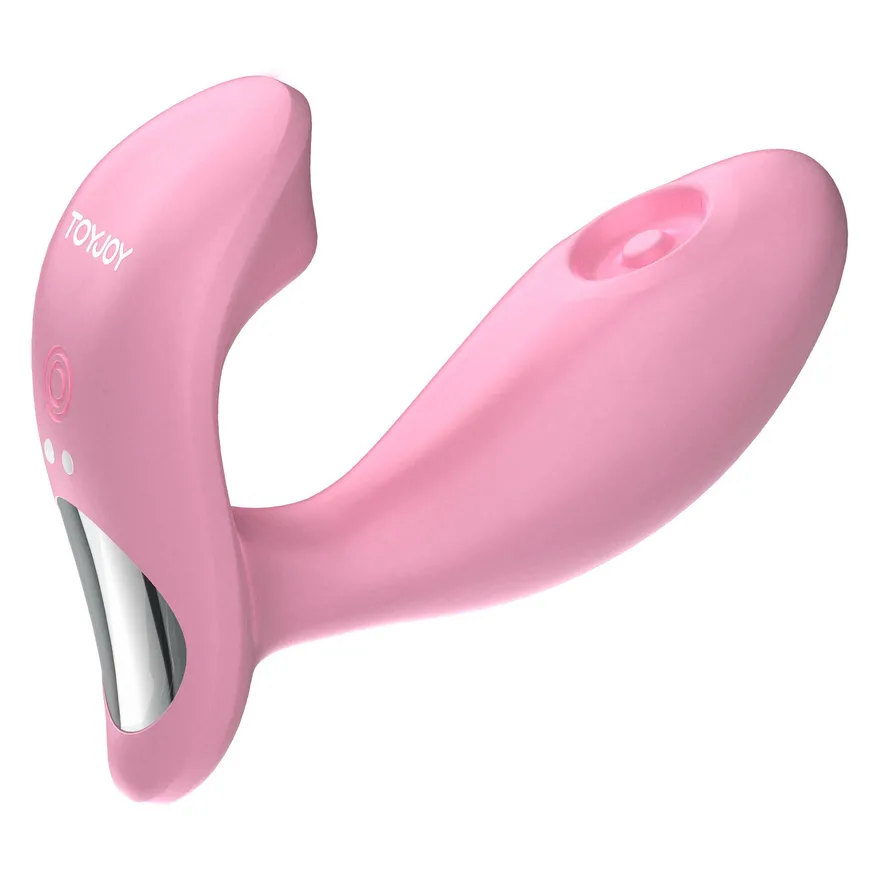
Review
Review: Toy Joy Flamengo Pulsating G-spot Vibrator
The cheapest way to portable double stimulation.
12 September 2026
 Best budget
Review · G-spot vibrator · Dual motors and heat
Svakom’s G-spot vibrator with vibration, thrust motion and a warming tip reviewed against the manufacturer’s own specifications, the PDF manual and price data from six Swedish stores. Five modes times five intensity levels, 38-degree heat, 800 mAh lithium polymer, IPX7 according to IEC 60529 and USB-C — at a price that differs by 64 percent between the cheapest and the most expensive store.
Unusually much technology for the money: two separate motors for vibration and thrusting motion, plus an independent heat function up to 38 degrees; all in liquid silicone with IPX7 and standard USB-C. Battery data is among the most complete in the category. What you pay for is runtime—a one-hour rating with 800 mAh is the shortest among the compared models, and charging takes 2.5 times as long as it provides. The manufacturer’s documentation is also sloppy in several areas.
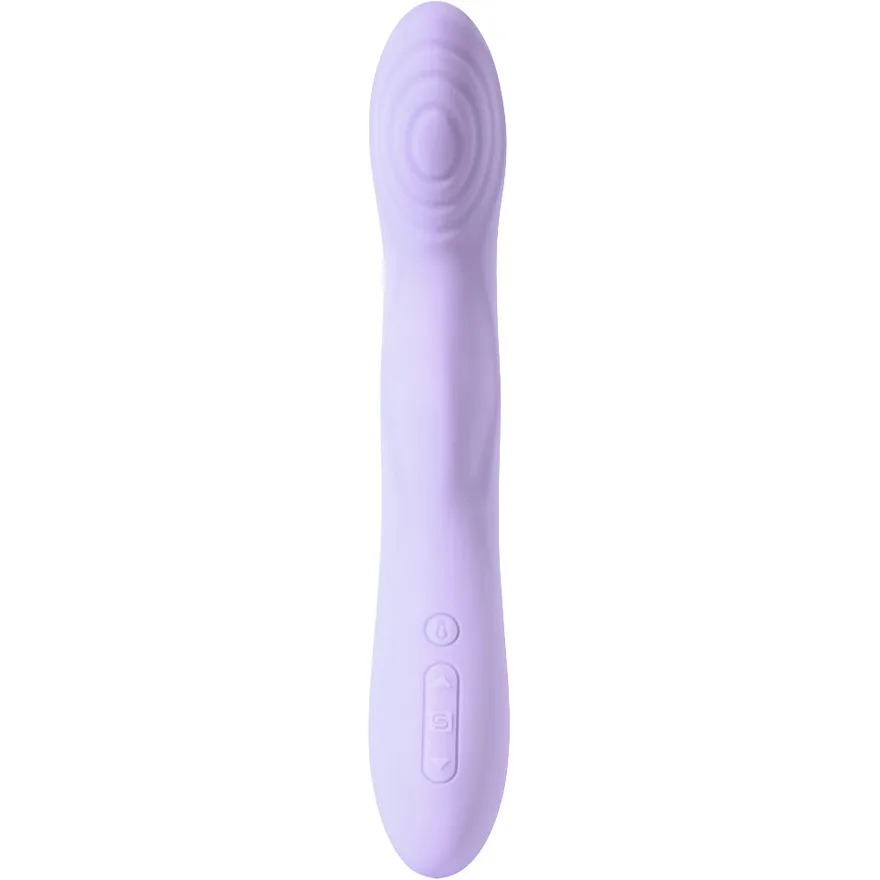
Svakom Selena is a G-spot vibrator that tries to do three things at once. It vibrates in the head, it pushes the throat back and forth in a thrust motion, and it heats the tip. The three functions are in the same silicone body and are controlled from the same button panel, and on top of that there is app control via Bluetooth. There’s an unusually large amount of technology in a product sold from 549 SEK in Sweden.
The specification looks like this according to the manufacturer: 210 × 35 × 35 millimeters, 194 grams, liquid silicone, five modes for thrust motion and vibration with five intensity steps each, a separate heating function that goes up to 38 degrees, a lithium polymer battery of 800 mAh, a 2.5-hour charging time, one hour of operating time, charging via USB-C, and an IPX7 enclosure rating. The sound level is stated as at most 60 decibels. The manufacturer’s item number is SA695A, and it is available in six Swedish shops between 549 and 899 SEK.
This review is about the item with EAN 6959633105917. The number is verified directly in the source code on Svakom’s own product page, where it is shown as gtin13 linked to item number SA695A, and it is also found as a barcode at Taboo. The manufacturer sells Selena in a single variant with no color options; the Swedish shops alternately call it Lavender and Lila, but it is the same item with the same EAN in all six shops.
The manufacturer describes Selena as a product with dual motors, and the manual’s overview image names them separately: a vibration motor and a thrust motor. It’s not marketing language for the same thing, but two physically separate drives with different tasks. The vibration motor sits in the ridged head and transmits vibrations through the silicone. The thrust motor sits in the neck and drives a back-and-forth motion along the product’s lengthwise axis.
The numbers for the two motions are not published in the specification table, but in the manufacturer’s own gallery images. The thrusting motion is stated to be 8 millimeters of stroke length and up to 450 thrusts per minute. The vibration is stated to be 16 vibrations per second. What can be concluded from these figures is that 8 millimeters is a short stroke length—the motion is intended to maintain pressure on a point rather than imitate deeper intercourse—and that 450 thrusts per minute corresponds to 7.5 thrusts per second at the highest setting, i.e., a fast, short pulse rather than a slow sweep.
The manufacturer also states that the drive uses a tungsten motor instead of a standard motor, and justifies the choice with smoother vibration. Technically, it’s a reasonable design principle: tungsten has a high density, and a heavier unbalanced weight gives more amplitude at the same RPM, which allows the motor to run slower for the same perceived force. The manufacturer does not publish any measurements that substantiate the difference, so the claim should be read as a design description rather than a performance figure.
Svakom’s lineup includes several models that share a heat function, app control, and a silicone body, and they’re easy to mix up. Three of them are close together.
So the difference between them isn’t primarily about quality, but about the type of motion. If you want heat without thrusting motion and in the smallest possible format, Cici 2 is the way to go. If you want motion in the shaft but can do without heat, Mora Neo is the alternative. Selena is the only one of the three that combines heat and thrusting motion, and it’s also the one that pays the most for the combination in runtime—more about that further down.
The material issue is the only property of an intimate product that neither experience nor care can compensate for, and it determines whether the product is still hygienic after a few years. Svakom states one material for Selena: liquid silicone. The specification block in the manual is shorter — silicone — and none of the sources mention any hard plastic part in the body. That sets Selena apart from, for example, the Lelo Ina Wave 2, where the manufacturer expressly lists body-friendly silicone and ABS plastic.
Silicone is a non-porous material. A non-porous surface can be cleaned because there are no microscopic voids where residues can get trapped. This is the single most important property of a material that will be in contact with the mucous membrane, and that is why the material category weighs more than almost every other category in a specification.
The term liquid silicone — liquid silicone in the manufacturer’s English text — refers to the manufacturing method. The material is injection-molded as a two-component liquid that cures in the mold instead of being rolled and pressed. The noticeable consequence for a buyer is that the casting becomes more even and that the product can be molded in one piece without visible seams. That is relevant here, because Selena has a flexible neck: each seam in a moving part is both a potential leak point for water and a place where residues can collect.
In the manufacturer’s material description, the surface is soft with a matte finish. The retailer Joyland specifies that it is ridged and silky-smooth with medium hardness — three details that the manufacturer does not publish. The ridging is intended to be the raised rings around the head, which, according to the manufacturer, should guide the vibration toward the center of the head instead of spreading it across the entire surface.
Phthalates are a group of plasticizers used to make plastic — above all, flexible PVC — pliable. The Swedish Chemicals Agency describes them as substances that can affect the endocrine system and make reproduction more difficult, and several of them are therefore restricted or banned within the EU in a large number of products. This product category is a recurring subject of supervision, because it contains flexible plastic against the skin and mucous membrane.
There is a gap worth noting. Svakom does not state any explicit phthalate declaration for Selena, either on the product page or in the manual. The closest the manufacturer comes is the wording that the material is free from harmful chemicals, which is not a chemical claim but an assessment. The retailer Joyland, on the other hand, explicitly states phthalate-free: yes. That is a store statement and not a manufacturer declaration, and the difference matters if you ever need to refer to it.
What can still be established, however, is that silicone as a material class does not require phthalate plasticizers to become soft—the softness comes from the polymer’s own structure. An unambiguous material statement like silicone is therefore in itself a better sign than terms like TPE or jelly rubber, which say nothing at all about which plasticizers are included. But an explicit statement from the manufacturer would have been better than a line of reasoning, and that’s missing.
The manufacturer’s specification table and PDF manual state the same dimensions: 210 × 35 × 35 millimeters. The weight is listed as 194 grams, and that figure is repeated in three of the six Swedish stores — Joyland, Taboo, and Lustly — which makes it one of the best-supported pieces of information in the entire specification.
But the manufacturer’s own dimension graphic in the product gallery shows different numbers. It lists 186 millimeters as the length and 33 millimeters as the height, while 35 millimeters is marked above the head. That means it is 24 millimeters shorter and 2 millimeters lower than the specification table on the same page. Most likely, the graphic measures the product in a different orientation than the table’s enclosing dimensions, but the manufacturer does not explain the discrepancy, and anyone working out whether the product will fit in a certain box should go by the larger number. The specification table and the manual match each other, and they carry more weight than a marketing image.
The manufacturer does not publish an insertable length. The retailer Joyland lists 14 centimeters as the penetrative length and 3.5 centimeters in diameter—the only source we found that distinguishes between total and insertable length for this model. If you put those figures side by side, it means that roughly 7 centimeters of the product is the handle with a button panel. For comparison, Lelo lists an insertable length of 110 millimeters for the Ina Wave 2 and Svakom lists 125 millimeters for the Cici 2, so Selenas 14 centimeters is longer than both.
The manufacturer also publishes a graphic showing where the stimulation is meant to land, with three marked points at 4–8 centimeters, 8–11 centimeters, and 12–14 centimeters measured from the tip. That’s unusually specific for this category and a useful reminder that the entire insertable length is not intended to be used at the same time.
194 grams is a normal weight for this format. Lelo Ina Wave 2 is listed as weighing 176 grams, and Svakom Mora Neo as 178 grams, while the Cici 2, which has no thrust motor, weighs 59 grams. The difference between 59 and 194 grams, in practice, is what a thrust motor and a battery that’s twice as large weigh.
The interface is simpler than the feature list implies. The manual’s overview image names the buttons: an S button for power on, off, and pause, an up and a down button for intensity, and a separate button for the heating function. In addition, there are battery indicator lights and the USB-C port. Everything is located on the top side of the handle.
The manual is unusually precise about how the buttons behave. You hold the S button pressed for 1.5 seconds to turn on or off. When switched on, the product automatically goes into standby mode and starts searching for the SVAKOM app. A short press on S starts or pauses thrust movement and vibration. The plus and minus buttons step through the intensity, and a double-press on either of them switches modes. The heating function is turned on with a 1.5-second press of its own button, and an LED lights up as long as the heat is active.
Two details in the manual are worth highlighting before purchase. The memory function means the product starts in the most recently used setting but always with intensity step 1—so it remembers which pattern you were running, not how strong it was. And Intelligent Mode, which is activated with a double-press on S, automatically switches between the modes with about 25 seconds on each. It’s a specific interval, unlike most automatic modes in the category where the manufacturer only writes that the product switches.
However, the counting of the modes is a source of confusion in the stores. The manufacturer lists five modes for thrust movement and vibration, each with five intensity steps, plus a separate heating function that is independent of them. Both Taboo and Lustly instead write that there are six modes, apparently by counting the heat as a sixth vibration mode. That’s a store claim that has no support from the manufacturer. What can actually be established is that you have 5 × 5 = 25 combinations of mode and intensity, and that the heat can be on or off regardless of which one of them you run.
However, one nuance belongs here, and it comes from the manufacturer itself. The specification table and the manual write five modes for thrusting and vibration as a single unit, while the manufacturer’s own overview graphic— the one Joyland publishes on its product page— instead lists five vibration modes and five thrusting modes as two separate rows. Joyland’s specification table follows the graphic and specifies five intensity levels and five thrusting modes separately. The manual’s wording is the clearest of the three—it describes five modes that combine thrusting motion and vibration, with five intensity steps for each—and that’s the interpretation we base ourselves on. But it’s worth knowing that two of the manufacturer’s own channels present the same thing in two different ways.
The manufacturer states that the tip is heated to 38 degrees Celsius. It’s around normal body temperature—the manufacturer describes its own purpose as mimicking the body’s natural heat, not as exceeding it. All six Swedish stores repeat the same figure, which makes 38 degrees the most consistent piece of information throughout the entire material.
What the manufacturer does not publish is how long the heating takes, how long the heat is maintained, and whether the heat is automatically turned off after a certain time. The manual only states that the LED lights up as long as the function is active and that a long press again turns it off. In practice, that means you can’t plan around the heating function based on published data—you’ll have to determine how it behaves on site.
The practical point of the heat is material-related and not just about the experience. Silicone is a poor heat-conducting material, which is why a silicone product feels cold at the beginning and takes time to reach body temperature. A built-in heating element bypasses that problem. Also, since the function is independent of vibration and jolt movement, it can be used on its own, which is relevant for anyone who wants heat without movement.
The jolt movement is the function that most clearly sets Selena apart from a regular G-spot vibrator, and it’s also the one that uses the most battery life. The manufacturer’s gallery image shows an 8-millimeter stroke length and up to 450 jolts per minute.
8 millimeters is short. The comparison that makes the figure understandable is that a vibrator with a longer stroke moves several centimeters, whereas 8 millimeters is more of a push than a pull. In practice, that means the movement stays within a small area and presses against the same point again and again instead of gliding along a distance. This is consistent with the manufacturer’s own description of the product as being aimed at the G-spot rather than deep penetration, and it also matches the shape: the ridged head is made to stay in one place.
450 jolts per minute, on the other hand, is high. That corresponds to 7.5 jolts per second at the highest setting. The combination of short stroke length and high frequency describes a product that works more like a pressure pulse than like a movement. Expect the upper range to be more relevant as a technical limit than as an everyday setting, just like with most products with many steps.
Selena is controlled in addition to the buttons via the SVAKOM app or the KooSync app. The manual states that the product is paired with a Bluetooth-enabled device in order to customize settings and enable remote control over distance with invited guests. The manufacturer’s product page adds that the app provides extra preset modes, custom patterns drawn with your finger, and control that follows music or ambient sound, along with a text chat and video calls.
The radio part is unusually well documented for the category. The manual states the operating frequency as 2400.0–2483.5 MHz—that is, the common 2.4 GHz band—and a maximum transmitter power of at most +6 dBm. In the same document, the manufacturer assures that the radio equipment complies with Directive 2014/53/EU and refers to its certificate page for the full EU declaration of conformity. The product also bears FCC ID 2A74F-SA695A.
What those figures mean in practice: +6 dBm corresponds to roughly 4 milliwatts, which is a low transmitter power even for Bluetooth class. That points to short range in the same room rather than through multiple walls. The manufacturer does not publish a range in meters for the Bluetooth connection, and remote control over longer distances, according to the description, is done via the internet through the app—not directly over Bluetooth.
Here, Svakom actually publishes a number, which is more than most in the category do. The product page states the sound level as 60 dB, and the manual’s specifications section writes ≤ 60 dB, meaning at most 60 decibels. The marketing image on the same page describes the product as whisper-quiet.
The two descriptions don’t quite add up. 60 decibels is on the order of a normal conversation, not a whisper, and the decibel scale is also logarithmic—a whisper is many times lower in sound pressure than a conversation, not just somewhat lower. What can be established is that 60 dB is a ceiling, not a measured typical value: the notation ≤ 60 dB indicates a limit that the product does not exceed, not what it sounds like on average. The manufacturer also does not state at what distance that figure applies, which is a prerequisite for being able to compare a decibel value between products.
For comparison, Lelo does not publish a maximum decibel value at all for Ina Wave 2, and Svakom publishes nothing for Cici 2 or Mora Neo. That makes Selena’s 60 dB a detail that is hard to put into context, but it’s still worth something: a product with two motors that states a ceiling is more transparent than one that only says “quiet running.” This is precisely what makes Lustly’s wording, which states the sound level as “quiet design” without a number, a worse message than the manufacturer’s own.
A practical tip that applies regardless of the model: a product with a shock motor sounds louder on a hard surface than on a soft one, because the tabletop works as a resonance box. Place it on a towel between uses.
Swakoms product page states the enclosure class as IPX7 and specifies it in plain language as submersible up to one meter. The rating comes from the international standard IEC 60529, which defines enclosure classes for electrical equipment. The number 7 in the second position means that the product has been tested for submersion in water to a depth of one meter for 30 minutes.
An exception is worth noting. The manual’s specification block only states “Waterproof Level: Waterproof” without an IP rating. The same applies to the printed specification on the back of the packaging, visible in Joylands product image: there, too, it only says “Waterproof”. So the product page is more specific than both the manual and the carton. It doesn’t change the assessment — the product page is also the manufacturer’s own publication — but it means that anyone who only reads what comes with the package never learns which class applies.
The same printed specification is, incidentally, a useful guide to the rest of the information. It repeats 210 × 35 × 35 millimeters, 194 grams, 800 mAh, 2.5 hours of charging time, one hour of operating time, five modes plus a heat setting, five intensity steps, and up to 60 decibels — in other words, exactly the same numbers as the product page and the manual. It also names the motors in plain text: primary vibration motor in the head and secondary shock motor in the neck. The fact that three of the manufacturer’s channels say the same thing is unusual in this category and makes the specification unusually reliable, with the exceptions listed in this text.
Taboo states in its specification table “Water-resistant IPX5”. It’s a different and worse class than the manufacturer indicates. According to IEC 60529, IPX5 covers water jets from all directions but not submersion. The difference is practically significant: with IPX5, the product can be rinsed off but not placed in the bathtub; with IPX7, it can.
When a store and a manufacturer contradict each other, the manufacturer’s statement wins, and the discrepancy should be noted. There’s also a second internal problem on the same page: Taboos own product text states the charging time as approximately 150 minutes, while the specification table just below says about 180 minutes. The manufacturer’s information is 2.5 hours, i.e. 150 minutes. Anyone comparing stores should be aware that specification tables in Swedish shops are often auto-generated and don’t always match the product text on the same page.
The manual is clear: clean the product before and after each use with warm water and mild soap, or with a cleaning agent intended for intimate products. Do not use cleaning agents that contain alcohol, gasoline, or acetone. Store the product in a safe, clean, dry, cool, and dark place, and keep it away from substances that can damage the silicone.
The lubricant section in the manual is unusually sharply worded. The manufacturer explicitly warns against using massage oil and hand cream as lubricants, and states that silicone-based lubricants, oils, and lotions will damage the product. The rationale is given right away: using lubricants that are not water-based causes the material to break down, and a degraded material becomes a breeding ground for harmful bacteria, which in turn can lead to irritation or infection. It’s the same line of reasoning that applies to all silicone products, but few manufacturers spell out the cause-and-effect chain as plainly as this.
This also has economic consequences: Svakoms warranty terms explicitly state that damage caused by lubricants that are not water-based, by improper cleaning, or by attempts to take the product apart is not covered. So the wrong lubricant is both a material problem and a warranty problem.
The manual also addresses a limitation that rarely appears in store texts: the ideal environment is stated as −5 to 50 degrees Celsius. It rules out boiling and a dishwasher, even though the product is submersible according to IPX7. The manual’s general misuse warning also contains a standard wording stating that the product is intended for external use only, which does not go together with the fact that the entire product is marketed for G-spot stimulation and that the stores state a 14-centimeter penetrating length. It is boilerplate text in the manufacturer’s safety information rather than a performance claim, but it deserves to be mentioned because it is stated in black and white in the document that comes with the product.
The battery specifications are unusually complete here. The manufacturer states a lithium polymer battery of 800 mAh with a rated voltage of 3.7 volts. The charging voltage is specified as 5.0 volts, and the manual gives the input as 5 V and 0.4 A. The charging time is stated as 2.5 hours and the operating time as 1 hour. Charging is via USB-C, and the manufacturer also mentions that the port has a dust cover.
With a standard USB-C cable. The manual’s charging section describes it directly: plug the USB-C cable properly into the product’s charging port, connect the other end to a USB power source, charging time 2.5 hours. Battery indicator lights on the handle show the charging status.
That the charging connector is USB-C and not a magnetic special cable is a real advantage that’s easy to underestimate. Womanizer and several other premium manufacturers use magnetic cables that are product-specific, which means that a misplaced cable has to be ordered from the manufacturer. Here, it works with the same cable as for the phone. It matters all the more because Svakom’s warranty explicitly excludes accessories such as charging cables — a broken cable is always your own cost, and then it’s better that it only costs a fifty-kronor note at the nearest store.
The manual’s charging warnings are standard, but worth following: charge only where the mains voltage is suitable, do not use or immerse the product in water while charging, charge regularly for the sake of the battery, and unplug the cable right when the charging is finished.
The most telling figure in the entire specification is the relationship between capacity and runtime, and it only becomes clear when you compare. Svakom Mora Neo has exactly the same battery — 800 mAh lithium polymer at 3.7 volts — but the manufacturer states twice the runtime: 2 hours versus Selena’s 1 hour. Mora Neo is also charged in 2 hours versus Selena’s 2.5 hours.
It’s not an anomaly; it’s an explanation. Selena powers two motors plus a heating element from the same cell. A resistance heating element is the most energy-demanding part in a product like this, because heat can’t be produced efficiently unless energy is converted directly into heat, and a thrust motor that moves mass back and forth draws significantly more current than an unbalanced vibration weight. What you can conclude is that Selena’s hour is the price for the functions, not a sign of a small battery.
Put the numbers next to each other and the picture is complete. Cici 2 has a much smaller battery — 320 mAh — but the manufacturer still states a runtime of 2 hours, because it lacks a thrust motor. Lelo Ina Wave 2 has 520 mAh and is rated for up to 2 hours. Selena shares the largest battery with Mora Neo and still has the shortest runtime of all four — the other three are stated as 2 hours each. It’s a trade-off worth factoring into your decision: one hour is plenty of time for a single occasion, but it also means the product has to be charged often, and that charging takes 2.5 times as long as it provides.
Two stores deviate from the manufacturer here. Taboo states the usage time to be about 60 to 90 minutes, i.e. up to 50 percent longer than the manufacturer. Lustly states up to 60 minutes, which matches. Anyone planning for 90 minutes is planning based on a store’s claim without coverage from the manufacturer.
What applies generally to lithium batteries also applies here: capacity drops with the number of charge cycles, the cell is not replaceable, and the product does best when it is charged regularly rather than stored completely discharged. The manual itself states that the product should be charged regularly for optimal battery lifespan. With use a couple of times a week, it is the battery—not the silicone—that sets the limit for how long it lasts.
We do not have price data from shops in your market yet.
Mora Neo has exactly the same battery at 800 mAh — and twice the operating time. Selena’s hour is the price for the shock motor and the heat, not a sign of a stingy battery.
Three comparisons are relevant: versus Svakom’s own heat model without a thrusting mechanism, versus Svakom’s own thrust model without heat, and versus a premium G-spot vibrator from another brand. All information below comes from each manufacturer’s own specifications.
Cici 2 is Selena’s closest relative in the lineup. It has the same heat function up to 38 degrees, five vibration modes with five intensities, the same flowing silicone, the same IPX7, and the same app control. The difference is that it lacks a thrust motor.
The measurements that follow are visible straight through the specification. Cici 2 measures 178 × 25 × 49 millimeters versus Selena’s 210 × 35 × 35, and weighs 59 grams versus 194. It has a 320 mAh battery versus Selena’s 800, but it still states 2 hours of runtime versus Selena’s 1, and charges in 2 hours versus 2.5. The insert size is listed as 125 × 25 millimeters, meaning it is both shorter and narrower than the 14 centimeters and 3.5 centimeters that Joyland lists for Selena.
The conclusion is straightforward: if you want thrusting motion, there’s no way around Selena within the brand’s warming models, and you pay for it with twice as short runtime, three times the weight, and a half-hour longer charging time. If you don’t want thrusting motion, you get the same heat, the same number of modes, the same level of water resistance, and a significantly narrower product in Cici 2.
Mora Neo is the most illuminating comparison, because the battery is identical: 800 mAh lithium polymer at 3.7 volts in both. Still, the manufacturer lists 2 hours of runtime for Mora Neo versus 1 hour for Selena, and 2 hours of charging time versus 2.5.
The difference lies in what the cell powers. Mora Neo has rotating balls in the shaft in three steps and 5+1 vibration modes, but no heat function. Selena has a thrust motor and a heating element. This is the most concrete illustration we’ve found of what heat and thrusting motion cost in a product of this size: the same battery, half the runtime.
Otherwise, they are close to each other. Mora Neo measures 195 × 32 × 60 millimeters and weighs 178 grams versus Selena’s 210 × 35 × 35 and 194 grams. The insert size is listed as 111 × 32 millimeters, meaning it is shorter than Selena’s 14 centimeters according to Joyland. Both are IPX7 and both are flowing silicone. If you choose based on motion type: balls that rotate against the vaginal wall in Mora Neo, short thrusting motion toward a point in Selena.
Lelo Ina Wave 2 is a different kind of product but competes for the same buyer. It measures 200 × 65 × 45 millimeters, weighs 176 grams, and has an insertable length of 110 millimeters with a diameter of 37.09 millimeters. The battery is lithium-ion at 520 mAh and 3.7 volts; the charging time is stated as 2 hours at 5.0 volts and 500 milliamps, and the runtime as up to 2 hours. Lelo states twelve settings and an interface with five buttons, plus a standby time of up to 90 days.
Three differences matter. Material: Lelo states body-friendly silicone and ABS plastic, while Svakom states only silicone for Selena — an advantage for Selena. Runtime: 2 hours versus 1, a clear advantage for Lelo despite the smaller battery. And the function: Ina Wave 2 works with a wave motion in the insertable part and has a separate clitoral arm, while Selena has thrust motion and heat but no external arm.
The number of settings is the least interesting difference, even though it looks biggest on paper. Twelve versus five doesn’t mean twelve experiences versus five: Selena’s five settings each have five intensity levels, so 25 combinations, and to that comes the heat as an independent add-on. What’s actually missing in Selena compared to Ina Wave 2, on the other hand, is the external stimulation. If you want simultaneous clitoral stimulation, you have to add something else.
Six Swedish stores sell the item with EAN 6959633105917. Cheapest are Blush Me and SexleksakerOutlet at 549 SEK each, most expensive is Lustly at 899 SEK. That’s 350 SEK or a 64 percent difference for exactly the same item number and the same packaging.
The stock situation is unusually good for this category. Five of the six stores had the product in stock at the price check — all except Lustly, which is also the most expensive. That means the price spread is real and not an artifact of old prices in sold-out flows, which is otherwise the usual pattern. Between the cheapest and the second-most expensive available store, Joyland at 795 SEK, there’s a difference of 246 SEK.
The spread doesn’t depend on any store selling a different variant. The manufacturer sells Selena in a single version with no color options, and all six stores list the item either under EAN 6959633105917 or under their own item number that’s tied specifically to that product. So this is about the stores’ own margin setting on a model that’s still new enough that it hasn’t yet turned into a price-pressured volume product — and that’s exactly the situation where it pays off the most to compare before you pay.
The prices in the table above are updated when the shops’ product feeds are updated, but always check the final price at checkout. Shipping costs are added by most shops under a certain order value, and in this price range, all shops are below the threshold for free shipping — which can even out some of the difference between the cheapest options.
It’s for you if you want three functions in one product instead of three separate products. Vibration, thrusting movement, and heat in the same silicone body, controlled from the same button panel or from the app, isn’t a given in this price range. It’s for you who wants a product made entirely of silicone without any hard plastic parts, for you who want to be able to charge with the same cable as your phone, and for you who want to be able to rinse off the entire product under running water. It’s also for you who want a long insertable part—14 centimeters according to Joyland is more than both Cici 2 and Lelo Ina Wave 2.
It’s not for you if you prioritize run time. One hour is the shortest of all the compared models, and charging takes 2.5 times as long as the runtime it provides. It’s not for you if you want simultaneous clitoral stimulation, because there is no external arm. It’s not for you if you want the smallest possible product—Cici 2 is both shorter and significantly narrower. And it’s not for you if you require an explicit phthalate declaration from the manufacturer before purchase, because Svakom does not publish any for this model.
One more thing belongs in the decision. The manufacturer’s documentation for Selena includes several careless errors that are worth knowing before you spend time reading it. The section "Features" on the product page describes a different model throughout — the texts talk about Cici 2 instead of Selena, evidently a copied-over text that was never rewritten. The dimension graphic states 186 millimeters, while the table on the same page states 210. The manual’s specifications section omits the IP class that the product page lists. None of these points affect the product, but they do affect how much weight you should put on wording that only appears in marketing text.
Svakom provides a two-year replacement warranty against manufacturing faults, counted from the date of purchase. If the product becomes defective within that time and the claim is approved, the manufacturer replaces it. Registration is no longer required in order to be able to invoke the warranty, but the manufacturer recommends it and points out that both the purchase invoice and the product’s serial number are needed. The serial number is on the packaging, normally above the barcode—so save the box, or at least photograph that part.
The ten-year-long quality support, which is often cited as the “ten-year warranty” in store texts, is something other than a warranty and deserves clarification. The manufacturer describes it as meaning that after the first two years you get a 50 percent discount on a new purchase in their own web store if the product breaks or deteriorates. So it is a discount coupon, not a right to repair or replacement. Read the wording as a loyalty offer.
The exceptions are worth reading before, not after. The warranty covers only manufacturing defects, not damage caused by misuse or negligence. The manufacturer expressly lists four examples: use of lubricants that are not water-based, improper cleaning, submersion of products that are not waterproof, and attempts to take the product apart. Accessories such as charging cables are not covered at all. And the coverage applies only to products purchased directly from the manufacturer’s web store or from official retailers — purchases from unauthorized sellers on marketplaces are not covered.
What does, however, always apply is your statutory rights, and in Sweden they are stronger than the manufacturer’s promise. Under konsumentköplagen, you have a three-year right to complain about defects in the goods, regardless of what the manufacturer promises — i.e., one year longer than Svakoms own warranty, and directed at the store you bought it from. For distance purchases, you also have a right of withdrawal for fourteen days under lagen om distansavtal och avtal utanför affärslokaler. Be aware that in practice, the right of withdrawal is limited for hygiene products that have been taken out of a sealed package — but the right to complain about defects always applies. If you have questions about what applies in your case, Konsumentverket guides you via Hallå konsument.
Svakom Selena Heated Vibrator is ranked på plats 5 av 12 in g-spot vibrator best i test, where the entire category is compared against each other using five shared criteria. Guiden vinns av Womanizer OG.
Every numerical piece of information in the text can be traced to one of the sources below. The links were checked manually on the specified date.
This page is machine-translated from Swedish. Read the Swedish original