

Review
Review: We-Vibe Sync Go
Same C-shape with IPX7 and 90 minutes of operating time—82 SEK more expensive.
29 July 2026
Review · Couple vibrator · C-shaped with app control
We-Vibe’s cheapest C-shaped couple vibrator reviewed against the manufacturer’s own specifications and price data from six Swedish stores. Body-friendly silicone without phthalates, BPA, or latex, ten pattern modes, app control with a long-distance mode, 45 minutes of runtime, and a two-year warranty — but no published ingress protection class, and a manual that explicitly advises against immersing the product in water.
The cheapest way into the We-Vibes C-form, with full silicone, one-button control, and an app that provides twelve patterns and a long-distance mode. What you pay for is the operating time of 45 minutes, a charging time that’s twice as long as the operating time, a product-specific pin cable that is excluded from the warranty — and above all that the manufacturer publishes no IP rating at all, while the manual advises against submersion. For 82 SEK more, We-Vibe’s own Sync Go includes both IPX7 and double the operating time.
We-Vibe Sync Lite is the simplest and cheapest model in We-Vibe’s range of C-shaped couple vibrators. The manufacturer describes it as an entry-level product for curious couples: a flexible silicone arch that is worn during intercourse, with an inner part for the G-spot and an outer part for the clitoris. It has a single button, ten built-in pattern modes, and it can also be controlled from the We-Vibe app — even remotely.
The specification looks like this according to the manufacturer: dimensions 7.5 × 5.1 × 3.0 centimeters, body-friendly silicone free from phthalates and BPA and made without latex, a rechargeable lithium-ion battery, operating time up to 45 minutes, charging time up to 90 minutes, and a two-year manufacturer’s warranty. The model number is SCL2A. In Sweden, the product is listed in seven listings across six stores at prices between 764 and 990 SEK, and four of the listings had the item in stock at the price check.
This review is exclusively about the Aqua color with EAN 4251460619752, the manufacturer’s article number SNSY4SG5. We-Vibe sells Sync Lite in two colors — Aqua and Pink — and each color has its own EAN; the pink variant is called SNSY4SG3 and has EAN 4251460619745. Functionally, they are identical, but Swedish stores refer to the same color interchangeably as Aqua, turquoise, and blue, so check the number if you compare prices between stores.
What can already be established here is that one piece of information is missing from the manufacturer’s specification, and that is the piece of information that matters most in this particular product category: We-Vibe does not publish an IP rating for Sync Lite, and the manual explicitly states that the product must not be submerged in water. That section gets its own chapter further down, because it affects both cleaning and where the product can be used.
The C-shape is We-Vibes’ signature design construction and the one the entire product family is built on. The principle is simple: a flexible silicone frame is folded into a C, the shorter and narrower arm is inserted into the vagina and directed toward the G-spot, and the wider outer section rests against the clitoris. The frame is held in place by the body itself rather than by straps or suction, and because it doesn’t fill out the vagina, there’s still room for a partner. That’s why it’s called a pair vibrator and not just a vibrator—it’s designed to stay in place during intercourse and stimulate both.
So the difference from a standard clitoral stimulator isn’t primarily the vibration but the shape and attachment. A handheld product requires that someone hold it. A C-shaped pair vibrator instead requires the shape to fit the body, and that’s the single biggest uncertainty when buying this type: the fit can’t be specified away. The manufacturer describes the construction as ergonomic and adjustable, and the manufacturer’s own product images show how the frame can be pressed together and angled—but how large a range of anatomies it corresponds to is not published, and can’t be published.
The manufacturer does not state an insertion length for Sync Lite. Both retailers, Taboo and Lekosmek, list approximately 7 centimeters, which is a store claim and not a manufacturer value. For comparison, Lelo lists 78,2 millimeters as the insertion length for Tiani 3, so roughly the same. The order of magnitude is reasonable for a product meant to stay in place without taking up space, but treat the figure as just a store claim.
We-Vibe sells three C-shaped pair vibrators in parallel, and they’re systematically mixed up in Swedish stores because the names are close to each other and the shape looks similar in pictures. The differences in the manufacturer’s own specifications, however, are clear.
The important thing in this comparison is that Sync Lite isn’t a cheaper version of the same product, but a simpler product with a shorter runtime and no published water resistance rating. That Sync Go, which is 82 SEK higher in price at the cheapest store, is IPX7-rated and lasts twice as long per charge is the single most useful piece of information in this entire review for anyone deciding between the models.
The material question is the only property of an intimate product that cannot be compensated for with experience or care, and it determines whether the product is still hygienic after a few years. We-Vibe specifies a single material for Sync Lite: body-safe silicone, free from phthalates and BPA, and made without latex. This applies to the entire arched frame, both the inner and the outer arm, and it makes a real difference versus competitors in the same price range where only the contact surface is silicone and the rest of the housing is rigid ABS plastic.
Silicone is a non-porous material. A non-porous surface can be cleaned, because there are no microscopic cavities where residue can get trapped. It is the single most important property of a material that is meant to sit against the mucous membrane, and on a product that by definition is used by two people at the same time, it becomes even more important than usual. A sex toy is shared—that’s the whole point—and then the question of whether the surface can be cleaned completely is not a detail, but the main thing.
Having the entire product covered in silicone has two consequences. The first is mechanical: the arched frame must be able to be bent thousands of times without cracking, and silicone over a flexible core is the kind of construction that can handle that. The second is hygienic: there is no seam between a silicone head and a plastic handle where dirt can collect. The manufacturer’s safety instructions also address the opposite situation—the manual states that the product should not be used if you notice cracks or signs of degradation in the surface material. That’s the right instruction, and it’s worth reading like a date: a silicone surface that starts to feel sticky or look dull is used up, not dirty.
Phthalates are a group of plasticizers used to make plastic—especially flexible PVC—pliable. Kemikalieinspektionen describes them as substances that can affect the hormone system and make reproduction more difficult, and several of them are therefore restricted or banned within the EU in a large number of products. This product category is subject to regular supervision because it contains flexible plastic in contact with skin and mucous membranes.
We-Vibe explicitly states that the silicone in Sync Lite is free from phthalates and BPA and made without latex. It’s a clear, unambiguous declaration, unlike labels such as "TPE" or "jelly rubber," which say nothing at all about which plasticizers are included. Silicone does not need phthalate plasticizers to become soft—the softness comes from the polymer’s own structure—and that’s why specifying silicone as the material in itself is better information than almost any other item in a product specification.
The latex task is relevant for anyone who is allergic to latex, and especially for a product that two people use: it’s enough that one of them reacts. Latex allergy also causes reactions on the mucous membranes faster than on normal skin. That the manufacturer states it is a plus, and it is one of the few details in this category that is actually formulated as a statement and not as a feeling.
The EU declaration of conformity is also included in the material information, which We-Vibe publishes for Sync Lite under the model designation SCL2A. It declares the product in accordance with the RoHS directive 2011/65/EU with the amendment 2015/863—that is, the restriction of hazardous substances in electronics. This is not the same thing as the material declaration for the silicone, but it is a document that exists and can be read, and it is more than most manufacturers in this category publish.
We-Vibe lists the dimensions as 7.5 × 5.1 × 3.0 centimeters, i.e. 75 × 51 × 30 millimeters. According to the manufacturer, the packaging measures 9.0 × 9.0 × 4.7 centimeters. That makes Sync Lite a product that can fit in a toiletry bag without being noticeable, and that is clearly larger than We-Vibe’s own Sync Go at 77.4 × 29.7 × 45.2 millimeters—Sync Go is narrower but taller, while Sync Lite is wider and flatter. For comparison, Lelo Tiani 3 measures 78 × 44.5 × 32 millimeters, i.e. practically the same size category.
The weight information deserves a longer note, because it is a textbook example of how store data spreads without anyone checking it. We-Vibe publishes no weight for Sync Lite, either on the European or on the American product page. The stores fill the gap in three different ways:
The difference between 80 and 162 grams is twice as much, and both can’t apply to the same product. What can be established is that Lelo lists 42 grams for the Tiani 3 and Satisfyer lists 78 grams for the Double Joy—both products in the same size category. A silicone arch on 75 × 51 × 30 millimeters weighing 162 grams would be a deviation from everything else in the category, while 80 grams sits in the middle. The most reasonable interpretation is that 162 grams is the complete delivery and 80 grams is the product, but since none of the figures comes from the manufacturer, neither of them should be treated as a specification. If you need an exact weight—for example, because you want to carry the product under clothes—it isn’t published.
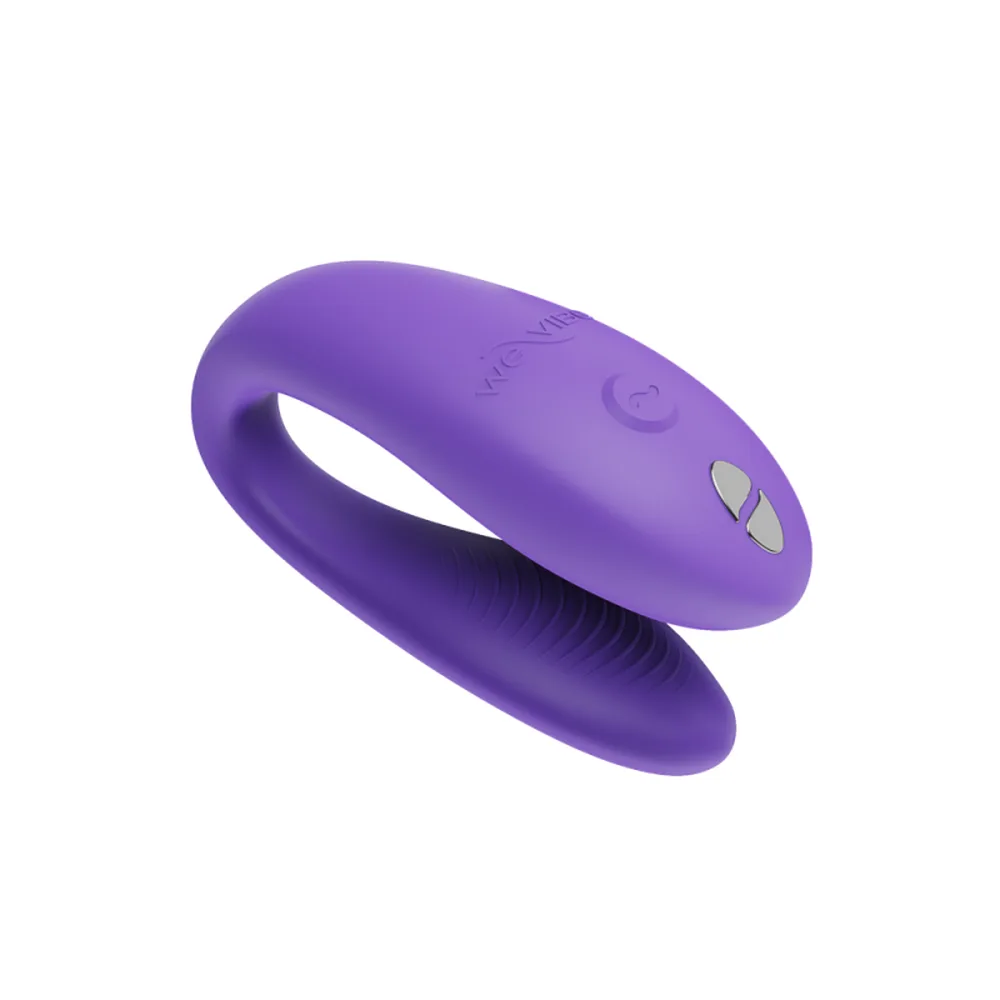
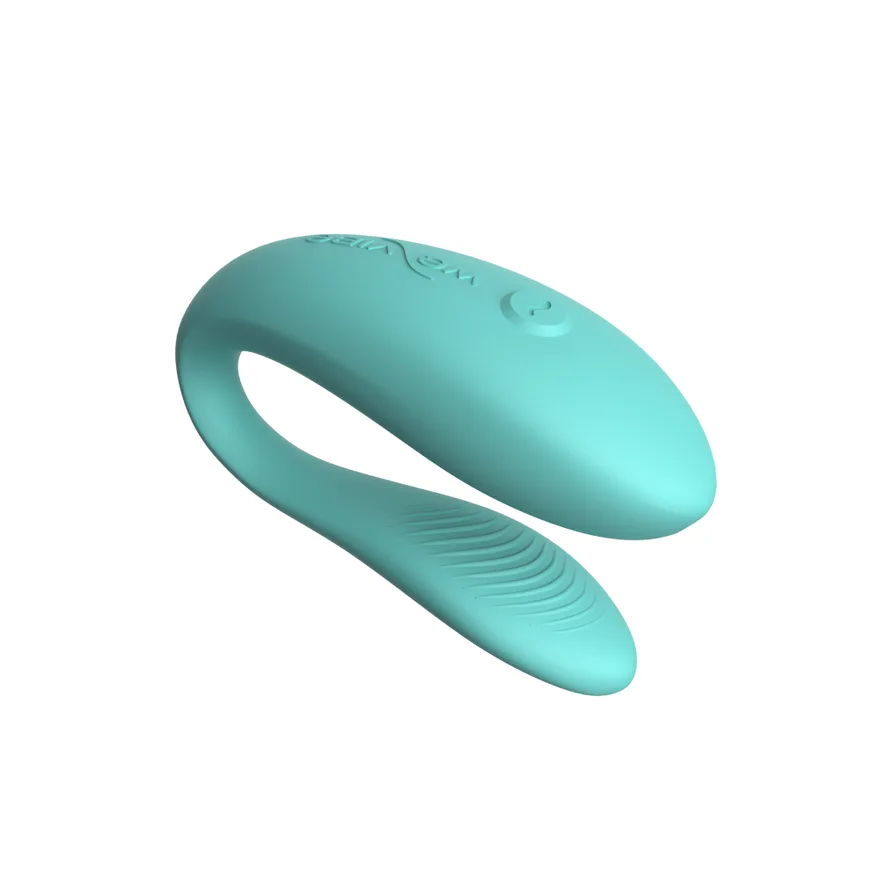
The shape is symmetrical around the arch, with the outer, wider part that carries the button and the charging contacts, and the inner, narrower arm with ridges on the top side. The ridges are molded into the silicone, not glued on, which means they can’t come loose, but they sit on a surface that needs to be cleaned. The angle between the arms is not fixed, since the arch is flexible, and it’s the characteristic the manufacturer calls an adjustable fit.
The interface on Sync Lite is as simple as it gets: a single button, labeled with the We-Vibes logo, and placed on the top side of the outer arm. The manufacturer’s manual describes the entire control system in two sentences. A press starts the product. Every additional press steps through ten different pattern modes.
It’s the direct opposite of a premium model with separate controls for intensity and programs, and it’s a deliberate choice on the manufacturer’s part—one-button control is listed as one of the product’s features on the product page, not as a limitation. The advantage is real: you don’t need to see the button to use it, and on a product that sits between two bodies during sex, it’s not a detail. The downside is just as real: you can’t jump back one step, and you can’t change the strength without switching patterns. If you want to get to mode two from mode nine, you’ll have to press your way around.
A note about the counting belongs here. The manufacturer’s product page markets “10+ vibration modes,” while the manual states ten pattern modes straight out. The “plus” presumably refers to the app, which according to We-Vibes’ own app page provides twelve patterns in Single Vibe mode plus its own saved patterns. What can be concluded, then, is this: ten modes on the product, twelve plus its own in the app.
The app is the feature that distinguishes Sync Lite from a purely mechanical couple vibrator, and according to the manufacturer it’s available for both iPhone and Android. Pairing can be done in two ways. We-Vibe’s app page describes the simple route: scan the barcode on the package with the app, turn on the product by holding the button until it vibrates twice, press once, and wait for three vibrations as confirmation. The manual describes the same thing with button presses and adds how to reset the product: hold the button down for five seconds until the LED blinks, and then continue blinking.
Range is one of the few numbers the manufacturer actually publishes for the connection. The manual states that Sync Lite connects at up to 30 feet in line of sight—just under ten meters—and within about 20 feet, just over six meters, when direction doesn’t matter. Those are reasonable values for Bluetooth, and they’re worded in a usable way: the shorter number is the one that applies through a wall or around a body.
A limitation that’s easy to miss is stated in the manual and nowhere else: Sync Lite can only be paired with one device at a time. So if the other person wants to take over control in the same room, the product has to be reconnected—not just shared. For long-distance mode, however, there’s no obstacle: there the product is paired with the phone that’s within Bluetooth range, and the partner controls via the app over the internet, with chat and video functions in the same app.
Four of the Swedish stores describe a music function. Lustly states that the vibrations can be connected to favorite songs on Spotify, and that the app includes hundreds of ready-made programs; Taboo, Lekosmek, and Vuxenkul all describe the vibrations in time with music.
We-Vibe’s own page about the app mentions neither music nor Spotify. The function list that the manufacturer publishes consists of Single Vibe with twelve patterns, Multi Vibe for products with multiple motors, Touch Mode where finger movement controls the intensity, your own saved patterns, chat and video calls, and Playlist Mode—which, according to the description, is a playlist of vibration patterns with its own ordering, intensity, and length, so it isn’t a music function despite the name.
It’s likely just there that the misunderstanding arises, and it’s worth knowing before you buy with music control as an argument. What can be established is that this is a store claim, that it isn’t supported by the manufacturer’s current description of the app, and that app features are also part of a product like this that can be changed after purchase without anything in the packaging causing it.
The radio section is unusually well documented for this product category, but the information isn’t on the product page—it’s in the EU declaration of conformity, which We-Vibe publishes as a PDF. It states that Sync Lite (SCL2A) is a C-shaped vibrating pager with the operating frequency 2 402–2 480 MHz and a maximum RF output power of −0,81 dBm. The frequency band is the standard band for Bluetooth, and the output power is low—negative dBm figures mean less than one milliwatt.
Practically speaking, the low output power means two things. It explains why the range in the manual is given in feet rather than in tens of meters, and it’s also the reason why the power consumption from the radio section is low compared to the motor. So if the operating time differs between use with and without an app, it’s not the radio that’s the explanation—it’s the intensity the app runs at.
The declaration also lists the harmonized standards the product is declared against, including ETSI EN 300 328 for radio equipment in the 2.4 GHz band and the EN 60335 series for household appliance safety, as well as the RoHS directive. None of them says anything about how the product feels, but they say there is documented supporting material behind the CE mark—which is more than you can say about large parts of the category.
This is where the biggest gap in Sync Lite’s specifications is, and it deserves to be written out in plain language. We-Vibe does not publish any IP rating for Sync Lite, either on the European or the American product page. The word waterproof also doesn’t appear. That’s notable, because the same manufacturer states IPX7 for Sync Go outright.
The manufacturer’s online manual, on the other hand, is clear on the substance, even if not in terms of classification. Under the heading Cleaning, it says that Sync Lite should be cleaned with a damp cloth, and that you should be careful not to fully submerge the product in water. It’s an instruction, not a marketing statement, and it’s the only information about water that comes directly from the manufacturer.
Retailer Lyko, which is outside the shop list above, states Sync Lite is splash-proof according to IPX4 and describes it explicitly as not submersible. That information aligns with the manufacturer’s cleaning instructions, but it therefore doesn’t come from the manufacturer.
The ratings come from the international standard IEC 60529, which defines enclosure classes for electrical equipment. IPX4 means the product has been tested against splashing water from all directions. IPX7 means submersion in water to a depth of one meter for 30 minutes. The difference isn’t a grade difference but a type difference: with IPX4 you can rinse off a surface, and with IPX7 you can put the product in water. Baths and hot tubs are therefore ruled out for Sync Lite—and that applies regardless of which of the pieces of information you choose to believe, because neither of them says anything else.
A shop claim belongs here, and it points the wrong way. Taboos specification table includes the line "Water-resistant IPx5: Yes". IPX5 is a third rating that neither the manufacturer nor Lyko states, and it refers to water jets from a nozzle. The fact that three different sources give three different answers—no rating at all from the manufacturer, IPX4 at Lyko, IPX5 at Taboo—is in itself the clearest message: treat Sync Lite as a product that can’t be submerged. The absence of a rating is never a sign that the product would be approved.
Follow the manufacturer’s instructions: wipe the product with a damp cloth after each use, and if you like, use a cleaning product intended for intimate products. Be extra careful with the ridges on the inner arm and with the seam around the button, which are the two places where residue can actually remain. Let the product air-dry before putting it away, and store it dry and out of direct sunlight—the cotton pouch included in the package is intended specifically for that.
On a sex toy, cleaning is not just a maintenance issue, but a sharing issue. The manual covers it itself: sharing sex toys can transmit sexually transmitted diseases, and the manufacturer advises against sharing the product with anyone other than your partner and recommends protection if needed. That’s the right wording, and it’s one of the few times this product category gets a direct medical instruction instead of a formulation about experiences.
The lubricant question is simple and is determined by the material. The manufacturer recommends water-based lubricant and explicitly advises against scented and alcohol-based lubricants, gels, and massage oils—and against silicone-based lubricant on silicone products. Silicone-based lubricant breaks down the silicone surface over time and makes it porous, and a porous surface can no longer be cleaned properly—only replaced. Oil-based products such as coconut oil also leave a film that’s difficult to remove.
The manual also covers three things that rarely appear in store texts. The product and its battery must not be exposed to temperatures above 45 degrees, which rules out boiling water and the dishwasher. The product contains magnets and should not be used directly over a pacemaker, and credit cards with a magnetic stripe should be kept away from it. And Sync Lite is explicitly not designed for anal use—which is a relevant warning for a product without a stop fin.
We-Vibe states the operating time as up to 45 minutes and the charging time as up to 90 minutes. The battery is a rechargeable lithium-ion battery and, according to the manual, is not replaceable. Mshop repeats the operating time as 45 minutes in its product text, which confirms that the information that was included at the distribution stage.
Forty-five minutes is short, and it should be said plainly. We-Vibe’s own Sync Go lists 90 minutes for the same charging time, Sync 2 lists up to 120 minutes, and Lelo lists two hours for the Tiani 3. Sync Lite is therefore half the time of the nearest sibling and at about one third of the top model. The charging time is also twice as long as the operating time—90 minutes of charging for 45 minutes of use—which is unusual for the category and means that, in practice, the product should be charged after each use.
Charging happens via charging pins on the top of the product and an included USB cable with a pin connector. The manual’s overview image names both parts: charging pins on the product and charging socket for the cable. The delivery contents according to the manufacturer are the product, a USB charging cable, a quick-start guide and safety information, an illustrated multilingual manual, and a cotton storage pouch.
Pin charging is a trade-off, not a pure advantage. The advantage is that no opening in the housing is needed, which makes the construction easier to seal. The disadvantage is that the cable is product-specific: if you lose the charging cable, no regular USB-C cable will work, so you have to get a replacement from the manufacturer. We-Vibe’s warranty terms also expressly exclude consumables such as batteries and charging cables from the warranty, so a broken cable is always your own cost. That’s a real difference compared with, for example, Satisfyer Double Joy, which is charged with a magnetic cable, or compared with a product that has USB-C directly built into the housing.
The manual also describes the LED’s positions during charging, which is the only feedback the product provides: rapid blinking means it’s charging, steady light means it’s fully charged, and the lamp being off means it’s out of power or that the charger isn’t seated correctly on the product. The last point is worth noting— with pin charging, a misplaced cable is a more common problem than a broken cable.
We-Vibe does not publish the battery’s capacity in mAh or its voltage for Sync Lite, either on the product page or in the online manual. What’s provided is the battery type and that the battery cannot be replaced. It’s worth noting because competitors do: Lelo states 70 mAh and 3.7 volts for the Tiani 3 and also specifies charging to 5.0 volts and 70 milliamps. Without the capacity, you can’t convert runtime into power consumption, and you can’t compare how heavily the cell is stressed between models.
What generally applies to lithium-ion batteries also applies here: capacity decreases with the number of charging cycles, the battery isn’t replaceable, and the product does best when it’s charged regularly rather than stored completely discharged. The manufacturer writes in the manual itself that the product should be charged regularly even when it isn’t being used. With a runtime of 45 minutes, the number of charging cycles is also higher than on a model with a longer runtime for the same usage—and since the cell is permanently soldered, the product is effectively used up when the battery is.
We-Vibe markets Sync Lite as whisper-quiet and lists “Whisper quiet” as one of six characteristics at the top of the product page, with the description “almost soundless but still powerful vibrations.” The question is what that means in numbers, and that answer has to be honest: We-Vibe does not publish any measured decibel value for Sync Lite, either on the product page, in the manual, or in the EU declaration of conformity.
Unlike some other models, there isn’t even a comparison chart here to lean on. What can be established is that Lelo publishes a figure for the same type of product — maximum noise level 50 dB for the Tiani 3, with the specified frequency 125 Hz — and that the lack of a corresponding figure from We-Vibe makes it impossible to compare on that specific point. Websites that provide an exact decibel figure for Sync Lite either show their own measurement or a value without a source.
Two things can still be said about the sound without guessing. The first is structural: a product that is worn between two bodies is dampened by the bodies themselves, which is a completely different situation than a handheld product in the air. The second is practical and applies regardless of model — place the product on a soft surface between the users, because a hard tabletop works as a resonant box and noticeably amplifies the sound.
We do not have price data from shops in your market yet.
We-Vibe does not publish a protection rating for Sync Lite, and the manual states that the product should not be submerged in water. The sister model Sync Go is IPX7 and costs 82 SEK more.
Four comparisons are relevant: versus We-Vibe’s two own C-shaped siblings, versus the other premium brand in the category, and versus the cheapest way into app-controlled pair vibrators. All the information below comes from the respective manufacturers’ own specifications, and all prices come from the shops’ product feeds on 29 July 2026.
This is the comparison that matters most. We-Vibe Sync Go costs from 846 SEK, i.e. 82 SEK more than Sync Lite at its cheapest. For those 82 kronor, according to the manufacturer’s own specifications you get two things that Sync Lite doesn’t have: the IPX7 enclosure rating and 90 minutes of runtime instead of 45. The charging time is the same: 90 minutes. The material is the same too: body-friendly silicone without phthalates, BPA, or latex. The warranty is the same: two years.
What Sync Lite has instead is the format: 75 × 51 × 30 millimeters versus Sync Go’s 77.4 × 29.7 × 45.2 millimeters. So Sync Go is narrower but significantly taller, which is a real difference in fit rather than in performance — and fit is exactly what you can’t determine from a specification.
The conclusion is uncomfortable but clear: if you don’t have a specific reason to choose Sync Lite’s shape, Sync Go is the better deal, because 82 SEK buys both double runtime and a published water-resistance rating. Sync Lite is justified by the price — it’s the cheapest way into We-Vibe’s C-shaped line — but the margin to the next model is small enough that it should be an active choice.
We-Vibe Sync 2 costs from 1,295 SEK, meaning 531 SEK more than Sync Lite. The manufacturer states up to 120 minutes of operating time, 90 minutes of charging time, the dimensions 41.7 × 74.8 millimeters, the same body-friendly silicone without phthalates, BPA, or latex, and the same two-year warranty. In the box, there is also a separate remote control in addition to the app.
So the difference in operating time is close to three times, and the difference in control is that Sync 2 can be used by two people without anyone needing to take out their phone. That’s the most practical advantage for a couple’s product, and it’s the one that Sync Lite completely lacks: there is only the button on the product, or the app on one phone.
If you want a couple’s vibrator that’s meant to be used regularly and by two people, the price difference is easy to justify. If you want to try the shape first, it’s harder—and then it’s really Sync Go, not Sync 2, that’s the relevant comparison.
Lelo Tiani 3 costs from 949 SEK, meaning 185 SEK more than Sync Lite. Tiani 3 measures 78 × 44.5 × 32 millimeters, weighs 42 grams, has a lithium-ion battery of 3.7 volts and 70 mAh, a two-hour charging time, two hours of operating time, 90 days of standby, a maximum sound level of 50 dB, and, according to the manufacturer, is completely waterproof. The material is FDA-approved body-friendly silicone and ABS plastic, so it is not full silicone like Sync Lite. The warranty is two years plus a ten-year quality warranty.
The decisive difference isn’t performance but openness. Lelo publishes battery capacity, voltage, charging current, weight, sound level, frequency, standby time, and waterproofness. We-Vibe publishes dimensions, operating time, charging time, material, and warranty—and it publishes neither weight, capacity, sound level, nor an IP rating. For a comparison site, the difference is between a product that can be assessed and one that has to be taken on trust in part.
What Sync Lite has instead is the app and the long-distance mode. Tiani 3 is controlled with a remote control, not with the app, which means it works in the same room but not over the internet. If you go by the reported data—operating time and waterproofness—Lelo wins. If you go by app control, long-distance, and full silicone, We-Vibe wins.
Satisfyer Double Joy Connect App costs from 399 SEK with stock, meaning 365 SEK less than Sync Lite. Both are app-controlled couple vibrators in a C-shape; both are intended to be worn during intercourse; both are controlled from one phone.
Satisfyer lists the dimensions as 91.4 × 41.8 × 57.4 millimeters and the weight as 78 grams—so it’s a larger and heavier product. The material is listed as ABS plastic and silicone—not full silicone. And above all: Satisfyer states the IPX7 water-resistance rating directly in the specification, meaning it’s submersible, which Sync Lite is not. Satisfyer’s manufacturer warranty also lasts 15 years for the We-Vibes two, with the battery explicitly excluded.
Are you unsure whether the shape works for you? Double Joy is a hard-to-beat way to find out for under four hundred kronor, and you also get water tightness and a significantly longer warranty to go with it. If you already know that the C-shape suits you, and you want silicone all over the product, a smaller format, and the We-Vibes app, then the price difference is justified—but it should be a conscious choice and not an assumption that the more expensive option is better.
Six Swedish shops sell the item with EAN 4251460619752, spread across seven listings. The cheapest is Taboo at 764 SEK, and the most expensive is Lustly at 990 SEK. That’s a difference of 226 SEK, or 30 percent, for exactly the same item number, the same color, and the same packaging.
The stock situation is at least as important as the spread in prices. Four of the seven listings had the product in stock at the time of the price check: Taboo at 764 SEK, Mshop and Lekosmek at 899 SEK each, and Lustly at 990 SEK. That means the difference between the cheapest available and the second-cheapest available is 135 SEK. Shops that list a product as sold out may still have an old price in the feed, and that price is rarely what you actually end up paying when the item comes in again.
One detail in the shop data is worth a note. Sexonic lists the same EAN twice, under the item numbers 103391834 and 121353076, at the same price of 796.85 SEK—once as “We-Vibe Sync Lite Aqua” under parvibrator products and once as “Sync Lite Clitoris Stimulator Turquoise” under clitoris products. It’s the same product in two categories, not two variants, and both listings were sold out at the time of the check. Such duplicates are common in product feeds, and one of the reasons EAN is the only reliable key when comparing prices.
The price picture also includes the fact that We-Vibe’s own European web shop states 89 euros as the price for Sync Lite. What that corresponds to in kronor depends on the exchange rate and on what shipping terms apply, but it says something about where Swedish shop prices are relative to the manufacturer’s suggested price. Always check the final price at checkout—shipping costs are added by most shops under a certain order value, and in this price range several shops are below the threshold for free shipping.
It’s for you who want to try a C-shaped dual vibrator for the first time and want to do it with as little learning as possible. One button, ten settings, and an app that you can ignore completely is a reasonable way to find out whether the shape works for you. It’s also for you who want silicone all over the product rather than just on the contact surface, and for you who want a long-distance mode without paying a premium price for it.
It’s not for you who want to be able to use the product in a shower or bathtub—there, both We-Vibes own Sync Go, Lelo Tiani 3, and Satisfyer Double Joy are waterproof, while Sync Lite doesn’t even have a published rating. It’s not for you who want long runtime: 45 minutes is half of Sync Go and one third of Sync 2. It’s not for you who want to be able to charge with the same cable as your phone, because the pin cable is product-specific and excluded from the warranty. And it’s not for you who require a published battery capacity, weight, and measured sound level before purchase, because We-Vibe doesn’t publish either for this model.
One more thing belongs in the decision. Sync Lite is designed as an entry-level product, and it should be assessed as such. The starting price from 764 SEK is low within We-Vibe’s range but high in absolute terms for a product that isn’t waterproof and has a 45-minute runtime—and that’s exactly why the gap to Sync Go at 846 SEK is the figure that should be at the top of every store text instead of at the bottom of a comparison table.
We-Vibe provides a voluntary manufacturer warranty of two years for Sync Lite, which is stated both on the product page and by the retailer Lekosmek. The terms specify the period as 24 months from the first delivery to the customer, but at most two years after the manufacturing date. In an approved case, the manufacturer itself chooses whether to replace the product with a new one of the same type or to refund the purchase price, and it covers the costs in the event of a replacement. The warranty applies to products handed over to customers in the EU, Switzerland, Norway, and Iceland since January 1, 2018, meaning it also applies when purchasing in a Swedish store.
Read the exclusions before you count on the warranty. It does not cover minor faults that do not affect usability, wear parts, or consumables such as batteries and charging cables. It also does not apply in the event of normal wear and tear, intentional damage, improper commissioning, your own repair attempts, or use of aggressive chemicals and cleaning agents. In practice, that means the two parts that are most likely to break first—the battery and the charging cable—are outside the warranty. Faults must also be reported within two months from when they are discovered, and you need to be able to show proof of purchase.
An observation about the manufacturer’s own material: the list of models covered by the two-year warranty on We-Vibes’s warranty page lists older products such as Sync, Unite, Chorus, and Melt, but does not mention Sync Lite by name. The product page, on the other hand, states a two-year warranty for the model, and the general terms and conditions apply as written for We-Vibes products. So it is likely a model list that hasn’t been updated — but save the receipt, because it is the document that matters in practice.
What always applies, however, are your statutory rights. Under konsumentköplagen, you have a three-year right to complain about defects in the goods, regardless of what the manufacturer promises — in other words, longer than We-Vibes’s own warranty. For distance purchases, you also have a right of withdrawal for fourteen days under lagen om distansavtal och avtal utanför affärslokaler. Be aware that in practice the right of withdrawal is limited for hygiene products that have been removed from a sealed package — but the right to complain for defects applies always. If you have questions about what applies in your case, Konsumentverket guides you via Hallå konsument.
We-Vibe Sync Lite Aqua is ranked på plats 13 av 15 in couples vibrator best i test, where the entire category is compared against each other using five shared criteria. Guiden vinns av We-Vibe Sync O Petrol Green.
Every numerical piece of information in the text can be traced to one of the sources below. The links were checked manually on the specified date.
This page is machine-translated from Swedish. Read the Swedish original