

Review
Review: Lovense Lapis
App-controlled strapless strap-on with published runtime and IPX7.
29 July 2026
Review · Strapless strap-on · Three motors
Toy Joy’s self-free couple vibrator reviewed against the manufacturer’s own information and price data from five Swedish stores. Three motors, wireless remote control, silicone and USB charging — but a manufacturer that neither publishes dimensions, weight, operating time, charging time, nor an ingress protection rating, and five stores that are not in agreement about the material.
A selfri strap-on for couples with three motors and a physical remote control at a price that is reasonable for what it does. What pulls the rating down isn’t the product—it’s the documentation: Toy Joy publishes neither measurements, weight, run time, charging time, battery capacity, nor an ingress protection rating, and instead refers to the packaging. The measurements and the ten vibration modes come from the stores, and the stores aren’t even in agreement about the material.
Nymphea is a strapless strap-on, meaning a double-ended dildo worn without a harness. The shorter, curved end is inserted vaginally by the person wearing the product and is held in place by the pelvic floor muscles, while the longer, penis-shaped end is used to penetrate the partner. The manufacturer Toy Joy includes it in its Designer Edition collection and markets it as a hands-free vibrator for couples.
What the manufacturer itself prints is short but unambiguous: three powerful motors, an ergonomic self-supporting design that enables hands-free use, an included remote control for adjusting the vibration settings, high-quality body-safe silicone, and charging via USB. The item is called Nymphea Strapless Strapon in Toy Joy’s own system, has the item number 10369-PURPLE, and is sold in a single color — purple. The price in the manufacturer’s own store is 67,99 euro.
This review applies exclusively to the purple variant with EAN 8713221837523. The number is checked directly against the manufacturer’s product data, where it appears on the purple variant, and it can be found as an item number or EAN13 at four of the five Swedish stores that sell the model. In Sweden, it costs between 605 and 749 SEK, and four out of five stores had it in stock at the price check on September 12, 2026.
What makes this product unusual to review is how little the manufacturer publishes. Toy Joy does not state any dimensions, weight, operating time, charging time, battery capacity, enclosure class, or number of vibration modes on its product page. The company’s general manual explains why: it explicitly refers to the packaging for the materials, battery type, charging method, water-tightness class, radio specifications, and model number. This is a fully legal arrangement, but it means that as a buyer you can’t read the specifications until the cardboard box is on the table. The numeric information below therefore largely comes from the stores, and it is marked as store information every time it appears.
A standard strap-on consists of two parts: a dildo and a harness that is tightened around the hips. The harness carries the entire load, and the dildo stays in place. A strapless strap-on removes the harness completely and replaces it with an insertion part that the wearer’s own musculature holds in place. It creates a more direct connection between the two bodies—the movement is transmitted through the product instead of through a fabric strap—but it also places completely different demands on fit.
Nymphea differs from a simple strapless strap-on in three points. The first is motorization: the manufacturer states that it has three motors, while a base model in the same category has none at all. The second is the remote control, which allows the settings to be changed without anyone having to search for a button in the middle of the act. The third is the ridged surface between the two ends. The retailer Joyland describes it as a clitoral-stimulating surface and states that one of the three motors is positioned right there, while the other two are located at each end.
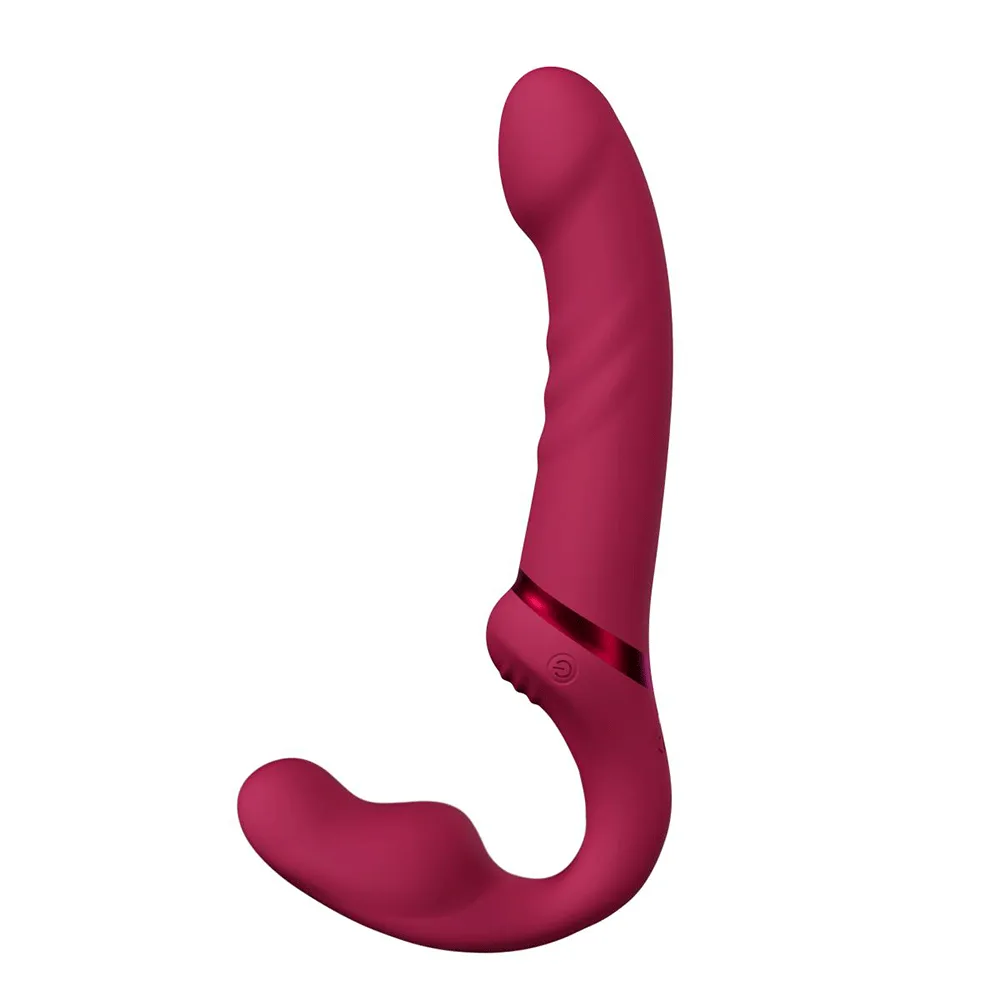
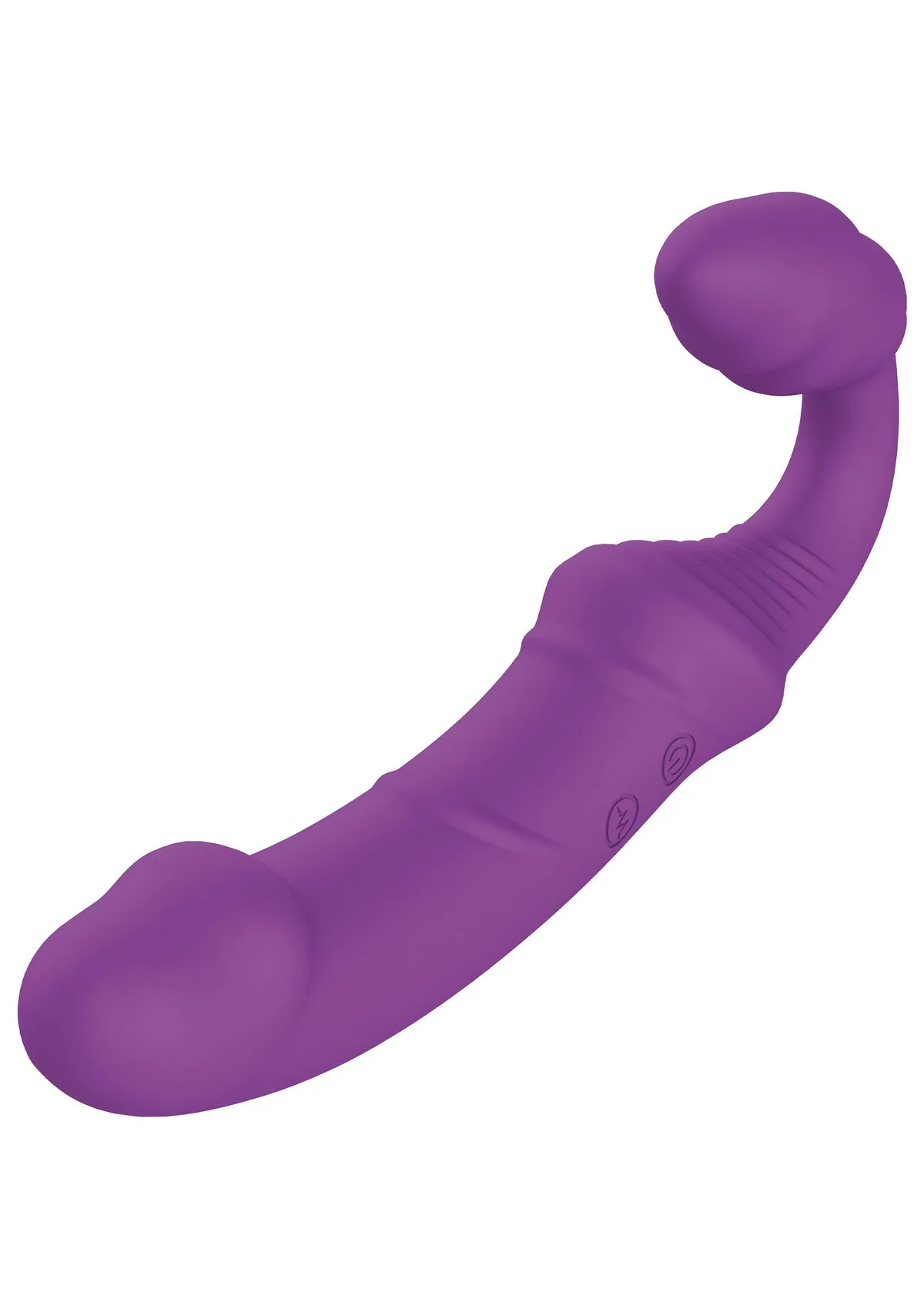
What can be determined based on the manufacturer’s own images is that the product is molded in a single piece with a clear U-shape: the long penetrating part runs straight forward, the short end bends off at almost a right angle, and between them there is a wide, ridged section that rests against the wearer’s pubic bone. Two buttons are molded into the silicone on the underside of the long section. There is no harness, no adjustment screw, and no hinge—the shape is fixed, and precisely that is crucial.
The manufacturer states there are three motors but says nothing about where they are placed. Joyland explains it: one motor at each end and one near the ridged surface toward the clitoris. It’s a store description and not a manufacturer description, but it matches how the product is shaped and that both parties are said to receive stimulation at the same time.
What three separate motors mean in practice is that the vibration does not need to travel through the entire product from a single point. On a single-motor double dildo, the motor is most often in one end, and the other end only gets what the silicone transmits—which is noticeably less, because silicone dampens. With a motor in each end, you avoid that problem. What still can’t be determined anywhere is whether the three motors are controlled separately or always run at the same time. Neither the manufacturer nor any of the five stores state whether the motors can be adjusted individually, and the manufacturer’s instruction image shows only a single vibration button on the product itself. That suggests they run in the same program, but it’s a conclusion from the visual material, not a stated, published claim.
A comparison puts the numbers into context. XOCOON Strapless Strap-On Pulse Vibe, which is sold in the same store and has the same total length, is also stated to have three motors — but only three speed settings. Lovense Lapis, the most expensive model in the category in Swedish retail, instead has app control with an unlimited number of patterns. So the number of motors matters less than you might think for how much you can actually adjust.
The material issue is the only feature of an intimate product that cannot be compensated for by experience or care, and on a plug-in product it weighs even more heavily than on an external stimulator. There’s also something to sort out here, because the sources don’t say the same thing.
The manufacturer lists a single material: high-quality, body-safe silicone. No ABS plastic is mentioned on the product page. Blush Me repeats the same information and writes "High-quality silicone" word for word. Three of the stores do the opposite: Vuxen lists "ABS + Silicone", Joyland lists "ABS-plast, Silikon", and SexleksakerOutlet writes "Silikon, ABS-plast".
This is a real contradiction between the stores, and between three stores and the manufacturer. When the store and the manufacturer contradict each other, the manufacturer carries the most weight, and the manufacturer’s statement is silicone. At the same time, it’s worth noting that an ABS listing rarely comes out of nowhere in a product flow — the most common explanation in this product category is that an internal chassis, button inserts, or the remote control casing is ABS, while all surfaces that contact the body are silicone. The manufacturer’s own images show a completely matte, seamless silicone surface across the entire product, including the two molded-in buttons, and the remote control also appears to be made of the same material.
What’s practically important is that both materials are non-porous. A non-porous surface can be cleaned, because there are no microscopic cavities where residue can get left behind, and that is the single most important hygiene feature of something that’s meant to lie against mucous membrane. The difference between all-silicone and silicone over ABS is therefore primarily tactile and mechanical — how soft the product feels and how it behaves when it’s bent — not hygienic.
Phthalates are a group of plasticizers used to make plastic — above all, flexible PVC — pliable. The Swedish Chemicals Agency (Kemikalieinspektionen) describes them as substances that can affect the hormone system and make reproduction more difficult, and several of them are therefore restricted or banned within the EU in a large number of products. Intimate products are a recurring supervisory category precisely because they consist of flexible plastic against skin and mucous membrane.
Silicone doesn’t require phthalate plasticizers to become soft. The softness comes from the polymer’s own structure, which is why a silicone indication itself is a better sign than labels like TPE or "jellygummi", which tell you nothing at all about which plasticizers are included. The manufacturer doesn’t print the word “phthalate-free” on the product page. Joyland does—and lists "Ftalat-fri: Ja" in its specification table. Again, that’s a shop claim and not a manufacturer declaration.
Toy Joy does not publish any material declaration online that explicitly excludes phthalates, BPA, or latex for this model. Instead, the manufacturer’s general manual refers to the packaging for the material list and warns the person who is allergic to any of the materials mentioned there. It’s a legitimate order of information, but the person who needs to know the material composition before buying—for example, in case of a latex allergy—gets no answer from the manufacturer’s website.
The manufacturer publishes no dimensions at all. The shops do—and for once, they all agree. Vuxen, Blush Me, and SexleksakerOutlet all state a total length of 20 centimeters and a maximum diameter of 4 centimeters. Joyland adds two details that no one else has: a penetrating length of 12 centimeters, and that the short end worn vaginally measures 10 × 3 centimeters.
The last two digits are the ones that actually determine whether the product works for you, and they’re worth paying attention to. A twelve-centimeter penetrating length is a moderate length—shorter than an average strap-on dildo—which makes sense, since a large portion of the twenty centimeters goes to the wearer’s end and to the ribbed middle section. Four centimeters in diameter, on the other hand, is in the thicker part of the range for this category.
The short end of 10 × 3 centimeters is the most underrated detail in the entire specification. It’s the part that should be held in place by the pelvic floor muscles during movement, and ten centimeters is a substantial insertion area to carry while you’re also trying to focus on something else. If it’s too small, the product slips out; if it’s too big, it becomes uncomfortable. Since the shape is firm and there’s no harness to support it, there’s also no adjustment option—the part that doesn’t fit can’t be set in.
No source publishes the weight at all—not the manufacturer and not any of the five shops. It’s a real shortcoming in a product whose entire function depends on being held in place by muscle power, because the weight is a direct part of what is supposed to be carried. For comparison, Lovense states that Lapis, a model in the same category, weighs 315 grams.
The manufacturer does not publish a written user manual for the model, but one of the images in the product gallery is a clean instructional graphic, and it is detailed enough to function as a manual. It shows two controls on the product and three on the remote control.
On the product itself there is a power button and a wave button, both molded into the silicone on the underside of the long part. According to the manufacturer’s graphics, the product is turned on and off by pressing and holding the power button for three seconds, while the wave button steps between vibration modes with short clicks. The remote control has three buttons: a power button that also requires a three-second press, an up arrow that goes to the next function, and a down arrow that returns to the previous mode.
It’s a pared-down interface, and for this type of product it’s more of an advantage than a drawback. A strapless strap-on is used while moving, often with both hands occupied, and the fewer buttons you have to find by feel in the dark, the better. That the power button requires a three-second press instead of a short click is essentially the same thing: it makes it harder to accidentally turn off the product when your body presses against the button.
The answer honestly depends on who you ask. The manufacturer specifies no number of modes anywhere—neither on the product page, in the product data, or in the two manuals that are published. Joyland states "10 different steps" in its specification table. The other four stores state no number at all and only write that the vibrations can be adjusted with the remote control.
So ten modes is a store claim from a single source. It’s entirely plausible—the product is stepped through with one button, and the remote control has a forward and a backward arrow, which is exactly the kind of interface you’d build for a fixed list of programs—but it should be read as just a store claim. What can be concluded from the manufacturer’s own graphics is that the modes are a closed list that is stepped forward and back, not two separate controls for strength and pattern.
The comparison with nearby models is illuminating. XOCOON Strapless Strap-On Pulse Vibe has, according to Vuxen, three speed modes, which is significantly fewer. Lovense Lapis has no fixed modes in the usual sense; it is controlled via an app with an unlimited number of patterns. Nymphea is in between: more steps than the simpler model, but a fixed list with no ability to create your own.
The remote control is the product’s clearest design choice, and at the same time it’s the part that’s worst documented. The manufacturer confirms that it is included and what the three buttons do. Beyond that, nothing is published.
The range is not stated, the transmission technology is not stated, and the remote control’s battery type is not stated — either by Toy Joy or by any of the five stores. The only thing that can be inferred is that the transmission is wireless and radio-based: the manufacturer’s general manual includes a section about radio equipment and states that products with wireless functions meet the requirements of Directive 2014/53/EU, the Radio Equipment Directive. The manual also refers here to the packaging for the product-specific radio specifications.
The fact that the remote control’s battery type is not published is the missing piece of information that matters most. For most products in this price range, the remote control is powered by a button-cell battery that cannot be recharged and is not always easy to replace, while the main product is rechargeable. Toy Joy’s general manual includes an entire section about button-cell batteries — that they should be kept away from children and that swallowing requires immediate medical care — which shows that such batteries are present in the range, but it says nothing about this particular model. Count on getting the answer from the packaging, not before the purchase.
A strapless strap-on rises and falls on whether it stays in place. It’s not an opinion but a design requirement: without a harness, there’s only the musculature for attachment, and the manufacturer puts it that way itself by describing the design as ergonomic and self-supporting for hands-free use.
What can be determined from the measurements is that Nymphea has a relatively large carrying end — 10 × 3 centimeters according to Joyland — and a wide, ridged midsection that, according to the manufacturer’s images, rests against the carrier’s body. The broad contact surface is an advantage for stability because it distributes the pressure and provides the product with a second support in addition to the insertion part. On the other hand, the entire construction is cast in one piece without joints, which means the angle between the two ends is fixed. If that angle matches your anatomy, the product will work; if it doesn’t, there’s nothing to adjust.
So two things are worth factoring in. First, water-based lubricant is necessary even on the carrying end, not just on the penetrating one — the manufacturer’s manual states water-based and explicitly warns that oil- and silicone-based lubricants can damage the materials. Second, a strapless strap-on generally requires that the wearer can actively tense the pelvic floor muscles. That’s a skill you can build up, but the first use shouldn’t be planned as a test.
Enclosure class is the piece of information where the sources differ the most, and where the difference between the wording actually matters for how the product can be handled.
The manufacturer does not state any ingress protection rating at all for Nymphea. The product page does not mention water, and the general manual refers to the packaging for the water-resistance rating. Joyland states IPX7 in its product text. Vuxen writes “100% waterproof” and “Waterproof: Yes,” but does not provide a rating. Blush Me and SexleksakerOutlet say the product is waterproof and suitable for showering or bathing as well, also without any rating label.
The difference between those formulations is not cosmetic. IPX7 is a defined class in the international standard IEC 60529 and means that the product is tested for submersion in water to a depth of one meter for 30 minutes. “100% waterproof” is not a class at all but a marketing phrase, and it cannot be verified against any standard. The reference model XOCOON Strapless Strap-On Pulse Vibe shows why it matters: it is listed as IPX5, which according to the same standard only covers water jets and explicitly not submersion. A product that is IPX5 can be rinsed off but not immersed.
So what can be established is this: one store states IPX7, the manufacturer does not confirm it, and the manufacturer’s own manual says that products without an ingress protection rating must not be exposed to water. The reasonable approach until the packaging is opened is to rinse the product under running water but to refrain from bathtubs and submersion. The manual also points out that even waterproof products may only be submerged when all charging ports and covers are fully closed—and Nymphea has an open DC port on the underside, which makes that point directly relevant.
The manufacturer’s instructions are brief but clear. The product should be cleaned both before and after each use, with lukewarm water and mild soap or a cleaning agent intended for intimate products. It should be completely dry before it is put away, and it should be stored dry, dust-free, and at room temperature without direct sunlight.
One detail in the manual that rarely appears in store texts: products should be stored separately from each other to avoid chemical reactions between different materials. Toy Joy suggests a small box or a satin pouch. This is not overdoing it—molded plastic and silicone can react with each other during longer contact and create sticky surfaces that cannot be salvaged.
The lube question is settled in the manufacturer’s own text: use water-based. Oil- and silicone-based lubricants can damage the materials. On a silicone product, this is not just a precaution but a materials issue—silicone-based lube breaks down the silicone surface over time and makes it porous, and a porous surface can no longer be cleaned properly, only replaced. Oil-based products such as coconut oil also leave behind a film that is difficult to remove.
Two warnings belong here, both from the manufacturer’s general manual. The product must not be heated, frozen, or exposed to temperatures above 45 degrees, which rules out boiling and dishwasher use regardless of whichever ingress protection class is printed on the box. And the one with an integrated medical device, for example a pacemaker, should consult a doctor before use — the manual specifically notes that products with magnetic charging contacts can interfere with certain implants.
The manufacturer states that the product is rechargeable via USB. That is the entire published battery specification. The stores add nothing: Blush Me states “Charging type: USB”, Vuxen states “Rechargeable”, Joyland states “Rechargeable via USB” — but none of them provides a figure.
The manufacturer’s instruction image provides more information than the product text. It shows a small round socket on the underside of the long part, labeled DC, and a cable that connects to it. The image also indicates what the lights mean: a blinking light while charging, and steady light when the battery is full.
A DC socket is not the same thing as USB-C on the product. It means that the cable has a product-specific end for the toy and a USB end for the charger, and the manufacturer’s manual for rechargeable products is explicit: only the included USB charging cable may be used, since another cable can damage the product. Practically, that means a lost cable can’t be replaced with your phone’s charging cable. It’s a real difference versus a model that charges directly via USB-C, and one of the clearest downsides in this specification.
The manual adds three instructions worth following: never charge the product in or near water, do not charge a damaged product, and charge regularly also during periods when the product isn’t being used. The last one applies to all lithium-based cells — a cell that’s stored completely discharged loses capacity faster than one that’s kept partially charged.
Toy Joy does not publish run time, charging time, battery capacity in mAh, or the battery type for the Nymphea. None of the five Swedish stores does either. The general manual refers to the packaging as well for the battery type. That means it isn’t possible to convert the specification into any usable figure: how long the product runs on a charge, how long the charging takes, and how heavily the cell is loaded by three motors at the same time are simply unknown details before purchase.
It’s worth putting this in context, because the competitors do things differently. Lovense specifies a lithium-polymer battery for the Lapis: up to 156 minutes of operating time, 105 minutes of charging time, and up to 120 hours of standby — four figures where Toy Joy has zero. The price difference is, of course, significant, but the published data costs nothing to print, and three motors on an unknown cell is the single biggest uncertainty in the entire product.
What you can still establish, in general terms: the product has a built-in cell that is not described as replaceable, the manufacturer’s environmental section states that the product and its batteries should be collected separately for electronics, and a product of this type is, in practice, used up once the cell is. With three motors that can run simultaneously, you should expect the runtime at the highest setting to be substantially shorter than at the lowest — how much shorter it is cannot be answered without a published capacity.
We do not have price data from shops in your market yet.
The manufacturer does not publish measurements, weight, runtime, charging time, or an IP rating—and refers to the packaging, that is, after purchase.
Three comparisons are relevant: versus Toy Joy’s own selfria base model, versus the closest competitor in the same price range, and versus the most expensive model in the category in Swedish retail. All specifications below come from the respective manufacturer’s own information or from named stores, and the comparison prices are taken from the stores’ product pages on September 12, 2026.
Toy Joy has a simpler strapless strap-on in its lineup: Get Real Bend Over Boyfriend, EAN 8713221832979. It’s made of silicone, measures 23 centimeters, and costs 39.99 euro in the manufacturer’s own store. Nymphea costs 67.99 euro in the same store. The difference is 28 euro, i.e. about seventy percent markup.
What that money buys is unequivocal: Bend Over Boyfriend has no motor and no remote control at all. It’s a purely mechanical product. Nymphea has three motors, a wireless remote control, a rechargeable battery, and the ridged clitoris surface between the ends. In return, Bend Over Boyfriend is three centimeters longer overall and has nothing that can break electrically — it never needs charging, can’t lose a cable, and has no battery that ages.
The conclusion is simple and applies to the entire product category: if you want vibration, the added cost is unavoidable, but if you only want the strapless strap-on function, the cheaper model is a completely reasonable way in — especially if you’re unsure whether the fit works for you, because that question determines everything else.
XOCOON Strapless Strap-On Pulse Vibe is the closest competitor on the store shelf. According to Vuxen, it costs 622 SEK versus Nymphea at 679 SEK as the cheapest in stock — a difference of 57 SEK. The dimensions are strikingly similar: 20 centimeters total and 4 centimeters in maximum diameter, i.e. exactly the same as Nymphea.
That’s where the similarities end. XOCOON is stated to have three motors but only three speed settings, compared with the ten settings Joyland lists for Nymphea. On the other hand, the store provides more about XOCOON: an insertable length of 17.5 centimeters, a minimum diameter of 2.5 centimeters, and a clearly stated ingress protection class — IPX5. Nymphea has a longer published settings list but leaves both the minimum diameter and the ingress protection class unanswered by the manufacturer.
The IPX5 information is at the same time XOCOON’s clearest weakness and the most illuminating thing in the entire comparison. IPX5 covers water jets according to IEC 60529 but not submersion. That a closely related product explicitly stops at IPX5 is a reason to be cautious about the single store detail that gives Nymphea IPX7 — the two models are built for the same use, and one of the manufacturers has obviously not considered itself able to promise more than splash protection.
Lovense Lapis is the category’s most expensive model in Swedish retail. Vuxen lists it at 2 595 SEK, i.e. 1 916 SEK more than Nymphea at the cheapest in-stock price. For that money, you get a product where every specification line is actually filled in.
Lovense lists silicone, a weight of 315 grams, a lithium polymer battery, ingress protection class IPX7, up to 156 minutes of operating time, 105 minutes of charging time, and up to 120 hours of standby. The delivery includes the product, a USB charging cable, and a manual. Control is via an app, which provides an unlimited number of vibration patterns instead of a fixed mode list, and makes remote control over the internet possible.
The differences that actually matter: Lapis publishes operating time, charging time, weight, battery type, and ingress protection class — five pieces of information where Toy Joy publishes zero. In return, Nymphea has a physical remote control in the package, which someone who doesn’t want to install an app or pair a phone in the middle of the act may see as an advantage rather than a limitation. But the price is almost four times as high, and the one who chooses Lapis pays as much for disclosed data as for the technology.
Five Swedish stores sell the item with EAN 8713221837523. Cheapest in the listings is Sexonic at 605 SEK, most expensive is Vuxen at 749 SEK. That’s 144 SEK, or just under 24 percent difference for exactly the same item number, the same color, and the same packaging — a significantly tighter spread than in many other product categories, which usually indicates that the model is relatively new and that stores haven’t yet started competing with it.
The stock situation, however, changes what the numbers mean. Sexonic, which has the lowest price, was the only one of the five stores that did not have the product in stock at the price check. The cheapest store where the item was actually possible to buy was Blush Me at 679 SEK, followed closely by SexleksakerOutlet at the same price, Joyland at 695 SEK, and Vuxen at 749 SEK. So the actual price spread among the available stores is 70 SEK, not 144.
One price point is worth noting for context: the manufacturer’s own store lists the model at 67.99 euro, and Sexonic states the same list price with a campaign price of 55.07 euro. That provides a useful reference for what a Swedish price should be, and the Swedish prices of 605 to 749 SEK are in line with it.
The prices in the table above are updated when the stores’ product flows are updated, but always check the final price at checkout. Shipping costs are added by most stores under a certain order value, and in this price range all of the stores are below the free-shipping threshold at several of them—which can eat up the entire difference between the cheapest and the most expensive.
It fits couples who want a strapless strap-on where both get stimulation at the same time, and who want to do without a harness. Three motors and a ridged clitoral surface mean that the wearing partner is not just the one who does something, and the remote control means that the settings can be changed by any one of you without anyone needing to go looking for a button. It also fits you who prefer a physical remote control over an app, and who want a silicone product in the lower part of the seven-hundred-kronor price range rather than a premium model for three times the price.
It’s not for you if you want to know what you’re buying before you open the box. The manufacturer does not publish any dimensions, weight, runtime, charging time, battery capacity, enclosure class, or number of positions, and the figures that do exist come from stores that partly contradict each other about the material. It’s also not for you if you want to be able to charge with the same cable as your phone—the charging connector is a DC port, and the manufacturer expressly advises against other cables than the one included. And it’s not for you if you plan to use the product in the bathtub, because the enclosure class has not been confirmed by the manufacturer.
One more thing belongs in the decision, and it’s more important than any single specification line. A strapless strap-on without a harness only works if the fit is right, and that question can’t be solved with data. The supporting end is given as 10 × 3 centimeters, and the fixed angle between the ends is given — they can’t be adjusted, replaced, or added. If you’re unsure whether the design works for you, that’s an argument for starting with a cheaper model of the same type, Toy Joy’s own Bend Over Boyfriend, before you pay for three motors and a remote control that you may never get any joy out of.
Here’s the answer, short and to the point, and it’s one of the things a buyer should know before placing the order. Toy Joy does not provide any voluntary manufacturer warranty with the specified length for this product. The company’s general manual explicitly states that the product is covered by the statutory warranty and that it covers material and manufacturing defects during normal use. Normal wear and tear, accidents, improper use, lack of maintenance, changes you make yourself, and damage that results from not following the instructions are excluded. A receipt is required when making a claim.
This differs from several brands in the category, which add their own warranty on top of the law. For you as a consumer in Sweden, it matters less than it sounds, because the law provides solid protection on its own — but that also means there’s no extra time to fall back on once the statutory period has expired.
Under konsumentköplagen, you have three years to make a complaint for defects in the goods, regardless of what the manufacturer promises. In distance selling, you also have a right of withdrawal for fourteen days under lagen om distansavtal och avtal utanför affärslokaler. Be aware that in practice, the right of withdrawal is limited for hygiene products that have been taken out of a sealed package — however, the right to complain for defects always applies. If you have questions about what applies in your case, Konsumentverket guides you via Hallå konsument.
The manufacturer behind the product is TOYJOY, with the address Bijsterhuizen 3151, 6604 LV Wijchen in the Netherlands, a registered trademark belonging to SCALA 2.0 B.V. That’s the information you need if a warranty case needs to be handled beyond the store, and it can be found in the manufacturer’s own manual rather than on the product page.
Toy Joy Designer Edition Nymphea Vibrating Strap-On is ranked på plats 6 av 12 in strap-on best i test, where the entire category is compared against each other using five shared criteria. Guiden vinns av Lovense Lapis.
Every numerical piece of information in the text can be traced to one of the sources below. The links were checked manually on the specified date.
This page is machine-translated from Swedish. Read the Swedish original