

Review
Review: Satisfyer Pro 2 Next Generation
Cheapest among the widely sold — 219 SEK and a 15-year warranty.
29 July 2026
 Author's pick
Review · Strapless strap-on · App-controlled
Lovense app-controlled strapless strap-on reviewed against the manufacturer’s own packaging print, the manufacturer’s dimension graphic, and specification sheets from three Swedish resellers. Three motors, seven patterns, 230 millimeters total length, 138 and 87 millimeters insertable at each respective end, IPX7 according to IEC 60529, and a one-year warranty — at a price with a 161 percent difference between the cheapest and most expensive store.
The only Selfri strap-on in the comparison with both three motors and full app control, and the only one where the stimulation goes both ways at the same time. The manufacturer’s dimension graphic is unusually open—insertable length is shown separately for both ends. What you pay for is a runtime of 58 minutes at full power versus 105 minutes of charging time, a one-year warranty that’s short for the category, and a manufacturer whose specs page can’t be fetched programmatically.
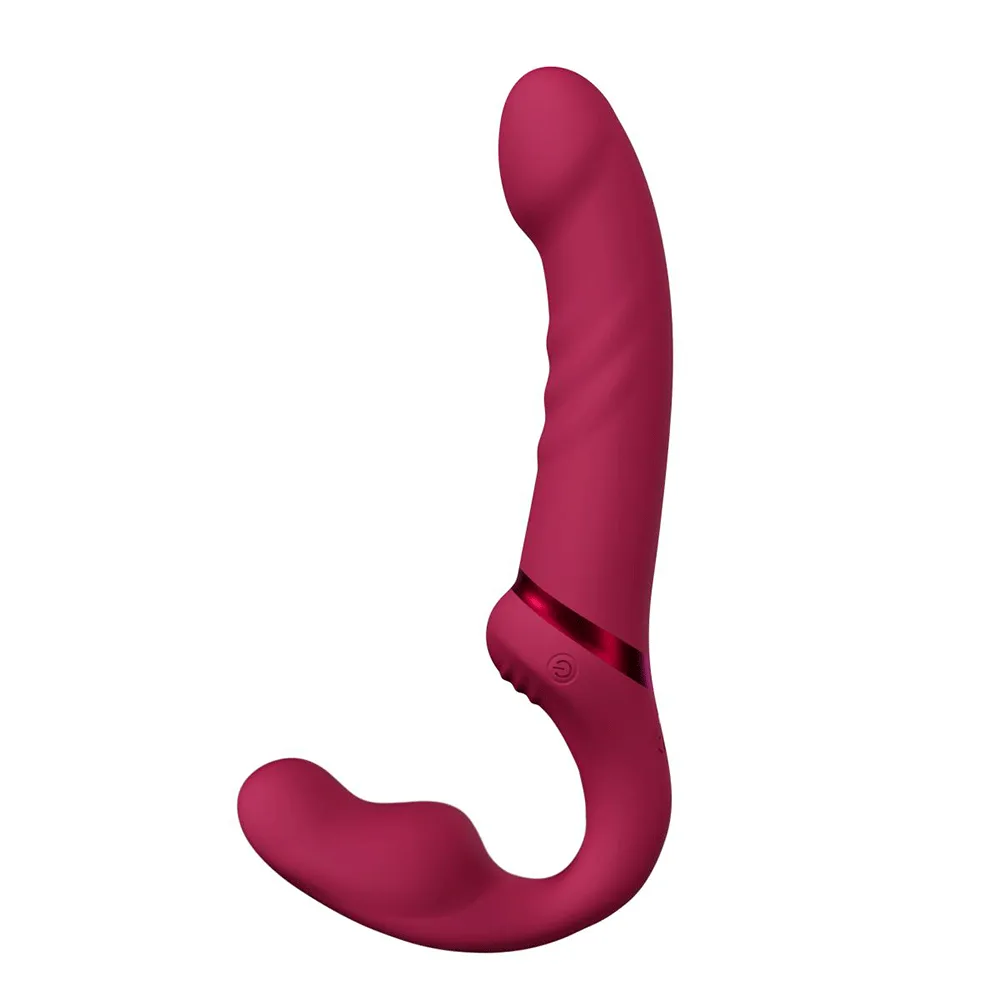
Lovense Lapis is a vibrating strapless strap-on with app control. The manufacturer describes it on the back of the packaging as a Bluetooth dual-ended vibrating strapless strap-on — meaning a double-ended, harness-free strap-on with Bluetooth. It consists of two connected parts in one piece of silicone: a long, ridged arm that is used for penetration and a shorter bulb part that the wearer keeps in place inside them. Between them is a flexible neck and a control ring with the product’s only button.
The specification looks like this. The manufacturer’s own dimension chart states a total length of 230 millimeters, an insertion length of 138 millimeters on the long arm, an insertion length of 87 millimeters on the bulb part, and 41 millimeters as the largest circumference. The weight is given by several Swedish retailers as 315 grams. The product has three separate motors, seven vibration patterns with button control, and an enclosure rating of IPX7. The charging time is listed as 105 minutes, the operating time as up to 156 minutes on the lowest setting, and up to 58 minutes on the highest. The packaging states a one-year manufacturer’s warranty. In Sweden, the item is sold by seven stores at prices between 995 and 2,595 SEK, and five of them have it in stock.
The review is about the pink variant with EAN 6972677430227. The number can be checked directly against the barcode on the back of the packaging in Lovense’s own print, and all seven stores in the price comparison list the item under the same number. There is therefore no risk that the price comparison below mixes up two colors or two generations, which otherwise is common in this category.
A note about the sources belongs here already, because it affects how the text is written. Lovense’s own website responds with HTTP 429 to automated requests—the entire domain is behind a Cloudflare challenge that blocks all automated retrieval, including robots.txt. The page exists and works in a normal web browser, but the specification table can’t be quoted directly from there. The numerical information below instead comes from two parts of Lovense’s own material that retailers publish in original— the packaging print and the manufacturer’s dimension chart— as well as from specification sheets from three large Swedish retailers. Where the information comes from is shown every time it is mentioned.
A typical strap-on hangs in a harness around the hips. A strapless strap-on has no harness at all. Instead, it’s kept in place by the wearer inserting the shorter bulb part vaginally and holding it there with the pelvic floor muscles, while the longer arm points forward and is used for penetration. The entire product is one piece, so all movement in the outer arm transfers to the bulb and vice versa.
That’s the fundamental difference from a harness-worn model, and it has two sides. The obvious advantage is that the stimulation goes in both directions: the wearer gets movement and vibration inside themselves at the exact same moment as the partner does, which is difficult to achieve with a harness where the dildo sits in a plastic ring without contact with the body. The equally obvious disadvantage is that nothing other than muscle effort keeps the product in place. It’s not a design flaw—it’s how the product category works—but it’s the single most common reason a strapless strap-on ends up lying in the box.
Lovense addresses it in two ways that can be read from the construction. The bulb part is 87 millimeters long and 38.5 millimeters wide according to the manufacturer’s dimension graphic, meaning it’s significantly more than a small plug — there’s surface area to brace against. And the neck between the two arms is flexible, which the manufacturer describes in its own user material as something you adjust to get the right angle. What can be established is that the construction is made to be shaped to fit the body rather than the other way around. How well it works depends on anatomy and how much pelvic floor control you have, and it’s nothing that a specification can answer.
Lovense’s lineup is large, and the names rarely tell you anything about the shape. Three models show up side by side in Swedish stores and are often mixed up, even though they solve completely different problems.
What links them is the ecosystem, not the shape: same app, same magnetic charging cable, and the same option for remote control. If you want something to wear discreetly, Lush is the right track. If you want something two people use together in the same moment, Lapis is the only one of the three that’s built for that.
The material issue is the only property of an intimate product that neither experience nor care can compensate for, and it determines whether the product is still hygienic after five years. Lapis is listed as silicone by all Swedish resellers, and Lovense’s own packaging bears the marking Body-Safe. Joyland’s specification sheet also explicitly states that the silicone is phthalate-free.
Silicone is non-porous. A non-porous surface can be cleaned because there aren’t microscopic cavities where residue can remain. It’s the single most important property of a material that’s meant to lie against mucous membranes, and that’s why the material row in a specification weighs more heavily than almost everything else in the table.
On Lapis, the choice of materials has an extra consequence that doesn’t apply to a standard vibrator. The product is used by two people at the same time, with one end inside one body and the other end inside the other body. That makes it a product where cleanability isn’t just about durability, but about shared use — and it’s exactly in that situation where a porous surface becomes a real problem rather than a theoretical one. Lovense’s own usage images recommend a condom on the outer arm, which is a reasonable piece of advice for the same reason.
The construction is a single piece of silicone over the entire body, with the exception of the control ring in glossy plastic where the button sits. That means there’s no seam between a soft head and a hard shaft where dirt can collect, which is a real difference compared with cheaper models. The ring is also the only point on the product where two materials meet, and that’s where you should look for wear over time.
Phthalates are a group of plasticizers used to make plastic—especially softened PVC—flexible. The Swedish Chemicals Agency describes them as substances that can affect the endocrine system and make reproduction more difficult, and several of them are therefore restricted or banned within the EU in a large number of products. This product category is recurring subject to supervision because it contains softened plastic against mucous membranes.
Silicone doesn’t need phthalate plasticizers to become soft—the softness comes from the polymer’s own structure—and that’s why listing silicone as the material in itself is better information than terms like "TPE" or "jelly rubber," which don’t say anything at all about which plasticizers are included.
But here the text has to be honest about what can actually be substantiated. Lovense does not publish a material declaration for Lapis that can be retrieved and quoted, because the entire website is unavailable for machine retrieval. What is available is the Body-Safe labeling on the packaging and a phthalate-free claim in Joyland’s specifications sheet—in other words, a retailer statement, not the manufacturer’s own writing. Compare that with We-Vibe, which on its product page for Sync 2 states that the material is produced without phthalates, BPA and latex. This difference in openness isn’t cosmetic: the latex information is crucial for someone who is allergic to latex, and it isn’t published for Lapis at all.
The manufacturer’s own measurement graphics are unusually detailed and meant to be read carefully. They list a total length of 230 millimeters, an insertable length of 138 millimeters for the long arm and 87 millimeters for the bulb section, 120 millimeters for the shaft above the neck, 41 millimeters as the largest girth, and 38.5 millimeters over the bulb. That the manufacturer breaks out insertable length separately for both ends is more than most people do, and it’s precisely those two figures that determine whether the product fits.
The weight is given by Blush Me and Joyland as 315 grams. This is a retailer specification and not taken directly from Lovense, but the two shops state the same figure independently of each other, and the order of magnitude is reasonable for 230 millimeters of solid silicone. For comparison, Fun Factory lists 433 grams for its Share Lite, which is 252 millimeters long and has no electronics at all. So Lapis is both shorter and lighter than the most well-known competitor in this format, even though it contains three motors and a battery.
What the weight means in practice is worth a few lines, because it works differently here than on a handheld product. On a strapless strap-on, the entire weight hangs in the pelvic floor. 315 grams isn’t much in your hand, but it is measurable when muscle work is what keeps it in place, and it’s one of several reasons why this type of product has a learning curve. The 118 grams that separate it from Share Lite are therefore a truly relevant figure and not just a detail in a table.
The 41-millimeter girth corresponds to roughly a 13-centimeter circumference, placing it in the upper mid-range among dildos—noticeable, but not extreme. The ridged surface of the shaft, according to the shop descriptions, is intended to both provide extra sensation and spread the vibrations along the arm. The manufacturer publishes no measurement for the depth of the ridges, and it’s not a number that would say all that much anyway.
The interface on the product itself is as simple as it gets: one button, placed on the control ring between the two arms. Lovense’s own measurement graphics put the label "ON/OFF 7 Patterns" right next to it, and Vuxenkul’s specification sheet likewise lists seven vibration modes. In practice, that means you step through seven pre-set patterns with repeated presses and turn it off with a long press—the usual pattern for products in this category.
Having only one button is a deliberate choice and not a cost-saving. The button sits on a product that, during use, is between two bodies, where no one can see it and no one has a free hand nearby. More buttons wouldn’t have made it easier to control. The real interface is instead the app, and that’s where the model’s functions actually are.
Both Joyland and Vuxenkul state that there are three separate motors. That’s more than on most strapless strap-ons, and that explains what Lovense means with the wording that the Lapis provides stimulation of the G-spot, P-spot, and C-spot—three stimulation points require motors in three places, because silicone effectively damps vibrations over distance. A single motor in the middle would have provided strong vibration at the ring and almost nothing at the tips.
What can be established purely from a technical standpoint is that a multi-motor design in a product of this length is a prerequisite rather than a luxury. 230 millimeters is long, and the vibration damping through massive silicone is significant. What the manufacturer, however, inte publishes is the motors’ placement in millimeters, their power, or whether they can be regulated independently of each other in the app. The retailer descriptions only state the number.
Also note what three motors do to the battery. The runtime at the highest setting is stated to be up to 58 minutes, versus up to 156 minutes at the lowest—2.7 times between the outer modes. That’s an unusually large range, and it’s exactly what you’d expect when three motors can run simultaneously at full power. The number that matters for a couple’s product is the lower of the two.
The back of the packaging states that the Lapis syncs with the Lovense Remote app, available via the App Store and Google Play. Joyland’s specification sheet lists the system requirements: iOS 14.2 or later, Android 5.0 with Bluetooth 4.0, and a Mac or Windows PC with a USB-B Bluetooth adapter. The fact that desktop support exists at all is unusual in this category and is relevant for long-distance use, where one partner often sits at a computer.
App control is the feature that justifies the price difference compared to a simple vibrating strapless strap-on. With the app, the patterns can be controlled by the person who inte is wearing the product, which is a meaningful difference specifically for a couple’s product: the only button is located somewhere where no one can reach it, while a phone can be placed next to it. It’s also the only way to access the functions that are outside the seven built-in patterns.
A reservation is also needed at the same time. Lovense does not publish an accessible technical specification for the Bluetooth version or the range in meters. The only thing stated is that the Android side requires Bluetooth 4.0, which is a requirement for the phone and not a statement about what’s inside the product. Range at close distance is thus not something you can plan for in advance—and an app-controlled product whose radio specifications aren’t published is a product where you have to rely on the brand instead of on a datasheet.
The back of the packaging states that the product is intended for solo use, use up close, and control over distance. Long-distance control does not work via Bluetooth, but via the internet: the phone next to the product keeps the Bluetooth connection, and the Lovense service connects that phone with a second user somewhere else. What can be established is that the function therefore requires a working internet connection at both ends and that it passes through the manufacturer’s servers.
It’s worth being aware of before buying, for two reasons. The first is practical: the delay over the internet is not zero, and the function depends on a service from the manufacturer continuing to run. The second is principle: a product that communicates via a third party’s servers is a different kind of product than one that only talks via Bluetooth with the phone next to it. If you don’t need the long-distance function, the app can be used only for close-range mode, and the seven patterns work completely without a phone.
This is the section that determines whether the product actually gets used, and it’s also the part that you can read the least out of from a specification. What can be established is the following: the bulb part is 87 millimeters long and 38,5 millimeters wide, the neck between the arms is flexible, and the entire construction is one piece.
The flexibility of the neck is the design detail that makes the biggest difference. On a rigid double dildo, the angle between the two arms is determined once and for all in the shape, and if it doesn’t fit your anatomy there’s nothing you can do about it. Lovense’s own user manual images explicitly show that the neck should be adjusted to set the penetration angle, and that the bulb end is inserted first.
The result is twofold. The advantage is obvious: the same product can work for more bodies, and the angle can be changed between positions. The disadvantage is just as real: a flexible neck gives way under pressure. The more flexible the connection is, the more of the force during penetration is taken up by the neck instead of going forward, and the more work the pelvic floor has to do to resist. It’s a design trade-off that every strapless strap-on has to make, and there’s no way around it.
A practical tip that follows from the construction: a separate harness or a pair of tight panties worn over the product solves the problem for anyone who thinks it slips. It reduces some of the point of a selfri model, but it’s a common and working approach and it affects neither vibration nor material.
Lovense’s own usage images state three steps in order: put on a condom, apply lubricant, and adjust the neck. The condom area is worth taking seriously for this product type, because it’s used by two people at the same time and because a condom also makes cleaning the outer arm substantially easier.
The choice of lubricant follows the usual rule for silicone: use water-based. Silicone-based lubricant should not be used on silicone products—it breaks down the silicone surface over time and makes it porous, and a porous surface can no longer be cleaned properly; it can only be replaced. Oil-based products such as coconut oil leave a film that’s hard to remove and also break down latex condoms. That combination—condom plus oil-based lubricant—is particularly unsuitable here.
Cleaning is helped by the IPX7 rating: the entire product can be rinsed under running water with lukewarm water and unscented soap or a cleaning product intended for intimate products. Wipe it off and let it air-dry before putting it away. The storage bag included in the package is not just a nice detail—silicone attracts dust and lint, and a bag means the product also doesn’t need to be rinsed off before every use.
Lovense labels the package with Waterproof and the IPX7 symbol. Blush Me and Joyland state the same rating in their specification sheets. The rating comes from the international standard IEC 60529, which defines enclosure classes for electrical equipment. The number 7 in the second position means that the product is tested for submersion in water to a one-meter depth for 30 minutes.
One deviation should be pointed out straight out, because it’s present in the Swedish price data. Vuxenkul’s product page states “Waterproof: No” in its own facts table, which is contradicted by both the manufacturer’s package printing and the specification sheets of two other retailers. The manufacturer’s own labeling carries more weight than a shop’s field entry, but it’s worth knowing about if you read that page and feel unsure.
The difference from a splash-proof product is greater than the wording suggests. Splash protection covers water droplets and, at best, water jets, but not submersion. Such a product handles a damp cloth and possibly a shower, but not a bathtub, and it shouldn’t be held under running water—use some common sense about the button and the charging contact.
With IPX7, the entire product can be rinsed off without being careful. For Lapis specifically, that’s especially relevant for two reasons: the control ring with the button is the only seam in the construction, and it would be the weak spot on a product that’s not as well sealed, and the product is used in a way that makes careful cleaning a requirement rather than a wish. If a product lacks an IPX rating entirely, it should be treated as not waterproof—the absence of a rating is never a sign that the product is approved.
Blush Me states the charging time as 105 minutes, the operating time as up to 156 minutes on the lowest setting and up to 58 minutes on the highest, and the standby time as up to 120 hours. Joyland states the battery time as up to 2.5 hours, which is close to the 156 minutes and therefore refers to the lowest setting. All of these are retailer details, not taken from Lovense directly, but the three figures are internally consistent.
What can be established is that the charging time of 105 minutes is almost twice as long as the operating time of 58 minutes on the highest setting. This isn’t, in itself, a disapproval—58 minutes at full power is more than enough for the use the product is made for—but it means that Lapis isn’t a product you charge between two occasions the same evening. Charge in advance. For comparison, We-Vibe states up to 120 minutes of operation and up to 90 minutes of charging for Sync 2, meaning both longer runtime at maximum power and shorter charging.
With a magnetic USB charging cable. Joyland explicitly states the charging method, and Lovense sells the cable separately as Lovense Magnetic Charger USB for 169 SEK in the Swedish price data—the compatibility list for that cable lists Lapis along with, among others, Edge 2, Ferri, Gravity, Hush 2, Lush 3, Nora, and Ridge.
Magnetic charging is a trade-off, not a pure advantage. The advantage is that no opening is needed in the housing, which makes it easier to achieve IPX7 without a rubber plug—and for a product that’s meant to be rinsed off after every use, that’s a real design win. The downside is that the cable is product-specific: if you lose the charging cable, no regular USB-C cable works, so you have to get a replacement. The good news is that the cable is shared across almost the entire Lovense range and that a replacement can be bought in a Swedish store for 169 SEK, which is significantly better than being limited to imports.
No available source publishes the battery’s capacity in mAh or its voltage for Lapis— neither Lovense’s packaging print, the manufacturer’s size diagram, nor any of the three Swedish spec sheets. Without the capacity, you can’t convert runtime into power consumption, and you can’t compare how hard the cell is being stressed between models. With three motors and a range of 58 to 156 minutes, that number would have been more informative here than on a product with a single motor.
What generally applies to lithium-ion batteries also applies here: capacity drops with the number of charge cycles, the cell isn’t replaceable in a fully molded silicone body, and the product does best when it’s charged regularly instead of being stored fully discharged. With use a couple of times a month, it’s the battery—not the silicone—that sets the limit for lifespan—and because an IPX7-sealed product can’t be opened without destroying the seal, the product is, in practice, used up when the cell is.
The question of how loud the Lapis is has a short answer, and it has to be honest: no available source publishes a measured decibel value for Lovense Lapis. The packaging says "Super-Powerful" but gives no sound measurement, the size diagram doesn’t address the issue, and none of the Swedish spec sheets gives a number. Websites that list an exact decibel value for the model either report their own measurement or a value without a source.
What can be established, however, is the construction. Three motors embedded in solid silicone is a damping design in itself—the silicone that dampens the vibration on the way to the tips also dampens the sound on the way out. At the same time, three motors are three sound sources, and a product used between two bodies has a lot of soft material around it during operation, which further dampens the sound. This is reasoning, not measurement, and it should be read as such. A practical tip that applies regardless of the model: place the product on a soft surface between uses, since a hard tabletop works like a resonance box.
We do not have price data from shops in your market yet.
Same EAN, same color, same packaging — and 1 600 SEK between the cheapest and the most expensive store. Both had it in stock.
Three comparisons are relevant: against the most well-known selfria strap-on without electronics, against the app-controlled partner product that solves the same problem in a different way, and against Lovense’s own best-selling model. The competitors’ specifications come from each manufacturer’s own product pages, and all prices come from the stores’ product feeds on July 29, 2026.
Fun Factory Share Lite costs from 599 SEK and is the classic self-friendly strap-on in body-friendly silicone. Fun Factory states 252 millimeters total length, 115 millimeters width, 44 millimeters height, and a weight of 433 grams, and describes the model as 22 percent lighter than the original Share model. It is completely waterproof. It doesn’t vibrate.
So the difference isn’t gradual but rather fundamental. Share Lite is a piece of silicone without a battery, without motors, without an app, and without anything that can fail electrically. Lapis has the same basic shape with three motors, Bluetooth, and a built-in battery, for 396 SEK more. Lapis is also shorter — 230 vs 252 millimeters — and 118 grams lighter despite the electronics.
The conclusion is more direct than the price tag suggests. If you’re unsure whether the format works for you at all, Share Lite is a cheap and durable way to find out, and it has no battery that degrades. If you know that the format works and want vibration for both partners as well as the option to let your partner control it, there’s no way to get there via Share Lite — then the 396 SEK is what that feature costs.
We-Vibe Sync 2 costs from 1 295 SEK, so it’s 300 SEK more than Lapis at its cheapest. Both are app-controlled couple products, both are IPX7, both are intended to be used by two people at the same time. That’s where the similarities end.
Sync 2 measures 41.7 × 74.8 millimeters and is worn inside by one of the partners during intercourse, with one arm against the clitoris and one against the G-spot. It therefore doesn’t replace anything — it’s placed on top. We-Vibe states body-friendly silicone without phthalates, BPA, and latex, a rechargeable lithium-ion battery, runtime of up to 120 minutes, charging time of up to 90 minutes, ten intensity levels, remote app control, and a two-year warranty in three colors.
The differences that actually matter: Sync 2 has a longer runtime at maximum power (120 minutes vs 58), a shorter charging time (90 vs 105 minutes), double the warranty (two years vs one), and a fully written materials declaration that also covers latex. Lapis, on the other hand, has a completely different use — it is the penetration, not an add-on to it — three motors instead of two, and a 300 SEK lower entry price. If you choose based on the stated data and warranty, We-Vibe wins. If you choose based on what the product actually does, there’s no competition: they solve different problems.
Lovense Lush 3 costs from 1 249 SEK and is the brand’s most sold model: a portable vibrating egg for internal stimulation, with the same app and the same magnetic charging cable as Lapis. The comparison is relevant precisely because many people buy into an ecosystem rather than a single product.
What applies is this: the charging cable is shared, the app is shared, and both can be controlled remotely. So if you already have a Lovense product, you already have the cable and the account. But Lush is a solo product that can be controlled remotely, while Lapis is a product that two people use at the same time. Sharing the app doesn’t make them interchangeable, and a Lush is not an argument against a Lapis—or vice versa. Lovense does not publish comparable specifications in an accessible form for either of them, which is why the comparison here stays with function and price.
Seven Swedish stores sell the item with EAN 6972677430227. The cheapest is Joyland at 995 SEK, the most expensive is Vuxen at 2 595 SEK. That’s 1 600 SEK or a 161 percent difference for exactly the same item number, the same color, and the same packaging—one of the largest spreads in the entire product category.
What’s unusual here is that stock status doesn’t explain away the difference. Both the cheapest and the most expensive store had the product in stock during the price check, as did Vuxenkul at 1 579 SEK and Lustly at 1 999 SEK—five of seven stores in total. The two that were missing stock, Lekosmek at 1 709 SEK and Taboo at 1 899 SEK, are also in the middle of the range. So you can actually end up paying 1 600 SEK too much for an item that someone else has at home and that same day.
The difference between the cheapest and the next-cheapest available store is 500 SEK (Joyland 995 vs Blush Me 1 495). That in itself is notable: half of the price spread is already in the entry level. Joyland’s own feed also lists 1 899 SEK as the regular price, versus 995 SEK at checkout, which means the price there is a promotional price and not necessarily what will still be there when you read this.
The prices in the table above are updated when the stores’ product feeds are updated, but always check the final price at checkout. Shipping costs are added at most stores under a certain order value—Joyland states 69 SEK in its feed—and in this price range, several stores are above the threshold for free shipping, which can smooth out a few tens, but nowhere near 1 600 SEK.
It’s for you if you want a penetrating sex product where both get stimulation at the same time, and want to skip the harness/strap. It’s for you if you want to be able to let one person control the vibration while the other carries the product, because that’s a feature that a single button between two bodies can never provide. It’s for you if you already have a Lovense product and therefore already have the app and the charging cable. And it’s for you if you want to be able to rinse off the entire product under running water, which the IPX7 rating makes possible.
It doesn’t fit the one who wants maximum runtime at full power — 58 minutes is on the low side, and We-Vibe Sync 2 delivers double. It doesn’t fit the one who requires published battery capacity, measured noise level, or a complete materials declaration before purchase, because neither is available for this model. It doesn’t fit the one who wants a long manufacturer warranty: one year is short in a category where competitors offer two years and where other brands offer five or fiveteen. And it doesn’t fit the one who isn’t sure whether selfria strap-ons work for them at all — that’s a much cheaper way to find out: Fun Factory Share Lite for 599 SEK.
One more thing belongs in the decision. Lapis is designed as a product for two people to plan for, not something you pull out spontaneously. The bulb part must be inserted, the neck must be adjusted, a condom and lube are included, and the battery must be charged in advance because charging takes 105 minutes. This isn’t a criticism — it’s how this product type works — but it’s worth knowing before you pay between 995 and 2 595 SEK.
Lovense states on the back of the packaging that it includes a one-year manufacturer warranty. That’s short compared with the category overall: We-Vibe offers two years for Sync 2, and other manufacturers in nearby product classes offer significantly longer. What the warranty covers in detail — exceptions for wear parts, accessories such as the charging cable, or the terms for how a case is handled — can’t be provided here because Lovense’s warranty terms are not accessible for the same reasons as the rest of the manufacturer’s website.
What applies at all times, though, is your statutory rights, and in this case they’re more extensive than the manufacturer warranty. According to the Swedish Consumer Sales Act (konsumentköplagen), you have three years’ right to complain for defects in the goods, regardless of what the manufacturer promises — i.e., three times as long as Lovense’s own pledge. The complaint is made to the store you bought from, not to the manufacturer, which in practice is easier.
In addition, for distance purchases you have a right of withdrawal for fourteen days under the Act on Distance Contracts and Contracts Outside Business Premises. Be aware that in practice the right of withdrawal is limited for hygiene items that have been removed from a sealed package — however, the right of complaint for defects always applies. If you have questions about what applies in your case, Konsumentverket (the Swedish Consumer Agency) provides guidance via Hallå konsument.
Lovense Lapis is ranked etta av 12 in strap-on best i test, where the entire category is compared against each other using five shared criteria.
Every numerical piece of information in the text can be traced to one of the sources below. The links were checked manually on the specified date.
This page is machine-translated from Swedish. Read the Swedish original