

Review
Review: Another World Dildo Pink & Purple 22.4 cm
Silicone dildo with suction cup where the manufacturer publishes both total and insertable length.
29 July 2026
Review · Realistic dildo · PVC with suction cup
Toy Joy’s most sold realistic dildo reviewed against the manufacturer’s own specifications and price data from seven Swedish shops. Total length 18 cm, insertable length 14 cm, and Ø 4.5 cm as stated by the manufacturer—versus shops that list up to 17 cm insertable and 4.7 cm in diameter. The material is stated as PVC, but the manufacturer does not publish any phthalate declaration.
A realistic PVC dildo in a mid-size where the manufacturer does one thing really well: it publishes total length, insertable length, and diameter both in text and in a dimension diagram, so you know that 18 cm in practice means 14 cm insertable. What’s missing is the material declaration. PVC must be plasticized to become bendable, and the manufacturer says nothing about which plasticizers are used—phthalate-free is only stated in the shop texts. Add that neither hardness, the load-bearing capacity of the suction cup, nor any warranty is published, and you have a product you buy based on shape, dimensions, and price.
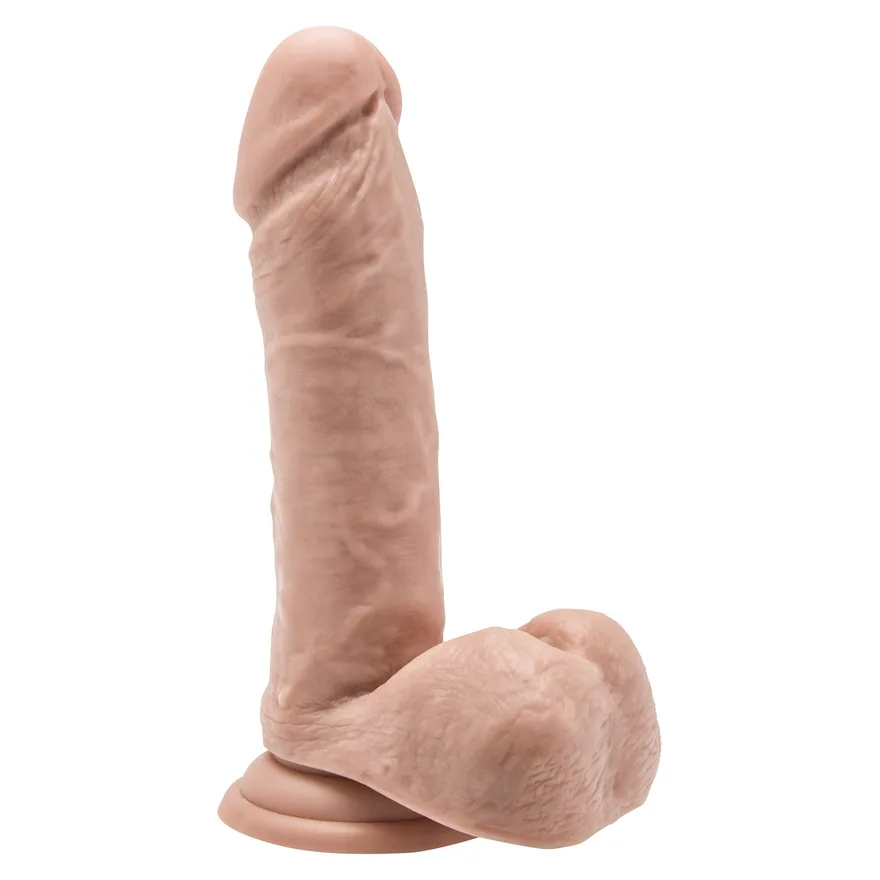
Get Real Dildo With Balls 18 cm is a realistically shaped dildo without electronics: a veined shaft, a defined glans, balls that are attached to the shaft, and a suction cup at the base. It has no motor, no battery, and no charging, and therefore there are no settings to set up. Everything that determines whether it’s right for you comes down to four numbers and a material specification.
The manufacturer states the total length as 18 centimeters, the insertable length as 14 centimeters, and the insertable diameter as 4.5 centimeters. The material is listed as PVC. The weight per unit is given as 0.47 kilograms and the packaging as 25 × 13 × 5 centimeters. The product is manufactured in China and sold as item 10166 in the manufacturer’s catalog, with a recommended store price of 20.99 euro. In Sweden, the item is sold by seven stores at prices between 187 and 299 SEK, and five of them had it in stock at the price check on September 12, 2026.
This review is exclusively about the light skin tone with EAN 8713221486387, the manufacturer’s item number 10166-SKIN. The same model is also available in black, and that variant has its own EAN: 8713221486394. The measurements are identical, but check the number if you compare prices between stores—several of them mix the colors on the same page, and one of them even lists both colors as features under the light item number.
Get Real is a product line within the ToyJoy brand, and ToyJoy is one of the brands of the Dutch wholesaler SCALA. It’s worth knowing for purely practical reasons: it’s SCALA’s product catalog, not a consumer-focused brand website, that is the primary source for the specification. There’s no separate product page for Get Real with user manuals or material declarations to go to, and there’s no downloadable PDF manual. What’s published is eight lines of specifications, three product images, and a short product description.
That makes the information source unusually lean compared with categories where manufacturers compete with technology. An air pressure vibrator has operating time, charging time, ingress protection rating, and the number of intensity steps to report. A dildo without a motor has dimensions, material, and shape — and that’s exactly where the manufacturer’s descriptions stop. Anyone who wants to know something about hardness, plasticizer, or the load-bearing capacity of the suction cup has to look at the stores instead, and then it’s important to keep separate who has said what.
What can still be established is that the manufacturer’s own packaging image puts two markings on the box: BODY-SAFE and SUCTION BASE. It also states the model name, 7 Inch Dildo, meaning 18 centimeters expressed in inches. There are no other promises on the packaging. It’s short, but at least it’s the manufacturer’s own.
The Get Real series consists of the same basic shape in several sizes, and since they are all sold under very similar names, it’s easy to order the wrong one. The manufacturer’s catalog differentiates them like this:
The important thing in this lineup is that the size step isn’t just about length. Between the 15- and 18-centimeter model, the diameter increases from 4 to 4.5 centimeters, and between 18 and 20.5 centimeters it increases further to 5 centimeters. A half centimeter in diameter sounds like a little, but it’s an increase in circumference of a bit more than one and a half centimeters — and it’s the circumference, not the length, that determines whether a product feels too big. So if you’re unsure, you shouldn’t assume that the next size is only longer.
The material question is the only characteristic of an intimate product that can’t be compensated for with experience or care. It determines whether the product is still hygienic after a few years, and it determines what actually comes into contact with the mucous membrane. Here the manufacturer gives just one word: PVC. Nothing more.
PVC, polyvinyl chloride, is a hard material by itself. To make it soft and flexible—which a realistic dildo must be—plasticizers are added. The Swedish Chemicals Agency (Kemikalieinspektionen) puts it plainly: almost all use of phthalates in products is as plasticizers of just PVC, and as plasticizers, phthalates can make up up to half of the material. That means that a soft PVC product, by definition, contains a significant share of something other than PVC, and that the question of what that substance is is not a detail but half of the material declaration.
What makes the question sharper for this product category is how the plasticizers are incorporated into the material. The Swedish Chemicals Agency describes that phthalates are commonly added through so-called external plasticizing, which means they are not chemically bound to the plastic. The consequence the authority draws is that they can relatively easily leak out of the plastic, and that this can happen as long as the product is used. So this is not a problem that disappears after the first wash.
Silicone, which is the material more expensive realistic dildos are cast from, works differently: the softness comes from the polymer’s own structure and does not require any added plasticizers. The difference between PVC and silicone in this category is therefore not primarily about feel, but about whether there is at all a plasticizer question to ask. For silicone, there isn’t one. For PVC, there always is—and it can only be answered by the person who declares the material.
The answer has to be precise here, because it differs depending on who you ask. The manufacturer does not publish a phthalate declaration for this item. The word phthalate does not appear anywhere on the manufacturer’s product page—not in the specifications box and not in the product description. The only material word is PVC. On the packaging image, the BODY-SAFE symbol is shown, but BODY-SAFE is not a defined term and says nothing about which plasticizers are included.
Four of the Swedish stores, however, write it out. Vuxen describes the material as phthalate-free PVC material. Blush Me lists the material as phthalate-free PVC in its feature table. SexleksakerOutlet repeats the same wording verbatim. Joyland has its own line in the specification where it says phthalate-free: yes. That’s four independent retail chains saying the same thing—but it’s still store information, not the manufacturer’s own declaration, and a store text normally goes back to the same wholesale source material, which is why it’s not actually four independent confirmations but, in practice, one.
What does that mean in practice? What still applies regardless of what someone writes is the legislation. Kemikalieinspektionen states that four well-known phthalates — DEHP, DBP, BBP and DIBP — may not be included in concentrations above 0.1 weight percent in the plasticized material in goods, under the restriction annex of the REACH Regulation, and that this restriction also applies to imported goods. So a product that is sold legally within the EU should, in practical terms, be free of the four phthalates. The restriction, however, does not cover all phthalates, and the stricter regulation in the Toys Directive applies to toys for children, not to this product category.
So the conclusion is neither an alarm nor a reassuring message, but a clear gap: the information is available at the retailers and missing from the manufacturer. If you want a material specification that comes directly from the person who manufactures the product, and that does not leave the question about softeners open, silicone is the only answer in this product category — and then you’re in a different price bracket.
The manufacturer lists three measurements, and they are clearly separated: overall length 18 centimeters, insertable length 14 centimeters, and insertable diameter Ø 4.5 centimeters. The same three figures also appear in the manufacturer’s own size chart, which shows 14 cm along the shaft, 18 cm across the entire product, and Ø 4.5 cm across. That all three details are provided both in the text and in the image is unusual in this price range, and it makes them easier to trust than a single line in a table.
The difference between 18 and 14 centimeters is the scrotum and the suction cup. The four centimeters at the bottom do not go in; they form the base. This is an important piece of information, because a product marketed as 18 centimeters effectively works like a 14-centimeter product in use. Anyone comparing with another model must compare insertable length with insertable length, never overall length with insertable length — and that is exactly the mix-up that makes an order feel unexpectedly short.
The stated diameter of 4.5 centimeters corresponds to a circumference of just over 14 centimeters if the shaft were completely round and evenly thick. But it isn’t: the product images show a shaft that is narrower in the middle and widest over the glans, and Joyland writes in its product text that the diameter varies between 4.3 and 4.7 centimeters. So the manufacturer’s 4.5 centimeters should be read as a measure of the greatest or average thickness of the insertable part, not as a constant.
The manufacturer states 0.47 kilograms, but the heading is the one that determines how the figure should be read: it appears under the heading Additional Information, together with the packaging’s dimensions, the number of items per outer carton, and the country of manufacture, and it is labeled as weight per unit. The manufacturer does not specify whether the 470 grams refer to the dildo alone or to the fully packaged unit, and no separate product weight is published.
Mshop lists the same figure, 0.47 kilograms, in its own specification — but there it appears in the section Dimensions (Packaging), together with the measurements 27.50 × 15.00 × 8.50 centimeters. The store therefore explicitly treats it as a packaging weight. That is also the most reasonable interpretation of the manufacturer’s information, and that is how the figure should be used: as a shipping weight, not as the product’s weight in hand.
There is a comparison that supports that reading. The manufacturer states 0.36 kilograms for the 15-centimeter model and 0.78 kilograms for the 20.5-centimeter model. That a product that is 2.5 centimeters longer and a half centimeter thicker would weigh 310 grams more is difficult to reconcile with a product that weighs 470 grams — unless the packaging is included. The packaging format also differs between the three sizes, with the 20.5-centimeter model getting a larger box measuring 29 × 16 × 5 centimeters.
The same comparison also provides another piece of information that is worth including: this is not a lightweight product. Even if you remove the box and the blister, there is a massive PVC casting in it at this size of a couple of hundred grams, and a product that is supposed to be mounted on a suction cup against a vertical surface therefore has a real weight to carry. That comes up below.
Without a motor and without buttons, it’s the shape that determines the function. Three design features show up in the descriptions: the suction cup in the base, the balls that sit together with the lower part of the shaft, and a slight bend in the shaft. The manufacturer’s own product description does not mention any of them explicitly — it only says that it is a realistic dildo intended for gentle penetration, that it is made of PVC, and that it should be used with water-based lubricants. It’s the stores that have described the construction, and the manufacturer’s packaging image, which confirms the suction cup with the SUCTION BASE symbol.
A suction cup attaches by vacuum pressure. You press the air out between the cup and the surface, and the surrounding air pressure then keeps the product in place. Physically, that means two things: the surface must be completely smooth and airtight, and the cup must be clean and slightly damp in order to seal properly. Tile, bathtub sides, shower walls, mirror glass, and lacquered smooth panels work. Wood with visible grain, painted walls, matte stone, sheet metal with texture, and any kind of porous surface do not work, because air seeps in through microscopic channels and the vacuum disappears within a few seconds.
The stores describe the suction cup as strong. Vuxen writes that the strong suction cup makes it easy to attach it to smooth surfaces for handsfree pleasure, Blush Me and SexleksakerOutlet state that it sticks to most flat surfaces, and Mshop highlights a stable suction cup as a feature in its own product image. The manufacturer does not publish the suction cup’s diameter or any load capacity, so there’s nothing to compare it to. What can be established is that the attachment must hold a heavy PVC casting, and that a suction cup that sits perfectly on a level surface can release on a vertical surface if the load comes at an angle.
Two practical consequences are worth mentioning. The first is that the scrotum sits directly above the suction cup and partially casts a shadow over it. That means you need to press down the base firmly and hold it for a couple of seconds while the air is pressed out, instead of just placing it on. The second is that a suction cup that is stored compressed against a surface for a long time can develop a permanent indentation, which makes it worse at sealing tightly. Store the product lying freely, not pressed down.
The stores say yes; the manufacturer says nothing. Vuxenkul lists the suction cup and strap-on compatible functions, and Mshop’s function image has the Strap-on Compatible symbol. The manufacturer’s specifications mention neither a harness nor harness compatibility.
From a purely construction standpoint, the prerequisite is simple to describe: a dildo with a flat suction-cup base can be used in harnesses that have an O-ring, because the base is then wider than the ring and prevents the product from sliding through. What determines whether it works in practice is the ring’s inner diameter relative to the shaft’s thickness at the point where the ring will sit. With a shaft that measures about 4.5 centimeters in diameter, you need a ring at the larger end of the usual selection. A harness with a ring that’s too small will pinch the shaft, and one with a ring that’s too large will allow the base to slide through.
Weight matters here too. A heavy dildo in a harness hangs more than a light one, and that places demands on the harness straps rather than on the dildo itself. There’s nothing wrong with the product, but it’s a reason not to assume that it works equally well in every harness, the way a lighter silicone model does.
Mshop’s functional image marks both Anal Safe and a stop for anal use, and the store writes in the product text that the firm scrotum works as a stop, which means the dildo can be used both vaginally and anally. Vuxenkul categorizes the product under anal dildos and states that the stimulation area is anal and prostate, in addition to vulva and vagina. The manufacturer doesn’t address the question at all.
What can be established purely from a construction standpoint is that the product has a base that’s wider than the shaft—the scrotum plus the suction cup—and that a wide base is the feature that makes anal use possible without risk of the product being pulled in. It’s the same principle that applies to anal plugs. The size, however, isn’t a beginner size: 4.5 centimeters in diameter is significantly more than what’s usually recommended as a first anal product, and the 14 centimeters that can be inserted are more than most people have any use for with anal. If that’s the use you’re after, there are also narrower and shorter products constructed for the purpose.
The measurements of this product are an unusually clear example of how the same item can be described in five different ways in five different stores. This is what the details look like when you put them side by side.
Everyone agrees on the overall length. It’s the other two measurements that shift. Joyland states that it’s 1.5 centimeters more insertable than the manufacturer does, and Mshop states it’s between 2 and 3 centimeters more. Two stores also list a diameter of 4.7 centimeters versus the manufacturer’s 4.5.
The rule in such situations is simple: the manufacturer wins. It’s the one that molds the product that knows where the insertable part begins, and the manufacturer has also published the same three measurements in both the text and the measurement illustration. So count on 14 centimeters insertable and 4.5 centimeters in diameter, and treat the higher figures as the stores’ own estimates.
The deviation is still understandable. A dildo with a scrotum has no sharp boundary where the base ends and the shaft begins—the scrotum sits together with the shaft and gives way when it’s pushed aside. Where someone draws the line depends on how hard you assume it’s being compressed. The manufacturer’s 14 centimeters is the cautious reading; Mshop’s 16 to 17 centimeters is the optimistic one. Mshop also has a customer comment on its own page complaining specifically that the diameter has been stated as 4.7 centimeters when it actually varies, which is an unusually clear confirmation that it’s the store’s figure that’s the weak link.
The manufacturer states it in its product description: the product is to be used with a water-based lubricant. Joyland says the same thing as one of its own specification lines: recommended lubricant, water-based, and Vuxenkul writes in its product text that you should use a water-based lubricant to be as gentle as possible on the sex toy. Three sources, the same message.
Blush Me and SexleksakerOutlet, on the other hand, write in their bullet lists that the product is compatible with both water- and silicone-based lubricants. That’s a real contradiction to the manufacturer’s own instruction, and it should be presented as such. When a store contradicts the manufacturer, the manufacturer applies, and the manufacturer’s only lubricant instruction is water-based.
The background to why the stores reason the way they do isn’t made up out of thin air. The warning against silicone-based lubricant primarily applies to silicone products, where the lubricant over time breaks down the surface and makes it porous. PVC is another material and doesn’t react in the same way. But there are still two reasons to stick to water-based: partly because it’s the only instruction the manufacturer actually provides, and partly because silicone-based lubricant is harder to wash off and leaves a film that holds onto dirt on a surface that’s already difficult to clean. Oil-based products such as coconut oil should be avoided entirely, both because they break down materials and because they’re nearly impossible to remove from a veined structure.
The product lacks electronics, which in theory makes cleaning straightforward: there are no buttons, no seams around a motor, and no charging contact to keep dry. What remains is the material and the surface texture, and that’s where the whole care question lies.
The manufacturer publishes no enclosure rating and doesn’t say anything about water resistance. Vuxenkul states that it is water-resistant: yes in its feature table, and Mshop’s functional image has the Waterproof symbol. Both are store claims.
The absence of an IP rating, however, is not the same thing as on an electrical product. An enclosure class according to IEC 60529 measures how well a housing protects electronics against penetrating water, and a product that completely lacks electronics has nothing to protect. What matters instead is whether water can seep into the actual material or collect in a hollow cavity. The manufacturer does not publish whether the casting is solid or has a core, so that question cannot be answered from the sources. The practical advice is therefore phrased carefully: rinse the product with lukewarm water and mild, unperfumed soap, but avoid soaking it for longer periods.
Dry it off afterwards. A textured surface keeps water droplets in the indentations, and moisture that remains in the structure is exactly what you don’t want on a product that will be stored away until the next time. Use a towel and then let it air-dry completely before putting it away.
There is no manufacturer information at all here—no lifespan, no hardness, and no recommendation for an exchange interval. Joyland lists the hardness as the average in its own table, which is the only numerically close indication that is published somewhere, and it’s a shop claim without a scale.
What can be stated generally is that soft plastics age differently than silicone. Because the plasticizers are not chemically bound to the PVC—which the Swedish Chemicals Agency (Kemikalieinspektionen) describes—they slowly migrate out of the material during the service life. In practice, this shows up as the surface becoming sticky or the material becoming stiff over time. A product that starts to feel sticky or that has developed a changed odor should be replaced—it can’t be washed off, because it isn’t dirt; it’s the material itself.
Store it dry, in the dark, and by itself. Soft PVC can react with other soft plastics on direct contact, and two products that have been lying against each other in a drawer can leave stains or sticky surfaces. A cloth bag or a separate box solves that, and nothing like that is included in the packaging: the manufacturer’s included contents are the product in a blister pack—nothing else.
We do not have price data from shops in your market yet.
18 centimeters is the total length. 14 centimeters is what you can actually use—the rest is the shaft and suction tip.
Four comparisons are relevant, and three of them are within the same brand. All the information below comes from the manufacturer’s own product pages, and the price details in euros are the manufacturer’s recommended retail prices—not what they cost in a Swedish store.
Get Real Dildo PVC 15 cm has the same shape in a smaller format: 15 centimeters total, 12 centimeters insertable, and Ø 4 centimeters, in the same material and with the same packaging format, 25 × 13 × 5 centimeters. The weight is stated as 0.36 kilograms versus 0.47, and the recommended price is 16.99 euros versus 20.99.
The difference in insertable length is two centimeters, which is small. The difference in diameter is half a centimeter, which is big — it’s the figure that determines whether the product feels comfortable. If you’re unsure about size, you’d do best to start there, both because the step down in thickness is real and because the price difference in the manufacturer’s catalog is four euro. If, on the other hand, you want the extra length, the 18-centimeter model is the obvious choice, since the next step up jumps straight to 5 centimeters in diameter.
Get Real Dildo PVC 20.5 cm measures 20.5 centimeters total, 15 centimeters insertable and Ø 5 centimeters. It weighs 0.78 kilos per unit and costs 31.99 euro at the recommended price, i.e. eleven euro more than the 18-centimeters model.
The interesting figure here is not the total length but the insertable: 15 centimeters versus 14. Even though the product is 2.5 centimeters longer overall, the insertable part grows by only one centimeter, because the base with shaft and suction cup is also bigger. So what you actually pay eleven euro for is essentially half a centimeter more in diameter, not length. If that’s the size you’re after, it’s a reasonable buy. If length is what you need, the difference isn’t that great.
Get Real Vibrating Dildo PVC 18 cm has the same total length as our model but differs in three ways. The insertable length is given as 15.5 centimeters, i.e. 1.5 centimeters more, because the base is designed differently. The diameter is given as 4 centimeters, i.e. half a centimeter slimmer. And it’s powered by two AA batteries, which are not included according to the manufacturer’s specification of battery type and number.
Price is the big difference: 35.99 euro in the recommended price versus 20.99. So you pay 15 euro for a vibration function, and you get a product that’s slimmer. What speaks in favor of the vibrating model is, of course, the vibration. What speaks against it is that AA batteries in an intimate product mean a battery compartment, and a battery compartment means a seam in the casing that has to be kept dry — which makes cleaning harder than with the passive model, not easier. If you primarily want a realistic shape without electronics, there’s no reason to pay more for it.
Inferno Realistic Dildo PVC 18 cm comes from the same wholesaler but a different brand, and is closest in the specification of all the compared products: 18 centimeters total, Ø 4.5 centimeters and PVC, with a suction cup shown as its own specification line. The insertable length is, however, given as 13 centimeters, i.e. one centimeter less than Get Real, and the weight per unit as 0.52 kilos. The recommended price is 27.99 euro versus 20.99.
That makes it the most interesting comparison precisely because the products are so close to each other. Same material, same total length, same diameter, same type of base—but seven euros apart in the recommended price and one centimeter less in the insertable length for the more expensive one. What differs in the reported data is that Inferno has the suction cup as its own specification line listed by the manufacturer, while Get Real only has it as a symbol on the packaging. It’s a marginal advantage in documentation, and it hardly justifies the price difference.
Seven Swedish stores sell the item with EAN 8713221486387, split across eight listings—Sexonic has posted the same item twice under two different item numbers, at the same price. Cheapest is Sexonic at 187 SEK, most expensive is Mshop at 299 SEK. That’s a difference of 112 SEK, or 60 percent, for exactly the same item number, same color, and same packaging.
The stock situation changes the picture. Both Sexonic listings were marked as not in stock in the store’s own product flow at the price check on September 12, 2026, and the same applied to Vuxenkul at 239 SEK. The listings that were available at home were five: Vuxen, Blush Me, SexleksakerOutlet, and Joyland at 229 SEK each, plus Mshop at 299 SEK. That means that the actual choice at the time of the check was between 229 and 299 SEK—70 SEK or a 31 percent difference, not 60.
That four stores are at exactly 229 SEK is revealing in itself. The manufacturer’s recommended retail price is 20.99 euros, and Sexonic lists the product at 20.99 euros as the regular price, with 17.00 euros as the campaign price. So 229 SEK is the price level that is closest to the recommended price, and the four stores have simply followed the recommendation. Mshop’s 299 SEK is clearly above, and Sexonic’s 187 SEK is clearly below.
The price spread isn’t because any store sells a different variant. Six of the seven stores publish EAN 8713221486387 or a corresponding reference on their own product page, and the seventh, Joyland, lists the item under its own item number 18911 with the same brand, the same series name, and the same total length. So this is the stores’ own margin-setting on a cheap volume product, and in that price range, shipping costs often weigh more than the price difference. Always check the final price at checkout—an item at 229 SEK is below the threshold for free shipping at most stores.
It fits you who want a realistically shaped dildo in a clearly medium size and who don’t need vibration. Fourteen centimeters insertable and 4.5 centimeters in diameter is a common combination that suits most people who already know that they want something in that size. It fits you who want to be able to attach the product to a tile or a shower wall for hands-free use, and you who want something that works in a harness with a sufficiently large O-ring. That the manufacturer publishes both total length, insertable length, and diameter in both text and picture also means you know what you’re ordering, which isn’t a given at this price range.
It doesn’t fit you who require a material declaration from the manufacturer. PVC without any phthalate information is precisely the situation where you have to rely on store texts instead of the one that molds the product, and if you want to avoid that issue entirely you should choose silicone. It doesn’t fit you who are new to size—the 15-centimeter model in the same series is half a centimeter narrower and a better starting point. It doesn’t fit you who want vibration without changing products, because it lacks a motor and can’t be upgraded. And it doesn’t fit you who want a lightweight product, because a solid PVC casting in this size has a real weight that both the suction cup and the harness must carry.
One more thing belongs in the decision. This is a product where the documentation is thin at the bottom, and where several of the details that normally determine a purchase—hardness, phthalate status, the load capacity of the suction cup, whether the casting is solid—are simply not published by anyone who manufactures it. That isn’t the same as saying the product is bad. But it means you buy based on shape, measurements, and price, and you have to accept that the rest is unknown. At this price range, it’s a reasonable trade-off. If the product had cost three times as much, it wouldn’t have been that.
The manufacturer does not publish any consumer warranty for this product. SCALA sells to stores and not to private individuals, and the terms published on the manufacturer’s site are retailer terms regarding deliveries, complaints about transport damage, and returns of discontinued items—not a warranty you as an end customer can rely on. There is also no warranty period stated on the product page or on the packaging.
In practice, that means it’s Swedish consumer legislation that applies, and it applies regardless of what a manufacturer does or does not promise. Under the Swedish Sale of Goods Act (konsumentköplagen), you have three years of complaint rights for defects in the goods, counted from when you received them. That right is directed at the store you bought from, not at the manufacturer, and it’s therefore just as strong here as for a product with a five-year manufacturer warranty—provided that the defect was present in the item from the start.
For distance purchases, there is also a right of withdrawal for fourteen days in accordance with the Law on Distance Contracts and Contracts Outside Business Premises. Be aware that in practice the right of withdrawal is limited for hygiene items that have been removed from a sealed package — and this product is sold in a sealed blister package, which makes the exception highly relevant. If you ordered the wrong size, it is therefore the unopened package that gives you the right to a return. The right to complain in the event of defects in the goods applies, on the other hand, always. If you have questions about what applies in your case, Konsumentverket guides you via Hallå konsument.
Toy Joy Get Real Dildo With Balls 18 cm is ranked på plats 10 av 19 in realistic dildo best i test, where the entire category is compared against each other using five shared criteria. Guiden vinns av Silexd Silex-D Dual Density Silicone Dildo 17,6 cm.
Every numerical piece of information in the text can be traced to one of the sources below. The links were checked manually on the specified date.
This page is machine-translated from Swedish. Read the Swedish original