

Review
Review: Good Vibes Only Lisa Thrusting Rabbit Vibrator
Rabbit with thrust function, silicone, and IPX6 — from 395 SEK.
29 July 2026
Review · Rabbit vibrator · Bumpy shaft
Toy Joy’s classic rabbit vibrator reviewed against the manufacturer’s own details and price data from six Swedish stores. Two motors, continuously variable rotary dial, 14 centimeters insertable, and 3.5 centimeters in diameter — but a manufacturer that does not publish material, weight, run time, sound level, or enclosure rating, and whose own product text describes an entirely different model.
A cheap rabbit vibrator with two motors and a continuously variable rotary dial, which does exactly what it claims to do. What pulls the rating down isn’t the function but the information basis: the manufacturer does not publish material, weight, run time, sound level, enclosure rating, or warranty, and the body text on the official product page describes a different model. The material is, according to the stores, PVC, which is not porous in the way silicone is. Buy it to find out whether the rabbit shape suits you — not so it can last for years.
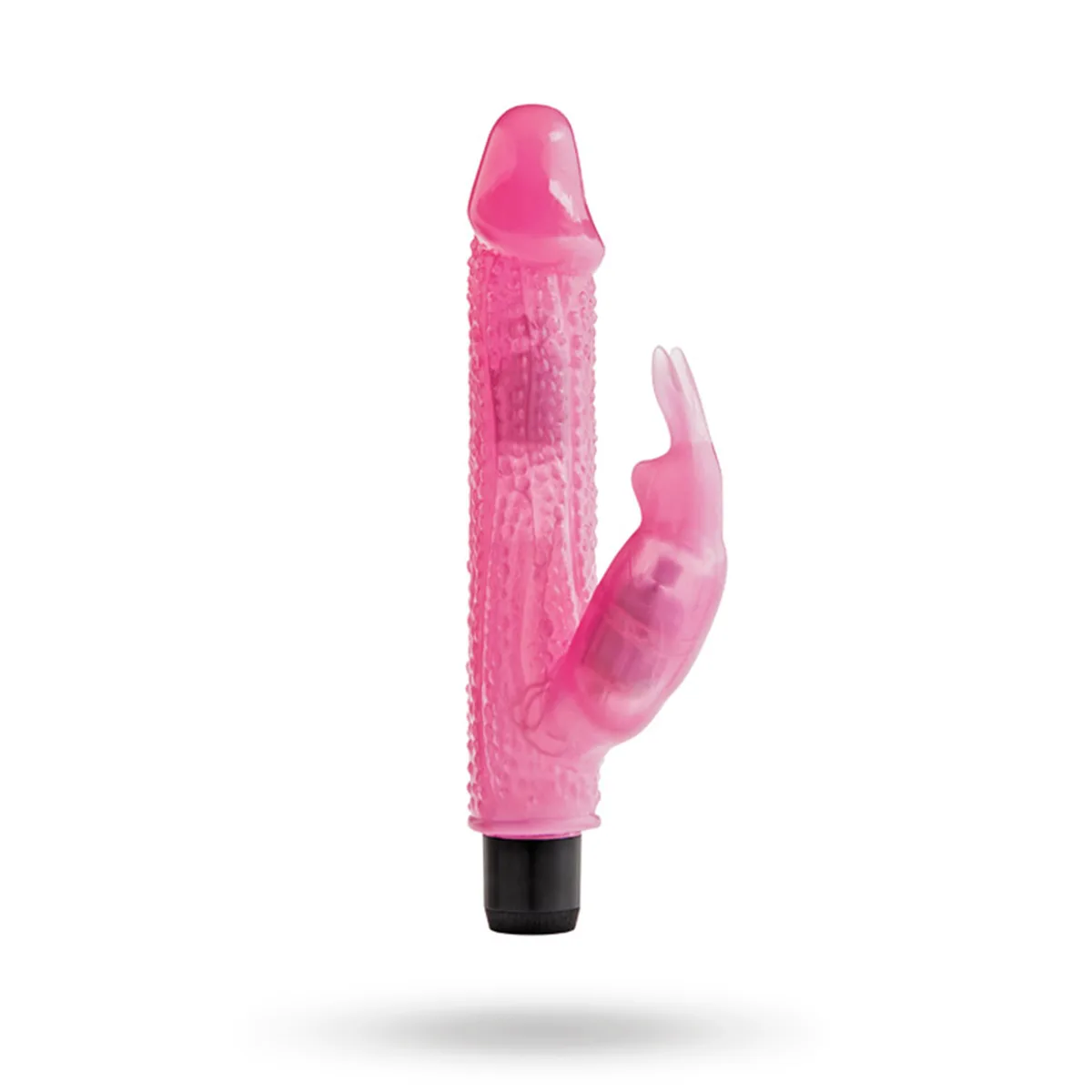
Toy Joy Knobbly Wobbly is an old-school rabbit vibrator: a flexible shaft of translucent pink plastic, covered with small raised bumps, with a separate canal-shaped arm for the clitoris and a twist control at the bottom. It’s powered by two AA batteries and costs from 195 SEK. It belongs to the series The Rabbits by TOYJOY and has the manufacturer’s item number 10263-PINK.
This review is about the pink variant with EAN 8713221016690. The number is verified against the variant table on the manufacturer’s own product page, where gtin 8713221016690 is linked to the article name "Knobbly Wobbly – pink". The same number is printed at two of the Swedish stores, Vuxenkul and Sexonic, and Vuxenkul also includes the manufacturer’s wholesaler number SC2214-1. There is therefore no doubt about which item is meant — which is worth stating before the rest of the text, because very little else about this product is as unambiguously matched.
The specification looks like this: the manufacturer states an insertable length of 14 centimeters and a diameter of 3.5 centimeters, two motors, stepless speed control, and that the product is waterproof. Four of the six Swedish stores list a total length of 22 centimeters and PVC as the material. Operation is with 2 × AA batteries (not included). In Sweden, the item is sold by six stores at prices between 195 and 259 SEK, and three of them had it in stock at the price check on July 29, 2026.
A rabbit vibrator is designed to stimulate two places at the same time: a shaft that is inserted vaginally and an external arm that rests against the clitoris. The name comes from the fact that the outer arm is traditionally shaped like a rabbit’s head with two ears, and that exact shape is clearly shown on Knobbly Wobbly — the manufacturer’s own product images show two distinct ears and a rounded body where the second motor sits.
This design principle sets it apart from a simple wand-style vibrator in a way that matters in practice. Since the arm and shaft sit together at a fixed angle, the fit is determined by the distance between the shaft’s opening and the clitoris — a distance that varies from body to body and can’t be adjusted on this model. There is no hinge, no adjustable arm, and no alternative arm length. What can be concluded is that this specific type of construction either works very well or not at all, and that is decided by anatomy rather than settings.
The bumps are the model’s signature and what the name refers to. The shaft is covered with small raised nubs made of the same material as the rest of the shaft, cast in one piece. The manufacturer does not say how many there are or how tall they are; the product images show that they cover the entire insertable part in a tight pattern and that they are softer in shape than the pointed nubs found on harder anal sex toys. The effect of a textured surface is that stimulation becomes more varied during movement than on a smooth shaft — but it’s also a characteristic that makes the product less suitable for someone who is sensitive, because a textured surface requires more lubricant to not feel chafing.
Here the text has to become uncomfortably specific, because it is the single most important observation about this product. The manufacturer does not publish material, not total length, not weight, not battery type, not runtime, not sound level, and not any ingress protection rating. What is on the official product page is brand, item number, EAN, color, product type, list price in euros, and four images.
Two of those images are in practice the closest thing to a datasheet that exists. One is a dimension sketch that indicates an insertable length of 14 centimeters and a diameter of Ø 3.5 centimeters. The other is a row of icons with five claims: body-safe, multispeed, silent, twin motor with the number 2, and waterproof. That’s the level the manufacturer’s specifications are at — five words and two measurements, presented as graphics in an image gallery rather than as text in a table.
And the scrolling text on the same page describes the wrong product. The description on the manufacturer’s product page for Knobbly Wobbly is about a model called Crystal Dancer Rabbit — it talks about a transparent design, rotating pleasure pearls, diamond decor on the control panel, and five pulse programs plus three vibration and three rotation speed settings. If you search for "crystal dancer" in the manufacturer’s own shop, Knobbly Wobbly is the only match, which means the text does not belong to any other item in the assortment either. It’s simply been inserted on the wrong product.
That has two practical consequences worth taking with you. The first is that information about rotation, about five programs, or about three speed steps that circulates among store staff is most likely coming from the incorrect text and not from this product. The second is that Vuxenkuls functional description "Vibrations, Rotating" is most likely the same misunderstanding — no other source, including the manufacturer’s own function icons, mentions any rotating function. Rely on vibrations, not rotation.
The material question is the only property of an intimate product that cannot be compensated for through experience or care, and it determines whether the product is still hygienic after a few years. The situation is clear on the facts but messy in the sources: the manufacturer states no material at all. Five of the six Swedish shops list PVC, and three of them specify it as phthalate-free, flexible, and skin-friendly PVC. A retailer outside our list, Amazon in the United Kingdom, only lists "Plastic".
The difference between softened PVC and silicone is not a matter of finesse, but of porosity. Silicone is non-porous: the surface lacks microscopic cavities, which means it can be cleaned completely. Softened PVC is a thermoplastic material that becomes flexible by mixing in plasticizers, and the material is in practice porous in the sense that the surface over time absorbs and retains residue. A porous surface can be rinsed, but it can’t be made clean in the same way.
In practice, that means three things. First, this type of material has a limited service life as a hygiene item—not because it breaks, but because it can no longer be cleaned. Second, a PVC product should be used with a condom if it is shared between people, because the surface can’t be disinfected. Third, the material is sensitive to storage: softened PVC should not be stored in direct contact with other plastic products, because the plasticizers can migrate between materials and make both of them sticky.
The comparison with the price category above is straightforward. Lelo specifies body-friendly silicone and ABS plastic for the Ina 3, and Satisfyer specifies silicone and ABS plastic for the Pro 2 Next Generation. Both materials are non-porous. So what can be established is that Knobbly Wobbly is one step below both of them on exactly the point that weighs heaviest in a material assessment—and that is the trade-off you make when you pay 195 SEK instead of 219 or several thousand.
Phthalates are a group of plasticizers used specifically to make plastic—above all softened PVC—flexible. Kemikalieinspektionen describes them as substances that can affect the hormone system and make reproduction harder, and several of them are therefore restricted or prohibited within the EU in a large number of products. Since PVC is precisely the material that is traditionally softened with phthalates, the question is more relevant here than on a silicone product, where the softness comes from the polymer’s own structure and no plasticizers are needed.
That is why the source is important to keep separate. The manufacturer makes no declaration at all about phthalates for this model — the icon row on the product page says “body-safe,” which is a marketing term without a definition, not a material declaration. It is the retailers Vuxen, Blush Me, and SexleksakerOutlet that write that the material is phthalate-free PVC. Joyland and Vuxenkul only state “PVC” without any addition.
The fact that three shops say the same thing is not the same as the manufacturer having certified it, and the three shop texts are also almost word-for-word identical, which suggests a shared wholesaler text rather than three independent checks. What can be said is that the product is sold within the EU and therefore is covered by the restrictions that apply there, and that no source claims the opposite. What cannot be said is that the manufacturer itself has written it out. If you want a material declaration directly from the manufacturer, it is not available for this item, and that in itself is a reason to choose differently if the material issue weighs heavily.
The size illustration is the clearest example of what this product’s data quality looks like, and it deserves to be presented line by line.
So four out of five Swedish shops and the manufacturer’s own sketch point in the same direction, while Joyland’s figures stand alone. The rule is simple: when a shop contradicts the manufacturer, the manufacturer wins. The 14 centimeters insertable and 3.5 centimeters in diameter that the manufacturer states are the values that apply, and the overall length of 22 centimeters is a shop claim that four shops agree on. Joyland’s 18.5 × 15 × 4 centimeters should be treated as an incorrect entry in a product data flow — not as another variant of the product, since the EAN number is the same.
What does 22 centimeters overall and 14 insertable mean in practice? That eight centimeters of the product is never intended to be inserted. That part is the handle, the battery compartment, and the rotating control. The difference compared to a recommended premium competitor is noticeable: Lelo lists 200 × 65 × 45 millimeters overall and 110 millimeters insertable for the Ina 3, meaning both a shorter overall length and four centimeters less insertable length. The diameter of 3.5 centimeters versus Lelo’s 37.09 millimeters, on the other hand, is basically the same.
The weight is not published by the manufacturer and not by any Swedish store. The only figure you can find is on Amazon in the United Kingdom’s package information: 320 grams with package dimensions of 30 × 5 × 8 centimeters — but that page’s bullet list is mixed up with another manufacturer’s product text, so the information should be read as a shipping weight of questionable origin, not as a product weight. Assume the product weighs less than that in your hand, and treat the weight as a missing piece of information.
The interface on Knobbly Wobbly is as simple as it can be. Blush Me and SexleksakerOutlet describe it word for word the same way: speed is controlled by turning the dial. The dial sits at the bottom of the product and is also the battery cover — the black part you can see furthest down in the manufacturer’s product images. There are no buttons, no display, and no LEDs.
A rotary control is a completely different kind of control than a button-controlled stepped scale, and the difference cuts both ways. The advantage is that the regulation is stepless: you don’t choose between preset levels—you turn it up to exactly the point you want, and you don’t have to step through an entire scale just to go back. The disadvantage is that you can’t recreate a setting — there’s no “step 4” to go back to — and you can’t turn it off quickly with a single press. You have to turn it all the way back.
A second practical consequence of the dial and the battery cover being the same part: the control sits at the end that’s farthest from your wrist when you hold the product in your grip, and it’s turned with your thumb and index finger. It’s a design that’s existed in this product category for decades and that works, but it’s not made to be adjusted with wet hands or during use.
The manufacturer’s icon row states “twin motor” with the number 2, and Vuxenkul writes that the vibrator has a dual-motor setup. Having two motors in a rabbit vibrator means that the shaft and the rabbit arm each have their own source of vibration rather than sharing one. That’s why the outer arm in the manufacturer’s images appears to have its own casing: the second motor sits in the rabbit body.
What can be established purely from a technical standpoint is that two motors provide a smoother distribution of vibration than a single motor placed in the base, because vibration is dampened as it’s meant to be transmitted through soft plastic over a longer distance. On a single-motor model, the outer arm is almost always weaker than the shaft. With a motor of its own in the arm, you avoid that effect.
What, however, can’t be said is that the motors can be regulated independently. Neither the manufacturer nor any of the six stores states that the shaft and the rabbit arm have separate controls. The product has a single rotary control, and the reasonable conclusion is that both motors follow it. That’s the most important functional difference compared to more expensive rabbit models, where each motor has its own button and where you can run the clitoral stimulator on its own. Here you get both or neither.
The answer is that the question is phrased incorrectly, and it’s actually a good answer. The manufacturer doesn’t state any number of settings. The icon says "multispeed", Joyland writes "multispeed", and Vuxenkul describes a stepless increase in the vibrations. No source mentions any program, any pulsing, or any pattern.
Stepless control doesn’t have settings in the sense that the marketing of modern vibrators uses the word. There’s no list of ten programs to browse through and no alternating pattern. There’s a steady vibration, whose intensity you freely choose between off and maximum output. For some, that’s a drawback, since variation in patterns is part of the experience. For others, it’s an advantage, because you don’t have to search through programs you’ll never use anyway.
The difference compared to the competing products being compared is clear and easy to put numbers on. Lelo lists ten settings for Ina 3, and Satisfyer lists eleven pressure-wave intensities for Pro 2 Next Generation. Both of those figures are published by their respective manufacturers. Knobbly Wobbly doesn’t have a corresponding number to go up against, and a comparison table that counts "number of settings" will therefore always make this product unfair to both sides — it has neither ten settings nor one.
No source publishes a measured decibel value for this product. The manufacturer’s icon row includes the word "silent". Vuxenkul writes that the vibrator is very quiet and discreet despite the dual motor. Joyland is the only one that attempts a rating and indicates the sound level as "medium" on a three-step scale. That’s two contradictory marketing descriptions and a store scale with no definition — none of it is a measurement.
What can be established about this product category is the following. A battery-powered vibrator of this type uses a rotating motor with an eccentric weight, meaning an unbalanced weight that makes the entire house shake. It’s the loudest of the constructions that appear in the category, clearly louder than air-pressure products with a pump and than the linear motors used in more expensive models. A housing made of soft PVC dampens some of the sound, while a hard plastic battery cover does the opposite.
A practical tip that applies regardless of model: put the product on a soft surface between uses and avoid placing it on a hard tabletop while it’s running. A tabletop works as a resonance box and noticeably amplifies the sound. And consider the word "silent" on the icon row for what it is — a statement with no numbers behind it.
This is the only point where the sources are directly contradictory, and it deserves to be presented openly rather than evened out.
The rule I use is that the manufacturer wins over the shop, and the manufacturer says it’s water-resistant. But the discrepancy should be noted, and it isn’t trivial: two of six shops say the exact opposite, and both do it in a structured specification table rather than in a salesy text.
The word "waterproof" has no technical meaning by itself. What it does have is the enclosure classes in the IEC 60529 standard, where a number in the second position indicates which water test the product has been tested against. IPX4 means splashes from all directions, IPX6 means a powerful water jet, and IPX7 means immersion to a depth of one meter for 30 minutes. A product without an IPX specification has not been tested according to any of them — or at least the manufacturer doesn’t report it.
Neither the manufacturer nor any shop lists an IPX class for Knobbly Wobbly. That means "waterproof" on the icon row is an undefined claim. For comparison, Satisfyer lists IPX7 for Pro 2 Next Generation, and Lelo states that Ina 3 is completely waterproof — one with a rating, the other without.
The construction also gives reasons to be cautious. The product is powered by two AA batteries, which requires a battery compartment with a cover that has to be openable, and the same cover is also the rotary control. An openable cover that also rotates is the hardest seal to make durable in a cheap product. Practical conclusion: treat it as tough against splashes and rinsing, not as something that should be submerged in bathwater. And never turn the control with wet hands without first drying the bottom.
Rinse the product in lukewarm water after each use and use an unperfumed soap or a cleaning agent intended for intimate products. Be extra thorough with the bumps—because a textured surface has more places where residue can be left behind than a smooth one, and that’s the whole point of choosing a textured product so the surface isn’t smooth. Pat it dry with a clean towel and let it air-dry before putting the product away.
The lube question is simple here, and Joyland answers it: water-based lubricant. Avoid silicone-based lubricant for this type of soft plastic, and oil-based products like coconut oil leave a film that’s hard to remove and can also break down soft-formed PVC over time. A textured product also needs more lube than a smooth one—expect to top up during use.
Storage requires a special kind of thought because the material is soft-formed plastic. Don’t put the product directly against other plastic toys in a bin; plasticizers can migrate between materials and make both surfaces sticky. Store it cool and dark, and remove the batteries if it’s going to be left unused for a longer period—leaking alkaline batteries are the most common cause of a battery-powered vibrator stopping to work. No storage pouch is included according to any source.
Five of the six stores state that it’s powered by AA batteries, and four of them specify that it’s 2 × AA that are not included. Joyland states the battery type as AA (LR6), meaning alkaline standard cells. The manufacturer itself states no battery information at all on the product page.
With two AA batteries that you buy separately. That’s the single biggest practical difference compared to everything in the price range above, and it applies both ways.
The benefits are real and are often underestimated. A replaceable battery means the product doesn’t have any built-in lifespan limit tied to a cell that degrades—the most common cause of death for a rechargeable vibrator is that the lithium-ion battery no longer holds a charge, and on most models the cell is permanently soldered in, meaning the product is effectively used up. Here, you just replace the batteries. It also means there’s no charging cable to misplace, no proprietary magnetic contact, and no waiting time: new batteries deliver full performance right away.
The drawbacks are just as real. Batteries are an ongoing cost that nobody factors into the price tag. Alkaline cells gradually lose voltage, which means that the vibration becomes weaker long before the product stops working — unlike a lithium-ion battery that maintains near full power until almost the very end. A battery compartment also requires an opening in the casing, which is exactly the kind of design that makes sealing against water difficult. And batteries aren’t included, which in practice means that a product costing 195 SEK costs a few tens more to get started with.
No source states how long the product runs on a pair of batteries, either from the manufacturer or from any of the six stores. There’s no mAh figure to calculate from, because the capacity sits in the batteries you buy yourself, and the manufacturer doesn’t provide either current draw or runtime.
What can be established is that two motors draw more power than one, and that the runtime of alkaline AA cells is therefore shorter on this model than on a single-motor wand vibrator with the same battery type. What can also be established is that the comparison with rechargeable competitors isn’t fair to either side: Lelo states up to two hours of runtime and two hours of charging time for Ina 3, while Knobbly Wobbly instead has a runtime that depends entirely on which batteries you put in, and that resets in ten seconds with a new pair.
A concrete piece of advice: buy rechargeable NiMH cells in AA format if the product is going to be used regularly. They have lower cell voltage than alkaline batteries, which can result in somewhat weaker maximum power, but they eliminate the ongoing cost and the risk of leakage during longer storage. And always remove the batteries when you put the product away for longer periods of time.
We do not have price data from shops in your market yet.
The manufacturer’s complete specification for this model is two measurements in a parts diagram and five words in an icon row. The main text on the same page describes another product.
Two comparisons are relevant: against what costs roughly the same amount but is based on a different technology, and against what costs many times more and shows what your money actually buys. All the information below comes from each manufacturer’s own specifications.
Satisfyer Pro 2 Next Generation is the best-selling clitoral stimulator in the category and sits in the same price range as Knobbly Wobbly. The differences in what the manufacturer discloses are striking, and it’s that comparison that says the most about this product.
Satisfyer lists length 165 millimeters, height 65 millimeters, weight 174.7 grams, material ABS plastic and silicone, eleven pressure-wave intensities, whisper mode, a rechargeable battery, an IPX7 protection rating, and a 15-year manufacturer’s warranty. Toy Joy lists insertion length 14 centimeters, diameter 3.5 centimeters, two motors, multispeed, silent, and waterproof — and nothing else. That’s seven specific specification values versus two measurements and five words.
Functionally, they’re different products as well. The Satisfyer is a pure clitoral stimulator that works with pressure waves in air and is not inserted at all. Knobbly Wobbly is a vaginal vibrator with an outer clitoral arm. If you want both things at the same time, the Satisfyer doesn’t do that job, and if you want the touch-free air pressure stimulation that made the product category famous, Toy Joy doesn’t do that. So the price range is the only dimension where they’re interchangeable.
The conclusion is nevertheless unambiguous on one point: if two products cost about the same and one publishes dimensions, weight, material, number of steps, IPX rating class, and warranty time, while the other publishes two dimensions and an icon row, then you get less uncertainty for the same money with the first one. It’s an argument that applies regardless of which of the two techniques you prefer.
Lelo Ina 3 is the same product type as Knobbly Wobbly: a rabbit vibrator with an insertion shaft and an outer clitoral arm. It sits in a completely different price bracket, so the comparison isn’t a buying recommendation but an illustration of what that higher price bracket actually means.
Lelo lists the dimensions as 200 × 65 × 45 millimeters, insertion length 110 millimeters, diameter 37.09 millimeters, weight 150 grams, material body-friendly silicone and ABS plastic, a lithium-ion battery of 500 mAh and 3.7 volts, charging time two hours, operating time up to two hours, ten settings, fully waterproof, and a two-year manufacturer’s warranty, complemented by a ten-year quality warranty.
Set it against Knobbly Wobbly. The insertion part is longer for Toy Joy — 14 centimeters versus 11 — while the diameter is essentially the same in practice: 3.5 centimeters versus 37.09 millimeters. Overall, Toy Joy is two centimeters longer. What you don’t get is pore-free silicone, a published battery, a published operating time, a published number of settings, a manufacturer’s warranty, and a materials declaration. What you get instead is interchangeable batteries and a price that’s a fraction of the cost.
So what’s the difference between a rabbit vibrator for 195 SEK and one for several thousand? Not the shape, and not necessarily the basic function. The difference is the material’s hygienic properties, motor control, reported data, and the warranty. If you’re unsure whether the rabbit design even fits your anatomy — and that’s the question that determines everything for this product type — it’s hard to argue that you should find out for several thousand kronor. That’s where Knobbly Wobbly has a legitimate reason to exist.
Six Swedish stores sell the item with EAN 8713221016690. The cheapest is Joyland at 195 SEK, and the most expensive is Vuxen, Blush Me, and SexleksakerOutlet, all at 259 SEK. That’s 64 SEK, or a 33 percent difference, for the exact same article number, the same color, and the same packaging.
The inventory situation is at least as important as the price spread. Three of the six stores had the product in stock during the price check on 29 July 2026: Joyland at 195 SEK, Vuxenkul at 249 SEK, and Blush Me at 259 SEK. Sexonic at 224 SEK, Vuxen at 259 SEK, and SexleksakerOutlet at 259 SEK were sold out. That means that the cheapest store also happens to be one of the ones that could actually deliver, which isn’t always the case — and that the difference between the cheapest and the second-cheapest available is 54 SEK.
The price spread doesn’t come from any store selling a different variant. The model is manufactured only in pink according to the manufacturer’s variant table, and all six stores list the item either under EAN 8713221016690 or under their own article number that’s linked to just that one. So it’s about the stores’ own margin setting on an old and inexpensive catalog item.
One more thing belongs in the price calculation: the batteries. Two AA cells aren’t included according to any source, and in this price range that’s a significant share of the total cost. Take that into account when you compare to a rechargeable product where nothing needs to be bought. Shipping costs are also added by most stores under a certain order value, and in this price range all six stores are likely under the threshold for free shipping — which can make the shipping fee a bigger line item than the price difference between the stores.
It fits you if you want to try whether a rabbit design works for your anatomy at all without spending more than a couple of hundred SEK on the answer. It fits you if you prefer a stepless rotary control knob over a program list to browse through. It fits you if you want replaceable batteries instead of a built-in lithium-ion battery that determines the product’s service life, and you want a textured surface rather than a smooth shaft. Two motors at this price also isn’t a given—many cheap rabbit models only have one.
It doesn’t fit you if you want a pore-free material. Softened PVC can be rinsed, but not made completely clean, and for the person who shares the product with someone else or who values hygiene the most, silicone is the only reasonable choice—there are both Satisfyer and Lelo in different price ranges. It doesn’t fit you if you want to be able to adjust the clitoral arm and the shaft separately, because there is only one control. It doesn’t fit you if you want a stated sound level, a stated runtime, or an enclosure rating, because none of that information is published by anyone.
And it also doesn’t fit you if you want to be able to submerge the product in bathwater with a clear conscience. The manufacturer’s icon says waterproof, but two stores explicitly say no—no IPX rating is published, and the construction with an openable battery compartment that also serves as a rotary control suggests caution. Rinse it off—don’t submerge it.
Finally: it doesn’t fit you if you want to be able to check what you’re buying against the manufacturer’s own documentation. There is no manual, no material declaration, no warranty commitment, and a product description that concerns another model. For some, it doesn’t matter at all in a product for 195 SEK. For others, it’s exactly what determines it.
Toy Joy does not publish any manufacturer warranty for Knobbly Wobbly, either on the product page or in any document connected to the article. None of the six Swedish shops also states any warranty period for the model. That’s a difference from the competitors that’s worth putting numbers on: Satisfyer provides 15 years of manufacturer warranty on Pro 2 Next Generation, and Lelo provides two years of manufacturer warranty plus ten years of quality warranty on Ina 3.
What does always apply, though, is your statutory rights, and they are independent of what the manufacturer promises. Under the konsumentköplagen (Consumer Sales Act), you have three years of right to complain about defects in the goods. A defect that shows up within two years is also assumed to have been there from the start if the seller can’t show anything else, which in practice is the most important provision for a product like this—a motor that stops working after a few months of normal use is a defect in the goods, not normal wear and tear.
For distance purchases, you also have a right of withdrawal for fourteen days under the law on distance contracts and agreements outside business premises. Be aware that, in practice, the right of withdrawal is limited for hygiene products that have been taken out of a sealed package. According to the manufacturer’s own image, the packaging for Knobbly Wobbly is a cardboard box with a transparent window where the product sits in a molded plastic insert—check how your store handles the issue before breaking the seal, since the assessment differs between stores. However, the right to complain about defects always applies, regardless of how the packaging looks. If you have questions about what applies in your case, Konsumentverket provides guidance via Hallå konsument.
Toy Joy Knobbly Wobbly is ranked på plats 21 av 21 in rabbit vibrator best i test, where the entire category is compared against each other using five shared criteria. Guiden vinns av We-Vibe Nova 2.
Every numerical piece of information in the text can be traced to one of the sources below. The links were checked manually on the specified date.
This page is machine-translated from Swedish. Read the Swedish original