

Review
Review: Satisfyer Pro 2 Next Generation
Cheapest among the broadly sold — 219 SEK and 15 years of warranty.
29 July 2026
 Best budget
Review · Rabbit vibrator · Thrust function
Rabbit vibrator with three independent functions reviewed against the manufacturer’s own specifications and pricing data from five Swedish stores. 265 × 42 × 86 millimeters, 288.5 grams, silicone and ABS plastic, enclosure rating IPX6 according to IEC 60529 and USB charging — but neither battery data, sound level, nor warranty is published, and the manufacturer’s own material contradicts itself about the number of G-point modes.
Three independent stimulation sources — thrusting shafts, fluttering G-spot tongue, and vibrating clitoral ball — each with its own button, for under four hundred kronor. That’s a lot of function per kronor. What you pay for is documentation: neither battery capacity, charging time, runtime, sound level, warranty, nor material declaration is published. The enclosure rating is IPX6 and not IPX7, and the manufacturer’s own material lists both seven and ten G-spot settings for the same item number.
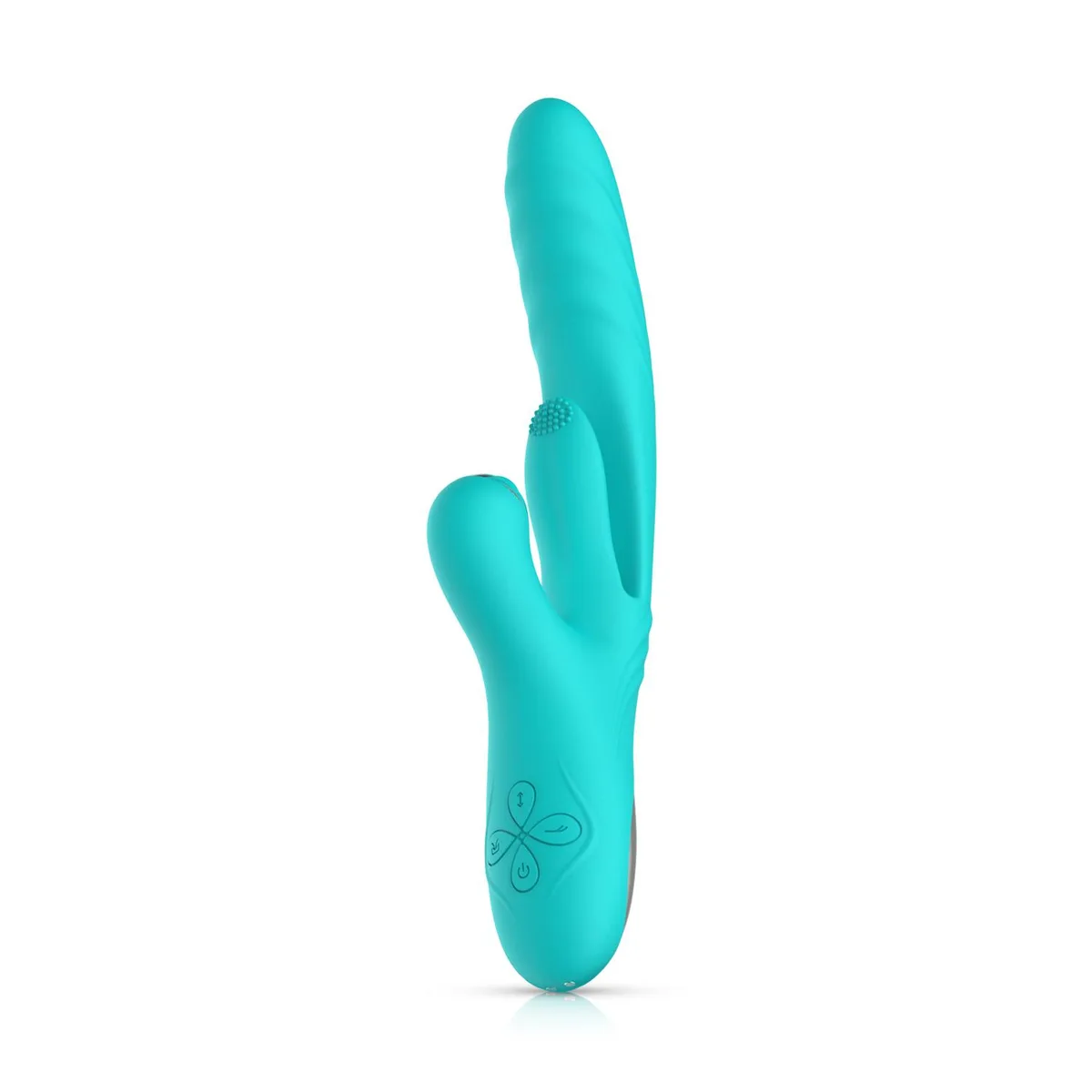
Good Vibes Only Lisa is a rabbit vibrator with a thrust function, meaning a product where the shaft doesn’t just vibrate but also moves back and forth on its own. The manufacturer calls it a 4 in 1 vibrator on the packaging, and that label is unusually accurate: besides the shared vibrations, there are three separate stimulation sources— a thrusting shaft, a fluttering G-spot stimulator with a bumpy surface, and a small ball for point stimulation of the clitoris.
The specifications look like this according to the manufacturer’s own material: dimensions 265 × 42 × 86 millimeters, weight 288.5 grams, silicone and ABS plastic, enclosure rating IPX6, and USB charging. The number of modes is given as seven for the clitoris, ten for the G-spot, and three for the shaft’s combination of thrusts and vibrations. The manufacturer’s item number is GVO020; on the packaging graphics it’s written #GV020, and the brand is one of EDC’s own house brands.
This overview is about the turquoise variant with EAN 8719934019409. The number is verified directly against the manufacturer’s product page, where it appears together with the item number GVO020 and the variant ID 317150. In Sweden, the item is sold by five stores at prices between 395 and 879 SEK, and all five had it in stock at the price check—which is unusual in this category.
The standard rabbit vibrator has two stimulation points: an insert shaft and a clitoris arm, often driven by their own motor. Lisa adds a third. Between the shaft and the clitoris arm sits a shorter, bumpy tongue that, according to the manufacturer, works with a fluttering motion aimed at the G-spot, and the shaft in turn moves with thrusts instead of just vibrating.
What can be established is that the three functions each have their own button. On the manufacturer’s own product image, four buttons are visible on the underside of the handle, arranged like four petals around a central point: an on/off button, a button marked with a bidirectional arrow for the thrust function, and two buttons with wave symbols for the other two stimulations. All five Swedish stores describe the same thing in text—four buttons on the handle, one per function.
The consequence is that the functions are independent of each other. You can run only thrusts, only clitoral stimulation, only the fluttering against the G-spot, or any combination of the three. It’s a fundamental difference compared with a program-controlled vibrator where each new setting switches everything all at once, and it’s by far the single most important reason why this product is more complicated to learn than a two-motor rabbit.
Vibration and thrusting are two completely different mechanical principles, and the difference is worth understanding before you pay for one or the other. A vibrator contains a motor with an unbalanced weight or a linearly oscillating mass. The movement is fast and short, and what reaches the body is a high-frequency shaking that propagates through the material.
Instead, a thrusting function — in English thrusting — is based on a motor, via a mechanical transmission, moving the entire outer part of the shaft back and forth along its own length axis. The movement is slow compared with vibration, the stroke length is millimeters to centimeters rather than micrometers, and what is felt is displacement rather than shaking. That’s why a thrusting product isn’t “a stronger vibrator” but another category of stimulation.
In practice, that means two things. The first is that the thrusting function requires more space inside the product — a motor, a gearbox, and a sliding outer sleeve — which is why Lisa is 265 millimeters long and weighs 288.5 grams, while the sister model Tess, which lacks a thrusting function, makes do with 252 millimeters and 225.5 grams. The second is that a moving mechanical joint is always a potential weak point in a product that has to withstand water and cleaning. The manufacturer does not publish stroke length, the number of thrusts per minute, or motor power for any of the three functions, which means you can’t compare the actual strength of the thrusting function in numbers with any competitor.
All five Swedish stores say the same thing: seven vibration modes for the clitoris, ten fluttering modes for the G-spot, and three thrusting and vibration modes for the shaft—so twenty stimulation options in total. That figure matches the back of the packaging, where the 7 / 10 / 3 breakdown is also repeated in eight language panels — Dutch, German, French, Spanish, Italian, Russian, Polish, and Norwegian — without any deviation.
But the manufacturer’s own spec sheet for the same item number lists seven G-point positions, not ten. The graphic is labeled #GV020; it shows the same product, and the same dimensions and weight, and it lists seven clitoral positions and three thrust-and-vibration positions just like the packaging. So this is an isolated discrepancy on a single line, and it indicates either 20 or 17 possible settings depending on which of the manufacturer’s two documents you read.
Weighing it is not difficult: eight language panels and a main panel on the physical packaging weigh more than a single line in a marketing sheet, and all retailers have received ten. So expect ten flickering positions. But it’s worth knowing that the number is not unambiguous in the manufacturer’s materials, and that someone who gets a product with seven positions doesn’t necessarily have the wrong one. It also says something about how much weight you should put on the position count as a buying argument in this category.
The material question is the only property of an intimate product that can’t be compensated for through experience or care, and it determines whether the product is still hygienic after a few years. The manufacturer’s spec sheet states the material as silikon / ABS. It’s a combination, not a single material, and it deserves an explanation because the stores describe it differently.
Silicone is a non-porous material. A non-porous surface can be cleaned, because there are no microscopic cavities where residue can get trapped. This is the single most important property of a material that’s meant to lie against the mucous membrane. ABS is a hard thermoplastic that has no place against the body, but it’s excellent as a supporting structure inside a product—it’s rigid, dimensionally stable, and inexpensive to injection-mold with high precision, which is exactly what a mechanical thrust function requires.
The manufacturer’s own product images show where the boundary is. On the underside of the handle there’s a clearly visible shiny metal panel, and a narrow metal ring runs around the clitoral ball. The rest of what comes into contact with the body—the shaft, the bumpy G-point tongue, the clitoris arm, and the grip—is silicone-covered. That matches how the stores describe the surface: Joyland describes it as bumpy and silky-smooth, and the firmness as medium.
The retailers’ material descriptions diverge in a way worth noting. Joyland states “ABS plastic, silicone,” meaning the same breakdown as the manufacturer. Blush Me only writes “high-quality silicone,” SexleksakerOutlet “soft silicone,” and Mshop simply “silicone.” None of them is wrong about the surface, but three out of four omit that the product also contains hard plastic. The manufacturer’s information applies, and it is silicone plus ABS.
Phthalates are a group of plasticizers used to make plastic — above all, soft plasticized PVC — flexible. Kemikalieinspektionen describes them as substances that can affect the endocrine system and make reproduction more difficult, and several of them are therefore restricted or banned within the EU in a large number of products. This product category is a recurring subject of oversight because it contains plasticized material against the skin.
There is a gap here. The manufacturer does not publish an explicit material declaration about phthalates, BPA, or latex for Lisa, either on the product page or on any of the specification graphics. The only information given is silicone and ABS. The Swedish retailer Joyland, however, lists "Phthalate-free: Yes" in its specification table — but it is a store-provided detail, not a manufacturer commitment, and it should be read as such.
What can still be established is that the choice of materials speaks for itself. Silicone does not require phthalate plasticizers to become soft; the softness comes from the polymer’s own structure. ABS is a hard plastic that is also not softened with phthalates. The risk material in this category is plasticized PVC and undefined TPE blends, and neither is included according to the manufacturer’s stated information. The absence of an explicit declaration is therefore a documentation shortcoming rather than an alarm — but it is a real difference compared with brands like Womanizer and Lelo, which spell it out.
The product is labeled with CE and UKCA, as well as the WEEE symbol, the crossed-out wheeled bin, embossed directly into the silicone. CE marking means that the manufacturer itself certifies that the product meets the applicable EU requirements; it is not a material guarantee, but it is a prerequisite for the product to be sold within the EU at all. The WEEE symbol means that the product must be submitted for electronics recycling and not disposed of in household waste — relevant here, since the battery cannot be removed.
The manufacturer states the dimensions 265 × 42 × 86 millimeters and the weight 288.5 grams. The dimensions should be read as an enclosing box: 265 millimeters is the total length, 42 millimeters is the greatest width across the shaft, and 86 millimeters is the depth across the two arms. This makes Lisa a physically large product — it does not fit in a makeup bag without taking up space, and it is noticeably longer than most rabbit vibrators.
The stores fill in the dimensions that the manufacturer omits, and that is where three deviations occur that are worth reporting separately.
The weight specification also deserves a note. The manufacturer lists 288.5 grams, an exact figure that fits well for a product of this size in silicone with mechanics and a battery inside. Mshop, on the other hand, states 0.42 kilograms, i.e. 420 grams. That number is 46 percent higher than the manufacturer’s and is almost certainly a shipping weight including packaging — Mshop also lists the packaging dimensions as 5 × 10 × 28 centimeters, at the same time, which is the box and not the product. The manufacturer’s 288.5 grams is the weight you hold in your hand.
The color indication is the last small discrepancy: the manufacturer’s own images show a clearly turquoise product; Joyland writes "turquoise" and Blush Me writes "green". It’s the same item and the same EAN—just two different words for the same shade.
The interface is what determines whether a product with three independent functions becomes useful or just complicated. Lisa solves it with four buttons arranged in a flower-shaped pattern on the top of the handle, and the manufacturer’s product picture shows the symbols clearly: a bidirectional vertical arrow for the thrust function, two different wave symbols for the two vibrating and fladdring functions, and a classic power symbol for on and off.
The buttons are on the same side as the clitoral arm points, which means they end up under your thumb when you hold the product in a normal grip with the arm held upward. The manufacturer’s own picture of the product in a hand shows exactly that grip: the back part of the handle rests in your palm, and the thumb sits over the button panel.
That each function has its own button means you don’t need to step through a long program list just to change one thing. If you want to lower the clitoral stimulation but keep the thrusts, you just press one button. The counterargument is just as simple: four buttons without a display and without tactile differences between them means there are more things to keep track of in the dark than with a single button. Expect it to take a few uses before you find the right one without looking.
The manufacturer publishes no manual, no button-press table, and no description of how to lock the product or turn it off in any of the sources available without logging in. This is a clear difference compared with brands in higher price ranges, where the entire online manual is open. Here, you have to rely on the printed sheet in the package.
A thrusting product behaves differently than a still one. The outer part of the shaft moves, which means that the effective insertion depth varies during use and that the product does not stay in place by itself. The store information sets the insertion depth at 15.2 centimeters according to Blush Me and 15.5 centimeters according to Joyland—so it is not the full 26.5 centimeters of the product that is intended to be inserted, but barely sixty percent of it.
The manufacturer’s own instruction graphic gives two pieces of advice and only two: use lubricant when you insert the product, and enjoy clitoral stimulation while the product is inserted. The first piece of advice is not politeness. A movement the product performs itself requires more lubricant than a movement the hand performs, because silicone against mucous membranes has higher friction than most people expect, and because you don’t sense resistance in the same way when it’s a motor doing the work.
One practical consequence of this: since the clitoral arm’s position is fixed relative to the shaft, and the shaft moves, clitoral contact will vary in step with the thrusts. That’s the whole point of the design, but it also means that the fit matters more than with a stationary rabbit. The shaft’s largest diameter of 42 millimeters and the distance between the arms determine whether the product lands correctly or not, and there’s nothing you can adjust.
Water-based. Both Joyland and Blush Me explicitly state water-based lubricant as a recommendation, and it’s the only type that works on silicone. Silicone-based lubricant should not be used on silicone products—it breaks down the surface over time and makes it porous, and a porous surface can no longer be cleaned properly; it can only be replaced. Oil-based products like coconut oil leave a film that’s difficult to remove and that collects dirt.
Since the thrust function uses up lubricant faster than a stationary product, it’s worth expecting to top it up during use rather than applying it all at once at the beginning. This isn’t a shortcoming of the product—it’s a consequence of the technology.
Here is the most important individual point in the entire specification, and it is also the point where the stores are least clear. The manufacturer’s packaging explicitly states Waterproof IPX6, and the same classification is repeated in all eight language panels on the back of the packaging.
Four of the five Swedish stores instead only write “splash-proof” or “splash-resistant” — Vuxen even tightens it to “only splash-proof”. Only Joyland reproduces the manufacturer’s classification correctly and writes that the product is waterproof according to IPX6, with the addition that it can be used in the shower but that you should avoid fully submerging it in water. Joyland’s wording is the one that matches the standard.
The rating comes from the international standard IEC 60529, which defines enclosure classes for electrical equipment. The number in the second position indicates protection against water. IPX6 means that the product is tested against powerful water jets from any direction. IPX7 means something else: immersion in water to a depth of one meter for thirty minutes.
In practice, that means that Lisa can be rinsed under the tap, can handle a shower, and can get really wet — but it is not tested to be left lying in a bathtub. It is a genuine limitation of a product that is intended to be used with plenty of lubricant and therefore needs to be cleaned thoroughly after every use. Rinse, yes. Submerge, no.
That a product with a moving mechanism ends up at IPX6 rather than IPX7 is, incidentally, not surprising. A thrust function requires a sliding seam between the moving sleeve and the housing, and such a seam is harder to seal against pressure than an entirely closed casing. It’s the same trade-off that makes most thrusting products across all price ranges fall below IPX7. For comparison, Lelo states that Ina Wave 2, which does not have a thrust function, is completely waterproof.
Rinse the product in lukewarm water after every use and use fragrance-free soap or a cleaning agent intended for intimate products. Be especially careful at the seam between the moving sleeve and the housing, as well as around the bumpy G-spot tongue, because that’s where residue collects. Keep the charging contacts at the bottom away from direct water jet and wipe them last. Let the product air-dry completely before putting it away.
The manufacturer publishes no temperature range, no care instructions, and no information about what’s included in the package other than the product and the charging cable. Still, the general rule for lithium-ion batteries and silicone products applies: boiling, the dishwasher, and direct sunlight are ruled out, and the product is best stored cool and dry in a fabric bag rather than loose in a box where it rubs against other plastic. None of the five stores states that any storage bag is included.
Neither the manufacturer nor any of the five Swedish stores publishes a measured decibel value for Lisa. There is also no marketing wording about quietness in the manufacturer’s materials—this product is sold on functionality, not on sound level.
What can be established on technical grounds is that a tap/stim function usually sounds louder than pure vibration. Vibrations sound come from a small motor and propagate as a buzz, while a tap/stim function includes a gear and a back-and-forth moving mass that produce a lower, more mechanical sound with a clear rhythm. Rhythmic sounds are also perceived as more intrusive than steady sounds at the same sound level, which is relevant if thin walls are a factor.
A practical tip that applies regardless of model: place the product on a soft surface between uses, and avoid letting it work against a hard tabletop. A hard surface acts as a resonator box and noticeably amplifies the sound. Sites that provide an exact number of decibels for this model either show an in-house measurement or a value without a source.
The manufacturer states on both the specification sheet and the packaging that the product is USB rechargeable. That’s also all that’s stated. No capacity, no voltage, no charging time, and no run time.
With a supplied cable. The manufacturer’s own product image shows a white cable with a USB-A connector on one end, and on the product’s bottom plate you can see two small round charging contacts. Two contact points on the bottom and a dedicated cable in practice mean the cable is product-specific—there is no USB-C port in the housing.
It’s a trade-off rather than a pure disadvantage. The advantage is that a housing without an opening is easier to seal, which is part of the reason the product can manage IPX6 at all despite the moving mechanism. The disadvantage is concrete: if you lose the cable, no ordinary USB-C cable works, and since the manufacturer does not sell directly to consumers in Sweden, getting a replacement cable is not straightforward. This is a real difference compared with, for example, Lelo Ina Wave 2, which—according to the manufacturer—is charged with a cord and where the charging specification is also stated exactly.
This is the biggest gap in the entire specification, and it deserves to be written out plainly: no source—neither the manufacturer, any of the five stores, nor the back of the packaging—states the battery’s capacity in mAh, its voltage, how long a full charge takes, or how long the product runs on a single charge.
It matters for two reasons. The first is that a product with three motors draws significantly more power than one with one motor, which makes run time a more relevant question here than it is for a basic vibrator. The second is that the comparison becomes impossible. Lelo states for the Ina Wave 2 a lithium-ion battery of 520 mAh and 3.7 volts, a charging time of two hours at 5.0 volts and 500 milliamps, a runtime of up to two hours, and a standby time of up to ninety days. Without corresponding figures for the Lisa, it’s not possible to say whether it lasts half the time or double that time.
What generally applies to lithium-ion batteries applies here too: capacity drops with the number of charge cycles, and because the product is labeled with the WEEE symbol and lacks a battery compartment, the cell is not intended to be replaced. With use a couple of times a week, it’s the battery and the moving mechanism—not the silicone—that set the limit for how long it lasts.
We do not have price data from shops in your market yet.
Three independent functions for 395 SEK are hard to beat. What you pay for is the documentation—neither the battery, the sound level, nor the warranty is published.
Two comparisons are relevant: against the brand’s own rabbit without a shock function, and against a premium product in the same product class where the manufacturer publishes everything that Good Vibes Only omits. All the information below comes from each manufacturer’s own specifications, and all prices are from the stores’ product feeds on July 29, 2026.
Tess is the brand’s rabbit without a shock function, item number GV018. The manufacturer’s spec sheet lists the dimensions as 252 × 42 × 83 millimeters, the weight as 225.5 grams, the same material combination of silicone and ABS, the same USB charging, and the seven-way split of modes: seven clitoral modes, seven G-spot modes, and seven vibration modes.
So the differences are three. Lisa is 13 millimeters longer, 63 grams heavier, and has a shock function that Tess lacks—Tess’s seventh-plus-seventh-plus-seventh split is three vibration and flutter modes, not a mechanical movement. According to the packaging, Lisa also has ten G-spot modes versus Tess’s seven.
The price makes the comparison interesting. Tess costs 395 SEK at Blush Me—exactly the same price as Lisa at the same store. For the same money, you can therefore either get a shock function and 63 grams extra, or a lighter and shorter product without a mechanical movement. If you know that shock function is what you’re after, there’s no reason to choose Tess. If you’re unsure whether you want a product that moves on its own, Tess is the calmer choice, and the size difference—13 millimeters shorter and 3 millimeters narrower across the arms—is noticeable in the hand.
Lelo Ina Wave 2 costs 1,195 SEK at Joyland, so 800 SEK more than Lisa, the cheapest. Both are rabbit vibrators with motion in addition to pure vibration — Lelo’s insert piece works with wave motion instead of impacts — but otherwise they’re different products, and the difference in how much data the manufacturer reports is at least as large as the price difference.
Lelo lists for the Ina Wave 2: dimensions 200 × 65 × 45 millimeters, insertable length 110 millimeters, diameter 37.09 millimeters, weight 176 grams, lithium-ion battery of 520 mAh and 3.7 volts, charging time two hours at 5.0 volts and 500 milliampere, runtime up to two hours, standby time up to ninety days, twelve modes, body-friendly silicone and ABS plastic, fully waterproof, plus a two-year manufacturer’s warranty with an additional ten-year quality warranty.
Compare it with Lisa and the picture becomes clear. Lisa is 65 millimeters longer, 112.5 grams heavier, has about 40 millimeters more insertable length, and a third source of stimulation that Lelo doesn’t have. In return, Lelo is smaller, lighter, fully waterproof instead of IPX6, has a published battery specification, and a manufacturer’s warranty with a stated service life.
The conclusion isn’t that one is better. If you’re choosing by size, impact/knock function, and price, Lisa wins by a good margin — three independent functions for 395 SEK is hard to beat. If you’re choosing by the reported data, compactness, and water resistance, Lelo wins, and the 800 kronor, in practice, buys you as much documentation as the product.
Five Swedish shops sell the item under EAN 8719934019409. The cheapest are Blush Me and SexleksakerOutlet at 395 SEK each; then Joyland at 421 SEK, Vuxen at 716 SEK, and Mshop at 879 SEK. That’s a difference of 484 SEK or 123 percent between the cheapest and the most expensive for exactly the same item number and the same packaging.
All five shops had the product in stock at the price check, which is unusual and makes the price comparison unusually useful — here, the cheapest price is actually available, not a ghost price on a sold-out listing. Joyland, however, noted only one unit left, so that stock status could be short-lived.
The price spread isn’t explained by any shop selling a different variant. Four out of five list the item directly under the EAN number; Joyland and Mshop use their own item numbers, 27507 and 585852 respectively, but both state the same EAN in their feeds. So this is about the shops’ own margin setting for a product that several of them simultaneously market as heavily discounted — Blush Me states the regular price as 895 SEK, Joyland 695 SEK, and Mshop 879 SEK without a discount.
This product is an unusually clear example of why store text shouldn’t be read as specifications. You can point out four separate mismatches in the material:
The prices in the table above are updated when the stores’ product feeds are updated, but always check the final price at checkout. Shipping cost is added by all five stores in this price range—according to the feeds it’s 29 SEK at Blush Me and SexleksakerOutlet, 39 SEK at Mshop, and 69 SEK at Joyland—which in practice evens out the difference between the three cheapest by a few dozen SEK.
It’s for you if you know you want a product that moves on its own, and you want to be able to control impacts, G-spot stimulation, and clitoral stimulation separately instead of stepping through preset programs. It’s for you if you want a substantial insertion depth—about 15 centimeters, according to the stores—and you don’t mind a physically large product. And it’s for you if you want all of that for under four hundred SEK, which is remarkably low for this product category.
It’s not for you if you want something small and discreet; 265 millimeters and 288.5 grams are on the upper end of the category. It’s not for you if you want to be able to put the product in the bathtub, because IPX6 covers water jets but not submersion. It’s not for you if you want to charge it with the same cable as your phone. And it definitely isn’t for you if you require published battery capacity, charging time, runtime, sound level, and a materials declaration before buying—on all of those points, the manufacturer publishes nothing.
One more thing belongs in the decision. The thrusting function is the feature that separates this product from both the sister model Tess and from most rabbit vibrators in the same price range. If you’re unsure whether mechanical motion is something you want, 395 SEK is an inexpensive way to find out — but if you already know you prefer pure vibration, you’re paying for a motor you won’t use, and then Tess costs the same for an easier-to-use product.
The manufacturer does not publish any voluntary consumer warranty for Good Vibes Only Lisa, either on the product page or on the brand page. None of the five Swedish stores states any manufacturer warranty in its product data either. That’s a real difference compared to brands like Lelo, which state a two-year manufacturer warranty plus a ten-year quality warranty for Ina Wave 2, and that should be factored in when comparing a product for 395 SEK with one for 1 195.
What always applies, though, is your statutory rights, and they don’t depend on what the manufacturer promises. Under konsumentköplagen, you have three years to make a complaint for defects in the item. For distance purchases, you also have a right of withdrawal for fourteen days under the Act on Distance Contracts and Contracts Outside Business Premises. Be aware that in practice, the right of withdrawal is limited for hygiene products that have been taken out of a sealed package — however, the right to complain for defects applies at all times. If you have questions about what applies in your case, Konsumentverket guides you via Hallå konsument.
A store policy is worth highlighting in this context: Joyland offers 365 days of open purchase. It’s a voluntary undertaking from the store, not a right under law, and it applies only to that store — but for a product without a manufacturer warranty, it’s a difference that actually matters, and it costs 26 SEK compared with the cheapest store.
Finally: since the product is marked with the WEEE symbol and contains a permanently installed lithium-ion battery, it must be taken to electronics recycling when it’s used up, not disposed of with household waste. It’s not a warranty issue, but it is the only waste instruction the manufacturer actually provides — molded into the silicone on the back of the product.
Good Vibes Only Lisa Thrusting Rabbit Vibrator is ranked på plats 9 av 12 in thrusting vibrator best i test, where the entire category is compared against each other using five shared criteria. Guiden vinns av Fun Factory Bi Stronic Arc Thrusting Rabbit Pulsator.
Every numerical piece of information in the text can be traced to one of the sources below. The links were checked manually on the specified date.
This page is machine-translated from Swedish. Read the Swedish original