

Review
Review: Satisfyer Pro 2 Next Generation
Cheapest among the widely sold ones — 219 SEK and a 15-year warranty.
29 July 2026
 Author's pick
Review · Pairing · Two motors and remote control
Toy Joy’s triple ring reviewed against the manufacturer’s own specifications, dimension drawing, manuals, and price data from four Swedish stores. Ten vibration modes, two motors, wireless remote control, floating silicone, and IPX7 according to IEC 60529 — but neither runtime, battery capacity, nor a time-limited warranty is published by the manufacturer.
Three stimulation points from a single product — ring pressure, clitoris vibration, and an anal bullet on its own motor — plus a wireless remote control, for a price that’s below the manufacturer’s own list price. Silicone throughout and IPX7 are genuine advantages in this price range. What you pay with is the documentation: ToyJoy does not publish runtime, battery capacity, noise level, product weight, or a time-limited manufacturer warranty, and there is no product-specific manual for the item.
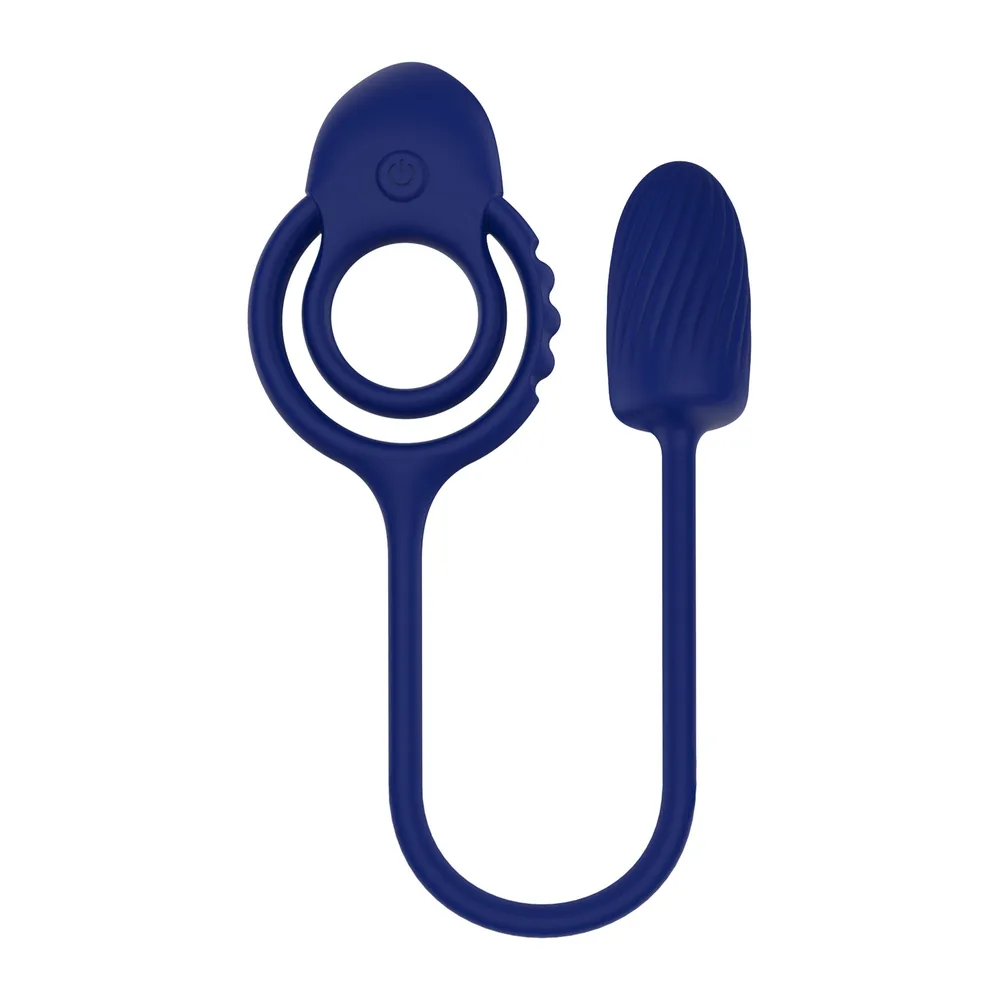
The Thria Ultimate Couple Climaxer is a couples product from ToyJoy’s Fame series, and the name is a clue to the overall design. This isn’t a penis ring with a vibration motor on the top side, like most products in this category. The manufacturer’s own product image shows three separate parts in the package: a double ring in silicone with a clitoral-stimulating head and a single button, a long silicone cord that ends in a ribbed bullet for anal stimulation, and a standalone wireless remote control with an additional button. Three stimulation points, two motors, and one remote control.
According to the manufacturer, the specifications look like this: ten vibration modes, two motors, enclosure rating IPX7, super-soft floating silicone, and a rechargeable battery. The manufacturer’s own dimension drawing states a total length of 33 centimeters, two rings with diameters of 3 and 4 centimeters respectively, and a bullet that is 5 centimeters long and 4 centimeters in diameter. In Sweden, the item is sold by four stores at prices between 539 and 694 SEK, and three of them had it in stock during the price check on September 12, 2026.
This review is exclusively about the blue variant with EAN 8713221844446, the manufacturer’s item number 11054-BLUE. According to the manufacturer’s product page, Blue is the only color the item is available in, which makes the EAN check easier here than for products that are sold in five colors, each with its own number. The number is verified in the structured product data on the manufacturer’s own site, and it matches the item number at Vuxen and the reference number at Sexonic.
What’s already worth mentioning here—something that comes up throughout the text—is how thin the manufacturer’s documentation is. ToyJoy does not publish runtime, charging time, battery capacity, sound level, product weight, or any product-specific manual for item 11054. Several of the figures that circulate in the store texts do not come from the manufacturer but from the stores’ own product sheets, and they also differ from the manufacturer’s dimension drawing in a couple of points. This is covered in detail further down.
The construction is easier to understand with the dimension drawing in front of me than with the marketing text. At the top there is a double ring: an inner ring with a diameter of 3 centimeters and an outer ring with a diameter of 4 centimeters. On top of them sits the elongated head, which contains one of the motors, the on/off button, and the ridged underside that, according to the manufacturer’s product images, is facing the clitoris when the ring is worn.
From the bottom of the ring, a narrow silicone cord runs straight downward. It ends in the ridged bullet, which contains the other motor. The manufacturer’s dimension drawing states that the bullet is 5 centimeters long and 4 centimeters in diameter, and that the total length from the top of the ring to the bullet’s tip is 33 centimeters. It’s that figure that makes the stores’ “total length 33 cm” look unreasonable at first glance—for a penis ring, 33 centimeters is absurd, but for a penis ring with a thirty-centimeter cord and a bullet at the end, it’s correct.
The manufacturer’s illustration in the product gallery also shows how the parts are intended to sit: the ring around the penis base with the head pointing upward toward the partner’s clitoris, and the cord led backward between the buttocks with the bullet positioned anally. So this is not a product where the bullet is placed between the bodies, but one where it is meant to sit in one of them. That has practical consequences for both fit and cleaning, which are discussed further down.
A point about the store texts belongs here as well. The manufacturer writes that the removable bullet provides deep anal stimulation. Some foreign retailers instead describe the other part as something that rests in the vagina for G-spot stimulation. That is the store’s description, not the manufacturer’s, and it is contradicted by ToyJoy’s own illustration. Where the two descriptions differ, the manufacturer’s description applies.
The principle behind a penis ring is mechanical and has nothing to do with electronics. The ring sits around the penis base and slows the venous return, while the arterial flow into the erectile bodies is affected less. The result is that the erection is held back for a bit longer and feels firmer. The electronics in a vibrating ring add something entirely different: a motor that applies vibration to the surface the ring is still pressed against, and which on couple products like The Thria is directed at the partner’s clitoris rather than at the wearer.
What sets The Thria apart from a simple vibrating ring is that it has two motors instead of one, and that the second motor is housed in a body that is physically separate from the ring. The manufacturer expressly states “twin motor” on the packaging. What ToyJoy, on the other hand, doesn’t say is whether the two motors can be controlled independently of each other or whether the ten settings always move both at the same time. The manufacturer does not publish any such information, and it also can’t be inferred from the product images, where the ring has a single button and the remote control likewise.
What can be established purely from the design is that a ring with two looped sections of different diameters distributes the pressure differently than a single ring. The inner loop at 3 centimeters and the outer one at 4 centimeters are intended to enclose different areas, which is a common approach to keep the product in place without tightening it more than necessary. The silicone is elastic—stores state the ring diameter as a range of 3 to 5 centimeters, meaning with stretching included, while the manufacturer’s dimension drawing shows the two rings in their resting state.
The material is the only characteristic of an intimate product that can’t be compensated for through experience or care, and it determines whether the product is still hygienic after a few years. ToyJoy states a single material for The Thria: ultra-soft liquid silicone. According to the description, this applies to the entire product—ring, main body, cord, and bullet. The stores use the wording high-quality silicone, respectively silicone, in their fact boxes.
“Liquid silicone” is essentially a manufacturing technique, not a material of its own. Liquid silicone rubber is cast into the mold in liquid form and then vulcanized there, instead of being pressed as a solid mass. The advantage for a product with this shape is obvious: a ring with two loops, an integrated electronics housing, and a thirty-centimeter cord in one piece is easier to cast in a single operation than assembling it from multiple parts. Fewer seams means fewer places where water and residue can end up staying, and that’s exactly what the IPX7 rating requires.
Silicone is also a non-porous material. A non-porous surface can be cleaned, because there are no microscopic cavities where residue can remain. This is the single most important property of a material that is meant to lie against mucous tissue, and that’s why the material declaration weighs more heavily than almost every other line in a specification.
That the entire product is covered in silicone has two consequences. One is tactile: the surface is soft and has a certain grip even when it’s wet, unlike glossy ABS plastic. The other is hygienic: there is no seam between a silicone part and a plastic part where dirt can collect. For comparison, Lelo states that the Tor 3 is made of body-friendly silicone and ABS plastic—so it’s a combination.
Phthalates are a group of plasticizers used to make plastic—above all, flexible PVC—pliable. The Kemikalieinspektionen describes them as substances that can affect the hormonal system and make reproduction more difficult, and several of them are therefore restricted or prohibited within the EU in a large number of products. This specific product category is repeatedly the subject of oversight, because it contains flexible plastic against skin and mucous membranes.
Here there’s a real difference from premium brands, and it’s worth stating plainly. ToyJoy publishes no declaration that The Thria is free from phthalates, BPA, or latex. The product page lists the material, the packaging bears the “body-safe” symbol, and the manufacturer’s general manual refers to the packaging for material information—but there is no explicit commitment regarding plasticizers. We-Vibe, by comparison, explicitly states that the Pivot 2 is made from body-friendly silicone free from phthalates and BPA and made without latex.
How serious is it? Silicone doesn’t require phthalate plasticizers to become soft—the softness comes from the polymer’s own structure—so a correct silicone specification is in itself a good sign. But “body-safe” is a marketing term without a definition, while “free from phthalates, BPA, and latex” is a claim that can be held against the manufacturer. Anyone with a latex allergy gets no help from ToyJoy’s documentation, because the manual only refers to the fact that the materials are listed on the packaging—which you can’t read until the item is at home.
The manufacturer’s dimension drawing in the product gallery is the most useful single source for this product, and it provides four values: overall length 33 centimeters, the rings Ø 3 centimeters and Ø 4 centimeters, the bullet’s length 5 centimeters, and the bullet’s diameter Ø 4 centimeters.
Here the shops and the manufacturer disagree on two points, and that in itself is a find. Blush Me, SexleksakerOutlet, and Vuxen all state “insertable length 5.5 cm” where the manufacturer’s drawing states 5 centimeters, and all three state “ring diameter 3–5 cm” where the drawing indicates two fixed rings of 3 and 4 centimeters. The difference of half a centimeter is small, but it shows that the three Swedish shops are reproducing the same product sheet rather than the manufacturer’s drawing. The interval 3–5 centimeters is likely a stretching specification, not a measurement of the product at rest. The manufacturer’s drawing applies.
Bullet’s diameter of 4 centimeters deserves a note in itself, because it is the only figure in the specification that has a direct impact on whether the product will fit you at all. Four centimeters is a significant circumference for anal use and is clearly above what beginner products in the category usually measure. Anyone without experience should read that figure before the price.
Weight is the piece of information where the documentation is weakest. ToyJoy does not publish any product weight for The Thria. The only number that can be found with the manufacturer is 226 grams in the web shop’s article data, and that is the shipping weight for the entire packaged item—not the product’s net weight. None of the four Swedish shops lists any weight at all. So assume that the actual silicone product weighs clearly less than 226 grams, but treat the figure as a shipping measure until the manufacturer specifies it.
The packaging is a standing light purple cardboard box with the serial marking FAME by TOYJOY and the product name THE THRIA on the front, and with the product’s five symbols printed on the side: body-safe, ten vibration modes, twin motor, waterproof IPX7, and rechargeable. No material declaration or battery information is visible in the manufacturer’s picture of the packaging, but the manual states that that exact information is printed on the box—which means that the only place where the materials are stated completely is the one you won’t be able to access before the purchase.
The interface is as simple as it can be. The manufacturer’s product image shows a single button on the ring’s main unit, labeled with the usual on/off symbol, and a single button on the remote control. Ten vibration modes and two motors are therefore controlled with a total of two buttons, one of which is on a unit that sits loosely.
It is a deliberate trade-off, and it has a clear downside: with one button, there is no way back. If you go from position seven to position three, you move forward through eight, nine, ten, and around. On a product that is worn during intercourse—where the button is also located between two bodies—it is a worse solution than a pair of plus and minus buttons, but it is also standard in this price range. Lelo states eight vibration patterns on the Tor 3 and solves the step-through with an app instead.
The remote control is the function that most noticeably sets The Thria apart from simpler pairings, and it is also the only place where the product becomes radio equipment. The manufacturer’s product image shows an oval, silicone-covered unit with a button, and the packaging image marks the wireless connection with the usual radio waves. The stores list “control: remote control” in their information boxes.
Next, the information runs out. ToyJoy does not publish either range, frequency band, transmitter power, battery type in the remote control, or whether the control is rechargeable or uses a button cell. The manufacturer’s general manual refers to products with wireless functionality to the Radio Equipment Directive 2014/53/EU and states that the product-specific radio details are on the packaging. The same manual also states that the EU declaration of conformity can be downloaded from the manufacturer’s manual page. That page contains three general manuals and no declaration of conformity at all—neither for this article nor for any other.
Two practical conclusions follow from this. First: expect room-range, not that you can control the product from another room, since nothing else is promised. Second: if the remote control is powered by a button cell, it is a consumable material that you need to be able to replace, and that information is missing. The manual’s battery safety section explicitly covers button cells and warns that they can be swallowed, which suggests that ToyJoy has such cells in its range—but which type this particular control uses is not stated.
Ten modes is the most common number in this price range, and the manufacturer lists them as “vibration modes” rather than intensity steps. The difference is not cosmetic. An intensity step is the same vibration, just stronger or weaker; a mode could just as well be a pattern—pulses, waves, gradual ramping up. So a product with ten modes will typically have fewer than ten pure strength levels, since part of the list goes to rhythms.
ToyJoy does not publish a breakdown of the ten settings into intensities and patterns, nor whether the settings list is the same for the ring’s motor and for the bullet’s motor. It is a recurring pattern in this specific specification: the number is there, but not what it consists of. For comparison, Lelo states that the Tor 3 has eight vibration patterns and that they can be added in the app.
What can be established is that two motors in two physically separate bodies provide a different experience than one motor, regardless of how the settings are distributed. Vibration then spreads poorly through a narrow silicone cord, which in this case is an advantage: the bullet’s motor works against its own surroundings and the ring’s motor against its, instead of both being felt in the same place.
Here the answer has to be two-part, and it’s important to keep separate who is saying what. ToyJoy does not publish any measured decibel value for the The Thria, either on the product page, in the manuals, or on the packaging. There is also no sound symbol among the packaging’s five markings.
The three Swedish retailers, however, all state "sound level: under 50 dB" in their product sheets. It is a retailer statement with no indicated measurement method, no distance, and no information about which of the two motors is being referred to, and it should be read as an order of magnitude and nothing more. Under 50 dB is also a low ceiling that most small motors in the category can handle—about the level of a quiet office room. A number without a measurement method tells you very little, and the fact that three retailers give the same figure only means that they share product sheets, not that the figure has been confirmed.
A practical tip that applies regardless of model: a vibrating product that is pressed against a hard surface sounds noticeably louder than the same product against a soft surface, because the desktop acts as a resonance box. This applies very much to the loose remote control and the bullet when they lie on a nightstand during charging or between uses.
The Thria is rated IPX7 according to both the manufacturer’s product description and the symbol on the packaging. The rating comes from the international standard IEC 60529, which defines enclosure classes for electrical equipment. The 7 in the second position means that the product has been tested for submersion in water to a depth of one meter for 30 minutes. Retailers summarize it as "completely waterproof" and "100% waterproof," which is a reasonable translation.
The difference versus a splash-proof product is greater than the wording suggests. Splash protection covers water droplets and, at best, water jets, but not submersion. Such a product can handle a damp cloth and possibly a shower, but not a bathtub, and it should not be held under running water without thinking through the buttons and the charging contact. The manufacturer’s own manual formulates the same distinction: splash-protected products may be cleaned with water but not submerged, and products without a specified rating must not be exposed to water at all.
With IPX7, the entire product can be rinsed off without caution. A caveat from ToyJoy’s manual is, however, worth reading carefully: waterproof products may only be submerged when all charging ports, battery compartments, and covers are completely closed. For a product where the charging contact is not described anywhere in the manufacturer’s materials, this is an instruction you must follow without knowing in advance what the contact looks like.
One detail: the remote control’s ingress protection rating is not specified separately. The IPX7 marking is on the product in the manufacturer’s materials, and there is no information that the remote control left loose would be as watertight. Treat the remote control as not watertight until the packaging states otherwise.
ToyJoy’s instructions are unusually clear on this point, despite the rest of the documentation being thin. Clean the product before and after each use, with lukewarm water and mild soap or a cleaning product intended for intimate products. Rinse thoroughly afterward and let it dry completely before putting the product away. Since this product is intended for anal use on one end and for contact with mucous membrane on the other, the order of cleaning is not a detail but the whole point: the bullet and the cord should be cleaned separately and first, then the ring and the head.
The lubricant issue is decided by the manufacturer. The manual states that only water-based lubricant should be used, and that both oil-based and silicone-based lubricants can damage the material. It’s an instruction with a technical basis: silicone-based lubricant breaks down the silicone surface over time and makes it porous, and a porous surface can no longer be cleaned properly—only replaced. Oil-based products such as coconut oil leave a film that is difficult to remove.
Two more instructions from the manual belong here, because they rarely appear in the store texts. The product must not be heated up, frozen, or exposed to temperatures above 45 degrees—so boiling water and a dishwasher are out of the question despite IPX7. And storage should be done dry, dust-free, and kept separate from other products, preferably in a bag or box, because different materials can react with each other when they come into contact. The manufacturer does not state that a storage bag is included.
This is the chapter where the The Thrias specifications are thinnest, and it’s worth being direct about why. The manufacturer states that the product is rechargeable and nothing more.
Via USB. Blush Me, SexleksakerOutlet, and Vuxen all state that charging is done with a USB cable, and Blush Me and SexleksakerOutlet also specify the charging time as 120 minutes. These are store details, not manufacturer details—ToyJoy does not publish any charging time at all.
What type of charging connector the product has is also not published, either by the manufacturer or by the stores. "USB" says something about the other end of the cable, not about the one that plugs into the product. On an IPX7-rated silicone product with no visible access panel in the manufacturer’s images, a magnetic connector is the most common solution, because it doesn’t require any opening in the housing—but this is a conclusion from the design, not a published claim. Practically, this means you should assume that the charging cable is product-specific and that a dropped cable can be hard to replace. ToyJoys older manual explicitly states that only the included USB cable should be used.
Otherwise, the manual’s charging instructions are straightforward: charge fully before first use, charge only in a dry environment and never in or near water, unplug the cable when charging is finished, never charge a damaged product, and do not use the product while charging unless otherwise stated. The manufacturer also recommends that the product be charged regularly even when it isn’t being used, which is the standard advice for lithium-ion cells that would otherwise self-discharge down to a level where they can be damaged.
ToyJoy does not publish the battery’s capacity in mAh, its voltage, its type, or the product’s operating time on a charge. None of the four Swedish stores does either. The only battery-related figure that exists anywhere in the chain is the stores’ charging time of 120 minutes.
This is a real shortcoming, and it becomes clearest in comparison. Lelo states for the Tor 3 a lithium-ion battery of 3.7 volts and 70 mAh, an operating time of up to two hours, and a charging time of up to two hours at 5.0 volts and 70 milliamperes. We-Vibe states for the Pivot 2 a rechargeable lithium-ion polymer battery, up to 120 minutes of operating time, and up to 90 minutes of charging time. So both competitors publish exactly the information that ToyJoy leaves out.
Without the capacity, it’s not possible to convert the runtime into power consumption, and it’s not possible to compare how heavily the cell is loaded between models. Without the runtime, you can’t know whether the product lasts for one occasion or ten. And since The Thria has two motors that can run simultaneously, the runtime is also a number that reasonably varies a lot depending on how the product is used—making the absence of a runtime figure especially noticeable.
What applies generally to lithium-ion batteries also applies here: capacity drops with the number of charge cycles, and a cell that is cast inside a fully welded silicone body is, in practice, not replaceable. The product is thus used up when the battery is. It’s a reasonable design for an IPX7 product, but it also means the battery specs are exactly the kind of information a buyer should see before purchasing.
Since the manufacturer does not publish any product-specific manual for item 11054, the general safety manual is the only instruction available, and it’s worth reading before buying rather than after. Some points are especially relevant for this particular product.
The manual says that products intended for external stimulation should not be used internally, and that products intended for anal use are designed with a wide base and should only be used as intended. The Thria’s bullet sits on a 33-centimeter-long cord that is firmly connected to the ring, which in itself functions as a safety barrier—but it assumes that the ring is actually in place.
Further: inspect the product before each use and do not use it if it is damaged, cracked, or deformed. Do not use it on irritated or damaged skin. Remove genital piercings before use where relevant—an instruction that is especially warranted for a ring that tightens around the base of the penis. Stop immediately if you experience pain, discomfort, or numbness, and seek medical care if the symptoms persist. A numbness sensation is the warning that is most relevant specifically for penis rings, because it’s the early sign that the ring is either too tight or has been on for too long.
The manual also covers medical caveats: anyone who is pregnant, has recently had surgery, has an implanted medical device such as a pacemaker, or has a condition that could be affected by vibration should talk to a doctor before use. The product is sold as adult novelty and not for medical use. How long a penis ring may be worn, however, ToyJoy does not state anywhere—which is the piece of information that is most clearly missing in a manual for this type of product.
We do not have price data from shops in your market yet.
The dimensions drawing is provided, the number of settings is provided, and the ingress protection rating is provided. The runtime, battery capacity, and warranty period are not.
Two comparisons are relevant: against the established premium ring from Lelo and against the pairing from We-Vibe. All details below come from the respective manufacturer’s own specifications, and all Swedish prices come from the shops’ product feeds on September 12, 2026.
Lelo Tor 3 is a simple ring with a motor. Lelo states the dimensions 46.7 × 22.2 × 60 millimeters and a diameter of 29 millimeters, the body-friendly material is silicone and ABS plastic, a lithium-ion battery of 3.7 volts and 70 mAh, a runtime of up to two hours, a charging time of up to two hours at 5.0 volts and 70 milliamps, eight vibration patterns, app control via Bluetooth, that the product is 100 percent waterproof, and a two-year warranty followed by a ten-year quality warranty.
The differences that actually matter: Tor 3 is a ring; The Thria is a ring plus an anal bullet plus a remote control. Tor 3 has one motor; The Thria has two. Tor 3 has app control and The Thria has a radio remote control without a published range. Tor 3 has silicone and ABS; The Thria has only silicone. And the decisive difference in the reporting: Lelo publishes battery capacity, voltage, runtime, charging time, charging current, dimensions, and warranty duration. ToyJoy publishes dimensions and the number of modes.
The conclusion is simple. If you want a pure penis ring with an app, documented battery data, and a manufacturer’s warranty with a stated duration, then Tor 3 is the product that actually can be reviewed. If you want three stimulation points and a remote control, that combination isn’t available from Lelo in this product — but you buy it without knowing how long the battery lasts.
We-Vibe Pivot 2 is the closest conceptual competitor: a pair that is worn during intercourse and stimulates both. We-Vibe states body-friendly silicone free from phthalates and BPA, and made without latex, a rechargeable lithium-ion polymer battery, runtime up to 120 minutes, charging time up to 90 minutes, enclosure rating IPX7, control with both a button on the product and an app, a two-year warranty, and a price of 89 euro.
So both products are IPX7 and both are silicone. From there, they differ. Pivot 2 is controlled with an app; The Thria with a physical remote control — which is an advantage for the person who doesn’t want yet another app with an account, but a disadvantage for the person who wants to be able to control from a distance and save settings. Pivot 2 has one motor in the ring; The Thria has two motors, one in a separate anal bullet. And We-Vibe publishes runtime, charging time, warranty duration, material declaration, and price; ToyJoy publishes neither of those except the material.
The price comparison is interesting in the opposite direction of what you might expect. We-Vibe lists 89 euros for the Pivot 2, and ToyJoy lists 77.99 euros for The Thria in its own store—so they are therefore close to each other according to the manufacturers. In Sweden, The Thria costs from 539 SEK, so clearly less than the manufacturer’s own price converted. That’s where this product’s real argument lies: you get three parts and two motors for what a single ring from a premium brand costs.
The question is more common than you’d think in searches, and the answer is mechanical in nature. A regular penis ring has a single job: to slow the venous return so that the erection is maintained for longer. It doesn’t need a motor or battery, and the cheapest versions are a simple silicone ring for under a hundred bucks.
A cock ring adds a motor and directs it toward the partner. The ring sits around the base of the penis just like before, but the head on the top side ends up against the clitoris during intercourse. The Thria goes one step further by adding a second motor in a bullet on a long cord, directed anally toward the wearer herself. So it’s three stimulation points from one product: ring pressure, clitoral vibration, and anal vibration—and that’s what the manufacturer means by "triple pleasure ring".
The trade-off is equally clear. The more parts a product has, the more things need to be positioned correctly at the same time, and the greater the risk that one of them will get in the way. A product with a thirty-centimeter cord between two bodies is, by definition, more demanding to put on than a simple ring. If you’re looking for the easiest way to add vibration to sex, you buy a simple ring; The Thria is made for someone who wants everything at once and is willing to accept that it requires more from positioning.
Four Swedish stores sell the item with EAN 8713221844446. The cheapest are Blush Me and SexleksakerOutlet at 539 SEK each, then Vuxen at 689 SEK, and the most expensive is Sexonic at 694 SEK. It’s 155 SEK, or a 29 percent difference, for the exact same item number, the same color, and the same packaging.
Three of the four stores had the product in stock during the price check: Blush Me and SexleksakerOutlet at 539 SEK, as well as Vuxen at 689 SEK. The only store that was sold out was Sexonic, which was also the most expensive. That means the price range among the stores where the item was actually available to buy was 539 to 689 SEK—a difference of 150 SEK, or 28 percent—which in practice is the entire spread of prices.
Two shops charging exactly the same price are worth a comment. When two retailers list identical 539 SEK for the same EAN, it almost always means the same wholesale chain and the same recommended retail price—not competition. The difference between them then lies in shipping terms and delivery time rather than the price. Vuxen offers free shipping from 799 SEK, which means that a single order of this product ends up below the threshold at that store.
One final price observation: the manufacturer’s own price in its own web shop is 77,99 euro. Anyone comparing Swedish prices with the manufacturer’s should therefore not assume that the Swedish price is marked up—it isn’t here. The 539 kronor are below the manufacturer’s own list price, suggesting that the item has already been discounted in Swedish retail. Blush Me states an actual regular price of 799 SEK and a campaign price of 539 SEK, meaning a discount of 33 percent. The prices in the table above are updated when the stores’ product feeds are updated, but always check the final price at checkout.
It’s for couples who already know they want vibration during intercourse and who want more than one stimulation point from the same product. It’s for the person who wants a physical remote control instead of an app with an account and updates. It’s for the person who wants to be able to rinse off the entire product under running water, and for the one who wants silicone all the way through instead of silicone on plastic parts. And it’s for the one who thinks 539 SEK for the ring, bullet, and remote control is a reasonable price—which, measured against the competitors’ price tags, it is.
It’s not for you if you’re new to anal use. The bullet’s four centimeters in diameter is a real measurement, and that number should be read before purchase, not after. It’s not for you who want to know how long the battery lasts before you buy, because ToyJoy does not publish the runtime. It’s not for you who require a materials declaration about phthalates, BPA, and latex before purchase, because it isn’t published. It’s not for you who want to control each motor separately, because it isn’t clear that it’s possible. And it’s not for you who want a manufacturer’s warranty with a stated length—where both Lelo and We-Vibe are clear, and ToyJoy is not.
One more thing belongs in the decision. A product with three parts and a 33-centimeter cord puts higher demands on getting everything positioned correctly than a simple ring does, and it’s harder to carry discreetly. What makes the Thria interesting—that it does three things at the same time—is also what makes it something it can end up being left lying around if what you really wanted was just vibration against the clitoris. If you’re unsure, you’d do better to start with a simple pairing and then upgrade afterwards.
The warranty question is easy to answer and uncomfortable to read. ToyJoy does not provide any own time-limited manufacturer warranty for The Thria. Both manuals use the same wording: the product is covered by the applicable statutory warranty, which covers material and manufacturing defects during normal use. Normal wear and tear, accidents, improper use, poor care, any own modifications, and damage caused by not following the instructions are excluded. A receipt is required when making a claim.
In other words: what you get is what the law already gives you—nothing more. That is a clear difference versus the competitors in the comparison—Lelo states two years of warranty plus ten years of quality warranty, and We-Vibe states two years. It doesn’t say anything about how durable the product is, but it does say something about the risk the manufacturer is willing to take with its own design.
What always applies, though, is your statutory rights—and they are stronger in Sweden than ToyJoys wording suggests. Under konsumentköplagen, you have three years of right of complaint for defects in the goods, regardless of what the manufacturer commits to, and the claim is directed at the store you bought from—not at ToyJoy in the Netherlands. For distance purchases, you also have a right of withdrawal within fourteen days under lag om distansavtal och avtal utanför affärslokaler.
Be aware that in practice, the right of withdrawal is limited for hygiene products that have been taken out of a sealed package. Konsumentverket describes the exception, and for products of this type, it is regularly applied by the stores. The right of complaint for defects, on the other hand, always applies. If you have questions about what applies in your case, Konsumentverket guides you via Hallå konsument.
Toy Joy The Thria Ultimate Couple Climaxer isn’t included in any ranking yet. In best i test guides, the entire categories are compared against each other using five shared criteria, with what was left out shown.
Every numerical piece of information in the text can be traced to one of the sources below. The links were checked manually on the specified date.
This page is machine-translated from Swedish. Read the Swedish original