

Review
Review: Dream Toys Glamour Glass Curved Wand
Curved double-ended glass wand in borosilicate glass — 17 cm and IPX7.
4 August 2026
Review · Glass dildo · Nine balls · Temperature play
ToyJoys beaded glass wand was reviewed against the manufacturer’s own specifications and price data from three Swedish retailers. Porfritt glass (porous-free glass), nine beads that grow toward the base, 22 centimeters in length and a largest diameter of 3.5 centimeters according to the manufacturer’s own dimension sketch — but also a missing glass type, a missing weight, a missing warranty period, and two conflicting statements about the temperature in ToyJoys’ own material.
A straight glass wand with nine beads that grow toward the base, completely without electronics and completely in porfritt glass. The material is the most durable in the category: it can be cleaned completely, it does not age, and it can withstand all lubricants. The shape provides a gradual progression instead of a single diameter. What you pay for is brittleness and documentation that doesn’t measure up — ToyJoy does not state either the glass type, net weight, IP rating, or warranty period, and it gives two conflicting statements about the specific temperature at which the product is sold.
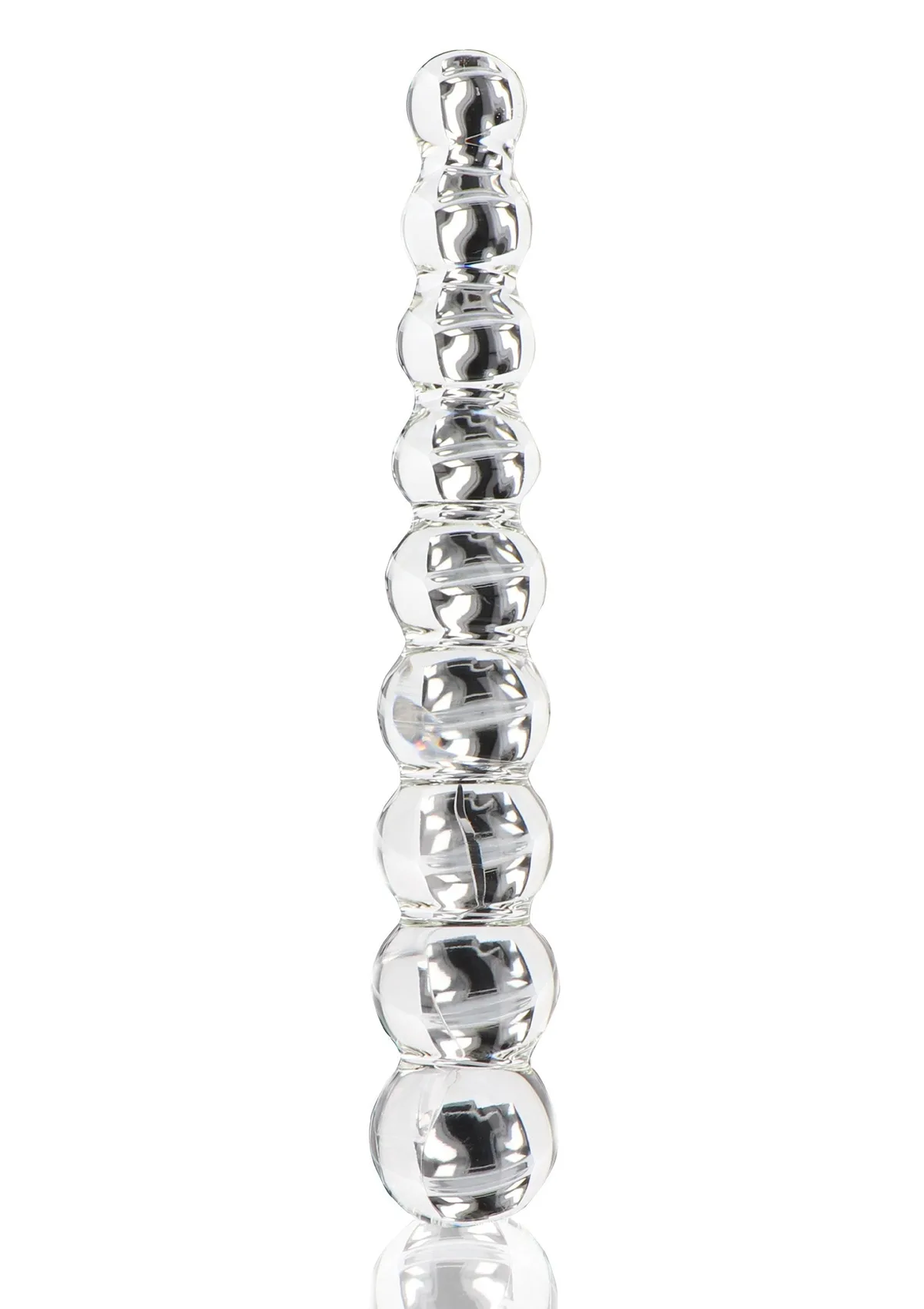
ToyJoy Frozen Fountain is a transparent glass rod measuring 22 centimeters, built like a row of balls that grow in size from the narrow tip down toward the base. It is part of ToyJoy’s glass series Glass Worxx and carries article number 10610 with the manufacturer. The EAN number is 8713221821294, and that number appears both on the manufacturer’s own product page for the 10610-CLEAR variant and as EAN13 at the Swedish store Sexonic — the same item, regardless of what the stores choose to call it.
The specification is short, and that in itself is one of the most telling features of the product. The manufacturer publishes exactly two measurements: total length 22 centimeters and maximum diameter 3.5 centimeters. Both are shown in a measurement sketch that ToyJoy themselves added to the product gallery. The material is listed as "first-class, non-porous glass" — first-class, non-porous glass — and as hypoallergenic. No weight, no glass type, no IP rating, no warranty period, and no product-specific manual. In Sweden, the item is sold by three stores at prices between 249 and 303 SEK, and two of them had it in stock at the price check on September 12, 2026.
The manufacturer is ToyJoy in Wijchen, the Netherlands, which according to its own manual is a registered trademark and company name for SCALA 2.0 B.V. The country of origin for the product itself is not stated by ToyJoy; the Dutch retailer Masculum, which publishes the manufacturer’s wholesale data straight from the source, states China.
A glass dildo is a solid rod of tempered or heat-formed glass, without a motor, battery, joints, or surface coating. That makes this product category the simplest there is in this industry, and at the same time one of the most hygienically well-positioned. Glass is a non-porous material. A non-porous surface can be cleaned because there are no microscopic cavities where residue can get stuck. It’s the single most important property of a material that will be placed against mucous membranes.
The difference between silicone and the category’s other non-porous standard material is stiffness. A silicone dildo gives way and follows the body’s shape, while a glass rod doesn’t do that at all. Vuxen states in its own fact box “Elasticity: Not bendable” and “Stiffness: Hard,” which is exactly what it sounds like. In practice, that means the pressure impression becomes completely different: each ball on the rod is a distinct shape that passes through, not a soft wave. That’s the whole point of the design, and at the same time the reason it isn’t for everyone.
The second big difference is chemical. Glass is inert. It doesn’t react with lube, it doesn’t age, it doesn’t soften, and it doesn’t become sticky over time. A silicone dildo can be ruined by the wrong lube; a glass rod, in principle, can’t. What can happen to glass instead is the obvious: it can break. That’s the whole trade-off in one piece.
Here there’s a discrepancy worth knowing about before you order, because it affects how the product is intended to be used.
What can be established is that the manufacturer describes the same article in two different ways in the same text, and that the Swedish stores have chosen different sides. In terms of shape, it’s a beaded rod with two ends of different sizes—hence the word “Dual-Use” in Sexonic’s name—and it’s a design that appears in both categories. The question of anal use, however, requires its own detailed discussion, and it’s further down under the heading about flared base.
The material is the only characteristic of an intimate product that can’t be compensated for by habit or care, and it determines whether the product is still hygienic after ten years. With a glass product, the answer is almost always good—but “almost always good” isn’t the same as documented.
ToyJoy describes the material as top-class, non-porous glass, and calls the entire series hypoallergenic. Non-porousness is the decisive feature. A porous material—softened PVC, the so-called jelly rubber, certain TPE blends—has a surface with microscopic cavities. You can rinse it clean on the surface, but you can’t clean it properly at depth, and therefore, in practice, products like this have a limited lifespan as a hygienic item.
Glass doesn’t have that problem at all. The surface is completely sealed; it can be scrubbed without damage, and it can withstand significantly harsher cleaning agents than silicone can. Blush Me lists the material as "High-quality glass" and Vuxen simply as "Glass". None of them contradicts the manufacturer, and there is no material specification in this product’s documentation that conflicts with any other.
A practical consequence of non-porousness that is rarely mentioned: glass is the only common material in the category where the manufacturer’s lubricant guidance in principle has little or no importance for the material itself. It doesn’t matter for glass whether the lubricant is water-based, silicone-based, or oil-based. So the fact that both Vuxen and Blush Me state that the wand is compatible with all types of lubricants matches the nature of the material—but this is contradicted by the manufacturer’s own manual, which we’ll come back to.
This is where the clearest gap appears in the documentation. ToyJoy never states what type of glass Frozen Fountain is made of. The product page says "first-class, non-porous glass", the packaging image shows no material labeling on the visible side, and the general manual refers the material question to the packaging. None of the three Swedish stores lists any glass type either: Vuxen says "Glass", Blush Me says "High-quality glass", and Masculum says "Glass".
Why does it matter? Because the difference is measurable and directly linked to how the product is marketed. Dream Toys, which sells a directly competing glass wand, states borosilicate glass as the material specification and also explains why: borosilicate glass is made from silicon dioxide together with boron trioxide, and that composition makes the glass significantly more resistant to sudden temperature changes than regular glass. That’s why laboratory equipment is made from it.
And temperature changes are exactly what ToyJoy instructs you to expose the product to. The manufacturer’s own product text tells you to heat the glass under a hot tap or cool it under a cold one. That is the function that sells the product. The fact that the same manufacturer does not state whether the glass is borosilicate or not is therefore a real drawback, not a formality. The conclusion that can be drawn is simple: you’re told that it’s glass, you’re told that you should subject it to temperature cycling, but you’re not told whether the glass is the kind that is designed to withstand it.
Phthalates are a group of plasticizers used to make plastic—above all flexible PVC—pliable. The Swedish Chemicals Agency (Kemikalieinspektionen) describes them as substances that can affect the hormone system and make reproduction more difficult, and several of them are therefore restricted or banned within the EU in a large number of products. This product category in particular is repeatedly the subject of supervision, because it contains flexible plastic for contact with the skin and mucous membranes.
Glass requires no plasticizers at all. The material’s properties come from its own composition, not from added substances, and therefore there is no phthalate issue to address with a solid glass product. That is why, considered as a material declaration, a glass sex toy is more unambiguous than almost every alternative in the category—also more unambiguous than silicone, where “silicone” is sometimes used as an umbrella term for blends. In its fact box, Vuxen marks the competing product Icicles No. 2 as “Body-safe & Free from Phthalates,” and that is an attribute that follows from the material rather than from a single manufacturer’s commitment.
What does not, however, automatically follow from glass is dyes and surface treatments. Frozen Fountain is completely transparent—the manufacturer states the color “clear”; Blush Me and Masculum state “Transparent”—which means there is neither coloring nor a surface layer to ask about. It’s simpler than a colored glass rod, where the question of whether the pigment is in the glass or at least can be raised.
The manufacturer’s dimension sketch in the product gallery shows two figures and nothing more: total length 22 centimeters and Ø 3.5 centimeters. Vuxen lists the same two values in its fact box (“Total length 22 cm”, “Maximum diameter 3.5 cm”), and Blush Me lists “Length 22.00 cm” and “Diameter (max) 3.50 cm”. So there is unusual agreement here: the manufacturer and both Swedish stores say exactly the same thing.
It’s worth noting, because the specification of 22 × 3.7 centimeters circulates on second-hand sites. The manufacturer’s own sketch says 3.5, and the manufacturer’s specification takes precedence. Diameter details that deviate from 3.5 centimeters are not supported by ToyJoy.
The manufacturer’s dimension sketch and product images show nine balls in a row, where each ball is slightly larger than the one above it. The narrowest sits at the tip, and the largest, at 3.5 centimeters, sits at the bottom. Between the balls there are clear indentations. That’s the whole idea of the design: the silhouette gradually increases in circumference toward the base, so you can get used to it step by step instead of facing the full diameter all at once.
The manufacturer only publishes the largest diameter. Measurements of the individual balls, and of the narrowest ball at the tip, are not published. That means it’s not possible to say exactly how big the first step is—only that the sketch shows a smooth progression over nine steps. It’s a task the manufacturer could easily have provided, and it would have said significantly more about how the product actually feels to start with than the single figure of 3.5 centimeters.
The length of 22 centimeters is also worth noting in its own right. Masculum lists "Inbrengbare lengte"—insertable length—at 22.00 centimeters, meaning the entire product. It’s an obviously theoretical figure: a shaft without a handle where each centimeter counts as insertable assumes you let go completely, which you don’t do with a glass product. Treat 22 centimeters as total length and nothing else; the usable length is determined by where you hold it.
ToyJoy publishes no weight for Frozen Fountain, either on the product page, in the product data behind it, or in the manual. It’s a striking gap specifically for a glass product, because weight is the characteristic that most directly determines how the product feels in the hand and how hard a drop onto the floor is.
The only weight that can be found comes from the reseller channel. Masculum lists 0.342 kilos as "weight per unit"—but in that same field, they combine it with the packaging dimensions of 27.0 × 10.4 × 6.5 centimeters, which suggests that 342 grams is gross weight including cardboard rather than the glass’s net weight. None of the three Swedish stores lists any weight at all. The conclusion has to be an honest one: the net weight of the product is not published by any source we’ve been able to verify, and the 342 grams should be read as shipping weight until the manufacturer specifies it.
The packaging dimensions themselves are useful, though. 27 × 10.4 × 6.5 centimeters is a relatively large box for a 22-centimeter-long wand, and that’s because the product comes in an upright gift package with a hanging hook. The manufacturer’s packaging image shows a white cardboard box with the series name Glass Worxx by TOYJOY on the front and the product name FROZEN FOUNTAIN at the bottom. ToyJoy notes on the product page itself that the item is now delivered in a new packaging.
A product without buttons has nothing to learn, and that’s a real advantage. There’s nothing to charge, nothing that can pair up with an app, and nothing that can disappear as a cable. The things you need to decide on are three: lubricant, grip, and tempo.
The grip is controlled by the shape. The wand has nine balls and two ends of different sizes, and the grooves between the balls work as natural finger positions. What sets a glass wand apart from a silicone product in your hand is that it has no friction at all when it’s wet—and with lubricant on your hands, it’s practically slippery. That’s a reason to work over a bed or a rug rather than over tile, and it’s a bigger reason than it sounds, because glass dropped onto a hard surface isn’t just scratched—it can, in the worst case, be unusable.
Here, the manufacturer’s materials differ from the retailers’, and the difference is worth understanding instead of just noting.
Both Vuxen and Blush Me state that the wand is compatible with all types of lubricants. In terms of material chemistry, that’s correct: glass is inert, and neither silicone-based nor oil-based lubricants break it down. It’s actually one of the concrete advantages of glass over silicone, where silicone-based lubricant makes the surface porous over time.
ToyJoy’s own user manual, on the other hand, expressly says that only water-based lubricant should be used, with the reasoning that oil- and silicone-based lubricants can damage certain product materials. That wording is general and applies to the entire range—the manual is a collection manual, not one written for the glass series. The rule we follow is that the manufacturer wins when sources contradict each other, and the manufacturer says water-based. Practically speaking, water-based lubricant also causes the least trouble when cleaning and works with all the other products you could possibly have, so the advice costs nothing to follow. If you want to use something else, it’s worth knowing that the retailers’ claim is based on the material’s properties and not on a statement from ToyJoy.
Temperature play is the product’s stated specialty, and that’s also where the manufacturer’s documentation contradicts itself most clearly.
The product page urges you to warm the glass under a warm running tap for a warm feel, or to cool it with cold water for a cool feel. Both Vuxen and Blush Me repeat this, and it’s the function the whole product name is built around.
The general user manual from the same manufacturer instead says: don’t heat it, don’t freeze it, and don’t expose the product to temperatures above 45 degrees.
These are two messages that don’t go together, and there is no product-specific manual for the glass line that can resolve the contradiction — ToyJoy’s only published user manual is titled "Motorised Intimate Products", i.e. motorized products, a category Frozen Fountain doesn’t belong to. The reasonable interpretation is that the temperature prohibition is written for products with a battery and electronics, and that the product page’s temperature advice applies to the glass. But that’s an interpretation, not a clear statement.
What can be established regardless of interpretation: stick to tap water. Hot and cold water from the tap fall within a range that glass in all forms can handle. Boiling water, freezing, the oven, and the dishwasher are a completely different matter — then it comes down to the type of glass, and ToyJoy does not publish what type of glass it is. Putting an unknown type of glass rod in the freezer and then dipping it in warm water is testing the material’s resistance to thermal shock without knowing what it is. Don’t do it.
This is the most important safety issue regarding the product, and it deserves to be presented plainly.
ToyJoy places the article itself in the category anal pearls, and Blush Me says it’s suitable for both vaginal and anal penetration. At the same time, ToyJoy’s own user manual, under the heading for intended use, states: products intended for anal use are constructed with a flared base and should only be used as intended.
The manufacturer’s own dimension sketch shows no flared base. It shows nine beads in a row, where the lowest bead at 3.5 centimeters is the largest point on the entire rod. A final bead isn’t the same thing as a flared flange: a flange is wider than everything else and lies across the body, while a bead continues the logic of the shape. That the lowest bead is the biggest does provide some resistance, but the construction does not meet the description the manufacturer itself gives of an anal product in its manual.
So the conclusion is that the manufacturer categorizes the product as an anal product while the manufacturer’s own safety section describes anal products in a way this article doesn’t match. That’s not a small point. Always hold the rod, and treat the length of 22 centimeters as something you control with your hand, not something that’s meant to be released.
A product without electronics has no lifespan in the usual sense. There’s no battery that loses capacity, no motor that wears out, and no charging contact that oxidizes. A glass rod that’s handled correctly will, in principle, last for as long as you can keep it—Pipedream puts it that way for its own glass series, saying it’s made to last a lifetime when cared for properly.
The condition lies in that final clause. Glass is brittle, and brittleness is a property that doesn’t warn in advance. A fall against a bathroom floor can make the product unusable in a second, and unlike a silicone product that leaves a mark, a damaged glass product immediately becomes dangerous to use.
ToyJoy’s manual is clear on this point, and the advice applies double for a glass product: inspect the product before each use, and don’t use it if it’s damaged, cracked, deformed, or has sharp edges. For a silicone product, it’s routine advice. For a glass rod, it’s the actual prerequisite for safe use.
What you’re looking for is concrete: hair-thin cracks that go into the material, chips at the edges of the balls, and dull areas that can indicate an incipient crack. Hold the rod up to a lamp—transparent glass makes inspection easy, and that’s one of the advantages of this particular model being completely uncolored. The slightest doubt: throw it away. A glass product can’t be repaired, and a product for 249 SEK isn’t worth the risk.
The same applies to storage. ToyJoy’s manual recommends a storage pouch or a separate storage box, and that products should be stored separately from each other to avoid reactions between materials. For glass, the second point is less about chemistry and more about mechanics: the storage pouch is not included in the delivery according to any of the sources we’ve been able to verify, and a glass rod that lies loose in a drawer together with other hard objects is exactly the scenario that causes chips. Expect to buy a pouch separately.
Cleaning is the simplest step in the entire category. ToyJoy’s manual states: clean before and after each use, use lukewarm water with mild soap or a cleaning agent intended for intimate products, rinse thoroughly afterward, and let the product dry completely before putting it away.
Glass works modestly well in that respect. There’s no seam where water can stay, no battery compartment that needs to be kept dry, and no silicone surface that gets damaged by cleaning agents. There are also no buttons or LEDs to avoid. The only practical precaution is not to wash a glass rod over a hard sink with wet hands—the same applies to a drinking glass.
Drying is worth mentioning. Let the product air-dry or wipe it dry with a clean towel before putting it away; a damp glass surface in a sealed bag is not dangerous, but it attracts dust when the bag is opened again, and dust on an entirely transparent product is more visible than on any other.
ToyJoy does not publish an IPX rating for Frozen Fountain. The product page states none, the packaging picture shows none on the visible side, and the general manual refers the question onward using wording to the effect that the water-resistance rating is printed on the packaging. The Dutch retailer Masculum briefly lists "Waterbestendig," meaning water-resistant, without a rating. The Swedish stores state nothing at all.
In this case, the absence of a rating is not the same kind of shortcoming as it usually is. The IP rating comes from the IEC 60529 standard, which defines enclosure classes for electrical equipment—the number describes how well a housing prevents water from getting into the electronics inside. A solid glass rod has no housing, no interior, and no electronics. There is literally nothing for water to get into.
What can be established is therefore simple: the product can be rinsed under running water, taken into the shower, and used in a bathtub without any electrical property being compromised. Comparing it to a competitor makes the point clear—Dream Toys lists IPX7 for its Glamour Glass Curved Wand, which is also a clean glass product without electronics. Formally, that is a stronger claim than ToyJoy’s silence, but it does not describe any real difference between the two products. Both are solid glass.
One thing, however, that differs between a bath and a shower: in the bathtub, the surface is hard and wet, and a dropped glass rod against an enameled bathtub bottom is not an insignificant event. That is the only water-related risk that actually applies to this product, and it is not stated in any specification.
We do not have price data from shops in your market yet.
You’re told that it’s glass, you’re told that you should temperature-cycle it—but not whether the glass is the type that’s built to withstand it.
Three comparisons are relevant: versus a glass rod with better-documented material, versus the best-selling beaded glass rod in Swedish stores, and versus the rest of ToyJoy’s own glass range. All the details below come from the respective manufacturers’ own specifications where available, and are otherwise labeled as store details.
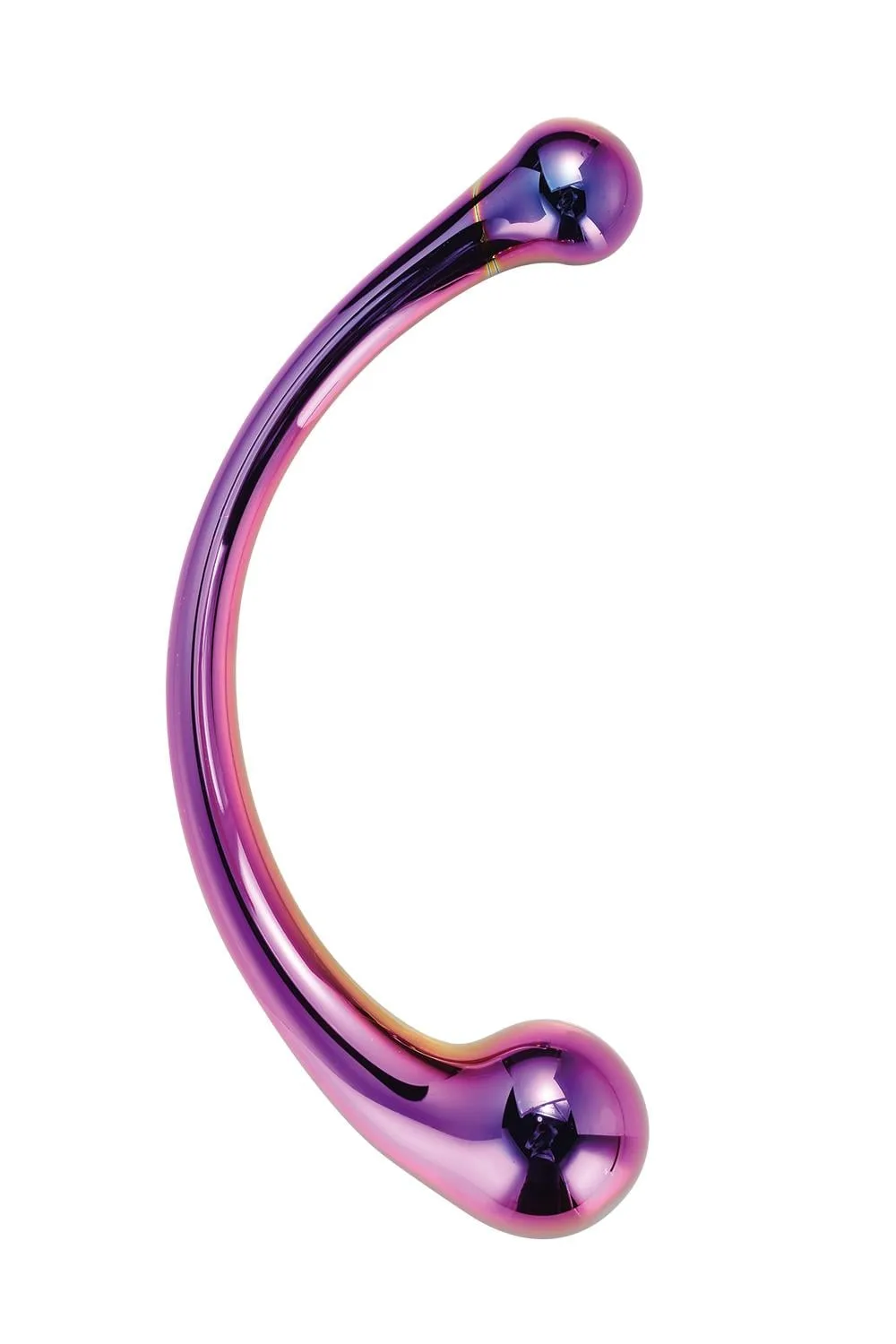
Dream Toys Glamour Glass Curved Wand is a curved, double-ended glass rod. The manufacturer lists a length of 17 centimeters and a diameter of 3.3 centimeters, i.e., five centimeters shorter and two millimeters narrower than Frozen Fountain. The difference in length is noticeable in this category; the difference in diameter is hardly so.
The deciding factor instead is the documentation. Dream Toys lists borosilicate glass as the material specification and explains on its own product page what it means: the glass is manufactured with bortrioxide and can handle sudden temperature changes significantly better than regular glass. They also state IPX7. ToyJoy does not state either the type of glass or the IP rating. So two glass rods that look like they belong on the same shelf differ in the only specification that actually matters for their function—both are marketed with.
In terms of shape, they are different products. Curved Wand is curved and has two ball-shaped ends in different sizes, intended for targeted stimulation. Frozen Fountain is straight, with a smooth progression across nine balls, intended for gradual acclimation. If you want a shape that points somewhere, you choose Dream Toys; if you want a ladder of sizes, you choose ToyJoy.
Pipedream Icicles No. 2 is the closest direct equivalent that is widely sold in Sweden: a transparent, beaded, hand-blown glass rod in the same size class. On its own product page, Pipedream states that the glass is hand-blown, hypoallergenic, and non-porous, and it gives the same temperature advice as ToyJoy—warm or cold water. Pipedream publishes neither length nor diameter on its product page, which means the comparison has to be taken from the retailer’s information.
An adult retailer that sells both lists a total length of 21.5 centimeters and a diameter of 3.8 centimeters for Icicles No. 2, versus ToyJoy’s 22 and 3.5. So they are within half a centimeter of each other in length, while Icicles is three millimeters thicker. Both are described by the store as rigidity “Hard” and texture “Ribbed.”
The price, however, differs clearly. Icicles No. 2 costs 319 SEK at Vuxen versus the recommended price of 349 SEK. ToyJoy Frozen Fountain costs 249 SEK at the same store. That is a difference of 70 SEK, i.e. 28 percent, for two products with essentially identical specifications. Whether Pipedream’s brand and hand-blown origin are worth it is something you decide for yourself; the specifications don’t justify it.
Frozen Fountain is not a standalone product but one of fifteen items in ToyJoy’s glass series. In the manufacturer’s own web shop, the series ranges from 20.99 euro for the cheapest up to 54.99 euro for Rhinestone Scepter. Frozen Fountain costs 33.99 euro, meaning it’s in the upper half of the series but not at the top.
By comparison, the sister model Crystal Jewel costs 24.99 euro and Brilliant Star costs 34.99 euro—both are butt plugs rather than rods. That Frozen Fountain is one of the more expensive items in the series can reasonably be explained by the fact that it is among the longest: 22 centimeters of solid glass simply involves more material than a plug.
What’s interesting about the series overview is that ToyJoy uses the same short product text, the same material wording, and the same lack of information about the type of glass and the weight throughout the entire series. So it’s not that this particular item is documented worse than the others—the entire Glass Worxx is documented at the same level, and that level is an outline and a marketing text.
Three Swedish stores sell the item with EAN 8713221821294. The cheapest is Vuxen and Blush Me, both at 249 SEK. The most expensive is Sexonic at 303 SEK. That’s a difference of 54 SEK, or 22 percent, for the exact same article number, the same color, and the same packaging.
The stock situation makes the choice easier. Two of the three stores had the product in stock at the price check on September 12, 2026, and it’s exactly those two that are at 249 SEK. At the same time, the most expensive store was the one that didn’t have the item at home. That means the price spread you see in the table is not a choice you need to make: the two available options cost exactly the same, and the difference between them lies in shipping and delivery time, not in price.
One way to calibrate the price picture is to look at what the manufacturer charges themselves. ToyJoy’s own web shop lists the item at 33.99 euros, and Sexonic’s euro price for the same article is 27.53 euros. We don’t convert any of the figures to kronor here, because the exchange rate changes daily and we don’t have any exchange rate to cite—but they’re useful as reference points when Swedish shop prices fluctuate, and they show that the item is priced within the same range across Europe.
The prices in the table above are updated when the stores’ product flows are updated, but always check the final price at checkout. Shipping cost is added at all three stores under a certain order value, and for an item priced at 249 SEK, shipping can make up a large share of the total.
It’s for you if you know you want a hard, non-porous material rather than a soft one. It’s for you if you want a shape that steps up in size instead of meeting you with full diameter right away, and for you who want to be able to work with temperature as part of the experience. It’s for you if you’re tired of charging cables and apps and want something that always works, is ready in a second, and can be rinsed clean under the tap without a second thought.
It’s also for you if you prioritize the material’s lifespan. A glass product has no best-before date in the material—it’s just as hygienic after ten years as the day you bought it, as long as it’s intact. That’s more than you can say about almost everything else in the category.
It doesn't suit you if you want a material that gives way. A 22-centimeter fully rigid glass shaft with a maximum diameter of 3.5 centimeters is a product you have to steer deliberately, and it forgives nothing. It doesn't suit you if you want vibration — there is no motor and no battery. It doesn't suit you if you store your things loosely in a drawer in the bed, because no storage pouch is included and glass against hard objects is a bad combination.
And it doesn't suit you if you require complete documentation before buying. ToyJoy does not state the type of glass, net weight, the individual dimensions of the balls, the IP rating, or the warranty period for this item, and it also provides two contradictory statements about temperature in its own material. It's a product whose physical properties are good and whose paperwork isn't.
ToyJoy does not state a warranty period in years for its products. The wording in the manufacturer's own manual is that the product is covered by the applicable statutory warranty, that it covers material and manufacturing defects during normal use, and that normal wear and tear, accidents, improper use, lack of maintenance, unauthorized changes, and damage resulting from not following the instructions are excluded. Proof of purchase is required when filing a complaint.
It's not unusual at this price range for a manufacturer to refer to the statutory warranty instead of providing its own, but it is worth knowing that you don't get anything beyond the law. Compare with the broader category, where individual manufacturers offer fifteen years of warranty on their products, and the difference becomes clear.
What always applies, however, are your statutory rights. Under konsumentköplagen, you have a three-year right to complain about defects in the goods, regardless of what the manufacturer promises. For distance purchases, you also have a right of withdrawal for fourteen days under lagen om distansavtal och avtal utanför affärslokaler. Be aware that in practice the right of withdrawal is limited for hygiene products that have been taken out of a sealed package — the right to complain about defects, however, always applies.
A practical note that applies specifically to glass: a manufacturing defect in a glass product is either obvious right away or it never shows up. Check the rod against the light when you open the package, before using it. If you discover a chip or a crack, then it's a defect in the product in the sense of konsumentköplagen. If you discover the same thing after half a year, the evidence situation is completely different. If you have questions about what applies in your case, Konsumentverket will guide you via Hallå konsument.
ToyJoy Frozen Fountain 22 cm Glass dildo is ranked på plats 12 av 13 in glass dildo best i test, where the entire category is compared against each other using five shared criteria. Guiden vinns av Gildo Glass Dildo No. 5.
Every numerical piece of information in the text can be traced to one of the sources below. The links were checked manually on the specified date.
This page is machine-translated from Swedish. Read the Swedish original