

Review
Review: Satisfyer Pro 2 Next Generation
Cheapest among the widely sold — 219 SEK, IPX7, and a 15-year warranty.
29 July 2026
Review · Clitoris vibrator · Massaging nozzle
Unihorn’s best-selling unicorn vibrator reviewed against the manufacturer’s own specifications and price data from seven Swedish stores. Dual motors with ten vibration speeds and ten tongue patterns, silicone as the only stated material, IPX6 according to IEC 60529, 60 minutes of runtime and a one-year warranty — at a price where there’s a 51 percent difference between the cheapest and the most expensive store.
A simple product with an unusual grip: two independent motors, ten vibration speeds and ten tongue patterns for under three hundred SEK, with silicone as the only stated material. What you pay for is a short runtime of 60 minutes, IPX6 instead of a submersible class, a one-year warranty, and a specification where neither battery capacity nor sound level is published. The stores’ information also differs for both dimensions, weight, and ingress protection rating.
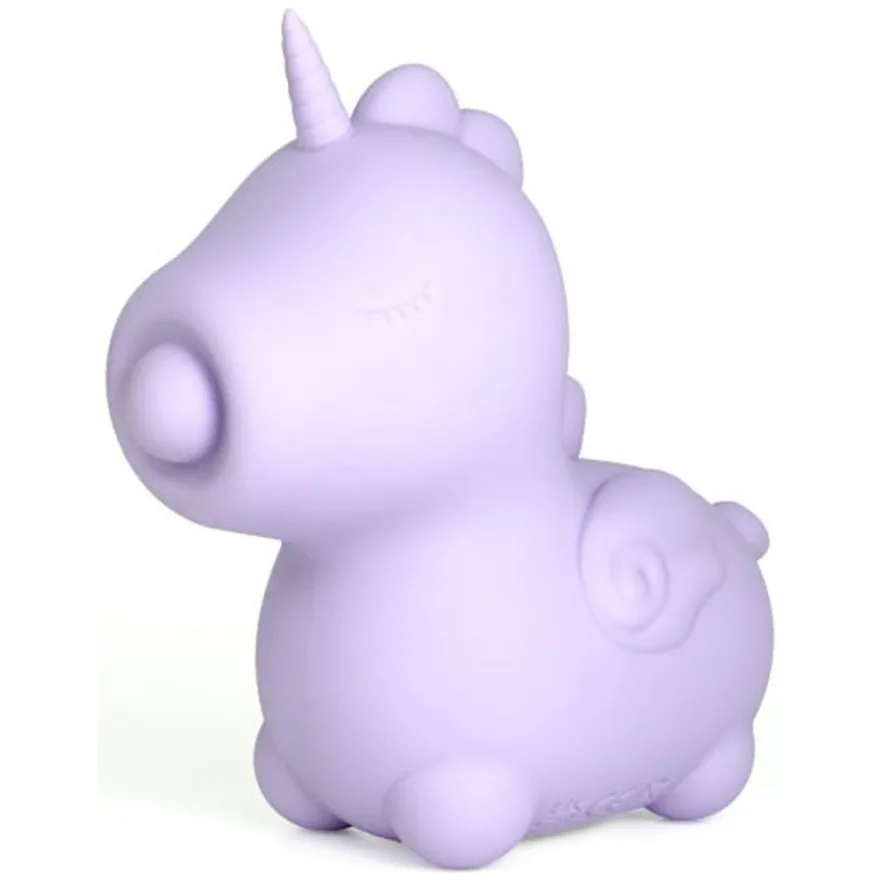
Unihorn Karma Lilac is a clitoral vibrator shaped like a small purple unicorn. It sounds like a gimmick, and the design is a gimmick — but underneath it is a specification that’s unusually concrete for this price range. The manufacturer states dual motors, ten vibration speeds, ten vibration patterns, silicone as the only material, an IPX6 enclosure rating, a 120-minute charging time, and a 60-minute operating time. The product dimensions are listed as 122 millimeters and the weight as 200 grams.
This review is exclusively about the item with EAN 5037353009409, which the manufacturer calls Karma Lilac Massaging Clitoral Vibrator and has the item number UNIKL. It’s worth keeping track of, because there’s a second product with an almost identical name: Karma Lilac USB Bullet Vibrator, item number UNIKLBUL, and EAN 5061076320039. It’s a completely different type of product for roughly half the price, and it’s sold in several of the same Swedish stores. Check the number before you pay.
In Sweden, the item is sold by seven stores at prices between 297 and 449 SEK. Five of them had it in stock during the price check. The price spread is 152 SEK, which corresponds to 51 percent based on the lowest price — a spread that’s large even by the standards of this category, and which means that the store choice matters more for the total cost than almost any single product feature.
Unihorn is a brand from Creative Conceptions, a British wholesaler and distributor that sells the item under the trade name Unihorn – Karma Lilac (The Massaging One). Knowing that is actually useful, because several Swedish stores list “Creative Conceptions” as the brand in their product databases, while others list “Unihorn,” and a third lists “EDC” — the same product, three different brand names in the stores’ systems. It’s also one of the reasons why searches for the brand name produce such different results in different stores.
The series basically consists of five models that the manufacturer calls OG Unihorns, and that all have the same body shape but different stimulation principles: Bean Blossom (fluttering), Heart Throb (pulsing), Mount'n Peak (tongue), Wild Spirit (whirling), and Karma Lilac (massaging). Since then, the range has grown to include, among other things, Blaze Diablo, Cupid's Beau, and a series of seahorses. The point of listing them is that the models don’t differ in size or battery, but in what the mouthpiece does — and that’s the only difference you need to pay attention to when choosing between them.
The manufacturer describes Karma Lilac as a clitoral stimulator with a thrumming mouthpiece, meaning a mouthpiece that beats rhythmically, and a vibrating core. Technically, it’s about two separate motors: one that drives the vibration through the entire body and one that drives the moving part in the mouthpiece. The manufacturer calls this movement "tongue motion" and lists ten patterns for it.
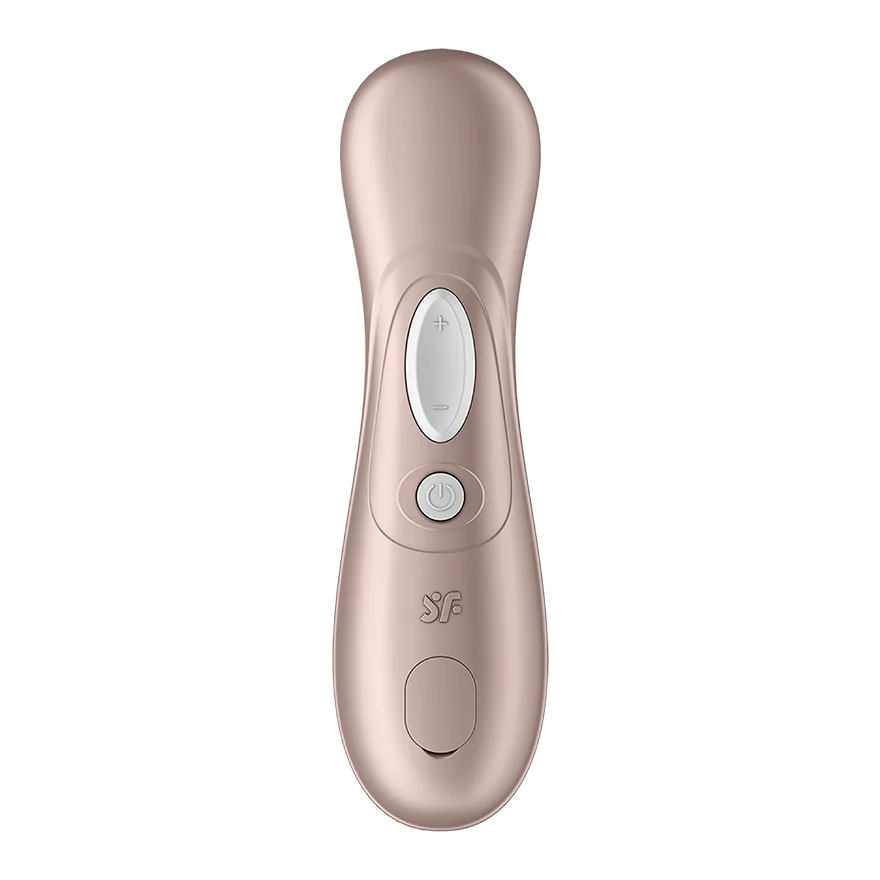
What can be said is that this is not air pressure technology. An air pressure product like Satisfyer Pro 2 uses pressure waves in a sealed chamber that never touches the skin. Karma Lilac makes contact with the skin and instead transfers a mechanical, repeated tapping. These are two completely different sensations, and that difference matters more than which of them just happens to cost the most. If air pressure hasn’t worked for you, that means nothing at all about whether this model works — and vice versa.
A note about the shop texts belongs here already. The retailer Mshop describes the model as a "jolting vibrator" that can "simulate a tongue with jolting movements". The manufacturer doesn’t use the word jolting anywhere, but instead consistently talks about rhythmic massage and tapping. The difference isn’t academic: a jolting vibrator has a part that moves back and forth with several centimeters of stroke length, which this product, based on the manufacturer’s own description and pictures, doesn’t have. Read the shop text as an interpretation, not as a specification.
Three items are so close to each other in name and price that they get mixed up in Swedish shops. Here’s how they differ:
The difference between Karma Lilac and Mount'n Peak is therefore neither size, battery life, nor water resistance — according to the manufacturer’s own pages, they are identical on every published specification line except for the shape of the head. The difference between the large model and the bullet version is, on the other hand, substantial: the bullet model has a motor instead of two and lacks the entire function that the model is named after.
The material is the only property of an intimate product that can’t be compensated for with experience or care, and it determines whether the product is still hygienic in a few years. The manufacturer lists a single word on the material line: Silicone. On the product page, it’s described as "silky smooth body-safe silicone" with a velvet-smooth surface.
Silicone is a non-porous material. A non-porous surface can be cleaned, because there are no microscopic cavities where residue can get trapped. That is the single most important property of a material that should sit against mucous membranes, and that’s why the material declaration weighs more heavily than almost all other lines in a specification.
Having the whole body covered in silicone is a real advantage compared with cheaper products where only the contact area is silicone and the rest is hard plastic. For example, Satisfyer states that ABS plastic and silicone are the materials for the Pro 2 Generation 2 — meaning a combination, with the silicone only where the product meets the body. Unihorn lists silicone straight up.
What the manufacturer, however, does not publish is any breakdown by part. The product has a moving component in the nozzle, a charging interface with magnets in the base, and two buttons, and none of those components can reasonably be pure silicone. Nowhere in the manufacturer’s material information is it stated how the internal construction is set up, how hard the silicone is, or whether there is a plastic core beneath the surface. The retailer Joyland lists the hardness as “medium,” but that’s a shop claim with no equivalent from the manufacturer.
Phthalates are a group of plasticizers used to make plastic—above all, flexible PVC—pliable. The Swedish Chemicals Agency (Kemikalieinspektionen) describes them as substances that can affect the endocrine system and make reproduction more difficult, and several of them are therefore restricted or prohibited within the EU in a large number of products. This particular product category is therefore repeatedly the subject of supervision, because it contains flexible plastic in contact with the skin.
Here, the answer has to be precise. Unihorn writes "body-safe silicone" but publishes no explicit declaration about phthalates, BPA, or latex for Karma Lilac—neither on the product page nor on the distributor’s article page. The retailer Joyland states "Phthalate-free: Yes" in its specification table, but that is a store claim, not a commitment from the manufacturer, and it should be read accordingly.
That said: silicone does not require phthalate plasticizers to become soft. The softness comes from the polymer’s own structure, unlike flexible PVC, where the plasticizer is added. Therefore, the material specification stating silicone is, in itself, a better indication than labels such as "TPE" or "jelly rubber," which say nothing at all about which additives are included. It does not replace a declaration, but it is not the same as lacking information.
The manufacturer states the product dimensions as 122 millimeters and the weight as 200 grams. The shape is a sitting unicorn, which means that a single measurement for length is a simplification: the product is roughly as tall as it is long. The manufacturer does not publish separate measurements for height and width—only one number.
The stores fill the gap, but they fill it with different figures, and the differences are large enough to justify a separate review:
The manufacturer wins when shops contradict each other, so 122 millimeters and 200 grams are the values that apply in this text. But two observations are worth bearing in mind. The first is that Mshop’s labeling makes the 200-gram value ambiguous: if the same figure shows up both as the product weight from the manufacturer and as the packaging weight at a shop, it’s not possible to know for sure which one the manufacturer intends. Taboos 80 grams points in the same direction — that the bare product weighs clearly less than 200 grams and that the manufacturer’s figure is a shipping or packaging weight.
The second observation is stronger. The manufacturer publishes exactly the same measurements and exactly the same weight for the sister model Mount'n Peak — 122 mm, 200 g, IPX6, 120 minutes charging time, 60 minutes runtime. It’s entirely possible that the models really are identical in those respects, since they share a body. But it’s also a pattern that’s typical of values set at the series level rather than measured per model, and it’s a reason to treat just these two figures as approximate.
What you can say with certainty is the order of magnitude: this is a product that fits in your palm and fits in a toiletry bag without taking it over. For comparison, the Satisfyer Pro 2 Generation 2 measures 165 × 46 × 65 millimeters and weighs 174.7 grams — longer and narrower, so a completely different shape with about the same approximate volume.
The interface is as simple as it can be without becoming insufficient. On the base there are two buttons: one marked with a wave and one marked with a mouth. The wave button controls the vibration, the mouth button controls the tongue movement, and the two work completely independently of each other.
The manufacturer’s instructions are unambiguous. Press and hold the wave button for two seconds to start the vibration, then press repeatedly to step through the ten vibration settings. Press and hold the mouth button for two seconds to start the tongue movement, then press repeatedly to step through the ten tongue patterns. Press and hold the wave button for three seconds to turn off both functions. If only one of the functions is still on, you repeat the procedure.
Two things follow from the description. The first is that there is no back button: if you’ve clicked past the mode you wanted, you have to go all the way around. That’s the usual way to solve a two-button interface, and it’s rarely a problem with ten steps, but it’s worth knowing. The second is that starting requires a long press, which in practice acts as a child lock to prevent the product from turning on by itself in the bag.
The manufacturer markets “20 mix and match pleasure settings” and states “Frequency: 20 patterns” on the specifications line. What can be established is that the number 20 is a total, not a product: ten vibration speeds plus ten wave patterns. Since the two motors are controlled independently of each other, the number of combinations in practice is actually higher — ten times ten, plus the settings where only one motor runs.
It’s unusual for marketing to underestimate itself, and that’s exactly why it’s worth saying plainly: counting 20 is the cautious figure, not the inflated one. However, the manufacturer does not publish a description of what the individual patterns do — there’s no list of which are steady, which pulse, and which ramp up. You’ll have to find that out by going through them.
The pattern in this product category is that the lowest steps are clearly separated, while the top steps are closer together, because the difference per step decreases as the motor approaches its maximum power. Count on the fact that in practice you’ll return to just a few favorite combinations rather than all twenty, and that the most important function is the ability to run the nozzle on its own without vibration — that’s the setting that sets the model apart from a standard bullet.
The question of how much of a vibrator can be heard determines whether it can be used in a household with thin walls, and it’s therefore one of the most common questions before buying. The answer here has to be honest: Unihorn publishes no measured decibel value for Karma Lilac, either on the product page or on the distributor’s item page.
What comes closest from the manufacturer is a qualitative line in the product page’s feature box, where the sound level is described as “fairly discreet,” meaning fairly discreet. It’s wording, not a measurement, and it should be read as an order of magnitude and nothing more. Sites that list an exact decibel value for this model either provide their own measurement or a value without a source.
Two things can still be established on a technical basis. The first is that the product has two motors, and that a product with a moving mechanical part in the nozzle has a sound source compared with a plain vibrator. The second is that a small, tightly fitting silicone housing without voids attenuates more than a thin plastic housing. What that amounts to in decibels is not published, and that’s why “not published” appears on the sound line in the specifications table further down.
A practical tip that applies regardless of model: place the product on a soft surface between uses. A hard tabletop works like a resonance box and noticeably amplifies the sound.
The manufacturer states the IPX6 enclosure class on the specifications line and repeats it in its own Q&A section, where the wording says that the products are water resistant tested to IPX-6 standards and are therefore protected against powerful water jets from all angles. In the same answer, the most important sentence in the entire section also appears: avoid immersing the product in water; instead, rinse it.
The rating comes from the international standard IEC 60529, which defines enclosure classes for electrical equipment. The number in the second position indicates protection against water. IPX6 means that the product is tested against powerful water jets. IPX7 means that it is tested for immersion to a depth of one meter for 30 minutes. So the two are not the same, and the difference is exactly what determines whether the product can be taken into the bathtub.
With IPX6, you can rinse off the product under the tap, use it in the shower, and clean it without having to be careful around the buttons. What you should not do is put it in a filled bathtub or in a soaking tub. This is a real limitation compared with products like the Satisfyer Pro 2 Generation 2, which the manufacturer classifies as IPX7.
Here, the stores’ information becomes a problem, and it’s worth addressing because it’s exactly this kind of information that you rely on at checkout:
Three stores, three different answers, and only one of them matches the manufacturer. If you’ve read somewhere that this product can be immersed in water, that information does not come from Unihorn. Treat it as IPX6, i.e. rinseable but not immersible—and note that the absence of a rating is never a sign that a product would be approved for immersion.
The manufacturer’s care instructions are short and clear. Clean after each use with warm water and mild, unperfumed soap or a cleaning agent intended for intimate products. Rinse thoroughly and let it air-dry completely before putting the product away—the manufacturer expressly points out that storing a damp product leads to damage over time. Store it dry, preferably in its own bag or box, away from dust, heat, and direct sunlight, and separately from other toys because some materials react with each other after prolonged contact.
On the lubricant question, the manufacturer is equally clear: use a water-based lubricant, and avoid silicone-based, because it can damage the product’s silicone surface. It’s no exaggeration—silicone-based lubricant breaks down the silicone surface over time and makes it porous, and a porous surface can no longer be cleaned properly; it only needs to be replaced. Oil-based products like coconut oil also leave a film that’s hard to remove. The manufacturer recommends applying lubricant both to the skin and to the product itself, especially at the higher settings.
Two things that are often missing from store texts are found in the manufacturer’s own material: the product is intended for adults and should be stored out of reach and preferably out of sight of children, and it should not be exposed to heat or direct sunlight. That it’s intended for clitoral stimulation and nothing else is clear from the shape—there’s no insertable part and no lower stop, which means it has no place for anal use.
The manufacturer states the operating time as 60 minutes and the charging time as 120 minutes. So the ratio is two hours of charging for one hour of use, which is the worst ratio among the products compared in this text. It’s also a figure that’s stated honestly—many manufacturers in this price range don’t publish any operating time at all.
Sixty minutes are enough in practice for a large number of occasions, because a single use is rarely particularly long. What sets the limit instead is how often you need to remember to charge it. With two motors running at the same time, the actual operating time should be on the low side of what the manufacturer states, since operating-time figures in this category normally refer to a lower setting.
Charging happens via the included USB cable, which attaches magnetically to two contact points in the product’s base. The manufacturer’s instructions are to insert the USB end into any standard port—computer, wall adapter, or power bank—and then let the other end of the cable click into place against the magnets. The manufacturer also states that a light on the product shows the charging status and that it normally turns off or changes color when charging is complete, but it does not describe the colors in more detail.
Magnetic charging is a trade-off, not a pure advantage. The advantage is that no opening in the housing is needed, which makes it easier to achieve a sealed design without a rubber plug. The disadvantage is that the cable is product-specific: if you lose the charging cable, no regular USB-C cable works, so you have to get a replacement. That is a real difference compared with the Karma Lilac USB Bullet bullet variant, which is charged by plugging the connector directly into a USB port with no cable at all, and compared with Satisfyer Pro 2 Generation 2, which charges with a magnetic cable but is available in such large volumes that replacement cables are easy to get.
The contents of the delivery are modest and partly unclear. The manufacturer explicitly mentions only the USB charging cable and a collector card, where, according to the manufacturer’s Q&A section, the card comes with each Unihorn. The retailer Mshop lists the contents of the delivery as the product plus the USB charging cable, and the retailer Taboo states "Included in the package: Charging cable" and also points out that lubricant is not included. So, no storage pouch is included according to any of the sources, even though the manufacturer recommends storing it in a pouch or box.
Unihorn does not publish the battery’s capacity in mAh, its voltage, or its type for Karma Lilac. What is stated is that the product is rechargeable via USB, that charging takes 120 minutes, and that operating time is 60 minutes. No Swedish store fills the gap either— the seven stores either state nothing or repeat the manufacturer’s two time figures.
Without the capacity, you can’t convert operating time into power consumption, and you can’t compare how heavily the cell is loaded between models. What generally applies to rechargeable lithium-ion cells still applies, though: capacity decreases with the number of charge cycles, and the product is best kept by charging it regularly rather than storing it completely drained. Since the housing is cast as a single piece with no visible battery compartment, the cell is in practice not replaceable, which means the product is used up when the battery is. At this price range, that’s normal—but it’s also why a product for 297 SEK and one for 1,500 SEK can have roughly the same actual service life.
We do not have price data from shops in your market yet.
The manufacturer states IPX6 and plainly writes that the product should be rinsed, not submerged. Three Swedish stores list three other classes.
Three comparisons are relevant: against the sister model in the same series, against the cheaper bullet variant with almost the same name, and against the best-selling air-pressure product in the same price range. All the details below come from the respective manufacturers’ own specifications, and all prices come from the stores’ product feeds on July 29, 2026.
Mount'n Peak costs from 295 SEK, which is two kronor less than Karma Lilac at its cheapest. The manufacturer publishes the exact same specification block for both: 122 millimeters, 200 grams, IPX6, silicone, 120 minutes of charging time, 60 minutes of operating time, and 20 patterns. Both cost 38,24 pounds in the manufacturer’s own web store. In other words, there is no measurable published difference between them.
The difference lies in the shape of the tip and in what the manufacturer calls the motion. Mount'n Peak is marketed as "the pointy tongued one" with a pointed tongue, while Karma Lilac is "the massaging one" with a wider, massaging tip. This translates to a more point-like form of stimulation and a more widespread one. Which one suits you is a matter of preference, not quality, and there is no specification that can determine it for you.
Practically, this means that the price comparison is the whole decision basis if you’re indifferent to the shape. Both are available from several of the seven shops, and both fall within the range of 295 to 469 SEK depending on the shop.
The bullet variant is almost exactly the same thing, has the same color and the same theme, but it is a different product. It costs from 199 SEK versus 297 SEK for the larger model, i.e. 98 SEK less. The manufacturer lists ten vibration settings, body-safe silicone, a water-resistant construction, and USB charging — but no tongue function and no other motor. The price in the manufacturer’s own web store is 14,99 pounds versus 38,24 pounds.
The most important practical difference after the function is charging. The bullet model charges by pushing the connector straight into a USB port—no cable to lose and no product-specific connection. For a product that’s meant to be kept in a toiletry bag, that’s a real advantage.
The conclusion is simple: if you buy Karma Lilac for the look, the bullet variant is 98 SEK cheaper and does the same thing as a regular bullet. If you buy it for the massaging tip, there’s no shortcut—then the larger model is the only way there, and 98 SEK is cheap for a whole extra motor.
Satisfyer Pro 2 Next Generation, which the manufacturer calls Pro 2 Generation 2, costs from 219 SEK. Karma Lilac costs from 297 SEK, i.e. 78 SEK more. Both are clitoral stimulators in the same price range, but they work in completely different ways.
The Satisfyer measures 165 × 46 × 65 millimeters and weighs 174,7 grams. It has eleven air pressure intensity levels, is rated IPX7, has a lithium-ion battery, and comes with a 15-year manufacturer warranty. The material is listed as ABS plastic and silicone. The technology is touch-free: pressure waves in a sealed chamber that are placed over the clitoris without touching it.
The differences that actually matter: Satisfyer has a higher ingress protection rating and can handle being submerged, which Karma Lilac does not. It has a fifteen-year warranty, compared with Unihorn’s one-year warranty. In return, Karma Lilac has silicone as the only stated material, a dual-motor design, and a stimulation that works for those who don’t like air pressure. If you choose based on specifications and warranty, Satisfyer wins by a comfortable margin. If you choose based on how the product feels, and on the fact that it should be able to be left out without looking like a sex toy, Karma Lilac wins.
If you’re unsure whether air pressure technology works for you at all, Satisfyer is a hard-to-beat way to find out. If you already know that the technology isn’t for you, there’s no point buying the cheaper product just because it’s cheaper—then rhythmic tapping is another route that may work better.
Seven Swedish stores sell the item with EAN 5037353009409. The cheapest is Joyland at 297 SEK, and the most expensive is Vuxen, Lekosmek, and Taboo at 449 SEK. That’s a 152 SEK or 51 percent difference for exactly the same item number, the same color, and the same packaging.
The stock situation is unusually good in this case. Five of the seven stores had the product in stock at the price check: Joyland at 297 SEK, Mshop at 355 SEK, Blush Me and SexleksakerOutlet at 395 SEK each, and Vuxen at 449 SEK. Lekosmek and Taboo, both at 449 SEK, were sold out. That means the entire price range is, in practice, available—and that the difference between the cheapest and the most expensive available store is still 152 SEK.
The price spread isn’t because any store sells a different variant. All seven list the item either under EAN 5037353009409 or under the manufacturer’s item number UNIKL. So it’s the stores’ own margin-setting—and in a price range where the most expensive store takes over more than half the base price extra, it’s more worth comparing than choosing the right model.
One more thing to factor in: shipping. In this price range, all stores are below the free-shipping threshold, and the shipping cost can therefore change the order in the table. Always check the final price at checkout, and note that a couple of the stores list regular prices that are significantly higher than the price they actually charge—Joyland lists a regular price of 595 SEK versus the sale price of 297 SEK, which is the kind of comparison price that’s hard to take seriously.
It fits you if you want rhythmic, massaging stimulation rather than pure vibration, and you want to be able to run the two motors independently. It fits you if you want silicone as the only stated material, for under three hundred kronor. It fits you if you want a product that can sit out on the bedside table without signaling what it is—the shape is the whole point for many buyers, and it’s a completely legitimate reason to buy. And it fits you if you’re a beginner: the two-button interface can’t really be messed up.
It doesn’t fit you if you want to be able to submerge the product in bathwater, because IPX6 only covers rinsing and jets. It doesn’t fit you if you want a long runtime—60 minutes is short, and two hours of charging for that one hour is a poor ratio. It doesn’t fit you if you require a published battery capacity, measured sound level, or an express phthalate declaration before purchase, because the manufacturer does not publish either. And it doesn’t fit you if you want air pressure technology—that’s a different product category, and you can get it for less.
One more thing belongs in the decision. Karma Lilac is a product whose specifications are reasonable but not impressive, and whose main competitive advantage is that it looks the way it does. There’s nothing to be ashamed of, but it should be a conscious choice: if you pay 297 SEK, you get a solid, simple product with an unusual shape. If you pay 449 SEK at another store, you pay 152 SEK extra for exactly the same thing.
The manufacturer states a one-year warranty on the product page, marked as "1 year warranty included". No complete warranty terms with exceptions and handling procedure are published—there is no separate warranty page at Unihorn, and the distributor’s item page doesn’t address the issue. One year is short in this category: Satisfyer offers 15 years on the Pro 2 Generation 2.
The stores also differ here. The retailer Lekosmek lists "2 års produktgaranti" on its product page, i.e. double compared to the manufacturer. It’s a store statement that likely reflects the store’s own policy rather than the manufacturer’s commitment, and if so it only applies when you buy there. Ask the store if you intend to rely on it.
The manufacturer’s own return policy is also worth clarifying, since it’s often quoted without context. Unihorn accepts returns of unused, unopened goods in the original packaging within 30 days. This applies to purchases in Unihorn’s own web shop. If you buy from any of the seven Swedish stores listed above, then you’re therefore not covered by it—instead, you’re covered by the respective store’s terms.
What always applies, however, is your statutory rights. Under the konsumentköplagen, you have three years to complain about defects in the item, regardless of what the manufacturer promises—which in this case means that the law gives you three times as much protection against defects as the manufacturer’s own warranty. For purchases made at a distance, you also have a right of withdrawal for fourteen days under the lagen om distansavtal och avtal utanför affärslokaler. Be aware that, in practice, the right of withdrawal is limited for hygiene products that have been taken out of a sealed package—whereas the right to complain about defects always applies. If you have questions about what applies in your case, Konsumentverket guides you via Hallå konsument.
Unihorn Karma Lilac is ranked på plats 29 av 32 in clitoral stimulator best i test, where the entire category is compared against each other using five shared criteria. Guiden vinns av Womanizer Premium 2 Red Gold.
Every numerical piece of information in the text can be traced to one of the sources below. The links were checked manually on the specified date.
This page is machine-translated from Swedish. Read the Swedish original