

Review
Review: Satisfyer Pro 2 Next Generation
Cheapest among the widely sold — 219 SEK and 15 years of warranty.
29 July 2026
Review · penis ring · perineum stimulation
We-Vibe’s app-controlled penis ring reviewed against the manufacturer’s own instructions and price data from seven shop listings. Ten named vibration modes, 90 minutes of charging time, Bluetooth control via We-Connect, and a two-year warranty — but no published IPX rating, no battery capacity, and no operating time. Here we sort out which figures actually come from We-Vibe and which are the shops’ own.
A well-thought-out penis ring with the right idea: the vibrations are directed toward the wearer’s perineum instead of only toward the partner, the ring is sized for both the penis and the testicles, and ten named modes are controlled via an app. The problem is the documentation. The model is discontinued; the manufacturer’s product page redirects to Verge 2, and neither the enclosure rating, battery capacity, operating time, dimensions, nor materials are published. The shop’s claimed “up to 2 hours” battery life is actually the charging-time figure. Buy it for 761 SEK — not for 1 189.
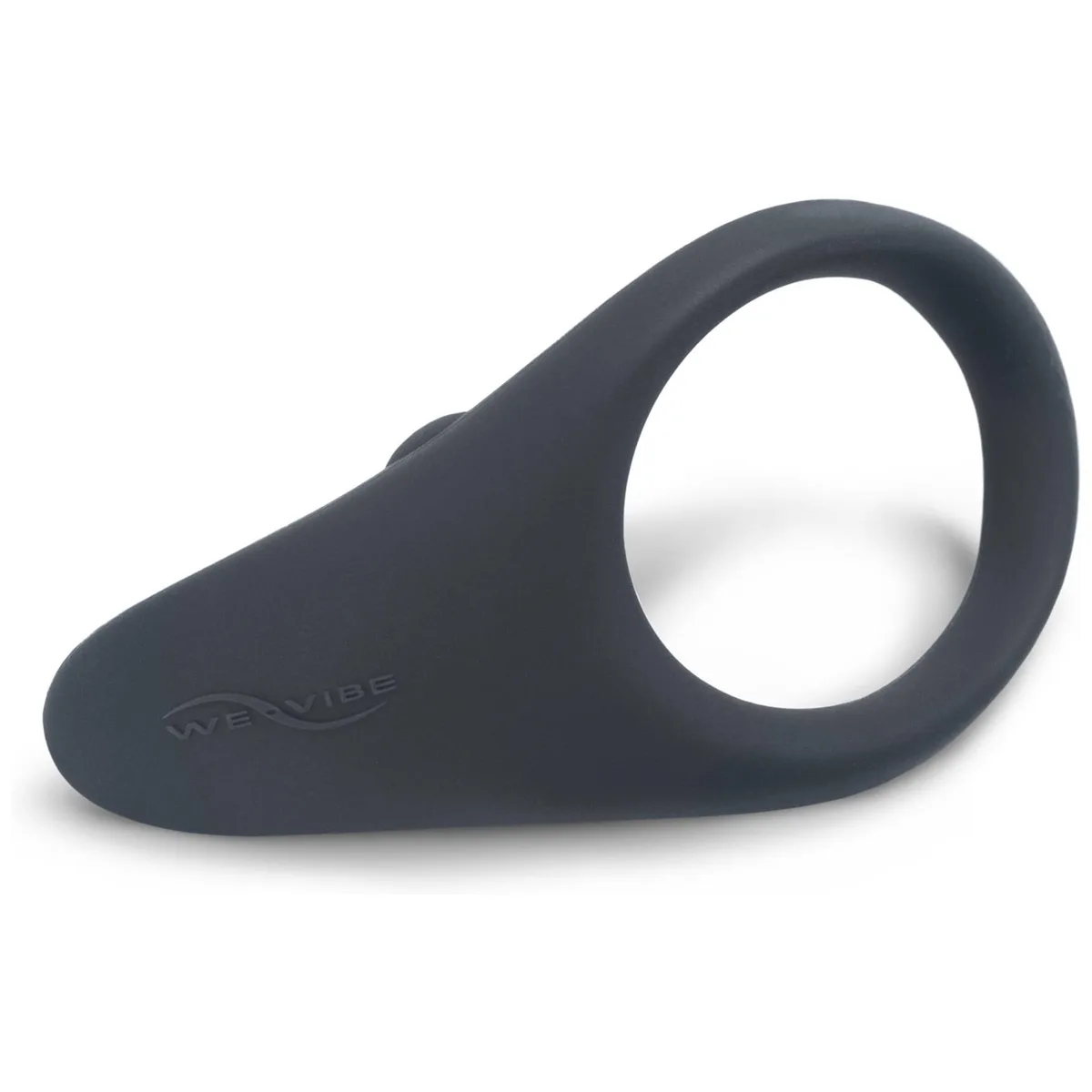
We-Vibe Verge is a vibrating cock ring with an extended, droplet-shaped body that rests downward against the perineum. The manufacturer calls this part a perineum stimulator, and that is the whole point of the product: a regular vibrating cock ring places the motor on top of the ring where it reaches your partner’s clitoris, whereas Verge in its default position directs the vibrations downward toward the wearer’s own perineum. The ring can be flipped, and then it works as a classic coupling ring instead.
The specification that the manufacturer itself publishes is short but unambiguous: ten named vibration modes, a single control button, a 90-minute charging time, app control via We-Connect over Bluetooth, operation between +10 and +45 °C, and a two-year warranty. The model number is 6000-01, and the radio module is type-approved under FCC ID ZUE6000, issued on 8 September 2017 for WOW Tech Canada Ltd in Ottawa. In Sweden, the item is available in seven store listings at prices between 761 and 1,189 SEK.
This review covers exclusively the gray variant with EAN 839289006805, which the stores alternately call Grey and Slate. The number is checked against four independent store feeds and, in all cases, points to the same item. One thing, however, is crucial to know before you read on, and it is covered right in the next section: this is no longer a model that the manufacturer sells.
No. The address we-vibe.com/eu/verge now redirects to the successor, Verge 2, with item number SNVG2SG9, and the product page for the original model is no longer available. What remains on the manufacturer’s side is the user manual: the PDF file for Verge is still published on We-Vibe’s own manuals page. That makes the manual the only remaining primary source for this product, and that’s why it underpins almost every single number in the text below.
The consequence is practical and worth taking seriously. An expired model means that the pricing in the stores is no longer determined by the manufacturer’s recommended retail price, but by how much stock each shop happens to have left—which explains the unusually large spread between 761 and 1,189 SEK. It also means that some information that a manufacturer normally publishes on a live product page can simply no longer be found anywhere. Where those gaps are located is reported continuously in the text, and they are summarized in the specifications table with the row “Not published by the manufacturer”.
The differences from the successor, on the other hand, are well documented, since Verge 2 has a live product page. Verge 2 is said to be rated IPX7, has a USB-rechargeable lithium-ion polymer battery with a runtime of up to 120 minutes and a charging time of up to 90 minutes, is made from body-friendly silicone free from phthalates and BPA and without latex, and comes with a two-year warranty. So three of the pieces of information—enclosure rating, battery type, and runtime—are published by the manufacturer for the second model but not for the original.
Perineum is the Swedish term for the perineum area: the area between the scrotum and the anal opening. It is richly supplied with nerves and is also located superficially over the prostate, which is why pressure and vibrations against the area are described differently than stimulation of the penis itself. It is not an insertion product and doesn’t reach the prostate directly—it’s an external stimulator that works through the tissue.
The shape follows the function. The ring sits at one end, and the broad, tapering body sticks out in the opposite direction, with the motor in the thickest part all the way at the tip. The manufacturer’s own instruction manual names the parts: the control button sits on the side of the perineum stimulator, the charging contacts sit on the underside of the body, and the indicator light sits in the same area. In practice, that means everything you need to access is located on the part that points away from the body, which is reasonable when the ring is in place.
That the ring is the only attachment point has two consequences that are worth understanding before buying. The first is that the fit determines everything: if the ring is too loose, the stimulator won’t end up where it’s supposed to, and if it’s too tight, the safety rules apply in a separate section further down. The second is that the product is directional—it has a correct side and a wrong side. The manufacturer describes that Verge can be worn in different ways and encourages the user to find a position that feels comfortable, and one of the Swedish stores specifies it further: the larger part of the stimulator facing downward provides perineum stimulation, while the same part turned upward directs the vibrations toward the partner.
The material question is the only property of an intimate product that can’t be compensated for with habit or care. A non-porous surface can be cleaned because there are no microscopic cavities where residue can get trapped, and a porous one doesn’t. On a product that’s worn around the penis and testicles during sex, this isn’t a theoretical issue.
Silicone is non-porous, tolerates body temperature without softening, and doesn’t absorb odors. It’s also a material that becomes soft without softeners: the softness comes from the polymer’s own structure and not from added phthalates. That difference is the whole reason silicone, as a material specification, is itself a better signal than terms like TPE or jelly rubber, which say nothing at all about which softeners are included.
Phthalates are a group of softeners used to make plastic—especially flexible PVC—pliable. Kemikalieinspektionen describes them as substances that can affect the hormone system and make reproduction harder, and several of them are therefore restricted or banned within the EU in a large number of products. This product category is subject to oversight again and again precisely because it contains soft plastic that sits against skin and mucous membranes.
Here there’s a gap that should be stated plainly. We-Vibes user manual for Verge contains no material declaration at all—neither the word silicone, phthalates, BPA, nor latex appears in the descriptive section, and the product page that would have carried the information no longer exists. What can be established directly from the manufacturer’s own material is indirect but unambiguous: the manual explicitly prohibits silicone-based lubricant with the justification that it damages the product. In practice, that warning is only relevant for silicone surfaces, since silicone lubricants break down silicone but not hard plastic.
The shops fill the gap, and they’re consistent. The retailer Lustly lists body-safe soft silicone, free from phthalates and BPA. Vuxen lists 100% premium silicone. Joyland lists silicone with a smooth and silky-smooth surface, medium-hard hardness, and phthalate-free. Mshop and Vuxenkul list silicone. These are five independent shop claims pointing in the same direction, and they match what the manufacturer itself states for the successor Verge 2: body-friendly silicone free from phthalates and BPA, made without latex.
The conclusion has to be phrased carefully, because the source situation requires it. Everything points to Verge being all-silicone across the entire surface, but the claim is a shop statement and not a manufacturer declaration for this particular model. If you’re latex-allergic and want an assurance from the manufacturer itself, it’s only available for Verge 2, not for the original—and that’s a fully reasonable reason to pay the price difference for the second one.
The manufacturer publishes no dimensions and no weight for Verge. The shops do, but they contradict each other, and the discrepancies themselves are a result worth reporting rather than smoothing over.
What can still be established is the scale: the ring with the stimulator body measures a little over eleven centimeters from outer edge to outer edge, and the ring opening is somewhere around six centimeters in outer diameter—so it’s clearly smaller on the inside. For comparison, Lelo lists an inner diameter of 29 millimeters for its Tor 3, and that ring is designed to be worn only around the penis. Verge, according to the manufacturer’s own instructions, is intended to be worn over both the testicles and the penis, which requires a significantly larger opening—and that’s the explanation for why the two products can’t be compared directly by ring size.
The packaging is the only dimensions detail that only one shop provides and that no one contradicts: Mshop states 16.00 × 9.50 × 7.00 centimeters. The same shop also lists the contents of delivery in detail—the ring itself in the Slate color, a USB charging cable, a quick start guide, and a lubricant sample of 2 milliliters. The manufacturer’s manual confirms the USB charging cable but doesn’t list the rest of what’s included in the package.
The interface on the We-Vibe Verge consists of exactly one button, located on the side of the perineum stimulator. The manufacturer’s user manual describes the entire control system in three sentences: one press starts the product, each additional press steps to the next vibration mode, and a press held for two seconds turns it off. There is no separate plus and minus button, no display, and no LED that shows which mode you’re on—an indicator light is used only for battery and charging status.
The one-button design is a trade-off. The advantage is that it can be operated blind, with one hand, in the dark, and with lubricant on your fingers — which is exactly the situation the product is built for. The drawback is that there’s no shortcut back: if you’ve clicked past your favorite position, you have to step all the way around again through the remaining modes. With ten modes in the cycle, that means at worst nine presses. It’s the most concrete ergonomic difference versus the successor Verge 2, which, according to the manufacturer, is controlled with separate plus and minus buttons.
The stores consistently write "10 modes" or "more than 10 vibration modes" without listing them. The manufacturer’s instruction manual does, and the list is exactly ten items long. The first four are pure intensity steps, the following six are patterns:
It’s worth noting what this list doesn’t include. There’s no automatic function that switches between modes on its own, no memory function that returns to the last used mode, and no silence sensor. Six of the ten modes are patterns, which in practice means that four fixed intensities are all you have to choose from if you prefer even vibration. Expect to come back to two or three of the ten.
Verge is app-controlled, and the manufacturer describes the pairing exactly: download the We-Connect app, open it, and follow the on-screen instructions, then press and hold the control button on Verge for five seconds until the product pulses twice. Then it’s ready to be paired. To play at a distance afterward, you send an invitation to your partner via the menu option "connect lover" in the app.
Technically, it’s based on two separate links, and the instruction manual’s own illustration names both: Bluetooth between the product and the phone, and internet via Wi-Fi, 3G, 4G, or LTE between the two phones. The type approval act further specifies the radio part: the module transmits in the band 2402–2480 MHz — that is, the usual 2.4-gigahertz band — with a measured output power of a mere 0,0000087 watt. It’s that low power that limits the range in the room — it’s the phone’s internet connection, not the product’s radio, that makes remote control over longer distances possible.
An honest note is in order here. The app that the user manual refers to is called We-Connect, and it is the generation of the We-Vibes app that was used when the product was type-approved in 2017. Which app today supports an expired model does the manufacturer not publish any updated information about, and app compatibility is by far the most common reason that older connected products lose functions over time. The vibration modes on the button work regardless—they are in the product and not in the phone—but count app control as a feature whose future nobody has promised anything about.
The manufacturer’s instructions are short and unambiguous, and they are worth following in the right order. Put on Verge before you get aroused. Insert one testicle at a time through the ring, and then the penis. Apply water-based lubricant to both the inner and the outer part of the ring before you start—it’s not about comfort, but that a dry silicone ring is significantly harder to get off again.
Taking off the ring requires the same care. The manual is explicit: if you experience discomfort or pain during erection, you should stop the sexual activity and avoid arousal until the erection has gone down before you try to take off the ring. Pulling a penis ring off during erection can, according to the manufacturer, cause bruising, painful injuries, or lasting damage to the penis, scrotum, or testicles.
This is the section that store texts almost never include, and it is at the same time the section where the manufacturer is most clear. We-Vibe writes in Swedish in its own user manual: limit the use of penis rings to a maximum of 30 minutes per time, and let 60 minutes pass between each use. Prolonged use without removing the ring can, according to the manufacturer, cause lasting damage to the penis.
The list of other instructions is long and specific. Don’t fall asleep with the ring on. Don’t use it in connection with alcohol or drugs, because judgment is impaired and the risk of injuries increases. Don’t use it if you have reduced sensitivity around the penis, because then you may miss an incipient injury, and don’t use it if you have reduced hand strength, because it can make the ring difficult to get off. Stop using it if the genitals feel cold, or if you experience irritation, swelling, pain, a change in color, or loss of sensation, and consult a doctor if the symptoms don’t go away when the ring has been removed.
The manufacturer also lists a number of conditions in which you should consult a doctor before use: interference with blood clotting, peripheral vascular disease, diabetes, nerve disease, and ongoing treatment with blood-thinning medication. If you have symptoms of erectile dysfunction, the manufacturer urges you to seek a doctor first, because otherwise a penis ring can delay the diagnosis of an underlying cause. And one last, purely factual piece of information worth repeating: penis rings do not prevent pregnancy or sexually transmitted infections.
What makes this list worth its place in a product review is that it comes from the manufacturer itself and not from us. The thirty-minute limit is also a real functional limitation: it sets the ceiling for how long the product should be used at all, and makes the question of runtime per charge far less important than it looks to be in the comparison tables at the stores.
All Swedish stores state that Verge is waterproof, and two of them print “100 % waterproof”. It sounds categorical, but it is not a rating—it is a wording. The manufacturer’s user manual for Verge contains no IP rating at all, and the product page that would have carried that information has been removed.
The comparison with the successor makes the absence clear. For Verge 2, We-Vibe explicitly states the enclosure rating IPX7. This rating comes from the international standard IEC 60529 and means that the product is tested for submersion in water to a depth of one meter for 30 minutes. The fact that the manufacturer prints it for the two but not for the one does not automatically mean that the one is worse sealed—it means that no one has published a test result you can rely on.
What the manual says about charging, however, is this: do not charge near water. That instruction applies to the charger and not the product, but it’s a good benchmark for how much margin you have. A reasonable approach is to rinse Verge under running water and use it in the shower, but not to leave it soaking in a bathtub without knowing how it’s sealed. A missing rating is never a sign that the product would be approved for submersion.
The manufacturer’s cleaning instructions are simple: clean with We-Vibe’s own cleaning agent or with soap and water. In addition to that, the manual lists five things you should not do, and all five are worth knowing because several of them are common household tricks.
Charging is the part of the specification where the manufacturer actually provides a number. The user manual states a charging time of 90 minutes, and at the same time specifies that a full charge can take up to 2 hours depending on how much charge remains in the product. The battery does not need to be fully discharged before recharging, and any USB charger can be used.
With a magnetic charging cable that attaches to two metal contacts on the underside of the stimulator body. The retailer Vuxenkul describes that the cable clicks easily into place, and the manufacturer’s own exploded view names both the charging contacts and the USB charging cable included in the package.
Magnetic charging is a trade-off rather than a pure advantage. The advantage is that there’s no need for an opening in the housing, which makes the entire product easier to seal—and on a product that is supposed to withstand lubricant and rinsing, that’s a real argument. The disadvantage is that the cable is product-specific. If you lose the charging cable, no standard USB-C cable works, and since the model is discontinued, a replacement cable is no longer an obvious order from the manufacturer. We-Vibe’s warranty terms also explicitly exclude consumables such as batteries and charging cables, so a broken cable is always your own cost.
The indicator light handles all feedback, and the manual lists four states: a slowly flashing light means low battery, a quickly flashing light means the product is charging, a solid light means fully charged, and a light that’s off means there is no mains voltage or that the charging cable is seated incorrectly. The manufacturer also points out two things that are easy to miss: a computer in sleep mode stops supplying power through the USB port, and Verge will not charge at all if it’s warmer than +45 °C—charging then automatically starts again when the temperature has dropped.
Here is the most widespread mistake in the in-store texts about this product, and it’s worth clearing up properly. Three Swedish retailers state that the Verge lasts "up to 2 hours" on a charge. The manufacturer publishes no runtime at all for the Verge — neither in the user manual nor anywhere else. The only place where the wording "up to 2 hours" appears in the manufacturer’s own material is in the charging section, where it describes how long a recharge can take when the battery is completely drained.
It therefore appears that a charging-time figure has been carried over into the battery-time field somewhere along the chain between the distributor and the store. What can be established is that the only runtime We-Vibe actually publishes in this product family is 120 minutes, and it applies to the successor Verge 2 — not the original. For comparison, Lelo states up to 2 hours of runtime for the Tor 3, and it also backs up that figure with a battery specified to 3.7 volts and 70 mAh.
We-Vibe does not publish the Verge’s battery capacity in mAh, its voltage, or its chemistry. For Verge 2, the type is listed as lithium-ion polymer, but no capacity figure is given. Without the capacity, you can neither convert the runtime into a power consumption figure nor compare how hard the cell is being loaded between models. What generally applies to lithium-ion batteries also applies here: capacity drops with the number of charge cycles, the cell is housed in a sealed silicone body and is not replaceable, and the product does best when it’s charged regularly rather than stored discharged. The manufacturer states that charging is retained for several months during storage, but it decreases over time, and it recommends recharging as soon as the vibrations start to fade.
Practically speaking, the uncertain runtime matters less than it seems, and that’s the honest conclusion. The manufacturer’s own safety limit is 30 minutes per use with a 60-minute break. So even a battery that only lasts an hour is enough for two full-length sessions before it needs to go back on the charger.
We do not have price data from shops in your market yet.
Retailers' "up to 2 hours battery life" is actually the manufacturer's charging time. We-Vibe does not publish any operating time at all for Verge.
Three comparisons are relevant: against the model that replaced it, against the other major premium brand in the category, and against cheaper routes to a vibrating penis ring. All the specifications below come from each respective manufacturer’s own published information, and all prices come from the stores’ product feeds on 29 July 2026.
We-Vibe Verge 2 costs from 886 SEK, i.e., 125 SEK more than Verge at its cheapest. It’s a small difference, and for that money you mainly get one thing: a live product page with information that has actually been published.
Specifically, the manufacturer states that Verge 2 has an IPX7 ingress protection rating, a USB-rechargeable lithium-ion polymer battery, operating time of up to 120 minutes, charging time of up to 90 minutes, body-friendly silicone that is free from phthalates and BPA and made without latex, as well as a two-year warranty. Three of those lines — ingress protection rating, battery type, and operating time — are completely missing for the original model. Verge 2 is also controlled with separate plus and minus buttons instead of a single cycle button, which solves the most noticeable ergonomic problem of the one.
The conclusion is simple to state and uncomfortable for the original. The price difference is small, the warranty period is the same, and what you get for the extra money is a product that is still sold, still documented, and reasonably still supported in the app. Verge is a sensible buy when it is noticeably cheaper than 886 SEK — and a questionable buy when it isn’t.
Lelo Tor 3 costs from 846 SEK, i.e., 85 SEK more than Verge at its cheapest. On the price tag, they’re close to each other; in the design, they aren’t.
Tor 3 measures 46.7 × 22.2 × 60 millimeters with an inner diameter of 29 millimeters, and is therefore a significantly smaller ring worn around the penis on its own. Lelo lists the material as body-friendly silicone and ABS plastic — so not full silicone — and specifies the battery as a lithium-ion 3.7 volt battery with 70 mAh, with charging time up to 2 hours at 5.0 volt and 70 mA, as well as operating time up to 2 hours. The product is stated to be 100% waterproof, have eight vibration patterns, be controlled via an app, and have a maximum sound level of 60 decibels. The warranty is two years, followed by a ten-year quality warranty.
The differences that matter: Lelo publishes battery capacity, operating time, and a maximum sound level, while We-Vibe publishes neither of that for Verge. In return, Verge has ten modes versus eight, a shape designed for perineum stimulation rather than just the partner’s clitoris, and a ring sized to be worn over both the penis and the testicles. If you choose based on the stated data, Lelo wins. If you choose based on what the product is actually designed to do, it’s two different products that happen to share the same price range.
We-Vibe Pivot costs from 712 SEK and is Verge’s sister model from the same generation. That they’re related isn’t a guess: Pivot’s user manual lists model number 6000-02 versus Verge’s 6000-01; both carry the same type approval under FCC ID ZUE6000; both list a 90-minute charging time; both have the same ten named vibration modes; and both have the same two-year warranty. It’s therefore the same electronics platform in two different silicone bodies. The difference lies in the shape and in what it’s aimed at, not in the technology.
Satisfyer Power Ring costs from 209 SEK and is the cheapest way into the category among the products that are widely sold in Sweden. The price difference versus Verge is 552 SEK, meaning the We-Vibe ring is more than three times as expensive. If you’re unsure whether a vibrating penis ring is even something for you, it’s hard to justify starting at the expensive end — and the one who already knows that this format works has in Verge a ring with a completely different approach to stimulation and with app control, two things a simple ring doesn’t have.
Seven store listings sell the item with EAN 839289006805. Cheapest is Joyland at 761 SEK, and most expensive is Vuxenkul at 1,189 SEK. That’s 428 SEK or a 56 percent difference for the exact same item number and the same color — an unusually large spread that is the direct result of the model being discontinued and the stores pricing their remaining stock separately.
A detail in the table deserves an explanation. Two of the seven listings are the same store. Sexonic lists Verge on two separate product pages — one under the name "We-Vibe Verge Grey" and one under "Verge Vibrating Ring" — with an identical price of 886,38 SEK and identical EAN. It is therefore six actual stores, not seven, and it’s worth knowing this when comparing the breadth of availability between different price comparisons.
The stock situation is at least as important as the price spread. Only three of the seven listings had the product in stock during the price check: Joyland at 761 SEK, as well as Vuxen and Mshop at 799 SEK each. That means the difference between the cheapest available and the next cheapest available is 38 SEK, not 428. Stores that list a product that’s sold out may still have an old price in the feed, and for a discontinued model the risk is significant that the item will never come back into stock at all.
The prices in the table above are updated when the stores’ product feeds are updated, but always check the final price at checkout. Shipping costs are added by several of the stores under a certain order value, and in this price range the shipping fee is often in the order of a few tens of kronor — enough to even out the difference between the three stores that actually have the item in stock.
It’s a fit for you if you want the vibrations directed toward your own groin rather than just toward your partner, and if you want a ring designed to be worn over both the penis and the testicles. It’s for you if you prefer one button over several, and if you plan to use the product together with someone—the app control is built so that a partner can take over control, either on-site or remotely. And it’s for you if you find it at a price that clearly undercuts the successor’s, because that’s where the whole argument lies.
It’s not for you if you want a published ingress protection rating, a published battery capacity, or a published operating time, because the manufacturer does not list any of those for this model. It’s not for you if you want to switch intensity back and forth quickly, which a single-button cycle with ten modes doesn’t allow. It’s not for you if you’re allergic to latex and want the manufacturer’s promise rather than the one from the shop. And it’s not for you if you want a product with a secured future: the model is discontinued, the charging cable is product-specific and excluded from the warranty, and nobody has promised anything about how long app support will remain.
One more thing belongs in the decision. The manufacturer’s own safety limit of 30 minutes of use per session, with a 60-minute break in between, applies no matter which penis ring you buy. That limit means that several of the specifications that usually determine a purchase in this category—operating time above all—matter less than they appear to. What’s left to choose from is shape, material quality, control, and price, and in just those four points Verge holds up reasonably well as long as the price tag sits in the lower end of the range.
We-Vibe provides a two-year voluntary manufacturer’s warranty on Verge. The user manual is worded narrowly: the two-year warranty covers only replacement of products in the event of manufacturing defects, and the only compensation the user is entitled to is a replacement product. The manufacturer’s general warranty terms specify the time as 24 months counted from the first delivery to the customer, however no more than two years after manufacture.
Read the exclusions before you count on the warranty, because they’re broad. It does not cover minor faults that do not affect the product’s usability, wear parts such as seals, and consumables such as batteries and charging cables. It also does not apply in cases of normal wear and tear, intentional damage, incorrect use contrary to the user manual, damage caused by aggressive chemicals or cleaning agents, or attempts to repair by a third party. In practice, that means that the two parts most likely to break first—the battery and the charging cable—are both outside the warranty.
The wording about aggressive chemicals is linked to the cleaning section further up. If you clean the silicone with hand sanitizer or acetone, or use a silicone-based lubricant, then, according to the terms, you have caused the damage yourself. This is another reason to stick to soap and water and water-based lubricant.
What always applies, however, is your statutory rights, and the manufacturer states itself that the voluntary warranty does not affect them. Under the Swedish Consumer Sales Act (konsumentköplagen), you have three years to lodge a complaint regarding defects in the goods, regardless of what the manufacturer promises—so one year longer than We-Vibe’s own warranty. For distance purchases, you also have a right of withdrawal in fourteen days under the Act on Distance Contracts and Contracts Outside Business Premises (lagen om distansavtal och avtal utanför affärslokaler). Be aware that, in practice, the right of withdrawal is limited for hygiene products that have been removed from a sealed package—however, the right to lodge a complaint regarding defects always applies. If you have questions about what applies in your case, Konsumentverket (Swedish Consumer Agency) provides guidance via Hallå konsument.
We-Vibe Verge is ranked på plats 15 av 16 in cock ring best i test, where the entire category is compared against each other using five shared criteria. Guiden vinns av Satisfyer Swordsman Vibrating Cock Ring Blue.
Every numerical piece of information in the text can be traced to one of the sources below. The links were checked manually on the specified date.
This page is machine-translated from Swedish. Read the Swedish original