

Review
Review: Satisfyer Double Joy
App-controlled par vibrator in the same C-shape—at a fraction of the price.
13 September 2026
Review · Couple vibrator · C-shaped with squeeze remote control
We-Vibe’s most well-equipped couple vibrator reviewed against the manufacturer’s own specifications, the EU declaration of conformity, and pricing data from five Swedish stores. Three motors, ten vibration patterns, haptic squeeze remote control, 120 minutes of runtime, and a charging case—but neither dimensions, weight, battery capacity, nor the enclosure rating are published by the manufacturer.
The most feature-packed couple vibrator in We-Vibe’s range: three motors, ten vibration patterns, a squeeze remote that reproduces the toy’s intensity in your hand, and a charging pouch that keeps both parts charged. The operating time of 120 minutes and the charging time of 90 minutes are a clear improvement over the predecessor. What you pay for is a specification full of gaps: the manufacturer does not publish dimensions, weight, battery capacity, sound level, or an ingress protection rating, and the warranty lasts only until two years.
We-Vibe Chorus Pro is the brand’s top model among couple’s vibrators. The format is the same as for the rest of the C family: a flexible, C-shaped silicone body that is worn inside the sleeve during intercourse, where the inner arm lies against the G-spot and the outer arm against the clitoris. In the manufacturer’s EU declaration of conformity, the product is classified exactly like that, as a C-shape couple’s vibrator. The new feature in the Pro version is that the outer arm contains two motors instead of one, and that the remote control responds to how tightly you squeeze it.
The specification looks like this according to the manufacturer: body-friendly silicone without phthalates and BPA, and made without latex, up to 120 minutes of operating time, up to 90 minutes of charging time, three motors, ten vibration patterns, ten intensity levels, three touch sense modes, control via both the remote control and the app, a charging case that both charges and stores the toy and the remote control, and a two-year manufacturer’s warranty. In Sweden, the item is sold by five shops at prices between 1,795 and 1,995 SEK, and four of them had it in stock at the price check on September 12, 2026. The manufacturer’s own euro price is 209 euro.
This review is exclusively about the Cosmic Purple color with EAN 4251460634199, the manufacturer’s item number SNSP1SG5. We-Vibe sells the Chorus Pro in three colors, and each color has its own number: Electric Pink has EAN 4251460634205 and Satin Black has 4251460634182. Functionally they are identical, but the number is the only thing that reliably distinguishes them when the shops re-label the product on their own — and they do, which we’ll get back to later.
A standard C-type paired vibrator has a motor in each arm: one motor for clitoris stimulation and one motor for the G-spot. Chorus Pro has three. The manufacturer’s own cross-sectional diagram names them Motor 1, Motor 2, and Motor 3, and the back of the packaging summarizes the distribution plainly: two motors for clitoral stimulation and one motor for G-spot stimulation.
The technical approach is that the two clitoris motors sit in the same arm and run synchronized in offset phases. The manufacturer describes the result as a wave-like movement that pulses and flows rather than just vibrating. Mechanically speaking, it’s a reasonable description: two motors that vary their relative phase offset create a hovering (beating) pattern that a single motor can’t produce, because a single motor has only one parameter it can vary—its frequency.
What that means in practice is that the number of patterns and the number of intensity levels become two separate things. The manufacturer lists ten vibration patterns: seven classic We-Vibe patterns and three exclusive Fusion Wave patterns named Echo Wave, Surge Wave, and Ripple Wave. At the same time, the packaging lists ten intensity levels. What can be concluded is that the three Fusion Wave patterns are the only things in the entire specification that are unique to Pro—everything else can be found in cheaper models in the same family.
We-Vibe’s naming is simpler than in many competitors’, but the three models are so close to each other that Swedish shops regularly mix them up.
So the difference between Chorus Pro and Chorus isn’t just the “Pro” in the name. Operating time increases from 90 to 120 minutes, charging time decreases from 120 to 90 minutes, the materials description goes from ABS plus silicone to just silicone, the remote control gets haptic feedback, and charging moves from a magnetic cable to a case. Those are five real changes, and they justify the 50 euro price difference better than most Pro upgrades in the category.
The material question is the only property of an intimate product that cannot be compensated for with habit or care, and it determines whether the product is still hygienic after five years. We-Vibe states a single material for Chorus Pro: body-friendly silicone, free from phthalates and BPA, and made without latex.
Silicone is a non-porous material. A non-porous surface can be cleaned because there are no microscopic cavities where residues can become trapped. It is the single most important property of a material that is meant to sit against the mucous membrane for an extended period, and for a product that is also worn inside the body during intercourse, it matters more than for almost any other type of product.
The fact that the manufacturer states silicone without any reservation is, by itself, a clear message. Compare it with the predecessor Chorus, where We-Vibe writes “ABS and Body-safe silicone.” That wording means that parts of the casing are hard plastic, which normally concerns seams, buttons, and the part where the electronics are located. On Chorus Pro, there is no such reservation on the product side. What, however, is not shown is how the material is distributed between the toy, the remote control, and the charging case—the manufacturer does not publish any material breakdown by component, and in the manufacturer’s own images, the charging case is clearly made of hard plastic.
The construction is based on a flexible hinge. The manufacturer calls it “adjustable fit” and describes it as the shape being adjusted to provide the right pressure exactly where you want it, and that it stays in place once it has been set. A hinge is also the point where a silicone product wears down first, because the material is bent there every time the product is used. We-Vibe’s warranty terms expressly exclude wear parts such as seals, which is worth reading before you assume the warranty covers that specific detail.
Phthalates are a group of plasticizers used to make plastic—above all, softened PVC—flexible. Kemikalieinspektionen describes them as substances that can affect the endocrine system and make reproduction more difficult, and several of them are therefore restricted or prohibited in the EU in a large number of products. This particular product category is the subject of ongoing oversight, because it contains softened plastic against skin and mucous membrane.
We-Vibe states all three: phthalate-free, BPA-free, made without latex. It is an unambiguous declaration, unlike labels such as “TPE” or “jelly rubber,” which say nothing at all about which plasticizers are included. Silicone does not require phthalate plasticizers to be soft—the softness comes from the polymer’s own structure—and that is why silicone as a material specification is, in itself, a better indication than almost any other item in a product specification.
The latex claim is relevant for anyone who is allergic to latex. Latex allergies cause reactions on mucous membranes faster than on normal skin, and a product that is worn inside the body during intercourse is exactly the kind of use where this information matters. The fact that the manufacturer states it is a plus. In addition, the EU declaration of conformity refers to the RoHS directive 2011/65/EU with the amendment 2015/863, which limits lead, mercury, cadmium, hexavalent chromium, certain flame retardants, and four phthalates in electronics. It is not an approval stamp for the silicone against the skin, but it is a verifiable commitment regarding the electronics inside.
There is a clear gap in the documentation. We-Vibe does not publish any information on the length, width, height, or weight of Chorus Pro, neither on the product page nor in the online manual. That’s notable, because the same manufacturer publishes dimensions for both Sync 2 (41.7 × 74.8 millimeters) and the predecessor Chorus (height 44 millimeters, width 33 millimeters, length 78 millimeters, remote control 37 × 96 millimeters) on their respective product pages. For a product that is meant to be worn inside the body together with a partner, the dimensions aren’t a detail—they’re what determines whether it fits.
The retailer Blush Me lists a length of 8,00 centimeters and a maximum diameter of 4,10 centimeters. So that information comes from the store, not from We-Vibe, and should be read as a store-provided specification. What can be established is that it’s close to the dimensions the manufacturer publishes for the two sibling models, which makes it plausible but not verified. None of the five Swedish stores lists any weight, and none states the dimensions of the remote control.
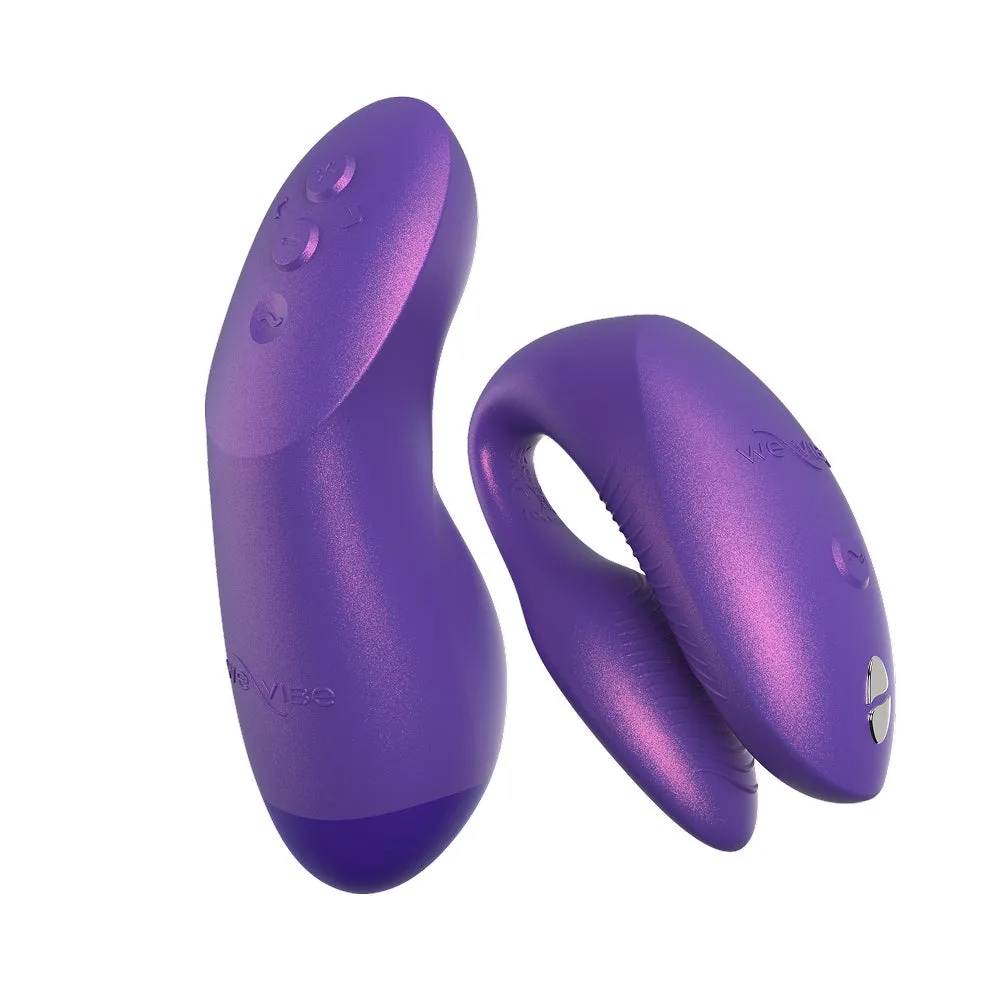
The shape is asymmetrical and flexible. The outer arm is wide and rounded, with the We-Vibe logo embossed into the silicone and a single control button; the inner arm is narrower and grooved toward the hinge. The remote control is a separate, elongated body with four touch areas and a soft middle section that can be squeezed. The manufacturer’s own image calls the soft middle section “air pocket design,” and the manual confirms that it literally involves an air pocket: it has a pressure equalization valve that may need to be pressed in with a ballpoint pen before first use, since air pressure changes during transport can cause the chamber to collapse in on itself.
Chorus Pro has three control paths: a button on the toy itself, a remote control, and an app. The manual describes the toy’s interface as a single control button under the We-Vibe logo, and that’s also where the touch sensor sits. All the fine details happen somewhere else — which is the whole point of a product that’s supposed to stay in place during intercourse and not be fingered.
The remote control has four functions according to the manual: turn on and increase intensity, turn off and decrease intensity, scroll through patterns, and the squeeze mode. The squeeze mode is activated with a press on the We-Vibe button on the remote control, and then you control the intensity by squeezing the air pocket harder or more loosely.
What is new compared to the predecessor is the haptic feedback. The manufacturer states that the remote control vibrates in sync with the toy’s intensity—meaning that the person holding the remote control feels the same strength in their hand as the partner feels. It’s one of the few functions in the category where the purpose is to inform the user rather than to stimulate: without feedback, you control it blindly, because you neither hear nor see what’s happening under the covers.
The pairing is documented in detail, which is not a given. The toy and remote control are delivered paired. If you turn on the toy by pressing it and keep the plus button on the remote control pressed in for three seconds, the connection is activated. If it doesn’t work, you reset the toy by keeping the We-Vibe button pressed for five seconds, after which you keep the button on the remote control pressed for five seconds. When they find each other, the toy vibrates three times.
The counterargument to the whole setup is just as simple: it’s another device to charge, misplace, and break. The remote control has its own built-in lithium-ion battery of 3.7 volts and 0.2 ampere according to the manufacturer’s rated data, and it is not replaceable. If it breaks after the warranty period, that part of the product is used up, and We-Vibe does not sell the remote control separately in its EU shop.
The manufacturer states there are ten patterns. Patterns 1 to 7 are classic We-Vibe programs that are available on several models in the range. Patterns 8 to 10 are the three that are only available on Chorus Pro, and the manual describes them individually: Echo Wave as rolling pulses in time with soft, steady waves, Surge Wave as a playful rhythm with alternating pulses and changing intensity, and Ripple Wave as a rising wave that builds up and releases in powerful pulses.
Alongside the patterns, there is intensity. The back of the package states ten intensity levels, and the retailer Joyland writes in its specification table “10 different steps.” What you can conclude is that pattern and intensity are two independent controls—just like on most app-controlled products—and that a comparison that only counts “number of modes” therefore becomes misleading. Ten patterns times ten intensity levels is a substantially wider range than the numeric figure alone suggests.
The manual also includes a clarification that’s easy to miss in store text: all ten patterns, including the three Fusion Wave modes, are available in the app. The remote control can browse between patterns, but the app is the way that provides full access, since it also lets the user control the clitoris and G-spot motors separately.
Under the We-Vibe logo on the outer arm there’s a sensor. When Touch Sense Mode is activated in the app, the product responds to contact with the partner’s body during intercourse. The manual describes three modes, and the description is unusually specific for this category.
The practical value is that nobody needs to hold anything. The downside is just as obvious: the function requires the app even to be able to turn it on at all, and anyone who doesn’t want to connect an intimate product to a phone will never get access to it. It’s worth factoring this in before buying, since Touch Sense is one of the three functions the manufacturer highlights most clearly.
The app is free and available for iOS and Android. The manual states that the connection is made by scanning the barcode on the underside of the packaging, and that the app then provides access to separate control of the clitoris and G-spot motors, different control modes, synchronization to music, and handing over control to a partner remotely.
The radio section is the best-documented part of the entire product, thanks to the EU declaration of conformity. The toy operates in the 2402–2480 megahertz band with a maximum RF output power of −2.82 dBm, and the remote control in the same band with −11.15 dBm. So both are Bluetooth devices with very low transmitter power, which in practice means short range — remote control works via the phone’s internet connection, not via the radio in the product. The declaration refers to the Radio Equipment Directive 2014/53/EU and to a long list of harmonized standards, including ETSI EN 300 328 for the 2.4-gigahertz band and EN IEC 60335-2-32 for electrical household appliances.
This is the point where the surface comes apart the most, and it deserves to be presented plainly. We-Vibe states no IP rating for Chorus Pro—neither on the product side, in the specification table, nor in the online manual. The only thing the manufacturer writes about water is the cleaning instructions: rinse Chorus Pro and the remote control with warm water and add a toy cleaning product.
Two of the five Swedish stores claim IPX7. Blush Me writes “Waterproof (IPX7)” in its bullet-point list, and Joyland writes that the product is “100% waterproof (IPX7)”. Vuxen and Mshop are satisfied with “waterproof” without a rating. None of them refers to any manufacturer information, and as mentioned, We-Vibe publishes none.
Comparing it to the predecessor makes the picture even clearer. On the product page for We-Vibe Chorus, it explicitly says “Waterproof IPX7”—and in the same paragraph it explicitly states: the remote control is only splash-proof, not fully waterproof. So historically, the manufacturer has made a distinction between the toy and the remote control in exactly this regard. For Chorus Pro, they don’t make any such clarification, for the simple reason that they don’t state any rating at all.
What IPX7 technically means is laid down in the international standard IEC 60529: the number 7 in the second position means that the product is tested for submersion in water to a depth of one meter for 30 minutes. It’s a tested value, not a description. And that’s exactly why the difference matters: a product that lacks a rating hasn’t necessarily failed the test, but no one has published that it passed it.
What can be established is the following. The remote control contains an air chamber with a pressure-equalization valve that, according to the manual, must be pressed in with a pen before first use. A valve that lets air through is, by definition, not a sealed enclosure. The practical conclusion is this: treat the toy as intended to be rinsed with running water, since the manufacturer itself instructs it, but treat not the remote control as bath-proof until We-Vibe publishes an IP rating for it. The charging unit should never be submerged—the manual is unambiguous that the charging device and the charging cable must never be dipped in water or other liquids.
The manual’s cleaning instructions are short: rinse the toy and the remote control in warm water and use a cleaning agent intended for intimate products. Wipe it off and let it air-dry before putting the product back into the case. The manufacturer also explicitly recommends storing the toy and the remote control in the charging case between uses—which is a practical point: the case protects the silicone from dust and keeps both parts charged.
The lubricant question is settled in the manual. Use a water-based lubricant. Do not use perfumed or alcohol-based lubricants, gels, or massage oils, and do not use silicone-based lubricant on silicone products. The reason is material chemistry: silicone-based lubricant breaks down the silicone surface over time and makes it porous, and a porous surface can no longer be cleaned properly—only replaced. Joyland gives the same recommendation in its specification table, which is at least one case where the shop and the manufacturer say the same thing.
The manual also covers three things that rarely show up in shop text. The product and its battery must not be exposed to temperatures above 45 degrees, which rules out boiling and the dishwasher. The product contains magnets and should therefore not be used directly over a pacemaker, and a card with a magnetic stripe should be kept away from it. And Chorus Pro is explicitly not designed for anal use.
We-Vibe states up to 120 minutes of operating time and up to 90 minutes of charging time. Two hours is in the upper half of the category and a direct improvement over the previous model Chorus, which is listed as 90 minutes of operating time and 120 minutes of charging time—so exactly the other way around. Both the toy and the remote control have built-in, non-replaceable lithium-ion batteries.
By putting both the toy and the remote control into the charging case, which in turn is connected to a USB power source using the included cable. The case has its own model number, CHB-SCP1A, and according to the manufacturer’s marking data it is specified for 5 volts and 0.7 ampere. The toy itself is labeled 3.7 volts and 0.5 ampere, the remote control 3.7 volts and 0.2 ampere.
The manual is clear about two limitations. Use only the included cable, and use a USB-C adapter—which is not included—with a power output that corresponds to the product’s rated data. In practice, that means you need a wall plug you already own, and that an arbitrary high-power charger isn’t automatically the right choice. According to the manufacturer, the delivery includes: Chorus Pro, Haptic Squeeze Remote, charging case, USB cable, quick guide, and safety information.
The charging-case solution is a tradeoff rather than a pure benefit. The advantage is that there’s no need for an opening in the toy’s housing, that both devices charge at the same time, and that the storage is discreet and all in one place. The downside is that the case becomes a potential single point of failure: if you lose it or it breaks, there’s no documented alternative charging method for the toy, and We-Vibe’s warranty terms explicitly exclude consumables such as batteries and charging cables from the warranty.
A tip from the manual that’s hard to find anywhere else: if the toy or the remote control stops responding — for example after static electricity — the device can be reset by connecting it to the charging cable with the cable plugged into a power outlet, and then holding the We-Vibe button down for five seconds.
We-Vibe does not publish any battery capacity in mAh for either Chorus Pro or its remote control. What is published is voltage and current — 3.7 volts and 0.5 ampere for the toy, 3.7 volts and 0.2 ampere for the remote control — which says something about power output from the outlet but nothing about the cell’s size. Without capacity, you can’t convert operating time into consumption, and you can’t compare how heavily the cell is loaded between models.
The competitors do it better. Lelo states 200 mAh and 3.7 volts for the Tiani Duo and also provides charging current: 2 hours at 5.0 volts and 200 milliamperes. That’s the level of detail that makes a specification checkable. What generally applies to lithium-ion batteries also applies here: capacity drops with the number of charging cycles, the batteries aren’t replaceable, and the product does best when it’s charged regularly instead of being stored completely discharged. The manufacturer itself writes in the manual that the product should be charged regularly even when it isn’t used.
The answer has to be honest: We-Vibe publishes no measured decibel value for Chorus Pro, either on the product page, in the manual, or in marketing materials. None of the five Swedish stores either lists any value. So there’s no source to rely on, and every decibel figure that circulates for this model lacks support from the manufacturer.
The only comparison figure that can be presented comes from a competitor: Lelo lists a maximum sound level of 50 dB for the Tiani Duo and also provides the motor frequencies, 130 Hz and 105 Hz. That a brand in the same price class publishes both sound level and motor frequency shows that the information can be obtained — it isn’t missing because it’s impossible to measure, but because We-Vibe has chosen not to publish it.
We do not have price data from shops in your market yet.
Three motors, ten patterns, and a remote control that feels good in your hand — but neither dimensions, weight, battery capacity, nor ingress protection class is stated anywhere by the manufacturer.
Three comparisons are relevant: versus We-Vibe’s own predecessor, versus the simpler C model in the same lineup, and versus the closest competitor from another premium brand. All the information below comes from the respective manufacturers’ own specifications, and the Swedish prices come from the stores’ product feeds on September 12, 2026.
The predecessor, We-Vibe Chorus, is listed by the manufacturer at 159 euros, regular 209 euros, versus Chorus Pro at 209 euros. The differences are more and more specific than you’d think.
Chorus is stated to have 90 minutes of operating time and 120 minutes of charging time; Chorus Pro is stated to have 120 and 90 minutes, respectively. Chorus material is listed as ABS and body-friendly silicone; Chorus Pro only as body-friendly silicone. The Chorus squeeze remote lacks haptic feedback; Chorus Pro has it. Chorus has one motor per arm; Chorus Pro has two in the outer arm and one in the inner arm. And Chorus is charged with a cable, while Chorus Pro is charged in a case.
What Chorus has on the other hand, and what Chorus Pro lacks, is published information. We-Vibe gives measurements for Chorus—height 44 millimeters, width 33 millimeters, length 78 millimeters, and remote control 37 × 96 millimeters—and also lists the toy’s IPX7 enclosure rating, along with the important warning that the remote control is only splash-resistant. For Chorus Pro, neither is provided. Anyone who values a controllable specification more than the latest motor configuration has a real argument for buying the predecessor.
We-Vibe Sync 2 is listed at 159 euro. It’s the simpler C model: same basic shape, same full silicone without phthalates, BPA, and latex, same two-year warranty—and exactly the same battery data, up to 120 minutes of operating time and up to 90 minutes of charging time. The manufacturer also states dimensions: 41.7 × 74.8 millimeters.
So what you pay an extra 50 euro for on Chorus Pro is therefore not the battery life. It’s the third motor, the Fusion Wave patterns, the haptic squeeze remote control, Touch Sense Mode, and the charging case. Sync 2 is controlled via the app and has no remote control in the package at all. If it’s the remote control you want—and for many couples it’s the only practical difference you notice during sex—the upgrade is justified. If you’re only looking for a C-shaped couple vibrator, you get the same operating time and the same materials for a third less.
Lelo Tiani Duo is the closest competitor from another premium brand, and the comparison is instructive precisely because it points in different directions depending on what you measure.
Functionally, Chorus Pro is ahead. Tiani Duo has eight modes versus Chorus Pro’s ten patterns and ten intensity levels; it has two motors versus three; it has no haptic feedback and no touch sensor; and its remote control is powered by two AAA batteries instead of a rechargeable one. The material is listed as body-friendly silicone and ABS—so it’s not full silicone.
In terms of datasheet specs, Lelo is ahead—and by a wide margin. Lelo publishes dimensions (90 × 45 × 30 millimeters), weight (80 grams), battery capacity (200 mAh, 3.7 volts), charging time (2 hours at 5.0 volts and 200 milliamperes), motor frequencies (130 Hz and 105 Hz), automatic shut-off after 20 minutes, and a maximum sound level of 50 dB. They also state a two-year warranty plus a ten-year quality warranty, versus We-Vibes’ two years flat. They refer to ISO 3533—the international safety standard for sex toys.
The conclusion is uncomfortable but fair: if you choose based on functions, Chorus Pro wins; if you choose based on reported and verifiable data, Tiani Duo wins. That one manufacturer publishes seven measurable values and the other none is, in itself, a clue about how much information you as a buyer get before you pay close to two thousand SEK.
Five Swedish stores sell the item with EAN 4251460634199. The cheapest is Joyland at 1,795 SEK, and the most expensive is Vuxen at 1,995 SEK. It’s a difference of 200 SEK—or 11 percent—for the exact same item number, the same color, and the same packaging—an unusually tightly clustered price picture in this category, and a sign that the model is new enough not to have started circulating in discount campaigns yet.
The inventory situation is good. Four of the five stores had the product in stock at the price check: Joyland at 1,795 SEK, Mshop at 1,799 SEK, Blush Me at 1,895 SEK, and Vuxen at 1,995 SEK. Sexonic lists 1,861 SEK but didn’t have it in stock. That means the four kronor between the two cheapest stores, in practice, is the whole deciding factor for someone who only chases the lowest price—and that shipping cost, delivery time, and return conditions weigh more than the price tag here.
For comparison, the manufacturer’s own euro price is 209 euros. The prices in the table above are updated when the stores’ product feeds are updated, but always check the final price at checkout. Shipping cost is added by most stores under a certain order value, and in this price range all five are above the threshold for free shipping at the stores that offer it.
This is the single most important warning in this review, and it came from reading all five store pages instead of just the cheapest one.
Mshop lists the item under the name We-Vibe Chorus Purple, and the entire product text on the page is about the predecessor: it describes AnkerLink technology, the We-Connect app, and ten vibration modes, and the store’s image gallery shows the old Chorus with a magnetic charging cable and a package labeled “Chorus”. At the same time, the store’s structured product data is correct: item number 581423 is linked to gtin13 4251460634199, meaning Chorus Pro in Cosmic Purple, and the price 1 799 SEK is in line with the other stores’ Pro prices, not the predecessor’s.
In other words: the EAN number points to the right product, but the name, text, and images point to the wrong product. The manufacturer always wins out over the store when the details don’t match, and the two models also have completely different EAN series—the original Chorus is 4251460631365 and up, and Chorus Pro is 4251460634182 and up—so you can determine the matter without guessing. Check the EAN at checkout before you order, and ask the store to confirm which generation you’re getting if anything is unclear. The same goes the other way around: Mshop calls the Electric Pink variant “Cosmic Pink,” while the manufacturer itself writes Electric Pink.
It’s for you if you already know that a C-shaped couple vibrator works during intercourse and you want more than one motor in the outer arm. It’s for you if you want to be able to adjust the intensity without hunting for a button, because the squeeze remote control with haptic feedback is the only one in the category that lets the person controlling it feel what their partner feels. It’s for you who want full silicone rather than silicone plus ABS, for you who want two hours of runtime, and for you who appreciate that a charging case both charges and stores both parts away between uses.
It’s not for you if you require a published ingress protection rating before you bring a product into the shower or the bathtub—We-Vibe doesn’t state an IP rating for this model, and the remote control has an air vent that indicates it isn’t meant for full submersion. It’s not for you if you want to know exactly how big the product is before you buy, because the manufacturer doesn’t publish the dimensions. It’s not for you if you choose based on battery capacity or sound level, because neither is published. And it’s not for you if you don’t want to install an app, because both Touch Sense Mode and separate control of the two motor groups require it.
One more thing belongs in your decision. Chorus Pro consists of three parts, each of which can break: the toy, the remote control with its own permanently fixed battery, and the charging case, which is the only documented charging method. The more parts there are, the more ways there are to get rid of the product prematurely—and with a two-year warranty, the time window to spot a manufacturing defect is shorter than for several competitors in the same price range.
We-Vibe provides a two-year voluntary manufacturer’s warranty on Chorus Pro. The terms specify the duration as 24 months from the first delivery to the customer, but no more than two years after the manufacturing date — the second half of that sentence is worth noting, because a product that has been sitting in the store’s warehouse for a long time in theory may have a shorter remaining warranty period than the purchase date suggests.
Read the exceptions before you count on the warranty. It does not cover minor faults that do not affect usability, wear parts such as seals, and consumables such as batteries and charging cables. It also does not apply in the event of normal wear and tear, intentional damage, incorrect commissioning, use for any other purpose, attempts at your own repairs, or damage caused by aggressive chemicals and cleaning agents. In an approved warranty case, the manufacturer either replaces the product with a new one of the same type or refunds the purchase price, and the choice between the two is the manufacturer’s — not the customer’s.
We-Vibe’s 100-day satisfaction guarantee is often quoted in store texts and needs clarification. According to the manufacturer, it applies only to purchases in We-Vibe’s own web shop; it provides a value voucher to spend for in the same shop rather than money back; and it can be used for one item per order. So if you buy from any of the five Swedish stores listed above, you are therefore not covered by it.
What always applies, on the other hand, is your statutory rights. Under the Swedish Consumer Sales Act (konsumentköplagen), you have a three-year right to complain about defects in the goods, regardless of what the manufacturer promises — in other words, one year longer than We-Vibe’s own warranty. For distance purchases, you also have a right of withdrawal for fourteen days under the Distance Contracts Act (lagen om distansavtal och avtal utanför affärslokaler). Be aware that, in practice, the right of withdrawal is limited for hygiene products that have been removed from a sealed package — however, the right to complain about defects applies at all times. If you have questions about what applies in your case, Konsumentverket guides you via Hallå konsument.
We-Vibe Chorus Pro Cosmic Purple is ranked på plats 9 av 15 in couples vibrator best i test, where the entire category is compared against each other using five shared criteria. Guiden vinns av We-Vibe Sync O Petrol Green.
Every numerical piece of information in the text can be traced to one of the sources below. The links were checked manually on the specified date.
This page is machine-translated from Swedish. Read the Swedish original