

Review
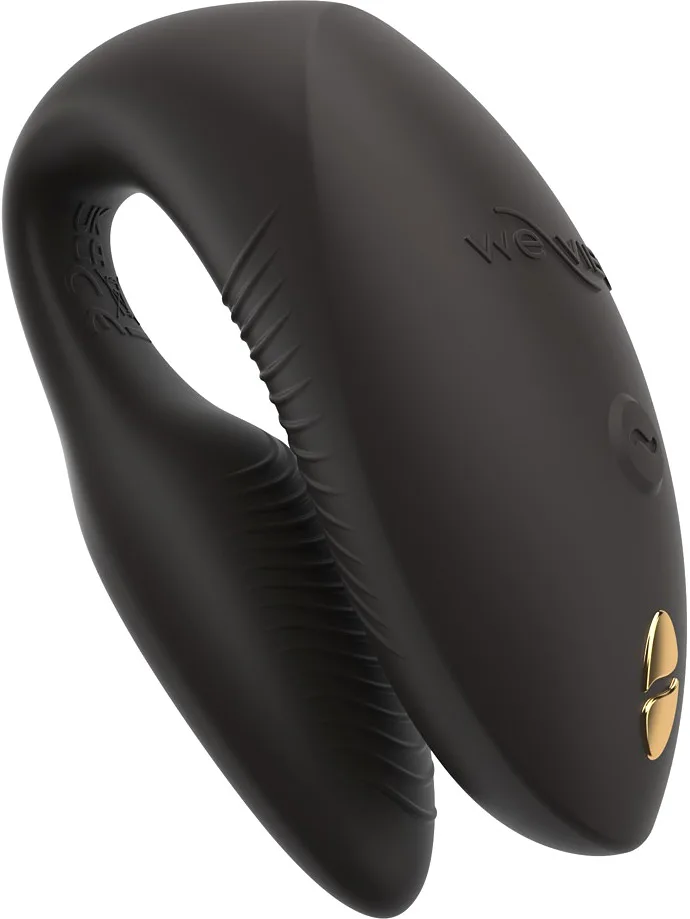
Review: We-Vibe Chorus Pro Black
Same product in Satin Black — a different EAN and partly different shop prices.
13 September 2026
 Premium pick
Review · Couple vibrator · Fusion Wave Technology
We-Vibe’s most feature-rich couple vibrator reviewed against the manufacturer’s own specifications, the EU declaration of conformity and price data from six Swedish stores. Three motors, ten vibration patterns, three of which are exclusive, haptic squeeze remote control, full silicone and up to 120 minutes of runtime — but We-Vibe does not publish any dimensions, weight or enclosure rating.
The most feature-rich paired vibrator in the comparison: three motors, ten vibration patterns, including three exclusive Fusion Wave modes, a haptic remote control that’s controlled by squeezing, and Touch Sense in three documented modes. Up to 120 minutes of runtime on a 90-minute charge is best in its category. What you pay for is transparency: We-Vibe does not publish measurements, weight, battery capacity, sound level, or the model’s IP rating, and the charging case is the only documented charging method.
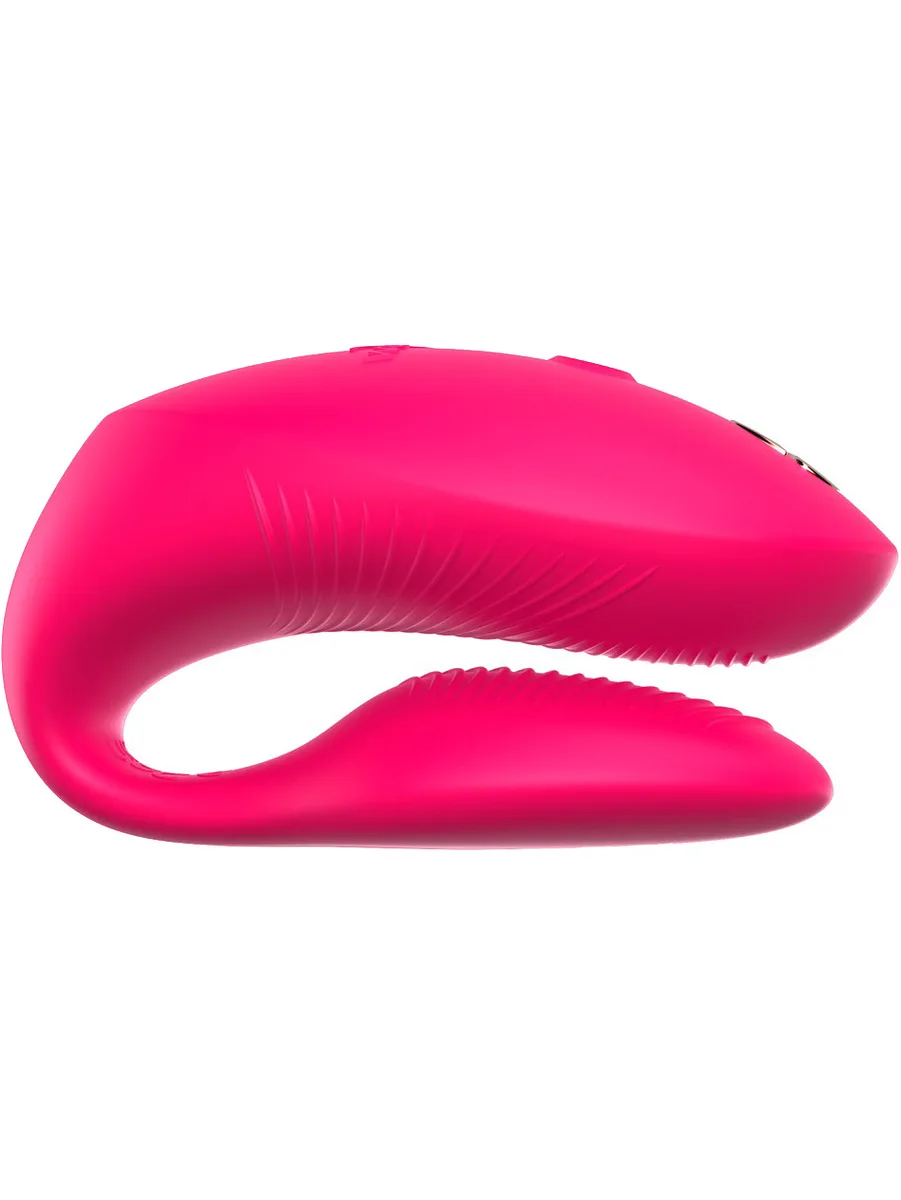
We-Vibe Chorus Pro is the model where the manufacturer took the step from one motor per arm to three motors in a single pair vibrator. The construction is the C-shape that We-Vibe has built its entire category on: an inner arm that sits in the sleeve against the G-spot, and an outer arm that rests against the clitoris, joined by a flexible hinge that clamps the product in place during intercourse. What’s new is what sits in the outer arm. The manufacturer specifies two synchronized motors there and calls the interaction between them Fusion Wave Technology.
The specifications look like this according to We-Vibe: body-friendly silicone free from phthalates and BPA and made without latex, up to 120 minutes of operating time, up to 90 minutes of charging time, ten vibration patterns, three of which are exclusive, a haptic remote control that you squeeze instead of pressing, app control over any distance, a charging case that both charges and stores the toy and the remote control, and a two-year manufacturer’s warranty. The manufacturer’s list price is 209 euro. In Sweden, the item is sold by six shops at prices between 1,795 and 2,599 SEK, and four of them had it in stock at the price check on September 12, 2026.
This review is exclusively about the Electric Pink variant with EAN 4251460634205, the manufacturer’s item number SNSP1SG3. We-Vibe sells Chorus Pro in three colors — Cosmic Purple, Satin Black, and Electric Pink — and each color has its own EAN. Functionally, they are identical, but the number is worth checking at checkout, and in this particular case there is a specific reason for that, which we’ll get back to further down.
A typical vibrator has a motor. It rotates or swings, and the material around it transfers the movement to the skin as a steady vibration with a certain frequency and a certain amplitude. More power gives stronger vibration, but the curve looks the same all the way up: the same motion, just more powerful.
Chorus Pro does something different in the outer arm. The manufacturer specifies two motors there and describes that they work together and create a wave-like motion that stimulates the clitoris rhythmically rather than statically. In the manual, We-Vibe puts it as stating that the product doesn’t just vibrate, but pulses and flows. What can be established purely from a technical standpoint is that two motors running with a time offset create a resulting motion that varies over time — a hovering rather than a constant tone. It’s the same principle that makes two instruments that are almost but not completely in sync create an audible pulse.
A third motor for the G-spot is included in the inner arm, along with the two clitoral motors. The two-plus-one split is printed on the manufacturer’s own packaging, where the back lists two motors for clitoral stimulation and one for the G-spot. The retailer Vuxenkul states the same thing in its specification, phrased as three powerful motors.
The practical result is that the two zones can be controlled separately. The manufacturer’s manual explicitly states that the app lets you control the clitoral motors and the G-spot motor separately. It’s a real functional difference compared to a dual vibrator with one motor per arm, where both zones follow the same controls. The price you pay for that is the number of components: three motors, three units with their own electronics, and three things that can break.
We-Vibe has three C-form models that are close to each other and are regularly mixed up in Swedish store texts. The differences can be read directly from the manufacturer’s own specification sheets.
Note that operating time and charging time are identical between Chorus Pro and Sync 2, while the predecessor Chorus is worse on both: 90 minutes of operation and 120 minutes of charging. So the upgrade from Chorus to Chorus Pro isn’t just about the motors, but also about an operating time that, according to the manufacturer, is a third longer on a charge that takes a quarter less time.
There is a discrepancy worth knowing about before you click the lowest price. The manufacturer’s product page unambiguously links EAN 4251460634205 to Chorus Pro in the color Electric Pink, article number SNSP1SG3. Five of the six Swedish stores use the same number for the same product. Blush Me, Sexonic, Vuxen, and Vuxenkul state this openly in their specifications, and Joyland sells the item under the name Chorus Pro rosa.
Mshop lists EAN 4251460634205, however, under the name We-Vibe Chorus Cosmic Pink, with a product text that describes the predecessor Chorus and a delivery contents list that enumerates lubricant sample packs — something that is included in Chorus packaging but not in Chorus Pro according to the manufacturer’s own contents list. The same pattern shows up on the store’s other variant, where EAN 4251460634199 is called We-Vibe Chorus Purple even though the manufacturer states the number as Chorus Pro Cosmic Purple.
When a store contradicts the manufacturer, the manufacturer wins. The EAN number is linked to Chorus Pro, and it is that article that underlies the price. But since the store text describes a different product, it’s wise to check the article number in the order confirmation if you’re buying there—exactly the kind of double-labeling that can cause the wrong model to end up in the box.
The material is the only property of an intimate product that neither habits nor care can compensate for, and it determines whether the product is still hygienic after five years. We-Vibe specifies a single material for Chorus Pro: body-friendly silicone, free from phthalates and BPA, and manufactured without latex. This is a change compared with the predecessor, whose material specification lists ABS and body-friendly silicone.
Silicone is non-porous. A non-porous surface can be cleaned because there are no microscopic cavities where residue can get trapped. It is the single most important property of a material that is meant to sit against the mucous membranes for a longer time, and that is why the material list carries more weight than almost any other item in a specification.
Having the entire house covered in silicone has two consequences for this particular product. The first is mechanical: the hinge between the arms must be bent every time the product is put in place, and a bend zone in silicone wears differently than a seam between silicone and hard plastic. The second is hygienic. Chorus Pro has no removable part at all—the toy is a single sealed body—which means there is no gap to clean, but also that nothing can be replaced if the surface is damaged.
There is a discrepancy between the sources that must be reported. The retailer Vuxenkul lists the material as “Silicone, PU”, meaning silicone and polyurethane, while the manufacturer and the other stores only list silicone. Joyland also describes the surface as ribbed, silky-smooth, and smooth with medium hardness—a store claim with no equivalent at We-Vibe. The manufacturer’s declaration is the one that applies, but the information is worth noting for anyone who is sensitive to polyurethane.
Phthalates are a group of plasticizers used to make plastic—above all, flexible PVC—pliable. The Swedish Chemicals Agency (Kemikalieinspektionen) describes them as substances that can affect the hormone system and make reproduction more difficult, and several of them are therefore restricted or banned within the EU in a large number of products. Intimate products are a recurring object of oversight precisely because the category contains flexible plastic that sits directly against skin and mucous membranes.
We-Vibe explicitly states that the silicone in Chorus Pro is free from phthalates and BPA and manufactured without latex. This is an unambiguous declaration, unlike labels such as TPE or jelly rubber, which say nothing at all about which plasticizers are included. Silicone does not need phthalate plasticizers to become soft—the softness comes from the polymer’s own structure—and therefore specifying silicone as the material is, in itself, better information than almost any other item in a specification.
Latexuppgiften matters for anyone who is latex-allergic. Reactions on the mucous membrane come faster than on normal skin, and a product worn inside the body during intercourse is exactly the kind of use where the information is relevant. Joyland repeats its phthalate-free status in its own specification table, which means the information is available to the buyer even without having to visit the manufacturer’s site.
Here is the biggest gap in the information base, and it’s noticeable because it wasn’t there before. We-Vibe does not publish any length, width, height, or weight for Chorus Pro. The specification table on the product page includes the model, colors, battery, operating time, charging time, material, and warranty—and then it ends there. The online manual also states no dimensions. On the predecessor Chorus, the line remains: height 44 millimeters, width 33 millimeters, length 78 millimeters, and remote control 37 × 96 millimeters. On Sync 2, it’s there as well: 41.7 × 74.8 millimeters. On Chorus Pro, it has disappeared.
What is available is store information, and the two stores that publish measurements agree. Blush Me states a length of 8.00 centimeters and a maximum diameter of 4.10 centimeters, and Vuxenkul states a length of 8 centimeters and a diameter of 4.1 centimeters. Two independent retailers arriving at the same figures is a reasonable indication, and the values are close to the predecessor’s 78 millimeters in length and 44 millimeters in height. But these are store details, not manufacturer data, and they should be read as such.
The weight is entirely unsubstantiated. None of the six stores publishes a weight, and the manufacturer doesn’t either. For a product that is supposed to stay in place on its own during intercourse, the weight is actually relevant—it determines how much clamping force in the hinge has to compensate for—but the information isn’t available anywhere in the sources you can check. Anyone who sees a gram figure for Chorus Pro on another site should ask themselves where it comes from.
The remote control also lacks dimensions. The manufacturer lists 37 × 96 millimeters for the predecessor’s remote control, but Chorus Pro has a new remote control with a different design—it includes an air pocket and a vent—and therefore the predecessor’s dimensions can’t be transferred.
The interface is divided into three units. On the toy itself, according to the manual’s overview image, there is a single control button, magnetic charging prongs, the internal stimulator, the external stimulator, and the adjustable hinge. The remote control has four functions in addition to squeezing: on and up, off and down, change pattern, and a button for the clamping mode. It also has a vent called a travel vent, which has no equivalent on any other product in the range.
The manufacturer’s first instruction in the manual is specifically about that valve. According to We-Vibe, changes in air pressure during transport can cause the remote control’s air chamber to empty slightly, and before first use the valve should be gently pressed in with a ballpoint pen to fill the air pocket again. It’s an unusual instruction, and it says something about the design: the squeeze function is based on real air pressure, not on a strain sensor in the rubber.
The remote control’s main argument is that it replaces button presses with a grip. The manufacturer describes that the vibration intensity follows how hard you squeeze, and that the remote control also vibrates with the same intensity as the toy. That feedback is the point of the name: the person holding the remote control feels in their hand what their partner feels.
The squeeze mode isn’t on all the time. According to the manual, it is activated by pressing the We-Vibe button on the remote control, and then the squeeze force controls the intensity in real time. Without that activation, the remote control works like a normal remote control with plus, minus, and pattern switching.
What can be established is that the design solves a real problem. One button requires you to see or remember where it is, and it only gives discrete steps. A grip is analog and doesn’t require precision—it works in the dark, under a blanket, and without moving your gaze. The counterargument is just as concrete: an air chamber is a mechanical component that can lose pressure, which the manufacturer itself indirectly admits by building in a valve to top it up.
The manufacturer lists ten vibration patterns, and the manual numbers them. Patterns 1 through 7 are classic We-Vibe patterns found across the entire range. Patterns 8, 9, and 10 are exclusive to Chorus Pro and use the two clitoral motors:
In addition, the manufacturer’s packaging lists ten intensity levels alongside the ten patterns, and Joyland reproduces the information in its specification as vibration modes in ten different steps. In practice, this means that intensity and pattern are two separate controls, just like on the rest of We-Vibe’s range, and that the number of combinations is significantly greater than the list of ten patterns suggests.
A note about the app belongs here. The manual states that all ten patterns, including the Fusion Wave modes, are available via the app. This wording does not mean that they are only in the app—the pattern button on the remote cycles through them—but the app is the only route that the manufacturer documents for controlling the two motor groups separately.
Under the We-Vibe logo on the outer arm, there is a sensor. With Touch Sense enabled, it detects contact with a partner’s body during intercourse and changes the vibration intensity according to the rhythm. The function is turned on in the app, and the manual describes three modes with clearly different behavior:
This is an unusually concrete description of an automation function. Most manufacturers are content to call it smart. When We-Vibe prints out the three-second threshold in mode 2, the function becomes predictable, and it’s worth reading before purchase: mode 1 never returns to a calm starting position—it cycles as long as contact is present.
The app is available for iOS and Android and, according to the manual, is connected by scanning the barcode on the underside of the outer carton. It’s worth knowing this before the packaging is thrown away. Through the app, it’s possible to control the clitoris and G-spot motors separately, synchronize the vibrations with music, and hand over control to a partner in another location.
According to the manufacturer, the toy and remote are paired from the factory. The manual states that you start the toy by pressing the We-Vibe button and then, after that, hold the plus button on the remote for three seconds to confirm the connection. If it doesn’t work, the toy is reset by holding in the We-Vibe button for five seconds, after which the remote’s We-Vibe button is held in for five seconds. Once they’ve found each other, the toy vibrates three times.
There’s a smaller discrepancy between the sources here. The retailer Vuxen describes pairing as holding the We-Vibe button on the toy for five seconds until it vibrates twice, and then the remote’s button for at least five seconds. The manufacturer’s reset procedure is described as if it were the normal way. The manufacturer’s manual is the one that applies.
Chorus Pro is radio equipment, and that means there is documentation that can be checked—something that is unusual in this product category. We-Vibe publishes separate EU declarations of conformity for the toy and for the remote control.
The declaration for the toy describes the product as a C-shape couple’s vibrator, lists the operating frequency as 2402–2480 megahertz, and states the maximum radio transmission power as −2,82 dBm. The remote control R-SCP2A and the charging base CHB-SCP1A are listed as accessories in the same document. The online manual states the frequency band as slightly broader, 2400–2480 megahertz, and gives the remote control’s maximum output power as −11,15 dBm. Both are in the license-free 2.4-gigahertz band, meaning the same band as Bluetooth and wifi.
The output power is low in this context: −2,82 dBm corresponds to a bit over half a milliwatt. That is relevant for range. The manufacturer does not publish a range in meters for Chorus Pro, unlike for example Lelo, which states up to 12 meters for Tiani 3. What can be concluded is that the remote control transmits weaker than the toy, and that the practical range is therefore set by the remote control, not by the product in the body.
The answer has to be short and honest here. We-Vibe publishes no measured decibel value for Chorus Pro, either on the product page or in the online manual. None of the six Swedish shops publish any sound level either. The word silent is not even used as a marketing claim in the manufacturer’s specifications for this model.
The comparison is enlightening. Lelo states 50 decibels as the maximum sound level for the Tiani 3 and also the vibration frequency at 125 hertz. Those are two figures that you can compare to other products. For Chorus Pro, neither exists. Anyone who sees a decibel figure for Chorus Pro listed somewhere should therefore assume it is either their own measurement or a value without a source.
What can be said based on the design is limited but not worthless. The product is worn inside and against the body during intercourse, which dampens more than a handheld vibrator that sits freely in the air. A practical tip that applies regardless of model: never place the product on a hard tabletop while it is running. The tabletop acts as a resonance box and noticeably amplifies the sound.
This is the point where the sources differ the most, and the difference is important. We-Vibe does not publish any ingress protection rating for Chorus Pro—either on the product page or in the online manual. Three of the six Swedish stores state IPX7 directly: Joyland says 100 percent waterproof with IPX7 in parentheses, Blush Me says waterproof with IPX7 in parentheses, and Vuxenkul says completely waterproof with IPX7 in parentheses. Sexonic and Vuxen are content to state that the product is waterproof, without a rating.
The designation comes from the international standard IEC 60529, which defines ingress protection ratings for electrical equipment. The number 7 in the second position means that the product has been tested for submersion in water to a depth of one meter for 30 minutes. X in the first position means that protection against solid objects has not been tested or is not specified.
That three independent stores state the same rating is a strong indication, but it does not replace information from the manufacturer. Therefore, treat IPX7 as a store statement. The manufacturer’s own cleaning instructions—rinse the toy and the remote control with warm water and add a cleaning agent for intimate products—are consistent with that rating, but they are worded as instructions, not as a rating.
One thing, however, is crystal clear in the manual and applies regardless of what rating the toy has: the charging unit and the charging cable must never be submerged in water or any other liquid. So the charging case is not water-resistant, and because the case is the documented charging route, it is part of the product that must be kept dry.
Rinse the toy and the remote control in warm water after each use and add a cleaning agent intended for intimate products—that is the manufacturer’s own instruction, word for word. Let the parts dry before putting them back in the case, which according to the manual is the recommended storage location and, at the same time, keeps them charged.
The lubricant issue is clearly regulated in the manual. Use a water-based lubricant. Do not use perfumed or alcohol-based lubricants, gels, or massage oils, and never use silicone-based lubricant on silicone products. Silicone-based lubricant breaks down the silicone surface over time and makes it porous, and a porous surface can no longer be cleaned properly—only replaced, which here means the entire toy. Joyland states the same thing briefly in its specification: the recommended lubricant is water-based.
The manual also covers three things that rarely appear in store texts. The product and its battery must not be exposed to temperatures above 45 degrees, which rules out boiling and dishwashing. The product contains magnets and should not be used directly over a pacemaker, and a card with a magnetic stripe should be kept away from it. And Chorus Pro is expressly not designed for anal use.
We-Vibe states the operating time as up to 120 minutes and the charging time as up to 90 minutes, and the manual repeats the same pair: up to two hours of play and full charging in 90 minutes. Blush Me gives both of these details in its own specification, and Joyland lists the battery life as up to two hours. The sources point in the same direction.
Two hours of operation is strong for a couple’s vibrator. The predecessor Chorus is listed as 90 minutes, so one-third shorter, on a charge that takes 120 minutes instead of 90. Lelo lists two hours for the Tiani 3 with a charging time of two hours. So Chorus Pro charges faster than both of them and lasts at least as long as the best of the two.
Through the charging case. Both the toy and the remote control are placed in the case, which in turn is connected with the included USB cable. The toy has magnetic charging pins, which, according to the manual’s overview image, is what transfers power when it is in place. The case is labeled CHB-SCP1A and is powered with 5 volts and 0.7 ampere.
The design has an obvious advantage and an equally obvious disadvantage. The advantage is that there is no opening in the toy’s housing—no contacts, no rubber plug—and that charging and storage become the same single handling. The disadvantage is the dependence: the manufacturer documents no way to charge the toy without the case. If you drop or lose the case, there is no spare cable to plug in, and the warranty terms also expressly exclude consumables such as batteries and charging cables. The manual also states that a USB-C adapter is needed for wall charging, and that it is not included.
A tip from the manual that’s hard to find anywhere else: if the toy or the remote control stops responding—for example after static electricity—it can be reset by plugging the charging cable into a power outlet and then holding the We-Vibe button pressed for five seconds.
The manufacturer publishes rated voltage and rated current but not capacity. The toy SCP2A is listed as 3.7 volts and 0.5 amp with a built-in lithium-ion battery, the remote control R-SCP2A as 3.7 volts and 0.2 amp with a built-in lithium-ion battery, and the charging base CHB-SCP1A as 5 volts and 0.7 amp. No capacity in milliampere-hours is stated for any of the three devices, either on the product page or in the manual, and no store publishes any either.
It’s worth noting because the competitor does it: Lelo lists 70 milliampere-hours and 3.7 volts for Tiani 3. Without the capacity, you can’t convert operating time into power consumption, and you can’t compare how heavily the cell is loaded between models. What you do know is that the 0.5 ampere power draw for the toy is double the remote control’s 0.2—reasonable since one has three motors and the other only has one haptic.
What generally applies to lithium-ion batteries also applies here: capacity drops with the number of charge cycles, and according to the manual the batteries are not replaceable. The manufacturer itself states that the product should be charged regularly even when it isn’t used so the battery lasts longer. With a couple of uses per week, it’s the batteries—not the silicone—that set the limit for lifespan—and since they’re permanently mounted in three separate units, the product is practically used up when the first of them gives out.
A curiosity in the manual is worth mentioning for anyone who reads it carefully. Among the general battery warnings, there’s a line stating that only CR2302 batteries may be used, despite the same document indicating permanently mounted lithium-ion batteries in both the toy and the remote control. It’s a leftover from the manufacturer’s shared safety text, not information about this product.
We do not have price data from shops in your market yet.
Two motors in the outer arm and one in the inner. That’s the whole difference versus the predecessor — and the whole reason why three out of ten patterns are available here only.
Three comparisons are relevant: versus the model it replaces, versus the cheaper model in the same family, and versus the other premium brand in the category. All the information below comes from each manufacturer’s own specifications.
The predecessor Chorus costs 159 euros from the manufacturer versus the regular 209, i.e. 50 euros less than Chorus Pro. The differences in the specifications are more than the name suggests.
Chorus is listed as ABS and body-friendly silicone, while Chorus Pro is body-friendly silicone only. Chorus provides 90 minutes of operating time on a 120-minute charge; Chorus Pro up to 120 minutes on up to 90 minutes. Chorus has a clamp remote control but no Fusion Wave technology and no exclusive wave patterns. Chorus Pro has two motors in the outer arm and three patterns that build on them.
What Chorus has that Chorus Pro lacks is a listing. The manufacturer publishes the dimensions for Chorus — height 44 millimeters, width 33 millimeters, length 78 millimeters, and remote control 37 × 96 millimeters — but not for Chorus Pro. For anyone who wants to know exactly how big the product is before it’s in their hand, that’s a downgrade, not an improvement.
Conclusion: if you want Fusion Wave, longer operating time, and a shorter charging time, Chorus Pro is worth the difference. If you just want a C-shaped perineal vibrator with a clamp remote control, Chorus does the same basic job for less money, and you also get to know how big it is.
Sync 2 costs 159 euros from the manufacturer, so it’s the same 50 euros less. The battery side is identical: up to 120 minutes of runtime and up to 90 minutes of charging time, just like on Chorus Pro. The material is the same, body-friendly silicone without phthalates, BPA, and latex. The warranty is the same, two years.
Sync 2 also lists its dimensions: 41.7 × 74.8 millimeters. That makes it the only one of the three We-Vibe models in this comparison where you get both a lower price and a complete dimensions specification.
The extra 50 euros you pay for on Chorus Pro is therefore not for the battery, material, or warranty. It’s for the third motor, the three Fusion Wave patterns, the haptic clamp remote control, the Touch Sense modes, and the charging case. Are any of those features the reason you’re considering the model for the price difference to be justified? If not, you get the same runtime and the same material for less money.
Lelo Tiani 3 is the closest competitor outside of We-Vibe’s own range, and the comparison becomes interesting precisely because Lelo publishes what We-Vibe doesn’t.
Lelo lists the dimensions as 78 × 44.5 × 32 millimeters, the insertion depth as 78.2 millimeters, the weight as 42 grams, a lithium-ion battery at 3.7 volts and 70 milliampere-hours, charging for two hours at 5.0 volts and 70 milliamps, runtime two hours, standby time 90 days, maximum sound level 50 decibels, vibration frequency 125 hertz, automatic shut-off after 20 minutes, and wireless range up to 12 meters. The material is stated as body-friendly silicone and ABS plastic—so not all-silicone.
The differences that actually matter: Chorus Pro has three motors, compared to Tiani 3’s design with a single vibration source in each arm. It has all-silicone instead of silicone and ABS. It charges in 90 minutes instead of 120. And it has app control with long-distance play. Tiani 3, on the other hand, has a published weight, a published battery capacity, a published sound level, a published range, and published dimensions.
Choose based on features and material, and Chorus Pro wins. Choose based on how much the manufacturer is willing to disclose about its own product when Lelo wins, and that’s not an insignificant criterion—it’s the difference between being able to compare and having to rely on a description.
Six Swedish stores sell the item with EAN 4251460634205. Cheapest is Joyland at 1,795 SEK, and most expensive is Vuxenkul at 2,599 SEK. That’s 804 SEK, or about 45 percent, in difference for exactly the same item number, the same color, and the same packaging.
The inventory situation evens out the picture significantly. Four of the six shops had the product in stock during the price check: Joyland at 1 795 SEK, Mshop at 1 799 SEK, Blush Me at 1 895 SEK, and Vuxen at 1 995 SEK. So the difference between the cheapest and the most expensive available shop is 200 SEK, not 804. The two shops that were highest in price—Sexonic at 1 861 SEK and Vuxenkul at 2 599 SEK—were both sold out according to their product flows, and a price in a flow for a sold-out item is rarely the price you actually end up paying when the item comes back into stock.
The difference between the two cheapest is four kronor. In practice, it makes no difference at all, and then other things carry more weight—especially that Mshop sells the item under the wrong product name, which means you should check the item number in the order confirmation.
The price spread does not depend on any shop selling a different variant. All six list the item under EAN 4251460634205 or under their own item number that is tied specifically to that pink Chorus Pro. So it’s about the shops’ own margin-setting for a model that is still new—the manufacturer’s manual is dated July 2025—and therefore hasn’t had time to become a price-pressured volume item. That’s exactly the situation where it pays the most to compare before you pay.
The prices in the table above are updated when the shops’ product flows are updated, but always check the final price at checkout. In this price range, most shops are above the threshold for free shipping, which means shipping costs rarely affect the ranking.
It’s for you if you want a couple’s vibrator to wear during intercourse and want to be able to control clitoral and G-spot stimulation separately. It’s for you if one person wants to keep control without looking at buttons—the clamp remote with haptic feedback is the model’s strongest single idea, and it’s not available in that form anywhere else in the range. It’s for you if you want full silicone instead of a mix of silicone and hard plastic, and you if you want to be able to play remotely via the app.
It’s not for you if you want to know exactly what you’re buying before the package is opened. The manufacturer does not publish dimensions, weight, or the ingress protection class for this model, and the dimension information that does exist comes from two shops. It’s not for you if you want the smallest possible product or the simplest possible interface—three units, ten patterns, ten intensity levels, and three Touch Sense modes is a lot to keep track of. And it’s not for you if you want to charge with a regular cable: the charging case is the only documented charging method, and there is no backup option if it breaks.
One more thing belongs in the decision. Chorus Pro is designed as a main product, not as a travel accessory. The case is certainly travel-friendly according to the manufacturer, and the remote control even has a vent for pressure changes during transport, but the overall set consists of three units with their own batteries, and the price tag of at least 1,795 SEK means it’s not something you’d really want to risk losing. If you’re unsure whether the C-shape will work for your body, Sync 2 is a much cheaper way to find out.
We-Vibe provides a two-year voluntary manufacturer’s warranty on Chorus Pro. The terms specify the warranty period as 24 months from the first delivery to the customer, however no more than two years after manufacture. The last wording is important: if you buy a product that has been sitting on a store shelf for a long time, the warranty period in practice may be shorter than 24 months.
Under a valid warranty claim, the manufacturer chooses between replacing the product with a new one of the same type and refunding the purchase price. The manufacturer covers transport, travel, labor, and material costs for the replacement. The defect must be reported in writing within two months from the time it was discovered or should have been discovered, and proof of purchase is required. The warranty applies to products handed over to the customer in the EU, Switzerland, Norway, or Iceland.
Read the exceptions before you count on the warranty. It does not cover minor faults that do not affect usability, wear parts such as seals, or consumables such as batteries and charging cables. It also does not apply in cases of normal wear and tear, intentional damage, incorrect commissioning, use contrary to the instructions, attempts at self-repair, or aggressive cleaning agents. In practice, that means that the parts most likely to break first—batteries and the charging cable—are outside the warranty.
One detail from the manufacturer’s warranty page is worth noting. The list of products covered by the two-year warranty mentions Chorus but not Chorus Pro. However, the product page states two years for Chorus Pro, and that’s the information that applies—the list simply hasn’t been updated with the newer model.
We-Vibe’s 100-day satisfaction guarantee is often quoted in store texts and deserves a clarification. According to the manufacturer, it applies only to purchases in We-Vibe’s own web shop, and it provides a value check to buy another product in the same shop rather than a refund of money. So if you buy from any of the six Swedish stores listed above, you’re not covered by it.
What always applies, however, are your statutory rights. Under the Swedish Sale of Goods Act (konsumentköplagen), you have three years to complain about defects in the item, regardless of what the manufacturer promises. For distance purchases, you also have a right of withdrawal for fourteen days under the Act on distance contracts and contracts concluded away from business premises (lagen om distansavtal och avtal utanför affärslokaler). Please note that, in practice, the right of withdrawal is limited for hygiene products that have been removed from a sealed package—however, the right to complain about defects always applies. If you have questions about what applies in your case, Konsumentverket guides you via Hallå konsument.
We-Vibe Chorus Pro Electric Pink isn’t included in any ranking yet. In best i test guides, the entire categories are compared against each other using five shared criteria, with what was left out shown.
Every numerical piece of information in the text can be traced to one of the sources below. The links were checked manually on the specified date.
This page is machine-translated from Swedish. Read the Swedish original