

Review
Review: Satisfyer Pro 2 Next Generation
Cheapest among the widely sold — 219 SEK and a 15-year warranty.
29 July 2026
 Premium pick
Review · Couple vibrator · Fusion Wave Technology
We-Vibe’s most feature-packed couple vibrator reviewed against the manufacturer’s own specifications, the EU declaration of conformity, and pricing data from six Swedish stores. Three motors, ten vibration patterns, a pressure-sensitive remote control with haptic feedback, up to 120 minutes of runtime, and a charging case — but one specification where neither dimensions, weight, battery capacity, enclosure rating, nor sound level is published.
The most feature-packed couple vibrator in the comparison: three motors, ten patterns—three of which are exclusive—an input-sensitive remote control that vibrates in sync with the toy, movement-controlled Touch Sense in three modes, and a charging case that also serves as storage. Two hours of runtime on a 90-minute charge is strong in the category. What you pay for is documentation full of gaps—neither dimensions, weight, battery capacity, IP rating, nor sound level are published by the manufacturer—and a three-part system where the case is the only way to charge.
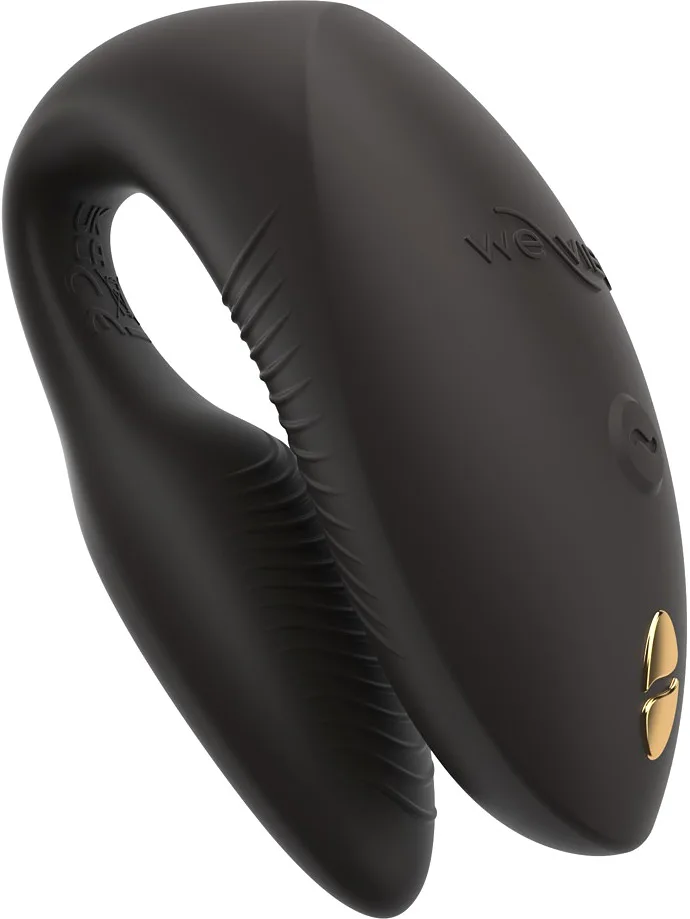
We-Vibe Chorus Pro is the model where the manufacturer introduced what they call Fusion Wave Technology. The basic shape is the same as the one the entire C-forms family is built on: a flexible dual vibrator that is worn during intercourse, with an inner arm toward the G-spot and an outer arm toward the clitoris, and with an adjustable hinge between them. The new part is in the drive system. In the EU declaration of conformity, WOW Tech describes the product in a nutshell as an "C-shape couple’s vibrator" with the model designation SCP2A.
The specification that the manufacturer publishes looks like this: body-friendly silicone, runtime up to 120 minutes, charging time up to 90 minutes, a built-in lithium-ion battery of 3.7 volts and 0.5 ampere, ten vibration patterns, of which three are exclusive to this model, a pressure-sensitive remote control with haptic feedback, a charging case that holds and charges both the toy and the remote control, app control via Bluetooth, and a two-year manufacturer’s warranty. In Sweden, the item is sold by six stores at prices between 1 795 and 2 299 SEK, and four of them had it in stock at the price check on September 12, 2026. The manufacturer’s own list price in the euro area is 209 euro.
This review is exclusively about the black variant — the manufacturer calls the color Satin Black — with EAN 4251460634182 and item number SNSP1SG9. We-Vibe sells Chorus Pro in three colors: Cosmic Purple, Satin Black, and Electric Pink. Each color has its own EAN, and the number is verified both in the page source on the manufacturer’s product page and at two of the Swedish stores, which list the same thirteen digits as the item number and the EAN13, respectively.
One thing should be said already here, because it comes up several times below. The manufacturer does not publish any measurements, weight, battery capacity, ingress protection rating, or sound level for Chorus Pro. The specification table on the product page has seven rows — model, colors, battery, runtime, charging time, material, and warranty — and it lacks the measurement that the same table includes for both the predecessor Chorus and the sibling model Sync 2. It is a striking omission for a product in this price range, and it means that several of the figures further down come from the stores instead of from the manufacturer. Where that information comes from is printed out every time.
A typical vibrator has a motor. A C-shaped dual vibrator normally has two: one in the inner arm toward the G-spot and one in the outer arm toward the clitoris. What the manufacturer has done with Chorus Pro is to include two motors in the outer arm instead of one. We-Vibe describes it on the product page as two synchronized motors that create wave-like sensations, and in the online manual as a movement that pulses and flows instead of just vibrating.
The manufacturer’s printed packaging is clearer than the website on this point. The back of the cardboard, shown in the retailers’ product images, breaks down the motors in plain language: two motors for clitoral stimulation and one motor for G-spot stimulation. The retailer Lustly states the same thing in its specification table — three motors. It also matches the online manual, which says that the clitoral and G-spot motors can be controlled separately in the app.
What that means in practice is simple to reason out. Two motors that sit next to each other and run with a slight phase shift produce a composite movement that neither motor can provide on its own. It’s the same principle behind how a single eccentric weight always gives an even, monotonous buzz, while two weights can create a pattern that wanders. What can be established purely technically, then, is that Chorus Pro has one degree of freedom in the outer arm compared with every other C-shaped dual vibrator in the lineup. Whether that degree of freedom is worth the price difference is another question, and it comes up again in the comparison section.
We-Vibe’s many C-shaped dual vibrators have similar-sounding names. Three models are most often mixed up in Swedish stores, and the differences are specific.
The most important difference between Chorus Pro and the other two, then, is not the number of patterns — Chorus also has ten. It’s the motor arrangement in the outer arm, the haptic feedback in the remote control and the charging case. The most important difference between Chorus Pro and Chorus in terms of endurance is also worth noting: Chorus Pro is stated to have 120 minutes of operating time and 90 minutes of charging time, while Chorus is stated to have 90 minutes of operating time and 120 minutes of charging time. So the figures have swapped places, to the advantage of the new model.
Material is the only characteristic of an intimate product that cannot be compensated for through experience or care, and it determines whether the product is still hygienic after five years. We-Vibe specifies a single material for Chorus Pro: body-friendly silicone, free of phthalates and BPA, and manufactured without latex. It is the same wording that is used for Sync 2, and it differs in one important respect from the wording for the predecessor Chorus, where the manufacturer states "ABS and Body-safe silicone".
Silicone is a non-porous material. A non-porous surface can be cleaned, because there are no microscopic cavities where residue can remain. That is the single most important property of a material that should sit against the mucous membrane, and that is why the material declaration carries more weight than almost all other lines in a specification.
The fact that the manufacturer has removed the ABS plastic from the material information between Chorus and Chorus Pro is a step in the right direction, because it means that the hard plastic is either gone or completely encapsulated. There is, however, one discrepancy to note: the retailer Lustly lists the material as "silicone, PU", meaning silicone and polyurethane. The manufacturer does not mention polyurethane anywhere. Such contradictions are always decided in the manufacturer’s favor, but the discrepancy is worth knowing if you specifically avoid polyurethane. We-Vibe does not publish what the housing’s innermost construction is like beneath the silicone, and this applies to almost the entire product category as well.
The shape is soft and the hinge is flexible. The online manual names five parts on the toy: control button, magnetic charging pins, inner stimulator, outer stimulator, and adjustable fit. The fact that the hinge is adjustable is the whole point of a C-shape — that is how the product stays in place during intercourse without being held there — and the manufacturer states that the arm should be adjusted before it is inserted. The retailer Vuxen describes the elasticity as "flexible" in its quick fact table.
Phthalates are a group of plasticizers used to make plastic — above all, soft PVC — flexible. Kemikalieinspektionen describes them as substances that can affect the hormone system and make reproduction more difficult, and several of them are therefore restricted or banned in the EU in a large number of products. This particular product category is repeatedly the subject of supervision because it contains soft plastic against skin and mucous membranes.
We-Vibe explicitly states that the material in Chorus Pro is free from phthalates and BPA and manufactured without latex. It is an unambiguous declaration—unlike labels such as "TPE" or "jelly rubber", which say absolutely nothing about which plasticizers are included. Silicone does not require phthalate plasticizers to become soft—the softness comes from the polymer’s own structure—and that’s why listing silicone as the material is, in itself, better information than almost any other entry in a product specification.
The latex information is relevant for anyone who is allergic to latex. Latex allergy causes reactions on mucous membranes faster than on normal skin, and a product that is worn internally during intercourse is exactly the use case where this detail matters. The fact that the manufacturer prints it is a plus. In addition, the retailer Joyland lists "ftalatfri: ja" in its own specification table, which is the same message from a second perspective.
This is where the biggest gap in the underlying information is. We-Vibe does not publish any measurements or any weight for Chorus Pro, either on the product page or in the online manual. It is remarkable because the same table on the manufacturer’s own website includes a measurement for both Chorus and Sync 2. For Chorus, it states 78 millimeters in length, 44 in height, and 33 in width, plus a remote control of 37 × 96 millimeters. For Sync 2, it states 41.7 × 74.8 millimeters. For Chorus Pro, that line simply isn’t there.
The stores fill the gap, but they fill it differently. The retailer Blush Me lists the length as 8.00 centimeters and the maximum diameter as 4.10 centimeters. It is strikingly close to the manufacturer’s published dimensions for the predecessor Chorus—78 millimeters long and 44 high—which could mean either that the shape is largely unchanged or that the information has carried over from the earlier model in the store’s product data. Which of these is correct cannot be determined without a measurement from the manufacturer, and such a measurement is not available.
Instead, the retailer Lustly provides the dimensions of the accessories: remote control 35.5 × 114.5 millimeters and charging box 138.8 × 129.9 × 54 millimeters. The same store gives a total weight of 433 grams. That it is a total weight and not the toy’s weight is clear from the wording "vikt (totalt)", and a charging box measuring almost fourteen centimeters squared plausibly accounts for most of it. What can be concluded is that, according to the store’s information, the remote control is significantly larger than that of the predecessor—114.5 millimeters versus the manufacturer’s stated 96 millimeters for the Chorus remote control—and it is logical, given that the new remote apparently includes an air pocket that is supposed to be squeezable.
The conclusion for someone comparing in-store: expect a product in the same size class as other C-shaped pair vibrators, but assume that you won’t get an exact measurement until the package is at home. If you need to know the insertion depth in advance, this is the wrong product to buy remotely — and it’s a criticism aimed at the manufacturer’s documentation, not at the design.
The interface on Chorus Pro is split across three places: one single button on the toy itself, five functions on the remote control, and the rest in the app. The online manual names the parts. On the toy, there’s the control button, the magnetic charging pins, the inner stimulator, the outer stimulator, and the adjustable hinge. On the remote control, there’s a button for power on and increased vibration, one for power off and decreased vibration, one to scroll between patterns, one for squeeze mode, and a vent that the manufacturer calls the travel vent.
Having just one button on the toy is a deliberate choice and explains why the remote control isn’t an accessory but part of the product. You can turn the toy on and off without the remote, but you can’t access the patterns in a convenient way without it or without the app. The manufacturer’s pairing instructions are straightforward: press the We-Vibe button on the toy once to turn it on, then hold the plus button on the remote control for three seconds to confirm the connection. If they don’t find each other, the toy is reset by holding down the We-Vibe button for five seconds, after which the same button on the remote control is held for five seconds until the toy vibrates three times.
The remote control is built around an air pocket. You squeeze it, and the pressure is converted into vibration strength in real time — the harder you squeeze, the stronger the vibration. What’s new compared with the previous squeeze remote is the haptic feedback: according to the manufacturer, the remote control vibrates with the same strength as the toy, so that the person holding the remote feels the same thing in their hand as their partner feels. Squeeze mode is activated with a press of the We-Vibe button on the remote control.
The air pocket has a practical consequence that the manufacturer covers first only in the online manual and not at all on the product page, and it’s worth reading before the first use. Changes in pressure during transport can cause the air pocket to empty partially, and the manufacturer instructs you that before the first use you should gently press on the travel vent valve with a ballpoint pen to refill the air pocket. If you skip that step, the remote control can feel loose and react worse, and it’s easy to mistake it for a manufacturing defect. It’s also a reminder that this remote control is a mechanical design with a seal inside, not just a keypad.
The remote control has its own battery. The manufacturer specifies 3.7 volts and 0.2 amperes for the R-SCP2A model, meaning a smaller built-in lithium-ion battery than the toy’s. It also has its own EU declaration of conformity, where the radio power is listed as −11.15 dBm, compared with the toy’s −2.82 dBm. That the remote control transmits weaker than the toy is normal, and in practice it means that it’s the distance between the remote and the toy that sets the limit—not the other way around.
The manufacturer’s online manual is unusually precise about the patterns. Chorus Pro has ten vibration patterns. Numbers one through seven are We-Vibes’ classic programs, meaning the same family as on the predecessor Chorus, where the manufacturer names them Low, Medium, High, Pulse, Wave, Ultra, Echo, Tide, Surf and Crest. Numbers eight through ten are exclusive to Chorus Pro and are called Echo Wave, Surge Wave and Ripple Wave. The manual describes them as rolling pulses in an even rhythm—a playful rhythm with varying intensity, respectively a rising wave that builds up and releases.
Alongside the patterns is intensity. Here, the manufacturer’s channels diverge. The product page and the online manual do not state any number of intensity steps at all, but the manufacturer’s printed packaging lists ten intensity levels — the information is on the back of the cardboard box and can be read in the retailers’ product images. The retailer Joyland states the same thing in its specification table, which says "10 different steps". Ten patterns times ten intensities give one hundred combinations on paper, but it is a misleading figure: the patterns and intensity work together, and several of the programs vary their intensity over time on their own.
The pattern for this product class is that the lowest steps are clearly spaced, while the top steps are closer together, because the difference in amplitude per step decreases as the motor approaches its maximum power. Expect that in practice you’ll end up with a couple of patterns and a couple of intensities, and that the squeeze mode is what you control once you’ve found the right program.
Under the We-Vibe logo on the outer arm, there’s a sensor. With Touch Sense enabled, the toy reacts to contact with a partner’s body during intercourse and adjusts the intensity according to the rhythm. The function is activated in the app, and the manufacturer describes three modes in its online manual:
This is a more transparent description of its automatic modes than most manufacturers provide, and it’s worth reading before you buy. Mode 3 is, in practice, a power switch that is controlled by motion, while mode 1 runs the entire range regardless of what you do. The fact that you need the app to switch between them is a limitation: the function can’t be accessed from the remote control.
The app is free and available for both iOS and Android. The manufacturer states that the connection is made by scanning the barcode on the underside of the outer box. In the app, you can control the clitoral and G-spot motors separately, change the control mode, sync the vibrations to music, and let a partner take over control remotely. All ten patterns are available in the app, including the three Fusion Wave modes.
The radio part is documented in the EU declaration of conformity. The toy works on 2402–2480 megahertz, meaning the standard 2.4-gigahertz band that Bluetooth and wifi share, with a maximum radio power of −2,82 dBm. It’s low power, which is normal for a body-close product and means that the range in the room is limited — the manufacturer does not publish a figure for range. Remote sex toys over longer distances don’t go through Bluetooth but through the internet via the app, which means the person controlling it needs an internet connection and the person wearing the toy needs to have the phone nearby.
It’s worth noting that the product and the remote control are two separate radio-certified devices for anyone thinking about the system’s reliability: if you lose the remote control, you still have the app, and if the app stops working, you still have the remote control. There are more ways into the product than with a model that uses only one control channel.
This is where the basis is weakest, and where the difference between what the manufacturer says and what the shops say is greatest.
We-Vibe does not publish any ingress protection rating for Chorus Pro. Neither the product page nor the online manual contains the words water resistant or IPX at all. What the manufacturer says about cleaning is that the toy and the remote control should be rinsed with warm water and cleaned with a sex toy cleaning product, which assumes that both can tolerate water, but it’s not the same as a rating.
The shops are significantly more confident. The retailer Joyland writes "100 % waterproof (IPX7)", and Blush Me and SexleksakerOutlet both write "waterproof (IPX7)" in the same product text. Vuxen writes "100 % waterproof" without a rating, and Lustly only writes "waterproof: yes". So four shops state a rating that the manufacturer does not publish anywhere. When a shop claim goes beyond the manufacturer’s, the manufacturer’s is the one that applies, and what can therefore be established is the following: that Chorus Pro is rated IPX7 is a shop claim, not a manufacturer claim.
For anyone who wants to know what the rating would mean if it is correct: IPX7 comes from the international standard IEC 60529, and the number 7 in the second position means that the product has been tested for submersion in water to a depth of one meter for 30 minutes. It is a rating that covers bath and shower, not just rinsing. The manufacturer’s silence does not mean that the product would be sensitive — C-shaped pair vibrators are fully molded throughout with no openings, and Chorus Pro is charged with magnetic pins specifically to avoid a contact in the housing — but the absence of a rating is never proof of the opposite. Our advice therefore becomes: treat rinsing under running water as safe because the manufacturer specifies it, and treat longer submersion in a bathtub as something you do based on the shop’s words rather than the manufacturer’s.
The charging case, however, is explicitly the exception. The online manual is categorical: the charging unit and the charging cable must never be submerged in water or other liquids. This applies to both the case and the USB cable, and it is not a formality — the case has an open USB contact at the edge.
The manufacturer’s cleaning instructions are brief: rinse the toy and the remote control with warm water and add a toy cleaning product. Wipe off and let them air-dry before putting them back in the case. That the case is also a storage location is an advantage for hygiene, because the product is not sitting loosely in a drawer, but it assumes that it is dry when you put it in — otherwise you store moisture in a closed space.
The lubricant instructions in the online manual are unambiguous. Use a water-based lubricant. Do not use scented or alcohol-based lubricants, gels, or massage oils. Do not use silicone-based lubricant on silicone products. The reason for the last point is chemical: silicone-based lubricant breaks down the silicone surface over time and makes it porous, and a porous surface can no longer be cleaned properly, only replaced. Oil-based products such as coconut oil leave a film that is difficult to remove. The retailer Joyland indicates "recommended lubricant: water-based" in its own table, which matches the manufacturer’s.
The manual also covers three things that rarely appear in store descriptions. The product and its battery must not be exposed to temperatures above 45 degrees, which rules out boiling and using it in a dishwasher. The product contains magnets, which means it should not be used directly over a pacemaker and that cards with a magnetic stripe should be kept away from it — a direct consequence of the charging pins. And Chorus Pro is explicitly not designed for anal use.
We-Vibe states the operating time as up to 120 minutes and the charging time as up to 90 minutes. The online manual repeats the same figures using the words "up to 2 hours of play" and "a full charge takes only 90 minutes". Two hours of operation is in the upper part of the category and is double what the manufacturer states for the predecessor Chorus, which is at 90 minutes. According to the manual, the batteries are not replaceable.
Charging takes place in the case. Both the toy and the remote control are placed in their respective recesses in the charging case, which is then connected to USB. The online manual specifies the electrical values for all three devices: the toy SCP2A with a built-in lithium-ion battery of 3.7 volts and 0.5 ampere, the remote control R-SCP2A at 3.7 volts and 0.2 ampere, and the charging base CHB-SCP1A at 5 volts and 0.7 ampere via USB. The manufacturer instructs that a USB-C adapter should be used with an output power that corresponds to the product’s rated power, and that only the included cable should be used. The adapter is not included.
The construction is a trade-off, just like magnetic charging always is. The benefit is twofold: there’s no need to open up the toy’s housing, which is the whole basis for a product of this kind being able to withstand water, and you don’t have to fiddle with a small magnet cable in the dark because the toy is simply placed down into the case. The drawback is equally concrete: without the case, there is no documented way to charge the toy. The manufacturer’s delivery list includes a charging case and a USB cable, not a magnet cable that connects directly to the toy. If you misplace or damage the case, the product is effectively unusable until you get a new one, and charging cables and consumables are also explicitly excluded from the warranty.
A tip from the manual that’s hard to find anywhere else: if the toy or the remote control stops responding — for example after static electricity — you can reset it by connecting the charging cable to a wall outlet and then keeping the We-Vibe button pressed for five seconds.
We-Vibe does not publish any battery capacity in mAh for Chorus Pro, nor for the toy, the remote control, or the case. What is provided is voltage and current: 3.7 volts and 0.5 ampere for the toy, 3.7 volts and 0.2 ampere for the remote control. This is nameplate data, not capacity, and you can’t convert it to operating time without additional assumptions.
It’s worth noting because the competitors do. Lelo lists 70 mAh and 3.7 volts for Tiani 3 with two hours of use time, so it has the same operating time as Chorus Pro on a cell whose size is actually shown. Without the capacity, you can’t compare how heavily the cell is loaded between models, and you can’t assess how quickly the operating time will drop with the number of charge cycles.
What generally applies to lithium-ion batteries also applies here: capacity decreases with the number of charge cycles, the batteries are not replaceable, and the product does best when charged regularly rather than stored completely discharged. The manufacturer writes in the manual itself that the product should be charged regularly even when it isn’t being used. With use a couple of times per month, it’s the batteries, not the silicone, that set the limit for service life — and because they are permanently soldered, the product is practically used up when the cells are. What’s more, there are three cells in the system, one in the toy, one in the remote control, and one in the charging case, which means there are three things that can run out instead of one.
We-Vibe does not publish any measured decibel value for Chorus Pro, neither on the product page nor in the online manual, and the manufacturer also makes no quiet claims about the model. This point is shorter than it usually is: there’s simply nothing to report, and a site that provides an exact decibel figure for Chorus Pro either reports its own measurement or a value without a source.
For comparison, Lelo lists a maximum sound level of 50 dB and a frequency of 125 hertz for Tiani 3, which shows that it’s possible to publish the information in this product category. What can be stated about Chorus Pro is only the general principle: the product is carried internally during sex, which dampens sound compared with a handheld product in free air, and it has three motors instead of one, which in itself points to more sound rather than less when all three are running at full power. A practical tip that applies regardless of model: don’t place the product on a hard tabletop while it’s running, because the surface acts as a resonance box and amplifies the sound noticeably.
We do not have price data from shops in your market yet.
Four stores list IPX7. The manufacturer mentions neither the word waterproof nor an enclosure rating—anywhere.
Three comparisons are relevant: against We-Vibe’s own predecessor, against the cheaper sibling model without a remote control, and against the other premium brand in the category. All information below comes from each respective manufacturer’s own specifications. The prices for Chorus Pro in Swedish stores come from the stores’ product flows on September 12, 2026; for the comparison models, the manufacturers’ own list prices are used, because we don’t have Swedish price data for them.
The predecessor Chorus costs €159 from the manufacturer, reduced from the regular €209, while Chorus Pro is €209. So the difference is €50 at today’s price, and the question is what you’re buying.
Four things differ in the specification. Run time: 120 minutes vs 90. Charging time: 90 minutes vs 120. The material specification: body-friendly silicone vs “ABS and body-friendly silicone.” And the motors: two motors in the outer arm plus one in the inner, versus a design where the manufacturer doesn’t disclose any motor distribution at all. On top of that comes the charging case, which Chorus doesn’t have, and the haptic feedback in the remote control, which the Chorus squeeze remote control lacks.
Four things don’t differ. The number of patterns is ten on both. The warranty is two years on both. App control is on both. And the squeeze principle — squeezing the remote control to increase intensity — was already on Chorus. What Chorus additionally has, which Chorus Pro lacks, is a published dimension spec: 78 × 44 × 33 millimeters and a remote control of 37 × 96 millimeters.
The conclusion is that the €50, in all that matters, goes to the Fusion Wave motors, the haptic remote, and the case, plus a third longer run time. If you want that feeling, there’s no other way to get it within the brand. If you don’t want it, you get the same number of patterns, the same warranty, the same app, and a published dimension spec for a quarter less money.
Sync 2 costs €159 from the manufacturer and is the model that’s closest to Chorus Pro in the battery specification: up to 120 minutes of run time and up to 90 minutes of charging time, i.e. exactly the same figures. The material is listed the same way: body-friendly silicone without phthalates, BPA, and latex, and the warranty is two years. Dimensions are published: 41.7 × 74.8 millimeters.
The differences that actually matter: Chorus Pro has the three Fusion Wave patterns and the haptic squeeze remote control; Sync 2 doesn’t. Chorus Pro has the charging case; Sync 2 doesn’t. Sync 2, on the other hand, has a published dimension spec and a price that’s €50 lower.
This is the comparison that becomes most decisive for most couples. If what appeals about Chorus Pro is the C-shape itself and app control—i.e., “we want a couples vibrator that stays put and can be controlled from the phone”—then Sync 2 does the same thing with the same runtime and the same material. If the point is the physical remote control and the shared control in the room—that you control it together without looking at a screen—then it’s Chorus Pro that does that, and Sync 2 doesn’t do it at all.
Lelo Tiani 3 is the most direct competitor outside We-Vibe’s own range: the same C-shape, the same use during intercourse, the same combination of toy and remote control. And it differs in a way that’s striking as soon as you put the specifications side by side.
Lelo publishes dimensions 78 × 44.5 × 32 millimeters, insertion depth 78.2 millimeters, weight 42 grams, a lithium-ion battery of 3.7 volts and 70 mAh, charging for two hours at 5.0 volts and 70 milliamps, runtime of two hours, standby time of 90 days, maximum sound level 50 dB, frequency 125 hertz, automatic shut-off after 20 minutes, and a wireless range up to 12 meters. Of these figures, We-Vibe publishes exactly one equivalent for Chorus Pro: the runtime, which is the same—two hours.
On the other hand: Tiani 3 is listed as body-friendly silicone and ABS plastic, meaning not fully silicone. The remote control is powered by two AAA batteries included in the package, which is a simpler solution but also means you’ll have to replace the batteries. It has a single button plus a remote control as the interface, and nothing that corresponds to Touch Sense or squeeze control. The warranty is two years, with an extended ten-year warranty that takes effect when the two-year warranty expires.
If you choose based on the reported data, Lelo wins, by a good margin, and it’s not even close. If you choose based on function in bed—three motors, ten patterns, pressure-sensitive remote with haptics, movement-controlled Touch Sense, and an app with distance play—then Chorus Pro wins just as clearly. It’s an unusually clear choice between documentation and function.
Six Swedish stores sell the item with EAN 4251460634182. The cheapest is Joyland at 1,795 SEK, and the most expensive is Lustly at 2,299 SEK. That’s 504 SEK or a 28 percent difference for exactly the same item number, the same color, and the same packaging.
The inventory situation makes the image gentler than the price spread suggests. Four of the six stores had the product in stock at the price check on September 12, 2026: Joyland at 1 795 SEK, Blush Me and SexleksakerOutlet at 1 895 SEK each, and Vuxen at 1 995 SEK. Among the available stores, the spread is therefore 200 SEK, not 504, and the difference between the cheapest and the second-cheapest of the available ones is 100 SEK. The two most expensive in the list — Sexonic at 1 861 SEK and Lustly at 2 299 SEK — were both sold out, and stores that list a product as sold out may still have an old price in the feed.
The price spread isn’t because any store sells a different variant. Vuxen lists the item under article number 4251460634182, Sexonic states the same thirteen digits as EAN13, and Blush Me and SexleksakerOutlet use the EAN number directly as the store article number. So it’s about the stores’ own margin setting on a model that is still new enough not to have had time to become a price-pressured volume item — the EU declaration of conformity is signed in August 2025, and the online manual is published in July the same year.
A reference point: the manufacturer’s own list price in the euro area is 209 euros. That figure isn’t directly comparable with a Swedish store price, because the exchange rate, shipping, and VAT differ, but it indicates that none of the Swedish stores is positioned unusually high relative to what the manufacturer itself charges. Still, always check the final price at checkout. Shipping costs are added by most stores below a certain order value, and in this price range several stores are above the threshold for free shipping.
It’s for you who want a couple vibrator that’s worn during intercourse and that you control together in the room rather than separately in an app. The haptic squeeze remote control is the only function in the entire comparison that’s built so that both of you can feel the same thing at the same time, and anyone drawn to exactly that gets no equivalent either with Sync 2 or with Lelo. It’s for you who want silicone all over the body rather than silicone plus ABS. It’s for you who want a charging case that’s also storage, and for you who think two hours of operation per charge is reasonable.
It doesn’t suit you if you need to know exactly how big the product is before you order, because the manufacturer does not publish the dimensions. It doesn’t suit you if you require a stated IP rating before you take a product into the bath — the IPX7 information comes from the stores, not from We-Vibe. It doesn’t suit you if you want published battery capacity or measured sound levels, because the manufacturer does not publish either. And it doesn’t suit you if you want to be able to charge with the same cable as your phone directly in the toy — charging goes via the case, and without the case there is no documented way in.
One more thing belongs in the decision. Chorus Pro is a system with three parts: the toy, the remote control, and the charging case, each with its own electronics, and two of them with their own battery. It offers more features than a simple pair vibrator, but it also brings more things that can break, get lost, or run out. Anyone who wants something simple to pack in the toiletry bag before a trip is better off choosing a model without a remote control — and that’s also where a model like Sync 2, with the same operating time and the same material for 50 euro less, makes the most sense as a complement rather than as a competitor.
We-Vibe provides a voluntary manufacturer warranty of two years for Chorus Pro. The terms are more precise than the product page’s “2 years”: the warranty applies for 24 months from the first delivery to the customer, however, for no more than two years after the date of manufacture. That wording is worth reading twice — a product that has been sitting in the store’s warehouse for a long time may, in theory, have a shorter remaining warranty than two years from your purchase.
Read the exclusions before you count on the warranty. It does not cover minor defects that do not affect usability, wear parts such as seals, or consumables such as batteries and charging cables. It also does not apply in the case of normal wear and tear, intentional damage, incorrect use, improper commissioning, your own attempts at repair, or damage from aggressive cleaning agents. In practice, this means that the parts most likely to break first — the USB cable and the batteries — are outside the warranty. If the warranty is approved, the manufacturer decides for itself whether to replace the product with a new one and/or refund the purchase price.
We-Vibe’s 100-day satisfaction guarantee is also worth a clarification, because it is often cited in store texts. According to the manufacturer it applies only to purchases in We-Vibe’s own web shop; it provides a voucher to shop for in the same store rather than a cash refund; and it can be used for one item per order. So if you buy from any of the six Swedish stores listed above, you are not covered by it.
What always applies, however, are your statutory rights. Under the Swedish Sale of Goods Act (konsumentköplagen), you have three years to complain about defects in the item, regardless of what the manufacturer promises — that is one year longer than We-Vibe’s own warranty. For distance purchases, you also have a right of withdrawal in fourteen days under the Act on Distance Contracts and Contracts Outside Business Premises. Be aware that, in practice, the right of withdrawal is limited for hygiene products that have been removed from a sealed package — however, the right to complain about defects always applies. If you have questions about what applies in your case, Konsumentverket provides guidance via Hallå konsument.
We-Vibe Chorus Pro isn’t included in any ranking yet. In best i test guides, the entire categories are compared against each other using five shared criteria, with what was left out shown.
Every numerical piece of information in the text can be traced to one of the sources below. The links were checked manually on the specified date.
This page is machine-translated from Swedish. Read the Swedish original