

Review
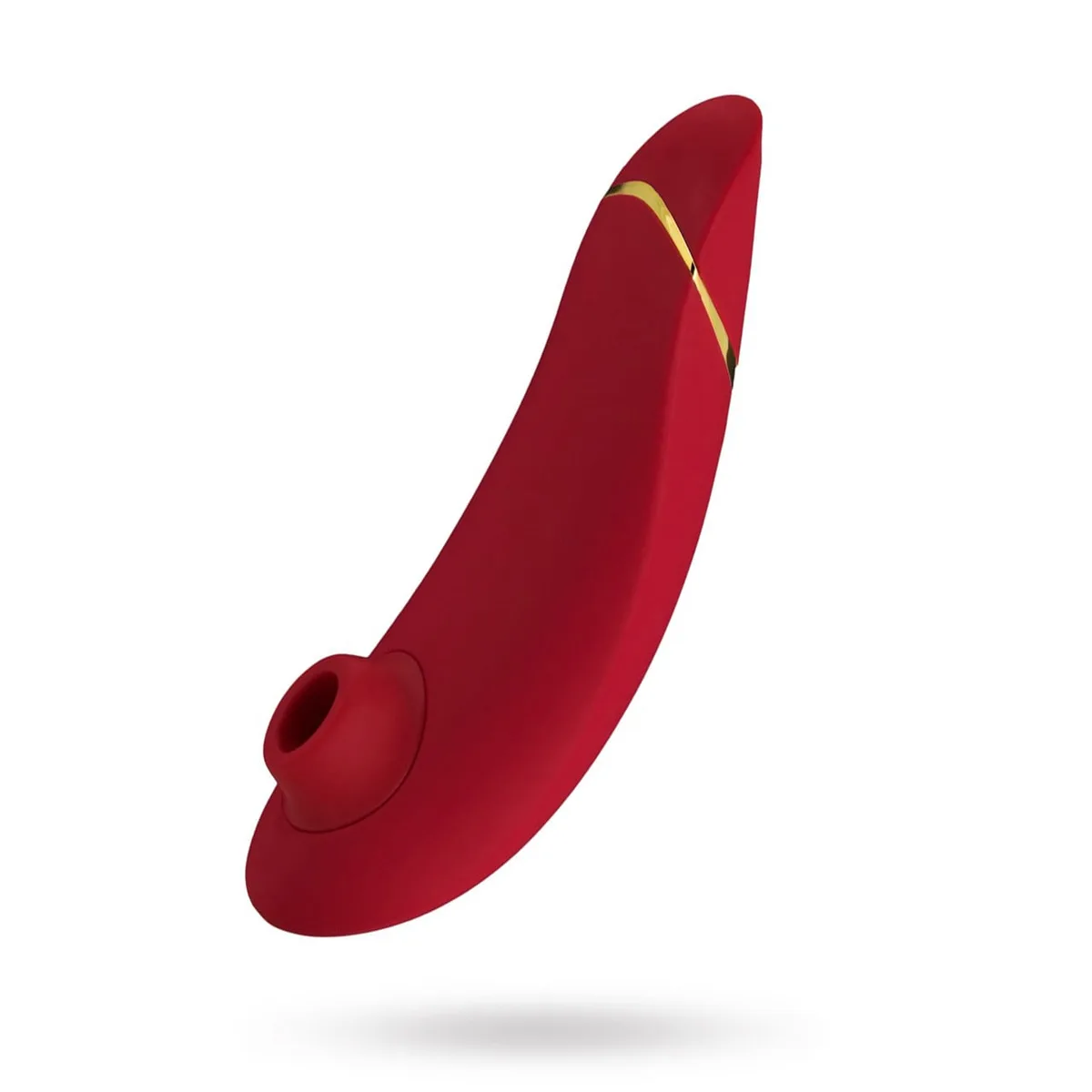
Review: Womanizer Premium 2 Red Gold
Same Pleasure Air technology, two top sizes, and a five-year warranty.
29 July 2026
Review · Clitoral stimulator · Air pressure technology
The air pressure stimulator that’s designed to sit between two bodies, reviewed against the manufacturer’s own specifications and pricing data from seven Swedish stores. Twelve intensity levels, 10 millimeters thick, IPX7 according to IEC 60529, up to two hours of runtime, and two years of warranty — at a price where there’s a 36 percent difference between the cheapest and the most expensive store.
The only air pressure stimulator in the class that’s ten millimeters thick, and thus the only one that truly solves couple play. Body-friendly silicone all over the body, twelve intensity levels, IPX7, and an app with long-distance control included at no extra cost. What you pay for in terms of missing specifications is a short warranty, short runtime, and a proprietary magnetic cable — and that the model is on its way out of the manufacturer’s range.
We-Vibe Melt is a clitoral stimulator that uses air-pressure technology instead of classic vibration, and it differs from almost everything else in the category in just one way: it is designed to fit between two bodies. The manufacturer states the dimensions 126 × 24 × 10 millimeters, body-friendly silicone, twelve intensity levels, IPX7 ingress protection rating, up to two hours of operating time, and a two-year warranty. In Swedish retail, the item is sold by seven stores for prices between 1,101 and 1,499 SEK.
It’s also a model that’s easy to confuse when you buy it online. Today, We-Vibe sells the follow-up Melt 2 in parallel, and the two names differ by just one digit even though the functions are not the same. This review is exclusively about the item with EAN 839289007154, which at We-Vibe has the item number SNELSG3 and is the pink variant of the original Melt. Check the EAN number before you add the product to your cart — it’s the only thing that reliably distinguishes the variants when the stores’ product names are almost identical.
One more thing worth knowing already here: at the check on 29 July 2026, the model was shown as sold out in We-Vibe’s own web shop, while the follow-up Melt 2 is sold there. In practice, that means Melt is at the end of its life cycle. For a buyer it’s both a risk and an opportunity — the risk is that stocks run out and the choice of color disappears; the opportunity is that Swedish stores price the remaining stock lower than the follow-up.
We-Vibe’s name for the technology is Pleasure Air. The manufacturer describes it as a patented technology that envelops the clitoris with pulsing waves and a soft suction, without touching it. Technically, it’s based on a diaphragm pump that creates alternating underpressure and overpressure in a small sealed chamber that is placed over the clitoris. The chamber never touches the clitoris directly — the stimulation happens through pressure changes in the air inside the head, and that’s why the manufacturer can call it touch-free clitoral stimulation.
The difference from a regular vibrator is principled rather than a difference in degree. A vibrator transfers mechanical motion from an unbalanced motor through the material to the skin. An air pressure product transfers pressure waves through air. That explains two things that show up in the descriptions of the entire product category: that the sensation is described as suction rather than vibrating, and that it feels more concentrated because the energy doesn’t spread throughout the entire product body.
Practically, that means that fit matters more here than with a vibrator. The chamber must seal tightly around the clitoris for a vacuum to be built up at all. We-Vibe Melt has a head of fixed size without replaceable tops. What can be established is that there’s no adjustment option: if the opening fits poorly, there’s nothing to screw on, unlike Womanizer Premium 2, which, according to the manufacturer, is delivered with two stimulation tops in different sizes.
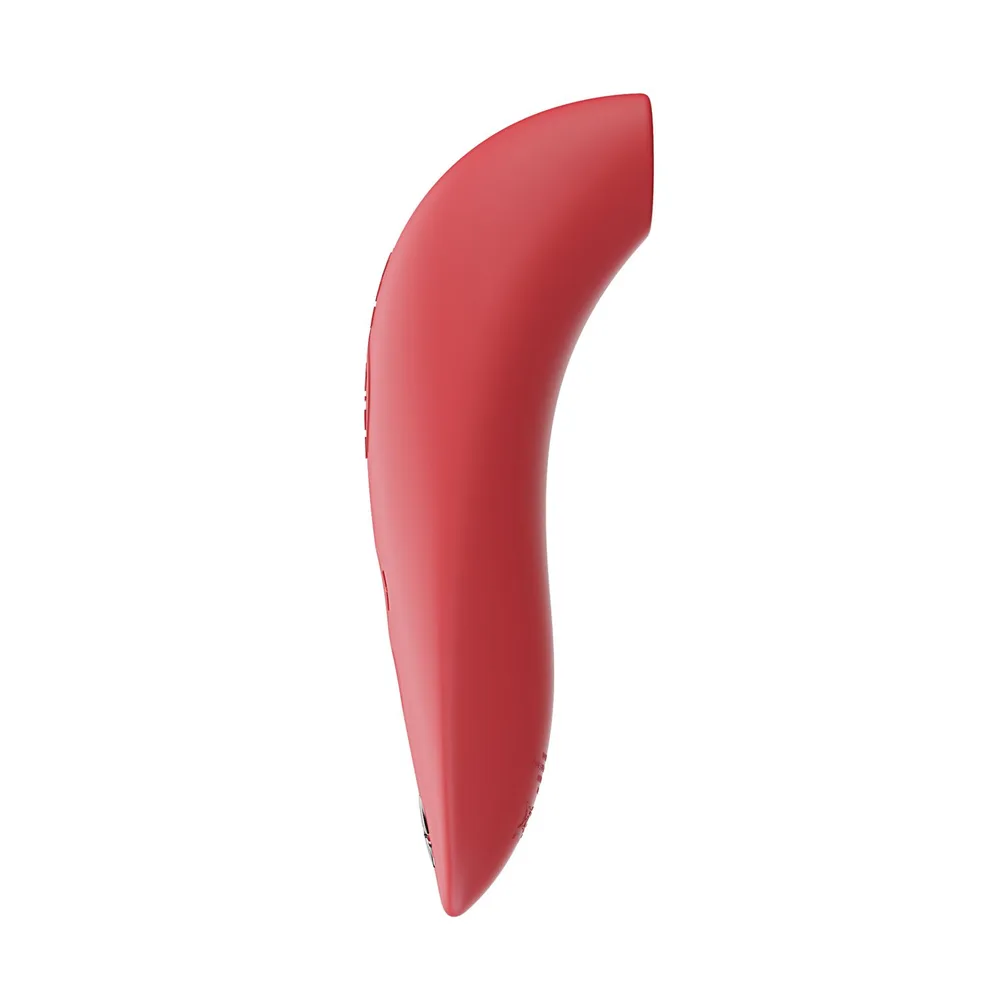
The dimensions are the single most interesting specification for this model. We-Vibe lists 126 millimeters in length, 24 millimeters in width, and 10 millimeters in thickness. Ten millimeters is unusually flat for an air pressure product—according to the manufacturer, the whole point of the design is that it should be able to slide in between partners during intercourse and provide clitoral stimulation at the same time.
Compared with Womanizer Premium 2, which comes from the same group and uses the same basic technology, the difference becomes clear: Premium 2 is listed as 155 × 50 × 35 millimeters. Melt is therefore both shorter, half as wide, and just under one third as thick. It’s the difference between a product that’s meant to be held in the hand against the body and a product that can stay still between two bodies.
The shape is asymmetrical and curved, with the gently curved back as the grip surface and the stimulation opening in the narrower end. The angle between the grip and the head is fixed, which means the angle to the body is controlled with the wrist. What can be established from the specification is that the product has no hinged or rotatable part at all.
The two models are sold in parallel at Swedish stores, often in the same search results, and the price difference between them is smaller than the price difference between stores for the same model. This is how they differ according to the manufacturer’s own specifications.
Note that the upgrade is not unambiguous. Melt offers more selectable steps, Melt 2 offers fewer but pattern-based modes plus a skin-contact sensor. The runtime is in practice the same—two hours versus 120 minutes is the same thing expressed in two ways. So who wins depends entirely on whether you want finely stepped manual control or automation.
The material is the only characteristic of an intimate product that neither experience nor care can compensate for, and it determines whether the product remains hygienic after three years. We-Vibe specifies a single material for Melt: body-friendly silicone, made without phthalates, without BPA, and without latex.
Having a material declaration that only includes silicone is a message in itself. Many products in the same price range combine silicone in the contact area with rigid ABS plastic in the shaft, which lowers manufacturing costs but gives a clearly different feel in the hand. For example, Satisfyer lists both silicone and ABS for Pro 2 Next Generation. We-Vibe states no other material for Melt than silicone.
For hygiene, it matters less than you might think—both medical-grade silicone and ABS are non-porous surfaces that can be cleaned. What differs is, on the one hand, the grip, and on the other, how the surface ages. Silicone retains its matte, slightly friction-rich surface significantly longer than mirror-polished plastic, which gets scratched and turns grayish. For a product intended to be clamped between two bodies, friction is also a function, not just a feel.
One limitation should be stated plainly: the silicone head on Melt is not removable. Models with a removable top can be cleaned more thoroughly inside the chamber, and they can be replaced if the surface is damaged. Here, the stimulation head is part of the product body. The manufacturer’s cleaning instructions solve the problem in a different way, which is covered further down.
Phthalates are a group of plasticizers used to make plastic—above all, soft PVC—flexible. Kemikalieinspektionen describes them as substances that can affect the endocrine system and make reproduction more difficult, and several of them are therefore restricted or banned within the EU in a large number of products. This particular product category is repeatedly subject to supervision because it contains soft plastic in contact with the skin.
Silicone does not require any phthalate plasticizers to be soft—the softness sits in the polymer itself. That We-Vibe explicitly states that Melt is made without phthalates, without BPA, and without latex is therefore not empty marketing talk, but a declaration that can be verified against the choice of materials. That is the whole reason why the material declaration is more important than the specifications list: a product that only states TPE or jelly rubber says nothing about which plasticizers are included, while silicone is unambiguous.
Latex-free is relevant for another reason as well. Latex allergy is common enough to be worth a line in a material declaration, and for someone who is sensitive, that information determines the purchase. We-Vibe states it explicitly.
The specification shows 126 millimeters in length, 24 millimeters in width, and 10 millimeters in thickness. That makes Melt a product that fits in a toiletry bag without taking up space, and unlike most in the category, it actually fits in an inner pocket.
We-Vibe, however, does not publish the weight. The specification table on the manufacturer’s product page lists colors, battery type, operating time, charging time, material, dimensions, and warranty—but no weight. Womanizer lists 141.4 grams for Premium 2 on a corresponding page, so the information exists under the group’s other brand. For Melt, it’s missing, and figures that circulate with retailers and price comparison services cannot be traced back to the manufacturer. Here we are, then, with nothing of value—and in that case, it’s better to say that than to guess.
What can be established anyway? That a product with the volume 126 × 24 × 10 millimeters in silicone with a small lithium polymer battery belongs in the lighter end of the category. But you can’t put an exact number on it without measurement, and the manufacturer has not published one.
We-Vibe lists twelve intensity levels for Melt. The control is done with two buttons on the product’s side: a plus button that also functions as the power-on button, and a minus button that also turns it off. That’s the entire interface on the product itself—everything else is in the app.
The user manual describes the sequence in three steps. Pressing the plus button starts the product. Further presses step up through the twelve intensities, and if you hold the button down, it goes directly to full intensity. To turn it off, you hold the minus button for two seconds.
Simplicity is a deliberate design point. There is no menu on the product, no way to get lost, and nothing to memorize by heart. Also, that the shutoff requires a two-second press instead of a normal press is logical, since the same button is used to lower the intensity—otherwise the product would shut off every time you stepped down to the bottom.
Twelve steps are more than most people use. The pattern in this product category is that the lowest steps are clearly spaced out, while the top steps are closer together, because the pressure difference per step decreases as the pump approaches its maximum output. The number of modes is therefore a poor buying criterion on its own. What determines it is the range between the weakest and strongest mode—not how many stops there are between them.
Melt is app-controlled via Bluetooth. The manufacturer describes that with the free We-Vibe app you can control and share the control of Melt remotely, access the full intensity register, and run the product together with other We-Vibe products. Switching is done by holding the plus button in for five seconds, after which the app takes over.
Range is the specification that is most often missing from product descriptions, but We-Vibe states it in the manual: up to 30 ft in line of sight—so just over nine meters—and about 20 ft—around six meters—when the range is measured in 360 degrees. It is stated under ideal conditions, and the manufacturer itself points out that the body between the transmitter and receiver affects it. Long-distance control over the internet requires that both parties have the app.
The radio part is also specified in the manufacturer’s EU declaration of conformity for model 12000-02: the operating frequency is 2402–2480 MHz and the maximum RF output power is stated as under 20 dBm. It is the standard 2.4 GHz band for Bluetooth and a low transmitter power—the same order of magnitude as a wireless keyboard. The declaration is issued by WOW Tech Europe GmbH in Berlin and declares the product against the Radio Equipment Directive 2014/53/EU and the RoHS Directive.
What’s worth highlighting is that the app is not a requirement. The product works independently with its two buttons and its twelve levels, and anyone who doesn’t want to connect an intimate product to an account and the cloud thereby loses remote control and the custom programs—but not the basic function. In a category where several competitors require an app to access the full power register, that is a genuine difference.
We-Vibe markets Melt as Whisper Quiet. What that means in measured decibels the manufacturer does not publish, either on the product page or in the manual.
It is worth saying plainly: there is no published dB value for We-Vibe Melt. Websites that list exact decibel levels for the model either report their own measurement or a value without a source. What can be established is that air-pressure products in the same class are consistently quieter than rotating eccentric motors, because the sound comes from a membrane pump rather than an unbalanced weight, and that We-Vibe has chosen to highlight quietness as a feature. The successor Melt 2 has also been given the feature Smart Silence, which, according to the manufacturer, makes the product start only when it makes contact with skin—which is an indirect acknowledgement that sound from a lying, switched-on product is a real problem in the category.
Practical advice that applies regardless of model: place the product on a soft surface between uses. A hard tabletop acts like a resonance box and noticeably amplifies the sound.
We-Vibe Melt is rated IPX7. The rating comes from the international standard IEC 60529, which defines enclosure classes for electrical equipment. The number 7 in the second position means that the product is tested for submersion in water to a depth of one meter for 30 minutes.
The difference from IPX6 is larger than what a step in the number suggests. IPX6 covers powerful water jets but not submersion. An IPX6 product can handle a shower but not a bathtub, and it should not be held under running water—use some common sense regarding buttons and the charging contact.
With IPX7, the entire product can be rinsed off without being careful, and it can come into the bath. That’s the single most important practical consequence of the rating. If a product has no IPX information at all, it should be treated as not waterproof—having no rating is never a sign that the product would be approved. Note at the same time that IPX7 applies to the product, not the charging cable: the user manual is explicit that Melt must not be charged near water.
We-Vibe describes a cleaning method that is specific to air-pressure products and that solves the problem that the stimulator head is not removable. Wash with soap and water, switch on the product and hold it under water while it is running, then shake out any excess water from the stimulator head and let the product air-dry before putting it away.
The point of running the product under water is that the membrane pump then flushes the chamber instead of letting water stay standing in it. It’s an instruction that more manufacturers should provide, and it’s only possible thanks to the IPX7 rating.
The manual’s prohibition list is just as important. Do not use a silicone-based lubricant—the manufacturer states plainly that it damages the product. Do not clean with agents that contain alcohol, gasoline, or acetone. Do not boil the product, do not put it in an oven or microwave oven, and do not put it in the dishwasher. Do not store it at extreme temperatures. The manual specifies We-Vibe’s own lubricant or a water-based lubricant, and a two-milliliter sample of We-Vibe’s lubricant is included in the package.
A detail that makes everyday life easier: a storage pouch in a silk-like weave is included. It is inexpensive for the manufacturer and rare in this category, and it matters—silicone attracts dust and lint, and a surface that constantly needs scrubbing wears out faster than one that only needs to be rinsed.
We-Vibe specifies a rechargeable lithium polymer battery, a runtime of up to two hours, and a charging time of 90 minutes. The manual confirms the charging time and describes the indicator light: a rapidly blinking light means the product is charging, a steady glow means it is fully charged, and a light that is off means there is no power or that the charging cable is not connected correctly.
The battery is 420 milliampere-hours and 3.7 volts. This information does not appear on the product page or in the manual—it is found in the manufacturer’s own certification documentation, in the test report that was produced for model 12000-02 for the FCC approval under FCC ID ZUE12000-02. There, the product’s power source is listed as DC 3.7 V from battery, 420 mAh. So this is the manufacturer’s own declared battery data, but it is published in the government documentation and not in the consumer materials, which is worth knowing if you compare specification lists with each other.
What does 420 mAh mean? That the cell is small even by category standards, and that the up to two-hour runtime is based on a membrane pump drawing a little power as long as the intensity is kept down. Compare that with the relationship between the figures We-Vibe publishes openly: 90 minutes of charging gives up to 120 minutes of operation. So the product charges for a shorter time than it runs, which is a better ratio than in much of the category.
According to the manual, the battery is not interchangeable, and it must be removed from the product before it is discarded. What generally applies to lithium batteries therefore also applies here: capacity decreases with the number of charge cycles, the cell cannot be replaced once it has been used up, and the product is best off not being stored completely discharged for longer periods. With use a couple of times per week, it is the battery—not the silicone—that sets the limit for its service life.
Melt is charged with a magnetic USB cable that attaches to two contact surfaces on the underside of the product. The cable is included in the package and has a standard USB connector on the other end, so it works with any USB port or power adapter. A power adapter is not included.
The construction is necessary for IPX7 — an open contact in the product body is more difficult to seal than a pair of contact surfaces. But it comes with a price. If you drop the cable, no ordinary cable will work, and you have to order a replacement from the manufacturer. It’s the same disadvantage that Lelo has with its magnetic solution, and it’s the most obvious practical difference versus cheaper competitors: Satisfyer Pro 2 Next Generation is charged with standard USB-C, where the same cable as for your phone is enough.
For a product that’s meant to come along on a trip, this isn’t a small thing. Count the charging cable as part of the product and pack it in the storage pouch together with Melt, not in the box with all the other cables.
Melt goes into standby after a period of inactivity, and that mode can be set. According to the manufacturer, you can keep the product in standby for up to four hours before it shuts off completely via advanced settings in the We-Vibe app. The setting is accessed under the device settings in the app after the product has been paired.
The feature sounds trivial, but it solves a real problem for a product that’s intended to be used together with someone else: a product that turns itself off and loses the Bluetooth connection in the middle of a session is harder to restart than just pressing a button. So having the limit at four hours instead of a few minutes is a deliberate choice, and at the same time it’s the only setting in the entire product that requires the app to be changed.
We do not have price data from shops in your market yet.
Ten millimeters are the product’s raison d’être — none of the larger competitors comes anywhere close.
Three comparisons are relevant: versus the successor in the same series, versus the group’s sibling model that does the same thing but bigger and more expensive, and versus the budget alternative that does the same thing for one fifth of the price. All the information below comes from the respective manufacturer’s own specifications, and the prices are from the stores’ product listings on July 29, 2026.
Melt 2 costs from 1,271 SEK at nine stores, i.e. 170 SEK more than Melt at its lowest price. The functional difference is less clear-cut than the price difference suggests. Melt 2 specifies six suction patterns, while Melt specifies twelve intensity levels. Melt 2 has Smart Silence, which means the product starts only upon skin contact. The operating time is the same — We-Vibe states up to 120 minutes for Melt 2 and up to two hours for Melt. Charging time is also the same, up to 90 minutes, and the warranty is two years for both.
So the upgrade is about control philosophy, not endurance. If you want preprogrammed patterns and a sensor that keeps the product quiet until it’s pressed against the skin, Melt 2 is worth the extra 170 SEK. If you’d rather step manually between twelve levels, Melt isn’t a worse product—it’s a different one. The fact that the older model is also on its way out of the manufacturer’s range is an argument for Melt 2 if you’re planning to own the product for a long time and want to be able to get accessories for it.
Womanizer Premium 2 comes from the same group and uses the same Pleasure Air core technology. It costs from 1 164 SEK at eight stores—that’s only 63 SEK more than Melt. On the specifications level, it’s superior on almost every measurable point: 14 intensity levels versus twelve, 240 minutes of runtime versus 120, a five-year warranty versus two, an autopilot mode that varies intensity automatically, Smart Silence, and—most importantly—two stimulation tips in different sizes. Both are IPX7.
What Womanizer can’t do is lie between two bodies. Premium 2 measures 155 × 50 × 35 millimeters and weighs 141.4 grams, versus Melt’s 126 × 24 × 10 millimeters. It’s not a marginal difference in form—it’s two different usage situations. If you know you want the product in your hand, in front of you, Premium 2 is the rational buy for almost the same money. If you want something that fits where nothing else can fit, there’s hardly any competitor at all.
Satisfyer Pro 2 Next Generation makes the same basic offer for 219 SEK as the cheapest one. It has eleven pressure-wave intensity settings versus Melt’s twelve, it’s IPX7 just like Melt, and it has a 15-year manufacturer warranty versus Melt’s two—the longest warranty period in the entire category. It also charges with regular USB-C instead of a proprietary magnetic cable.
So what about the extra 882 SEK in the middle? Silicone over the whole body instead of silicone in the head and ABS plastic in the shaft. App control with remote control and a long-distance function that the Satisfyer model completely lacks. And above all, the form factor: 10 millimeters thick versus a product that’s built like a handle. If you’re unsure whether air-pressure technology will work for you at all, Satisfyer is a hard-to-beat way to find out cheaply. If you already know it does, and it’s couples use you’re after, it doesn’t solve the same task.
Seven Swedish stores sell the item with EAN 839289007154. Cheapest is 1 101 SEK, most expensive is 1 499 SEK. That’s a difference of 398 SEK, or 36 percent, for the same article number and the same packaging.
The price spread isn’t because any store sells a different variant—the article number is checked with all of them. Instead, it comes down to how the stores price a model that’s being phased out. It also shows in stock status: four of the seven stores had the product in stock at the price check, and three didn’t. The three that were out of stock are also three of the four most expensive, which is a common pattern when stock is about to run out—prices for the last units no longer follow the market.
Practically, that means two things. First, it’s extra important to compare the price of this particular model, because the difference between the stores corresponds to a third of the product’s value. Second, stock status is at least as important as the price—a store that lists the product cheaply but doesn’t have it in stock won’t help you. The prices in the table above are updated when the stores’ product flows are updated, but always check the final price in the checkout. Shipping costs are added at most stores for orders below a certain order value.
It’s for you if you want air-pressure technology in a form factor that you can actually use together with something else. A thickness of ten millimeters is the model’s entire reason for existing, and none of the bigger competitors come close. It’s also for you if you want app control and long-distance functionality without paying extra for it—you want to be able to rinse off the entire product under running water; and you want silicone against the skin without hard plastic in the grip.
It’s not for you if you know you need a different head size than the standard one—there, Womanizer Premium 2 with its two tips is the right way to go, and at almost the same price. It’s not for you either if you prioritize battery life, because Premium 2 specifies a battery life that’s twice as long, or if you want the longest possible warranty. And it’s not for you if you absolutely want to be able to charge it with the same cable as your phone—the magnetic cable is proprietary, and there’s no way around that.
One final consideration that’s not about the product but about timing: the model is being phased out. If it’s essential for you to be able to buy a replacement cable or a new device in the same color in two years, that tips the balance in Melt 2’s favor.
We-Vibe offers a two-year warranty on Melt. The model is listed by name on the manufacturer’s warranty page, in the list of products covered by the two-year warranty. The warranty covers manufacturing defects—not normal wear and tear, not damage caused by improper use, loss, or careless handling—and a receipt is required when making a claim. We-Vibe notes that the warranty period may be longer where the law requires it.
Two years is short in this category. Womanizer, which is part of the same group, provides five years on Premium 2, and Satisfyer provides 15 years on Pro 2 Next Generation. That is a real difference, and it’s worth taking into account when the price difference to one of the competitors is 63 SEK.
The warranty, however, is a voluntary commitment from the manufacturer and does not replace your statutory rights. Under konsumentköplagen (the Swedish Sale of Goods Act), you have a three-year right to complain about defects in the goods, regardless of what the manufacturer promises. In addition, when purchasing at a distance, you have a right to withdraw within fourteen days under the lagen om distansavtal och avtal utanför affärslokaler (the Act on Distance Contracts and Contracts Outside Business Premises).
Note that in practice the right of withdrawal is limited for hygiene products that have been removed from their sealed packaging. The right to complain about defects applies, however, always. If you have questions about what applies in your case, Konsumentverket provides guidance via Hallå konsument.
We-Vibe Melt is ranked på plats 10 av 32 in clitoral stimulator best i test, where the entire category is compared against each other using five shared criteria. Guiden vinns av Womanizer Premium 2 Red Gold.
Every numerical piece of information in the text can be traced to one of the sources below. The links were checked manually on the specified date.
This page is machine-translated from Swedish. Read the Swedish original