

Review
Review: Satisfyer Pro 2 Next Generation
Cheapest of the broadly sold — 219 SEK and 15 years of warranty.
29 July 2026
 Author's pick
Review · G-spot vibrator · App-controlled
We-Vibe’s flexible G-spot vibrator reviewed against the manufacturer’s own specifications and price data from six Swedish stores. Two motors that are controlled independently, body-friendly silicone over the entire housing, IPX7 according to IEC 60529, 120 minutes of runtime, and 90 minutes of charging time — but a specification where neither weight, battery capacity, sound level, nor the number of modes is published by the manufacturer.
The G-spot vibrator in the comparison that gives the most control: two motors that are set independently of each other and switched with a button, all-silicone over the entire housing, and a bendable housing that can be angled to match the body. IPX7 means the entire product can be rinsed off, and the 90-minute charging time is in the faster half of the category. What you pay for is a base with holes—in addition, weight, battery capacity, noise level, or the number of vibration modes are not published by the manufacturer, and the dimension field on the product page does not refer to the product.
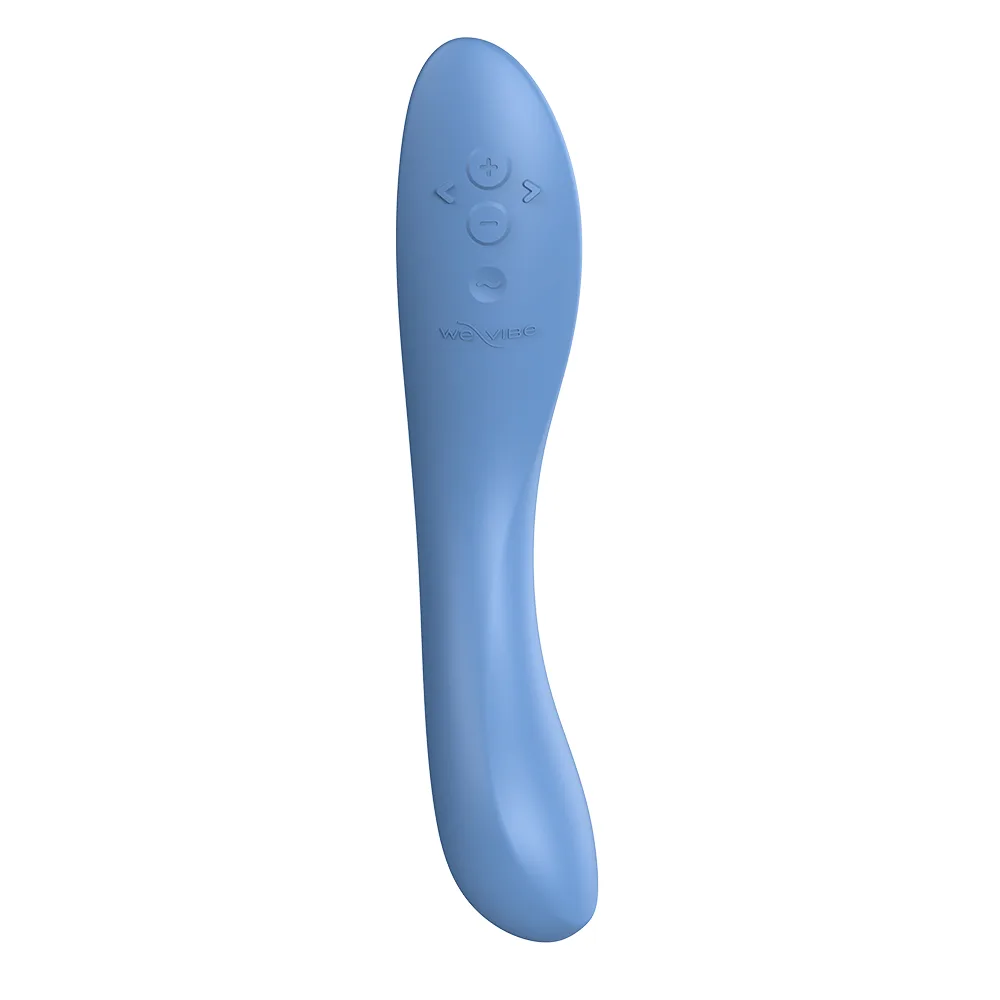
We-Vibe Rave 2 is a G-spot vibrator with two separate motors, a flexible body, and app control. The manufacturer is WOW Tech Europe GmbH in Berlin, which is also behind Womanizer, and the model is in the same price range as the brand’s other app-controlled products without being one of the ones that are marketed as a couples vibrator. So it’s primarily a solo product that can be passed on to someone else — literally, via the app.
The manufacturer’s specification looks like this: body-friendly silicone without phthalates, BPA, or latex, protection class IPX7, 120 minutes of operating time, 90 minutes of charging time, USB charging via magnetic pins, and a two-year warranty. The product model number is RAV20B. In Sweden, the item is sold by six stores at prices between 1,079 and 1,599 SEK, and five of them had it in stock at the price check on July 29, 2026.
This review is exclusively about the blue variant with EAN 4251460620048, the manufacturer’s item number SNRA2SG5. We-Vibe sells Rave 2 in two colors — Pink and Blue — and the pink one has its own EAN, 4251460620031. Functionally, they are identical, but several Swedish stores list both colors on the same product page with a shared price, so check the number before you compare.
What makes Rave 2 interesting to review is not the marketing, but how inconsistent the underlying information is. The manufacturer publishes operating time, charging time, materials, protection class, and warranty — but not the product’s actual length, its weight, the battery’s capacity in mAh, or how many vibration modes it has. The stores fill in the gaps, and they do it with numbers that don’t always add up. The two types of information are separated all the way below.
Rave 2 has one motor in the insertable part, oriented toward the G-spot area, and a second motor farther up toward the slider opening. The key point is not that there are two motors — many vibrators have that — but that they can be controlled independently of each other directly on the product. The manufacturer’s manual describes how: pressing the We-Vibe button activates the motor at the slider opening, two presses activate the motor at the G-spot area, and three presses run both with the intensities you already set for each.
In practice, this means you don’t need to choose between deep and shallow stimulation. You can set a low intensity on the inner motor and a high one on the outer motor—or vice versa—and then switch between three combinations with a button. On a vibrator with a single motor, the equivalent operation is impossible: the entire product then follows the same level.
The second design choice is the adjustable fit. The housing is bendable—the manufacturer calls the function adjustable fit, and the manual explicitly urges you to gently bend and shape the product to avoid damage. So the angle between the grip and the insertion part is therefore not fixed, which is unusual in this category. Combined with the twisted shape, the idea is that contact with the G-area should be constant instead of needing to be maintained with hand force. The downside is just as obvious: a bendable construction has more internal stresses than a rigid housing, and the manual’s wording about bending gently is a warning worth reading as a warning.
We-Vibe’s range is large, and the names don’t always say what the products do. Three models are most often mixed up in Swedish stores.
So the difference between Rave 2 and Nova 2 isn’t performance, but where the stimulation ends up. If you want simultaneous clitoral stimulation without having to hold anything, Nova 2 is the way to go. If you want a product that directs all the effect toward the G-area and the vaginal opening—and that can be angled—then it’s Rave 2.
Material is the only feature of an intimate product that can’t be compensated for with experience or care, and it determines whether the product is still hygienic after five years. We-Vibe lists a single material for Rave 2: body-friendly silicone, made without phthalates, BPA, or latex. That applies to the entire outer casing, not just the insertion part—and it’s a real difference compared with models where only the penetrative part is silicone and the grip is hard ABS plastic.
Silicone is a pore-free material. A pore-free surface can be cleaned, because there are no microscopic voids where residue can get trapped. It is the single most important property of a material that is meant to lie against mucous membranes, and that is why the material declaration carries more weight than almost every other line in a specification.
Having the entire body covered in silicone has two consequences here. The first is tactile: the surface is soft to the touch rather than slippery plastic, which provides better grip when your hands are wet or have lubricant on them—relevant for a product that is explicitly meant to be twisted during use. The second is hygienic: there is no seam between a silicone part and a plastic handle where dirt can collect. Rave 2 has no removable parts at all, which in this case is an advantage rather than a shortcoming, because there is also no gap to clean.
The buttons are molded directly into the silicone itself as raised symbols rather than sitting as separate plastic buttons in a recess. The manufacturer’s own product images show a plus, minus, left arrow, right arrow, and a rounded We-Vibe symbol—all embossed into the surface. It’s a design that both contributes to the enclosure and makes it possible to feel your way to the buttons without looking.
Phthalates are a group of plasticizers used to make plastic—above all, flexible PVC—pliable. The Swedish Chemicals Agency (Kemikalieinspektionen) describes them as substances that can affect the endocrine system and make reproduction more difficult, and several of them are therefore restricted or banned within the EU in a large number of products. This product category is also a recurring subject of oversight because it contains flexible plastic that comes into contact with skin and mucous membranes.
We-Vibe explicitly states that the material in Rave 2 is manufactured without phthalates, BPA, or latex. It’s an unambiguous declaration, unlike labels such as “TPE” or “jelly rubber,” which say nothing at all about which plasticizers are included. Silicone doesn’t require phthalate plasticizers to be soft—the softness comes from the polymer’s own structure—and that’s why silicone as a material specification, by itself, is better information than almost any other entry in a product specification. The retailer Joyland repeats the information in its own table, where the row labeled phthalate-free is filled in with yes.
The latex information is relevant for anyone who is allergic to latex. A latex allergy causes reactions on mucous membranes faster than on regular skin, and an insertion product is precisely the type of use where this information matters. For the manufacturer to spell it out is a plus, because the absence of a latex declaration among competitors rarely means that latex is included—only that no one has bothered to answer the question.
It gets messy here, and it’s worth going through it carefully because the length is the key piece of information that determines whether an insertion product even fits.
The manufacturer’s measurement field states 250 × 110 × 750 millimeters. That number can’t refer to the product. A vibrator that is 75 centimeters long does not exist in this category, and the first two digits—250 and 110 millimeters—match almost exactly the retailer Mshop’s information about the packaging dimensions, 25.50 × 11.00 × 7.00 centimeters. So the reasonable conclusion is that We-Vibe’s field contains the outer dimensions of the packaging with one extra zero in the third number, and that the product’s own dimensions are not published at all on the product page.
The best-supported information available does not come from the manufacturer’s product page, but from a dimension sketch in Mshop’s product gallery. It shows the product in two views and marks 193 millimeters in total length and 31 millimeters in thickness. The same store also lists 19 centimeters and 3 centimeters in its own specs table—so exactly the same numbers rounded—which suggests that the table is read from the sketch and not guessed.
The other stores say something else. Joyland lists total length as 20.2 centimeters, penetrating length as 15 centimeters, and diameter as 3.9 centimeters. Vuxenkul lists length as 20 centimeters and penetration depth as 15 centimeters. So the difference compared with the sketch’s 193 millimeters is between 7 and 9 millimeters in total length and almost one centimeter in thickness.
What should you believe? What can be established is that the manufacturer does not publish any useful product measurement; that the two store details that are most likely derived from the same source point to about 193 millimeters total and at most a little over 30 millimeters; and that the two stores that state 20 centimeters also state 15 centimeters as insertion length—a figure that no other source contradicts. Practically, that means: count on roughly 19–20 centimeters total, of which about 15 centimeters can be inserted, and a thickness of around three to four centimeters at the widest point. If you want a more exact number, you can’t get it from the manufacturer.
We-Vibe does not publish any weight for Rave 2, either on the product page or in the online manual. Two stores do, and they contradict each other. Retailer Vuxen lists 518 grams. Retailer Mshop lists 0.46 kilograms, i.e., 460 grams.
Both numbers are too high to refer to the product on its own. A silicone vibrator of just under 20 centimeters normally weighs a little under 300 grams—Lelo, for example, lists 87 grams for its Gigi 3, which is smaller but made of the same kind of material. What suggests that the Swedish figures are shipping weights is that Mshops 460 grams appears in the same table block as the package’s external dimensions. The difference between 460 and 518 grams is then likely explained by the fact that the stores count packaging differently.
The conclusion is simple but not satisfying: the product’s own weight is not published by any source that can be checked. Treat 460 and 518 grams as shipping weights, not something you’re going to be holding in your hand. It matters less for a product that you move with your wrist than for, for example, a wand massager, but it’s still a gap in the evidence that the manufacturer could easily fill.
The interface on the We-Vibe Rave 2 consists of five buttons, all embossed into the silicone surface on the top of the grip. The manufacturer’s online manual names them: plus for start and higher intensity, minus for reduced intensity and power off, right arrow for the next vibration pattern, left arrow for the previous one, and at the very bottom a We-Vibe button that switches between the motors. Under the buttons sits the brand’s logo—also embossed into the material.
According to the manual, you start the product by pressing plus and increase the intensity with more presses of the same button. The minus button lowers the intensity step by step, and a long press turns it off. The arrow buttons step back and forth between vibration patterns. It’s a classic setup where intensity and pattern are on separate controls, unlike cheaper products where a single button cycles through everything in one long list.
The We-Vibe button is the one that requires you to learn something. It doesn’t switch programs but the receiver: one press sends the vibration to the motor when the slider is open, two presses send it to the motor in the G-area, and three presses send it to both at the same time with the intensities you’ve already selected for each. It sounds complicated when described in text, and in practice it’s three presses on the same button, but that’s what explains why the Rave 2 has more buttons than most G-spot vibrators in this price range.
The consequence is worth saying plainly: the more controls, the longer it takes to find the right one, and for someone who wants a button and a feel, five buttons are a disadvantage rather than a feature. The Rave 2 rewards the person who can be bothered to learn the combinations and punishes the person who doesn’t.
This is the question where the sources differ the most, and the answer therefore needs to be broken down.
We-Vibe does not specify any number of vibration modes for Rave 2, either on the product page or in the online manual. The manual only states that the arrow buttons scroll between patterns, without counting them.
But the stores do. Lustly, Vuxen, and Joyland all state ten vibration modes. Joyland also specifies the row as “10 different steps, Multifunction” and adds a separate row about ten different speeds. Mshop and Vuxenkul instead write “10+ vibration modes,” a formulation that means everything and nothing.
The most enlightening information is in a functional graphic in Mshop’s product gallery. It states “2x Vibration Modes” and “10x Intensity Levels” as two separate rows. If you read that graphic together with the manual, the pieces fall into place: what is listed as ten is intensity levels, not programs, and the number ten in the store texts is most likely the intensity scale that was labeled “vibration modes” along the way through product listings. How many patterns the arrow buttons actually scroll between cannot be determined from any verifiable source.
In practice, it matters less than you might think. Ten intensity steps per motor, two motors, and three motor combinations provide more settings than anyone uses, and the app adds its own patterns on top of that. But it’s worth knowing that the number ten in the store texts is not supported by the manufacturer, and that a comparison based on the number of programs is misleading for this model in particular.
Rave 2 is paired via Bluetooth to the We-Vibe app. The manual provides the exact steps: hold the We-Vibe button pressed for five seconds; the product then vibrates twice and the LED starts blinking. When the pairing is complete, it vibrates three times and the diode stops blinking. For long-distance use, both parties need the app, and the product is then paired to the phone that is within Bluetooth range.
It’s worth clearing up a name issue, because it creates confusion in the store texts. Several Swedish stores state that the product is controlled via We-Connect. The manufacturer now calls the app We-Vibe App on its own product page. It’s the same app under a new name, not two different programs, but if you search for We-Connect in your phone’s app store, you could end up with the wrong one.
The radio part is, however, well documented, for once. The manual’s electrical data states that the product operates at 433.32 MHz and in the 2402–2480 MHz band with a maximum output power of under 3.5 dBm, and that it is approved in accordance with the Radio Equipment Directive 2014/53/EU as well as the RoHS Directive 2011/65/EC. The FCC ID is ZUE1000I and the IC number is 9804A-1000I. We-Vibe does not publish any range in meters for the Bluetooth connection, which is normal in this category but still worth noting: it means that range information circulating in store texts lacks documentation from the manufacturer.
Rave 2 has a lock, and the manual describes it clearly. Hold the plus and minus buttons pressed in at the same time for two seconds, and the product pulses twice and locks itself. The same button combination unlocks it again, and it’s also unlocked by being connected to the charging cable.
It’s a small feature with a big practical significance. A vibrator without a lock can start on its own in a bag when something presses against a button, and that’s both embarrassing and an unnecessary way to drain the battery. That the locking is documented with an exact button combination in the manufacturer’s manual also makes it searchable when you’ve forgotten how it works — which you will.
Several Swedish stores describe Rave 2 as whisper-quiet, and the manufacturer’s own text on the product page talks about quiet motors. The question is what that means in numbers, and there the answer has to be honest: We-Vibe publishes no measured decibel value for Rave 2, either on the product page or in the online manual. There is also no comparison chart that places the product on a sound scale, like the Womanizer brand uses for its models.
For comparison, Lelo states that Gigi 3 stays under 60 dB. It’s a published maximum value, with the manufacturer as the stated source, and it says something about how few figures there are to compare in this category even when a number is actually published — 60 dB is a limit, not a measurement at a defined intensity and a defined distance.
What can, however, be established generally is that a vibrator with two smaller motors embedded in a massive silicone housing tends to sound quieter than a single large eccentric motor in a hard plastic casing, because the silicone dampens and because the power is distributed. But it’s a principle, not a value, and websites that provide an exact decibel number for Rave 2 either show their own measurement or a number without a source.
A practical piece of advice that applies regardless of model: place the product on a soft surface between uses. A hard tabletop works as a resonance box and noticeably amplifies the sound.
We-Vibe Rave 2 is rated IPX7. The rating comes from the international standard IEC 60529, which defines enclosure classes for electrical equipment. The number 7 in the second position means that the product is tested for submersion in water to a depth of one meter for 30 minutes. The manufacturer formulates the consequence as that the product can be used in a bath and in the shower, and the care section in the manual says that it should be rinsed in warm water and dried with a lint-free cloth.
Here there is a direct contradiction between the sources worth highlighting. The retailer Mshop states in its specs table that water resistance is “Splash-resistant”. The manufacturer states IPX7. It’s not the same thing, and the difference isn’t academic.
Splash protection covers water droplets and, at best, water jets, but not submersion. A splash-resistant product can handle a damp cloth and possibly a shower, but not a bathtub, and it should not be held under running water—without careful consideration of the buttons and the charging contact. With IPX7, the entire product can be rinsed off without caution. The manufacturer’s statement weighs heaviest, and Vuxen also writes IPX7 directly in its own bullet list — but if you read Mshop’s table and conclude that the product can’t handle baths, then it’s the table that’s wrong, not you.
A side note on the same topic: We-Vibe’s own function text on the product page, in one place in running text, says “IPX77”, while the headline above the same section says IPX7. There is no enclosure-class system with two sevens in IEC 60529. It’s a typo by the manufacturer, not a higher class.
If a product lacks an IPX rating altogether, it should be treated as not waterproof. The absence of a rating is never a sign that the product would be approved.
The manual’s guidance is brief: rinse Rave 2 in warm water and dry with a lint-free cloth, and feel free to use a cleaning product intended for intimate products. Since the product has no removable parts, there are no cavities to access—the entire surface is accessible, and that’s the big hygienic advantage of a one-piece design.
We-Vibe’s own instructions are clear on the lubricant issue: use a water-based lubricant, and do not use perfumed or alcohol-based lubricants, gels, or massage oils. Silicon-based lubricants should not be used on silicone products—it breaks down the silicone surface over time and makes it porous, and a porous surface can no longer be cleaned properly; it can only be replaced. Oil-based products like coconut oil leave a film that is difficult to remove. Joyland gives the same recommendation in its own table.
The manual also covers three things that rarely appear in store texts. The product and its battery must not be exposed to temperatures above 45 degrees—so boiling water and a dishwasher are out of the question despite IPX7. The product contains magnets, which means it should not be used directly over a pacemaker, and that credit cards with a magnetic stripe should be kept away from it. And Rave 2 is expressly not designed for anal use; the manual states this in all caps. In addition, it includes the general instruction not to use the product if you notice cracks or signs of deterioration in the surface material, and to store it dry and without direct sunlight.
We-Vibe lists the runtime as 120 minutes and the charging time as 90 minutes. The manual repeats both in plain text: up to two hours of use per charge, and after 90 minutes the product is ready again. Two hours of runtime is average for the category—Lelo states up to two hours for the Gigi 3 and We-Vibe states the same 120 minutes for the Nova 2—but the 90-minute charging time is in the faster half, since Lelo states up to two hours for its model.
Charging happens via magnetic charging pins on the side of the product, where the included USB cable attaches magnetically. The manual is explicit on a point that’s easy to miss: only the included original cable may be used. The manual also states that no USB power adapter is included, but that you should use an adapter whose output power matches the product’s rating.
Magnetic charging is a trade-off, not a pure advantage. The advantage is that there’s no need for an opening in the casing, making it easier to achieve IPX7 without a rubber plug—and on a product that’s meant to withstand submersion, it’s a structurally good solution. The downside is that the cable is product-specific: if you lose the charging cable, no regular USB-C cable works, and you have to get a replacement from the manufacturer. On top of that, We-Vibe’s warranty terms expressly exclude charging cables as consumables, so a broken cable is always your own cost.
The manual also covers two charging rules that are worth following. The product must not be used or cleaned while the battery is charging, and the charging cable should be unplugged from the outlet after each charge. The charger and cable must never be submerged in water—IPX7 applies to the product, not the accessories.
We-Vibe does not publish battery capacity in mAh for Rave 2. The product page only states “USB rechargeable lithium-ion battery.” The manual goes one step further than most and lists the electrical rating data required by the regulations: built-in lithium-ion battery at 3.7 volts and 0.6 amperes, and a charge of 5 volts and 0.5 amperes via USB.
It’s more than what most manufacturers print, but it doesn’t replace capacity. With voltage and current but without mAh, you can’t convert the operating time into power consumption, and you can’t compare how heavily the cell is loaded between models. For comparison, Lelo lists 420 mAh and 3.7 volts for Gigi 3, which together with the same operating time of up to two hours provides a directly comparable picture that Rave 2 lacks.
What generally applies to lithium-ion batteries also applies here: capacity decreases with the number of charge cycles. The manual explicitly states that the battery is not replaceable and that you should not try to remove it yourself, and it recommends that the product be charged regularly even when it isn’t used so that the battery lasts longer. With use a couple of times per week, it’s the battery, not the silicone, that sets the limit for the product’s lifespan—and since the cell is permanently built in, the product is, in practice, used up when the battery is. The product therefore also includes a longer section stating that used batteries and electronics should be left for recycling and not thrown into household waste.
We do not have price data from shops in your market yet.
The manufacturer’s dimensions field states 250 × 110 × 750 millimeters. A vibrator that is 75 centimeters long doesn’t exist—the number is for the packaging, with one too many zeros.
Two comparisons are the most relevant: against We-Vibe’s own rabbit model in the same price range and against the other big premium brand in the category. All information below comes from the respective manufacturer’s own specifications.
Nova 2 is the model within We-Vibe’s own range that is closest to Rave 2 in price and technology, and it is therefore the first comparison to make. Technically, they are almost identical: both list body-friendly silicone without phthalates, BPA, or latex, both list IPX7, both list 120 minutes of operating time and 90 minutes of charging time, both are USB rechargeable, and both come with a two-year warranty.
The difference lies in the shape. Nova 2 measures 217 × 85 × 39 millimeters and has an external flexible arm that sits against the clitoris while the insertion part works inside. Rave 2 has no external arm at all—its other motor is positioned higher up on the same shaft and targets the vaginal opening, not the clitoris.
It largely settles the choice. If you want simultaneous clitoral stimulation without having to hold anything extra, Nova 2 is the only one of the two that does it. If you want a product that is narrower, that can be angle-adjusted by hand, and that puts all the effect on the G-area and the vaginal opening, Rave 2 is the one built for that. Nova 2 is also measurably wider—85 millimeters versus Rave 2’s approximately 31 millimeters according to the measurement diagram—because the arm is included.
Lelo Gigi 3 is the classic G-spot vibrator with a flat, spoon-shaped top, and it’s interesting here not just as a product, but as a contrast in how much the manufacturer publishes.
Gigi 3 measures 163 × 35 × 42 millimeters and weighs 87 grams. The material is listed as body-friendly silicone and ABS plastic—so not fully silicone like Rave 2. The battery is a lithium-ion battery of 420 mAh and 3.7 volts; the charging time is listed as up to two hours at 5 volts and 420 milliamps, the operating time as up to two hours, and the sound level as under 60 dB. Lelo states eight built-in modes plus two that are accessed via the app, and provides a two-year warranty with a ten-year quality guarantee in addition.
The differences that actually matter: Rave 2 has full silicone throughout the entire housing, two separately controllable motors, a flexible housing, and a 90-minute charging time versus Gigi’s two hours. Gigi 3, on the other hand, has published weight, published battery capacity, published sound level, a published number of modes, and a ten-year quality guarantee. If you choose based on disclosed data, Lelo wins without further ado. If you choose based on materials, dual motors, and an adjustable angle, Rave 2 wins. The fact that a product that costs from 1,079 SEK does not publish its own weight is a weakness in the basis—not in the product—but it’s still a weakness.
Six Swedish stores sell the item with EAN 4251460620048. The cheapest is Lustly at 1,079 SEK, and the most expensive is Vuxenkul at 1,599 SEK. That’s 520 SEK or a 48 percent difference for the exact same item number, the same color, and the same packaging.
The stock situation is unusually good in this case. Five of the six stores had the product in stock at the price check on July 29, 2026: Lustly at 1,079 SEK, Joyland at 1,186 SEK, Vuxen and Mshop at 1,199 SEK each, and Vuxenkul at 1,599 SEK. Only Sexonic, at 1,245 SEK, was missing stock. That means the cheapest store is actually the cheapest available—which isn’t always the case.
The price spread is not due to any store selling a different variant. We checked the EAN number with the shops: Mshop, Vuxenkul, and Sexonic all print 4251460620048 in their own product data. Vuxens page includes both 4251460620048 and the pink variant’s 4251460620031 because the shop lists both colors, and Lustlys variant number points to the blue one. So this is about the shops’ own margin setting for a model that has been on the market since 2023 — the manual’s publication date is 01/2023 — but which has not yet become a price-pressured volume product.
One caveat that applies to all price comparisons in this category: shops that list a product as sold out may keep an old price in the feed, and that price is rarely what you actually pay when the item comes back in. Always check the final price at checkout. Shipping costs are charged by most shops under a certain order value, and in this price range several shops are above the free-shipping threshold — which can even out parts of the difference between the cheapest options.
It’s for you if you know that G-spot stimulation works for you, and you want two motors to control independently rather than a single level for the entire product. It’s for you if you want silicone all over the body instead of silicone on the tip and plastic in the grip, if you want to be able to angle the product after your body instead of adapting to a fixed bend, and if you want to be able to rinse the entire product off under running water. App control also makes it a reasonable choice if long-distance use is part of how it’s used—that’s the feature the manufacturer has built the entire product family around.
It’s not for you if you want simultaneous clitoral stimulation—Nova 2 is the model within the same brand that’s built for that. It’s not for you if you want an interface with a single button; five embossed buttons and three motor modes mean you have to learn the product. It’s not for you if you require published weight, published battery capacity, published number of modes, and measured sound level before buying, because We-Vibe does not publish either one for this model. And it’s not for you if you want to charge with the same cable as your phone—the magnetic charging pins require the original cable, which also is excluded from the warranty.
One more thing belongs in the decision. Rave 2 is an insertable product with an estimated 19–20 centimeters, of which about 15 centimeters are intended to be inserted. It’s a full-size product, not a discreet mini version, and it’s the only piece of information in the entire specification that the manufacturer should publish exactly but doesn’t. If you’re unsure whether the measurements will fit you, it’s worth measuring 15 centimeters before you order—it’s a cheaper check than a return of a hygienic item that loses its right of withdrawal as soon as the seal is broken.
We-Vibe provides two years of voluntary manufacturer’s warranty on Rave 2, counted from the date of purchase. The warranty covers defects in materials and manufacturing, and the manufacturer chooses whether to replace the product with a new one or to refund the purchase price.
Read the exclusions before you count on the warranty. It does not cover wear parts such as seals, nor consumables such as batteries and charging cables. It does not cover normal wear and tear, intentional damage, improper use, or products that someone has tampered with. A valid receipt is required to make a claim, and the defect must be reported within two months from the time you discovered it. In practice, the exclusions mean that the two parts most likely to break first—the charging cable and the battery—are outside the warranty.
Two years is shorter than what several competitors offer. Lelo combines its two-year warranty with a ten-year quality warranty, and in the broader category there are manufacturers that offer significantly longer than that. It’s not something that makes Rave 2 a bad product, but it’s an argument that should be weighed when the price is over 1,000 SEK.
What does always apply, however, is your statutory rights, and they are not affected by the manufacturer’s warranty terms. Under the konsumentköplagen, you have three years to make a complaint if the goods are defective. For distance purchases, you also have a right of withdrawal for fourteen days under lagen om distansavtal och avtal utanför affärslokaler. Be aware that in practice the right of withdrawal is limited for hygienic items that have been taken out of a sealed package—however, the right to complain for defects applies in any case. If you have questions about what applies in your case, Konsumentverket guides you via Hallå konsument.
We-Vibe Rave 2 is ranked på plats 3 av 12 in g-spot vibrator best i test, where the entire category is compared against each other using five shared criteria. Guiden vinns av Womanizer OG.
Every numerical piece of information in the text can be traced to one of the sources below. The links were checked manually on the specified date.
This page is machine-translated from Swedish. Read the Swedish original