

Review
Review: We-Vibe Touch X Green Velvet
Same technology in a wider lay-on format—and 120 SEK cheaper.
29 July 2026
Review · Bullet vibrator · Point stimulation
We-Vibe’s bullet vibrator was reviewed against the manufacturer’s own specifications, the PDF manual, and pricing data from seven Swedish stores. Eight intensity levels times seven vibration patterns, IPX7 according to IEC 60529, 120 minutes of runtime on a 90-minute charge, and a travel lock that can actually be verified — but weight, battery capacity, or sound level are not published.
The smallest product in the comparison and the only one that really fits in a pocket: 9.98 × 2.29 × 2.43 centimeters, a tapered tip for point stimulation, and a travel lock that you can control before packing. Eight intensity levels and seven pattern modes are controlled with three buttons, and 120 minutes of runtime on a 90-minute charge is a better ratio than with the nearest competitor. What you pay for is a specification where neither weight, battery capacity, nor sound level is published, a product-specific charging cable that is excluded from the warranty, and only a two-year warranty.
We-Vibe Tango X is the brand’s bullet vibrator, meaning a small oblong vibrator that’s held in the hand and pressed against the skin instead of being inserted. It’s the successor to the original Tango, and the name is practically the only reason the model is confused with We-Vibe’s G-spot vibrators. Tango X does one thing: it vibrates, and it does so from a pointed tip that’s built to hit a small area.
The specifications look like this. The manufacturer states the dimensions as 9.98 × 2.29 × 2.43 centimeters, eight intensity steps, seven vibration patterns, enclosure rating IPX7, up to 120 minutes of runtime, 90 minutes of charging time, a USB-charged lithium-ion battery and a two-year warranty. The material is listed as ABS and skin-friendly silicone, free from phthalates and BPA, and made without latex. The product’s model number is 21000-01. In Sweden, the item is sold by seven stores at prices between 797 and 1 119 SEK, and five of them had it in stock at the price check.
This review is exclusively about the Midnight Blue variant with EAN 4251460603911, the manufacturer’s item number SNTTSG6. We-Vibe sells Tango X in two colors, and Cherry Red has its own number — 4251460603928. Functionally, they’re identical, but it’s worth checking the number when you compare prices, because several Swedish stores list both colors on the same product page and sometimes the same item number.
A bullet vibrator, or mini vibrator that Swedish stores often refer to as such, is the simplest type of vibrator available: a motor, a battery, and a casing small enough to hold between two fingers. It’s not designed to be inserted, and it has no design language that follows the body’s anatomy. The whole point is that it should be able to be placed exactly where you want it, and that it should be able to be held there without your hand getting in the way.
What distinguishes the products within this category is therefore not the number of functions, but three other things: how powerful the motor is, how the vibrations feel in terms of character, and how the tip is shaped. Tango X, according to the manufacturer’s own manual, has a tapered tip—called a pinpoint tip in the English text—which means that the contact area is small. This is an intentional design choice: a small contact area concentrates the energy on a smaller area of skin, while a wide lay-on vibrator spreads the same effect over a larger area.
What this means in practice is that Tango X and a wide lay-on vibrator are not interchangeable, even if they look equally similar in a specification table. What can be established is that We-Vibe sells both forms with largely identical technical data—Touch X has the same eight intensity steps, the same seven patterns, the same IPX7, and the same battery data as Tango X—which means that the choice between them is more of a shape choice than a performance choice.
Another distinguishing feature of the category is storage. A bullet vibrator ends up in a pouch, in a handbag, or in a travel suitcase considerably more often than a large vibrator does, and that’s why the zipper—something Tango X has—is not a gimmick in this product category, but the function that determines whether the product turns on in your luggage.
We-Vibe’s range is broad, and three models within it are close enough in price to be mixed up in Swedish stores. However, they do completely different things.
The difference between Tango X and Touch X, then, is not the number of settings, which many store texts suggest. Both have eight intensity steps and seven patterns. The difference is the shape, and therefore how the stimulation is distributed. If you want air pressure instead of vibration, you should look at Melt 2—and then you’re buying a different product category, not an upgrade of the same thing.
Material is the only property of an intimate product that cannot be compensated for with routine or care, and it determines whether the product is still hygienic after five years. We-Vibe specifies two materials for Tango X: ABS and body-friendly silicone. The manual’s overview image names the parts, and the Swedish text in the same manual calls the upper part the silicone shaft and the top the tapered top.
Silicone is a non-porous material. A non-porous surface can be cleaned, because there are no microscopic cavities where residue can remain. It is the single most important property of a material that is meant to lie against mucous membranes, and that is why the material declaration weighs more heavily than almost any other line in a specification.
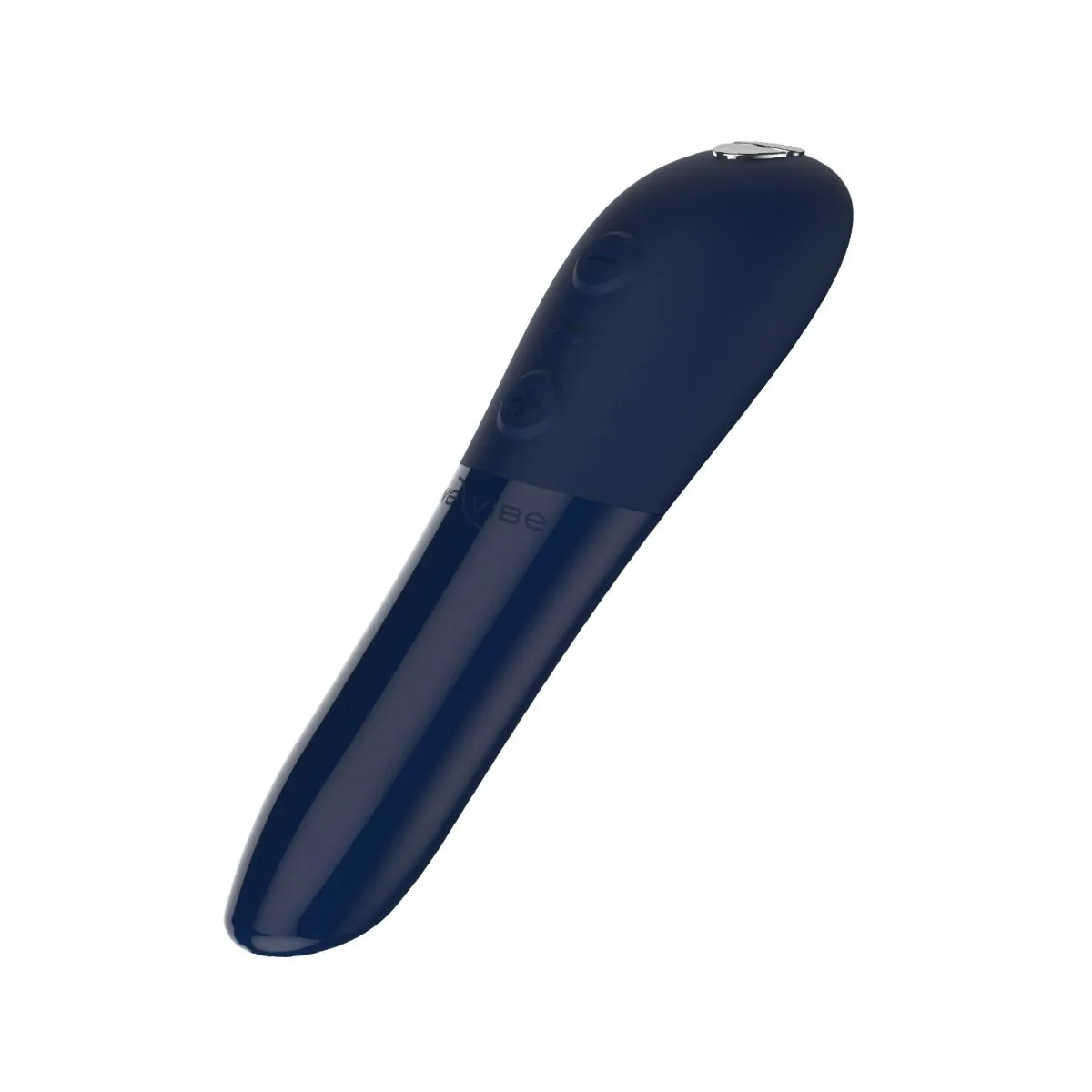
ABS is a hard thermoplastic. It is also non-porous and easy to clean, but it is slippery, it feels cold against the skin on first contact, and it provides no grip when your fingers are wet. The manufacturer’s own product images clearly show how the split looks on Tango X: the upper half with the buttons and the top are matte, the lower half is glossy. That means in practice that the part that lies against the body is silicone and the part you hold is the glossy plastic.
It’s a trade-off worth understanding before buying. The advantage is that a hard plastic body transfers vibrations more effectively than a thick silicone shell would, which is the whole point of a product whose only job is to deliver vibration. The disadvantage is that the glossy lower part becomes slippery when it gets wet or gets lubricant on it, and that the seam between silicone and plastic is a joint that needs to be rinsed properly. Compare it to an all-silicone product: there is no seam at all, but the vibration is also dampened more.
Phthalates are a group of plasticizers used to make plastic — above all plasticized PVC — flexible. Kemikalieinspektionen describes them as substances that can affect the hormone system and make reproduction more difficult, and several of them are therefore restricted or banned within the EU in a large number of products. This particular product category is a recurring subject of supervision, because it contains plasticized plastic against skin and mucous membranes.
We-Vibe explicitly states that the material in Tango X is free from phthalates and BPA and made without latex. It’s a clear statement, unlike terms such as "TPE" or "jelly rubber," which say nothing at all about which plasticizers are included. Neither silicone nor ABS requires phthalate plasticizers to work — silicone’s softness comes from the polymer’s own structure, and ABS is supposed to be hard — and that’s why these two material statements themselves are better information than almost any other item in a product specification.
The latex task is relevant for anyone who is allergic to latex. Latex allergy causes reactions on the mucous membrane faster than on normal skin, and an intimate product is therefore precisely the kind of use where this matters. The fact that the manufacturer states it is a plus. What We-Vibe, on the other hand, does not do is specify which type of silicone it is or what the surface hardness is—details that are not published for any model in the range.
The specification table on the manufacturer’s product page states 9.98 × 2.29 × 2.43 centimeters. We-Vibe also publishes its own measurement drawing in the product gallery, where the length is given as 99.83 millimeters and the width in the product’s widest view is 24.25 millimeters. The two sources are therefore consistent, and it’s unusual enough to be worth noting: in this category, it’s more common for the manufacturer’s graphics and table to say different things.
Ten centimeters in length and just over two centimeters in cross-section make Tango X a product that actually fits in a pocket. For comparison, the We-Vibe Touch X measures 10.22 × 4.33 × 3.43 centimeters—almost the same length but nearly twice as wide—and the Lelo Mia 3 measures 22 × 22 × 111 millimeters, so it’s one centimeter longer but slightly narrower.
We-Vibe does not publish the weight, neither on the product page, in the manual, nor in the measurement drawing. It’s a real gap in a product class where the weight matters: a bullet is held in the hand throughout use, and the difference between 30 and 90 grams is noticeable in the wrist in a way that the difference between two millimeters of width does not. Lelo lists 36 grams for the Mia 3, which gives an order of magnitude for what a product of this format weighs—but it’s Lelo’s figure for Lelo’s product, not information about Tango X. Expect it to weigh more than the Mia 3, because it’s wider and has more material in the body, but treat every exact gram number you see for Tango X as uncertain until the manufacturer publishes one.
The shape is asymmetrical. The top tilts diagonally, the buttons sit on the flatter side just below the top, and the shaft narrows downward to a rounded end. The manufacturer’s own illustration shows the grip: the product is held between the thumb and index finger with the shaft facing the palm and the top facing outward. It’s one of very few products in the category where you can actually control the angle with fingertip control instead of with the whole wrist, and that’s a direct result of how small it is.
The interface on the We-Vibe Tango X consists of three buttons, and the manual’s overview image names all of them. The plus button starts the product and increases intensity. The minus button lowers intensity, and if you hold it pressed, the product turns off. The wave button in between steps between the seven vibration patterns. An LED between the buttons shows status. That’s it—no display, no app, no sensor.
It’s a simpler setup than almost everything else in this price range, and in practice it’s both the model’s strongest and weakest feature at the same time. Strongest: you find the right option without having to see the buttons, which is the whole point when the product is against your body and your hand is turned away from you. Weakest: there’s no indication of which of the seven patterns you’re on, and no number for which of the eight steps you’re at. You have to count button presses or simply go by feel.
The manual mentions a shortcut grip that’s worth knowing and that rarely appears in store texts: hold the plus button pressed so the product goes directly to maximum vibration intensity, instead of you stepping up eight clicks.
We-Vibe names all seven patterns on the product page: Pulse, Wave, Cha-Cha, Tease, Tempo, Heartbeat and Vibrate. The last one, Vibrate, is the steady vibration without a pattern—so it’s the mode that most people in practice use the most. The other six are rhythmic variations: pulsing, wave-shaped, alternating, and so on. The manufacturer publishes no frequencies, no interval times, and no technical description of how the patterns are built up, so the names are all you have to go by before buying.
What can be stated is that intensity and patterns are two independent controls. So you can run a pattern at the lowest intensity or the steady vibration at the highest, and the combinations become 7 × 8 = 56. That sounds like a lot, but pattern modes are the function used least in this product category. The way people actually use products with both steps and programs is that they return to two or three settings, and on the Tango X the steady vibration at a couple of the higher steps is almost certainly one of them.
There’s one detail that deserves its own heading, because it explains why Swedish shops write different things about the same product. The heading text on We-Vibe’s own product page says that the Tango X delivers "8 types of body-shaking vibrations". The paragraph directly under the same heading says "7 different vibration modes and 8 intensity levels", and the function list further down lists exactly seven patterns by name.
So the “eight” in the headline refers to the number of intensity steps, not the number of patterns, but the wording is unclear enough to have spread further. You can see it directly in the stores’ product feeds: SexleksakerOutlet writes “8 vibration functions,” while Mshop writes “7 vibration patterns” for exactly the same article number. Both have read the manufacturer correctly—they’ve just read different sentences. The correct answer is seven patterns and eight intensity steps.
The transport lock is the feature that makes a bullet vibrator ready for travel, and We-Vibe describes the operation exactly in the manual. You press and hold both buttons at the same time for two seconds. Tango X then pulses twice and is locked. Do the same hold again to unlock it.
There’s also a detail in the manual that’s easy to miss and that causes unnecessary confusion: the transport lock is automatically deactivated when the product is charged. That means that a product you locked before your trip is unlocked again once you’ve charged it at the hotel. So if you want it to be locked on the way home, you have to activate the lock one more time. It’s reasonably designed—otherwise a locked and discharged product would be hard to get working—but it isn’t obvious.
Comparatively, We-Vibe Touch X has the same transport lock with the same description, while Lelo Mia 3 solves the problem differently by requiring a long press to turn the product on. Both approaches work; the difference is that an explicit transport lock can be verified with the naked eye before you pack the product away.
We-Vibe markets Tango X as whisper-quiet and highlights the silence as one of the model’s five main functions on the product page. The question is what that means in numbers, and there the answer has to be honest: We-Vibe publishes no measured decibel value for Tango X—either on the product page, in the specification table, or in the manual.
There also isn’t any comparison graphic to rely on, which several competitors publish. The wording “whisper quiet” is all the manufacturer offers. Sites that list an exact decibel figure for Tango X either present their own measurement or a value without any source from the manufacturer.
For comparison, Lelo lists under 60 dB as the maximum sound level for Mia 3. It says something about how little exact information there is to compare in this category, even when a number is published—a cap of 60 dB without a specified measurement method, measurement distance, or intensity mode is hardly a measurement you can really rely on either. But it’s at least a number, and it’s more than what We-Vibe provides.
What can, however, be established purely from a construction point of view is that a small product with a hard ABS body has worse conditions for being quiet than a large product with a thick silicone outer layer. Hard materials dampen less. A practical tip that applies regardless of the model: place the product on a soft surface between uses. A hard tabletop works like a resonance box and noticeably amplifies the sound—and this applies to an even greater extent for a small hard product than for a large soft one.
We-Vibe Tango X is rated IPX7. The rating comes from the international standard IEC 60529, which defines enclosure ratings for electrical equipment. The number 7 in the second position means the product has been tested for submersion in water to a depth of one meter for 30 minutes. The manufacturer draws the conclusion straight on the product page: Tango X is waterproof, which makes it easy to use anywhere and easy to clean.
The difference from a splash-proof product is greater than the wording suggests. Splash protection covers water droplets and, at best, jets of water, but not submersion. Such a product can handle a damp cloth and possibly a shower, but not a bathtub, and it should not be held under running water without thinking carefully about the buttons and the charging contact.
With IPX7, the entire product can be rinsed off without being careful. On this particular model, that’s especially valuable, because the charging contacts sit unprotected on the outside of the housing—there’s no rubber plug to remember to press in before rinsing, which is exactly the detail that makes cheaper products leak. If a product completely lacks an IPX rating, it should be treated as not water-resistant. The absence of a rating is never a sign that the product would be approved.
One limitation should be mentioned in the same breath. The manual states that the product and its battery must not be exposed to temperatures above 45 degrees, and that the device is approved for indoor use between +10 and +45 degrees. Boiling water and the dishwasher are therefore out of the question despite IPX7, and a sauna or a hot car is also not a suitable place to store it.
The manual’s cleaning instructions are brief: wash with We-Vibe Clean or with soap and water. Rinse the product in lukewarm water after each use, be especially careful with the joint between the silicone part and the glossy plastic part, and wipe it with a clean towel before putting the product away. The manual also points out that the product should be cleaned both before and after use, and that aggressive chemicals and cleaning agents both damage the surface and make the warranty void.
Silicone-based lube should not be used on silicone products. Over time, it breaks down the silicone surface and makes it porous, and a porous surface can no longer be cleaned properly—only replaced. Use water-based lube—this is also exactly what the manufacturer itself includes in the package: a two milliliter sample of We-Vibe Lube, which is a water-based lube made by pjur. Oil-based products such as coconut oil leave a film that’s difficult to remove from the joint.
A silk storage pouch is included in the delivery, and it serves a real purpose for a product that’s meant to be kept in a travel pouch: it keeps dust and lint away from the charging contacts. The manual also covers two things that rarely appear in store text. The product is expressly not designed for anal use—and a bullet without a base plate or a cord is precisely the kind of product where that warning is warranted. And sex toys should not be shared with anyone other than your partner, because sexually transmitted infections can be passed that way.
We-Vibe states the operating time as up to two hours and the charging time as 90 minutes. The feature list on the same page expresses the operating time as up to 120 minutes on a single charge, which is the same thing. Two hours is plenty of operating time for a product class where a usage session rarely exceeds a quarter of an hour, and the ratio between operating time and charging time—120 minutes of operating time on 90 minutes of charging—is better than it is on several more expensive models.
The battery is of the lithium-ion type and, according to the manual, is expressly not replaceable. The manual also states that the battery does not need to be fully drained before charging, and that the product should be charged regularly even when it’s not being used so the battery lasts longer. That’s standard advice for lithium-ion cells, but it’s worth following: the battery is fixed in place, and when the cell is used up, so is the product.
Charging happens via two charging contacts on the product’s top side, against which the included charging cable is placed. The cable is connected at the other end to a standard USB port. The manufacturer points out that no power adapter is included, and the manual states that any USB power adapter with compatible output power can be used—the manual’s technical specification lists 5 volts at 0.75 amperes.
What makes the construction possible is precisely that the contacts sit on the outside. No opening in the housing means IPX7 can be achieved without a rubber plug, and it’s the same solution that most premium manufacturers have chosen. The downside is the usual one: the charging cable is product-specific and no USB-C cable in the box works. If you lose it, you have to order a replacement, and We-Vibe’s warranty terms expressly exclude charging cables as consumables—a broken cable is always your expense.
The manual also explains the charging indicator, which is useful because the LED only has three modes, and none of them are self-explanatory. A quickly blinking light means the product is charging. A steady light means it is fully charged. A lamp that’s off means either that there is no power coming through or that the charger isn’t seated correctly on the product — and that is the most common reason people think a bullet with external charging contacts is broken. One last thing worth knowing: if you charge via a computer’s USB port, the product will not charge if the computer goes into sleep mode.
We-Vibe does not publish either the battery capacity in mAh or its voltage for Tango X, either on the product page or in the manual. It’s worth noting, because competitors do: Lelo lists 70 mAh and 3.7 volts for the Mia 3. Without the capacity, it’s not possible to calculate operating time into power consumption, and you can’t compare how heavily the cell is loaded between models.
The comparison is still informative in an indirect way. Lelo Mia 3 lists 70 mAh and up to 1.5 hours of runtime; We-Vibe lists up to 2 hours without saying anything about capacity. That Tango X gets a third longer runtime means either a larger cell or a more economical motor, and which of the two it is can’t be determined from the published information. Anyone who wants to compare raw power between the two models simply doesn’t have the basis for it, and every site that claims to know which is strongest without testing is guessing.
What generally applies to lithium-ion batteries also applies here: the capacity decreases with the number of charge cycles, and the battery is not replaceable. With use a couple of times a week, it’s the battery—not the silicone—that sets the limit for lifespan. That’s also why the warranty exclusions for batteries—see the warranty section below—are more important than they sound.
We do not have price data from shops in your market yet.
Tango X and Touch X have the same eight steps, the same seven patterns, the same battery, and the same warranty. The choice between them is a design choice, not a performance choice.
Three comparisons are relevant: against We-Vibe’s own lay-on alternative on the same technology platform, against the nearest bullet competitor from another premium brand, and against what you get when you add a few hundred SEK and switch technology entirely. All technical details below come from the respective manufacturers’ own specifications, and all prices come from the shops’ product feeds on 29 July 2026.
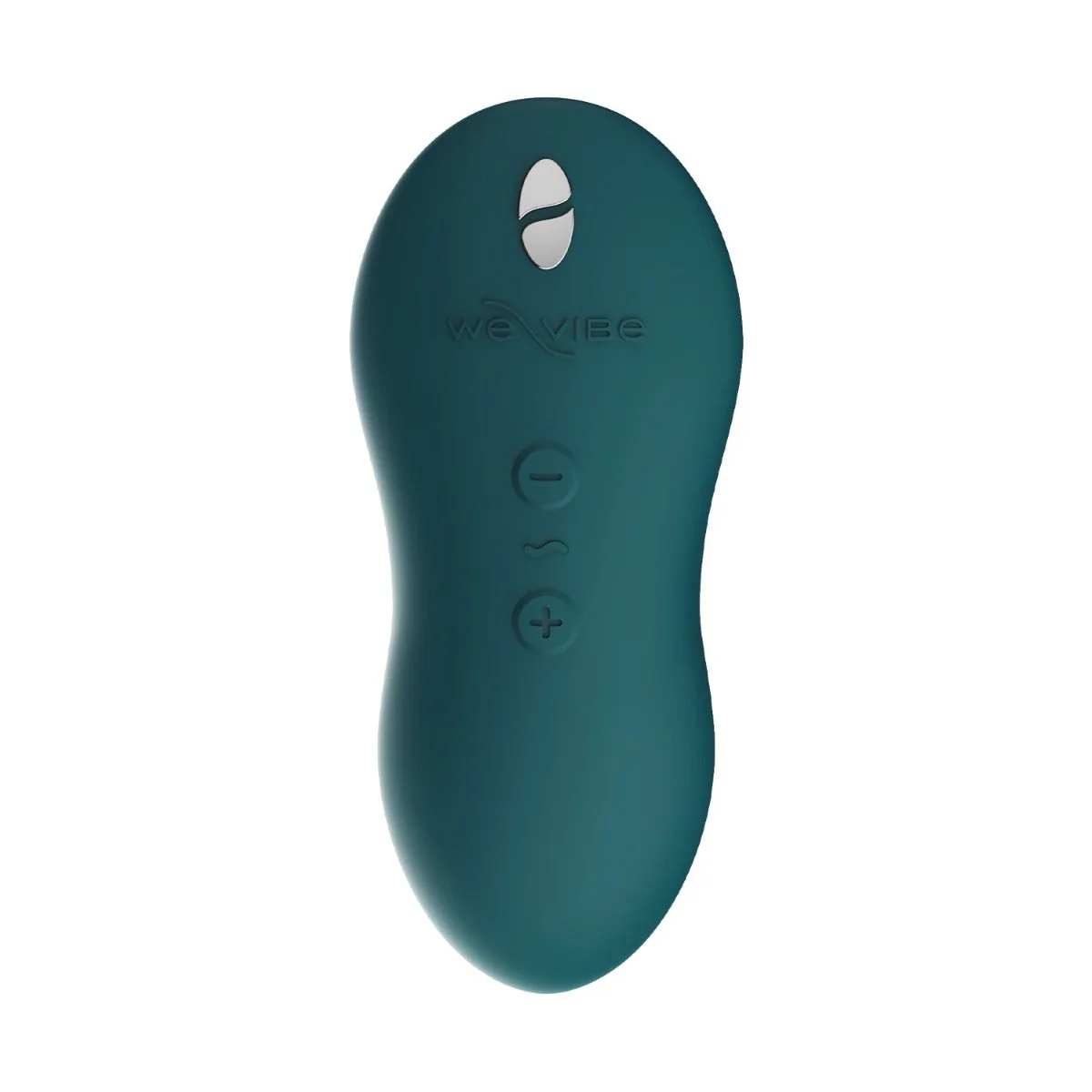
We-Vibe Touch X costs from 722 SEK, which is 120 SEK less than Tango X at its lowest price in stock. It’s the same brand, the same technology generation, and in practice the same datasheet: the same material specification with ABS and body-friendly silicone without phthalates, BPA, or latex, the same eight intensity levels, the same seven vibration patterns with the same names, the same USB-charged lithium-ion battery, the same operating time of up to two hours, the same charging time of 90 minutes, the same IPX7, the same travel lock, and the same two-year warranty.
The difference lies entirely in the shape. Touch X measures 10.22 × 4.33 × 3.43 centimeters, while Tango X measures 9.98 × 2.29 × 2.43. So they are almost exactly the same length, but Touch X is nearly twice as wide and 40 percent thicker. Touch X has a flat, wide contact surface that’s pressed against a larger area; Tango X has a tapered top that concentrates the same effect on a small surface.
The conclusion is therefore not that one is better. If you want broad, spread-out stimulation, Touch X is both cheaper and the right shape. If you want point stimulation, or something that really fits in a pocket, Tango X is the only one of the two that does that. What you don’t pay for is performance — on paper, there’s no difference at all.
Lelo Mia 3 costs from 886 SEK at Sexonic and 989 SEK at Vuxen, i.e. 44 to 147 SEK more than Tango X at its lowest price in stock. It’s the closest direct competitor: same category, same material combination of ABS and body-friendly silicone, the same number of settings — Lelo lists eight.
Mia 3 measures 22 × 22 × 111 millimeters and weighs 36 grams. So it’s a little over a centimeter longer than Tango X but slightly narrower, and Lelo publishes — unlike We-Vibe — both weight, a battery capacity of 70 mAh at 3.7 volts, a charging current of 70 mA, and a sound level below 60 dB. Runtime is stated as up to 1.5 hours and charging time as up to two hours.
The differences that actually matter: Tango X states a one-third longer runtime for a shorter charging time — 120 minutes of operation on 90 minutes of charging versus 90 minutes of operation on 120 minutes of charging — and Tango X has an explicitly stated IPX7 rating, while Lelo only uses the wording "100 % watertight" without specifying a class. Lelo, on the other hand, has a significantly more transparent specification, a ten-year quality warranty in addition to the two years of warranty, and a published gram rating. If you choose based on the reported data, Lelo wins. If you choose based on runtime, charging time, and a verifiable waterproofing class, Tango X wins.
We-Vibe Melt 2 costs from 1 271 SEK, meaning 429 SEK more than Tango X at its cheapest in stock. This is not an upgrade, but a change of product category: Melt 2 uses air pressure instead of vibration, has twelve intensity levels and six suction patterns compared with Tango X’s eight steps and seven vibration patterns, and it’s also controlled via We-Vibe’s app with a remote function. Battery data, on the other hand, is the same on paper: up to 120 minutes of runtime and up to 90 minutes of charging time. The material is listed as body-friendly silicone without phthalates, BPA, or latex—so without the ABS part.
The question to ask isn’t which one is best, but whether air-pressure technology works for you at all. It’s experienced very differently by different people, and here it costs an extra 429 SEK to try. If you already know you prefer vibration, Melt 2 is the wrong product regardless of price. If you’re unsure, there are cheaper ways to find out than starting with We-Vibe’s app-controlled top model.
Seven Swedish stores sell the item with EAN 4251460603911. The lowest listed price is Sexonic at 797 SEK, and the highest is Vuxenkul at 1 119 SEK. That’s 322 SEK, or a 40 percent difference, for the exact same item number, the same color, and the same packaging.
The stock situation, however, changes the picture entirely. Both the cheapest and the most expensive store were out of stock when prices were checked. Of the five stores that actually had the product in stock, Joyland was cheapest at 842 SEK, followed by Blush Me and SexleksakerOutlet at 890 SEK and Vuxen and Mshop at 899 SEK. This means that the real price spread among the available stores is 57 SEK, not 322—just under seven percent.
That in itself is useful information. A price spread of seven percent among stores that have the item at home means there isn’t any real bargain to chase here, and that it’s more reasonable to choose a store based on shipping, delivery time, and past experience than on the difference in SEK. Stores that list a product as sold out may also have an old price left in the feed, and that price is rarely what you actually end up paying when the item comes back in.
The price spread isn’t because any store sells a different variant. All seven stores list Midnight Blue, either under EAN 4251460603911 or under their own item number linked to that specific color—Vuxen’s item number 30337-SNTTSG6 even includes the manufacturer’s own variant number. By comparison, the manufacturer’s own list price is 89 euros, which puts the Swedish prices in roughly the right range without any store standing out as unreasonable.
The prices in the table above are updated when stores update their product flow, but always check the final price at checkout. Shipping costs are added by most stores under a certain order value, and in this price range several stores are just below the threshold for free shipping—which can easily erase the entire difference of 57 SEK.
It’s for you if you want point stimulation rather than broad stimulation, and if you want something that actually fits in a pocket or a small toiletry bag. At ten centimeters long and a little over two centimeters in cross-section, it’s in the smaller half of the category, and the combination with a proper locking clasp makes it one of the few products in this segment that’s made for traveling. IPX7 without a rubber plug also makes it easy to rinse off without any preparations, and a two-hour runtime on a 90-minute charge means you rarely need to think about charging at all.
It’s also for you if you want an interface with no learning curve. Three buttons, no app, no account, and no pairing—and for anyone who intentionally doesn’t want an internet-connected product in the bedroom, the absence of an app is an advantage, not a shortcoming.
It’s not for you if you want broad, spread-out stimulation—there We-Vibe Touch X is both cheaper and correctly designed. It’s not for you if you require published weight, battery capacity, and measured sound level before buying, because We-Vibe doesn’t publish either for this model. It’s not for you if you want to be able to charge with the same cable as your phone—the charging cable is product-specific and excluded from the warranty. And it’s not for you if you want to control the product from an app or remotely; that’s where Melt 2 belongs on the shelf in the same segment.
One more thing belongs in the decision. Tango X is designed as a complementary product as much as it is a main product. The format, the locking clasp, and the price tag of 842 SEK all point in the same direction: this is the product you take with you, not necessarily the only one you own. Anyone looking for a single product to handle everything should look at something bigger.
We-Vibe’s product page states a two-year warranty on Tango X, and the company prominently displays “2-Year Warranty On All Toys” across its website. The warranty terms specify the period as 24 months from the first delivery to the customer, however at most two years after the manufacturing date. The second half of that sentence is easy to miss and can, in practice, shorten the warranty for a product that has been sitting in the store’s warehouse inventory for a long time before you bought it.
An observation about the manufacturer’s own documentation belongs here. The warranty text on we-vibe.com is consistently worded for the Womanizer brand — it talks about “products of the Womanizer brand” — even though it is located under We-Vibe’s warranty page and even though We-Vibe product pages state a two-year warranty. It is reasonably the same terms that apply, since WOW Tech Europe GmbH stands behind both brands, but the person who wants to be sure exactly which text is invoked in a warranty case would do well to save a copy of the terms and conditions at the time of purchase.
Read the exclusions before you count on the warranty. It does not cover minor defects that do not affect usability, wear parts such as gaskets, and consumables such as batteries and charging cables. It does not apply either in the case of normal wear and tear, intentional damage, improper commissioning, use contrary to the user manual, aggressive chemicals, or your own repair attempts. On a product with a permanently attached battery that cannot be replaced, the battery exclusion in practice means that the actual wear part — the cell — is outside the protection. In an approved warranty case, the manufacturer replaces the product with a new one of the same type, or refunds the purchase price, and covers the costs of the replacement.
We-Vibe’s 100-day satisfaction guarantee is also worth a clarification, since it is often cited in store texts. According to the manufacturer, it applies only to purchases in We-Vibe’s own web store, it provides a value voucher to shop for in the same store rather than a money-back refund, and it can be used for one item per order. So if you shop at any of the seven Swedish stores listed above, you are not covered by it.
What always applies, though, are your statutory rights. Under the Swedish Consumer Sales Act (konsumentköplagen), you have a right to complain for three years in the event of faults with the goods, regardless of what the manufacturer promises — that is one year longer than We-Vibe’s own warranty. For distance purchases, you also have a right of withdrawal for fourteen days under the Act on distance contracts and contracts outside business premises (lagen om distansavtal och avtal utanför affärslokaler). Be aware that in practice the right of withdrawal is limited for hygiene products that have been taken out of a sealed package — the right to complain in the event of defects, on the other hand, always applies. If you have questions about what applies in your case, Konsumentverket (the Swedish Consumer Agency) guides you via Hallå konsument.
We-Vibe Tango X is ranked på plats 3 av 14 in mini vibrator best i test, where the entire category is compared against each other using five shared criteria. Guiden vinns av Svakom Echo 2.
Every numerical piece of information in the text can be traced to one of the sources below. The links were checked manually on the specified date.
This page is machine-translated from Swedish. Read the Swedish original