

Review
Review: Satisfyer Pro 2 Next Generation
Air-pressure technology instead of vibration — 219 SEK and 15 years of warranty.
29 July 2026
Review · Bullet vibrator · Point stimulation
We-Vibe’s best-selling bullet vibrator reviewed against the manufacturer’s own specifications, the PDF manual, EU declaration, and price data from six Swedish stores. Eight intensity levels and seven vibration patterns, ABS and body-friendly silicone, IPX7 according to IEC 60529, up to 120 minutes of runtime on 90 minutes of charging, and a two-year warranty — at a price where the difference between the cheapest and the most expensive store is 34 percent.
One of the most thoroughly documented bullet vibrators in the category: eight intensity levels and seven vibration patterns in a body of just under ten centimeters, IPX7, a travel lock that actually locks, and up to 120 minutes of runtime on 90 minutes of charging. The manufacturer publishes both the PDF manual and the EU declaration, which is unusual. What you pay for is a hard ABS tip against the body, a product-specific charging cable, a battery that can’t be replaced, and a specification where neither weight, battery capacity, nor sound level is listed.
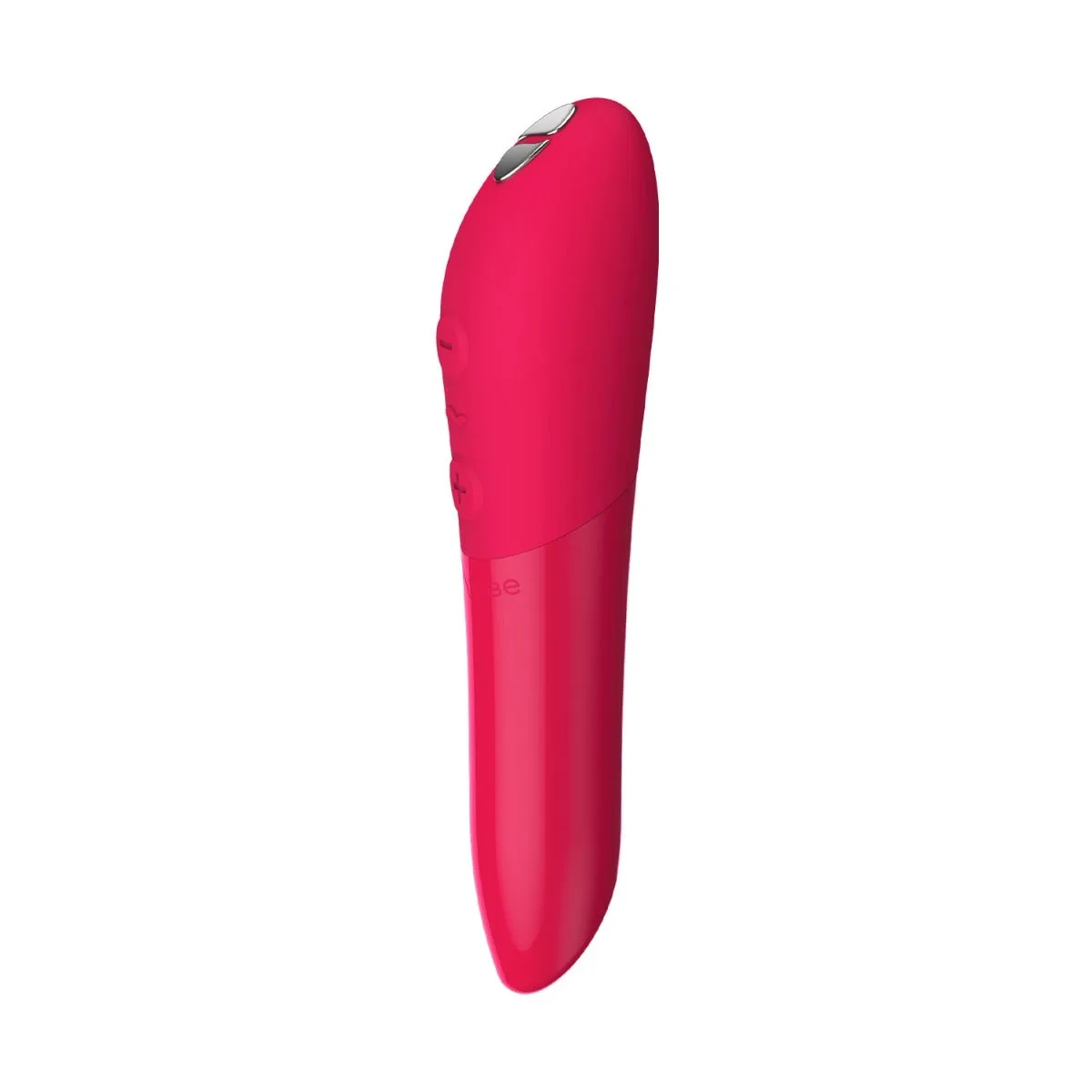
We-Vibe Tango X is the successor to the model that made We-Vibe known outside the niche of prostate vibrators. The manufacturer calls it simply a powerful bullet vibrator, and that categorization is also stated in the EU declaration of conformity that We-Vibe publishes for the model: the object of the declaration is listed there as "bullet vibrator". It’s a small, tapered shaft vibrator intended for pinpoint stimulation, not an air-pressure product and not an app-controlled toy.
The specification looks like this. The manufacturer lists the dimensions as 9.98 × 2.29 × 2.43 centimeters, eight intensity levels, seven vibration patterns, ingress protection rating IPX7, a runtime of up to two hours, a charging time of 90 minutes, a lithium-ion battery that charges via USB, the material ABS plastic and body-friendly silicone, and a two-year manufacturer’s warranty. The model number for the product is 21000-01. In Sweden, the item is sold by six stores at prices between 792 and 1,063 SEK, and four of them had it in stock at the price check on September 12, 2026.
This review is exclusively about the Cherry Red variant with EAN 4251460603928, the manufacturer’s item number SNTTSG3. We-Vibe sells Tango X in two colors, Cherry Red and Midnight Blue, and the blue variant has its own EAN — 4251460603911, item number SNTTSG6. Functionally, they are identical. Still, be aware when you compare prices: Vuxenkul calls this variant “pink” in its color selector, and Joyland has “pink” in the product page’s web address even though the color is listed as red on the page itself — in both cases with EAN and item number pointing to Cherry Red.
A bullet vibrator is the simplest form of vibrator: an elongated body with a motor inside, with no plug-in part, no air-pressure chamber, and no heating. The entire design is about concentrating the vibration to a small area so it can be placed exactly where it needs to be. Traditionally, that shape has been purely cylindrical — a cartridge shape, which is also the origin of the name.
Tango X differs from that design in two points that the manufacturer itself highlights. One is the tip: the manual’s overview image names it as “pinpoint tip,” meaning a tapered top instead of a round end, and Joyland describes it as made in ABS plastic. The other is the handle, which, according to the same overview image, is in silicone. So it is not a single-material product straight through, but a two-part body where the materials have different functions: hard plastic where the pressure should be transferred, and softer silicone where the hand should grip.
What that means in practice is that the shape determines how it’s used. A round bullet can be rolled against the skin and provides broad contact pressure. A tapering tip does the opposite: it gives a smaller contact area and thereby higher pressure per square centimeter with the same force. What can be established is that it makes Tango X a product for pinpoint stimulation rather than surface stimulation—and that it’s a choice, not an upgrade. If you want a broad, diffuse vibration, the shape is the wrong starting point.
We-Vibes naming is relatively simple, but three models are close to each other and are regularly mixed up in Swedish stores.
So the difference between Tango X and Touch X is not the number of modes, which several store texts suggest. Both have eight intensity levels and seven patterns. The difference is the shape, and thus what the vibration does to the body: Tango X concentrates, Touch X spreads. It’s a choice you make once, and it can’t be changed afterwards with a setting.
Material is the only property of an intimate product that can’t be compensated for with experience or care, and it determines whether the product is still hygienic after five years. We-Vibe states the material for the Tango X as “ABS, body-safe silicone, free from phthalates and BPA and made without latex”—meaning ABS plastic and body-friendly silicone, manufactured without phthalates, BPA, or latex.
The manufacturer’s material listing names two materials but doesn’t say on the product page which one is where. However, the manual’s overview image does: the handle is explicitly named as a silicone handle, and the tip as a “pinpoint tip.” Joyland is the only one of the six Swedish shops that writes out the consequence in plain text: the retailer states that the narrow top is ABS plastic. That matches the manufacturer’s two-part material list and the product images, where the upper part has a matte silicone surface and the lower part a glossy plastic surface.
There’s a contradiction between the shops that’s worth reporting. Vuxen states the material in its quick facts box as “100% Premium Silicone,” and Blush Me states in its specification box only “Skin-friendly silicone”. Neither one matches the manufacturer’s own information, and Blush Me also contradicts itself on the same page: further down in the body text, the manufacturer’s wording is translated word for word, with both ABS and silicone. Mshop, Joyland, and Vuxenkul all list ABS and silicone, which is what applies. When a shop’s claim conflicts with the manufacturer’s information, the manufacturer wins—and this discrepancy is worth knowing if you choose a product based on the material specification in a filter menu.
The difference isn’t academic. Both silicone and ABS are non-porous materials, and non-porosity is the single most important property of anything that’s meant to rest against mucous membranes—a non-porous surface can be cleaned, because there are no microscopic cavities where residue can get trapped. But they differ in feel and at the seams. Silicone is soft and easy to grip even with lubricant on your hands; ABS is hard and slippery. And where two materials meet, there’s a joint—the place where dirt collects first. On Tango X, the joint is in the middle of the body, clearly visible in the product images, and it should be included in cleaning every time.
Phthalates are a group of plasticizers used to make plastic—above all, flexible PVC—pliable. Kemikalieinspektionen describes them as substances that can affect the endocrine system and make reproduction more difficult, and several of them are therefore restricted or banned within the EU in a large number of products. This product category is a recurring subject of supervision because it contains flexible plastic in contact with skin.
We-Vibe states explicitly that the material in Tango X is manufactured without phthalates, BPA, and latex. It is a clear declaration, unlike labels such as "TPE" or "jelly rubber", which say nothing at all about which plasticizers are included. Neither silicone nor ABS requires phthalate plasticizers to work—silicone’s softness comes from the polymer’s own structure, and ABS is intended to be hard—and therefore this specific material combination as stated in itself is better information than almost any other entry in a product specification. Joyland separately states on its product page that the product is phthalate-free, which is the same message from the other side.
The latex information is relevant for someone who is allergic to latex. Latex allergy causes reactions on the mucous membrane faster than on normal skin, and an intimate product is therefore precisely the kind of use case where the information matters. That the manufacturer lists it is a plus. There is also a regulatory aspect to the materials question that is rarely mentioned in store texts: We-Vibe’s EU declaration of conformity for Tango X states that the model complies with the RoHS directive 2011/65/EU with the amendment 2015/863, which limits the use of certain hazardous substances in electrical and electronic equipment. It is a commitment on paper with a date behind it, unlike a marketing-style formulation.
We-Vibe lists the dimensions as 9.98 × 2.29 × 2.43 centimeters, meaning it’s just under ten centimeters long and a little over two centimeters in cross-section. That makes Tango X a product that actually fits in a toiletry bag without taking over the space, and it is noticeably smaller than most vibrators in its price range. Swedish stores round the measurements differently: Joyland reproduces the manufacturer’s figures exactly, Mshop and Blush Me state the length as 10.00 centimeters, Vuxen lists total length 10 centimeters with a maximum diameter of 2.4 and a minimum diameter of 2.2 centimeters, and Vuxenkul lists a diameter of 2.3 centimeters. The differences are within rounding and within the fact that the cross-section is oval rather than round—except for one: Blush Me states a maximum diameter of 2.50 centimeters, which is larger than the manufacturer’s largest cross-section measurement of 2.43 centimeters.
The weight information deserves its own note. We-Vibe does not publish any weight for Tango X, either on the product page or in the manual. The only weight that is available is a shop listing: Mshop states 0.26 kilograms. That figure should be read with caution. A handheld product measuring ten centimeters in ABS and silicone normally weighs only a fraction of 260 grams — Lelo, for comparison, lists 36 grams for the Mia 3, which is about the same length — and therefore 260 grams is likely a shipping or carrier weight including packaging, cable, bag, and printed materials. Treat it as a logistics item until the manufacturer publishes a product weight.
The same caution applies to Mshop’s packaging dimensions. The store lists 9.89 × 2.43 × 2.29 centimeters under the heading "Dimensions (Packaging)", but in practice those figures are the manufacturer’s product dimensions with two of the values swapped and the length rounded in the wrong direction. A package cannot be shorter than the product it contains. This means there is no published packaging dimension for Tango X — which in turn means you can’t rely on a specific mailbox size for delivery.
The interface on Tango X consists of three buttons on the silicone handle: plus, minus, and a wave symbol. The manual lays out the logic plainly. You start the product with a press, hold the button down to go directly to the highest vibration intensity, step with plus and minus between the eight levels, and turn it off by holding the minus button down. The wave button cycles through the seven patterns.
Three buttons are more than on the simplest bullet vibrator, which often has a single button that steps around in a circle, and that’s the direct advantage: you can reduce the intensity without first having to scroll all the way up and around. It’s a small thing in a specification and a big thing in practice, because the buttons sit on the handle while the tip rests against the body, meaning you’re controlling it blindly. Having plus and minus as separate buttons means the direction is always unambiguous.
We-Vibe names all seven patterns on the product page: Pulse, Wave, Cha-Cha, Tease, Tempo, Heartbeat, and Vibrate. The last one is the steady, continuous vibration; the other six are rhythmic variations. The manufacturer does not publish any frequencies or intervals for them, so what distinguishes, for example, Tempo from Cha-Cha can’t be derived from the specification — you have to find that out by browsing.
An annotation about store data belongs here. Mshop also lists seven vibration programs, but it lists "Medium" instead of the manufacturer’s "Vibrate". The number is correct, but the name list is not the manufacturer’s. It’s a small mistake, and it illustrates a bigger point: when a store copies a specification, discrepancies arise, and that’s why the manufacturer’s own page is always the one that should apply.
What you can determine about the combination of eight levels times seven patterns is that it provides 56 possible settings. The question isn’t whether that’s enough, but whether you want that many to scroll through. In this product category, most settings return to two or three combinations, and the rest mainly serve a function the first times. Anyone who wants a button and a feel should buy something else.
The travel lock is the function that most clearly sets apart a well-thought-out small product from a simple one. Without it, anything in a bag could press a button, and a vibrator that turns on in a checked travel suitcase is a problem that doesn’t need to be described in more detail.
We-Vibe’s solution is described in the manual and works like this: hold the plus and minus buttons pressed in at the same time for two seconds. Tango X then pulses twice as confirmation, and the buttons are locked. The same combination unlocks again. The lock also turns off automatically as soon as the product is connected to the charger, which is a detail that’s easy to miss—if you put it on charge before you leave, it will be unlocked when you pack it away again.
Vuxenkul describes the same button combination on its product page, and all six Swedish stores mention the travel lock in their product text. It’s one of the few functions where the stores and the manufacturer are completely in agreement.
Eight steps is a reasonable number—more than the five or six that are most common in the price range, fewer than the fourteen that the air-pressure products in the premium segment offer. The pattern in this product category is that the steps are more tightly grouped in the upper part of the scale, because the perceived difference per step decreases as the motor approaches its maximum power.
The manual’s shortcut is worth knowing for exactly this reason: if you hold the start button, the product goes straight to the highest intensity without stepping through the scale. It’s the function that, in practice, makes eight steps manageable—you never have to press your way up, only down from the top if you want to.
What the manufacturer does not publish is how powerful the steps are in measurable terms. There is no information about vibration frequency, none about amplitude, and none about motor power on either the product side or in the manual. For comparison, Lelo lists 130 Hz as the frequency for Mia 3. Without a frequency specification, you can’t compare how “deep” or “shallow” the vibration is between models, and wordings like “rumbly” in the marketing text should be read for what they are: marketing.
We-Vibe markets the Tango X as whisper-quiet and highlights silence as one of the model’s selling points—the feature list on the product page includes the item “Whisper quiet”. The question is what that means in numbers, and there the answer has to be honest: We-Vibe does not publish any measured decibel value for the Tango X, either on the product page or in the manual.
The stores don’t get any closer. Vuxenkul writes “as quiet as a whisper,” which is the manufacturer’s wording translated, and Joyland states the sound level as “low” in its specification table—an overall assessment without any measurement. None of the six stores states a decibel figure. Websites that publish an exact number for Tango X either show their own measurement or a value without a source.
For comparison, you can point to what a competitor does instead. Lelo lists for Mia 3 a maximum sound level of under 60 dB. It’s not, in itself, a particularly informative figure—it lacks a measurement distance and a weighting curve—but it is a published number, and it’s more than We-Vibe provides. What can, however, be established in general is that a small vibrator with a hard plastic shell often sounds louder than a larger one with silicone throughout, because the hard shell carries the sound instead of dampening it.
A practical tip that applies regardless of model: when it’s on and you’re not holding it, place the product on a soft surface. A hard tabletop works like a resonance box and noticeably amplifies the sound.
We-Vibe Tango X is rated IPX7. The rating comes from the international standard IEC 60529, which defines enclosure classes for electrical equipment. The number 7 in the second position means that the product is tested for submersion in water to a depth of one meter for 30 minutes. The manufacturer states the consequence concisely on the product page: Tango X is waterproof, making it easy to use anywhere and easy to clean.
The difference versus a splash-proof product is greater than the wording suggests. Splash protection covers water droplets and, at best, water jets, but not submersion. Such a product can handle a damp cloth and possibly a shower, but not a bathtub, and it should not be held under running water without due consideration for the buttons and charging contacts.
With IPX7, the entire product can be rinsed off without any special care, and it’s a genuine advantage with this specific design — Tango X has exposed charging contacts on the top, and that’s precisely the kind of opening that otherwise makes a product sensitive to water. If a product lacks an IPX rating entirely, it should be treated as not waterproof. The absence of a classification is never a sign that the product would be approved. All six Swedish stores report IPX7 or the wording "100 % watertight", which is unusually consistent.
The manufacturer’s instructions in the manual are brief: wash with We-Vibe Clean made by pjur or with soap and water. Rinse the product after each use, be careful with the seam between the silicone handle and the ABS tip, wipe it dry with a clean towel, and let it air-dry before putting it away. A storage bag made of silky fabric is included in the delivery.
The manual does not address the lubricant issue, but it follows from the choice of materials and is confirmed by the stores: Joyland states water-based lubricant as the recommended one, and Vuxenkul supports the same recommendation by saying that the handle is made of silicone. Silicone-based lubricant should not be used on silicone products — it breaks down the silicone surface over time and makes it porous, and a porous surface can no longer be cleaned properly, only replaced. Oil-based products such as coconut oil leave a film that’s hard to remove.
The manual covers two things that rarely appear in store texts. The product and its battery must not be exposed to temperatures above 45 degrees — boiling water and a dishwasher are therefore out of the question despite IPX7 — and the product is approved for indoor use in the temperature range +10 °C to +45 °C. The manual also explicitly states that Tango X is not constructed for anal use. That’s a relevant detail for this specific type, because a narrow, tapering product without a guard or flange is not safely usable for anal use.
We-Vibe states the runtime as up to two hours and the charging time as 90 minutes. Expressed in the product page’s own way: up to 120 minutes of use per charge. The manual confirms the charging time and adds that a full charge can take up to 90 minutes depending on how discharged the battery is when charging starts, and that the battery does not need to be run empty before recharging.
Two hours is plenty of runtime in this product class. Lelo states up to 1.5 hours for the Mia 3, which is a quarter shorter. The relationship between runtime and charging time is also favorable for the Tango X: a 90-minute charge provides 120 minutes of operation, meaning you get more playtime than charging time—something that isn’t a given in the category.
Charging is done via an included USB cable that plugs into the charging contacts on the top of the product. The manual’s overview image labels them exactly that—charging contacts—and the manufacturer states that any standard USB power adapter with the right output power can be used, and that the product will not charge if the computer’s USB port goes into sleep mode. The technical specification in the manual states an input of 100–240 volts and an output of 5 volts at 0.75 ampere.
The charging indicator is described in the manual and is worth learning: a rapidly blinking light means the product is charging, a steady light means it is fully charged, and no light means there is no power—or that the charger isn’t seated properly on the product. The latter is the most common source of errors in a design with contact tabs instead of charging connectors.
Here there’s a detail where the store goes further than the manufacturer. Joyland describes the included cable as magnetic; We-Vibe only writes "laddningskontakter" and "USB charging cable" without mentioning magnets. No matter which one is correct, the meaning is the same in what matters for you as a buyer: the cable end that goes to the product is product-specific. If you lose the charging cable, no regular USB-C cable works, and you need a replacement of the right type. The advantage of this solution is that it makes it easier to achieve IPX7 because there’s no need for a rubber plug in the casing; the downside is that the cable is a consumable part that you have to replace yourself—We-Vibe’s warranty terms expressly exclude charging cables.
We-Vibe does not publish either the battery’s capacity in mAh or its voltage for the Tango X, either on the product page or in the manual. What is stated is that the battery is of the lithium-ion type, that it is charged via USB and—in the manual—that it is explicitly not replaceable.
It’s worth noting because the competitor does the opposite: Lelo states for the Mia 3 a lithium-ion battery of 70 mAh and 3.7 volt, and it also shows the charging as up to two hours at 5.0 volt and 70 milliampere. Without the capacity, it’s not possible to convert runtime into a power consumption, and it’s not possible to compare how heavily the cell is loaded between models. The only electrical figures We-Vibe provides—5 volt and 0.75 ampere out—refer to the power supply, not the cell.
What generally applies to lithium-ion batteries also applies here. Capacity drops with the number of charging cycles, and since, according to the manual, the battery is not replaceable, the product is effectively used up when the cell is. The manufacturer itself writes in the manual that the product should be charged regularly even when it isn’t used, so the battery lasts longer. With use a couple of times a week, it’s the battery—not the silicone or the plastic—that sets the limit for lifespan—and that’s also why the two-year warranty carries more weight for this product than it would for something without a built-in cell.
We do not have price data from shops in your market yet.
Eight intensity levels times seven patterns give 56 combinations on a product that is just under ten centimeters long. The question is not whether that’s enough, but whether you can manage to scroll through them all.
Three comparisons are relevant: against We-Vibe’s own sister model, against the other Scandinavian premium brand in the category, and against the predecessor that still shows up in retailers’ surplus stock. All specifications below come from each manufacturer’s own product pages, and all prices for Tango X are taken from the stores’ product feeds on September 12, 2026.
Touch X is the closest comparison that exists, because it shares everything except the shape. We-Vibe lists the same eight intensity levels, the same seven vibration patterns, the same IPX7, the same runtime of up to two hours, the same charging time of 90 minutes, the same combination of materials of ABS and body-friendly silicone, and the same two-year warranty for both models.
The difference lies in the dimensions. Tango X measures 9.98 × 2.29 × 2.43 centimeters, while Touch X measures 10.22 × 4.33 × 3.43 centimeters. So they’re almost exactly the same length, but Touch X is nearly twice as wide and significantly taller. That corresponds to two different ways of using a vibrator: Tango X places a small contact area against a point, while Touch X places a broad, flat surface against a larger area.
The conclusion is simple, and it isn’t about money. If you know you want point stimulation, Tango X is the right model. If you want something to press flat—against the vulva, between bodies during intercourse, or as general massage—then Touch X is the same product in the right form. Choosing the wrong one of the two can’t be fixed with a setting, which is why the shape question should be decided before the price question.
Lelo Mia 3 is a bullet vibrator in the same size class and the same material family: Lelo lists ABS and body-friendly silicone, the dimensions 22 × 22 × 111 millimeter, and the weight 36 gram. So it’s a little over one centimeter longer and roughly about the same thickness as Tango X, with the cross-section that Lelo specifies as completely round—compared with Tango X’s oval one.
In terms of performance, Tango X wins. We-Vibe states a runtime of up to two hours, compared to Lelo’s up to 1.5 hours, and eight intensity levels across seven patterns, compared to Mia 3’s two buttons. Tango X is IPX7-rated; Lelo states “100% waterproof” without an IP rating. Both have a two-year warranty.
In terms of disclosure, Lelo wins—and by a wide margin. Lelo publishes battery capacity (70 mAh), voltage (3.7 V), charging current (70 mA), vibration frequency (130 Hz), maximum sound level (under 60 dB), standby time (90 days), weight (36 g), and automatic shutoff after 20 minutes. We-Vibe publishes none of the numerical specifications for Tango X. That doesn’t determine which product is best, but it does determine which of the two you can compare on grounds other than brand—and for a buyer who wants to know what they’re paying for, it’s a real difference.
When choosing based on runtime, number of settings, and documented enclosure rating, Tango X wins. When choosing based on transparent specifications and lowest weight, Mia 3 wins.
The original Tango is still sold in clearance stock by some retailers, and it’s hard to tell apart from Tango X on a product card. We-Vibe has no active product page for the older model, which means there’s no manufacturer-published specification you can compare against. The only thing you can substantiate with the manufacturer is that the model remains listed as its own entry in the EU declarations register, with internal number 0260 versus Tango X 21000-01.
Practically speaking, that means two things. First: always check the EAN or item number before you buy—the Cherry Red version of Tango X has EAN 4251460603928 and item number SNTTSG3. Second: a product without an active manufacturer page also has no active spare-parts supply, and for a product with a proprietary charging cable and a non-replaceable battery, it’s a real argument to choose the model that’s still being sold.
This is the part of a product specification that almost never makes it to store pages, and it’s one of the few that you can check in a public document. We-Vibe publishes its EU declarations openly, and there is a separate declaration for Tango X with model number 21000-01, issued on March 17, 2022.
The document states WOW Tech Canada Ltd in Ottawa as the manufacturer and WOW Tech Europe GmbH in Berlin as the importer into the EU. The subject of the declaration is described as a bullet vibrator. The product is declared to comply with two directives: the RoHS Directive 2011/65/EU with the amendment 2015/863, which limits hazardous substances in electrical and electronic equipment, and the EMC Directive 2014/30/EU on electromagnetic compatibility. The harmonized standards cited are EN IEC 55014-1:2021 and EN IEC 55014-2:2021 for EMC, and EN IEC 63000:2018 for RoHS.
What this means in practice is that the product has a traceable compliance documentation package with a date and a named legal entity behind it. It says nothing about how nice the product is and nothing about how long it lasts, but it is a verifiable statement in a category where most things are claims. Also, that a manufacturer publishes its declarations openly is, by itself, a reasonable selection criterion: most in this industry do not.
The manual adds two more regulatory details. Tango X is labeled as a Class B device according to FCC Part 15 and Canadian ICES-003, meaning it is approved for use in a residential environment from an interference standpoint, and the manufacturer provides an EAR registration number for the German electronics recycling register. The last detail is linked to the manual’s section on the environment, where the manufacturer points out that used electronic products and batteries must never be disposed of in household waste.
Six Swedish stores sell the item with EAN 4251460603928. The cheapest is Sexonic at 792 SEK, the most expensive is Vuxenkul at 1,063 SEK. That is 271 SEK or a 34 percent difference for the exact same item number, same color, and same packaging.
However, the stock situation changes the picture. Both the cheapest and the most expensive store lacked the product in stock during the price check. Four stores had it in stock: Mshop at 799 SEK, Vuxen at 849 SEK, Blush Me at 890 SEK, and Joyland at 990 SEK. The actually purchasable price spread is therefore 191 SEK or 24 percent, not 271 SEK — and the difference between the cheapest available store and the next-cheapest is 50 SEK. Stores that list a product as sold out may still have an old price in the feed, and that price is rarely what you actually end up paying when the item comes back in again.
A piece of information from one of the stores is worth highlighting as a reference. Vuxenkul shows on the product page the lowest price during the last thirty days and states it as 783 SEK — meaning it is below all six stores’ list prices at the time of the price check. It says something about how this product is priced: it is regularly promoted, and the list price at a store that doesn’t have it in stock is not a good benchmark for what it costs.
The price spread is not due to any one shop selling another variant. Sexonic and Vuxenkul both publish EAN 4251460603928 on their product pages, and Vuxen also publishes the manufacturer’s article number SNTTSG3, which ties them all to Cherry Red. It’s therefore about the shops’ own margin settings—and that’s exactly the situation where it pays to compare before you pay. The prices in the table above are updated when the shops’ product feeds are updated, but always check the final price at checkout. Shipping costs are added by most shops under a certain order value, and in this price range several shops are right around the threshold for free shipping.
It’s for you if you want pinpoint stimulation rather than broad contact, and you want it in a format that actually fits in a travel pouch: just under ten centimeters long and a little over two centimeters across. It’s for you if you want to be able to rinse off the entire product under running water without having to think about the charging contacts, thanks to IPX7. It’s for you if you travel and want a real travel lock rather than a button that has to be held in. And it’s for you if you want more than a handful of settings without needing an app to access them—eight levels times seven patterns are controlled entirely with three buttons on the product.
It’s not for you if you want silicone all over the product. The tip is made of ABS plastic, and it’s a deliberate design choice rather than a cost-saving measure, but that means the surface that sits against the body is hard. It’s not for you if you require published battery capacity, weight, or measured sound level before buying, because We-Vibe does not publish any of that for this model. It’s not for you if you want to be able to charge with the same cable as your phone. And it’s not for you if you’re looking for something for anal use—the manufacturer explicitly states that it isn’t designed for that, and the shape lacks the locking feature that’s required.
One more thing belongs in the decision. Tango X costs from 799 SEK at the cheapest shop that had it in stock, and that’s a lot of money for a bullet vibrator measured against the category as a whole. What you’re paying for is the operating time, the enclosure rating, the travel lock, and the fact that the manufacturer publishes both the manual and the EU declaration of conformity openly. What you’re not paying for is a longer warranty than two years, and not a specification that you can review in detail. If you think the second half carries more weight, there are cheaper ways to get eight vibration levels—but few of them come with a document you can look up.
We-Vibe provides a two-year voluntary manufacturer warranty on Tango X, and the terms specify the warranty period as 24 months from the first delivery to the customer—however, at most two years after the manufacturing date. The last limitation is easy to miss and can matter for a product that has been sitting in the store’s inventory for a while. In an approved warranty case, the manufacturer chooses itself between replacing the product with a new one and refunding the purchase price.
Read the exclusions before you count on the warranty. It does not cover minor defects that do not affect usability, wear parts such as seals, and not consumables, where the terms expressly mention batteries and charging cables. It also does not apply in the case of normal wear and tear, intentional damage, incorrect commissioning, use for any purpose other than the intended one, attempted repairs by you or by a third party, or damage from aggressive chemicals and cleaning agents. For this product, that means that the two parts most likely to break first—the charging cable and the battery—both are outside the warranty. A receipt is required, and faults must be reported within two months from the time they were discovered.
A note about the manufacturer’s own document belongs here. The warranty terms on We-Vibe’s page are worded as if they apply to products bearing the Womanizer brand, even though the page is We-Vibe’s warranty page and both the page header and the product section state a two-year warranty on all products. It is an inconsistency in the manufacturer’s own material, not a sign that Tango X would lack a warranty—the companies are part of the same group, and the terms text is clearly intended to apply to both brands. It’s worth knowing if you read the terms before you buy and get confused.
We-Vibe’s 100-day satisfaction guarantee is also worth a clarification, since it’s frequently cited. According to the manufacturer only purchases from We-Vibe’s own official web shop are covered; it provides a voucher to buy another product in a comparable price range rather than getting a refund, and it can be used for one item per order. So if you shop at any of the six Swedish stores listed above, you are therefore not covered by it.
What always applies, on the other hand, are your statutory rights. Under the Consumer Sales Act (konsumentköplagen), you have a three-year right to make a complaint about defects in the goods, regardless of what the manufacturer promises—meaning one year longer than We-Vibe’s own warranty. For distance purchases, you also have a right of withdrawal for fourteen days under the Act on Distance Contracts and Contracts Outside Business Premises. Be aware that in practice the right of withdrawal is limited for hygiene products that have been removed from a sealed package—however, the right to make a complaint about defects always applies. If you have questions about what applies in your case, Konsumentverket guides you via Hallå konsument.
We-Vibe Tango X Cherry Red is ranked på plats 2 av 14 in mini vibrator best i test, where the entire category is compared against each other using five shared criteria. Guiden vinns av Svakom Echo 2.
Every numerical piece of information in the text can be traced to one of the sources below. The links were checked manually on the specified date.
This page is machine-translated from Swedish. Read the Swedish original