

Review
Recension: Lovense Edge 2 Prostate Massager
Two motors, a bendable neck, and a published sound value — from 1 095 SEK.
29 July 2026
Review · Prostate massage · Two motors, remote control and app
We-Vibe’s app-controlled prostate massage reviewed against the manufacturer’s product page, two versions of the user manual, the warranty terms, and pricing data from six Swedish stores. Two motors, adjustable insertion arm, ten named vibration modes, remote control in the package, up to two hours of operating time, and two years warranty — but a manufacturer that does not publish measurements, weight, materials, or the enclosure rating for the model.
The most fully equipped prostate massager in the comparison: two motors, an adjustable insertion arm, a remote control in the box, and an app that adds twelve patterns and separate control of the two motors. Up to two hours of operating time and a two-year warranty are both better than the nearest competitor. What you pay for is transparency — We-Vibe does not publish dimensions, weight, material, or an enclosure rating for the model, and the two editions of the manufacturer’s own manual contradict each other regarding both battery type and electrical markings.
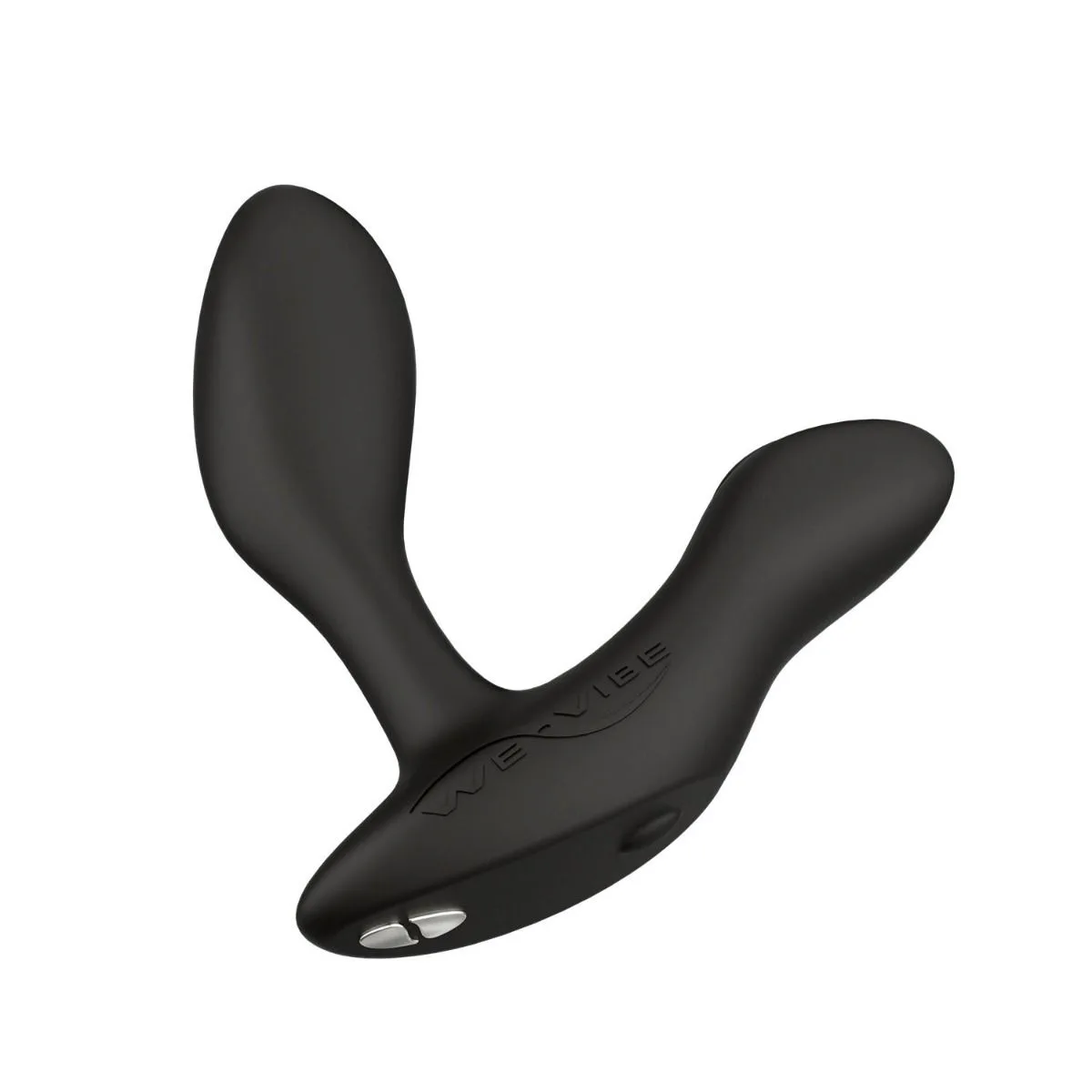
We-Vibe Vector+ is a prostate massager with two motors, an insert arm that can be bent to the right angle, and an outer arm that rests against the perineum. It can be controlled in three ways: with a single button on the product, with the wireless remote control that is included in the package, or with the We-Vibe app via Bluetooth. The manufacturer places it in the anal stimulation category and describes it as a rabbit-type anal vibrator for double stimulation.
According to We-Vibe, the specification looks like this: ten vibration modes on the product itself, runtime of up to two hours per charge, charging time 90 minutes via a magnetic USB cable, built-in lithium-ion battery that is not replaceable, and a two-year manufacturer’s warranty. The list price on the manufacturer’s own EU shop is 139 euro. In Sweden, the item is sold by six shops at prices between 1 079 and 1 499 SEK, and four of them had it in stock at the price check.
This review is exclusively about the black variant with EAN 4251460616850, the manufacturer’s item number SNVC2SG9, and the color Charcoal Black. We-Vibe sells Vector+ in two colors in the EU — Charcoal Black and Royal Blue — and Royal Blue has its own EAN, 4251460631518. The colors are functionally identical, but it’s worth checking the number when you compare prices, because several Swedish shops list both under the same product page and because the model name in the shops’ feeds alternates between "Vector" and "Vector+" for exactly the same item.
What’s interesting about this model isn’t the number of modes, but how it’s controlled. Two motors that can be regulated independently, a remote control that sits in the box instead of being sold separately, and an app that adds twelve pre-made patterns and custom ones. What’s less interesting is how little the manufacturer actually publishes about the product: neither dimensions, weight, material, nor an enclosure protection class is available on We-Vibe’s own product page. We’ll come back to each such gap in turn below, because they affect what you can reasonably expect.
A prostate massager is shaped to rest against the prostate, which sits a few centimeters inside the rectum against the abdominal wall. The design therefore differs from a standard anal plug in two ways. The insertion part is curved instead of straight, so that the bulb-shaped tip presses upward against the right spot when the product is in place. And the base is wide and angled, partly so the product can’t slide in, and partly so the outer arm reaches the perineum — the area between the scrotum and the anus opening.
Two motors mean that the two arms vibrate independently of each other. The manufacturer lists Vector among its products with dual motors, and describes the design as dual stimulation of the prostate and the perineum at the same time. What can be established purely technically is that a single motor in the base can never provide the same thing: vibrations are greatly dampened when they have to travel through a narrow silicone neck, and a product with one motor therefore always delivers more in the end where the motor is located.
However, the point of two motors becomes real only when they can be controlled separately. Here there is an important limitation that’s easy to miss: the button on the product only steps between the ten pre-set modes, and the remote control has buttons for intensity and for browsing between patterns. It’s in the We-Vibe app that the Multi Vibe function lets you take control of the two motors independently. So if you want strong vibration at the prostate and weak vibration at the perineum, then the app isn’t an extra feature—it’s the prerequisite.
This is the most common source of confusion about the model, and it shows up directly in the shop flows: the same EAN is sold under the names “We-Vibe Vector”, “We-Vibe Vector+” and “We-Vibe Vector+ Charcoal Black” at different stores. The manufacturer’s own product page is named Vector, but the page headline is Vector+, and the article number SNVC2SG9 is linked to gtin 4251460616850 in the page’s variant table.
The difference between the generations is made clear by the manufacturer’s own material. The packaging in We-Vibe’s own product image is labeled “Vector+” with the addition “+ new remote”, and the two editions of the manufacturer’s manual state different remotes: the downloadable PDF manual from October 2022 describes a remote with the model designation R-WVG3A, which is powered by a CR2032 coin-cell battery, while the online manual for Vector+ indicates the model designation R-WVG3B and a 4LR44 battery.
That means the remote control that comes with it today does not necessarily use the same battery as the one in the PDF manual that the manufacturer links to from the product page. Check which battery is in your device before you buy a new one — 4LR44 and CR2032 are completely different cells and cannot be swapped for each other. The fact that the manufacturer lets both documents be up at the same time without marking which one applies to which edition is a real documentation shortcoming, and it’s easy to tell which one is which.
The toy itself has the same model number, 10000-02, in both manuals. That suggests that the remote control has been updated, not the massager. However, the electrical labeling also differs between the documents: the PDF manual states 3.7 V 0.5 A for the built-in battery, while the online manual states 3.7 V 0.32 A. Which figure applies to a product bought today is not clear.
The material issue is the only feature of an anal product that can’t be made up for with experience or care. An anal product sits against mucous membranes, and mucous membranes absorb substances faster than normal skin. Here, however, is the first real objection to this model: We-Vibe provides no material declaration at all on the product page for Vector+. While other manufacturers list materials, dimensions, and weight in a specification table, We-Vibe only has marketing text, a table of contents for the packaging, and a link to the manual.
What the manufacturer, though, writes in its general FAQ is that We-Vibe products are made of either body-friendly silicone or body-friendly PC-ABS plastic, and that the range complies with the EU regulation REACH and the RoHS directive. The Vector+ manual also indirectly but unambiguously assumes silicone: it explicitly warns against using silicone-based lubricants on silicone products, an instruction that only makes sense if the product is made of silicone.
Silicone is a non-porous material, and that’s the whole point. A non-porous surface can be cleaned, because there are no microscopic cavities where residue can remain. On a product that’s used anally, that’s crucial: gut flora on a porous surface can’t be washed away — you can only throw it away. That’s also why the manual requires disinfection directly after each anal use and forbids moving the product from the anus to the vagina without cleaning in between.
The part that can be established based on the manufacturer’s own product images is that the entire product is covered in the same matte, seamless surface — the insertion arm, the neck, the base, and the outer arm. There is no visible seam between a silicone part and a plastic part, which is a real difference compared to cheaper designs where only the insertion part is silicone. The only visible hard details are the two magnetic charging pins at the front edge of the base and the small control button.
Phthalates are a group of plasticizers used to make plastic — especially flexible PVC — pliable. The Swedish Chemicals Agency (Kemikalieinspektionen) describes them as substances that can affect the endocrine system and make reproduction more difficult, and several of them are therefore restricted or prohibited within the EU. The product category sex toys is repeatedly subject to supervision for exactly that reason: it contains soft plastic against the skin and mucous membranes.
In its FAQ, We-Vibe refers to the fact that the range complies with REACH, which among other things restricts phthalates through Annex XVII, and to RoHS, which restricts lead, mercury, cadmium, and a number of flame retardants in electronics. The manufacturer also states that the products are tested by independent laboratories. It’s a credible commitment at the range level — but it’s worth noting that it is not a product-specific declaration for Vector+, unlike manufacturers that write “phthalate-free, BPA-free, and latex-free” directly on each product page.
Silicone itself does not need any phthalate plasticizers to become soft — the softness comes from the polymer’s own structure. That makes silicone as a material specification a better sign than almost any other item in a specification, and that’s why the missing material line on the product page is a bigger problem for the comparison than for safety.
The answer here has to be direct. We-Vibe does not publish either length, width, insertion depth, diameter, or weight for Vector+, either on the product page, in the online manual, or in the downloadable PDF manual. It’s remarkable in a product category where the fit determines everything: a prostate massager that’s too long presses the wrong way, and one that’s too thick can’t be used comfortably.
The measurements that circulate in Swedish stores come from the stores themselves. One of the six stores lists the insertion part as 8.5 centimeters and the diameter as 3 centimeters. So that information does not come from We-Vibe, and it should be read as an indication, not as a specification. International retailers also state different values for the same model among themselves, which is exactly what you would expect when the original source is missing.
What can be concluded then? The manufacturer’s own product images show the product being held in a hand, and there’s enough room for the entire toy to span across four fingers with a margin. Compared with the two closest competitors — Lovense Edge 2 with an insert piece of 91 millimeters and Lelo Hugo 2 with 72 millimeters — the retailer’s 85 millimeters places it in the middle. It’s reasonable based on the images, but it isn’t the same as a manufacturer value, and it shouldn’t be presented as such.
The shape, however, is what the manufacturer describes in detail: the insertion arm has a tapered tip and a narrow neck to make it easy to insert, while the bulb-shaped part higher up provides pressure against the prostate. The outer arm is described as flexible and directed toward the body. It’s a classic rabbit geometry adapted for anal use, and it’s the tapered tip that makes the model work for someone who hasn’t had experience with this beforehand.
The interface on the product itself consists of a single button, placed on the base. According to the manufacturer’s manual, a press on the button on the product steps you through to the next mode, and each additional press steps you further to the next of the ten vibration modes. It’s a deliberately simple setup, and it has an obvious advantage in this product category: the button is located on a part of the product that sits outside the body and that you can find without having to see it.
The downside of that same simplicity is that one button can’t do very much. You can’t move backward in the list, and you can’t adjust the two motors independently. If you want fine-grained control, you need the remote control or the app, and that’s where the model’s real functionality lies.
The manufacturer’s manual lists the modes in order: Low, Medium, High, Ultra, Pulse, Wave, Echo, Tide, Crest, and Surf. So the first four are straight intensity levels without rhythm, and the following six are patterns. It’s more information than most manufacturers provide — many are satisfied with stating a number — and it’s useful precisely because it tells you where in the list you are.
What that means in practice is that with the button on the product you step through four fixed strengths before the patterns begin. If you want the most even vibration, it’s in position four, not position ten. It’s a detail that’s easy to miss, and that’s why many describe the product as weaker than it is: once you get into the pattern part of the list, the perceived intensity drops because the patterns have built-in pauses.
The manufacturer publishes no frequencies or amplitudes for the motors, and no information about which motor is the strongest. For comparison, Lelo for Hugo 2 states that the motors work at 130 and 108 hertz, respectively. No corresponding information is available for Vector+ in any of the manufacturer’s documents.
The remote control is included in the package and is delivered ready-paired with the product according to the manual. It is worth highlighting this, because several competitors in the same price range either completely lack a remote control or sell it as a more expensive bundle option. The manufacturer’s overview image names five buttons: one to increase intensity, one to decrease it, two to scroll between patterns, and a We-Vibe button.
The range is stated in the PDF manual as up to 9 meters in line of sight and about 6 meters within 360 degrees. In its FAQ, the manufacturer is significantly more cautious and writes that a stable connection can be expected within 3 meters from the toy. Both pieces of information come from the same manufacturer and differ by a factor of three. Use the lower figure if the connection is to be reliable—the body itself is an obstacle between a product that is in place and a remote control that is lying on a nightstand, and Bluetooth at 2.4 gigahertz is heavily attenuated by water and tissue.
The remote control is powered by a non-rechargeable coin-cell battery, which is replaced by pulling off the bottom cover. The online manual for Vector+ states 4LR44; the older PDF manual states CR2032 for the previous remote control model. So the remote control is not fitted with a rechargeable battery, and it contains a coin-cell battery that, according to the manufacturer’s own warning text, can cause serious injuries if swallowed.
One limitation, taken directly from the manual: the product can only be paired with one remote control or one app device at a time. If you want to switch between the remote control and the app, you must first leave the app and then re-pair the remote control. This is likely the most common reason the remote control “stops working” after the app has been used.
The app is what distinguishes this model from a remote-controlled anal plug without connectivity. The manufacturer states that the app includes twelve preset vibration patterns plus the ability to create your own, and a function called Multi Vibe that, with one press, lets you control two motors separately. There is also Touch Mode, where the intensity follows how quickly you drag your finger across the screen, and Playlist Mode, where you chain together patterns with your own order, intensity, and duration.
The remote function is We-Vibes’s historical specialty. The product is paired with the phone that is within Bluetooth range, and the partner receives an invitation in the app and takes over control over the internet. Chat and video calling are in the same app. The connection to the toy itself always happens locally via Bluetooth—internet is only used between the phones.
The requirements are worth checking before you buy. The manufacturer states that the app requires Bluetooth LE, meaning Bluetooth 4.0 or later, and that it does not work with smartwatches, PC, or Mac. Pairing is done by scanning the barcode on the package—so save the box until the product is connected. The manual also describes the option to press and hold the control button for five seconds until the product vibrates twice and the LED starts blinking.
A realistic point about app-controlled products in general: the functionality depends on the manufacturer continuing to maintain the app and keeping it available in the App Store and Google Play. This applies to every app-controlled model in this category, including Lovense Edge 2 and Lelo Hugo 2, and it’s one of the few risk factors that you can’t see anywhere in a specification table.
The manufacturer highlights adjustability as the model’s main selling point, and that’s a reasonable choice. The manual shows an adjustment point marked with a dot in the illustration, and states that the position of the insertion arm can be fine-tuned there. The instruction is also clear: bend carefully, otherwise the product can be damaged.
Why it matters is easy to describe. The position of the prostate in relation to the anal opening varies from body to body, and a fixed angle that suits one person makes the next person’s experience less than ideal. The difference between a product that does exactly what it’s supposed to and one that is mostly just uncomfortable often comes down to a few degrees. Bending the arm once and letting it stay in that position is therefore a more meaningful feature than another five vibration patterns.
What can be concluded from the manufacturer’s wording is that it’s about “small adjustments” to the position, not about being able to freely reshape the product. It’s therefore a fine-tuning within a limited range—somewhat like the bendable neck on Lovense Edge 2, where the manufacturer describes the same thing in other words. If you’ve tried a fixed prostate massager that didn’t get the positioning right, this mechanism is the strongest argument for moving on to this particular model.
The outer arm, in turn, is described as flexible and oriented toward the body, so that it rests against the perineum. It doesn’t require any active adjustment moment—the shape follows the body once the product is in place. It’s also the arm that determines whether the product stays put when you move, because it works as counterforce to the inner arm.
Water resistance is not a comfort issue with an anal product—it’s a hygiene issue. If the product can’t be rinsed under running water, then it also can’t be cleaned properly, and that’s exactly the category where cleaning is mandatory after every use.
The reporting has to be exact here. We-Vibe does not state any IPX class for Vector+ on the product page, and none in the online manual either. The only enclosure information in the manufacturer’s material is in the downloadable PDF manual’s symbol list, and it contains two symbols: splash protection (IPX4) and waterproof (IPX7).
Which symbol applies to which part is shown in the cleaning section of the same manual. There, the manufacturer states that Vector is rinsed with warm water and a toy cleaner and dried with a lint-free cloth, while the We-Vibe remote control must not be submerged in water and is to be cleaned with a damp cloth and mild soap. The reasonable reading is that the toy uses the IPX7 symbol and the remote control uses the IPX4 symbol. It is an interpretation based on the manufacturer’s own instructions, not a published value, and that difference has to remain in plain text.
IPX7 is defined in the international standard IEC 60529 as submersion in water to a depth of one meter for 30 minutes. IPX4 means protection against splashing water from all directions, so not submersion. The consequence in everyday life is concrete: the toy can be rinsed under the tap and used in the shower or bath, but the remote control must be kept dry. Don’t place it on the edge of the bathtub.
The comparison is interesting here. Lovense states IPX7 outright for Edge 2, and Lelo states that Hugo 2 is completely waterproof. So We-Vibe is the only one of the three that leaves the question open on the product page for a product in the same price class. It’s an unnecessary gap, and it costs the model points in this review.
The manufacturer’s instructions are brief: rinse with warm water, feel free to use a toy cleaner, and dry with a lint-free cloth. The safety section adds what is specific for anal use—disinfect directly after each anal use, and never move the product from the anus to the vagina without first cleaning it with soap and water or toy cleaner. The latter is the single most important hygiene rule in the entire text.
The manufacturer is just as clear about lubricant. Use water-based lubricant. Do not use fragranced or alcohol-based lubricants, gels, or massage oils, and do not use silicone-based lubricant on silicone products. Silicone-based lubricant breaks down the silicone surface over time and makes it porous, and a porous surface can no longer be cleaned properly—so you may as well throw it away. A 2 ml test sample of We-Vibe’s own water-based lubricant, made by pjur, is included in the package.
A generous amount of lubricant is also a safety issue with anal use, not just a comfort issue. The manufacturer’s manual states plainly that insufficient lubrication can cause small tears in the sensitive rectal mucosa. There is no natural self-lubrication there, and it’s by far the most common cause of injuries in this product category.
A storage bag in linen is included. Store the product dry, away from direct sunlight, and let it air-dry before putting it away. Two warnings from the manual belong here: the product and its battery must not be exposed to temperatures above 45 degrees—boiling water and the dishwasher are therefore out of the question—and the product contains magnets, which means it should not be used directly over a pacemaker and that cards with a magnetic stripe should be kept away from it.
The manufacturer states a runtime of up to two hours per charge and a charging time of 90 minutes. These are reasonable figures in this category, and they’re also favorably worded compared to the competition: Lelo lists up to one hour of runtime for Hugo 2, and Lovense lists 65 to 130 minutes for Edge 2 depending on which level is used.
Charging is done via a magnetic charging cable that attaches to two charging pins in the product’s base and is connected to any USB port or a USB adapter. The cable is included in the package. The manufacturer’s manual specifies 5 V 0.5 A during charging and emphasizes that only the included cable should be used.
Magnetic charging is a trade-off, not a pure advantage. The advantage is that there’s no need for an opening in the housing, which is a prerequisite for being able to rinse the entire product under running water. The downside is that the cable is product-specific: if you lose the charging cable, no normal USB-C cable will work, and you’ll have to get a replacement. We-Vibe’s warranty terms also expressly exclude consumable parts such as batteries and charging cables, so a broken cable is always your own cost. The same applies, by the way, to Lovense Edge 2, which is also charged magnetically.
The manufacturer recommends charging the product regularly even when it’s not in use, so the battery lasts longer. Do not charge and use the product at the same time, and never submerge the charging cable in water.
We-Vibe does not publish battery capacity in mAh for Vector+. What the manufacturer states is an electrical rating: 3.7 V 0.32 A for the built-in lithium-ion battery according to the online manual, and 3.7 V 0.5 A according to the older PDF manual. A rated current is not a capacity, and it can’t be converted to operating time without assuming things about consumption. On top of that, the two documents also list different values, meaning that even the rating is not unambiguous.
Competitors do better on exactly this point. Lelo lists 420 mAh and 3.7 V for Hugo 2, plus 90 days of standby time. Without the capacity, you can’t assess how heavily the cell is being loaded relative to the operating time, and therefore you also can’t estimate how many charge cycles the product realistically holds.
What generally applies to lithium-ion batteries applies here too: capacity decreases with the number of charge cycles. According to the manufacturer’s manual, the battery is not replaceable, and you shouldn’t try to remove it yourself. With use a couple of times a week, it’s the battery, not the silicone, that sets the limit for lifespan—and because the cell is permanently built in, the product is effectively used up when the battery is.
One last technical detail from the manual that rarely appears elsewhere: the radio part operates at 2402–2480 MHz with a maximum output power under 20 dBm, both in the product and in the remote control. These are standard values for Bluetooth Low Energy, and they confirm that the product doesn’t differ from any other Bluetooth device in that respect.
We do not have price data from shops in your market yet.
Two motors, a remote control in the box, and a two-year warranty—but no dimensions, weight, or enclosure class published. You buy function, not facts.
Two comparisons are relevant, and both apply to products designed in exactly the same way: a flexible or adjustable insertion arm for the prostate, an outer arm toward the perineum, two motors, and app control. All the details below come from each respective manufacturer’s own specifications, and all prices come from the stores’ product feeds on 29 July 2026.
Lovense Edge 2 costs from 1 095 SEK and was in stock at all eight stores that list it. We-Vibe Vector+ costs 1 182 SEK at the cheapest store that had it on hand. The difference is 87 SEK—practically the same price tag.
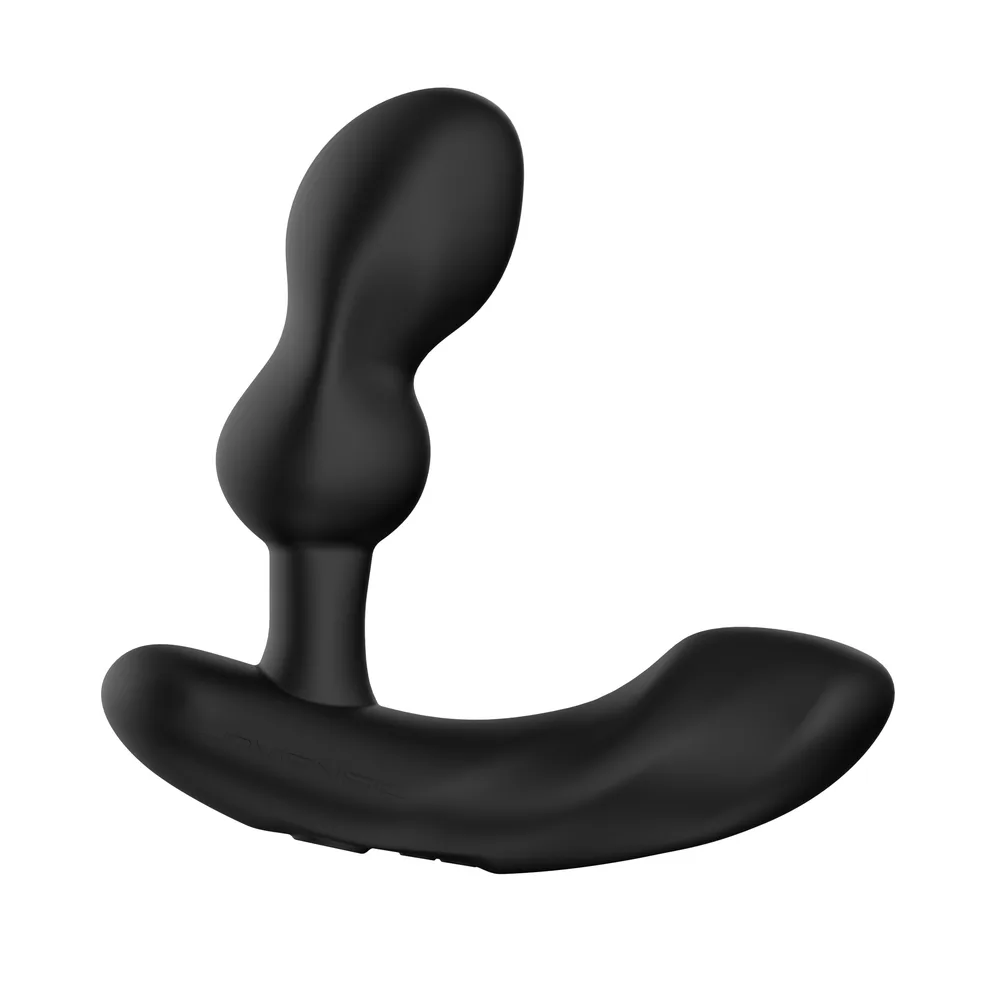
Edge 2 has two separate motors, a flexible neck, and app control just like Vector+. Where the difference becomes clear is in what the manufacturers publish. Lovense lists the weight as 151.3 grams, the insertion part as 91 millimeters, the largest diameter as 35 millimeters, IPX7 right out, operating time 65 to 130 minutes depending on level, charging time of about 100 minutes, and a measured sound value of 43 decibels. We-Vibe publishes none of this for Vector+.
Vector+ wins, however, on three points. It has a two-year warranty, while Lovense has one year. It also includes a remote control in the package, which Edge 2 does not have — with Edge 2, you need the app or the button. And the manufacturer states up to two hours of runtime, which at best is comparable to Edge 2’s 130 minutes but at worst is almost twice as much as its 65 minutes at a high level.
Conclusion: if you want a remote control without having to buy anything extra and have a warranty that’s twice as long, Vector+ is the choice. If you want to know exactly what you’re buying before you pay—measurements, weight, water resistance, and sound level—Edge 2 is the only one of the two that answers the questions.
Lelo Hugo 2 in black costs from 931 SEK and was in stock. That is 251 SEK less than the cheapest in-stock Vector+, i.e. 21 percent lower for a product in the same category and from a comparable brand.
Lelo’s specifications are the most complete of the three: dimensions 104 × 107 × 41 millimeters, insert piece 72 millimeters, weight 121 grams, body material skin-friendly silicone and ABS plastic, battery Li-Ion 420 mAh 3.7 V, runtime up to one hour, standby 90 days, charging time up to two hours at 5.0 V 500 mA, ten settings of which four on the toy and six via the app, motor frequencies 130 and 108 hertz, maximum sound level under 60 decibels, fully waterproof, plus a two-year warranty and a ten-year quality warranty.
Where Vector+ catches up is in the runtime and in the length of the insert piece. Two hours versus one hour is a real difference in everyday life, and Hugo 2’s insert piece of 72 millimeters is shorter than what the retailer listing states for Vector+. Hugo 2 is also a product made of silicone and ABS plastic, according to Lelo’s own material specification—so it’s not all-silicone.
Conclusion: Hugo 2 is cheaper, better documented, and has a longer quality warranty, but half the runtime. Vector+ is more expensive and worse documented, but it lasts longer on a charge and has an adjustable insert arm rather than a fixed shape. If you choose based on the spec sheet, Lelo wins. If you choose based on fit and endurance, there’s an argument for We-Vibe.
Six Swedish stores sell the item with EAN 4251460616850. Cheapest in the feed is Blush Me at 1,079 SEK, and most expensive is Lustly at 1,499 SEK. That’s a 420 SEK difference, or 39 percent, for the exact same item number, same color, and same packaging.
However, the stock situation changes the picture completely. Both the cheapest and the most expensive store were out of stock of the product during the price check. Of the four stores that had it at home, Joyland was cheapest at 1,182 SEK, followed by Vuxen at 1,196 SEK, Vuxenkul at 1,399 SEK and Mshop at 1,495 SEK. The real range for someone who wants to buy today is therefore 1,182 to 1,495 SEK — 313 SEK or 26 percent.
The difference between the two cheapest stock-listed shops is 14 SEK. In that situation, shipping cost and delivery time matter more than the price, and both of those details can change without the feed being updated. Shops that list a product as sold out often keep an old campaign price in the feed, and that price is rarely what you pay when the item comes back in again— the 1,079 kronor listing should therefore be read as a historical fact, not as an offer.
The price spread isn’t because any shop sells a different variant. All six list the item under EAN 4251460616850 or under their own article number tied specifically to the black Vector+. The fact that the model name varies between “Vector” and “Vector+” in the shops’ headlines is a naming problem at the shops, not a sign of different products.
As a reference point: the manufacturer’s own list price in the EU shop is 139 euro. The prices in the table above are updated when the shops’ product feeds are updated, but always check the final price at checkout.
It’s for you if you want a prostate massage that can be fine-tuned to your body instead of one with a fixed angle. It’s for you if you want to be able to hand over control to someone else—either with the remote control in the same room or with the app at any distance. It’s for you if you want two motors that can be adjusted independently—provided you also plan to use the app, because that’s where that feature is available. And it’s for you if you want long operating time without having to think about charging between uses.
It’s not for you if you want to know exactly what you’re buying before you pay. Neither dimensions, weight, material, nor protection class are published for this model, and in that price range, it’s a reasonable thing to require. It’s not for you if you’re unsure whether the insert size will work for you for the same reason. It’s not for you if you want a product that works fully without an app, because the button only steps through ten preset modes. And it’s not for you if you want to be able to charge with the same cable as your phone—the charging cable is magnetic, product-specific, and excluded from the warranty.
One more thing belongs in the decision. This is a product that becomes noticeably better when two people use it together, because both the remote control and the distance function are built for that. If it’s used alone, most of what you pay is for something you’re not using, and then a simpler, non-connected model is the more rational deal.
The manual for Vector+ includes an unusually detailed safety section for anal products, and it deserves to be quoted because it is rarely found in store texts. Use plenty of lubricant—insufficient lubrication can cause tears in the sensitive rectal mucosa. Never try to insert the product completely; the outer arm and base should sit comfortably outside the body. If the product should nevertheless end up inside, seek medical care immediately.
Do not use anal products under the influence of alcohol or drugs, because your judgment is affected and the risk of injury increases. Do not use numbing sprays or creams before insertion—they disable the pain signal, and the pain signal is the only protection there is against injury. Also do not use the product if you have reduced pain sensation in the area.
The manufacturer also lists a number of conditions where doctors should be consulted before use: a blood clotting disorder, peripheral vascular disease, a nervous system disorder, bleeding from the anus, and active Crohn’s disease or active ulcerative colitis. The product is expressly sold as a novelty item and is not intended for medical purposes. If complications occur, discontinue use and seek care.
We-Vibe provides a two-year manufacturer warranty. The terms specify the period as 24 months counted from the first delivery to the customer, however no more than two years after the manufacturing date. The warranty covers manufacturing defects, and a valid receipt is required to be able to file a claim. Defects must be reported within two months from when the defect was discovered or should have been discovered.
Read the exceptions before counting on the warranty. It does not apply to normal wear and tear or intentional damage, incorrect use, force majeure, or repair attempts by a third party. It also does not cover consumable parts such as batteries and charging cables, or seals. In practice, this means that the parts most likely to break first—the charging cable and the coin-cell battery in the remote control’s button—are outside the warranty.
We-Vibe’s 100-day satisfaction guarantee is often quoted in store texts, and it is worth a clarification. According to the manufacturer, it applies only to purchases in We-Vibe’s own web shop, it provides a value voucher to choose another product of similar value rather than getting money back, and it can be redeemed for one item per order. So if you buy from any of the six Swedish stores listed above, you are therefore not covered by it.
What always applies, however, are your statutory rights. Under the konsumentköplagen (the Swedish Consumer Sales Act), you have three years to complain about defects in the item, regardless of what the manufacturer promises—so one year longer than We-Vibe’s own warranty. For purchases made at a distance, you also have a right of withdrawal within fourteen days under the lagen om distansavtal och avtal utanför affärslokaler (the Act on Distance Contracts and Contracts Outside Business Premises). Be aware that, in practice, the right of withdrawal is limited for hygiene products that have been removed from a sealed package—however, the right to complain about defects always applies. If you have questions about what applies in your case, Konsumentverket (the Swedish Consumer Agency) guides you via Hallå konsument.
We-Vibe Vector+ is ranked på plats 8 av 15 in prostate vibrator best i test, where the entire category is compared against each other using five shared criteria. Guiden vinns av Svakom Iker Neo.
Every numerical piece of information in the text can be traced to one of the sources below. The links were checked manually on the specified date.
This page is machine-translated from Swedish. Read the Swedish original