

Review
Review: We-Vibe Melt 2
We-Vibe air pressure stimulator — same app, entirely different technology.
29 July 2026
Review · Wand vibrator · Cordless massage wand with app
We-Vibe’s cordless massage wand reviewed against the manufacturer’s own specifications and price data from nine Swedish stores. Ten intensity steps, app control over Bluetooth, body-friendly silicone all over the body, IPX7 according to IEC 60529, and a 270-millimeter length according to the manufacturer’s own dimension sketch — but only two hours of runtime and a two-year warranty.
The only wand in the comparison that is full-body silicone, and one of the few that is app-controlled. Flexible neck, IPX7, and the locking latch are genuinely useful features, and the stock situation is unusually good. What you pay with is the runtime: two hours is half of what the Lelo Smart Wand 2 Large states for 85 SEK more, the charging time is at least as long as the runtime, the warranty is only two years, and We-Vibe does not publish battery capacity, weight, frequency, or sound level.
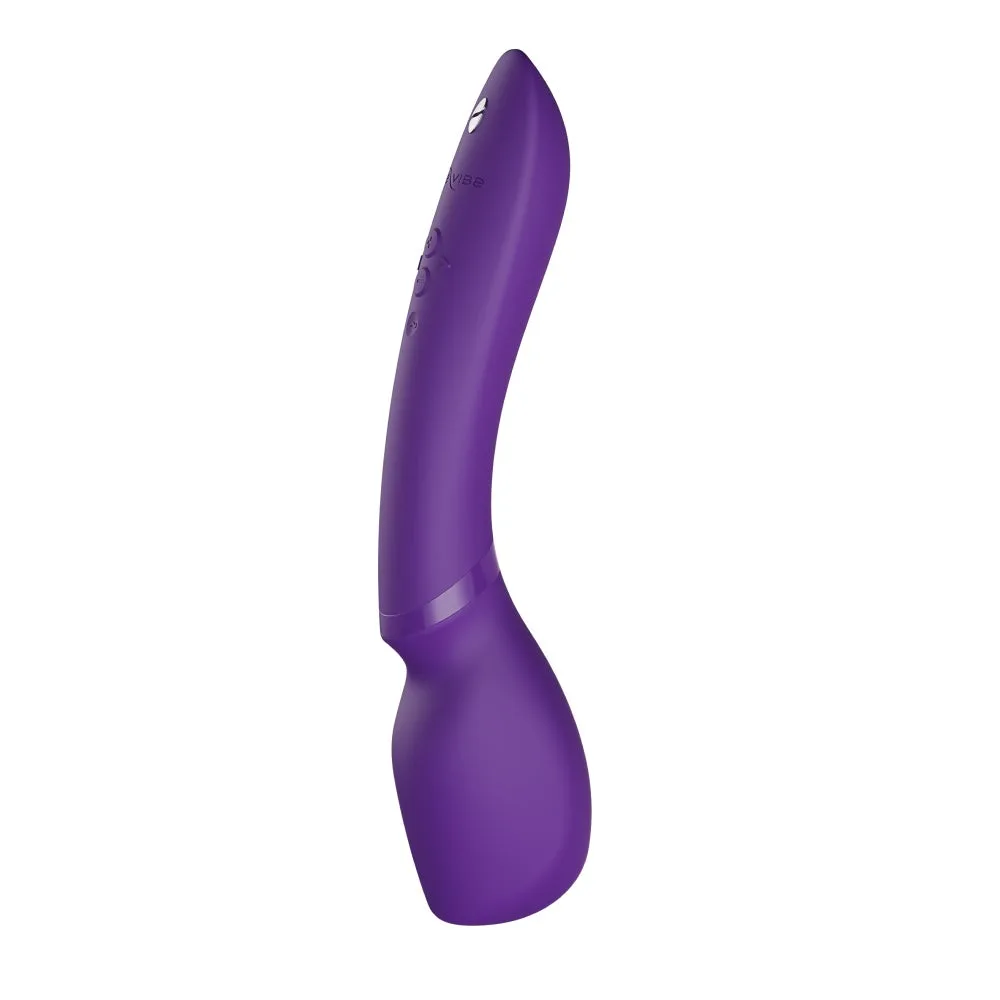
We-Vibe Wand 2 is the brand’s cordless body massager, and the product that We-Vibe itself markets as its most powerful vibrator. Unlike the rest of We-Vibe’s range, which largely consists of small products for a specific area of the body, Wand 2 is a full-body massager: a long handle with a large, rounded stimulation head at the end. The manufacturer classifies it in the category of body massage devices and provides the model designation "cordless body massager".
The specification looks like this: ten intensity levels set with the plus and minus buttons, control via the We-Vibe app over Bluetooth, an IPX7 ingress protection rating, up to 120 minutes of operating time, a USB-rechargeable lithium-ion polymer battery, body-friendly silicone, and a two-year warranty. The manufacturer’s own dimension sketch shows 270 millimeters in length and 55 millimeters in width. In Sweden, the item is sold by nine stores at prices between 1 101 and 1 595 SEK, and five of them had it in stock at the price check.
This review is exclusively about the purple variant with EAN 4251460623124. We-Vibe uses it internally as the article number SNWD2SG4, and in the manufacturer’s technical documentation the product is called WND20B. On We-Vibe’s own European store, it costs 159 euros. That figure is worth having on hand because it shows where the manufacturer places the model within its own lineup: in the middle of the price range, not at the top.
The wand category originated in massage wands for the neck and back, and that shape remains: a long shaft that provides reach and leverage, and a large head that distributes the vibration over a broad surface instead of concentrating it on one point. That’s the fundamental difference from a clitoral stimulator like the We-Vibe Melt or Womanizer Next, which works on a limited area — and from air-pressure products, which don’t vibrate at all but create pressure waves in a sealed chamber.
The consequence of the broad contact surface is that a wand places completely different demands on the motor. The larger the area that needs to be set in motion, the more energy it takes, and that’s the whole explanation for why wands are consistently larger, heavier, and more power-hungry than small stimulators. We-Vibe describes the vibrations as deep and "rumbly" — a word used in this product category for low-frequency vibration that travels through the tissue, unlike high-frequency buzzing that stays at the surface. We-Vibe, on the other hand, does not publish any measured frequency figures for the Wand 2, which is worth noting because Lelo does for its wands: 80 Hz for the Smart Wand 2 Large and 60 Hz for the Medium.
What can be established without measurement data is that Wand 2 is cordless. That sounds trivial, but it is still the dividing line that separates the wand category into two parts: the classic models run on wall outlets and therefore have unlimited operating time but a cord to deal with, while the battery-powered ones are free but limited by the cell. Wand 2 belongs to the latter group, and the manufacturer states the operating time as up to 120 minutes.
Three We-Vibe products are regularly mixed up in Swedish store lists, and the difference between them is greater than the names suggest.
In practical terms, that means that a comparison between Wand 2 and Melt 2 is a comparison between two different ways of solving two different problems, not between a more expensive and a cheaper variant of the same thing. Check the EAN number before you order—stores often use the same product image for the entire family, and the price differences between the items are large enough that a wrong order costs money.
Material is the only characteristic of an intimate product that can’t be compensated for with experience or care, and it determines whether the product is still hygienic after five years. We-Vibe specifies a single material for Wand 2: body-friendly silicone, free from phthalates and BPA, and made without latex. This applies to the entire product, both the head and the handle.
Silicone is a non-porous material. A non-porous surface can be cleaned because there are no microscopic cavities where residues can get left behind. This is the single most important property of a material that is meant to lie against mucous membranes, and that is why the material declaration weighs more than almost all other lines in a specification.
Having the entire body covered in silicone is a real difference versus the competitors in this category, and it’s worth pointing out because it isn’t standard. Both Lelo Smart Wand 2 and Satisfyer Wand-er Woman are, according to their respective manufacturers, combinations of body-friendly silicone and ABS plastic, meaning silicone on the contact surface and hard plastic in the shaft. The seam between the two materials is always the place where dirt collects first, and a product without such a seam is easier to keep clean over time. Silicone also has higher friction against skin than polished ABS plastic, which, purely in physical terms, means more grip when the surface is wet or has lubricants on it—not insignificant on a product that is IPX7-rated and is expressly intended for showering and bathtubs.
The opposite of full silicone also has a consequence that’s easy to miss: the stimulation head on Wand 2 is fixed in place. There are no interchangeable tips and no removable head whose inside needs to be cleaned separately. That makes cleaning easier than on air-pressure products with a removable chamber, but it also means you can’t change the fit if the head’s size doesn’t suit you. What you see in the box is what you get.
Phthalates are a group of plasticizers used to make plastic—above all, softened PVC—pliable. Kemikalieinspektionen describes them as substances that can affect the hormone system and make reproduction more difficult, and several of them are therefore restricted or prohibited within the EU in a large number of products. This specific product category is a recurring subject of oversight, because it contains pliable plastic against the skin and mucous membranes.
We-Vibe states that the material in Wand 2 is free from phthalates and BPA and made without latex. It’s a clear-cut declaration, unlike labels such as "TPE" or "jelly rubber," which say nothing at all about which plasticizers are included. Silicone doesn’t require phthalate plasticizers to become soft—the softness comes from the polymer’s own structure—and that’s why silicone as a material specification in itself is better information than nearly any other item in a product specification.
The latex information is relevant for the person who’s allergic to latex. Latex allergy causes reactions on mucous membranes faster than on regular skin, and an intimate product is exactly the kind of use where this information matters. Having the manufacturer state it is a plus, and it isn’t a given: many manufacturers are content with listing the material and leaving the allergy question unanswered.
We-Vibe does not provide any measurements in the specification table on the product page. Instead, there is a dimension sketch in the manufacturer’s own product gallery, and it indicates the total length as 270 millimeters and the width as 55 millimeters. The sketch also shows the placement of the buttons on the top side of the handle. We-Vibe does not state any depth measurement or any weight at all, either in the table, in the sketch, or in the online manual.
There are numbers in circulation, but they do not come from the manufacturer. A large American retailer lists 273.8 × 65.5 × 56 millimeters, meaning it is just under four millimeters longer and a little over ten millimeters wider than We-Vibe’s own sketch. The difference is likely a matter of what is being measured—outer dimensions at the widest point of the head versus the width at the handle—but since neither source specifies this, the retailer’s figure should be read as an approximate value and nothing else. The weight figures provided by retailers are also rounded to the nearest pound, which makes them unusable for comparison.
What can still be established is the size order of magnitude, and that is relevant. At 270 millimeters, the Wand 2 is shorter than both the Lelo Smart Wand 2 Large, which Lelo states as 304 millimeters, and the Satisfyer Wand-er Woman, which Satisfyer states as 340 millimeters. So it is not the largest wand in the category—but it is still a product that requires a fairly large box and does not fit in a small toiletry bag. For comparison, the Lelo Smart Wand 2 Medium is listed at 210 millimeters.
The single most singled-out design detail on the Wand 2 is the neck between the handle and the head. We-Vibe describes it as flexible and justifies it by saying it should provide the right amount of pressure in all positions, and the manufacturer’s own product images show the wand bent in a clear arc between two hands. So what can be established is that flexibility is an intended design feature—not a manufacturing tolerance.
What that means in practice is that the pressure on the body becomes self-regulating in a way that a completely rigid wand cannot. With a rigid wand, the entire hand’s pressure is transferred directly, and you have to dose with your wrist. A flexible neck gives way at a certain level of resistance and thereby puts a cap on the pressure. The downside of the same feature is just as predictable: if you want to press hard, you can’t, because the neck folds instead. We-Vibe publishes no measurement of how many degrees the neck bends or how much force is required, so you can’t read out how much it actually gives from the specifications.
One more thing belongs here, because it affects durability. A moving joint in a product that is otherwise fully molded is the point where the material works the most, and thus the point that is reasonably worn down first. We-Vibe’s warranty terms explicitly exclude wear parts. What counts as a wear part in this specific case is not specified by the manufacturer, and it is an ambiguity you should know about before you rely on the warranty.
The interface on the We-Vibe Wand 2 consists of five controls, and the manufacturer’s online manual names them all. The plus button turns the product on and increases the intensity. The minus button lowers it, and a long press turns it off. Two arrow buttons, forward and backward, step between vibration patterns. At the very bottom there is the We-Vibe button with the brand’s logo. On the back end of the handle, there are the magnetic charging pins.
Ten intensity levels are fewer than the fourteen that Womanizer states for its air-pressure products, but more than the five that Satisfyer states for the Wand-er Woman. The pattern within this product category is that the lowest steps are clearly spaced apart while the top steps are closer together, because the difference in effect per step decreases as the motor approaches its maximum. Expect that in practice you will return to two or three settings.
The manufacturer’s own product page uses two different wordings for the same thing, and it’s worth clearing up. In the feature box at the top, the heading says “10+ Intensity Levels” and states that the Wand 2 offers more than ten different intensity levels. Further down, in the section about how the product is used, it instead says that you choose between ten intensity levels with the plus and minus buttons.
The reasonable reading is that ten is the number of steps on the product itself, and that the plus sign refers to what’s added via the app. But We-Vibe never states what the plus sign stands for, and they also don’t say how many vibration patterns are built into the wand. The manual only states that the arrow buttons switch to the next or previous pattern, without counting them anywhere. It’s a striking gap in the documentation for a product whose interface has two buttons allocated solely for that function.
Smart Silence means the wand vibrates only when the head is in contact with skin. The function is turned on and off with the We-Vibe button according to the manual, and the manufacturer gives two reasons why it exists: it saves battery and it keeps the noise down. Practically, this means the product is quiet on the way from the nightstand to the body, which is exactly the stretch where a wand otherwise makes the most noise.
The lock feature is the function that deserves the most attention on a product of this size. The manual states that you activate it by holding down the plus and minus buttons at the same time for two seconds, after which the wand pulses twice and locks. The same command unlocks it again, and so does connecting the charging cable. On a 270-millimeter-long wand in a suitcase, that difference is between a checked bag and an awkward situation, and it’s one of the few functions in the category that has real practical value without being marketing.
However, there is a documented contradiction in the manufacturer’s own material that is worth knowing about. The product page states that the We-Vibe button is used to select pattern modes, while the online manual clearly says that this button turns Smart Silence on and off and that the patterns are changed with the arrow buttons. The manual is internally consistent and matches the button labeling in the manufacturer’s own dimension drawing, so it’s the product page’s wording that’s sloppy — but if you read the product page first, you’ll look for the wrong button.
Wand 2 is app-controlled, and it’s the function that most clearly sets it apart from a classic massage wand. The manufacturer’s technical documentation states that the radio works in the 2402–2480 MHz band, meaning the usual 2.4 GHz Bluetooth band, and that the maximum radio power is below 0.81 dBm. The latter is a very low transmitter power, which in practice means a short range.
Pairing is described step by step in the manual: hold down the We-Vibe button for five seconds, after which the wand vibrates twice and the LED starts blinking. Once the pairing is complete, it vibrates three times and the LED stops blinking. This matters here because you can’t see the LED when the wand is against your body.
What the app adds, We-Vibe states on its own app page. In Single Vibe mode, you can control the intensity in fine steps and choose from twelve vibration patterns or create your own. There’s also a Touch Mode where the pattern follows finger movements on the screen. Remote control works by having the wand paired to a phone within Bluetooth range, while the other party controls via the app over the internet—so it’s the phone next to the product that acts as the bridge, not the wand itself.
The app function is a real extension of the product, but it has a downside that rarely makes it into store descriptions. An app-controlled product depends on the manufacturer continuing to maintain the app and on it continuing to work with upcoming versions of iOS and Android. A button-controlled wand works just as well ten years from now as it does today; an app-controlled one only does if the app does. This isn’t an argument against Wand 2—the core functions are in the buttons and work without a phone—but it is a reason not to pay a premium just for the app.
The low transmitter power of under 0.81 dBm is also worth taking a closer look. It means that the range in the same room is short and that walls and bodies affect the connection. It doesn’t matter for normal use, but it means that “same room play” should be read literally: same room, not the same floor.
We-Vibe markets Wand 2 as whisper-quiet and says that the powerful, deep vibrations are surprisingly quiet and discreet. The question is what that means in numbers, and there the answer has to be honest: We-Vibe does not publish any measured decibel value for Wand 2, either on the product page or in the online manual. There is also no comparison chart with reference sounds, such as the one Womanizer publishes for its models.
What can be concluded is that, as a product category, a wand belongs to the louder groups—simply because the motor is bigger and sets a larger mass in motion. The fact that Smart Silence exists, and that it is justified specifically with the sound level, also suggests that the manufacturer itself considers sound something that needs to be addressed. Websites that provide an exact decibel number for Wand 2 either present their own measurement or a value without a source, and neither of those comes from We-Vibe.
A practical tip that applies regardless of model: place the wand on a soft surface between uses, and avoid running it against a hard tabletop. A hard surface works like a resonance box and noticeably amplifies the sound—and the effect is greater the bigger the product is.
Two marketing figures on the product page deserve the same treatment. We-Vibe says that 76 percent think that Wand 2 stimulates more strongly than other wand vibrators, and that 88 percent had an intense orgasm with it. Both figures are accompanied by an asterisk — but there is no footnote on the page that indicates the sampling, number of participants, or method. Treat them therefore as advertising, not as data.
We-Vibe Wand 2 is rated IPX7. The rating comes from the international standard IEC 60529, which defines enclosure classes for electrical equipment. The number 7 in the second position means the product is tested for submersion in water to a depth of one meter for 30 minutes. The manufacturer states the consequence simply on the product page: it can be used in a bathtub and in the shower.
The difference compared to a splash-resistant product is greater than the wording suggests. Splash protection covers water droplets and, at best, water jets, but not submersion. Such a product can handle a damp cloth and possibly a shower, but not a bathtub, and it should not be held under running water—without giving due thought to the buttons and the charging contact.
With IPX7, the entire product can be rinsed off without any caution. The fact that charging happens via magnetic pins instead of an opening in the housing is a direct part of the explanation: without holes, no rubber plug is needed that can be forgotten left open. If a product completely lacks an IP rating, it should be treated as not waterproof. The absence of a rating is never a sign that the product would be approved.
The manual’s guidance is short: rinse Wand 2 in warm water and dry it with a lint-free cloth, and feel free to use a cleaning product intended for intimate products. Since the head is permanently mounted, there are no cavities that need special attention—this is one of the few practical advantages of not having a detachable head.
The lubricant question is clear from the manufacturer. Use a water-based lubricant. Do not use fragranced or alcohol-based lubricants, gels, or massage oils. A silicone-based lubricant should not be used on silicone products—it breaks down the silicone surface over time and makes it porous, and a porous surface can no longer be properly cleaned, only replaced. Oil-based products such as coconut oil leave a film that is difficult to remove.
The manual also covers three things that rarely appear in store texts. The product and its battery must not be exposed to temperatures above 45 degrees—so boiling water and a dishwasher are out of the question despite IPX7. The product contains magnets, which means it should not be used directly over a pacemaker, and cards with a magnetic stripe should be kept away from it. And Wand 2 is explicitly not designed for anal use. The last point is especially relevant here, since the shape of a wand head can look like it invites it.
We-Vibe states the runtime as up to 120 minutes, and the manual repeats the same thing with the wording up to two hours of use per charge. The battery is listed as a USB-rechargeable lithium-ion polymer battery and, according to the manual, it is not replaceable.
Two hours of run time is the category’s weak point with this model, and it shows most clearly in the comparison with Lelo. Lelo states up to four hours for the Smart Wand 2 Large, which is double the time, and up to two hours for the significantly smaller Medium model. So the Wand 2 ends up at the Medium level for run time, even though it’s a product in the Large class in size and price.
Charging is done via magnetic charging pins on the end of the handle. The manual describes it plainly: place the charger against the magnetic pins. The manufacturer’s own image of what’s included in the packaging shows a white cable with a magnetic connector on one end and a standard USB-A connector on the other. The electrical rating is listed as 5 V and 1.0 A for USB charging, and the manufacturer points out that a USB power adapter isn’t included and that only the original cable should be used.
Magnetic charging is a trade-off, not a pure advantage. The advantage is that you don’t need an opening in the casing, which makes it easier to achieve IPX7. The downside is that the cable is product-specific: if you lose the charging cable, no regular USB-C cable works, so you have to get a replacement from the manufacturer. We-Vibe’s warranty terms also expressly exclude consumables such as batteries and charging cables, so a broken cable is always your own cost. Here, Wand 2 isn’t different from the Satisfyer Wand-er Woman, which is also charged with a magnetic USB cable, but it does differ from Lelo Smart Wand 2, which Lelo says is charged with a USB cord.
There’s a second contradiction in the manufacturer’s own material as well, and it concerns a number that actually matters. The product page’s specification table lists the charging time as up to 150 minutes. The manual states 120 minutes, with the wording that the product is ready after 120 minutes. The difference is half an hour, and We-Vibe provides no explanation for why the two documents say different things.
The most reasonable approach is to go with the higher value, because the product page’s table is the newer of the two sources of information and because a charging-time figure in a manual often indicates the fastest possible charging under ideal conditions. But what can be established is inconvenient either way: the charging time is longer than the run time. Wand 2 charges in at least two hours and then runs for up to two hours. Lelo Smart Wand 2 Large lists 2.5 hours of charging for four hours of run time—so a ratio of 1.6 versus Wand 2’s 1.0, or worse.
We-Vibe does not publish the battery’s capacity in mAh for Wand 2, either on the product page or in the online manual. It’s worth noting because competitors do: Lelo states 1050 mAh and 3.7 volts for Smart Wand 2 Large, and 520 mAh and 3.7 volts for Medium. Without the capacity, you can’t convert run time into power consumption, and you can’t compare how heavily the cell is loaded between models.
We-Vibe, on the other hand, publishes a piece of information, and it’s interesting. The electrical rating in the manual lists 7.4 volts and 0.6 amperes for the built-in lithium-ion battery. 7.4 volts is twice as much as the 3.7 volts that a single lithium-ion cell provides, which means that Wand 2 has two cells in series, while Lelo’s wands have one. This is the technical explanation for why a wand of this type can drive a large motor—higher voltage provides more power at the same current—and it also explains why the run time doesn’t end up being longer despite this: the power is used up.
We-Vibe, on the other hand, publishes a piece of information, and it’s interesting. The electrical rating in the manual lists 7.4 volts and 0.6 amperes for the built-in lithium-ion battery. 7.4 volts is twice as much as the 3.7 volts that a single lithium-ion cell provides, which means that Wand 2 has two cells in series, while Lelo’s wands have one. This is the technical explanation for why a wand of this type can drive a large motor—higher voltage provides more power at the same current—and it also explains why the run time doesn’t end up being longer despite this: the power is used up.
We do not have price data from shops in your market yet.
The charging time is at least as long as the operating time. Wand 2 charges for at least two hours and then runs for up to two hours.
Three comparisons are relevant: against the large premium competitor, against its smaller sibling, and against the cheapest broad entry point into the wand category. All information below comes from each manufacturer’s own specifications, and all prices from the shops’ product feeds on July 29, 2026.
Lelo Smart Wand 2 Large costs from 1,186 SEK. Wand 2 costs from 1,101 SEK. That’s 85 SEK difference—so in practice the same price range—and it makes the comparison the most decisive in the entire review.
Lelo lists 304 × 80 × 60 millimeters and 383 grams, a lithium-ion battery of 1050 mAh and 3.7 volts, charging for 2.5 hours at 5.0 volts and 750 milliamperes, run time up to four hours, standby up to 90 days, the frequency 80 Hz, an interface with three buttons, and automatic shut-off after 20 minutes. The material is stated as body-friendly silicone and ABS plastic. The warranty is two years, plus a ten-year quality guarantee afterwards. The package includes a satin pouch.
Facing each other, Lelo wins on three points that are all measurable: twice the runtime, published battery capacity, and published frequency, plus a ten-year quality guarantee and a storage pouch in the box. Wand 2 wins on three others: full silicone instead of silicone and ABS, app control via Bluetooth—something Lelo Smart Wand 2 does not have—and the flexible neck. It’s also 34 millimeters shorter, which can matter for storage.
The conclusion is uncomfortable but simple: if you want the longest runtime and the most reported data for your money, Lelo is the rational choice in this price range. If you want full silicone, an app, and a flexible neck, Wand 2 is worth the extra 85 kronor—but it’s a choice between different features, not between a better and a worse product.
Lelo Smart Wand 2 Medium costs from 1,189 SEK, which is 88 SEK more than Wand 2. Lelo lists 210 × 85 × 45 millimeters and 155 grams, a battery of 520 mAh and 3.7 volts, charging in two hours, runtime up to two hours, and the frequency 60 Hz.
The point of this comparison is runtime. Medium states the same two hours as Wand 2—but it does it with a 520 mAh battery in a product that is 60 millimeters shorter and that Lelo lists at 155 grams. So Wand 2 uses two cells and a higher voltage to achieve the same runtime as a significantly smaller competitor. That either means that the motor in Wand 2 draws more power, or that it works harder. Which of the two it is can’t be determined without the capacity information, and We-Vibe doesn’t publish that.
For anyone who actually wants a smaller wand, Medium is the obvious option, and it costs about the same. Wand 2 is for the one who wants the big head and the wide contact area.
Satisfyer Wand-er Woman costs from 349 SEK. Wand 2 costs from 1,101 SEK, meaning 752 SEK more—more than three times as much. Both are cordless wands, both are IPX7, and both charge with a magnetic USB cable.
Satisfyer lists 340 millimeters in length, 78 millimeters in height, 56.8 millimeters in width, and a weight of 647.13 grams. The material is listed as ABS plastic and silicone. The interface provides 50 vibration combinations, which Satisfyer describes as ten programs combined with five intensities. The warranty is 15 years—seven and a half times longer than We-Vibe’s two.
So Satisfyer is therefore both cheaper, longer-lasting, heavier, and has significantly longer warranty. What the Wand 2 adds is all-silicone instead of silicone and plastic, app control, a flexible neck, and ten pure intensity levels instead of five intensities spread across ten programs. If you’re unsure whether a wand even suits you, Satisfyer is a tough-to-beat way to find out for under three hundred and fifty kronor. If you already know that the format works, and you want the app and the materials, the price difference is justified—but it’s big enough that it should be a deliberate choice.
Nine Swedish stores sell the item using EAN 4251460623124. The cheapest is Joyland at 1,101 SEK, the most expensive is Taboo at 1,595 SEK. That’s a difference of 494 SEK or 45 percent for the exact same item number, the same color, and the same packaging.
The stock situation is unusually good for this category. Five of the nine stores had the product in stock at the price check: Joyland at 1,101 SEK, Blush Me at 1,249 SEK, Mshop at 1,299 SEK, Lekosmek at 1,395 SEK, and Taboo at 1,595 SEK. That means both the cheapest and the most expensive store actually have the item at home, and that the entire price range is therefore real—unlike situations where the lowest price is held by a store that is out of stock. The difference between the cheapest and the second-cheapest available is 148 SEK.
The price spread isn’t because one store sells a different variant—all nine list the item under EAN 4251460623124 or under their own item number tied specifically to that lilac Wand 2, and the same nine item numbers can be tracked in the stores’ product flows. So it’s about the stores’ own margin setting, and that’s exactly the kind of situation where it pays to compare before you pay. As a reference point, We-Vibe themselves sell the Wand 2 for 159 euros in their European web shop—but compare that figure with Swedish prices only after you know which exchange rate and which shipping your store applies.
The prices in the table above are updated when the stores’ product flows are updated, but always check the final price at checkout. Shipping costs are added by most stores under a certain order value, and in this price range several stores are above the threshold for free shipping.
It’s for you who want a wand with a wide contact surface rather than a point stimulator, and who want silicone all over the product instead of silicone on the head and plastic in the shaft. It’s for you who want to be able to use it in the shower or bathtub without having to think about it, for you who want app control and a remote function, and for you who appreciate a flexible neck that puts a cap on the pressure instead of letting your hand determine everything.
It doesn’t fit you if you want the longest operating time for the money—Lelo Smart Wand 2 Large gives you double the amount for 85 SEK more. It doesn’t fit you if you require a published battery capacity, a measured sound level, or a stated vibration frequency before buying, because We-Vibe does not publish any of them for this model. It doesn’t fit you if you want to charge with the same cable as your phone, and it doesn’t fit you if you want the longest possible warranty—two years is short in a category where Satisfyer offers 15 and Lelo offers two plus ten.
One more thing belongs in the decision. Wand 2 is designed as a main product. With a size of 270 millimeters, the product-specific charging cable, and the price tag all pointing in the same direction. The travel lock is, admittedly, travel-friendly in the sense that it doesn’t start up by itself in the bag, but it’s still big enough to take up space. Anyone who wants something to toss in a toiletry bag would be wiser to leave Wand 2 at home.
We-Vibe provides a two-year voluntary manufacturer’s warranty on Wand 2, and the terms specify it as 24 months from the first delivery to the customer. In an approved warranty case, the manufacturer itself chooses between replacing the product with a new one of the same type and refunding the purchase price, and in both cases it covers transport, labor, and material costs.
Two details in the terms deserve to be highlighted, because they are rarely quoted in store texts. The first: the warranty applies for 24 months from delivery but at most two years after manufacture. So if the product has been in stock for six months before you bought it, in practice you don’t have two years of warranty left, but eighteen months. The second: you must report the fault within two months from the time you discovered it or should have discovered it, and you have the burden of proof that the report was made within the warranty period. Save the receipt.
Read the exclusions before counting on the warranty. It does not cover minor faults that do not affect the product’s usability, does not cover wear parts such as seals, does not cover consumables such as batteries and charging cables, and does not cover display models. In practice, that means that the two parts that are most likely to stop working first—the battery and the charging cable—are outside the warranty. On a product with a permanently attached battery, that’s a significant limitation.
We-Vibe’s 100-day satisfaction guarantee is also worth a clarification. According to the manufacturer, it applies only to purchases in We-Vibe’s own official web shop, and it provides a value voucher to buy another product rather than getting money back. So if you buy from any of the nine Swedish shops listed above, you are therefore not covered by it.
What always applies, however, are your statutory rights. Under the Swedish Sale of Goods Act (konsumentköplagen), you have three years of right to complain about defects in the goods, regardless of what the manufacturer promises—so one year longer than We-Vibe’s own warranty. For purchases made at a distance, you also have a right of withdrawal for fourteen days under the law on distance contracts and contracts concluded outside business premises. Be aware that in practice the right of withdrawal is limited for hygiene products that have been removed from a sealed package—however, the right to make a complaint for defects always applies. If you have questions about what applies in your case, Konsumentverket provides guidance via Hallå konsument.
We-Vibe Wand 2 Purple is ranked etta av 11 in wand vibrator best i test, where the entire category is compared against each other using five shared criteria.
Every numerical piece of information in the text can be traced to one of the sources below. The links were checked manually on the specified date.
This page is machine-translated from Swedish. Read the Swedish original