

Review
Review: Cuties Mini Vibrator Pink
Second-generation Cuties — seven modes, waterproof, and 12.5 cm.
12 September 2026
Review · Mini vibrator · Clitoral stimulation
The 5th-generation Cuties mini vibrator was reviewed against the manufacturer’s own specifications and price data from four Swedish stores. Ten vibration modes on one button, two flexible silicone ears, 10.8 centimeters and 41 grams — but in a specification where the IP rating, battery, operating time, charging time, sound level, and warranty are all missing, and where the stores fill in the gaps with information that contradicts each other.
A small, lightweight, and cheap clitoral vibrator with a shape that no premium manufacturer offers: two soft, flexible silicone ears instead of a tip. Ten modes are controlled with a single button, and 10.8 centimeters and 41 grams make it one of the easiest-to-place products in the category. What you pay for is a specification that is, in practice, empty—the manufacturer does not publish an ingress protection rating, battery, operating time, charging time, sound level, or a warranty, and two of the four stores fill in the gaps with information that contradicts each other. Treat it as a product that can’t handle water.
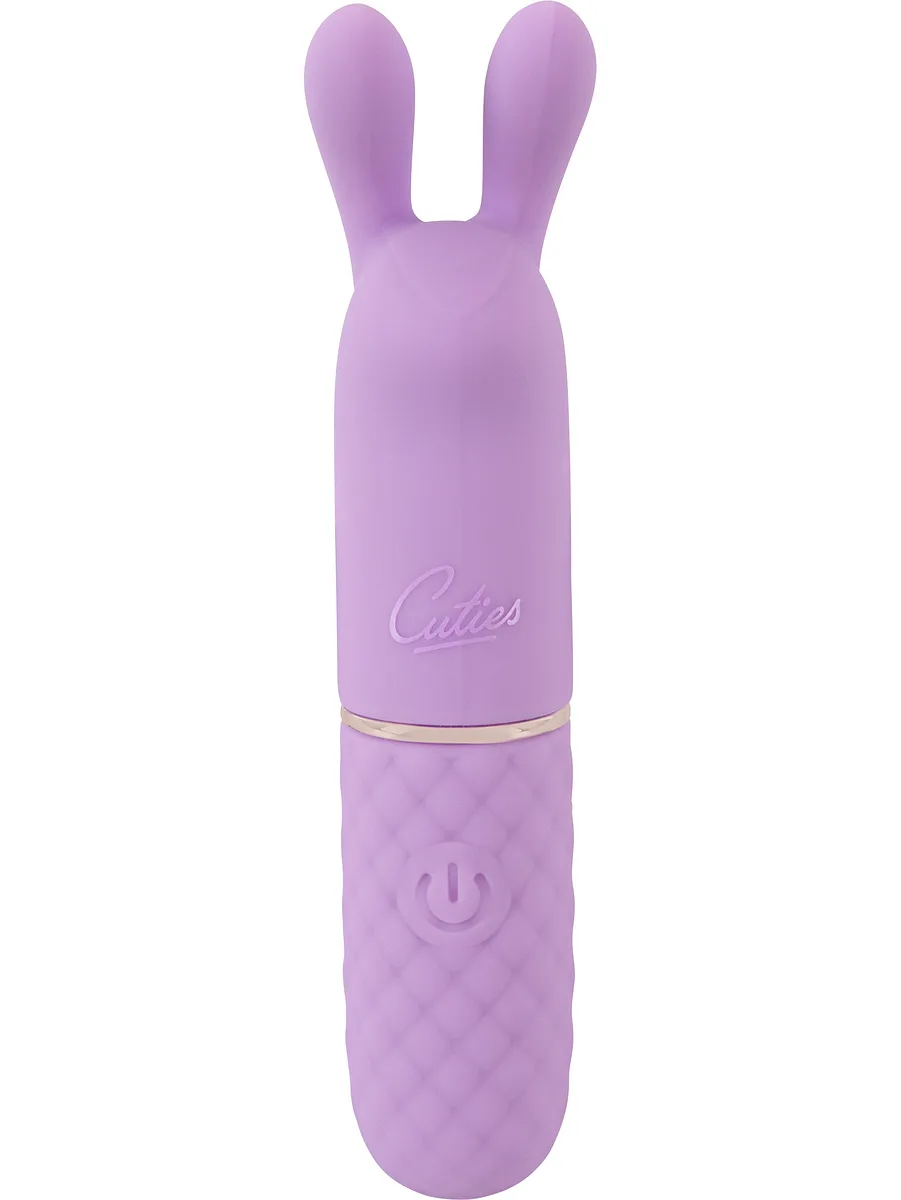
Cuties Flexible Ears Mini Vibrator is a small clitoral vibrator in light purple, with two soft, flexible ears at the top and a checkered grip section at the bottom. The manufacturer states ten vibration modes, a single button, a silicone surface with what’s known as a soft touch texture, and charging via an included USB cable. The model belongs to the fifth generation in ORION’s Cuties series, and the item carries the manufacturer’s number 54030140000 with EAN 4024144454204.
The specification looks like this: total length 10.8 centimeters, diameter 2.2 centimeters, weight 41 grams, material silicone, PU, and ABS, ten vibration modes, and a suggested retail price of 29.95 euro. The package measures 17.8 × 8.6 × 4.6 centimeters; the item is packed 48 per carton, and the country of manufacture is listed as China. In Sweden, it’s sold by four stores at prices between 229 and 299 SEK, and three of them had it in stock when the prices were checked on September 12, 2026.
Just as important is what isn’t stated in the specification, and this is unusually much for a rechargeable electric product. The manufacturer does not publish battery capacity, battery voltage, operating time, charging time, sound level in decibels, or any enclosure class. There is no openly available manual and no published EU declaration of conformity — ORION’s download area requires a wholesale account. What can be established is that four of the five rows in a normal technical specification are missing, and that the information that nevertheless circulates in Swedish stores comes from the stores themselves and contradicts each other. This review therefore gives as much space to the gaps as to the numbers.
Here’s a name question worth clarifying right away, because it makes the product hard to find. All four Swedish stores for the item list the brand You2Toys, and Vuxenkul explicitly spells out You2Toys in the Manufacturer field. The manufacturer itself does not: at ORION Wholesale, the item is listed under the label Cuties – ORION Brand. Both are brands within ORION Versand GmbH & Co. KG in Flensburg, so this is not two different products — but it explains why the same item shows up under four different names in four stores: “Cuties: Flexible Ears Mini Vibrator, 5th Generation”, “Mini Vibrator Cuties With ears”, and “Cuties Mini Bunny Vibrator”.
The practical tip is simple and applies to the entire product category: compare by EAN, not by name. All four stores list 4024144454204, and that number leads back to a single article with the manufacturer. The stores’ own item numbers differ, however—27313 at Joyland, 5403014 at Lekosmek and Taboo, OR1680-1 at Vuxenkul—and two of them, 5403014, are simply the manufacturer’s number with the leading and trailing zeros removed.
Five items in the manufacturer’s catalog are labeled as fifth generation Cuties. They share body, button, grip pattern, and material construction, but have different tips. All five are listed with ten vibration modes, the same combination of silicone, PU, and ABS, the same charging via the included USB cable, and the same recommended retail price of 29.95 euro. It’s the tip that sets them apart—and thus also what they’re good at:
So the difference isn’t strength, battery, or number of modes—it’s shape. The ear model is the only one in the series that the manufacturer explicitly describes as a clitoral vibrator; the other four are described as mini vibrators with the stated insertion depth. It’s a reasonable selection criterion: if you want a product that primarily works toward the clitoris, the ears are the point, and if you want something that also needs to be inserted, one of the other four is a better fit.
The manufacturer lists three materials for the item: silikon, PU och ABS. The Swedish product text writes PUR, while the German and English write PU—that’s the same thing, polyurethane. Three out of four Swedish stores render the information almost correctly. Taboo writes "Silikon, PUR, ABS" and Vuxenkul "ABS, Silikon, PU", while Joyland leaves out the polyurethane and only writes "ABS-plast, Silikon".
Materialtrion is typical for this price range and means something concrete. ABS is hard plastic and forms the inner structure and the load-bearing part of the housing; the manufacturer’s own material guide describes ABS as strong, durable, odorless, phthalate-free, and as an excellent vibration transmitter. The silicone is the outer layer against the body. PU is a coating—ORION explicitly describes it as “a cover/overlay on items made of ABS or silicone,” whose task is to provide a silky-smooth surface.
In practice, this means that the surface you touch is not pure silicone, but silicone with a thin polyurethane layer over it. This is also why the care instructions are stricter than for a pure silicone product. The manufacturer’s material guide is clear on two points: strong cleaning agents and massage oil destroy PU, and the coating can be worn away with cleaning that is too harsh—ORION adds that the actual wearing away is harmless. What can be established is that the soft-touch surface is a consumable in a way that the silicone underneath is not, and that the wear on a product in this series is likely to show up in the surface layer before anything else breaks.
Silicone itself is a non-porous material, and a non-porous surface can be cleaned because there are no microscopic cavities where residue can get trapped. This is the single most important property of a material that is meant to lie against mucous membranes. ORION states that the silicone is odorless, phthalate-free, and cleaned with warm water and soap—but also that silicone is not compatible with silicone-based lubricants.
Phthalates are a group of plasticizers that are used to make plastic—above all, flexible PVC—pliable. The Swedish Chemicals Agency (Kemikalieinspektionen) describes them as substances that can affect the endocrine system and make reproduction more difficult, and several of them are therefore restricted or banned within the EU in a large number of products. This product category is a recurring subject of supervision precisely because it contains flexible plastic against skin and mucous membranes.
ORION states in its material guide that both silicone and ABS are free from phthalates and that PU provides a non-toxic finished product. It is a commitment at the material level, not at the item level: the product page for this particular item contains no separate declaration about phthalates, BPA, or latex. It is weaker than what, for example, We-Vibe states for the Tango X, where the wording “phthalate- and BPA-free and made without latex” appears on the product page for the individual model. The difference is small but real, and it is worth knowing for anyone who is allergic to latex—there is no latex information at all for the Cuties item.
What can still be said is that the material specification itself is a better indication than the alternatives available in the same price range. Silicone does not require phthalate plasticizers to become soft—the softness comes from the polymer’s own structure—and ABS is hard plastic without plasticizers. Designations like “TPE” or “jelly rubber,” on the other hand, say nothing at all about which plasticizers are included, and it’s that comparison that makes the silicone line valuable.
The measurements deserve their own review, because the manufacturer’s own page contains two different sets of numbers, and the Swedish stores have picked up different ones.
The German and the Swedish product text on the same page indicate total length 10.8 centimeters and Ø 2.2 centimeters, and the same values appear in the page’s structured dimensions fields. They are also shown in the manufacturer’s own dimension graphic, which is printed both in the product gallery and on the front of the packaging: “~ 10.8 cm” and “Ø ~ 2.2 cm”. Three independent placements at the manufacturer therefore say the same thing.
The English product text on the same page says something else: “Total length 10.5 cm, insertion length 5.8 cm, Ø 2.1 cm”. Those values are exactly what the manufacturer lists for the sister model Tapered Tip, article 54029800000. With all probability, it’s a transferred entry from the manufacturer’s own material, not another variant of the product. The consequence is visible directly in the stores: Joyland lists 10.5 centimeters and 2.1 centimeters, Lekosmek and Taboo list 10.8 and 2.2 but add an insertion depth of about 6 centimeters—i.e. 5.8 rounded—and Vuxenkul lists 11 centimeters. Four stores, three different length listings, one single article.
Count on 10.8 centimeters and 2.2 centimeters. That’s what the manufacturer states in three places, and it’s what appears on the packaging you’ll receive. The manufacturer does not publish any insertion depth for the ear model in either the German or the Swedish text, unlike the four sister models where an insertion depth is given for each one. Anyone looking for a product to insert should read that as a message in itself.
The weight information also contains the same double ambiguity. The product text indicates 41 grams, while the page’s structured dimensions fields indicate 115 grams. The difference isn’t explained, but the pattern in the sister models speaks for itself: 115 grams for the pink one, 110 for the yellow, 120 for the blue, and 150 for the green Mini Wand—i.e. values that correspond to the package size rather than the product size. Lekosmek and Taboo both list 41 grams. Treat 41 grams as the product’s weight and 115 grams as a package or shipping weight. For comparison, Lelo lists 36 grams for Mia 3, a product with almost identical size.
The interface consists of one button. The manufacturer’s own product image shows it as an embossed power symbol in the middle of the grid-patterned grip section, on the same side that the ears point to. So the ten settings are controlled by pressing through them in order. The manufacturer describes it as "Einfache Bedienung" and explicitly targets the product to beginners: "Perfect for sex toy beginners," it says in the Swedish product text.
What can be established is that one button is both the product’s strength and its limitation. The strength is that there’s nothing to learn, and that you can’t press the wrong thing in the dark. The limitation is that you can’t go back. If you step one setting too high, you have to go through the entire scale to get back, and that’s exactly the situation where more modes make things worse rather than better. For comparison, the Lelo Mia 3, which is in the same size category, has two buttons for eight modes—fewer modes, but the ability to step in both directions.
The ears are the product’s entire idea, and they’re also the only thing that distinguishes the item from the four sister models. The manufacturer describes them as "flexible, soft vibro-ears" that pamper outer hotspots and intimate areas, "especially the clitoris." The shape consists of two narrow, tapering little fins that extend from the same top and stand apart.
Mechanically, the construction does two things. The first is that the contact surface is divided: instead of a single point, you get two, with a gap between them. The second is that the fins flex. A flexible fin transfers less force than a rigid surface of the same material, which in practice means that stimulation is distributed rather than concentrated. It’s the opposite of what a closed air-pressure chamber does, and that’s why an ear model and an air-pressure product can’t be used interchangeably, even though both are marketed toward the same area.
The manufacturer also states that the lower grip section has a grid-patterned relief "for perfect grip." It’s a detail that matters on a product that is 2.2 centimeters in diameter and that’s meant to be held with two or three fingers, especially together with lube.
Ten modes is the manufacturer’s number; it’s stated in the product text, in the function graphic ("10 VIBRATION MODES"), and printed on the packaging. All four Swedish stores reproduce it correctly, which is worth noting—within this product category, an incorrect number of modes is one of the most common mistakes in store texts.
What the manufacturer does not state is how the ten settings are distributed. There is no information on how many are even intensity steps and how many are patterns, pulses, or waves. The manufacturer also does not publish any frequency and no motor power for the product. Lelo, for example, lists 130 Hz as the frequency for Mia 3, and We-Vibe divides Tango X into eight intensity levels plus seven named patterns. No such breakdown exists here, and that means that “ten settings” is a number without content until the product is on the table.
Still, the pattern in this product category is predictable: the lowest steps are clearly separated, while the pattern modes in the upper half resemble each other more than the number suggests. In practice, expect to end up going back to two or three of the ten.
The manufacturer markets the product as a “superleise”—the Swedish text writes “the super-quiet, powerful motor”—and adds “klein, leicht, diskret leise” to the bullet list. ORION does not publish any measured decibel value, either on the product page, in the functional graphic, or on the packaging. None of the four Swedish stores lists a value either.
This should be read as a marketing claim and nothing more. For comparison, Lelo states an upper limit of under 60 dB for Mia 3— a published, verifiable value for a product in the same size class. Websites that state an exact decibel value for Cuties Flexible Ears either provide their own measurement or a value with no source from the manufacturer.
A practical tip that applies regardless of model: place the product on a soft surface between uses. A hard tabletop acts like a resonance box and noticeably amplifies the sound, and this applies even more to a small product with a hard ABS housing under the silicone.
This is the question where it pays off the most to read carefully, because the answer differs depending on which store you end up at—and because getting the wrong answer can cost you the product.
The manufacturer’s position is unambiguous through its silence. ORION does not state any ingress protection rating for item 54030140000, and the item’s list of features includes neither "Wasserdicht" nor "Spritzwassergeschützt". The properties listed are five: rechargeable, for women, multiple vibration modes, vibration, and for vaginal use. That the absence is meaningful can be documented, because the manufacturer actively uses both markings on other products in the same series: Cuties Dual Density Mini Vibrator (54084230000) is labeled "Wasserdicht", and Cuties Mini Vibrator 54083930000 is labeled "Spritzwassergeschützt". ORION therefore has both a strong and a weak water marking in its system, and has not put either of them on this product. Nor does the functional graphic, which highlights exactly three features, include any water icon.
Two of the four Swedish shops take a stand, and they take the opposite stand.
When a shop contradicts the manufacturer, the manufacturer wins, and when the manufacturer says nothing at all, it is the absence that should apply. Taboos IPX5 claim lacks support in the manufacturer’s materials. IPX5 is also a concrete thing according to the IEC 60529 standard — protection against water jets from a nozzle, not against submersion — and this classification requires a test that must be reported. Vuxenkuls "No", on the other hand, is in line with what the manufacturer actually publishes.
In addition, there is a physical argument that can be seen in the manufacturer’s own product image. Charging happens through a narrow round pin that is inserted into an opening in the product’s base — not through a magnetic contact but through holes in the casing. An open charging contact is the hardest point to seal on a handheld product, and that’s why more expensive models almost without exception switch to magnetic charging when they want to reach IPX7. The conclusion therefore becomes concrete: treat the product as not waterproof. Rinse the ears and body with a damp cloth or under gently running water with the base facing upward, don’t submerge it, and don’t take it into the bathtub. If you want a product for shower and bath, you should buy one that has a published rating — Lelo Mia 3 is listed as fully waterproof and We-Vibe Tango X as IPX7.
The manufacturer’s general instructions cover most of what’s missing on the product page. ORION states that toys should be cleaned before and after each use, with mild soap and warm water, and that silicone items should be used with a water-based lubricant. Joyland says the same thing in its specifications line: the recommended lubricant is water-based.
Water-based silicone lubricant should not be used on silicone products. It breaks down the silicone surface over time and makes it porous, and a porous surface can no longer be cleaned properly—only replaced. With this particular product, there’s a second reason: the PU coating. The manufacturer’s materials guide explicitly states that strong cleaning agents and massage oil destroy PU, and that the coating can be worn away with overly aggressive cleaning. Oil-based products such as coconut oil also leave a film that’s difficult to remove.
ORION’s other storage advice is worth following and isn’t included in the store texts: store items cool, dry, and protected from the sun; don’t store multiple products unprotected together because materials can react with each other and cause color changes or holes; and pack the product into a storage pouch only once it’s completely clean and dry. The manufacturer also notes that the user manual is normally printed on the product packaging—which in this case is the only documentation you get, because ORION’s download area requires a wholesaler account.
The manufacturer states that the product is rechargeable and that a USB charging cable is included. That’s the whole information. Neither battery type, capacity in mAh, voltage, operating time, or charging time are published for the item, and none of that is stated on the packaging either.
With the included cable—and this is where a detail is worth more than it looks like. The manufacturer’s own product image shows the cable in full: a standard USB-A connector on one end, labeled with the Cuties logo, and a narrow round pin on the other end. So it’s a so-called DC connector of the type found in a large part of the price range, not USB-C and not a magnetic connector.
It has three practical consequences. The first is that the cable is product-specific: if you lose it, no regular USB-C or micro-USB cable works, and you’ll need a replacement with the same pins. The second is that the connector requires an opening in the housing, which is the direct reason why a product with this design isn’t likely to be waterproof. The third is that USB-A on the other end means you need a USB-A port or an adapter—a modern phone charger with only USB-C isn’t sufficient without a middle piece.
The manufacturer’s general battery care advice applies instead of a manual, and they are unusually specific. ORION states that lithium-ion batteries are transported at 40–50 percent charge and therefore must always be charged before first use, that the charger should be able to handle at least 1,000 milliamps because a weak USB port on a computer otherwise can prevent charging from starting, that the product should be unplugged when charging is finished and not stored in the charger, that it must not be covered over or charged in the storage pouch, and that you should wait 30–60 minutes after charging has ended before using the product. ORION also states that their toys have a deep-discharge protection that shuts off the product when the cell drops below a certain level, and when that happens they recommend a ten-minute pause before charging instead of an immediate restart.
Since the manufacturer does not publish anything, it is the shops that fill the gap, and they do it in their own way. The information below is shop information, not manufacturer information:
The spread in charging time is 120 versus 300 minutes—a factor of 2.5 for the same article number and the same EAN. Both cannot be correct, and neither can be checked against the manufacturer. What can be established is that the order of magnitude of a 90-minute run time shows up for both, and that it is within what is reasonable for a product of this size: Lelo states up to 1.5 hours for Mia 3 with a 70 mAh battery, and We-Vibe states up to 2 hours for Tango X. Assume a run time at that level and treat the charging time as unknown until you’ve seen how the product behaves.
A final practical consequence of the capacity not being published: it is not possible to calculate run time into power consumption, and it is therefore not possible to compare how heavily the cell is loaded between models. The general rule still applies, though—the capacity decreases with the number of charge cycles, the battery is not replaceable in a product of this design, and in practice the item is used up when the cell is. The crossed-out waste bin is embossed in the silicone together with the CE and UKCA marks, which means the product should be taken for electronic recycling and not disposed of in household waste.
We do not have price data from shops in your market yet.
The manufacturer has both a waterproof and a splash-protection rating in its own system, and has not assigned either of them to this item. That absence is a statement.
Three comparisons are relevant: against the four siblings in the same generation, against a product in almost exactly the same size from a manufacturer that publishes everything, and against a premium model that shows what you’re paying for higher up in the category. All the information below comes from each manufacturer’s own specifications.
The five models in the fifth generation have the same price, the same material, the same ten positions, and the same charging solution. The only difference is the tip and the dimensions, and thus what the product can do.
The ear model is the only one that the manufacturer calls a clitoral vibrator, and the only one that lacks a published insertion depth. The other four all have one: 5.8 centimeters for Tapered Tip and Flattened Tip, 7.2 centimeters for G-spot, and 9.1 centimeters for Mini Wand. So if you want a product intended to be inserted, you would therefore choose to do without the ears. And if you want something that works on an outer area with two contact points instead of that, the ear model is the only one in the series that does it.
In terms of size, Mini Wand is the exception: 13.4 centimeters and Ø 3.3 centimeters versus the ear model’s 10.8 and 2.2. It’s the only one in the series that seriously departs from the mini-vibrator format, and it’s also the only one with a soft, flexible massage head intended also for body massage. The G-spot model at 11.8 centimeters is in between. Since the price is the same for all five from the manufacturer, the choice is purely functional, and it’s an unusually clear decision situation in this category.
Lelo Mia 3 measures 22 × 22 × 111 millimeters and weighs 36 grams. Cuties Flexible Ears measures 10.8 centimeters in length with Ø 2.2 centimeters and weighs 41 grams. In other words, they’re practically the same size and weight. The materials are also the same at their core: ABS and body-friendly silicone.
That’s where the similarities end, and the difference is less about performance than about how much the manufacturer is willing to publish. Lelo lists a lithium-ion battery of 70 mAh and 3.7 volts, charging up to two hours at 5.0 volts and 70 milliamps, operating time up to 1.5 hours, standby 90 days, frequency 130 Hz, automatic shut-off after 20 minutes, maximum sound level under 60 dB, two buttons, eight modes, a fully waterproof construction, manufactured according to ISO 3533, plus a two-year warranty and a ten-year quality warranty. For Cuties Flexible Ears, none of that is published—not the battery, not the sound, not the water resistance, not the frequency, not the warranty.
That doesn’t mean Mia 3 is a better product in your hand; it means it can be reviewed. The price difference is also significant — Cuties costs from 229 SEK in Sweden, while Mia 3 is in a completely different price class — and it’s reasonable that a product in the two-hundred-Swedish-kronor class hasn’t undergone the same documentation. But it’s still what you pay the price difference for.
We-Vibe Tango X is a bullet vibrator that measures 9.98 × 2.29 × 2.43 centimeters, so it’s still a little shorter than Cuties but wider. It has eight intensity levels plus seven named patterns, an IPX7 ingress protection rating, a runtime of up to two hours, a charging time of 90 minutes, a lithium-ion battery that charges via a USB cable, materials in ABS and body-friendly silicone free from phthalates, BPA, and latex, and a two-year warranty.
This comparison pinpoints exactly what’s missing. IPX7 means according to IEC 60529 that the product has been tested for submersion in water to a one-meter depth for 30 minutes — meaning the entire product can be rinsed off without overthinking it. Cuties Flexible Ears has no rating at all. Tango X has a published runtime and charging time from the manufacturer; Cuties has two conflicting store details. Tango X has an explicit materials declaration at the product level; Cuties has a materials guide at the brand level.
What Cuties has that Tango X doesn’t is the shape. The two flexible ears are a design that Tango X doesn’t offer at all, and the one who wants exactly those two bendable contact points instead of a round tip won’t find that in the premium segment at a comparable price. If you choose based on the reported data, Tango X wins without discussion. If you choose based on shape and price, there’s an argument for Cuties — but it should be a deliberate choice, not an assumption that the two do the same thing.
Four Swedish stores sell the item with EAN 4024144454204. The cheapest is Joyland at 229 SEK, and the most expensive is Vuxenkul at 299 SEK. That’s a 70 SEK difference, or about a 31 percent difference, for the exact same item number, the same color, and the same packaging. Lekosmek and Taboo are both at 298 SEK.
The stock situation is simpler here than in many other comparisons. Three of the four stores had the product in stock at the price check on September 12, 2026: Joyland at 229 SEK, as well as Lekosmek and Taboo at 298 SEK. Vuxenkul, which is the most expensive, was the only one that lacked stock. So the cheapest store is also one of the ones that has the item in stock, which makes the choice unusually straightforward — but note that Joyland also lists “Only 2 left in stock,” so the price can change quickly if the batch sells out.
Price differences are not because one store sells a different variant. All four either list EAN 4024144454204 directly or have their own item number that is linked to that specific lilac ear model. It is about the stores’ own margin setting. It’s also worth knowing that both Lekosmek and Taboo state a regular price of 359 SEK, and Joyland 295 SEK, while the manufacturer’s recommended retail price is 29.95 euros. In other words, this is an item where shelf prices in the shops are close to or above the manufacturer’s recommendation, and where the promotional price is the price that actually applies.
The prices in the table above are updated when the stores’ product flows are updated, but always check the final price at checkout. Shipping costs are added by all stores under a certain order value—Lekosmek and Taboo state free shipping over 699 SEK, Joyland over 995 SEK—and in this price range, shipping is a significant share of the total. A package for 229 SEK with 39 SEK in shipping costs costs more than one for 298 SEK if the latter is combined with something else up to the free-shipping threshold.
It’s for you if you want a small, rechargeable clitoral vibrator for under three hundred kronor and you want a shape that works with two flexible contact points rather than one. It’s for you if you want a silicone surface rather than bare hard plastic against the skin, for you who want something that fits in a makeup bag or handbag, and if you prefer an interface where there’s nothing to learn. The manufacturer explicitly targets beginners, and that’s a sensible fit: 10.8 centimeters, 41 grams, and one button is roughly the lowest threshold a product in this category can have.
It’s not for you if you want to be able to use the product in the shower or a bathtub. The manufacturer does not publish any ingress protection rating, and has refrained from its own markings for both water tightness and splash protection, and the charging contact is an exposed pin in the base. It’s not for you if you want to know what you’re buying in numbers—battery, operating time, charging time, sound level, and warranty are not published by the manufacturer, and the store information that is available contradicts itself. It’s not for you if you want to be able to charge with the same cable as your phone, because the connector is neither USB-C nor micro-USB. And it’s not for you if you want to be able to insert the product, because the manufacturer does not specify any insertion depth for this particular head, and because four sister models in the same series are designed for that instead.
One more thing belongs in the decision. This article is a consumable product rather than an investment. The PU coating wears down, the battery is not replaceable, the charging cable is product-specific, and there is no manufacturer warranty to fall back on. It shouldn’t be read as a verdict on the product—that’s what the two-hundred-krone class looks like—but it should be counted in what you pay for. If you want something that should last five years and withstand water, that’s another price class you should look at.
ORION does not publish any manufacturer warranty for item 54030140000 on its product page. No warranty period is specified, no terms are listed, and no exclusions are stated to read. It’s a clear difference from both Lelo, which states two years of warranty plus ten years of quality warranty for Mia 3, and We-Vibe, which states two years for Tango X.
One of the Swedish stores, however, makes its own commitment. Lekosmek writes “2 years product warranty” on its product page, with the addition “We stand behind every product we sell.” It’s a store warranty, not a manufacturer warranty, and therefore it only applies if you buy there. The other three stores do not state any warranty for the item.
What always applies, though, is your statutory rights, and in this case they’re the most important protection you have. Under the Swedish Sale of Consumer Goods Act (konsumentköplagen), you have three years right of complaint for defects in the goods, regardless of what the manufacturer or the store commits to. For distance sales, you also have a right of withdrawal of fourteen days under the Act on distance contracts and contracts outside business premises (lagen om distansavtal och avtal utanför affärslokaler). Be aware that, in practice, the right of withdrawal is limited for hygiene products that have been taken out of a sealed package—however, the right of complaint for defects always applies. If you have questions about what applies in your case, Konsumentverket guides you via Hallå konsument.
A practical tip that follows from the absence of a manufacturer warranty: save the receipt and the packaging. The packaging is also the only instruction manual you get—the manufacturer itself states that the instruction manual is normally printed on the item’s packaging, and ORION’s download area with item data is closed to consumers.
Cuties Flexible Ears Mini Vibrator, 5th Generation is ranked på plats 11 av 14 in mini vibrator best i test, where the entire category is compared against each other using five shared criteria. Guiden vinns av Svakom Echo 2.
Every numerical piece of information in the text can be traced to one of the sources below. The links were checked manually on the specified date.
This page is machine-translated from Swedish. Read the Swedish original