

Review
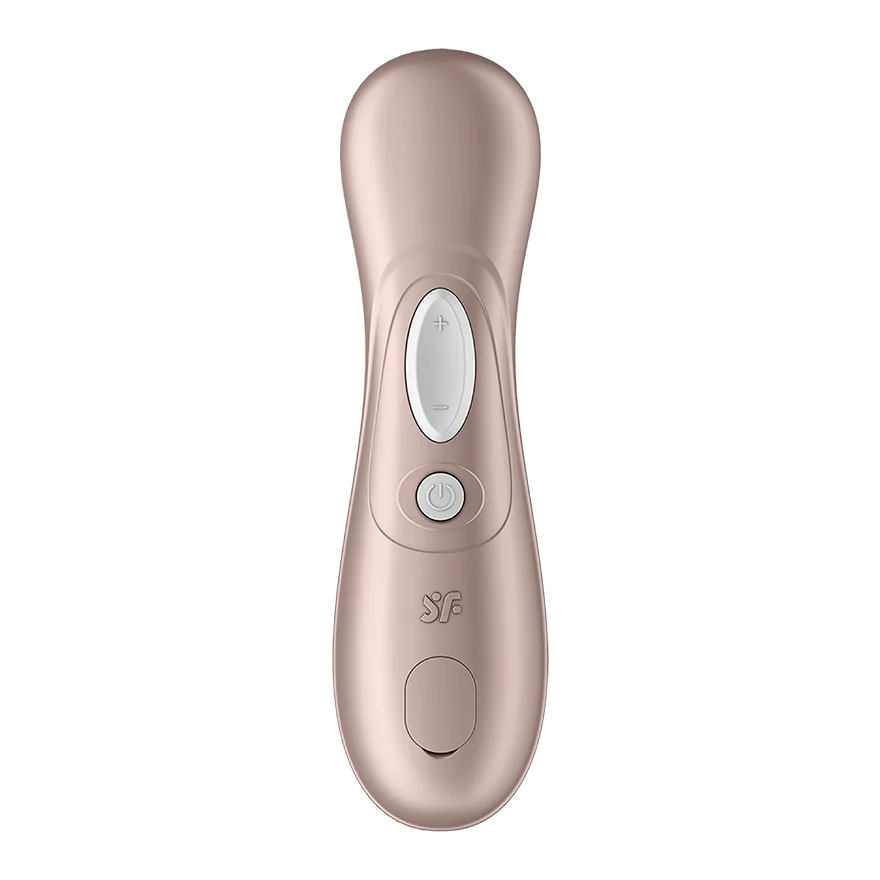
Review: Satisfyer Pro 2 Next Generation
Cheapest among the widely sold air pressure products — 219 SEK and IPX7.
29 July 2026
Review · Mini vibrator · Ten vibration modes
You2Toys and ORION’s pastel pink mini vibrator reviewed against the manufacturer’s own specifications, the customer information for item 54029800000, and price data from four Swedish stores. Ten vibration modes on one button, 10.5 centimeters, 40 grams, and silicone with a soft touch coating — but no ingress protection rating, no battery figures, and a manufacturer that explicitly states that the product must not be dipped in water.
A small, lightweight, rechargeable beginner vibrator with ten settings on one button, at a price from 195 SEK. The shape is well thought out: a tapered tip, a printed insertion length, and a grid-patterned grip area. What you don’t get is a disclosed specification — ORION does not publish an ingress protection rating, battery capacity, charging time, runtime, or sound level, and the customer information for the item explicitly says that the product must not be dipped in water. The charging cable also has a product-specific pin connector.
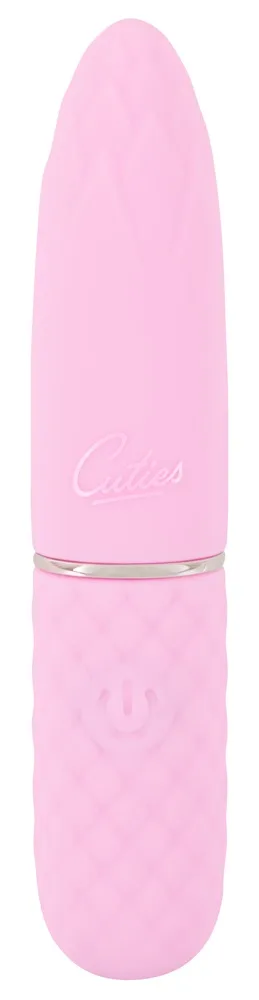
Cuties Tapered Tip Mini Vibrator, 5th Generation is a small rechargeable wand vibrator in pastel pink silicone, shaped like a lipstick and intended for both external stimulation and deep penetration. The specification is short and easy to scan: total length 10.5 centimeters, insertion length 5.8 centimeters, diameter 2.1 centimeters, weight 40 grams, and ten vibration modes controlled with a single button. The manufacturer lists the materials as silicone, PU and ABS, and in the package you get the vibrator and a USB charging cable — nothing else.
This review deals exclusively with the pink variant with EAN 4024144454174, the manufacturer’s item number 54029800000. That number is shown in plain text on the manufacturer’s own product page, in the Barcode field, and it can also be found in the product data from three of the four Swedish shops that sell the item. The fifth Cuties generation consists of several models with different tips, and each model has its own EAN — check the number before you compare prices, because the shops name them very differently.
In Sweden, the item is sold by four shops at prices between 195 and 298 SEK, and three of them had it in stock at the price check on September 12, 2026. The manufacturer’s recommended retail price in its own German shop is 29.95 euro. What makes this product interesting to review is not what the specification includes, but what it does not include: no IP rating, no battery capacity, no charging time, no operating time, and no measured sound level. That has consequences, and they go through this entire text.
Here’s a detail worth clarifying right away, because it creates confusion in the Swedish shops. The manufacturer is ORION Versand, and the product is sold in ORION’s wholesale catalog under the label Cuties. On ORION’s own consumer website, the brand is listed as Cuties, and the responsible manufacturer is stated as OV-Großhandel in Flensburg. Two of the Swedish shops instead state You2Toys as the brand, a third lists the supplier as Orion, and a fourth lists Cuties.
What can be established? That both Cuties and You2Toys are separate labels in ORION’s catalog, and that You2Toys, on its own brand website, lists seven product lines — Bad Kitty, Magic Shiver, Mandy Mystery, Nature Skin, Realistixxx, Rebel, and Sextreme — in which Cuties is not included. The item is therefore sold by ORION under the label Cuties, while the brand listing You2Toys in Swedish shops comes from the shops’ own categorization. Practically speaking, it doesn’t matter for how the product works, but it does matter when you search for it: search for EAN 4024144454174 or for item number 54029800000, not the brand.
The name "Tapered Tip" comes from the shape. The manufacturer describes the tip as conical with a soft stimulating texture, and that’s exactly what the pictures show: a narrowing, slightly textured top over a cylindrical body with a grid-patterned surface around the button. The fact that the tip is tapered is also why the manufacturer specifies an insertion length — 5.8 centimeters of the 10.5 are intended to be insertable.
Cuties fifth generation is not a single product, but a series—and it’s the most common source of incorrect purchases. The manufacturer lists five mini vibrators in the same generation, all with ten vibration modes, the same material set, and the same USB charging, but with different tips, different colors, and different dimensions. The differences are concrete enough to determine which one you actually want:
What can be established is that the choice within the series is about shape, not performance. The number of modes, the materials, and the charging are identical on all five. If you want something intended for the G-spot, you should buy the blue one; if you want clitoral ears, you should buy the purple one; and if you want a small massage head, you should buy the green one. The pink tapered tip is the series’ most general shape—and the one that works both externally and for shallow penetration.
The material question is the only quality of an intimate product that can’t be compensated for with experience or care. It determines whether the product is still hygienic after three years. The manufacturer lists three materials for this item: silikon, PU och ABS. It’s a more complex task than it looks like, and it deserves to be broken down.
ORION runs its own material guide that describes what each of the three material designations means in their range. Silicone is described there as the most popular and one of the safest materials: skin-friendly, odorless, free from phthalates, easy to clean with warm water and soap, and unaffected by soap, alcohol-based toy cleaners, and water-based glide gels. The only drawback the manufacturer itself mentions is that silicone isn’t compatible with silicone-based lubricants.
ABS is described as hard plastic — robust, dimensionally stable, phthalate-free, and according to the manufacturer an excellent vibration transmitter. In a product of this type, ABS is reasonably the inner casing that holds the motor, the battery, and the button in place. The manufacturer does not publish a drawing showing exactly where the boundary between silicone and ABS is, so that breakdown is not shown.
The interesting entry is PU. In ORION’s material guide, PU is not listed as a structural material, but as a coating: polyurethane applied as a layer over items made of ABS or silicone to provide a silky-smooth surface. So it’s the PU layer, not the silicone, that provides the soft-touch feel that all the marketing for Cuties is based on. And the same material guide states PU’s downsides outright: harsh cleaning agents and massage oil can damage PU, and when PU is used as a coating on silicone, silicone-based lubricants should not be used.
In practice, this means the surface should be treated more carefully than a bare silicone surface. A clean silicone product can, in principle, handle any fragrance-free soap. A PU-coated silicone surface does not, if you follow the manufacturer’s own guide. It’s not a disqualifying flaw — soft-touch surfaces are common across the whole price range — but it is a care consequence that none of the Swedish shop texts mention, and that explains why the product can look dull and worn after some time if it has been cleaned with the wrong products.
Phthalates are a group of plasticizers used to make plastic — above all pliable PVC — flexible. The Swedish Chemicals Agency describes them as substances that can affect the hormone system and make reproduction more difficult, and several of them are therefore restricted or banned within the EU in a large number of products. This product category is a recurring subject of oversight, because it contains pliable plastic that sits against the mucous membrane.
The manufacturer’s material guide explicitly states that both silicone and ABS are free from phthalates. This is a material description at the category level, not a product-specific declaration for that particular item 54029800000, and that distinction is worth keeping separate: ORION does not publish a separate phthalate-, BPA-, or latex declaration for this item on the article’s product page. What the manufacturer does, on the other hand, is name exactly which three materials are included, and neither silicone nor ABS requires phthalate plasticizers in order to get their properties. That is a significantly clearer piece of information than labels like "TPE" or "jelly rubber," which don’t say anything at all about which plasticizers are used.
The manufacturer’s customer information also includes a general call to read the information on the packaging in order to avoid allergic reactions, with latex given as an example. Latex is not included in the three specified materials, but no explicit latex-free commitment for this article is published either. If you are allergic to latex, it is worth noting that the material declaration—silicone, PU, and ABS—does not contain latex, but that the manufacturer does not state this as a guarantee.
The manufacturer states a total length of 10.5 centimeters, an insertion length of 5.8 centimeters, and a diameter of 2.1 centimeters. That makes the product really small: it’s not shorter than a normal lipstick, but it is narrow enough to fit in an inner pocket in a handbag, which is also the entire description the manufacturer itself chooses to give about the size. The packaging measures 18 × 8.7 × 4.7 centimeters, so it is significantly larger than the product—a hanging package intended for a retail shelf.
The weight information deserves a comment, because the manufacturer lists two different values on the same page. In the product text it says “Weight 40 grams,” in all languages and in all language versions of the page. But in the data table further down on exactly the same page it instead says “Gewicht: 115 g.” The manufacturer does not specify which of the two details refers to what.
What can be established is that the same pattern is repeated throughout the series. The yellow model is listed as weighing 38 grams in the product text and 110 grams in the data table; the purple one as 41 versus 115 grams; the blue one as 44 versus 120 grams; and the green wand model as 75 versus 150 grams. So the table value is consistently two to three times higher than the text value, and both values increase with the product’s size. This suggests that the table row is a shipping weight, while the figure in the product text is the weight of the vibrator itself. But the manufacturer does not state that, and therefore both figures remain in the specification table below. Assume the product in hand weighs around 40 grams and treat 115 grams as a shipping weight until ORION specifies it otherwise.
The diameter also has a deviation worth mentioning. The manufacturer states 2.1 centimeters, and three of the four shops follow that figure. The retailer Vuxenkul instead lists 2.2 centimeters. The difference is one millimeter and has no practical significance, but when a shop deviates from the manufacturer’s measurements, it is the manufacturer’s information that applies—and it is the same shop that also deviates on a significantly more important point further down in this text.
The interface consists of a button. The manufacturer describes it as placed in the checkered grip section at the bottom, and the product images show a single embossed power symbol. So ten vibration modes are controlled by repeated presses of the same button, and once you’ve passed the last mode, the sequence starts over or turns off. The manufacturer formulates it as the modes “can easily be controlled with a button press,” and markets the model as perfect for anyone who is new to sex toys.
It’s a conscious trade-off, not a shortcoming. One button means there’s nothing to learn, that the product can be controlled in the dark, and that it can’t end up in a mode you can’t get out of. The trade-off is that you can’t jump directly to a specific mode, can’t lower the intensity without stepping all the way around, and can’t differentiate between strength and patterns—those ten modes are a single list that mixes intensity steps and pulse programs. Which the ten modes are, the manufacturer does not publish; there is no listing of the patterns either on the product page or in the customer information.
The comparison with a product that has two buttons is illuminating. Lelo states for the Mia 3 that it has an interface with two buttons, which in that design usually means one button for up and one for down. We-Vibe splits the function across eight intensity levels and seven vibration modes, so that’s two independent scales. Cuties has neither of the two: one button, ten steps, one direction.
In practice, that means you need to go through the list every time you want to get back to a mode you’ve just left. On a product with ten modes, in the worst case that’s nine presses. It’s a manageable problem for a product of this size and price range, but it’s exactly the kind of everyday friction that distinguishes a one-button product from a two-button product, and it’s worth knowing before you buy rather than after.
A detail from the manufacturer’s customer information belongs here, since it affects use: the product turns off automatically when the battery is depleted, and the manufacturer expressly writes that it should not be turned on again but charged instead. ORION does not publish any automatic shut-off after a certain amount of usage time—for Mia 3, Lelo indicates 20 minutes—for this article.
The shape is what distinguishes the model from the rest of the series. The manufacturer describes the tip as conical with a slightly pronounced stimulating structure, and expressly states that the conical shape makes the product easy to insert. That’s also the reason the insertion length—5.8 centimeters—is shown separately from the total length.
The structure at the tip is clearly visible in the manufacturer’s product images as a faintly ridged pattern in the silicone. The retailer Joyland describes the surface as ridged and silky-smooth and states that the hardness is medium—it is a store claim, not a manufacturer claim, and no Shore hardness is published by ORION. What the structure adds is that the contact surface against the skin is broken up, which in this product category is usually experienced as a clearer but more localized feel than an entirely smooth tip.
The checkered section around the button has a different function. The manufacturer calls it a diamond structure and states that it is there for grip. For a product that weighs 40 grams and is intended to be handled with lubricant on the hands, that is a reasonable design choice, and it is also the only ergonomic measure the manufacturer describes—the shape is otherwise a straight cylinder without angles, without a handle, and without a flanged base.
That the base lacks a flange is worth a clear note. The manufacturer’s customer information states that the product is only suitable for vaginal use, and the same restriction is also listed in the specifications list on the product page. A smooth cylinder without a wide base should not be used anally, and here the manufacturer says so directly rather than leaving the question open.
“Super-quiet” is one of the two main arguments in the entire marketing— the English text talks about an “extremely quiet but very powerful motor,” the Swedish about a “super-quiet, powerful motor,” and two of the Swedish stores have even built the word into the product name: “Tystgående Mini Vibrator Cuties”. The question is what that means in numbers, and there the answer must be honest: ORION publishes no measured decibel value for this item, either on the product page, in the consumer store, or in the customer information.
You can put that lack of information into perspective. Lelo states that for the Mia 3, the maximum sound level is under 60 dB and it also specifies a vibration frequency of 130 Hz—two figures that can be compared with other products. We-Vibe does not provide a decibel value for Tango X but, instead, provides the enclosure rating class and battery data. ORION provides neither. That means the claim about quietness can’t be tested against anything other than other claims, and every site that gives an exact decibel number for Cuties is either reporting its own measurement or a value without a source.
What can, however, be established on a technical basis is that a small vibrator with a small battery and an eccentric motor of the size that fits into a body 2.1 centimeters in diameter simply cannot move very much air. The sound level in this product category follows largely from the motor’s size. A practical tip that applies regardless of model: place the product on a soft surface while it is running and you are not holding it. A hard tabletop works as a resonator box and noticeably amplifies the sound.
This is the most important finding of the review, and it differs from what several store texts suggest. The manufacturer provides no ingress protection rating whatsoever for this item—neither IPX7, IPX6, nor any other number. The product page does not mention water, and the specifications list contains no water-resistance entry.
What the manufacturer does, on the other hand, is give a direct instruction. In the customer information for this specific article 54029800000—the document is in Swedish—it says under both "Before first use" and "Care instructions": "Make sure that no water enters the battery compartment to prevent damage to the device. Do not submerge the device in water." This is not a cautionary phrasing; it is a prohibition, and it appears in the manufacturer’s own document for this article.
The consequence is clear. The product does not belong in a shower or a bathtub. It should be wiped dry and cleaned with a damp cloth, warm water, and mild soap, but it must not be held under running water and absolutely must not be submerged. If a product lacks an IPX rating, it should be treated as not being water-resistant—the absence of a rating is never a sign that the product would be approved—and here you don’t even need to make that interpretation, because the manufacturer spells it out.
The store information about water resistance differs, and that in itself is a finding. The retailer Vuxenkul has a specifications line that says "Water-resistant: No"—fully in line with the manufacturer’s instruction. At the same time, retailer Lekosmek lists the item under its own category label "Waterproof Vibrators". The two pieces of information cannot both be correct.
The rule is simple: when a store contradicts the manufacturer, the manufacturer wins. Here, the manufacturer’s statement is also unusually unambiguous, because it is written as a prohibition in a document that is linked to the article number. Anyone who buys the product believing that it can be rinsed off will therefore be surprised—and a vibrator with a charging rod and a battery inside a silicone shell that is not rated for sealing is exactly the kind of design where water ingress makes the product unusable right away.
The comparison with We-Vibe Tango X shows what the difference is worth. Tango X is rated IPX7, which according to the standard IEC 60529 means that the product is tested for being submerged in water to a depth of one meter for 30 minutes. Such a product can be rinsed off without a second thought, works in the bathtub, and can be cleaned properly. Cuties can do none of that. That’s the single biggest practical difference between the two products, and it’s more decisive than the number of settings.
The manufacturer’s instructions are clear and should be followed literally. Clean the product with warm water and mild soap before first use and after every use, and make sure no water gets in. Disinfect if necessary with a cleaning product intended for the product. Let the product cool down before putting it away, store it clean, cool and dry, avoid direct sunlight, and store it separately — the manufacturer explicitly warns about chemical reactions if products made of different materials are stored together.
The lubricant question has two independent reasons that come down to the same answer. In its consumer shop, the manufacturer writes that only water-based lubricant may be used, because lubricants containing silicone damage the soft surface, and the customer information repeats the same thing. The material guide provides the technical explanation: silicone-based lubricant is incompatible with silicone, and the PU coating that sits on top is also damaged by massage oil and harsh cleaning agents. So water-based is the only option, and oil-based products such as coconut oil are excluded.
Two more instructions from the customer information are worth mentioning, since they rarely appear in the store texts. The product should not be frozen or heated—so boiling and using a dishwasher are out of the question, which already follows from the fact that it may not be submerged in water. And the manufacturer explicitly advises against passing the product on to other people for infection-control reasons. It’s a product without removable parts and with no way to clean the inside of anything, so that instruction is hard to get around.
Here, the specification becomes as thin as it gets. The manufacturer states that the product is rechargeable and that a USB charging cable is included. That’s it. Neither the battery type, capacity in mAh, voltage, charging time, or runtime are published by ORION—not on the wholesaler side, not in the consumer shop, and not in the customer information.
With the included USB cable. The manufacturer’s own product image clearly shows the cable: a standard USB-A connector on one end and a small pin on the other end, meaning it’s a product-specific charging connector, not USB-C. That means a regular phone cable won’t work, and a lost cable must be replaced with the right type of cable. On a product that costs from 195 SEK, there’s a real risk that the product will become unusable in practice if a cable goes missing.
The advantage of this solution is the same as with other products that don’t have an open port: a small pin connector requires a smaller opening in the housing than a USB-C port. However, it doesn’t help with water resistance here, since the manufacturer still advises against submersion. So the connector is a trade-off in cost rather than a sealing solution.
The manufacturer’s customer information provides two charging instructions that apply regardless of the cable. Charge the product only with a suitable charger plugged into a wall outlet and follow the charging adapter’s instructions—so no charging from unknown chargers. And disconnect the product from the outlet as soon as the battery is fully charged, which is the manufacturer’s own way of saying that the product shouldn’t be left on the charger overnight. The customer information also mentions that, for safety reasons, lithium batteries are usually shipped charged to 40–50 percent, which explains why the product can be turned on right out of the box but doesn’t last particularly long the first time.
Two of the stores publish figures that the manufacturer doesn’t. Retailers Lekosmek and Taboo both state about two hours of charging time and up to 90 minutes of usage time. The information is worded identically at both stores, which suggests it comes from the same supplier documentation, but it’s not found in any of ORION’s own documents. Joyland and Vuxenkul state neither of the two figures at all.
That’s how they should be treated from there: as a store claim—useful as an order of magnitude, but not as a manufacturer-supplied specification. Put in context, it’s at least reasonable. For Mia 3—a product of a similar size—Lelo lists a lithium-ion battery of 70 mAh and 3.7 volts, up to two hours of charging time and up to 1.5 hours of run time. We-Vibe lists for Tango X a charging time of 90 minutes and up to two hours of run time. The stores’ figures of two hours charging and 90 minutes of operation fall in between the two, which is exactly what you’d expect from a battery in this size class.
Why does it matter that the capacity is not published? Without mAh, it’s not possible to convert runtime into power consumption, and it’s not possible to compare how heavily the cell is loaded between models. It also isn’t possible to assess how quickly capacity will drop with the number of charge cycles. What generally applies to lithium-ion batteries also applies here: the battery is not replaceable in a product with this design, and when the cell is used up, the product is. With use a couple of times a week, it’s the battery—not the silicone—that sets the limit for the lifespan.
We do not have price data from shops in your market yet.
The manufacturer states ten settings, 10.5 centimeters, and 40 grams. The enclosure rating, battery capacity, charging time, operating time, and sound level are not stated anywhere in ORION's own material.
Three comparisons are relevant: versus the closest form-wise equivalent in the premium segment, versus the most established bullet vibrator, and versus the four sister models in the same series. All the information below comes from each respective manufacturer’s own specifications, and the Swedish prices from the shops’ product feeds on September 12, 2026.
Lelo Mia 3 is the closest comparison available: same lipstick shape, same intended use, and almost the same dimensions. Lelo lists 22 × 22 × 111 millimeters and 36 grams, versus Cuties 10.5 centimeters, diameter 2.1 centimeters, and 40 grams. The materials are also nearly identical on paper—Lelo lists ABS and body-friendly silicone, ORION lists silicone, PU, and ABS.
The difference isn’t in the product, but in what the manufacturer reports. Lelo publishes a lithium-ion battery of 70 mAh and 3.7 volts, charge time up to two hours at 5.0 volts and 70 milliamps, runtime up to 1.5 hours, standby 90 days, vibration frequency 130 Hz, automatic shut-off after 20 minutes, maximum sound level under 60 dB, an interface with two buttons, that the product is completely waterproof, two years of warranty plus ten years of quality warranty, and that it complies with the international standard ISO 3533. ORION publishes none of that for Cuties.
The price differs to the same extent. Lelo lists 990 SEK for the Mia 3 on its own site. Cuties costs from 195 SEK at the cheapest Swedish store—so just over five times less. The conclusion is uncomfortable but reasonable: you’re not only paying for a better product, but also for a product that has been documented. If you want to be able to check the battery, sound level, water resistance, and warranty before you buy, there’s no way around the price difference. If you just want a small vibrator that works, 795 SEK is a lot of money for information.
We-Vibe Tango X is the category reference product among small vibrators and costs 89 euro on the manufacturer’s own European site. The dimensions are similar to Cuties—9.98 × 2.29 × 2.43 centimeters—and the materials are listed as ABS and body-friendly silicone without phthalates, BPA, or latex, so it’s a more specific declaration than ORION’s.
Three differences matter in practice. The first is water resistance: Tango X is rated IPX7 according to IEC 60529 and can be submerged in water, while Cuties is explicitly not allowed to be dipped. The second is control: Tango X splits the function into eight intensity levels and seven vibration patterns as two separate scales, while Cuties has ten modes in a single list. The third is battery reporting: We-Vibe states a charging time of 90 minutes and up to two hours of operating time as manufacturer information, while the corresponding figures for Cuties are only provided as a store listing.
What Cuties has left in this comparison is the price and size. A 40-gram product that costs 195 SEK and fits in a toiletry bag without anyone wondering what it is does not compete for the same buyer as a product for 89 euros. But anyone who wants to be able to rinse the product off under the tap should not buy Cuties—the function simply isn’t there, no matter how clearly it’s requested.
For many people, the most relevant comparison is within the series, since all five models are in the same price range and have identical technology. If you choose the tapered pink lace, you get the series’ most general shape: 10.5 centimeters overall, 5.8 centimeters insertion length, and a conical tip that the manufacturer explicitly describes as easy to insert.
If you want something intended for the G-spot, the blue model with the bent tip is the only option in the series—it’s also longer, 11.8 centimeters, and slightly thicker at 2.2 centimeters in diameter. If you want clitoral stimulation rather than penetration, it’s the purple one with flexible vibro-ears that applies, with the same outer dimensions as the pink. If you want a soft massage head, the green mini wand model is clearly the biggest: 13.4 centimeters overall, 9.1 centimeters insertion length, and 3.3 centimeters in diameter. The yellow one with a flattened tip is closest to a variant of the pink, with the same length and diameter but a wider contact area.
Since the technology, materials, and charging are the same across all models, the choice within the series is purely a matter of shape. And since they’re sold under five different EANs with effectively the same name in Swedish stores, this is also the point where it’s easiest to order the wrong one: always check the EAN number against the shape you want.
Four Swedish stores sell the item with EAN 4024144454174. Cheapest is Joyland at 195 SEK, most expensive are Lekosmek and Taboo at 298 SEK each. That’s 103 SEK or a 53 percent difference for exactly the same article number, same color, and same packaging. In between is Vuxenkul at 209 SEK.
The stock situation makes the picture easier than the price range suggests. Three of the four stores had the product in stock during the price check: Joyland at 195 SEK as well as Lekosmek and Taboo at 298 SEK. Vuxenkul, which is the second-cheapest available at 209 SEK, did not have it in stock. So the difference between the cheapest available and the second-cheapest available is a full 103 SEK — the one who buys without comparing pays a little over fifty percent more for the same item.
The price spread isn’t because any store sells a different variant. The EAN number is checked in the product data for Lekosmek, Taboo, and Vuxenkul, and Joyland’s item carries the manufacturer’s own product name with the generation designation printed. So it comes down to the stores’ own pricing. Two of them also show a higher regular price: Joyland states 295 SEK as the regular price, and Vuxenkul 299 SEK, which is close to the manufacturer’s recommended consumer price of 29,95 euro.
The prices in the table above are updated when the stores’ product flows are updated, but always check the final price at checkout. In this price range, shipping costs are also a significant part of the total — a product for 195 SEK with shipping may very well cost more than a product for 298 SEK at a store with free shipping, so calculate based on the entire order, not just the item price.
It’s for you if you want a small, light, and discreet vibrator without having to learn any interface. Ten settings on one button, 40 grams, and 10.5 centimeters is a combination that works for someone who’s new to sex toys, for someone who wants something to add to rather than a main product, and for someone who wants to be able to take something with them on a trip without risking either their budget or their attention. That it’s rechargeable rather than battery-powered isn’t at all obvious in this price range, and it’s a real advantage over time.
It also suits you if you want a tapered tip that works both externally and for shallow penetration — the insertion length of 5.8 centimeters is the manufacturer’s own stated figure, and it’s more straightforward than the product descriptions that let you draw your own conclusions about the total length.
It doesn’t fit you if you want to be able to rinse the product under the tap, use it in the shower or bathtub, or clean it by immersing it — the manufacturer explicitly advises against it, and this is the single biggest objection to the model. It doesn’t fit you if you want to be able to check battery capacity, charging time, operating time, or measured sound level before buying, because ORION doesn’t publish any of them. It doesn’t fit you if you want to charge it with the same cable as your phone, because the charging connector is product-specific. And it doesn’t fit you if you want two buttons and separate scales for strength and patterns — both Lelo Mia 3 and We-Vibe Tango X are built differently there.
One last thing belongs in the decision. The product is explicitly designed for vaginal and external use. It has a smooth, cylindrical body without a flanged base, and the manufacturer writes plainly that it is only suitable for vaginal use. This is not wording you can interpret freely.
ORION does not publish any voluntary manufacturer warranty for this item — neither on the wholesaler side, in the consumer store, nor in the customer information. That sets it apart from several competitors: Lelo states two years of warranty plus ten years of quality warranty for Mia 3, and We-Vibe states two years of warranty for Tango X. It’s a difference worth factoring in, even if it matters less on a product for 195 SEK than on one for 990.
What always applies, however, is your statutory rights, and they are independent of what the manufacturer promises. Under konsumentköplagen (the Swedish Sale of Goods Act), you have three years of reklamationsrätt for defects in the item. For distance purchases, you also have ångerrätt for fourteen days under lagen om distansavtal och avtal utanför affärslokaler. Be aware that in practice the right of withdrawal is limited for hygiene products that have been taken out of a sealed package — however, the reklamationsrätt for defects always applies. If you have questions about what applies in your case, Konsumentverket guides you via Hallå konsument.
A practical thing to note in this context: the manufacturer lists OV-Großhandel in Flensburg as the responsible manufacturer, meaning a German party. You still file a complaint with the Swedish store you bought it from — it’s the seller, not the manufacturer, that is responsible under konsumentköplagen. Save the receipt and note the EAN number, since the four stores use four different item numbers for the same product.
Finally, a note about waste handling, since the manufacturer addresses it in its own document. The product contains a built-in battery and should be taken to a collection point for electronic waste — not thrown in household trash. ORION also states that they accept batteries free of charge at their warehouse in Flensburg. For a product that can’t be opened and where the battery isn’t replaceable, that’s the only way out once the cell is used up.
Cuties Tapered Tip Mini Vibrator, 5th Generation is ranked på plats 13 av 14 in mini vibrator best i test, where the entire category is compared against each other using five shared criteria. Guiden vinns av Svakom Echo 2.
Every numerical piece of information in the text can be traced to one of the sources below. The links were checked manually on the specified date.
This page is machine-translated from Swedish. Read the Swedish original