
Review · Lubricant · Hybrid
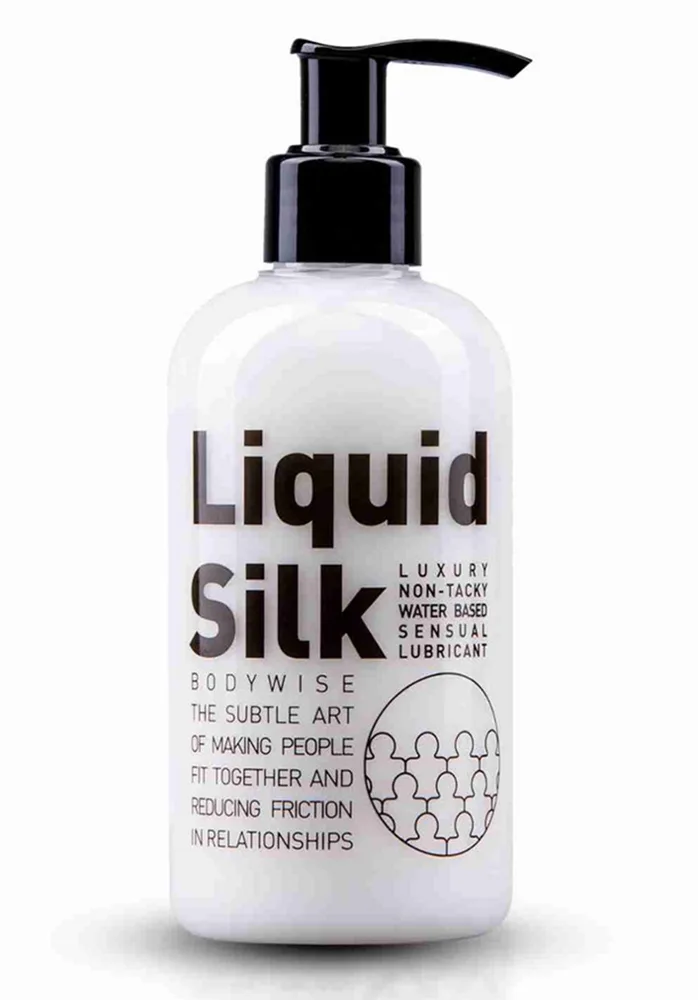
Liquid Silk 250 ml: review
A lubricant sold specifically to masturbator users, reviewed against the manufacturer’s own ingredient list and WHO’s table for commercial lubricants. A water-based emulsion with dimethicone, propylene glycol and three parabens in a pump bottle — with a published pH of 5,26, an osmolality far above WHO’s limit and no manufacturer statement about condoms.
My rating
An essentially water-based hybrid lubricant with an unusually complete disclosure: sixteen ingredients published by the manufacturer, without glycerin, fragrance or flavor, in a pump bottle where the manufacturer replaces defective pump parts no matter where you bought it. What you pay with is the mucosal profile — three parabens, phenoxyethanol and bronopol, and an osmolality of 3 167 mOsm/kg according to the WHO table — as well as the fact that the manufacturer does not state condom compatibility or a medical device classification itself.
- Water, propylene glycol, isopropyl palmitate and dimethicone — sixteen ingredients total
- pH 5,26 and 3 167 mOsm/kg according to the WHO appendix (measured in 2011)
- Three parabens, phenoxyethanol and bronopol
- 250 ml pump bottle, PETG with recycling code 7
- Manufacturer: Bodywise Ltd, Isle of Wight, registered 1980
- Sold by Clonezone, Liquid Silk (Bodywise), and Harmony
Liquid Silk 250 ml at a glance
Liquid Silk is a lubricant from the British company Bodywise Ltd on the Isle of Wight, and this review applies to the 250 ml pump bottle with EAN 663989000012. The manufacturer describes the product as a "predominantly water-based hybrid lubricant" — an essentially water-based hybrid lubricant — and publishes a complete ingredient list with sixteen ingredients, where dimethicone, a silicone, is in fourth place.
It is that ingredient list that makes the product interesting to review. Liquid Silk is sold alternately as a water-based lubricant and as a hybrid; the bottle’s own label says "water based", and the declaration contains both propylene glycol, three parabens, phenoxyethanol, and bronopol. The manufacturer does not publish pH, osmolality, a medical device class, or any information about condom compatibility. Still, two of those pieces of information exist — in an annex to the WHO’s guidance on lubricants from 2012.
The 250 ml bottle is sold by Clonezone, Liquid Silk (Bodywise), and Harmony.
EAN 663989000012 and the three bottle sizes
Bodywise sells Liquid Silk in three sizes on its own website liquidsilk.com: 50, 250, and 500 ml. The manufacturer does not publish any EAN numbers there, but retailer product data is consistent. The product data links 663989000012 to the 250 ml variant with item number DU0597-2, and 663989000029 to the 50 ml variant. Other retailers’ product data uses the same two numbers for the same two sizes; one listing uses gtin13 0663989000012 for “Liquid silk 250 ml”, and another publishes the number on its 250 ml product page. Two international resellers, Bed Time Toys and WorldCondoms, also list 663989000012 for 250 ml.
All three stores included in our comparison sell the 250 ml bottle—none of them lists the 50 ml variant in the same group, which is the most common source of error for lubricants sold in multiple sizes. It is still worth checking at checkout, because the listings compile the sizes on the same product page and let you choose the volume there.
The manufacturer’s own item number for the size is ls-250ml, and in the company’s own web shop it is sold both individually and in a ten-pack. One bottle costs 13.00 pounds and ten bottles cost 100.00 pounds, meaning 10 pounds per bottle in the multipack. The variant data lists the weight as 0.32 for one bottle and 3.1 for ten, without the unit being stated — presumably kilos, since 250 ml of liquid by itself weighs roughly a quarter of a kilo.
Who is Bodywise?
Bodywise Limited is a British private limited company with company number 01490051, registered on 9 April 1980 with Companies House, and with a registered address at Somerton Trading Estate in Cowes on the Isle of Wight. The same address, 8 Enterprise Way, is listed on the manufacturer’s information page for Liquid Silk. The company describes itself on liquidsilk.com as “Manufacturers of Liquid Silk” and has its own wholesale page for retailers.
WHO’s table of commercial lubricants from 2012 lists two products from the same manufacturer: Liquid Silk and Maximus, both with “Bodywise Limited, Isle of Wight, United Kingdom” as the manufacturer. This independently confirms that it is the same company and the same product name as what is sold today by retailers.
One thing to know is that there is a second website, liquidsilk.co.uk, which presents itself as Liquid Silks’ brand page but does not state which company runs it. It has different prices than the manufacturer’s own shop — from £12.99 for 250 ml compared with £13.00 on liquidsilk.com — and it makes claims that the manufacturer’s own page does not, including that the product is condom-safe and vegan. The information is presented further down, but it is treated here as third-party information.
Ingredients: water, propylene glycol, and a splash of dimethicone
The manufacturer publishes the complete ingredient list on its information page. It’s more than many lubricant brands do, and it is the single most important source for understanding what Liquid Silk is. The list reads: Highly Purified Water, Propylene Glycol, Isopropyl Palmitate, Dimethicone, Cellulose Polymer, Polysorbate 60, Sorbitan Stearate, Cetearyl Alcohol, Glyceryl Stearate N.S.E., B.N.P.D., Disodium E.D.T.A, Phenoxyethanol, Methyl Paraben, Ethyl Paraben, Propyl Paraben and BHT.
That the text on the manufacturer’s page reads “B.N.P.D. Disodium, E.D.T.A” with the comma in the wrong place is a typo in the list; the stores that reproduce it write “B.N.P.D., Di Sodium EDTA”, meaning two separate ingredients. This reading is used here.
The full INCI list, ingredient by ingredient
Sixteen ingredients is a lot for a lubricant, and they fall into clear groups. The first is the base: highly purified water and propylene glycol. WHO’s guidance describes glycols as glycerol and propylene glycol as common moisture-binding additives in water-based lubricants, and notes that propylene glycol in some lubricants is the main ingredient. Liquid Silk has no glycerin in the declaration — the glycol is propylene glycol.
The second group is what gives the product its creamy character: isopropyl palmitate, an ester of palmitic acid; dimethicone, a silicone; and an emulsifier group consisting of polysorbate 60, sorbitan stearate, cetearyl alcohol and glyceryl stearate. It’s that composition that sets Liquid Silk apart from a clear water-based gel. An emulsifier is needed when the fat and silicone phase are to be mixed into water, and that’s why the shops describe the product as white or whitish: one shop lists the color as white, and another describes it as “translucent white.”
The third group is thickening agents and stabilizers: a cellulose polymer that controls the viscosity, dinatrium-EDTA and the antioxidant BHT. The fourth group is preservation: B.N.P.D., phenoxyethanol and three parabens—methyl-, ethyl- and propylparaben.
What isn’t listed is just as relevant. The manufacturer states that the product is color- and fragrance-free, and that no perfume, aroma or sweetener is included in the declaration. There’s also no glycerin, no local anesthetic and no warming additives in the declaration. One shop summarizes it as “flavor- and fragrance-free.”
Water-based or hybrid—what is Liquid Silk really?
The question has two answers, and both come from the manufacturer. The bottle label says "Luxury non-tacky water based sensual lubricant". The manufacturer’s website says "a predominantly water-based hybrid lubricant". They don’t contradict each other—the base is water—but the second wording is more precise, since the declaration also includes a silicone and a fatty acid ester.
The shops provide differing descriptions of the formula. Some call it a hybrid formula with water and a smaller amount of silicone. Another describes it as "water-based with a few drops of silicone" and lists the lubricant base as water in its specifications. Several others describe it only as water-based, and some also place it in the category water-based lubricant.
How much dimethicone the formula contains does not publish the manufacturer. None of the six stores publishes any concentration either. What can be established is that dimethicone is one of four ingredients before the emulsifiers in the list, and that the manufacturer itself has chosen the word hybrid. In practice, that means that Liquid Silk is not a pure water-based lubricant in the same sense as a clear gel on water and glycerin, and it’s also not a silicone lubricant—it’s an emulsion, a cream in liquid form. A retailer describes the consistency as thick and creamy, and another describes it as "more full-bodied" and "almost reminiscent of conditioner".
For the buyer, the distinction matters in two places: how the product works with silicone sex toys and how it’s washed off. Both are covered further down.
Parabens, phenoxyethanol, and bronopol
WHO’s guidance states that water-based lubricants must contain preservatives to prevent microbial growth, that parabens—esters of p-hydroxybenzoic acid—are the most common, and that phenoxyethanol is among the options. It also states that preservatives can cause irritation and sensitization in some people. Liquid Silk has both of these types, and in addition a third one.
The third is B.N.P.D. PubChem, the chemical database from the American National Library of Medicine, lists BNPD as a synonym for bronopol, 2-bromo-2-nitropropan-1,3-diol, and classifies the substance as a nitro compound. The manufacturer does not say what function each ingredient has in the formula, and no concentration is published for any of the preservatives.
The parabens are the part of the listing that most buyers react to. The industry organization Kosmetik- och hygienföretagen, KoHF, explains that methyl-, ethyl-, propyl-, and butylparaben are permitted preservatives in cosmetic products under the EU’s Cosmetics Regulation, that certain so-called isoparabens were banned on July 30, 2015, and that Läkemedelsverket has found no support for introducing stricter national rules for propyl- and butylparaben. The same source says that phenoxyethanol has been assessed as safe in concentrations up to 1 percent. Note that KoHF is an industry organization and that its summary applies to cosmetics; a lubricant can be regulated as a medical device.
What can be established is simple: Liquid Silk is not paraben-free, and it is not marketed as such either. If you’re looking for a lubricant without parabens, this is the wrong product, regardless of what you think about the risks of the substances. If you have a known contact allergy to any preservative, the full list on the manufacturer’s site is the right place to check, and it’s a benefit that it’s published.
Stores that list butylparaben
The ingredient list is reproduced in five of the six stores, and it is not reproduced the same way. Some stores reproduce the manufacturer’s list with three parabens: methyl-, ethyl-, and propylparaben. The notation B.N.P.D. appears as "BNPDm", and the commas are in the wrong place in "Isopropyl, Palmitate Dimethicone", but the content is the same.
Two retailers list butylparaben, which is not found in the manufacturer’s list. One store’s list has fourteen ingredients in addition to water and lacks both propylparaben and BHT. Another store’s ingredient list includes propylparaben and BHT but lacks B.N.P.D. The American retailer WorldCondoms has a third version, with both B.N.P.D., butylparaben, propylparaben, and BHT.
The reasonable explanation is that the formula has been changed at some point and that different retailers copied the list at different times — but it is a conclusion, not something the manufacturer has stated. What applies is the manufacturer’s current list. Is butylparaben an ingredient you want to avoid? Check the label on the bottle you receive, because the store texts don’t match each other.
pH, osmolality, and mucous membranes
Two measurements largely determine how a water-based lubricant relates to mucous membranes: pH and osmolality. Bodywise publishes neither of them. None of the six stores does either. But both are published for Liquid Silk — in Annex 1 to WHO/UNFPA/FHI360’s guidance on lubricants for condom use from 2012, which reproduces measurement data from a study by Begay et al., published in 2011.
According to Population Council’s summary, the study investigated 41 lubricants for toxicity in a cell model, activity against HIV, and osmolality. Liquid Silk is one of them, listed with Bodywise Limited on Isle of Wight as manufacturer. So the values are not the manufacturer’s own, and they apply to the product that was included in the study, published fifteen years ago. If the formula has been changed since then — which the diverging ingredient lists from the stores suggest that it may have — the values apply to the version at that time.
What is the osmolality of Liquid Silk?
3 167 mOsm/kg, according to WHO’s table. Osmolality is a measure of the amount of dissolved particles per kilogram of water, and it determines whether the lubricant draws water out of the cells of the mucous membrane or not. WHO states that vaginal secretions normally have an osmolality of 260–290 mOsm/kg, that a lubricant preferably should not exceed 380 mOsm/kg in order to minimize the risk of damage to the epithelium, and that procurement agents, as an interim limit, should buy lubricants of at most 1 200 mOsm/kg.
So Liquid Silk is roughly eleven times higher than the level of vaginal secretions and more than two and a half times higher than WHO’s interim limit. At the same time, it’s worth putting it in perspective: WHO notes that most commercial lubricants are at 2 000–6 000 mOsm/kg, and Liquid Silk is in the lower half of that range. Bodywise’s other product in the same table, Maximus, was measured at 6 415 mOsm/kg — twice as high.
WHO also states what drives the value: glycol content is the main factor, and to keep osmolality below 1 200 mOsm/kg, propylene glycol should not exceed 8.3 weight percent. Liquid Silk has propylene glycol as the second ingredient. The manufacturer does not publish the amount, but the measured value suggests that it is above that level. WHO also notes that high osmolality may be of greater significance in rectal use.
What does that mean in practice? It doesn’t mean that the product is dangerous to use; WHO’s limits are procurement recommendations for HIV and STI prevention programs, and most lubricants on the market don’t meet them. But it does mean that Liquid Silk is not a low-osmolal lubricant, and anyone with sensitive mucous membranes, recurring burning, or who uses lubricants anally has reason to choose a product with published osmolality under 1,200 mOsm/kg. A store description of the product as "gentle on sensitive mucous membranes" has no support in any published measurement value.
What pH does Liquid Silk have?
pH 5,26, according to the same table. WHO states that the vagina’s pH normally lies between 3.8 and 4.5, that a vaginal lubricant preferably should have a pH of around 4.5, and that a rectal lubricant should be 5.5–7, and that lubricants with a pH above 7 are not recommended.
Liquid Silk falls between the two ideals: somewhat above the vaginal one and somewhat below the rectal one. It’s a compromise that WHO itself describes as unavoidable—the optimal requirements can’t, according to the guidance, be combined in a single lubricant—and the value is well below the pH 7 limit. The manufacturer makes no claim about pH balance, so there is no contradiction to present here; there is only a third-party value that the manufacturer itself doesn’t publish.
Is Liquid Silk a medical device?
The manufacturer indicates no CE marking, no medical device classification, and no notified body on both the product page and the information page. None of the six stores indicates anything like that either. The American retailer WorldCondoms writes that the product is "CE certified", but without a class, number, or document.
WHO’s guidance describes that in Europe lubricants are classified as medical devices in class I or IIa depending on product claims and duration of use, and that class I can be placed on the market based on the manufacturer’s own declaration of conformity, while class IIa requires review by a notified body. Which one applies to Liquid Silk can’t be determined from the available sources. That is the piece of information in the specification that is most desirable and least documented.
Condoms and sex toys
Compatibility is the area where the manufacturer’s own documentation is thinnest. Bodywise writes on its product page that Liquid Silk is "a versatile lubricant", and the warning text states that the product is not spermicide and not a contraceptive. No information about condoms or toy materials is provided on liquidsilk.com.
Can you use Liquid Silk with condoms?
The shops say yes again. One shop states "Latex-safe: Yes" and "Safe with toys and condom," another writes "Condom-safe," and the foreign retailer Bed Time Toys writes "Latex-friendly." The website liquidsilk.co.uk says that the product is "compatible with latex condoms." The manufacturer Bodywise does not publish any information about condom compatibility by itself, and no source states anything specifically about polyisoprene or polyurethane condoms.
WHO’s guidance provides a general framework: water- and glycol-based lubricants are generally considered compatible with natural latex, and silicone-oil-based lubricants as well. Almost all lubricants with documented safety can be used with polyurethane condoms, while polyisoprene is just as sensitive to oil-based lubricants as latex. Liquid Silk is water- and glycol-based with a silicone, which places it in the categories that WHO describes as latex-compatible. The declaration also contains isopropyl palmitate, a fatty acid ester; none of the sources publishes anything about how it affects latex.
The conclusion is that the shops’ information about latex safety is consistent with WHO’s general description of the product category, but that there is no manufacturer statement to rely on. If you use a condom as protection against pregnancy or infection, it is the condom’s packaging that should state which lubricants work.
Does Liquid Silk work with silicone sex toys?
In this market, Clonezone, Liquid Silk (Bodywise), and Harmony sell the product. The shops say yes again, and they make it clearer than for condoms. Some retailers write that the lubricant "even though the formula contains silicone" can be used with sex toys of different materials, including silicone sex toys. Other retailers write that it can be used with the vast majority of sex toys, including those made of silicone. Some retailers explain it by saying that the amount of silicone is minimal, and others write that it fits all sex toys. One listing lists compatibility as "Silicone Toys and Latex".
The manufacturer makes no claim about compatibility with silicone sex toys. The reason the shops give—that the silicone content is low—cannot be checked, because the amount is not published. What can be established is that all the sellers who comment say the same thing, and none of the sources warns against the combination. If the toy is expensive and the manufacturer of it has its own advice about lubricants, those are the recommendations that apply.
Why is Liquid Silk mentioned so often together with masturbators?
Three of the shops highlight the same use. One shop writes that Liquid Silk has become especially popular among men and is a recurring favorite together with disposable vaginas and other masturbators. Another writes that many men think it’s the best lubricant to use with masturbation products. A third shop writes that it is recommended especially for cock rings.
This is a store description of how the product is sold, not a property that the manufacturer states. But it does explain part of the appeal: a creamy hybrid with silicone in the formula and a pump bottle of 250 ml is a different product profile than a small tube of clear water gel. The comparison with Fleshlights’ own lubricant lower down makes the difference concrete.
Use, pump bottle, and storage
The instructions for use are one long sentence: "Apply a small amount to area as required"—apply a small amount where needed. The manufacturer describes the product as non-sticky and moisturizing, and states that any residue is easy to remove and leaves the skin soft. Other product information also mentions that it can be used as massage gel.
There are more warning texts than instructions for use. The manufacturer states that the product is for adults, is not a contraceptive, should not be used if the seal is broken, should be kept away from eyes and irritated skin, and must not be swallowed. In the event of contact with the eyes, rinse with plenty of water for at least 15 minutes, and in the event of skin irritation, wash the affected area with water and contact a doctor if the irritation persists.
The pump bottle and the manufacturer’s spare-parts promise
The 250 ml size is delivered with a pump. The manufacturer’s recycling information explicitly mentions bottle, pump, and cap, and other product listings describe the packaging as a pump bottle. A pump is the practical difference compared with the 50 ml bottle and with most 100 ml tubes: it can be dispensed with one hand and doesn’t have a cap that can be dropped or get messy.
The most interesting information about the pump, however, is stated in the manufacturer’s terms, not in the product description. Bodywise writes that defective dosing parts are replaced free of charge, regardless of where the product was purchased. The terms are otherwise restrictive—refunds are provided only for purchases made directly from Bodywise—but the promise about pump parts applies expressly also to someone who bought in another store. It’s unusual for a lubricant and worth knowing if the pump stops working before the bottle is empty.
Is it washed off with water?
What the manufacturer states is that residues are easy to remove, "easily removed," without saying with what. One source writes that the product can be washed away with water, and another says it’s easy to rinse off. No source mentions soap.
What can be said based on the declaration is that the base is water, but that the formula also contains dimethicone and isopropyl palmitate. How well they carry over with rinsing alone is not stated by any source. A toy should therefore be cleaned according to the toy manufacturer’s instructions rather than just rinsed—another source reminds you to clean the toy properly after use.
Shelf life and storage
The manufacturer lists four storage tips: store at room temperature, protect from heat and direct sunlight, store cool after opening, and use before the best-before date. The manufacturer does not state any shelf life after opening — a PAO symbol like 12M — and no store publishes it. The shelf life is therefore determined by the printed date on the packaging.
The preservation system with three parabens, phenoxyethanol, and bronopol is the reason why a water-based emulsion can be left open in a bathroom for months in the first place. Without preservation, microorganisms grow in a water-based lubricant; that’s exactly why the WHO writes that such products must be preserved. This is the downside of the paraben discussion: a product without preservatives either requires single-use packaging or a short shelf life.
Recycling: PETG, pump and cap
The manufacturer publishes recycling information for all three parts, which is unusual. The bottle is made of PETG and is labeled with recycling code 7. The pump is listed as recyclable if it is taken apart into its components, and the cap as recyclable. For all three, the manufacturer refers to local rules.
That the manufacturer specifically points out that the pump must be taken apart in order to be recycled shows that it is the complicated part of the packaging. The manufacturer does not state which materials the pump consists of, so it isn’t possible to say more precisely how the parts should be sorted.
Where can you buy it — and what does it cost?
3 shops sell this product. Lowest price £13, highest £15.99 — a difference of 23 per cent for exactly the same item. Prices were checked on 26 September 2026 and may have changed since.
The manufacturer does not publish either pH or osmolality. WHO does: pH 5.26 and 3,167 mOsm/kg — more than two and a half times the interim limit for guidance.
Pros
- The manufacturer publishes the full ingredient list, consisting of sixteen ingredients
- Fragrance- and odor-free, without glycerin and without flavoring or heat additives
- Published third-party value for pH (5,26) in WHO’s advice
- Pump bottle of 250 ml — the manufacturer replaces defective pump parts regardless of where it was purchased
- Can be used with silicone toys according to all the stores that comment
- Recycling information published for the bottle, pump, and cap
Cons
- Osmolality 3 167 mOsm/kg according to the WHO annex — more than two and a half times the interim limit
- Contains three parabens, phenoxyethanol, and bronopol
- The manufacturer states neither condom compatibility, CE marking, nor medical device class
- Some shop listings list butylparaben, which is not on the manufacturer’s list.
- No PAO information — just best-before date
- There is a large price spread for the same bottle.
The rating in detail: five criteria, the same for the entire category
- Ingredients and declaration
- 7,5
- Full list of 16 ingredients from the manufacturer; two stores state a deviating list.
- Mucosal compatibility
- 3,0
- The only measured value in the field: 3,167 mOsm/kg (WHO annex, 2011) — plus three parabens.
- Compatibility
- 6,0
- Latex and silicone toys: yes according to the stores—the manufacturer states nothing itself.
- Usage and packaging
- 8,0
- 250 ml pump bottle; no PAO, only a best-before date.
- Price per milliliter
- 7,0
- The price per 100 ml in stock listings varies depending on the product.
Liquid Silk compared with the alternatives
Three comparisons are relevant: against another hybrid lubricant with water and dimethicone, against a water-based lubricant that is sold for the same use, and against a silicone lubricant in the same bottle size. All prices come from the same product feeds and the same price check on September 12, 2026.
Against Just Glide Performance 200 ml
Just Glide Performance is the closest competitor of the type: a water-based lubricant with dimethicone, which the stores describe as silicone- and water-based. The ingredient list for the product has eight ingredients: water, glycerin, hydroxyethylcellulose, dimethicone, phenoxyethanol, a guar derivative, ethylhexylglycerin, and citric acid.
The differences are concrete. Just Glide Performance has half as many ingredients, no parabens, and no propylene glycol, but glycerin instead. Liquid Silk has an emulsifier group and an ester that Just Glide lacks, and is therefore a cream rather than a gel.
What speaks in favor of Liquid Silk in this comparison is that there is a published third-party value for pH and osmolality, even though it’s old. What speaks against it is the price and the parabens.
Against Fleshlube Water 100 ml
Fleshlube Water is Fleshlights’ own water-based glide lubricant, and Liquid Silk is the product it is most often compared to in masturbation contexts. The ingredient list includes, among other things, water, propylene glycol, glycerin, hydroxyethylcellulose, xanthan gum, and the preservatives diazolidinylurea, sodium benzoate, and potassium sorbate.
Fleshlube Water is a clear water-based gel without silicone, while Liquid Silk is an emulsion with dimethicone. Both contain propylene glycol. Liquid Silk comes in a pump bottle that holds two and a half times as much. Anyone who wants a paraben-free alternative can find it in Fleshlube Water; anyone who wants a creamier hybrid in a larger bottle can find it in Liquid Silk.
Against pjur Woman 250 ml
pjur Woman is a pure silicone glide lubricant in the same volume. The product lists the ingredients as cyclopentasiloxane, dimethicone, and dimethiconol—three silicones, no water.
The comparison shows what the hybrid provides. Liquid Silk can, according to the shops, be used with silicone toys. pjur Woman, on the other hand, has no water phase and therefore neither an osmolality nor preservatives to consider. It’s two different solutions for the same need—a long-lasting glide—and the choice depends on the toy material and your view on preservatives.
What is the difference between hybrid glide lubricants and silicone-based glide lubricants?
A silicone-based glide lubricant consists mainly or entirely of silicone oils and contains no water, like pjur Woman above. A water-based glide lubricant has water as its base and a polymer as a thickener, like Fleshlube Water. A hybrid glide lubricant is water-based but has some silicone mixed in—at Liquid Silk it’s dimethicone, and likewise with Just Glide Performance.
WHO’s guidance describes silicone oils as inert and says that water-, glycol-, and silicone-based glide lubricants are generally considered compatible with latex. The difference that can be supported by the sources here is the water phase: according to WHO, a glide lubricant with water must be preserved, and that means there is an osmolality to consider. A pure silicone glide lubricant like pjur Woman has neither. A hybrid like Liquid Silk has both—but it’s sold with the promise that it works with silicone toys. Liquid Silk was already on the market when the study behind WHO’s table was published in 2011.
Sold by Clonezone, Liquid Silk (Bodywise), and Harmony.
Clonezone, Liquid Silk (Bodywise), and Harmony sell the 250 ml bottle with EAN 663989000012.
Prices can vary between retailers for the same bottle.
Prices also move quickly—check the price in the store before you order.
Price per milliliter
In this market, Bodywise Liquid Silk (250 ml) is sold by Clonezone, Liquid Silk (Bodywise), and Harmony.
In this market, Bodywise Liquid Silk (250 ml) is sold by Clonezone, Liquid Silk (Bodywise), and Harmony.
In the comparison with the competitors, Liquid Silk lands in the middle.
When stores contradict each other
Reviewing the six store pages revealed three clashes worth reporting.
The first concerns the ingredients, and it’s described above: Two stores list butylparaben, which is not in the manufacturer’s list. One store is missing propylparaben and BHT, and another store is missing B.N.P.D. The manufacturer’s list applies.
The second concerns the base. One store lists the material as "Water-based". Two stores list the lube base as water, while one of those stores and another, in their product texts, call the product hybrid. The manufacturer itself says both things—"water based" on the label and "predominantly water-based hybrid" on the website. No store is wrong, but none of the pure "water-based" descriptions mention that the formula contains silicone.
The third concerns the weight. One store lists the weight as 62 grams for the 250 ml variant. It’s not possible for a bottle with 250 ml of liquid to be water-based; the manufacturer’s own variant data indicates 0.32 for a bottle. It’s likely information that belongs to the 50 ml variant on the same product page. For the buyer, it doesn’t matter, but it shows why the stores’ specifications can’t be taken for granted.
Who is Liquid Silk for—and who isn’t it for?
It suits you if you want a creamy hybrid lubricant in a large pump bottle and if you use it often. 250 ml with pump, a published ingredient list, and a manufacturer promise to replace defective pump parts is a practical profile for regular use — and it’s the profile that Clonezone, Liquid Silk (Bodywise), and Harmony sell the product with, not least together with masturbators.
It suits you if you want to be able to control the declaration. Bodywise publishes all sixteen ingredients, storage advice, and recycling information, and there is a third-party value for both pH and osmolality. It offers more than many lubricants in the same price range can show.
It doesn’t suit you if you’re looking for a paraben-free lubricant — Liquid Silk contains three parabens according to the manufacturer and four according to two of the stores. It doesn’t suit you if you want a low-osmolality lubricant for sensitive mucous membranes or for anal use: 3 167 mOsm/kg is more than two and a half times WHO’s interim limit. And it doesn’t suit you if you want the manufacturer’s explicit message about condom compatibility or a medical device class, because Bodywise publishes none of that.
Complaints, right of withdrawal, and the seal
Bodywise states that there is no voluntary manufacturer warranty for Liquid Silk. The terms at liquidsilk.com offer replacement or an exchange for purchases made directly from the manufacturer and refer the person who bought from another store to that store, with the added note that statutory rights are not affected. The exception is defective pump parts, which are replaced regardless of where the purchase was made.
In the EU and EEA, consumers buying online generally have a 14-day right of withdrawal, starting when the goods are received. In the EU, the seller is liable for defects that exist at delivery and appear within at least 2 years. A pump that doesn’t work from the start or a bottle that leaks upon delivery is a defect. One store states on its product page a two-year product warranty, which is the store’s own commitment and does not replace the statutory right.
For distance purchases, consumers in the EU and EEA generally have a 14-day right of withdrawal, starting when the goods are received. Under EU rules, sealed goods that are not suitable for return for health or hygiene reasons are exempt from the right of withdrawal once unsealed. The manufacturer’s own texts point in the same direction: the warning text says that the product should not be used if the seal has been broken, and Bodywise’s own terms allow cancellation within 14 working days only if the seal is unbroken. So normally you cannot withdraw an opened bottle of lubricant, but you can withdraw one with an unbroken seal. The store’s terms state a 365-day right of return; what that means for opened hygiene items is set out in the store’s terms.
Specifications: ingredients, mucosal values, compatibility, packaging, and purchase
Ingredients and base
- Base
- Hybrid, mainly water-based
- The manufacturer: “predominantly water-based hybrid”. The label: “water based”
- Ingredients (INCI)
- Highly Purified Water, Propylene Glycol, Isopropyl Palmitate, Dimethicone, Cellulose Polymer, Polysorbate 60, Sorbitan Stearate, Cetearyl Alcohol, Glyceryl Stearate N.S.E., B.N.P.D., Disodium EDTA, Phenoxyethanol, Methyl Paraben, Ethyl Paraben, Propyl Paraben, BHT
- Manufacturer’s list
- Number of ingredients
- 16
- Silicone
- Yes — dimethicone
- The concentration is not published by the manufacturer
- Glycol
- Propylene glycol
- The concentration is not published by the manufacturer
- Glycerin
- No
- Not listed by the manufacturer
- Parabens
- Yes — methyl-, ethyl-, and propylparabens
- Some retailers also list butylparaben
- Other preservatives
- Phenoxyethanol, B.N.P.D. (bronopol)
- Perfume and color
- No
- Manufacturer: "colour and fragrance free"
- Taste
- No
- Store information: taste- and odor-free
- Color
- White
- Store information
- Consistency
- Viscous
- Store information
- Vegan
- Not published by the manufacturer
- liquidsilk.co.uk, which does not state the operator, writes “vegan-friendly”
Mucous membranes and classification
- pH
- 5,26
- WHO/UNFPA/FHI360 2012, Appendix 1, from Begay et al. 2011 — not published by the manufacturer
- Osmolality
- 3 167 mOsm/kg
- WHO/UNFPA/FHI360 2012, Appendix 1, from Begay et al. 2011 — not published by the manufacturer
- WHO’s interim cutoff for osmolality
- 1 200 mOsm/kg
- WHO’s recommended pH
- About 4,5 vaginally, 5,5–7 rectally
- Medical device classification
- Not published by the manufacturer
- CE marking
- Not published by the manufacturer
- WorldCondoms (third party) writes ”CE certified”
- Notified body
- Not published by the manufacturer
- Contraceptives
- No
- Manufacturer: not spermicidal or contraceptive
Compatibility
- Latex condoms
- Yes, according to the shops
- Retailer information — the manufacturer does not state
- Polyisoprene condoms
- Not published by the manufacturer
- Polyurethane condoms
- Not published by the manufacturer
- Silicone sex toys
- Yes, according to the shops
- Retailer information — the manufacturer does not state
- Massage
- Yes
- Retailer information from two online shops
Packaging, storage, and purchase
- Volume
- 250 ml
- Packaging
- Pump bottle
- Bottle material
- PETG, recycling code 7
- Weight
- 0.32 according to the manufacturer’s variant data
- Unit not specified. A retailer indicates a deviating 62 g
- Shelf life after opening (PAO)
- Not published by the manufacturer
- Best before date applies
- Storage
- Room temperature, protected from heat and sunlight; cool after opening
- Other sizes
- 50 ml and 500 ml
- EAN
- 663989000012
- 50 ml has 663989000029
- Manufacturer's item number
- ls-250ml
- Manufacturer
- Bodywise Ltd, Cowes, Isle of Wight
- Country of manufacture
- Not published by the manufacturer
- Bed Time Toys and WorldCondoms (third party) state the United Kingdom
- Price from the manufacturer
- 13.00 pounds
- 100.00 pounds for ten bottles
- Price data in our market: £13–£15.99
- Price data in our market: £13–£15.99
- Three stores (Clonezone, Liquid Silk (Bodywise), and Harmony)
- Price per 100 mL
- Sold by Clonezone (£15.99, in stock), Liquid Silk (Bodywise) (£13, in stock), and Harmony (£14.99, out of stock).
- Sold by Clonezone (£15.99, in stock), Liquid Silk (Bodywise) (£13, in stock), and Harmony (£14.99, out of stock).
- Manufacturer's spare parts promise
- Defective dispensing parts are replaced free of charge
- Regardless of where the product is purchased
- Right of complaint
- 3 years
- In the EU and EEA, the seller is liable for defects that exist at delivery and appear within at least 2 years (the legal guarantee).
Frequently asked questions about Bodywise Liquid Silk
Is Liquid Silk water-based or silicone-based?
Can you use Liquid Silk with condoms?
Does Liquid Silk work with silicone sex toys?
What pH and what osmolality does Liquid Silk have?
Does Liquid Silk contain parabens?
Why is Liquid Silk recommended for masturbators?
What does Liquid Silk 250 ml cost?
Normally not. You have a 14-day right of withdrawal for distance purchases under lagen om distansavtal (the Act on Distance Contracts), but Konsumentverket guides that it does not apply to goods that are sealed for health or hygiene reasons and where the seal has been broken. Bodywise’s own terms allow cancellation within 14 business days only if the seal is unbroken, and the warning text says that the product should not be used if the seal is broken. If the goods are defective, you have a three-year right to complain under konsumentköplagen (the Consumer Sales Act), and the manufacturer will replace defective pump parts regardless of where you bought the bottle.
The best overall product
Bodywise Liquid Silk 250 ml is ranked på plats 10 av 12 in lube best i test, where the entire category is compared against each other using five shared criteria. Guiden vinns av Pjur Aqua 100 ml.
Related guides and searches
Sources
Every numerical piece of information in the text can be traced to one of the sources below. The links were checked manually on the specified date.
- The complete ingredient list (Highly Purified Water, Propylene Glycol, Isopropyl Palmitate, Dimethicone, Cellulose Polymer, Polysorbate 60, Sorbitan Stearate, Cetearyl Alcohol, Glyceryl Stearate N.S.E., B.N.P.D. Disodium, E.D.T.A, Phenoxyethanol, Methyl Paraben, Ethyl Paraben, Propyl Paraben, BHT), the instructions for use, the warning texts (only for adults, not spermicidal or a contraceptive, do not use if the seal is broken, avoid eyes and irritated skin, must not be swallowed), the first aid advice including rinsing the eyes for at least 15 minutes, the storage advice (room temperature, protect from heat and direct sunlight, store cool after opening and use before the best-before date), the recycling information (bottle in PETG with recycling code 7, the pump is recyclable if it is taken apart, the cap is recyclable) as well as the manufacturer’s address and opening hours (Monday–Thursday 07:30–15:00, Friday 07:30–11:00): Bodywise Ltd — Liquid Silk Information (liquidsilk.com) — checked 26 September 2026
- The product description “a predominantly water-based hybrid lubricant”, “non-tacky”, “moisturising properties”, “colour and fragrance free” and that residues are easy to remove, article number ls-250ml, packaging options 1 × 250 ml and 10 × 250 ml, and the price range 13.00–100.00 pounds: Bodywise Ltd — 250 ml Bottles of Liquid Silk — checked 26 September 2026
- The manufacturer’s variant data: 250 ml in a bottle for 13.00 pounds with the weight 0.32 and ten bottles for 100.00 pounds with the weight 3.1, as well as 50 ml for 6.00 pounds with the weight 0.09 (the weight unit is not specified in the data): Bodywise Ltd — product data from liquidsilk.com (WooCommerce Store API) — checked 26 September 2026
- The range of 50, 250 and 500 ml with the price intervals 6.00–13.00, 13.00–100.00 and 23.00–110.00 pounds, the manufacturer’s description of itself as a manufacturer of Liquid Silk, and company number 01490051: Bodywise Ltd — Manufacturers of Liquid Silk — checked 26 September 2026
- Terms: cancellation within 14 working days from delivery provided that the seal is intact, refund only for purchases made directly from Bodywise, that defective dosing parts are replaced free of charge regardless of where the product was purchased, and that products purchased from another seller are returned to it and that statutory rights are not affected: Bodywise Ltd — Terms & Conditions — checked 26 September 2026
- Company details for BODYWISE LIMITED: company number 01490051, registered address Unit 8 Enterprise Way, Somerton Trading Estate, Cowes, Isle of Wight, status active, private limited company, registered 9 April 1980: Companies House — BODYWISE LIMITED — checked 26 September 2026
- Appendix 1 states that for Liquid Silk, Bodywise Limited, Isle of Wight, the osmolality is 3,167 mOsm/kg and pH is 5.26, and for Maximus from the same manufacturer it is 6,415 mOsm/kg and pH 6.05 (data from Begay et al. 2011); vaginal secretions’ osmolality is 260–290 mOsm/kg, the ideal is at most 380 mOsm/kg, the interim cutoff is 1,200 mOsm/kg, and that most commercial lubricants are at 2,000–6,000 mOsm/kg; that the glycol content is the primary factor; and that propylene glycol should be kept below 8.3 weight percent and glycerol below 9.9; the vaginal pH is 3.8–4.5 and the recommendation is pH around 4.5 for vaginal use and 5.5–7 for rectal use; that water-based lubricants must contain preservatives, that parabens are the most common, and that preservatives can cause irritation and sensitization in some people; that water-, glycol-, and silicone-based lubricants are generally considered compatible with natural latex and that silicone oils are described as inert, that high osmolality may be of greater significance for rectal use, that the optimal pH requirements for vaginal and rectal use cannot be combined in a single lubricant, and that pH above 7 is not recommended; that almost all lubricants work with polyurethane condoms and that polyisoprene is equally sensitive to oil-based lubricants as latex; and that lubricants in Europe are classified as medical devices in Class I or IIa: WHO/UNFPA/FHI360 — Use and procurement of additional lubricants for male and female condoms: advisory note (2012) — checked 26 September 2026
- The study behind WHO’s table: 41 lubricants were examined for toxicity in a cell model, anti-HIV activity, and osmolality, published in AIDS Research and Human Retroviruses 27(9): 1019–1024: Population Council Knowledge Commons — Begay et al. (2011), Identification of personal lubricants that can cause rectal epithelial cell damage and enhance HIV-1 replication in vitro — checked 26 September 2026
- That BNPD is a synonym for bronopol and that bronopol is a nitro compound: PubChem (National Library of Medicine) — Bronopol — checked 26 September 2026
- Retailer info (third party): UPC 663989000012 for 250 ml, the store’s sku 75702 and mpn 75701, “Crafted in the UK”, “Hybrid formula: water-based with a touch of silicone” and “Safe with latex and all toy materials”: Bed Time Toys — Liquid Silk Luxury Water Based Lubricant in 250mL — checked 26 September 2026
- Reseller information (third party): barcode 663989000012 for the 250 ml pump bottle, the details “CE certified” and “Manufactured in the United Kingdom”, the compatibility field “Silicone Toys and Latex”, as well as an ingredient list containing both B.N.P.D. and butylparaben: WorldCondoms — Liquid Silk 8.5 fl oz — checked 26 September 2026
- Information from the liquidsilk.co.uk website, which does not state which company runs it: “condom-safe”, “Compatible with latex condoms and intimate accessories”, “Made in the UK”, “vegan-friendly and cruelty-free”, and the price from 12.99 pounds for 250 ml: liquidsilk.co.uk — Liquid Silk Premium Water-Based Personal Lubricant — checked 26 September 2026
- Prices, stock status, and item numbers at 6 stores for EAN 663989000012. Retrieved from the stores’ own product flows on 12 September 2026: Adtraction (channel Testkollen) and Addrevenue (channel Testra) — checked 12 September 2026
- Consumer rights when shopping in the EU Your Europe (European Union) — checked 2026-09-26