

Review
Review: Lovense Edge 2 Prostate Massager
App-controlled prostate massage with two motors and a flexible neck.
29 July 2026
Review · Prostate vibrator · Wireless remote control
A remote-controlled prostate vibrator in silicone reviewed against the manufacturer’s own specifications and price data from five Swedish stores. Ten vibration modes distributed across three speeds and seven patterns, 10 centimeters insertable length, 4 centimeter diameter, IPX7 according to IEC 60529, 60 minutes of operating time, and charging via standard USB-C — at a price with a 36 percent difference between the cheapest and most expensive store.
A remotely controlled prostate vibrator that does few things but does them without hassle: silicone all over, IPX7, ten settings on a physical remote control, and charging via a regular USB-C. The dimensions are substantial — 10 centimeters insertable and 4 centimeters in diameter — which makes it unsuitable as a first anal product. What you pay extra for compared with Lelo Hugo 2 and Lovense Edge 2 is a single motor, fixed angle, no app control, and a specification where battery capacity, sound level, and warranty period are missing.
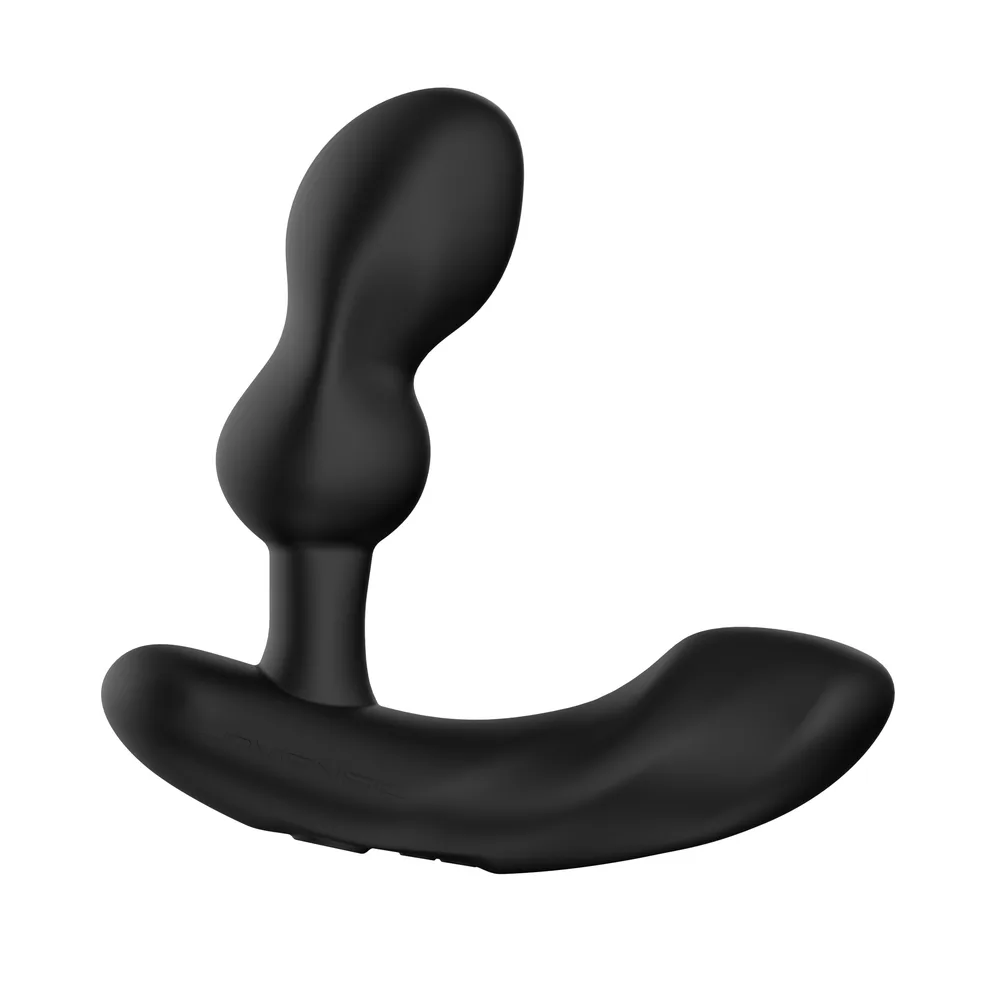
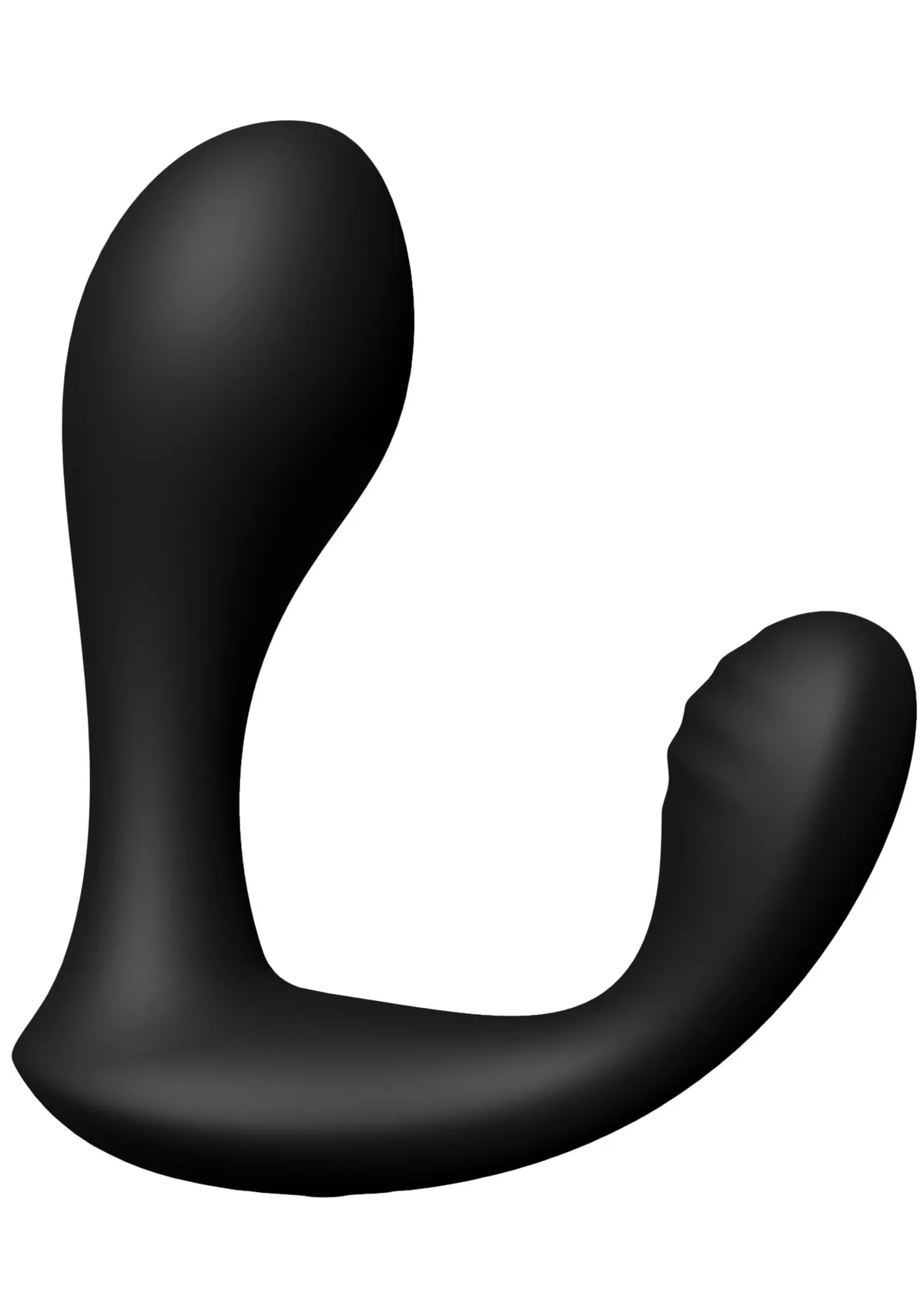
The Bullseye Prostate Plug is a remote-controlled prostate vibrator in silicone from Hidden Desire, which is the brand behind the Extreme series. The construction is the classic prostate shape: a droplet-shaped insert piece that is meant to rest against the prostate, a wide base that prevents the product from sliding in too far, and an outward-facing arm that lies against the perineum. What sets this model apart from most in its price range is that it’s controlled with a separate wireless remote control instead of via an app.
The specification looks like this according to the manufacturer: overall length 12.5 centimeters, overall width 11 centimeters, insertable length 10 centimeters, and an insertable diameter of 4 centimeters. The material is listed as silicone. The runtime is 60 minutes, the charging time is 90 minutes, and the ingress protection class is IPX7. The number of vibration modes is ten, split into three speeds and seven patterns. The battery is of the lithium-ion type, and charging is done via USB-C. The manufacturer also lists item number 20409, SKU 20409-BLACK, and a recommended consumer price of 79.99 euro.
In Sweden, the item is sold by five stores at prices between 549 and 747 SEK, and three of them had it in stock when the store data was retrieved on July 29, 2026. This review is exclusively about the black variant with EAN 8713221842329, which is the only color the manufacturer lists for the model. The number has been checked against the Barcode field on the manufacturer’s product page, against the EAN field in the Vuxenkul specification table, and against the EAN13 field at Sexonic — all three indicate the same number.
A prostate vibrator isn’t an anal plug with a motor inside, even if it can superficially look that way. The difference is in the geometry. The prostate sits a few centimeters in, against the abdominal wall, and a product meant to reach it needs a hooked tip — a bend that points forward when the product is in place. It’s the hook, not the motor power, that determines whether the product hits the right spot. A straight plug with a powerful motor doesn’t do anything for stimulation if the angle is wrong.
Bullseye solves it in the way that has become standard in the category: a teardrop-shaped, tapered insertion part that widens to 4 centimeters at its widest point and then narrows toward a clear neck above the base. The neck is the part that seals against the anal sphincter and keeps the product in place, and it is that which allows the product to stay in without being held. Outside the base there is a bent arm which, according to the manufacturer, should rest against the perineum, that is, between the scrotum and the anal opening. The dimension sketch in the manufacturer’s gallery states the diameter of that arm as 2.5 centimeters.
In practice, that means the product is built for two contact points at the same time. What can be established from the specification, however, is that it only has one motor. The manufacturer does not list any other motor or any separately controllable zones, unlike for example Lelo Hugo 2 and Lovense Edge 2, which both expressly have two motors. The vibration in the perineum arm is therefore transferred through the silicone from the motor that sits in the main body, not from a separate source.
Hidden Desire is a brand that is developed and distributed by SCALA 2.0 BV in the Netherlands. Extreme is the brand’s anal line, which is also shown on the packaging where the headline reads Extreme by Hidden Desire with the subheading Anal Gear. The country of manufacture is stated by the manufacturer as China. Knowing that matters for two reasons.
The first is that the specification is actually published. Many products in this price range are sold by brands that don’t have their own product page at all, and then the shop text becomes the only source. Here there is a complete table from the brand’s developer, and it can be checked against every store in retrospect. The second is that information that is missing in that table is very likely not published anywhere else either. Two rows are empty or absent in the manufacturer’s table: battery capacity and sound level.
A word about the name as well, since the stores write it in four different ways. The manufacturer’s website address contains the string "extreme-bullseye-prostate-plug", the heading on the same page just reads "Bullseye Prostate Plug", Sexonic calls it "Hidden Desire Bullseye Prostate Plug Black", and Blush Me calls it "Bullseye Prostate Plug" with the brand Hidden Desire as a separate field. It’s the same item in all cases—check the EAN, not the name, when you compare prices.
The material question is the single most important characteristic of an anal product. What is inserted into the body rests against the mucous membrane, and the mucous membrane absorbs substances faster than ordinary skin does. The manufacturer states a single material for Bullseye: silicone. Blush Me and SexleksakerOutlet write it as "high-quality silicone," Vuxenkul and Vuxen only write "silicone." None of them split the material out by component.
Silicone is a non-porous material. A non-porous surface can be cleaned because there are no microscopic cavities where residue can remain. For an anal product, this is not a comfort issue but a hygiene issue: gut flora in a porous surface can’t be washed away—only discarded. That’s why the material specification carries more weight than almost every other line in this particular specification.
Silicone also has two properties that directly affect how a prostate product behaves. One is that the material is soft but shape-stable, which means the curved part retains its angle even when the sphincter muscle contracts. The other is that silicone conducts vibrations relatively poorly compared with hard plastic. With a single motor in the main body, that means the vibration is likely strongest where the motor is located and weaker out in the perineum arm. The manufacturer publishes no information about where the motor is placed, and there is no frequency specification in hertz either—where Bullseye differs from Lelo Hugo 2, which states 130 hertz in the base and 108 hertz in the top.
Phthalates are a group of plasticizers used to make plastic—above all soft PVC—flexible. Kemikalieinspektionen describes them as substances that can affect the endocrine system and make reproduction more difficult, and several of them are therefore restricted or banned within the EU in a large number of products. This product category is repeatedly the subject of supervision, because it contains soft plastic against the mucous membrane.
It’s worth being precise here. The manufacturer does not print any explicit declaration stating that the product is free from phthalates, BPA, or latex. The closest thing that is published is the labeling "body-safe" in the manufacturer’s own function graphic and the wording "made from body-safe materials" in the product text. It’s a marketing term without a definition, not a material declaration.
At the same time, it’s worth knowing why the issue is less charged for silicone than for other materials. Silicone doesn’t require plasticizers to become soft—the softness comes from the polymer’s own structure. A material declared as silicone is therefore, by itself, a better sign than terms such as TPE or jelly rubber, which don’t say anything at all about which plasticizers are included. But the difference between “silicone” and “silicone without phthalates, BPA and latex” is the difference between a conclusion you draw yourself and a promise the manufacturer makes. Here, you only get the first.
The manufacturer’s dimension sketch is unusually clear for the price range and lists four values: total height 12.5 centimeters, total width 11 centimeters, the largest diameter of the insertable part 4 centimeters, and the diameter of the perineum arm 2.5 centimeters. The specification table also states an insertable length of 10 centimeters. This means that of the 12.5 centimeters the product measures in height, 10 centimeters are intended to be inserted, while the remaining height consists of the base and the neck.
A four-centimeter diameter corresponds to roughly 12.6 centimeters in circumference, and it’s noticeably thicker than the beginner category. For comparison, Lovense lists the largest diameter for the Edge 2 at up to 35 millimeters—so half a centimeter narrower—and Lelo states a 72-millimeter insertable length for the Hugo 2 versus Bullseye’s 100-millimeter length. Bullseye is therefore both longer and thicker than the two premium competitors in the comparison. This is not a product to start with if you don’t have anal experience beforehand, and the manufacturer’s own manual effectively says the same thing: it recommends starting with toys with a smaller diameter and increasing the size carefully.
The total width of 11 centimeters is also worth a comment, because the figure is confusing in the store texts. It refers to the distance from the top side of the insertable part to the tip of the perineum arm as seen from the side, meaning the product’s depth in profile—not a measurement that is inserted. The dimension sketch shows this unambiguously.
The manufacturer states 0.23 kilograms as “weight per unit” in the “Additional Information” section, i.e. in the same block as the package dimensions, the number of units per outer carton, and the country of manufacture. The placement is revealing. The weight is listed together with the logistics information, not together with the product dimensions, which suggests that 230 grams refers to the packaged unit—the product, the remote control, the charging cable, and the box measuring 15 × 9.5 × 5 centimeters.
None of the five Swedish stores publishes any weight at all, so there’s nothing to measure against. What can be established is that a silicone product of this size with a small lithium-ion battery normally ends up well below 230 grams, and that a remote control and a cardboard box easily explain the gap. Treat the number as a packaging weight until the manufacturer specifies it, and don’t assume the product in your hand weighs 230 grams.
A measurement that is completely missing is the remote control’s. The manufacturer publishes neither measurements nor weight for it, and it is only visible in the product images, where it is oval with a ring-shaped button panel with a plus, a minus, and an on/off symbol, as well as the brand name embossed into the lower part. It’s common for an accessory component not to be specified, but that makes it difficult to assess in advance whether the remote control is large enough to handle with wet hands.
The interface consists of two parts. On the product there are buttons, and separately there is a wireless remote control. Vuxenkul lists both under the heading control options: buttons and wireless remote control. The manufacturer’s specification table only mentions the remote control under Control options, but the product images show the remote control with three markings: plus, minus, and an on/off symbol.
The number of settings is given by the manufacturer as ten, divided into three vibration speeds and seven vibration patterns. The breakdown is confirmed both in the product text and in the manufacturer’s own function graphic, which lists “3 vibrating speeds” and “7 vibrating functions” as two separate points. It’s not the same as ten settings in a single sequence: three of them are constant levels, and seven of them are pulsing programs.
The remote control is a standalone unit that wirelessly controls the product. What can be established from the manufacturer’s materials is that it has three controls and that the brand name is embossed into the housing. The manufacturer publishes neither range, frequency band, radio protocol, nor power supply for the remote control, and none of the five Swedish stores does either. It is therefore not possible to say whether it is powered by a button cell or a rechargeable battery, and it’s also not possible to say how far from the product it works.
It’s still a practical advantage to have a separate remote control over the buttons on the product itself in this category. A prostate vibrator sits in a spot where the buttons are difficult to reach, and where every adjustment otherwise requires you to move the product out of position. That’s also why remote control is available on almost every model priced over five hundred SEK. The difference from app-controlled competitors is that a physical remote control works without a phone, without an account, and without updates—but only in the same room, and it can be lost.
If you want to control it from a distance, share the control with someone who isn’t in the room, or create your own patterns, this is the wrong product. Lovense Edge 2 builds its entire interface around the app, and Lelo Hugo 2 puts six of its ten modes behind the app. Bullseye has none of that, and the manufacturer does not make any such claims either.
Ten modes sounds like a lot, and in practice it’s more than most people use. The pattern in this product category is that the three constant speeds are the ones that keep coming up, while the seven programs work like alternation. Structurally, the one thing you can say is that Bullseye can’t mix: you can’t run a pattern at a selected speed, because the patterns are separate modes with their own built-in intensity curve.
That’s a real difference versus more expensive models where intensity and patterns are two independent controls. With three levels on the constant scale, the steps are also big. Expect the distance between the lowest and the middle speed to be noticeable, and that there’s no fine-tuning in between.
A detail missing from all documentation: the manufacturer does not state whether the product starts in the mode it was last used in, or whether it always starts from the beginning, and nor does it state whether there is any memory function. This is not published, either by the manufacturer or by the stores.
There’s a conflict between the sources that’s worth laying out clearly. Two Swedish shops—Blush Me and SexleksakerOutlet—write in their bullet lists "10 vibration modes (<55 dB)". That’s the only decibel information that’s available for this product.
The manufacturer’s own specification table has a row called Noise level, and that row is empty. No number, no reference, no measurement method. The rule we apply when the store and the manufacturer contradict each other is that the manufacturer wins—but here the manufacturer says nothing at all, and then the store information is the only thing that exists. Treat the 55 decibels as a store claim without a known measurement method, not as a measurement value. We don’t know at what distance it was measured, what mode the product was in, or whether the figure is a maximum level or an average value.
For the comparison, Lelo lists a maximum sound level under 60 dB for Hugo 2, and Lovense lists 43 dB for Edge 2 — but even those figures are published without a measurement distance and without a stated method. That says something about how little comparable information there is in this category, even when a number is actually printed. A practical piece of advice that applies regardless of model: an anal vibrator that sits inside the body is heavily dampened by the body itself, and what can be heard from a couple of meters away is rarely the same as what is measured against a product that’s placed on a table.
Bullseye Prostate Plug is rated IPX7. The information is stated both in the manufacturer’s specification table, in the manufacturer’s functional graphics, and at Blush Me and SexleksakerOutlet. The rating comes from the international standard IEC 60529, which defines enclosure classes for electrical equipment. The number 7 in the second position means that the product has been tested for submersion in water to a depth of one meter for 30 minutes.
The difference compared to an only splash-proof product is bigger than the wording suggests. Splash protection covers water droplets and, at best, water jets, but not submersion. Such a product can handle a damp cloth and possibly a shower, but not a bathtub, and it should not be held under running water without giving it some thought about the buttons and the charging contact.
For an anal product, IPX7 is not a convenience—it’s a prerequisite. It needs to be able to be properly rinsed, not wiped dry. That Vuxenkul and Vuxen settle for writing “water-resistant yes” and “100% waterproof,” respectively, without stating a class is typical of store copy, but it’s the IPX7 information from the manufacturer that’s what matters. Also note that the rating applies to the product itself. The manufacturer states no enclosure class for the remote control, and it should therefore be treated like an electronic device that can’t handle water.
Rinse the product in lukewarm water after each use, and use fragrance-free soap or a cleaning product intended for intimate products. Be careful at the transition between the neck and the base—that’s the geometrically tightest point on the product, and where residues are most likely to be left behind. Wipe it with a clean towel and let it air-dry before putting the product away. No storage pouch is included according to the manufacturer’s delivery information, which only covers the product in cardboard packaging.
The manufacturer’s manual for the brand’s vibrating anal toys is clear about the lube question: a water-based lubricant is recommended, and the manual also emphasizes that you should use plenty of it to avoid pain, injuries, or tears in the anal sphincter muscle during insertion. Silicone-based lubricant should not be used on silicone products—it breaks down the silicone surface over time and makes it porous, and a porous surface can no longer be cleaned properly; it only needs to be replaced. Oil-based products such as coconut oil leave a film that’s hard to remove.
The manual also covers two things that don’t appear in any of the store texts. The first is that there are two muscle rings in the anal opening that the product is meant to pass through, and that you should go slowly and carefully and, if needed, relax in advance with circular movements. The second is a warning that the anal vibrators in the brand’s range have no stopper and must always be held in place. That warning applies, however, to wand-shaped anal vibrators—Bullseye has a wide base, which is the whole point of the shape, and the base is clearly shown in the manufacturer’s dimension sketch. The manual is the same for the entire product type and is not written specifically for this model.
The manufacturer states the runtime as 60 minutes and the charging time as 90 minutes. The battery is of the lithium-ion type. Sixty minutes is short in absolute terms, but completely normal for the category: Lelo states up to one hour for Hugo 2, and Lovense indicates 65 to 130 minutes for Edge 2 depending on the vibration level. That the charging time is longer than the runtime—90 minutes versus 60—is, however, a worse ratio than with both competitors, where Lelo states up to two hours of charging for one hour of runtime and Lovense about 100 minutes of charging for at least 65 minutes of runtime.
Via USB-C. The manufacturer explicitly writes this in the product text, and the feature graphic lists USB rechargeable as one of seven features. Both Blush Me and SexleksakerOutlet repeat the USB-C information in their bullet lists, while Vuxenkul only writes "laddningstyp USB" and Vuxen only "uppladdningsbar".
Charging it with a regular USB-C cable is a genuine advantage that’s easy to underestimate. That means that a dropped or broken cable costs under a hundred kronor at the nearest electronics store instead of a replacement order from the manufacturer. Compare this with Lovense Edge 2, which is charged with a magnetic cable, and with Lelo Hugo 2, whose manual says that only the manufacturer’s original charger should be used. Here, Bullseye is easier to live with than both.
An instruction from the manufacturer’s manual that’s hard to find anywhere else: if the product automatically shuts off when the battery is low, it should not be started up again; instead, it should be charged in a wall outlet. Practically, this means that a product that dies in the middle of use should be put on charge, not started again.
The manufacturer does not publish either the battery capacity in mAh or its voltage. The specification table only states the battery type as lithium-ion. None of the five stores publishes any value either. The only electrical information that exists at all is the labeling “5 volt motor” in the manufacturer’s own functional graphic, and it refers to the motor—not the cell.
It’s worth noting because the competition is more open: Lelo lists 420 mAh and 3.7 volts for the Hugo 2 and also provides charging current and charging voltage. Without the capacity, you can’t recalculate operating time into power consumption, and you can’t compare how heavily the cell is loaded between models.
What generally applies to lithium-ion batteries also applies here: the capacity drops with the number of charge cycles, and the product does best when it’s charged regularly rather than stored fully discharged. The manufacturer doesn’t state whether the battery is replaceable, but on an IPX7-rated product without visible screws, you should assume it isn’t. With use a couple of times a week, it’s the battery—not the silicone—that sets the limit for lifespan.
We do not have price data from shops in your market yet.
The manufacturer’s specification table has a row called Noise level, and that row is blank. The 55 decibels that two shops state is a shop’s claim, not a measurement.
Two comparisons are relevant, and both are made against products that are clearly higher in price: Lelo Hugo 2 and Lovense Edge 2. All the information below comes from each manufacturer’s own specifications, and the prices for Bullseye come from the stores’ product feeds on July 29, 2026.
The Lelo Hugo 2 is the most documented product in this comparison. Lelo lists outer dimensions 104 × 107 × 41 millimeters, insertable length 72 millimeters, weight 121 grams, materials: body-friendly silicone and ABS plastic, lithium-ion battery 420 mAh and 3.7 volts, charging time up to two hours at 5.0 volts and 500 milliamps, operating time up to one hour, sound level under 60 dB, and a two-year manufacturer warranty. The model has ten modes, six of which are reached via the app, and two motors at 130 and 108 hertz, respectively.
The differences that actually matter: Hugo 2 is significantly smaller—72 millimeters insertable versus Bullseye’s 100—and it has two separate motors where Bullseye has one. Hugo 2 has app control, a published battery capacity, a published sound level, and a published warranty duration. In return, Bullseye has a physical remote control in the package, charging via standard USB-C instead of Lelo’s proprietary charger, and a shorter charging time: 90 minutes versus up to 120.
The conclusion is straightforward. If you want a smaller product, two motors, and a specification where every line is filled in, Hugo 2 is the way to go—and you have to pay for it. If you want a larger insert, a remote control that works without a phone, and a cable you already own, Bullseye gets the job done for a fraction.
Lovense Edge 2 is stated by the manufacturer to have an insertion length of 91 millimeters, a maximum diameter of 35 millimeters, and a weight of 151.3 grams. It has two motors, a bendable neck that keeps its position after adjustment, a runtime of 65 to 130 minutes depending on the vibration level, about 100 minutes of charging time, IPX7, and a stated sound level of 43 dB. Control is via the Lovense app; no remote control is included in the package.
The dividing line runs straight through the interface. Edge 2 can be adjusted at an angle, controlled remotely over the internet, connected to sound, and programmed with custom patterns. Bullseye has a fixed angle and ten preset modes on a remote control that works in the same room. In terms of dimensions, Bullseye is chunkier—40 millimeters versus 35—and longer—100 millimeters versus 91. The run time is shorter: 60 minutes versus at least 65.
What speaks in favor of Bullseye in this comparison is that a remote control never needs to be paired, never requires an account, and never stops working because an app hasn’t been updated. What speaks against it is everything else: fewer motors, shorter run time, no adjustable angle, and a manufacturer that publishes less.
The question comes up again in this category and deserves a straightforward answer. A physical remote control sends a radio signal directly to the product. It only works within range, it can get lost, and the number of functions is limited by the number of buttons. An app connects to the product via Bluetooth and can then reach the internet, which is what makes remote control, custom patterns, and sharing between two people in different places possible.
The cost of the app is the dependency. It requires a phone, an account, pairing, and for the manufacturer to continue maintaining the software. A remote control like the one that comes with Bullseye does one thing, but it does it without conditions. For a product that’s meant to be used in the same room as the person controlling it, it’s often the practically better choice—and it’s that trade-off that determines whether the price difference versus Hugo 2 and Edge 2 is justified for you.
Five Swedish stores sell the item with EAN 8713221842329. Cheapest are Blush Me and SexleksakerOutlet, both at 549 SEK. Most expensive is Vuxen at 747 SEK. It’s 198 SEK, or a 36 percent difference, for the exact same article number, same color, and same packaging. In between are Vuxenkul at 594 SEK and Sexonic at 716 SEK.
The stock situation is at least as important as the price spread. Three of the five stores had the product in stock at the time of the price check: Blush Me and SexleksakerOutlet for 549 SEK, as well as Vuxen for 747 SEK. Vuxenkul and Sexonic listed it as sold out. That means that if you want the item delivered to your home in practice, you choose between 549 and 747 SEK — and that the mid-range prices in the table are not available. Stores that list a product as sold out may also still have an old price in the feed.
Put the numbers next to the list prices, and the picture becomes clearer. The manufacturer states 79.99 euros as the recommended consumer price. Blush Me and SexleksakerOutlet state 799 SEK as the regular price, with 549 SEK as the campaign price, while Vuxenkul states 849 SEK as the regular price and Vuxen states 879 SEK as the recommended price, with 747 SEK as its price. Sexonic lists 79.99 euros reduced to 64.79 euros, meaning exactly the manufacturer’s list price as a starting point. In other words, there is no uniform list price in Sweden, and the percentage discount says nothing — it’s only the kronor at the checkout that matter.
The price spread isn’t because any store sells a different variant. Three of the stores list the item under EAN 8713221842329, and the other two under their own item numbers linked to the same product. So it’s about the stores’ own margin-setting for a model that is still new enough that it hasn’t yet turned into a price-pressed volume item.
It’s for you if you already have anal experience and want a remotely controlled prostate vibrator without stepping up to the premium class. A four-centimeter diameter and a ten-centimeter insertable length is a product for someone who knows what they’re getting into. It’s for you if you want to be able to hand over the remote control to someone else without first needing to install an app, and it’s for you if you prefer to charge it with the same cable as your phone. IPX7 also means that the entire product can be rinsed under running water, which for an anal product is a baseline requirement rather than a bonus.
It’s not for you if you’re a beginner — both the Lelo Hugo 2 and Lovense Edge 2 are narrower and shorter, and there are plenty of products under three centimeters in diameter that are intended for getting started. It’s not for you if you want two separately controllable motors, an adjustable angle, or app control. It’s also not for you if you require a published battery capacity, a measured sound level, and an explicit phthalate declaration before purchase, since the manufacturer doesn’t publish either of these.
One more thing belongs in the decision. The runtime of 60 minutes and the charging time of 90 minutes mean that the product charges for longer than it runs. It’s not a problem if you leave it charging between uses, but it’s worth knowing that it’s not a product you quick-charge a quarter of an hour before.
The warranty question is the weakest point in the manufacturer’s documentation. Hidden Desire does not publish any voluntary manufacturer warranty with a specified warranty period. Neither the product page, the brand’s consumer store, nor the terms of purchase mention any number of years. This should be compared with Lelo, which states a two-year manufacturer warranty for Hugo 2 — and thus promises something beyond the law.
What applies, however, is the purchase in their own web store, as stated in the brand’s terms of purchase: a 30-day period to send the item back after you have notified them that you are withdrawing, that the customer themselves is responsible for the return shipping, that products with broken hygienic seals cannot be returned, that visible defects must be reported within 48 hours from delivery, and that hidden defects must be reported in writing within two months from discovery. The last two time limits are short, and they apply to the manufacturer’s own store — not the Swedish stores.
What always applies are your statutory rights, and in this case they are significantly stronger than what the manufacturer promises. Under konsumentköplagen, you have a three-year right to complain about defects in the item, regardless of what the manufacturer says. For distance purchases, you also have a right of withdrawal in fourteen days under lagen om distansavtal och avtal utanför affärslokaler. Be aware that, in practice, the right of withdrawal is limited for hygiene products that have been removed from a sealed package — the right to complain about defects, on the other hand, always applies. If you have questions about what applies in your case, Konsumentverket guides you via Hallå konsument.
The conclusion for anyone buying in Sweden: buy from a Swedish store, not from the manufacturer. Then it is the three years under konsumentköplagen that applies against the store, and you avoid both the 48-hour time limit and the return shipping to the Netherlands.
Hidden Desire Bullseye Prostate Plug is ranked på plats 7 av 15 in prostate vibrator best i test, where the entire category is compared against each other using five shared criteria. Guiden vinns av Svakom Iker Neo.
Every numerical piece of information in the text can be traced to one of the sources below. The links were checked manually on the specified date.
This page is machine-translated from Swedish. Read the Swedish original